








A Brief Overview of Regulation of Interconnection
Tom Paseka
KINX Peering Forum 2016
tom@cloudflare.com
A little bit about CloudFlare
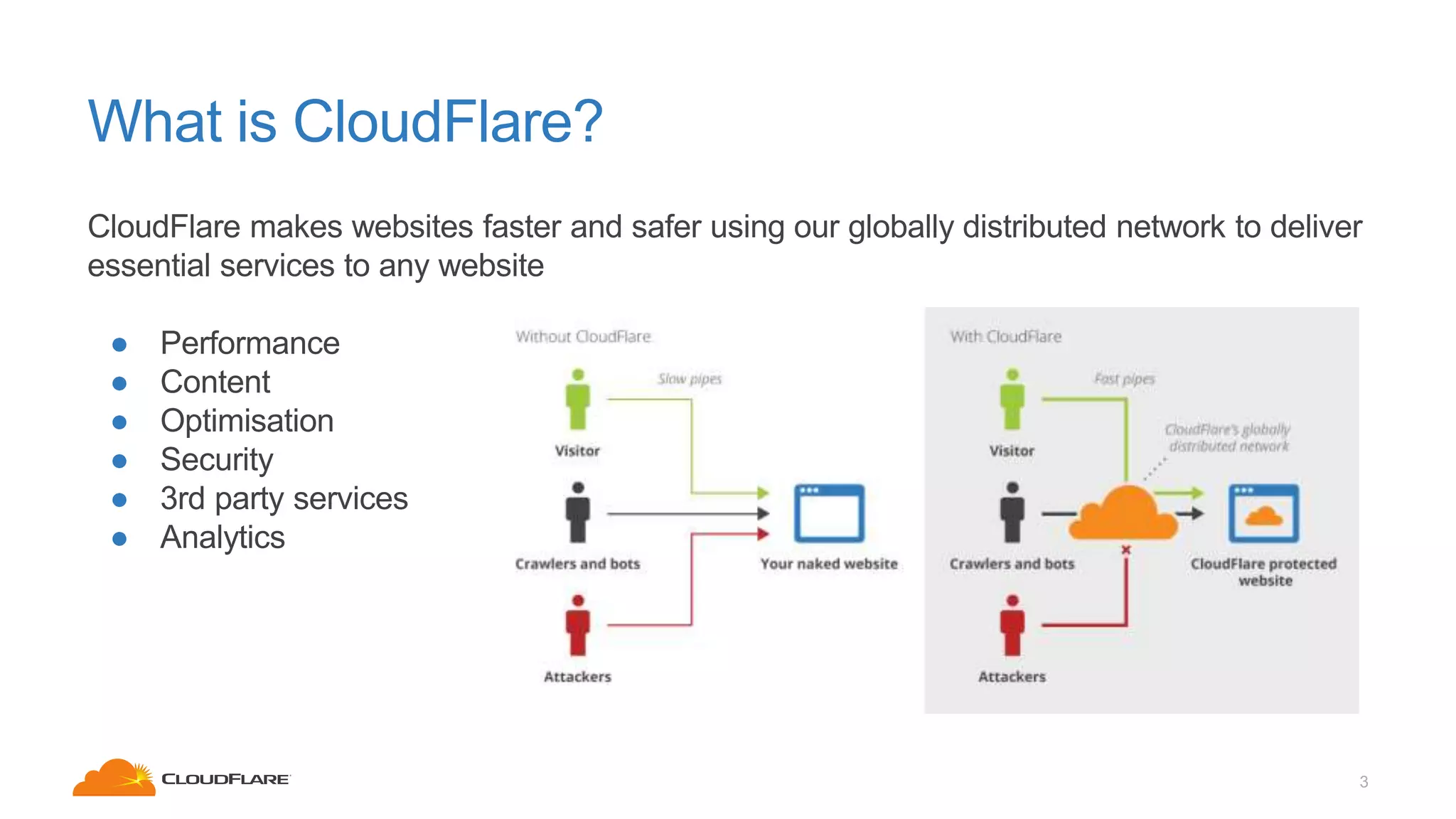
What is CloudFlare?
CloudFlare makes websites faster and safer using our globally distributed network to deliver
essential services to any website
● Performance
● Content
● Optimisation
● Security
● 3rd party services
● Analytics
3
How does CloudFlare work?
4
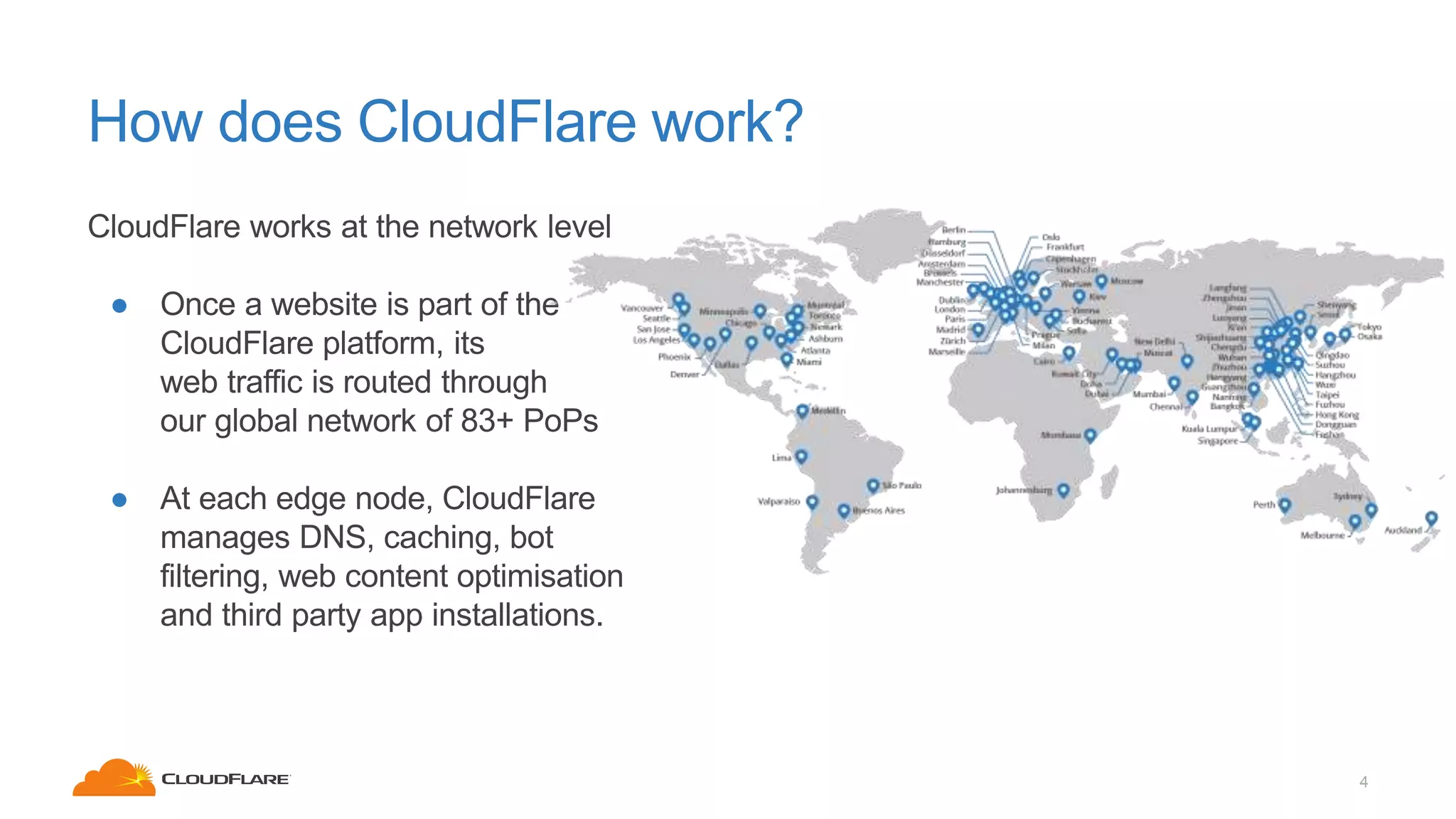
CloudFlare works at the network level
● Once a website is part of the
CloudFlare platform, its
web traffic is routed through
our global network of 83+ PoPs
● At each edge node, CloudFlare
manages DNS, caching, bot
filtering, web content optimisation
and third party app installations.
CloudFlare works globally
5
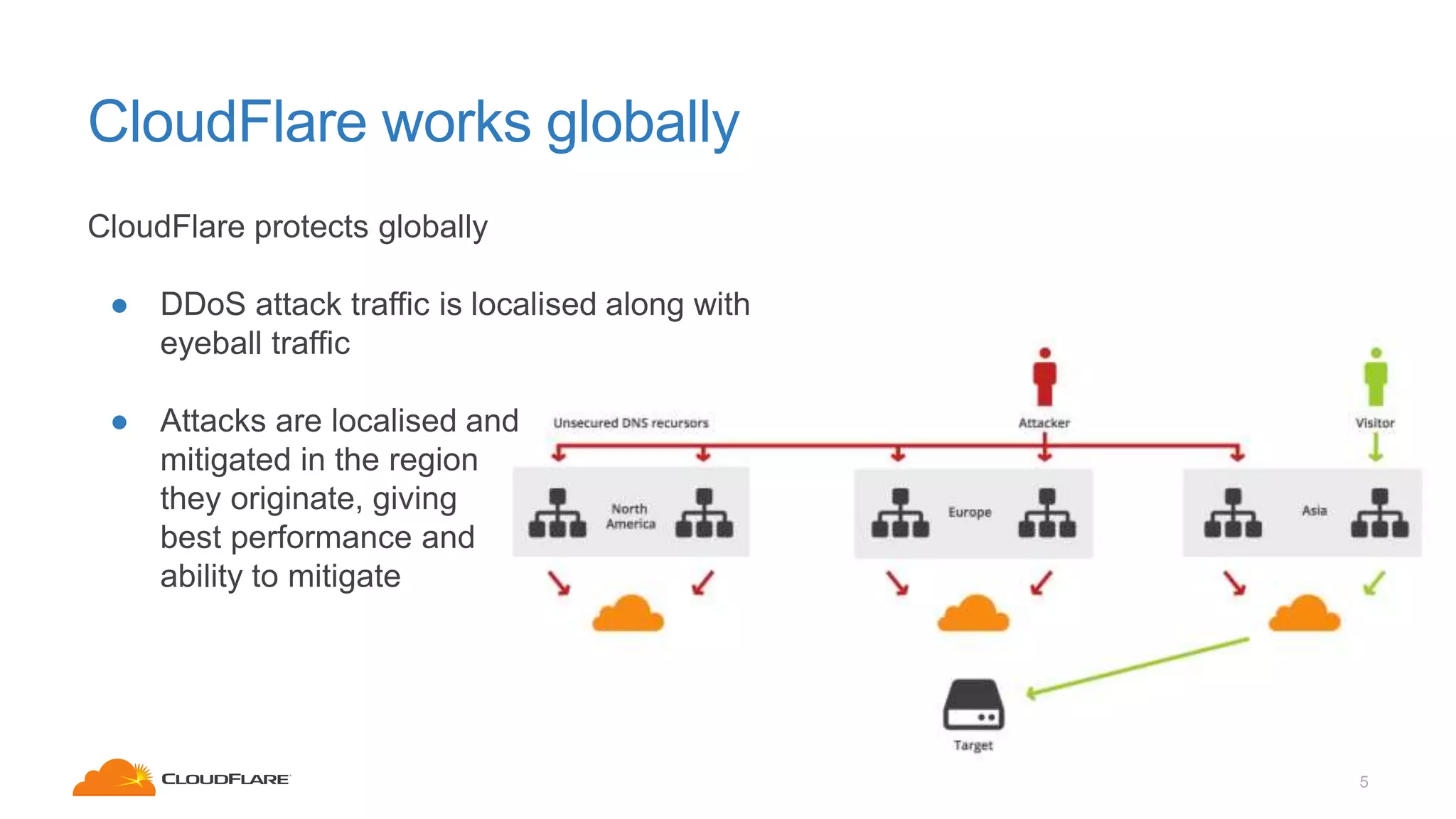
CloudFlare protects globally
● DDoS attack traffic is localised along with
eyeball traffic
● Attacks are localised and
mitigated in the region
they originate, giving
best performance and
ability to mitigate
Interconnection
Interconnection
Interconnection. Interconnection is the linking of two networks for the mutual exchange
of traffic.
• As defined from US Code of Federal Regulations (CFR)
• Peering? Transit? IX?
• What’s regulated?
Australia
Australia
• No regulation.
• Australian Competition and Consumer Commission (ACCC) is responsible for ensuring no
anti-competitive behaviors
• In 1998, The ACCC initiated action against Telstra for anticompetitive behavior with
regards to interconnection. Was done at request of Optus, Connect.com.au and OzEmail.
• No formal action taken, Telstra reached peering agreements with the other three networks.
• https://www.accc.gov.au/media-release/accc-welcomes-peering-arrangement-between-
telstra-and-optus
Australia
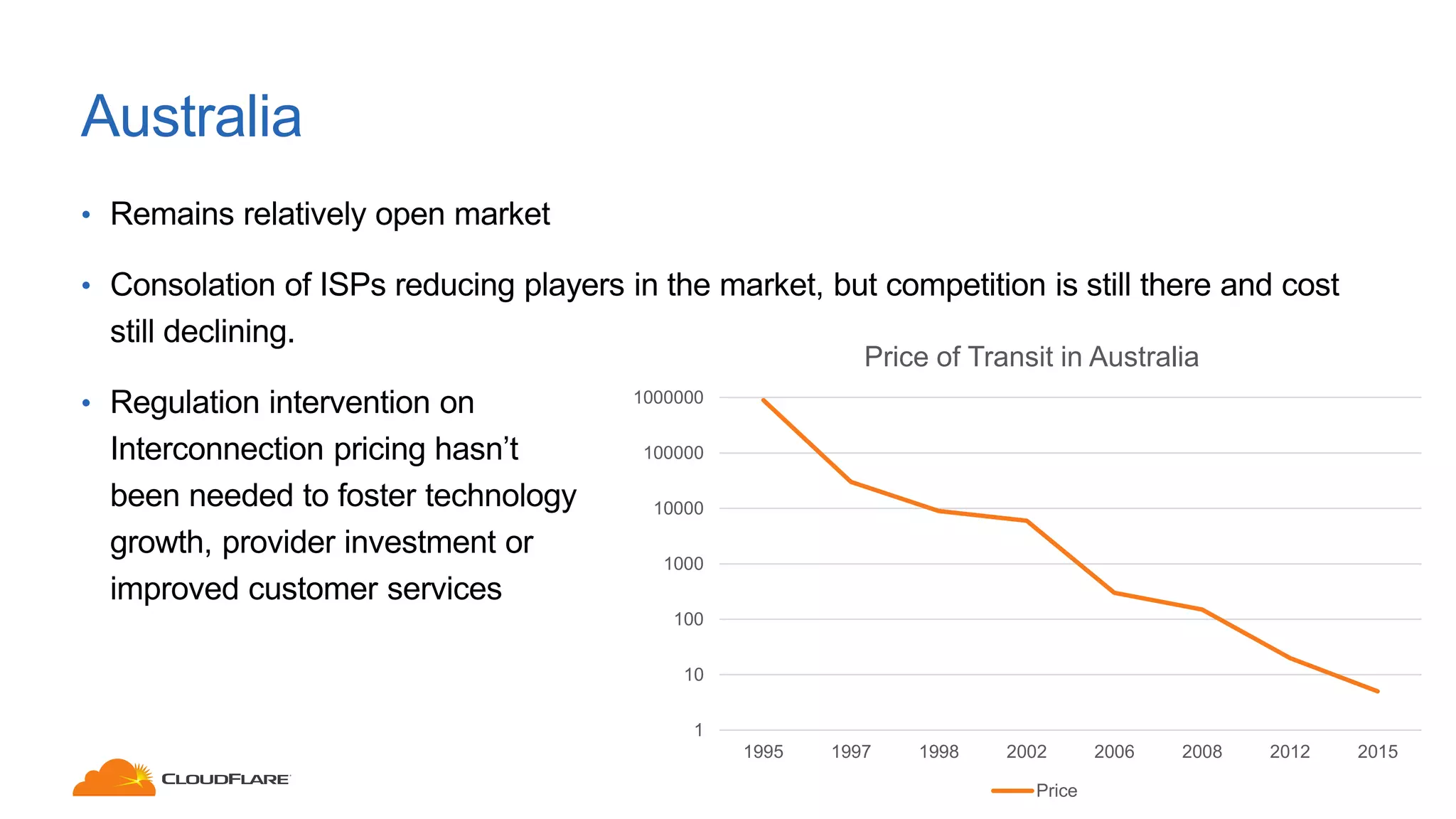
• Remains relatively open market
• Consolation of ISPs reducing players in the market, but competition is still there and cost
still declining.
• Regulation intervention on
Interconnection pricing hasn’t
been needed to foster technology
growth, provider investment or
improved customer services
1
10
100
1000
10000
100000
1000000
1995 1997 1998 2002 2006 2008 2012 2015
Price of Transit in Australia
Price
Australia
• Most ISPs in Australia are peering at an Internet exchange
• Around 45% of end users have their internet traffic made available at an Internet
Exchange.
• For a new ISP, 80%+ of Internet Traffic can be received at low or no cost from an Internet
Exchange Point.
• High cost of last mile, government building broadband network to help with the last mile
technology
Hong Kong
Hong Kong
• Very open market with vigorous competition.
• Open, non-for-profit Internet Exchange (IX)
• No regulation for for interconnection, however:
OFTA have the power under the Telecommunications Ordinance to regulate the terms of
Interconnection, including technical, commercial and financial terms.
and
Interconnection fees are monitored by OFTA which has the power to regulate them if
considered necessary
Hong Kong
• All ISPs in Hong Kong are connected to to the Hong Kong Internet Exchange (HKIX).
• All available to exchange traffic at very little cost.
• Continued aggressive growth in last mile access technologies.
• Most households in Hong Kong passed by multiple fiber providers
• Lost Cost, high speed availability without market intervention
United States
United States
• No currently enforced regulations
• Federal Communications Commission (FCC) oversees Interconnection, however hasn’t
made any industry-wide rulings about it.
• Net Neutrality a big issue.
• Some competition/merger rulings, example: Charter and Time Warner Cable
• FCC Chairman Tom Wheeler said in a statement: "New Charter will not be permitted to
charge usage-based prices or impose data caps. Second, New Charter will be
prohibited from charging interconnection fees, including to online video providers,
which deliver large volumes of Internet traffic to broadband customers."
United States
• Continued growth in last mile services.
• Fiber to the Household growing in many cities, by multiple providers, including new market
entrants (eg. Google).
• Some consolidation, mergers, changes.
• General good outlook in growth and freedom for interconnection.
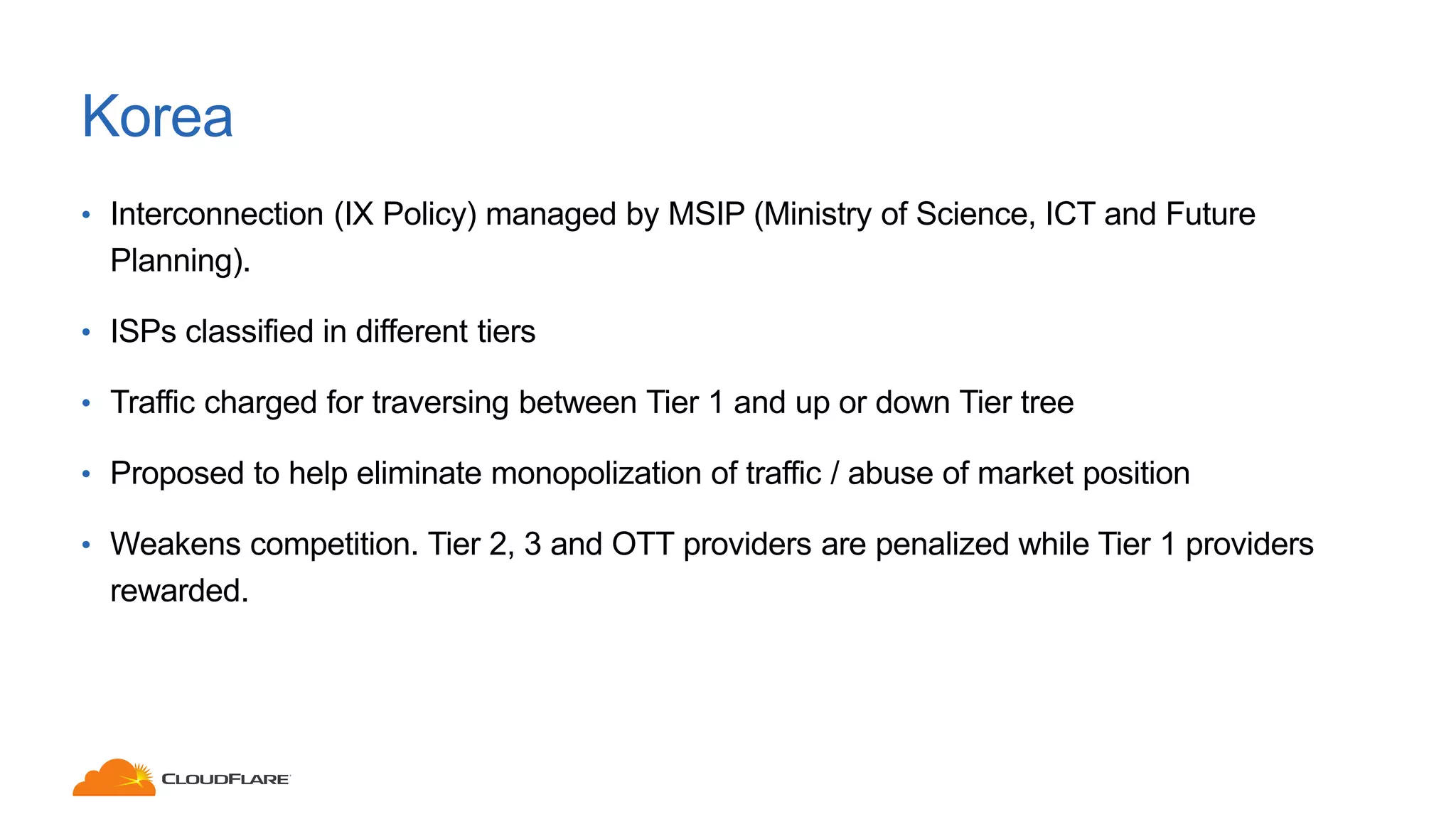
Korea
Korea
• Interconnection (IX Policy) managed by MSIP (Ministry of Science, ICT and Future
Planning).
• ISPs classified in different tiers
• Traffic charged for traversing between Tier 1 and up or down Tier tree
• Proposed to help eliminate monopolization of traffic / abuse of market position
• Weakens competition. Tier 2, 3 and OTT providers are penalized while Tier 1 providers
rewarded.
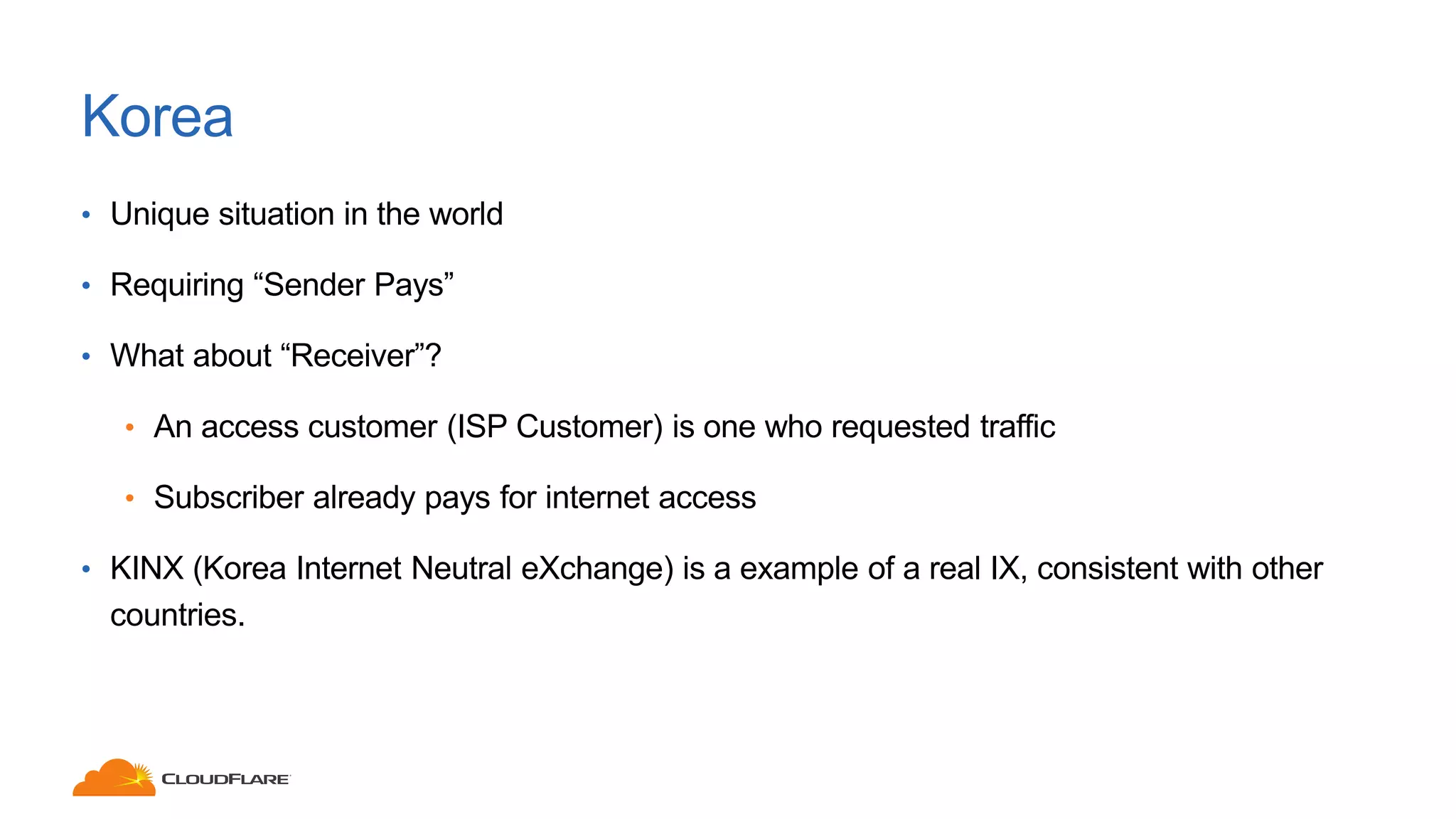
Korea
• Unique situation in the world
• Requiring “Sender Pays”
• What about “Receiver”?
• An access customer (ISP Customer) is one who requested traffic
• Subscriber already pays for internet access
• KINX (Korea Internet Neutral eXchange) is a example of a real IX, consistent with other
countries.
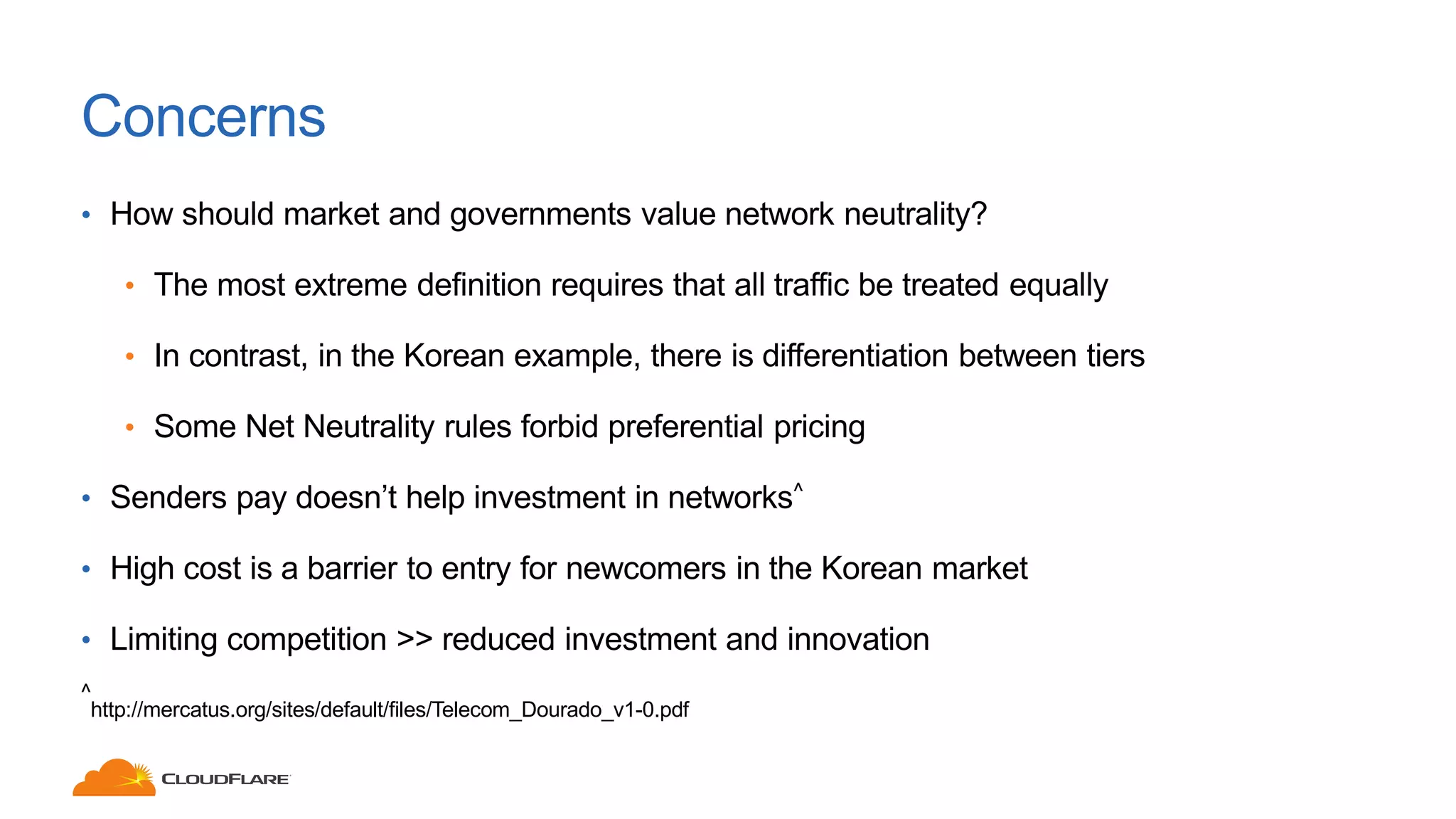
Concerns
Concerns
• How should market and governments value network neutrality?
• The most extreme definition requires that all traffic be treated equally
• In contrast, in the Korean example, there is differentiation between tiers
• Some Net Neutrality rules forbid preferential pricing
• Senders pay doesn’t help investment in networks^
• High cost is a barrier to entry for newcomers in the Korean market
• Limiting competition >> reduced investment and innovation
^
http://mercatus.org/sites/default/files/Telecom_Dourado_v1-0.pdf
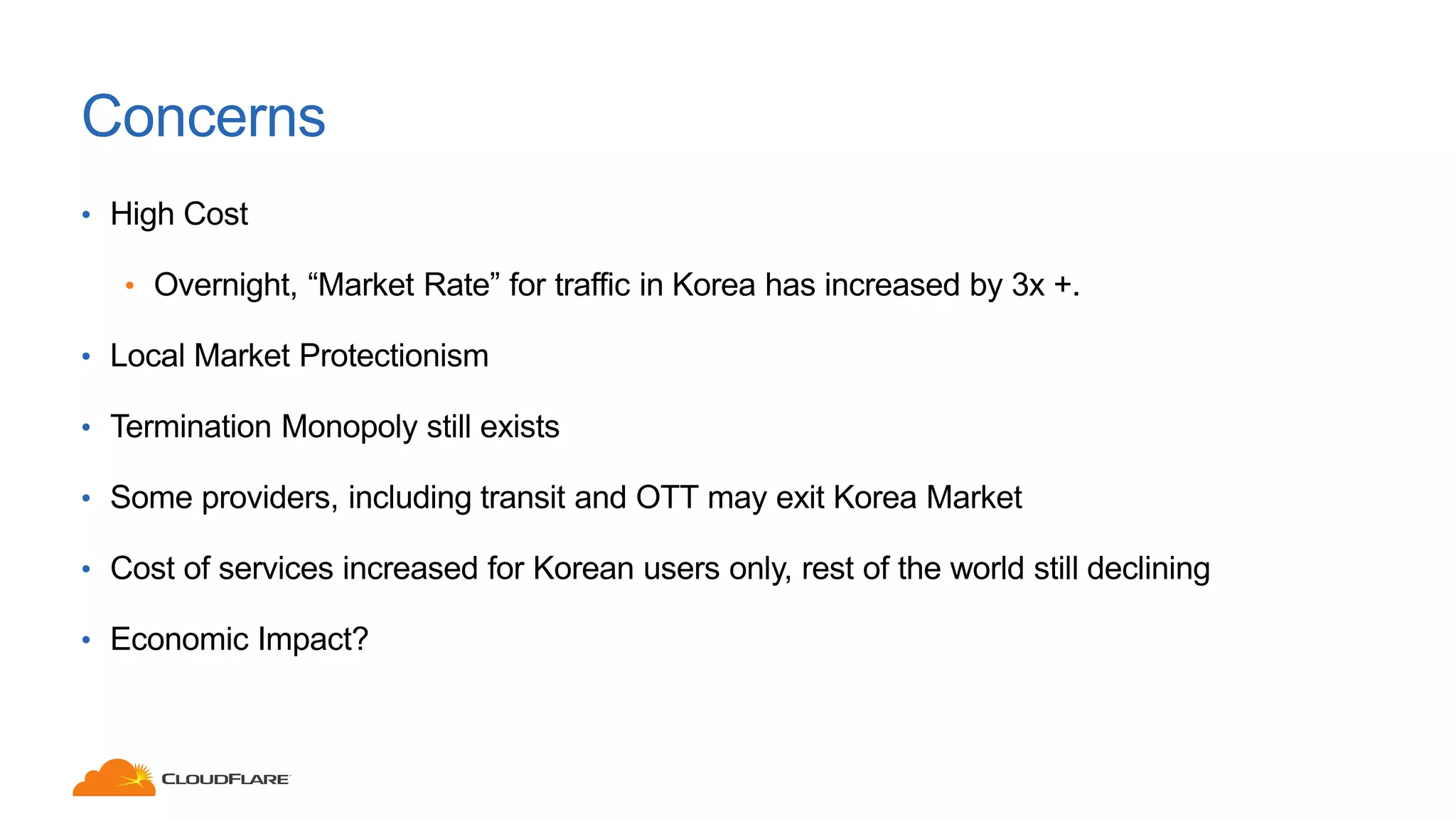
Concerns
• High Cost
• Overnight, “Market Rate” for traffic in Korea has increased by 3x +.
• Local Market Protectionism
• Termination Monopoly still exists
• Some providers, including transit and OTT may exit Korea Market
• Cost of services increased for Korean users only, rest of the world still declining
• Economic Impact?
Questions?
Thanks!

KINX Peering Forum - A Brief Overview of Regulation of Interconnection

  • 1.
    A Brief Overviewof Regulation of Interconnection Tom Paseka KINX Peering Forum 2016 tom@cloudflare.com
  • 2.
    A little bitabout CloudFlare
  • 3.
    What is CloudFlare? CloudFlaremakes websites faster and safer using our globally distributed network to deliver essential services to any website ● Performance ● Content ● Optimisation ● Security ● 3rd party services ● Analytics 3
  • 4.
    How does CloudFlarework? 4 CloudFlare works at the network level ● Once a website is part of the CloudFlare platform, its web traffic is routed through our global network of 83+ PoPs ● At each edge node, CloudFlare manages DNS, caching, bot filtering, web content optimisation and third party app installations.
  • 5.
    CloudFlare works globally 5 CloudFlareprotects globally ● DDoS attack traffic is localised along with eyeball traffic ● Attacks are localised and mitigated in the region they originate, giving best performance and ability to mitigate
  • 6.
  • 7.
    Interconnection Interconnection. Interconnection isthe linking of two networks for the mutual exchange of traffic. • As defined from US Code of Federal Regulations (CFR) • Peering? Transit? IX? • What’s regulated?
  • 8.
  • 9.
    Australia • No regulation. •Australian Competition and Consumer Commission (ACCC) is responsible for ensuring no anti-competitive behaviors • In 1998, The ACCC initiated action against Telstra for anticompetitive behavior with regards to interconnection. Was done at request of Optus, Connect.com.au and OzEmail. • No formal action taken, Telstra reached peering agreements with the other three networks. • https://www.accc.gov.au/media-release/accc-welcomes-peering-arrangement-between- telstra-and-optus
  • 10.
    Australia • Remains relativelyopen market • Consolation of ISPs reducing players in the market, but competition is still there and cost still declining. • Regulation intervention on Interconnection pricing hasn’t been needed to foster technology growth, provider investment or improved customer services 1 10 100 1000 10000 100000 1000000 1995 1997 1998 2002 2006 2008 2012 2015 Price of Transit in Australia Price
  • 11.
    Australia • Most ISPsin Australia are peering at an Internet exchange • Around 45% of end users have their internet traffic made available at an Internet Exchange. • For a new ISP, 80%+ of Internet Traffic can be received at low or no cost from an Internet Exchange Point. • High cost of last mile, government building broadband network to help with the last mile technology
  • 12.
  • 13.
    Hong Kong • Veryopen market with vigorous competition. • Open, non-for-profit Internet Exchange (IX) • No regulation for for interconnection, however: OFTA have the power under the Telecommunications Ordinance to regulate the terms of Interconnection, including technical, commercial and financial terms. and Interconnection fees are monitored by OFTA which has the power to regulate them if considered necessary
  • 14.
    Hong Kong • AllISPs in Hong Kong are connected to to the Hong Kong Internet Exchange (HKIX). • All available to exchange traffic at very little cost. • Continued aggressive growth in last mile access technologies. • Most households in Hong Kong passed by multiple fiber providers • Lost Cost, high speed availability without market intervention
  • 15.
  • 16.
    United States • Nocurrently enforced regulations • Federal Communications Commission (FCC) oversees Interconnection, however hasn’t made any industry-wide rulings about it. • Net Neutrality a big issue. • Some competition/merger rulings, example: Charter and Time Warner Cable • FCC Chairman Tom Wheeler said in a statement: "New Charter will not be permitted to charge usage-based prices or impose data caps. Second, New Charter will be prohibited from charging interconnection fees, including to online video providers, which deliver large volumes of Internet traffic to broadband customers."
  • 17.
    United States • Continuedgrowth in last mile services. • Fiber to the Household growing in many cities, by multiple providers, including new market entrants (eg. Google). • Some consolidation, mergers, changes. • General good outlook in growth and freedom for interconnection.
  • 18.
  • 19.
    Korea • Interconnection (IXPolicy) managed by MSIP (Ministry of Science, ICT and Future Planning). • ISPs classified in different tiers • Traffic charged for traversing between Tier 1 and up or down Tier tree • Proposed to help eliminate monopolization of traffic / abuse of market position • Weakens competition. Tier 2, 3 and OTT providers are penalized while Tier 1 providers rewarded.
  • 20.
    Korea • Unique situationin the world • Requiring “Sender Pays” • What about “Receiver”? • An access customer (ISP Customer) is one who requested traffic • Subscriber already pays for internet access • KINX (Korea Internet Neutral eXchange) is a example of a real IX, consistent with other countries.
  • 21.
  • 22.
    Concerns • How shouldmarket and governments value network neutrality? • The most extreme definition requires that all traffic be treated equally • In contrast, in the Korean example, there is differentiation between tiers • Some Net Neutrality rules forbid preferential pricing • Senders pay doesn’t help investment in networks^ • High cost is a barrier to entry for newcomers in the Korean market • Limiting competition >> reduced investment and innovation ^ http://mercatus.org/sites/default/files/Telecom_Dourado_v1-0.pdf
  • 23.
    Concerns • High Cost •Overnight, “Market Rate” for traffic in Korea has increased by 3x +. • Local Market Protectionism • Termination Monopoly still exists • Some providers, including transit and OTT may exit Korea Market • Cost of services increased for Korean users only, rest of the world still declining • Economic Impact?
  • 24.
  • 25.