Welsh Government Future
Trends Report 2017– Population
Theme data slides
The following slides provide background data
and graphs used for the Population theme in
the Future Trends Report 2017
0
500
1000
1500
2000
2500
Africa
Southern Asia
India
China
Europe
U28
South America
USA
Russia
Global population is projected to continue to increase.
Large population increases are projected for Africa and India (and Southern
Asia generally). China is projected to increase until 2030 but then to fall.
1950 205020001975 2025
Source: OECD and UN
population (millions)
0
20 000
40 000
60 000
80 000
100 000
120 000
140 000
160 000
2015 210020572036 2078
Russia
Germany
Spain
Italy
UK
France
Source: UN Department of Economic and Social Affairs
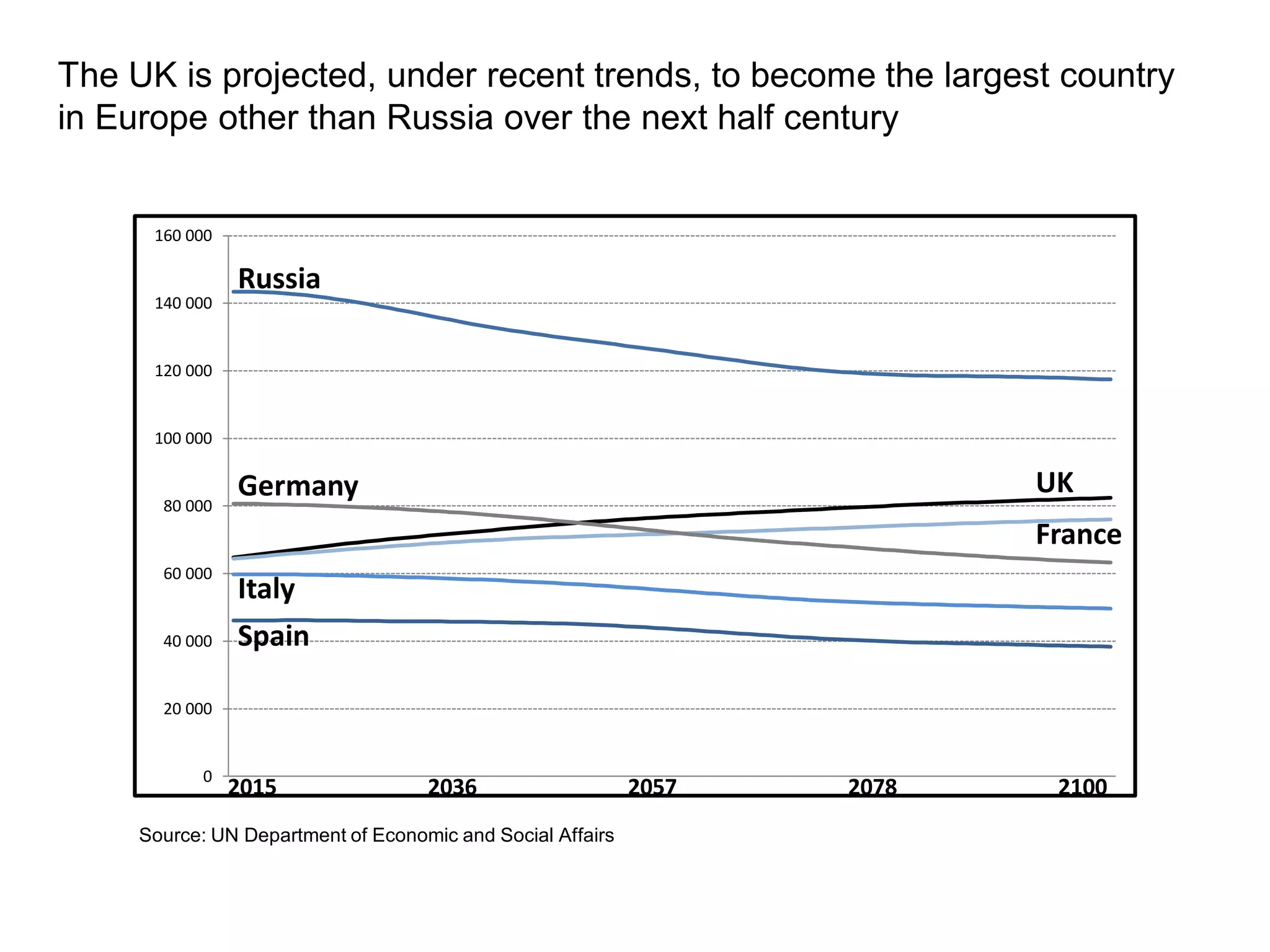
The UK is projected, under recent trends, to become the largest country
in Europe other than Russia over the next half century
The population of Wales is also projected to continue to grow, by
around 4% over the next twenty years
Wales: population projections
Source: StatsWales
3.11 million
3.21 million
3.25 million
2,950
3,000
3,050
3,100
3,150
3,200
3,250
3,300
2016 2026 2036
Thousands
estimated and projected population of Wales,
mid-1981 to mid-2039 (millions)
Source: Office for National Statistics (ONS)
1983 20391991 1999 2007 2015 2023 2031
3.6
3.5
3.4
3.3
3.2
3.1
3
2.9
2.8
2.7
Growth is expected under a number of different scenarios, although not
inevitable and depends on trends in fertility and migration
high fertility, high life expectancy, high migration
high fertility, low life expectancy, high migration
high migration
high fertility
high life expectancy
principal projection
low life expectancy
low fertility
low migration
low fertility, high life expectancy, low migration
low fertility, low life expectancy, low migration
principal projection
The growth in population is primarily driven by increases in those aged
65 or above
Wales: population projections
Source: StatsWales
0.0
20.0
40.0
60.0
80.0
100.0
120.0
140.0
160.0
2016 2021 2026 2031 2036 2041
index: 2016 = 100
all ages
0-15
65+
16-64
all ages
0-15
65+
16-64
570,000
567,000
570,000
567,000
570,000
567,000
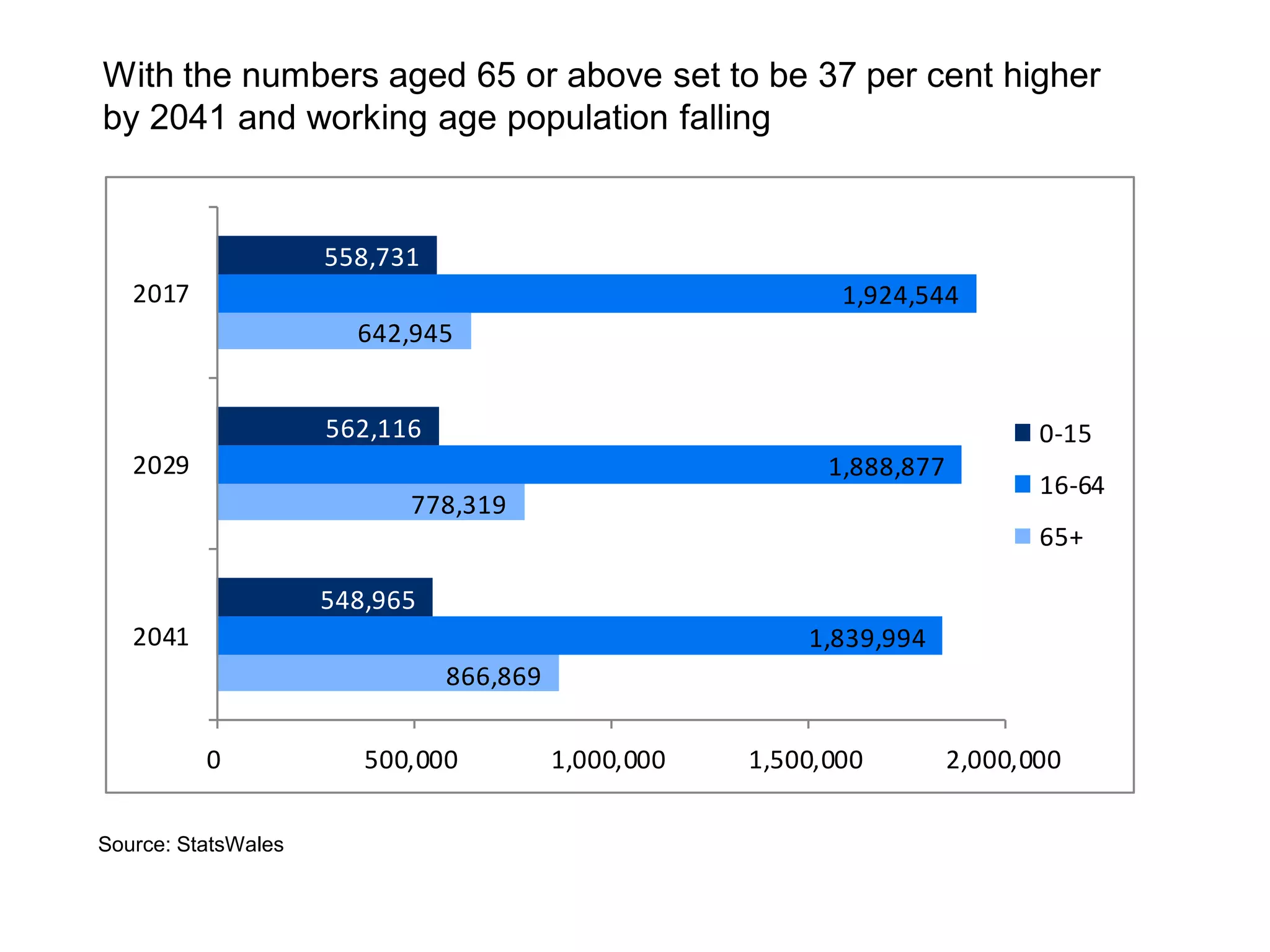
With the numbers aged 65 or above set to be 37 per cent higher
by 2041 and working age population falling
Source: StatsWales
866,869
778,319
642,945
1,839,994
1,888,877
1,924,544
548,965
562,116
558,731
0 500,000 1,000,000 1,500,000 2,000,000
2041
2029
2017
0-15
16-64
65+
Isle of Anglesey Neath Port Talbot
Gwynedd Bridgend
Conwy Vale of Glamorgan
Denbighshire Cardiff
Flintshire Rhondda Cynon Taf
Wrexham Merthyr Tydfil
Powys Caerphilly
Ceredigion Blaenau Gwent
Pembrokeshire Torfaen
Carmarthenshire Monmouthshire
Swansea Newport
Isle of Anglesey Neath Port Talbot
Gwynedd Bridgend
Conwy Vale of Glamorgan
Denbighshire Cardiff
Flintshire Rhondda Cynon Taf
Wrexham Merthyr Tydfil
Powys Caerphilly
Ceredigion Blaenau Gwent
Pembrokeshire Torfaen
Carmarthenshire Monmouthshire
Swansea Newport
projected population change for local authorities in Wales (2014 to 2039)
Population growth will not be uniform across Wales with some areas
projected to see a decline, and others increasing significantly
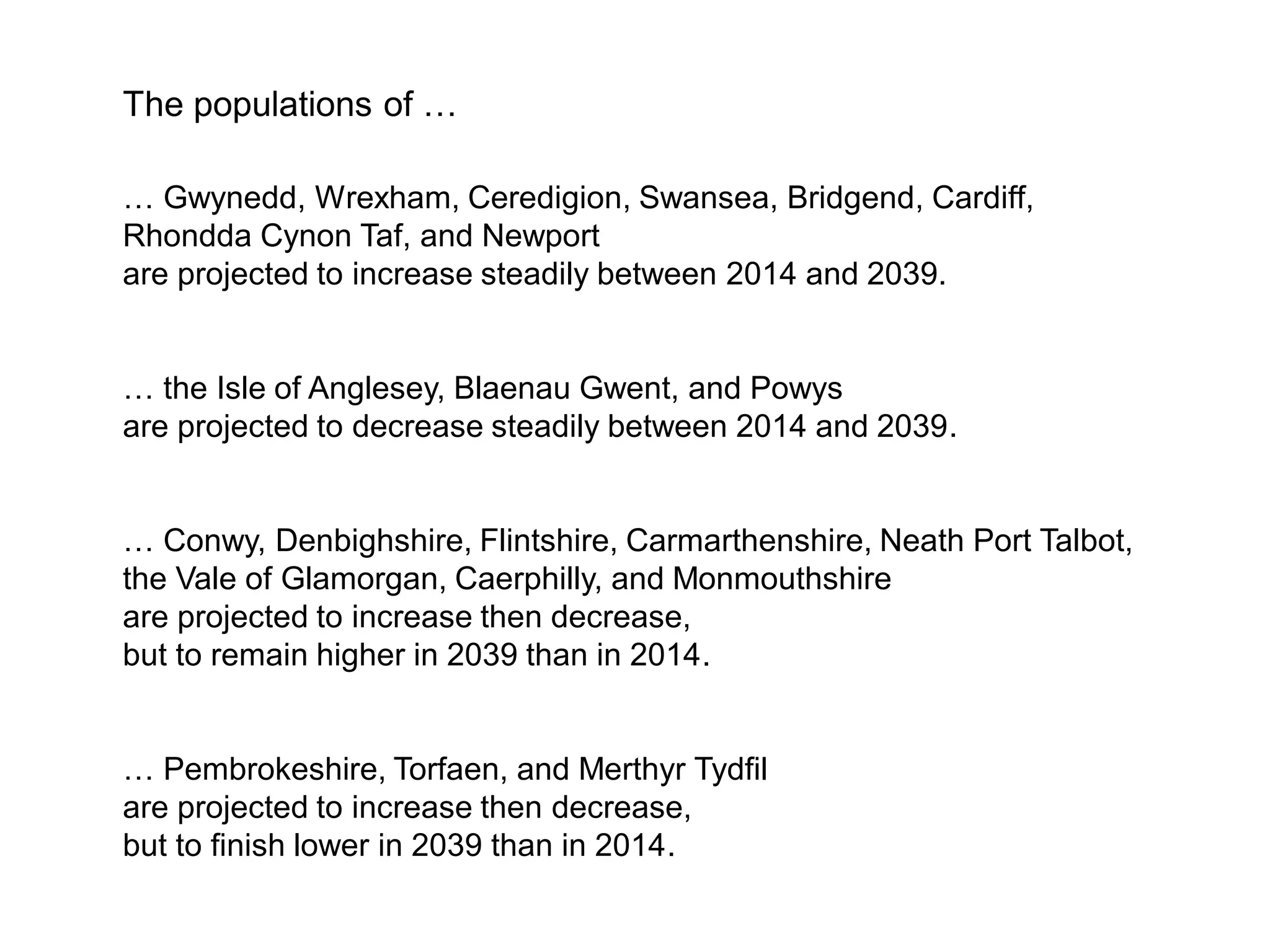
… Gwynedd, Wrexham, Ceredigion, Swansea, Bridgend, Cardiff,
Rhondda Cynon Taf, and Newport
are projected to increase steadily between 2014 and 2039.
… the Isle of Anglesey, Blaenau Gwent, and Powys
are projected to decrease steadily between 2014 and 2039.
… Conwy, Denbighshire, Flintshire, Carmarthenshire, Neath Port Talbot,
the Vale of Glamorgan, Caerphilly, and Monmouthshire
are projected to increase then decrease,
but to remain higher in 2039 than in 2014.
… Pembrokeshire, Torfaen, and Merthyr Tydfil
are projected to increase then decrease,
but to finish lower in 2039 than in 2014.
The populations of …
The population of older people is expected to see a large relative
increase, with the number of people in Wales aged 80 and over projected
to increase by over a quarter over the next 10 years, and by over 80 per
cent over the next 25 years.
Wales: population projections for people aged 80 and over
Source: StatsWales
0
50,000
100,000
150,000
200,000
250,000
300,000
350,000
2016 2021 2026 2031 2036 2041
age 80+
People aged 90 and over in Wales
F/M=2.8
5,211
16,086
21,297
0 5,000 10,000 15,000 20,000 25,000 30,000
Mid-year 2008
Persons Female Male
8,985
8,746
8,285
7,971
7,481
20,779
20,855
20,777
20,854
20,323
29,764
29,601
29,062
28,825
27,804
0 5,000 10,000 15,000 20,000 25,000 30,000
Mid-year 2017
Mid-year 2016
Mid-year 2015
Mid-year 2014
Mid-year 2013
Persons Female Male
F/M= 2.7
F/M= 2.6
F/M= 2.3
F/M= 2.4
F/M= 2.5
Female/Male=3.1
0
100
200
300
400
500
600
dependency ratio
65+
0-15
1991 20392007 2023
As a consequence the adult to older person dependency ratio will
increase sharply over time, although more stable for children
children and older people in Wales as proportions of working
age people
Source: StatsWales
Components of Population Change
Source: StatsWales
Over the longer period migration is projected to be the biggest driver in
population growth.
In the medium term (10 years) natural change (that is, births minus deaths)
is projected to account for around 3% of population growth in Wales,
international migration 67%, and UK migration 29%.
International migration-6,000
-4,000
-2,000
0
2,000
4,000
6,000
8,000
10,000
12,000
14,000
2016 to 2017 2021 to 2022 2026 to 2027 2031 to 2032 2036 to 2037
international migration UK migration
natural change (births - deaths) overall population change
average annual net migration flows for Wales with England
by age group, mid-2016 to mid-2017
Source: internal migration estimates, ONS
The picture of migration to England is mixed with Wales a net
gainer for most age groups. In total all regions are net gainers from
England.
-1,500
-1,000
-500
0
500
1,000
1,500
2,000
North Wales Mid Wales South West
Wales
South East
Wales
0 to 15
16 to 24
25 to 44
45 to 64
65+
Life expectancy is projected to continue to increase, but there are big
uncertainties about how far this will continue
Source: ONS
https://www.ons.gov.uk/peoplepopulationandcommunity/birthsdeathsandmarriages/lifeexpectancies/bulletins/pa
standprojecteddatafromtheperiodandcohortlifetables/previousReleases
https://www.
ons.gov.uk/pe
oplepopulatio
nandcommun
ity/birthsdeat
hsandmarriag
es/lifeexpecta
ncies/bulletin
s/pastandproj
ecteddatafro
mtheperiodan
dcohortlifetab
les/previousR
eleases
But “healthy life expectancy” is important and may impact the nature of
future pressures and health service use.
Overall, people can expect to spend just over three quarters of their life
in good health; at age 65, people can expect to spend just over half
their remaining life in good health.
Life expectancy and healthy life expectancy, Wales, 2013-15
Healthy Life
expectancy Life expectancy
% of life in
good health
Males at birth 61.5 78.4 78.4
Females at birth 62.7 82.3 76.2
Males at age 65 9.8 18.1 54.0
Females at age 65 10.7 20.5 52.3
Source: Office for National Statistics
https://www.ons.gov.uk/peoplepopulationandcommunity/healthandsocialcare/healthandlifeexpectanc
ies/bulletins/healthstatelifeexpectanciesuk/2013to2015
So although the number of people aged 75 and over is projected to
increase sharply, the number of deaths is far more stable.
0
50
100
150
200
250
300
Source: ONS projections
people 75+
deaths
index: 2015 = 100
2015 20392023 2031
Wales: projections for deaths and people aged 75 and over
Source: StatsWales
indexed population and household growth in Wales, 2016-2039
Demographic change will also influence housing demand, particularly
when combined with changes in household composition.
In Wales the number of households is projected (2014-based) to grow
faster than the population between 2016 and 2039.
96.0
98.0
100.0
102.0
104.0
106.0
108.0
110.0
112.0
114.0
2016 2021 2026 2031 2036
households
population
index: 2016 = 100
For more information on the Welsh Government Future
Trends Report 2017, please visit the following address:
http://gov.wales/statistics-and-research/future-trends/
Background data slides are also available on the website
for the other Themes of the Future Trends Report: Health;
Economy & Infrastructure; Climate Change; Land Use &
Infrastructure; and Society & Culture.

Welsh Government Future Trends 2017: population

  • 1.
    Welsh Government Future TrendsReport 2017– Population Theme data slides The following slides provide background data and graphs used for the Population theme in the Future Trends Report 2017
  • 2.
    0 500 1000 1500 2000 2500 Africa Southern Asia India China Europe U28 South America USA Russia Globalpopulation is projected to continue to increase. Large population increases are projected for Africa and India (and Southern Asia generally). China is projected to increase until 2030 but then to fall. 1950 205020001975 2025 Source: OECD and UN population (millions)
  • 3.
    0 20 000 40 000 60000 80 000 100 000 120 000 140 000 160 000 2015 210020572036 2078 Russia Germany Spain Italy UK France Source: UN Department of Economic and Social Affairs The UK is projected, under recent trends, to become the largest country in Europe other than Russia over the next half century
  • 4.
    The population ofWales is also projected to continue to grow, by around 4% over the next twenty years Wales: population projections Source: StatsWales 3.11 million 3.21 million 3.25 million 2,950 3,000 3,050 3,100 3,150 3,200 3,250 3,300 2016 2026 2036 Thousands
  • 5.
    estimated and projectedpopulation of Wales, mid-1981 to mid-2039 (millions) Source: Office for National Statistics (ONS) 1983 20391991 1999 2007 2015 2023 2031 3.6 3.5 3.4 3.3 3.2 3.1 3 2.9 2.8 2.7 Growth is expected under a number of different scenarios, although not inevitable and depends on trends in fertility and migration high fertility, high life expectancy, high migration high fertility, low life expectancy, high migration high migration high fertility high life expectancy principal projection low life expectancy low fertility low migration low fertility, high life expectancy, low migration low fertility, low life expectancy, low migration principal projection
  • 6.
    The growth inpopulation is primarily driven by increases in those aged 65 or above Wales: population projections Source: StatsWales 0.0 20.0 40.0 60.0 80.0 100.0 120.0 140.0 160.0 2016 2021 2026 2031 2036 2041 index: 2016 = 100 all ages 0-15 65+ 16-64 all ages 0-15 65+ 16-64
  • 7.
    570,000 567,000 570,000 567,000 570,000 567,000 With the numbersaged 65 or above set to be 37 per cent higher by 2041 and working age population falling Source: StatsWales 866,869 778,319 642,945 1,839,994 1,888,877 1,924,544 548,965 562,116 558,731 0 500,000 1,000,000 1,500,000 2,000,000 2041 2029 2017 0-15 16-64 65+
  • 8.
    Isle of AngleseyNeath Port Talbot Gwynedd Bridgend Conwy Vale of Glamorgan Denbighshire Cardiff Flintshire Rhondda Cynon Taf Wrexham Merthyr Tydfil Powys Caerphilly Ceredigion Blaenau Gwent Pembrokeshire Torfaen Carmarthenshire Monmouthshire Swansea Newport Isle of Anglesey Neath Port Talbot Gwynedd Bridgend Conwy Vale of Glamorgan Denbighshire Cardiff Flintshire Rhondda Cynon Taf Wrexham Merthyr Tydfil Powys Caerphilly Ceredigion Blaenau Gwent Pembrokeshire Torfaen Carmarthenshire Monmouthshire Swansea Newport projected population change for local authorities in Wales (2014 to 2039) Population growth will not be uniform across Wales with some areas projected to see a decline, and others increasing significantly
  • 9.
    … Gwynedd, Wrexham,Ceredigion, Swansea, Bridgend, Cardiff, Rhondda Cynon Taf, and Newport are projected to increase steadily between 2014 and 2039. … the Isle of Anglesey, Blaenau Gwent, and Powys are projected to decrease steadily between 2014 and 2039. … Conwy, Denbighshire, Flintshire, Carmarthenshire, Neath Port Talbot, the Vale of Glamorgan, Caerphilly, and Monmouthshire are projected to increase then decrease, but to remain higher in 2039 than in 2014. … Pembrokeshire, Torfaen, and Merthyr Tydfil are projected to increase then decrease, but to finish lower in 2039 than in 2014. The populations of …
  • 10.
    The population ofolder people is expected to see a large relative increase, with the number of people in Wales aged 80 and over projected to increase by over a quarter over the next 10 years, and by over 80 per cent over the next 25 years. Wales: population projections for people aged 80 and over Source: StatsWales 0 50,000 100,000 150,000 200,000 250,000 300,000 350,000 2016 2021 2026 2031 2036 2041 age 80+
  • 11.
    People aged 90and over in Wales F/M=2.8 5,211 16,086 21,297 0 5,000 10,000 15,000 20,000 25,000 30,000 Mid-year 2008 Persons Female Male 8,985 8,746 8,285 7,971 7,481 20,779 20,855 20,777 20,854 20,323 29,764 29,601 29,062 28,825 27,804 0 5,000 10,000 15,000 20,000 25,000 30,000 Mid-year 2017 Mid-year 2016 Mid-year 2015 Mid-year 2014 Mid-year 2013 Persons Female Male F/M= 2.7 F/M= 2.6 F/M= 2.3 F/M= 2.4 F/M= 2.5 Female/Male=3.1
  • 12.
    0 100 200 300 400 500 600 dependency ratio 65+ 0-15 1991 203920072023 As a consequence the adult to older person dependency ratio will increase sharply over time, although more stable for children children and older people in Wales as proportions of working age people Source: StatsWales
  • 13.
    Components of PopulationChange Source: StatsWales Over the longer period migration is projected to be the biggest driver in population growth. In the medium term (10 years) natural change (that is, births minus deaths) is projected to account for around 3% of population growth in Wales, international migration 67%, and UK migration 29%. International migration-6,000 -4,000 -2,000 0 2,000 4,000 6,000 8,000 10,000 12,000 14,000 2016 to 2017 2021 to 2022 2026 to 2027 2031 to 2032 2036 to 2037 international migration UK migration natural change (births - deaths) overall population change
  • 14.
    average annual netmigration flows for Wales with England by age group, mid-2016 to mid-2017 Source: internal migration estimates, ONS The picture of migration to England is mixed with Wales a net gainer for most age groups. In total all regions are net gainers from England. -1,500 -1,000 -500 0 500 1,000 1,500 2,000 North Wales Mid Wales South West Wales South East Wales 0 to 15 16 to 24 25 to 44 45 to 64 65+
  • 15.
    Life expectancy isprojected to continue to increase, but there are big uncertainties about how far this will continue Source: ONS https://www.ons.gov.uk/peoplepopulationandcommunity/birthsdeathsandmarriages/lifeexpectancies/bulletins/pa standprojecteddatafromtheperiodandcohortlifetables/previousReleases https://www. ons.gov.uk/pe oplepopulatio nandcommun ity/birthsdeat hsandmarriag es/lifeexpecta ncies/bulletin s/pastandproj ecteddatafro mtheperiodan dcohortlifetab les/previousR eleases
  • 16.
    But “healthy lifeexpectancy” is important and may impact the nature of future pressures and health service use. Overall, people can expect to spend just over three quarters of their life in good health; at age 65, people can expect to spend just over half their remaining life in good health. Life expectancy and healthy life expectancy, Wales, 2013-15 Healthy Life expectancy Life expectancy % of life in good health Males at birth 61.5 78.4 78.4 Females at birth 62.7 82.3 76.2 Males at age 65 9.8 18.1 54.0 Females at age 65 10.7 20.5 52.3 Source: Office for National Statistics https://www.ons.gov.uk/peoplepopulationandcommunity/healthandsocialcare/healthandlifeexpectanc ies/bulletins/healthstatelifeexpectanciesuk/2013to2015
  • 17.
    So although thenumber of people aged 75 and over is projected to increase sharply, the number of deaths is far more stable. 0 50 100 150 200 250 300 Source: ONS projections people 75+ deaths index: 2015 = 100 2015 20392023 2031 Wales: projections for deaths and people aged 75 and over
  • 18.
    Source: StatsWales indexed populationand household growth in Wales, 2016-2039 Demographic change will also influence housing demand, particularly when combined with changes in household composition. In Wales the number of households is projected (2014-based) to grow faster than the population between 2016 and 2039. 96.0 98.0 100.0 102.0 104.0 106.0 108.0 110.0 112.0 114.0 2016 2021 2026 2031 2036 households population index: 2016 = 100
  • 19.
    For more informationon the Welsh Government Future Trends Report 2017, please visit the following address: http://gov.wales/statistics-and-research/future-trends/ Background data slides are also available on the website for the other Themes of the Future Trends Report: Health; Economy & Infrastructure; Climate Change; Land Use & Infrastructure; and Society & Culture.