Family’s involvement in the hearing
impaired child’s rehabilitation and
education
Family
It represent the child’s first environment. The
child’s relations within the family, the
emotional climate and the behavior patterns
shown to the child are of great importance for
their social integration.
Need of the family support
 When dealing with a hearing impaired child within the family
there often appear feelings of guilt, fear and mistrust.
 Due to lack of information or professional support, parents can
consider their child’s impairment as a great obstacle in his
development. The lack of speech makes parents keep their
child within family boundaries and limit his contact with the
outside world.
Need of family support
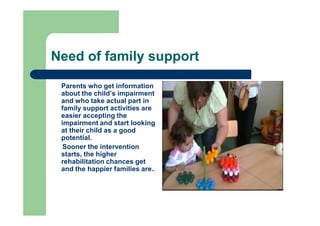
Parents who get information
about the child’s impairment
and who take actual part in
family support activities are
easier accepting the
impairment and start looking
at their child as a good
potential.
Sooner the intervention
starts, the higher
rehabilitation chances get
and the happier families are..
Purpose of the meetings
Family needs to be the main partner in the
integration and rehabilitation process. The
parents have to continue the rehabilitation
plan that was established together with the
professionals.
Family support services in our institution
 Our institution has two centers of rehabilitation:
 THE HEARING AND LANGUAGE REHABILITATION CENTER
 THE FAMILY SUPPORT AND EARLY INTERVENTION CENTER
 Within these two centers we have initiated different activities of
informing and guiding the parents.
 The first step was to identify the parents’ needs and problems.
We have noticed that parents do not hold enough information
about the hearing impairment and its etiology, about hearing aids
or cochlear implants.
Activities carried on together with the
parents:
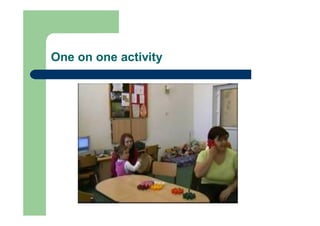
 One on one activities, also called rehabilitation therapy, include
forming communication abilities; lip-reading, auditory
training;ortophonics; rhythm education;
 Parents-children activities, are about training the parents to be
main educational factors in the rehabilitation of their child.
 Family support activities, are about parents’ counselling and
information about the hearing impairment and itds consequences.
 Cooperation activities within the professionals team: doctors, hearing
aid specialist, audiologist, special education teacher, speech therapist,
parents.
 Information activities carried on for the teachers in the public
schools come as a support for schools and kindergartens which
facilitate the integration of the hearing impaired children.
One on one activity
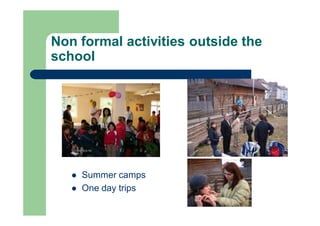
Non formal activities outside the
school
 Summer camps
 One day trips
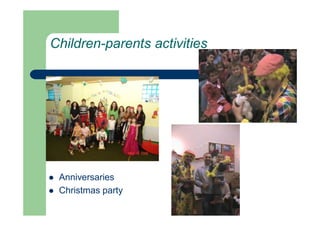
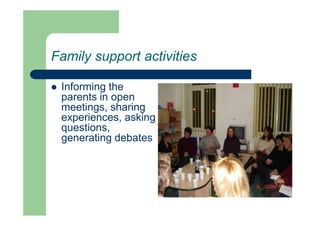
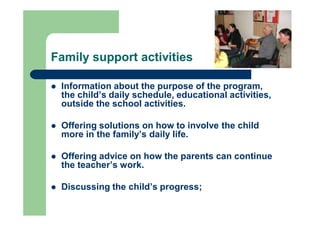
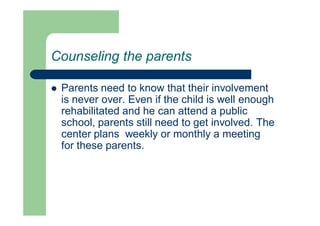
Children-parents activities
 Anniversaries
 Christmas party
Family support activities
 Informing the
parents in open
meetings, sharing
experiences, asking
questions,
generating debates
Family support activities
 Information about the purpose of the program,
the child’s daily schedule, educational activities,
outside the school activities.
 Offering solutions on how to involve the child
more in the family’s daily life.
 Offering advice on how the parents can continue
the teacher’s work.
 Discussing the child’s progress;
Counseling the parents
 Parents need to know that their involvement
is never over. Even if the child is well enough
rehabilitated and he can attend a public
school, parents still need to get involved. The
center plans weekly or monthly a meeting
for these parents.
Counseling the parents
It is very important for the parents to
know that the counselor gives them the
necessary support.
It is also important that the counselor
tells the information in a proper manner
so that the parent can understand it: clear
words, no professional terminology, lots
of examples, practical advice
School –family partnership
Encouraging parents to take part in
their children’s educational
development makes them feel
comfortable, proud and confident.
All of these will later reflect in the
progress of the hearing-impaired
child who will feel supported, loved
and understood.
Conclusions:
 The cooperation between school and family is absolutely
necessary for insuring the success of rehabilitation for a
hearing impaired child.
 School-family partnership is about communicating efficiently ,
about having the same purposes and actions where the hearing
impaired child is concerned
 It is imperative that the family has an active part in the
rehabilitation process and that there is a mutual collaboration
and coordination between school and family.

Román partner előadása.

  • 1.
    Family’s involvement inthe hearing impaired child’s rehabilitation and education
  • 2.
    Family It represent thechild’s first environment. The child’s relations within the family, the emotional climate and the behavior patterns shown to the child are of great importance for their social integration.
  • 3.
    Need of thefamily support  When dealing with a hearing impaired child within the family there often appear feelings of guilt, fear and mistrust.  Due to lack of information or professional support, parents can consider their child’s impairment as a great obstacle in his development. The lack of speech makes parents keep their child within family boundaries and limit his contact with the outside world.
  • 4.
    Need of familysupport Parents who get information about the child’s impairment and who take actual part in family support activities are easier accepting the impairment and start looking at their child as a good potential. Sooner the intervention starts, the higher rehabilitation chances get and the happier families are..
  • 5.
    Purpose of themeetings Family needs to be the main partner in the integration and rehabilitation process. The parents have to continue the rehabilitation plan that was established together with the professionals.
  • 6.
    Family support servicesin our institution  Our institution has two centers of rehabilitation:  THE HEARING AND LANGUAGE REHABILITATION CENTER  THE FAMILY SUPPORT AND EARLY INTERVENTION CENTER  Within these two centers we have initiated different activities of informing and guiding the parents.  The first step was to identify the parents’ needs and problems. We have noticed that parents do not hold enough information about the hearing impairment and its etiology, about hearing aids or cochlear implants.
  • 7.
    Activities carried ontogether with the parents:  One on one activities, also called rehabilitation therapy, include forming communication abilities; lip-reading, auditory training;ortophonics; rhythm education;  Parents-children activities, are about training the parents to be main educational factors in the rehabilitation of their child.  Family support activities, are about parents’ counselling and information about the hearing impairment and itds consequences.  Cooperation activities within the professionals team: doctors, hearing aid specialist, audiologist, special education teacher, speech therapist, parents.  Information activities carried on for the teachers in the public schools come as a support for schools and kindergartens which facilitate the integration of the hearing impaired children.
  • 8.
    One on oneactivity
  • 9.
    Non formal activitiesoutside the school  Summer camps  One day trips
  • 10.
  • 11.
    Family support activities Informing the parents in open meetings, sharing experiences, asking questions, generating debates
  • 12.
    Family support activities Information about the purpose of the program, the child’s daily schedule, educational activities, outside the school activities.  Offering solutions on how to involve the child more in the family’s daily life.  Offering advice on how the parents can continue the teacher’s work.  Discussing the child’s progress;
  • 13.
    Counseling the parents Parents need to know that their involvement is never over. Even if the child is well enough rehabilitated and he can attend a public school, parents still need to get involved. The center plans weekly or monthly a meeting for these parents.
  • 14.
    Counseling the parents Itis very important for the parents to know that the counselor gives them the necessary support. It is also important that the counselor tells the information in a proper manner so that the parent can understand it: clear words, no professional terminology, lots of examples, practical advice
  • 15.
    School –family partnership Encouragingparents to take part in their children’s educational development makes them feel comfortable, proud and confident. All of these will later reflect in the progress of the hearing-impaired child who will feel supported, loved and understood.
  • 16.
    Conclusions:  The cooperationbetween school and family is absolutely necessary for insuring the success of rehabilitation for a hearing impaired child.  School-family partnership is about communicating efficiently , about having the same purposes and actions where the hearing impaired child is concerned  It is imperative that the family has an active part in the rehabilitation process and that there is a mutual collaboration and coordination between school and family.