College of Early Childhood Educators (CECE) Standards of Practice
Standards of Practice Artifacts Reflective Narrative
1. Caring and Nurturing
Relationships that
Support Learning
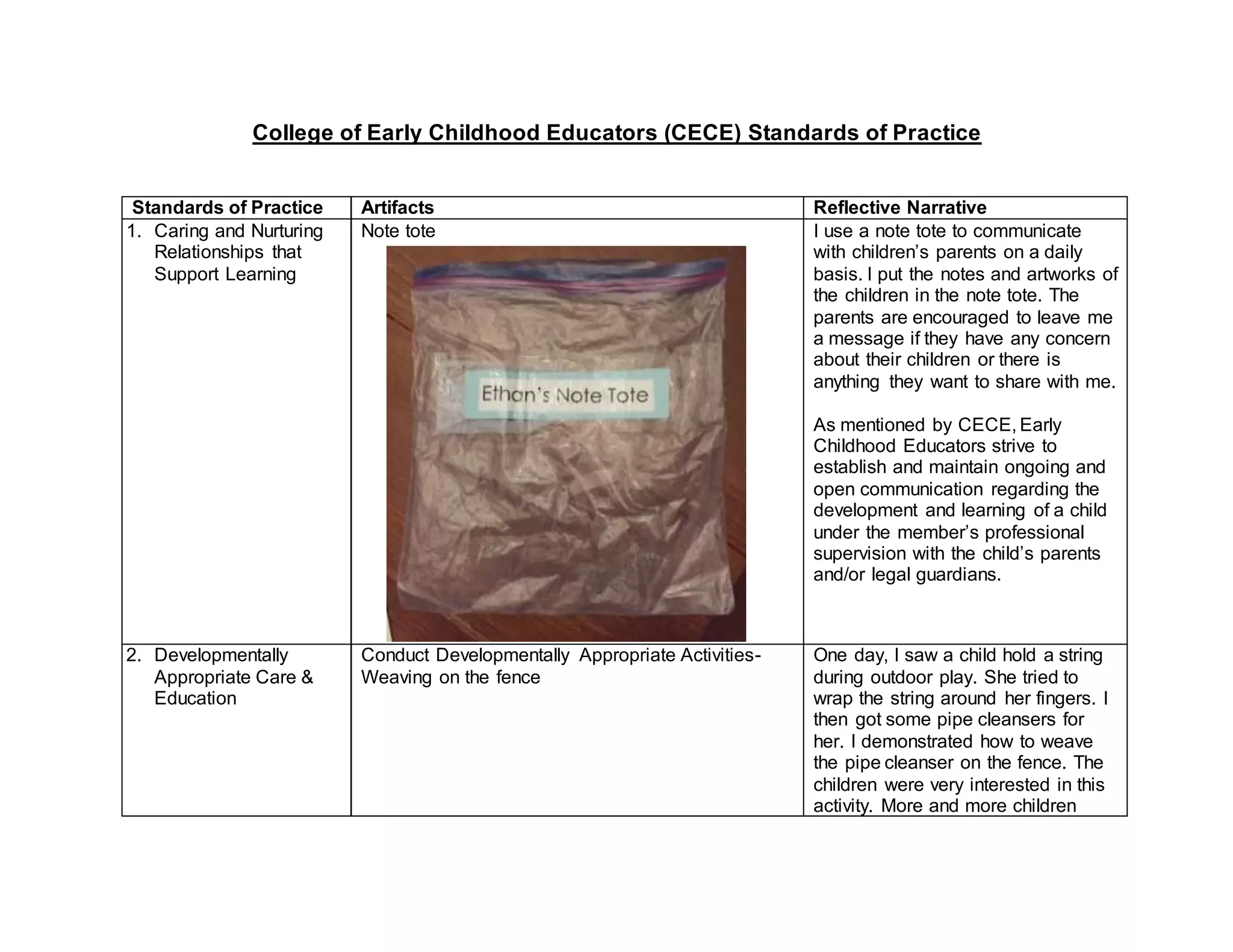
Note tote I use a note tote to communicate
with children’s parents on a daily
basis. I put the notes and artworks of
the children in the note tote. The
parents are encouraged to leave me
a message if they have any concern
about their children or there is
anything they want to share with me.
As mentioned by CECE, Early
Childhood Educators strive to
establish and maintain ongoing and
open communication regarding the
development and learning of a child
under the member’s professional
supervision with the child’s parents
and/or legal guardians.
2. Developmentally
Appropriate Care &
Education
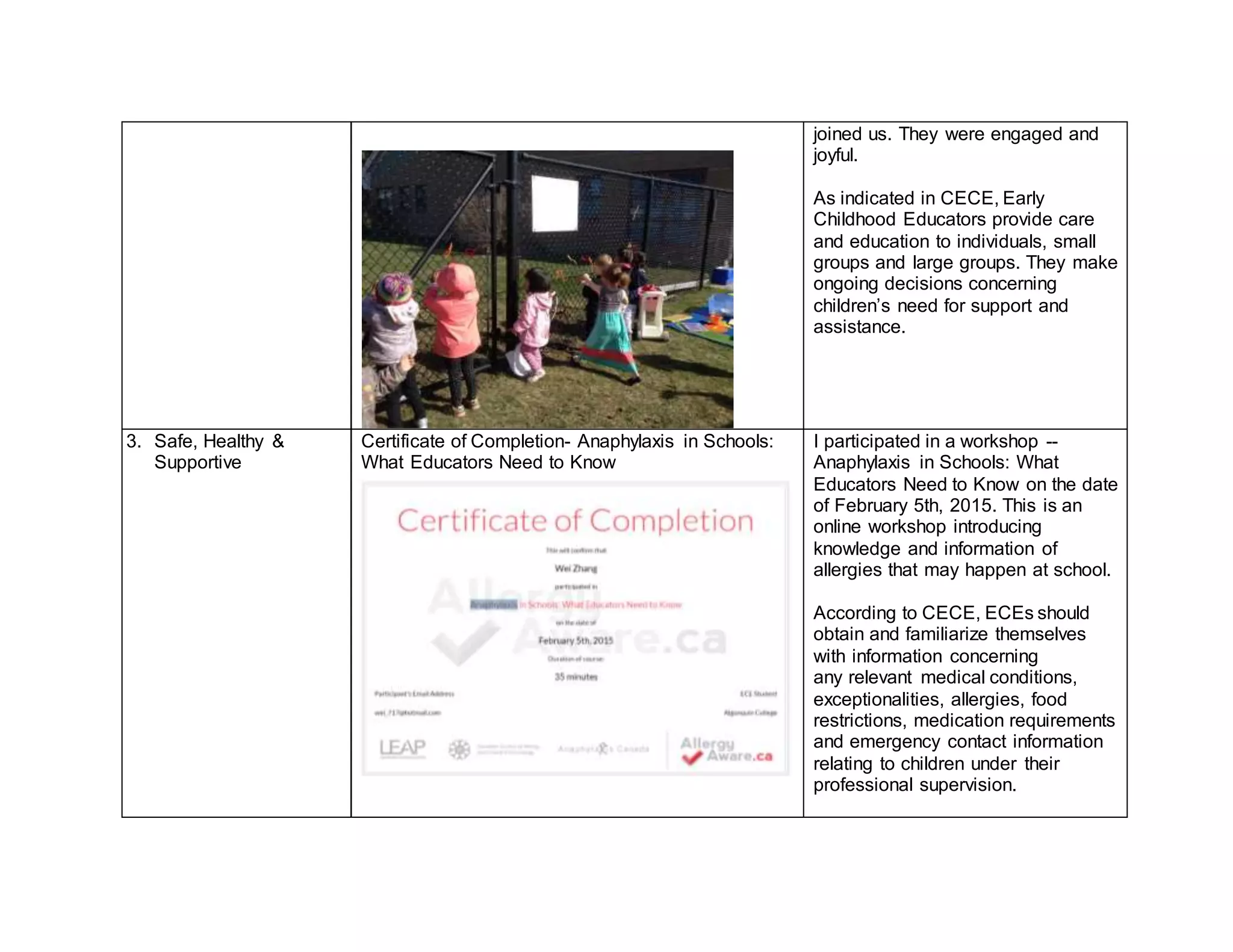
Conduct Developmentally Appropriate Activities-
Weaving on the fence
One day, I saw a child hold a string
during outdoor play. She tried to
wrap the string around her fingers. I
then got some pipe cleansers for
her. I demonstrated how to weave
the pipe cleanser on the fence. The
children were very interested in this
activity. More and more children
joined us. They were engaged and
joyful.
As indicated in CECE, Early
Childhood Educators provide care
and education to individuals, small
groups and large groups. They make
ongoing decisions concerning
children’s need for support and
assistance.
3. Safe, Healthy &
Supportive
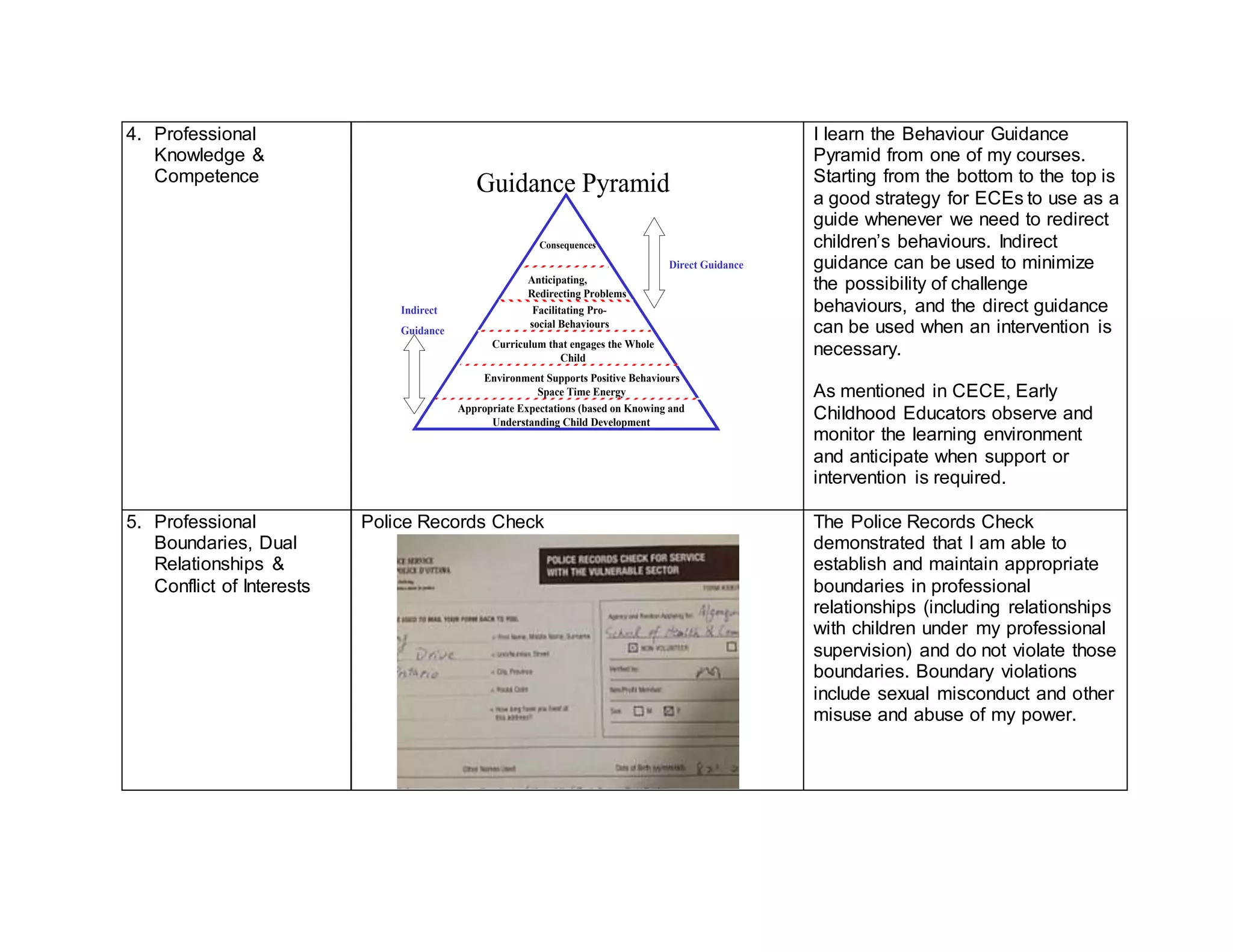
Certificate of Completion- Anaphylaxis in Schools:
What Educators Need to Know
I participated in a workshop --
Anaphylaxis in Schools: What
Educators Need to Know on the date
of February 5th, 2015. This is an
online workshop introducing
knowledge and information of
allergies that may happen at school.
According to CECE, ECEs should
obtain and familiarize themselves
with information concerning
any relevant medical conditions,
exceptionalities, allergies, food
restrictions, medication requirements
and emergency contact information
relating to children under their
professional supervision.
4. Professional
Knowledge &
Competence
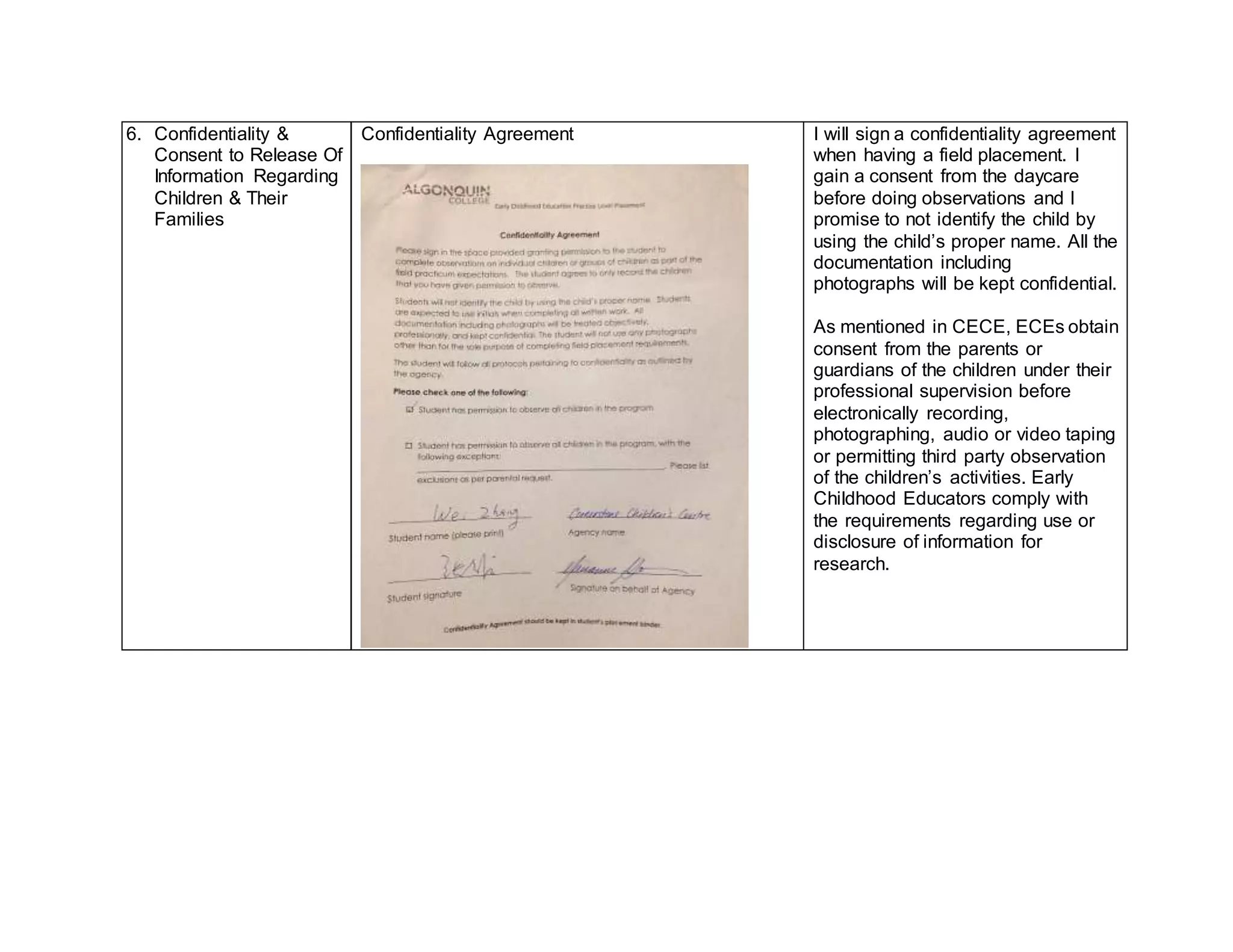
Guidance Pyramid
Appropriate Expectations (based on Knowing and
Understanding Child Development
Environment Supports Positive Behaviours
Space Time Energy
Curriculum that engages the Whole
Child
Facilitating Pro-
social Behaviours
Anticipating,
Redirecting Problems
Consequences
Direct Guidance
Indirect
Guidance
I learn the Behaviour Guidance
Pyramid from one of my courses.
Starting from the bottom to the top is
a good strategy for ECEs to use as a
guide whenever we need to redirect
children’s behaviours. Indirect
guidance can be used to minimize
the possibility of challenge
behaviours, and the direct guidance
can be used when an intervention is
necessary.
As mentioned in CECE, Early
Childhood Educators observe and
monitor the learning environment
and anticipate when support or
intervention is required.
5. Professional
Boundaries, Dual
Relationships &
Conflict of Interests
Police Records Check The Police Records Check
demonstrated that I am able to
establish and maintain appropriate
boundaries in professional
relationships (including relationships
with children under my professional
supervision) and do not violate those
boundaries. Boundary violations
include sexual misconduct and other
misuse and abuse of my power.
6. Confidentiality &
Consent to Release Of
Information Regarding
Children & Their
Families
Confidentiality Agreement I will sign a confidentiality agreement
when having a field placement. I
gain a consent from the daycare
before doing observations and I
promise to not identify the child by
using the child’s proper name. All the
documentation including
photographs will be kept confidential.
As mentioned in CECE, ECEs obtain
consent from the parents or
guardians of the children under their
professional supervision before
electronically recording,
photographing, audio or video taping
or permitting third party observation
of the children’s activities. Early
Childhood Educators comply with
the requirements regarding use or
disclosure of information for
research.

CECE Standards of Practice

  • 1.
    College of EarlyChildhood Educators (CECE) Standards of Practice Standards of Practice Artifacts Reflective Narrative 1. Caring and Nurturing Relationships that Support Learning Note tote I use a note tote to communicate with children’s parents on a daily basis. I put the notes and artworks of the children in the note tote. The parents are encouraged to leave me a message if they have any concern about their children or there is anything they want to share with me. As mentioned by CECE, Early Childhood Educators strive to establish and maintain ongoing and open communication regarding the development and learning of a child under the member’s professional supervision with the child’s parents and/or legal guardians. 2. Developmentally Appropriate Care & Education Conduct Developmentally Appropriate Activities- Weaving on the fence One day, I saw a child hold a string during outdoor play. She tried to wrap the string around her fingers. I then got some pipe cleansers for her. I demonstrated how to weave the pipe cleanser on the fence. The children were very interested in this activity. More and more children
  • 2.
    joined us. Theywere engaged and joyful. As indicated in CECE, Early Childhood Educators provide care and education to individuals, small groups and large groups. They make ongoing decisions concerning children’s need for support and assistance. 3. Safe, Healthy & Supportive Certificate of Completion- Anaphylaxis in Schools: What Educators Need to Know I participated in a workshop -- Anaphylaxis in Schools: What Educators Need to Know on the date of February 5th, 2015. This is an online workshop introducing knowledge and information of allergies that may happen at school. According to CECE, ECEs should obtain and familiarize themselves with information concerning any relevant medical conditions, exceptionalities, allergies, food restrictions, medication requirements and emergency contact information relating to children under their professional supervision.
  • 3.
    4. Professional Knowledge & Competence GuidancePyramid Appropriate Expectations (based on Knowing and Understanding Child Development Environment Supports Positive Behaviours Space Time Energy Curriculum that engages the Whole Child Facilitating Pro- social Behaviours Anticipating, Redirecting Problems Consequences Direct Guidance Indirect Guidance I learn the Behaviour Guidance Pyramid from one of my courses. Starting from the bottom to the top is a good strategy for ECEs to use as a guide whenever we need to redirect children’s behaviours. Indirect guidance can be used to minimize the possibility of challenge behaviours, and the direct guidance can be used when an intervention is necessary. As mentioned in CECE, Early Childhood Educators observe and monitor the learning environment and anticipate when support or intervention is required. 5. Professional Boundaries, Dual Relationships & Conflict of Interests Police Records Check The Police Records Check demonstrated that I am able to establish and maintain appropriate boundaries in professional relationships (including relationships with children under my professional supervision) and do not violate those boundaries. Boundary violations include sexual misconduct and other misuse and abuse of my power.
  • 4.
    6. Confidentiality & Consentto Release Of Information Regarding Children & Their Families Confidentiality Agreement I will sign a confidentiality agreement when having a field placement. I gain a consent from the daycare before doing observations and I promise to not identify the child by using the child’s proper name. All the documentation including photographs will be kept confidential. As mentioned in CECE, ECEs obtain consent from the parents or guardians of the children under their professional supervision before electronically recording, photographing, audio or video taping or permitting third party observation of the children’s activities. Early Childhood Educators comply with the requirements regarding use or disclosure of information for research.