King Lear
Three daughters.
Two liars.
A king grown old, but not wise.
“POWER IS THE PRIZE, BUT POWER SHALL BE DAMNED BY LIES”
“FATE LOVES A FOOL”
King Lear
• Tragedy centering on the decline and fall of a dysfunctional royal family.
Parallel Plots
King Lear Gloucester
Aging father (patriarch) Aging father (patriarch)
Imperious gullible
Tyrannical
Capricious
Each sees his children through a distorted lens, turning against the child who truly loves him,
unleashing in the others greed, lust, ambition.
Hamartia
 Aristotilian term
 The error of the tragic protagonist
 Does not have to be a character flaw, could be a mistake or failure to take a particular action
Theme
 Love, betrayal, revenge, loyalty, and foolishness
 All things are not as they appear
 Greed and lust for power corrupt human beings and bring their downfall
 Fate turns humans into playthings
 Candor has a sharp edge
 Advanced age and wisdom do not go hand in hand
 Suffering can transform a contemptible human being into a good person
Motifs
 Blindness 2..minf and eyes..gloucesetr was blind .
 Madness
 Nature and order
 Animals
Cast of Characters
Lear: King of Britain
His daughters
- Goneril - Regan - Cordelia
Earl of Gloucester
His sons
- Edmund (the illegitimate) - Edgar
Kent husband of daughtr
Cornwall same
Act 1, Scene 1
 Earl of Gloucester introduces Edmund (illegitimate son) to Earl of Kent, mentions legitimate son
(Edgar).
 King Lear intends to divide his power and kingdom among his three daughters:
Goneril (married to Duke of Albany)
Regan (married toDuke of Cornwall)
Cordelia (intened to marry Duke of Burgundy) but he doesn’t marry her
 demands they publicly profess their love for him
 Cordelia refuses to put on a show; Goneril & Regan get kingdom divided btw them
 Cordelia gets France, but is disinherited.
 Earl of Kent banished upon arguing with Lear for his treatment of Cordelia.
Act 1, Scene 2
• Edmund (illegitimate) decides to steal Edgar’s (legitimate) inheritance.
• Fools father (Gloucester) using a fake letter.
• Fools Edgar as well.
Act 1, Scene 3
Goneril -- bad daughter -- decides to humble her father, orders Oswald to treat him badly.
Act 1, Scene 4
• The banished Earl of Kent arrives in disguise to serve Lear
• The fool enters and mocks the king for banishing his good daughter and elevating his two bad
ones
Act 1, Scene 4
Original Modernized
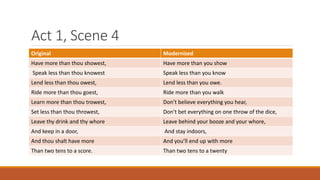
Have more than thou showest, Have more than you show
Speak less than thou knowest Speak less than you know
Lend less than thou owest, Lend less than you owe.
Ride more than thou goest, Ride more than you walk
Learn more than thou trowest, Don’t believe everything you hear,
Set less than thou throwest, Don’t bet everything on one throw of the dice,
Leave thy drink and thy whore Leave behind your booze and your whore,
And keep in a door, And stay indoors,
And thou shalt have more And you’ll end up with more
Than two tens to a score. Than two tens to a twenty
Act 1, Scene 4
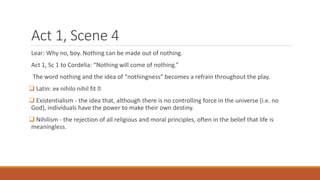
Lear: Why no, boy. Nothing can be made out of nothing.
Act 1, Sc 1 to Cordelia: “Nothing will come of nothing.”
The word nothing and the idea of “nothingness” becomes a refrain throughout the play.
 Latin: ex nihilo nihil fit
 Existentialism - the idea that, although there is no controlling force in the universe (i.e. no
God), individuals have the power to make their own destiny.
 Nihilism - the rejection of all religious and moral principles, often in the belief that life is
meaningless.
Act 1, Scene 4
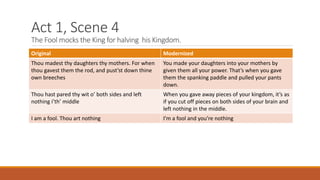
The Fool mocks the King for halving his Kingdom.
Original Modernized
Thou madest thy daughters thy mothers. For when
thou gavest them the rod, and pust’st down thine
own breeches
You made your daughters into your mothers by
given them all your power. That’s when you gave
them the spanking paddle and pulled your pants
down.
Thou hast pared thy wit o’ both sides and left
nothing i’th’ middle
When you gave away pieces of your kingdom, it’s as
if you cut off pieces on both sides of your brain and
left nothing in the middle.
I am a fool. Thou art nothing I’m a fool and you’re nothing
Act 1, Scene 4
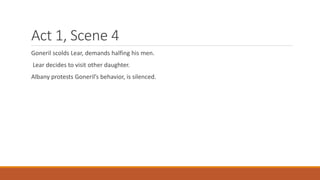
Goneril scolds Lear, demands halfing his men.
Lear decides to visit other daughter.
Albany protests Goneril’s behavior, is silenced.
Act 1, Scene 4
 Goneril scolds Lear, demands halfing his men.
 Lear realizes her ingratitude and begs the Gods to make her sterile
“How sharper than a serpent’s tooth it is to have a thankless child.”
Laments that maybe Cordelia’s flaw wasn’t all that bad
“Oh most small fault, how ugly didst thou in Cordelia show”
Lear decides to stay with his other daughter
“Who I am sure is kind and comfortable…”
Goneril sends Oswald with letter to Regan.
Act 1, Scene 5
 Lear sends Kent with letter to Regan.
 Fool again taunts his master, Lear.
Act 2, Scene 1
 Edmund tricks Edgar into appearing -- in front of Gloucester -- to fight.
 Gloucester vows to legitimize Edmund and capture/kill Edgar.
Concerning Edgar: “I never got him”, meaning, “He cannot truly be my son”
Concerning Edmund: “Loyal and natural boy…”, meaning: “My loyal and true son”
Act 2, Scene 1
 Regan and Cornwall arrive.
 Edmund tells Regan that Edgar was friends with Lear’s rowdy knights
 Cornwall and Regan are pleased with Edmund and take him on as a servant/companion (similar
to Kent and Lear)
For you, Edmund, whose virtue and obedience doth this instant so much comment itself, you
shall be ours.
Act 2, Scene 2
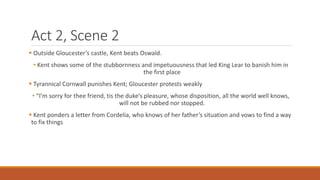
 Outside Gloucester’s castle, Kent beats Oswald.
• Kent shows some of the stubbornness and impetuousness that led King Lear to banish him in
the first place
 Tyrannical Cornwall punishes Kent; Gloucester protests weakly
• “I’m sorry for thee friend, tis the duke’s pleasure, whose disposition, all the world well knows,
will not be rubbed nor stopped.
 Kent ponders a letter from Cordelia, who knows of her father’s situation and vows to find a way
to fix things
Act 2, Scene 3
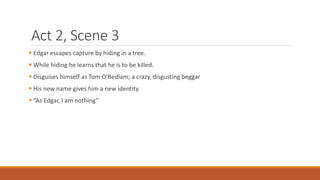
 Edgar escapes capture by hiding in a tree.
 While hiding he learns that he is to be killed.
 Disguises himself as Tom O’Bedlam; a crazy, disgusting beggar
 His new name gives him a new identity.
 “As Edgar, I am nothing”
Act 2, Scene 4
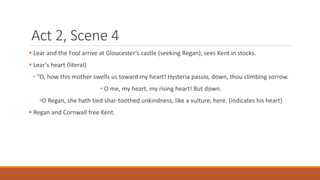
 Lear and the Fool arrive at Gloucester’s castle (seeking Regan), sees Kent in stocks.
 Lear’s heart (literal)
• “O, how this mother swells us toward my heart! Hysteria passio, down, thou climbing sorrow.
• O me, my heart, my rising heart! But down.
•O Regan, she hath tied shar-toothed unkindness, like a vulture, here. (indicates his heart)
 Regan and Cornwall free Kent.
Act 2, Scene 4
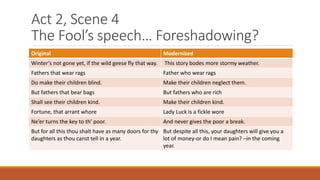
The Fool’s speech… Foreshadowing?
Original Modernized
Winter’s not gone yet, if the wild geese fly that way. This story bodes more stormy weather.
Fathers that wear rags Father who wear rags
Do make their children blind. Make their children neglect them.
But fathers that bear bags But fathers who are rich
Shall see their children kind. Make their children kind.
Fortune, that arrant whore Lady Luck is a fickle wore
Ne’er turns the key to th’ poor. And never gives the poor a break.
But for all this thou shalt have as many doors for thy
daughters as thou canst tell in a year.
But despite all this, your daughters will give you a
lot of money-or do I mean pain? –in the coming
year.
Act 2, Scene 4
Original Modernized
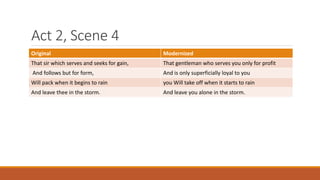
That sir which serves and seeks for gain, That gentleman who serves you only for profit
And follows but for form, And is only superficially loyal to you
Will pack when it begins to rain you Will take off when it starts to rain
And leave thee in the storm. And leave you alone in the storm.
Act 2, Scene 4
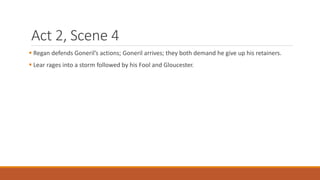
 Regan defends Goneril’s actions; Goneril arrives; they both demand he give up his retainers.
 Lear rages into a storm followed by his Fool and Gloucester.
Act 3, Scene 1
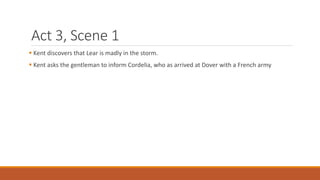
 Kent discovers that Lear is madly in the storm.
 Kent asks the gentleman to inform Cordelia, who as arrived at Dover with a French army
Act 3, Scene 1
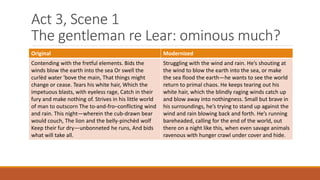
The gentleman re Lear: ominous much?
Original Modernized
Contending with the fretful elements. Bids the
winds blow the earth into the sea Or swell the
curlèd water 'bove the main, That things might
change or cease. Tears his white hair, Which the
impetuous blasts, with eyeless rage, Catch in their
fury and make nothing of. Strives in his little world
of man to outscorn The to-and-fro–conflicting wind
and rain. This night—wherein the cub-drawn bear
would couch, The lion and the belly-pinchèd wolf
Keep their fur dry—unbonneted he runs, And bids
what will take all.
Struggling with the wind and rain. He’s shouting at
the wind to blow the earth into the sea, or make
the sea flood the earth—he wants to see the world
return to primal chaos. He keeps tearing out his
white hair, which the blindly raging winds catch up
and blow away into nothingness. Small but brave in
his surroundings, he’s trying to stand up against the
wind and rain blowing back and forth. He’s running
bareheaded, calling for the end of the world, out
there on a night like this, when even savage animals
ravenous with hunger crawl under cover and hide.
Act 3, Scene 2
Lear raves
In a moment of lucidity he realizes he is not acting normally:
“My wits begin to turn”
Kent arrives, takes him to nearby shelter.
Fool predicts bad things to happen.
Act 3, Scene 3
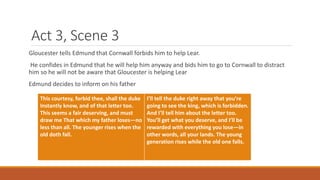
Gloucester tells Edmund that Cornwall forbids him to help Lear.
He confides in Edmund that he will help him anyway and bids him to go to Cornwall to distract
him so he will not be aware that Gloucester is helping Lear
Edmund decides to inform on his father
This courtesy, forbid thee, shall the duke
Instantly know, and of that letter too.
This seems a fair deserving, and must
draw me That which my father loses—no
less than all. The younger rises when the
old doth fall.
I’ll tell the duke right away that you’re
going to see the king, which is forbidden.
And I’ll tell him about the letter too.
You’ll get what you deserve, and I’ll be
rewarded with everything you lose—in
other words, all your lands. The young
generation rises while the old one falls.
Act 3, Scene 4
Lear, Kent, and the Fool approach the shelter (hovel).
Fool goes in, comes out afraid of Tom O’Bedlam (Edgar).
Lear and Edgar commiserate.
Gloucester appears, offers shelter, warns Kent that Regan and Goneril want to kill Lear.
Act 3, Scene 4
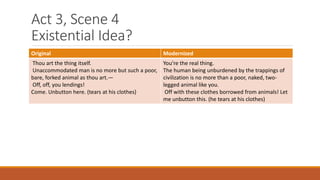
Existential Idea?
Original Modernized
Thou art the thing itself.
Unaccommodated man is no more but such a poor,
bare, forked animal as thou art.—
Off, off, you lendings!
Come. Unbutton here. (tears at his clothes)
You’re the real thing.
The human being unburdened by the trappings of
civilization is no more than a poor, naked, two-
legged animal like you.
Off with these clothes borrowed from animals! Let
me unbutton this. (he tears at his clothes)
Act 3, Scene 4
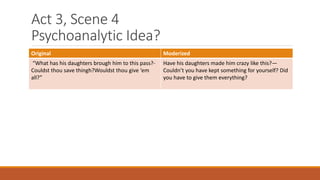
Psychoanalytic Idea?
Original Moderized
“What has his daughters brough him to this pass?-
Couldst thou save thingh?Wouldst thou give ‘em
all?”
Have his daughters made him crazy like this?—
Couldn’t you have kept something for yourself? Did
you have to give them everything?
Act 3, Scene 4
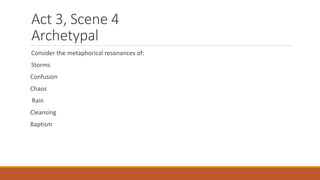
Archetypal
Consider the metaphorical resonances of:
Storms
Confusion
Chaos
Rain
Cleansing
Baptism
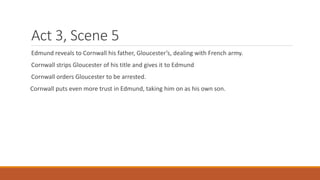
Act 3, Scene 5
Edmund reveals to Cornwall his father, Gloucester’s, dealing with French army.
Cornwall strips Gloucester of his title and gives it to Edmund
Cornwall orders Gloucester to be arrested.
Cornwall puts even more trust in Edmund, taking him on as his own son.
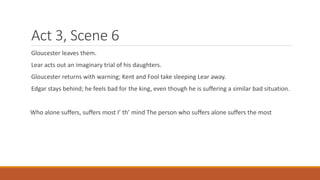
Act 3, Scene 6
Gloucester leaves them.
Lear acts out an imaginary trial of his daughters.
Gloucester returns with warning; Kent and Fool take sleeping Lear away.
Edgar stays behind; he feels bad for the king, even though he is suffering a similar bad situation.
Who alone suffers, suffers most I’ th’ mind The person who suffers alone suffers the most
Act 3, Scene 7
Gloucester, arrested, is sent to Regan/Cornwall.
Cornwalls blinds Gloucester.
A loyal servant attacks Cornwall. The servant is killed.
Other servants take Gloucester to wandering madman (Edgar) to escape.
Act 4, Scene 1
Gloucester is led to Edgar.
Edgar continues as Tom O’Bedlam, agrees to lead Gloucester to the cliffs of Dover.
Act 4, Scene 2
Oswald meets Goneril and Edmund.
Albany likes Cordelia’s invasion, dislikes Gloucester’s situation.
Goneril sends Edmund to Cornwall to gather an army; hints of plot against Albany.
Messenger arrives, tells of Cornwall’s death, Gloucester’s blinding.
Aside, Goneril is jealous of Regan about Edmund.
Aside, Albany vows revenge for Gloucester.
Act 4, Scene 3
In Dover, the gentleman tells Kent about Cordelia’s reaction about Lear’s situation.
Kent says that Lear is nearby but ashamed to see his daughter, Cordelia.
Act 4, Scene 3
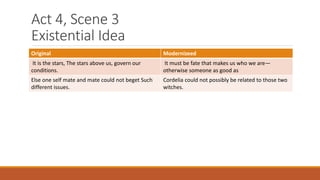
Existential Idea
Original Modernizeed
It is the stars, The stars above us, govern our
conditions.
It must be fate that makes us who we are—
otherwise someone as good as
Else one self mate and mate could not beget Such
different issues.
Cordelia could not possibly be related to those two
witches.
Act 4, Scene 4
Cordelia orders a search party for Lear.
Albany and Cornwall’s armies approach.
Act 4, Scene 5
Oswald tells Regan that Goneril convinced Albany to fight Cordelia.
Letter from Goneril to Edmund makes Regan jealous; says that it makes more sense for Edmund
to marry her now that her husband is dead
Regan gives Oswald her own token, tells him to kill Gloucester for reward.
Act 4, Scene 6
Edgar convinces Gloucester that he has jumped and survived the cliffs at Dover.
Gloucester accepts his affliction.
Lear appears, raving.
Search party takes Lear to Cordelia.
Oswald appears, attacks Gloucester, is killed by Edgar. While dying, gives letters to Edgar.
Letters (from Goneril for Edmund) propose Albany’s death and their marriage.
Act 4, Scene 7
Cordelia greets Lear.
Lear mistakes her for a spirit.
Kent and the gentleman talk about upcoming battle
Act 5, Scene 1
Regan corners Edmund about Goneril.
Edgar appears, in disguise, gives Albany letters; proposes a challenger after the battle to
prove/disprove letters.
Edmund needs Albany’s military leadership but hopes he dies after battle.
Albany has proposed mercy, Edmund will not allow it.
Act 5, Scene 2
Edgar goes to fight in battle.
Fleeing soldiers, and Edgar, pass by Gloucester, informing him of Cordelia and Lear’s defeat and
capture.
Gloucester and Edgar flee.
Act 5, Scene 3
Edmund sends Cordelia and Lear to prison (with orders to have them killed in an apparent
murder- suicide).
Albany, Regan, Goneril arrive.
Albany arrests Edmund and Goneril for treason. Regan is poisoned, leaves.
Act 5, Scene 3
Edgar appears in full armor, fights Edmund, who is wounded.
Albany shows letter, Goneril leaves
Dying Edmund confesses.
Edgar reveals himself, tells of his revelation to Gloucester, which shocked and killed him.
And then…
A report arrives that Goneril poisoned Regan and killed herself.
Soldier is sent to stop Lear and Cordelia’s deaths.
Lear carries in Cordelia’s body, mad again.
Edmund dies.
Finally
Albany will return kingdom to Lear.
Lear “sees” Cordelia breathing, then dies.
Albany orders funerals, Kent and Edgar to assist in ruling kingdom.
Kent predicts his own death.
Dramatic Conventions
Aside – Private words that a character in a play speaks to the audience or to another character
and that are not supposed to be overheard by others onstage. Stage directions usually tell when
a speech is an aside.
Soliloquy – A long speech in which a character who is usually alone onstage expresses his or her
private thoughts or feelings.
Monologue – A long formal speech made by a character in a play. A monologue may be directed
at another character or the audience.

shakespeare famous (King lear) tragedy crux

  • 1.
    King Lear Three daughters. Twoliars. A king grown old, but not wise. “POWER IS THE PRIZE, BUT POWER SHALL BE DAMNED BY LIES” “FATE LOVES A FOOL”
  • 2.
    King Lear • Tragedycentering on the decline and fall of a dysfunctional royal family.
  • 3.
    Parallel Plots King LearGloucester Aging father (patriarch) Aging father (patriarch) Imperious gullible Tyrannical Capricious Each sees his children through a distorted lens, turning against the child who truly loves him, unleashing in the others greed, lust, ambition.
  • 4.
    Hamartia  Aristotilian term The error of the tragic protagonist  Does not have to be a character flaw, could be a mistake or failure to take a particular action
  • 5.
    Theme  Love, betrayal,revenge, loyalty, and foolishness  All things are not as they appear  Greed and lust for power corrupt human beings and bring their downfall  Fate turns humans into playthings  Candor has a sharp edge  Advanced age and wisdom do not go hand in hand  Suffering can transform a contemptible human being into a good person
  • 6.
    Motifs  Blindness 2..minfand eyes..gloucesetr was blind .  Madness  Nature and order  Animals
  • 7.
    Cast of Characters Lear:King of Britain His daughters - Goneril - Regan - Cordelia Earl of Gloucester His sons - Edmund (the illegitimate) - Edgar Kent husband of daughtr Cornwall same
  • 8.
    Act 1, Scene1  Earl of Gloucester introduces Edmund (illegitimate son) to Earl of Kent, mentions legitimate son (Edgar).  King Lear intends to divide his power and kingdom among his three daughters: Goneril (married to Duke of Albany) Regan (married toDuke of Cornwall) Cordelia (intened to marry Duke of Burgundy) but he doesn’t marry her  demands they publicly profess their love for him  Cordelia refuses to put on a show; Goneril & Regan get kingdom divided btw them  Cordelia gets France, but is disinherited.  Earl of Kent banished upon arguing with Lear for his treatment of Cordelia.
  • 9.
    Act 1, Scene2 • Edmund (illegitimate) decides to steal Edgar’s (legitimate) inheritance. • Fools father (Gloucester) using a fake letter. • Fools Edgar as well.
  • 10.
    Act 1, Scene3 Goneril -- bad daughter -- decides to humble her father, orders Oswald to treat him badly.
  • 11.
    Act 1, Scene4 • The banished Earl of Kent arrives in disguise to serve Lear • The fool enters and mocks the king for banishing his good daughter and elevating his two bad ones
  • 12.
    Act 1, Scene4 Original Modernized Have more than thou showest, Have more than you show Speak less than thou knowest Speak less than you know Lend less than thou owest, Lend less than you owe. Ride more than thou goest, Ride more than you walk Learn more than thou trowest, Don’t believe everything you hear, Set less than thou throwest, Don’t bet everything on one throw of the dice, Leave thy drink and thy whore Leave behind your booze and your whore, And keep in a door, And stay indoors, And thou shalt have more And you’ll end up with more Than two tens to a score. Than two tens to a twenty
  • 13.
    Act 1, Scene4 Lear: Why no, boy. Nothing can be made out of nothing. Act 1, Sc 1 to Cordelia: “Nothing will come of nothing.” The word nothing and the idea of “nothingness” becomes a refrain throughout the play.  Latin: ex nihilo nihil fit  Existentialism - the idea that, although there is no controlling force in the universe (i.e. no God), individuals have the power to make their own destiny.  Nihilism - the rejection of all religious and moral principles, often in the belief that life is meaningless.
  • 14.
    Act 1, Scene4 The Fool mocks the King for halving his Kingdom. Original Modernized Thou madest thy daughters thy mothers. For when thou gavest them the rod, and pust’st down thine own breeches You made your daughters into your mothers by given them all your power. That’s when you gave them the spanking paddle and pulled your pants down. Thou hast pared thy wit o’ both sides and left nothing i’th’ middle When you gave away pieces of your kingdom, it’s as if you cut off pieces on both sides of your brain and left nothing in the middle. I am a fool. Thou art nothing I’m a fool and you’re nothing
  • 15.
    Act 1, Scene4 Goneril scolds Lear, demands halfing his men. Lear decides to visit other daughter. Albany protests Goneril’s behavior, is silenced.
  • 16.
    Act 1, Scene4  Goneril scolds Lear, demands halfing his men.  Lear realizes her ingratitude and begs the Gods to make her sterile “How sharper than a serpent’s tooth it is to have a thankless child.” Laments that maybe Cordelia’s flaw wasn’t all that bad “Oh most small fault, how ugly didst thou in Cordelia show” Lear decides to stay with his other daughter “Who I am sure is kind and comfortable…” Goneril sends Oswald with letter to Regan.
  • 17.
    Act 1, Scene5  Lear sends Kent with letter to Regan.  Fool again taunts his master, Lear.
  • 18.
    Act 2, Scene1  Edmund tricks Edgar into appearing -- in front of Gloucester -- to fight.  Gloucester vows to legitimize Edmund and capture/kill Edgar. Concerning Edgar: “I never got him”, meaning, “He cannot truly be my son” Concerning Edmund: “Loyal and natural boy…”, meaning: “My loyal and true son”
  • 19.
    Act 2, Scene1  Regan and Cornwall arrive.  Edmund tells Regan that Edgar was friends with Lear’s rowdy knights  Cornwall and Regan are pleased with Edmund and take him on as a servant/companion (similar to Kent and Lear) For you, Edmund, whose virtue and obedience doth this instant so much comment itself, you shall be ours.
  • 20.
    Act 2, Scene2  Outside Gloucester’s castle, Kent beats Oswald. • Kent shows some of the stubbornness and impetuousness that led King Lear to banish him in the first place  Tyrannical Cornwall punishes Kent; Gloucester protests weakly • “I’m sorry for thee friend, tis the duke’s pleasure, whose disposition, all the world well knows, will not be rubbed nor stopped.  Kent ponders a letter from Cordelia, who knows of her father’s situation and vows to find a way to fix things
  • 21.
    Act 2, Scene3  Edgar escapes capture by hiding in a tree.  While hiding he learns that he is to be killed.  Disguises himself as Tom O’Bedlam; a crazy, disgusting beggar  His new name gives him a new identity.  “As Edgar, I am nothing”
  • 22.
    Act 2, Scene4  Lear and the Fool arrive at Gloucester’s castle (seeking Regan), sees Kent in stocks.  Lear’s heart (literal) • “O, how this mother swells us toward my heart! Hysteria passio, down, thou climbing sorrow. • O me, my heart, my rising heart! But down. •O Regan, she hath tied shar-toothed unkindness, like a vulture, here. (indicates his heart)  Regan and Cornwall free Kent.
  • 23.
    Act 2, Scene4 The Fool’s speech… Foreshadowing? Original Modernized Winter’s not gone yet, if the wild geese fly that way. This story bodes more stormy weather. Fathers that wear rags Father who wear rags Do make their children blind. Make their children neglect them. But fathers that bear bags But fathers who are rich Shall see their children kind. Make their children kind. Fortune, that arrant whore Lady Luck is a fickle wore Ne’er turns the key to th’ poor. And never gives the poor a break. But for all this thou shalt have as many doors for thy daughters as thou canst tell in a year. But despite all this, your daughters will give you a lot of money-or do I mean pain? –in the coming year.
  • 24.
    Act 2, Scene4 Original Modernized That sir which serves and seeks for gain, That gentleman who serves you only for profit And follows but for form, And is only superficially loyal to you Will pack when it begins to rain you Will take off when it starts to rain And leave thee in the storm. And leave you alone in the storm.
  • 25.
    Act 2, Scene4  Regan defends Goneril’s actions; Goneril arrives; they both demand he give up his retainers.  Lear rages into a storm followed by his Fool and Gloucester.
  • 26.
    Act 3, Scene1  Kent discovers that Lear is madly in the storm.  Kent asks the gentleman to inform Cordelia, who as arrived at Dover with a French army
  • 27.
    Act 3, Scene1 The gentleman re Lear: ominous much? Original Modernized Contending with the fretful elements. Bids the winds blow the earth into the sea Or swell the curlèd water 'bove the main, That things might change or cease. Tears his white hair, Which the impetuous blasts, with eyeless rage, Catch in their fury and make nothing of. Strives in his little world of man to outscorn The to-and-fro–conflicting wind and rain. This night—wherein the cub-drawn bear would couch, The lion and the belly-pinchèd wolf Keep their fur dry—unbonneted he runs, And bids what will take all. Struggling with the wind and rain. He’s shouting at the wind to blow the earth into the sea, or make the sea flood the earth—he wants to see the world return to primal chaos. He keeps tearing out his white hair, which the blindly raging winds catch up and blow away into nothingness. Small but brave in his surroundings, he’s trying to stand up against the wind and rain blowing back and forth. He’s running bareheaded, calling for the end of the world, out there on a night like this, when even savage animals ravenous with hunger crawl under cover and hide.
  • 28.
    Act 3, Scene2 Lear raves In a moment of lucidity he realizes he is not acting normally: “My wits begin to turn” Kent arrives, takes him to nearby shelter. Fool predicts bad things to happen.
  • 29.
    Act 3, Scene3 Gloucester tells Edmund that Cornwall forbids him to help Lear. He confides in Edmund that he will help him anyway and bids him to go to Cornwall to distract him so he will not be aware that Gloucester is helping Lear Edmund decides to inform on his father This courtesy, forbid thee, shall the duke Instantly know, and of that letter too. This seems a fair deserving, and must draw me That which my father loses—no less than all. The younger rises when the old doth fall. I’ll tell the duke right away that you’re going to see the king, which is forbidden. And I’ll tell him about the letter too. You’ll get what you deserve, and I’ll be rewarded with everything you lose—in other words, all your lands. The young generation rises while the old one falls.
  • 30.
    Act 3, Scene4 Lear, Kent, and the Fool approach the shelter (hovel). Fool goes in, comes out afraid of Tom O’Bedlam (Edgar). Lear and Edgar commiserate. Gloucester appears, offers shelter, warns Kent that Regan and Goneril want to kill Lear.
  • 31.
    Act 3, Scene4 Existential Idea? Original Modernized Thou art the thing itself. Unaccommodated man is no more but such a poor, bare, forked animal as thou art.— Off, off, you lendings! Come. Unbutton here. (tears at his clothes) You’re the real thing. The human being unburdened by the trappings of civilization is no more than a poor, naked, two- legged animal like you. Off with these clothes borrowed from animals! Let me unbutton this. (he tears at his clothes)
  • 32.
    Act 3, Scene4 Psychoanalytic Idea? Original Moderized “What has his daughters brough him to this pass?- Couldst thou save thingh?Wouldst thou give ‘em all?” Have his daughters made him crazy like this?— Couldn’t you have kept something for yourself? Did you have to give them everything?
  • 33.
    Act 3, Scene4 Archetypal Consider the metaphorical resonances of: Storms Confusion Chaos Rain Cleansing Baptism
  • 34.
    Act 3, Scene5 Edmund reveals to Cornwall his father, Gloucester’s, dealing with French army. Cornwall strips Gloucester of his title and gives it to Edmund Cornwall orders Gloucester to be arrested. Cornwall puts even more trust in Edmund, taking him on as his own son.
  • 35.
    Act 3, Scene6 Gloucester leaves them. Lear acts out an imaginary trial of his daughters. Gloucester returns with warning; Kent and Fool take sleeping Lear away. Edgar stays behind; he feels bad for the king, even though he is suffering a similar bad situation. Who alone suffers, suffers most I’ th’ mind The person who suffers alone suffers the most
  • 36.
    Act 3, Scene7 Gloucester, arrested, is sent to Regan/Cornwall. Cornwalls blinds Gloucester. A loyal servant attacks Cornwall. The servant is killed. Other servants take Gloucester to wandering madman (Edgar) to escape.
  • 37.
    Act 4, Scene1 Gloucester is led to Edgar. Edgar continues as Tom O’Bedlam, agrees to lead Gloucester to the cliffs of Dover.
  • 38.
    Act 4, Scene2 Oswald meets Goneril and Edmund. Albany likes Cordelia’s invasion, dislikes Gloucester’s situation. Goneril sends Edmund to Cornwall to gather an army; hints of plot against Albany. Messenger arrives, tells of Cornwall’s death, Gloucester’s blinding. Aside, Goneril is jealous of Regan about Edmund. Aside, Albany vows revenge for Gloucester.
  • 39.
    Act 4, Scene3 In Dover, the gentleman tells Kent about Cordelia’s reaction about Lear’s situation. Kent says that Lear is nearby but ashamed to see his daughter, Cordelia.
  • 40.
    Act 4, Scene3 Existential Idea Original Modernizeed It is the stars, The stars above us, govern our conditions. It must be fate that makes us who we are— otherwise someone as good as Else one self mate and mate could not beget Such different issues. Cordelia could not possibly be related to those two witches.
  • 41.
    Act 4, Scene4 Cordelia orders a search party for Lear. Albany and Cornwall’s armies approach.
  • 42.
    Act 4, Scene5 Oswald tells Regan that Goneril convinced Albany to fight Cordelia. Letter from Goneril to Edmund makes Regan jealous; says that it makes more sense for Edmund to marry her now that her husband is dead Regan gives Oswald her own token, tells him to kill Gloucester for reward.
  • 43.
    Act 4, Scene6 Edgar convinces Gloucester that he has jumped and survived the cliffs at Dover. Gloucester accepts his affliction. Lear appears, raving. Search party takes Lear to Cordelia. Oswald appears, attacks Gloucester, is killed by Edgar. While dying, gives letters to Edgar. Letters (from Goneril for Edmund) propose Albany’s death and their marriage.
  • 44.
    Act 4, Scene7 Cordelia greets Lear. Lear mistakes her for a spirit. Kent and the gentleman talk about upcoming battle
  • 45.
    Act 5, Scene1 Regan corners Edmund about Goneril. Edgar appears, in disguise, gives Albany letters; proposes a challenger after the battle to prove/disprove letters. Edmund needs Albany’s military leadership but hopes he dies after battle. Albany has proposed mercy, Edmund will not allow it.
  • 46.
    Act 5, Scene2 Edgar goes to fight in battle. Fleeing soldiers, and Edgar, pass by Gloucester, informing him of Cordelia and Lear’s defeat and capture. Gloucester and Edgar flee.
  • 47.
    Act 5, Scene3 Edmund sends Cordelia and Lear to prison (with orders to have them killed in an apparent murder- suicide). Albany, Regan, Goneril arrive. Albany arrests Edmund and Goneril for treason. Regan is poisoned, leaves.
  • 48.
    Act 5, Scene3 Edgar appears in full armor, fights Edmund, who is wounded. Albany shows letter, Goneril leaves Dying Edmund confesses. Edgar reveals himself, tells of his revelation to Gloucester, which shocked and killed him.
  • 49.
    And then… A reportarrives that Goneril poisoned Regan and killed herself. Soldier is sent to stop Lear and Cordelia’s deaths. Lear carries in Cordelia’s body, mad again. Edmund dies.
  • 50.
    Finally Albany will returnkingdom to Lear. Lear “sees” Cordelia breathing, then dies. Albany orders funerals, Kent and Edgar to assist in ruling kingdom. Kent predicts his own death.
  • 51.
    Dramatic Conventions Aside –Private words that a character in a play speaks to the audience or to another character and that are not supposed to be overheard by others onstage. Stage directions usually tell when a speech is an aside. Soliloquy – A long speech in which a character who is usually alone onstage expresses his or her private thoughts or feelings. Monologue – A long formal speech made by a character in a play. A monologue may be directed at another character or the audience.