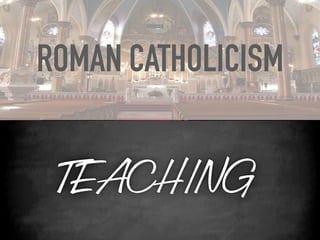
ROMAN CATHOLICISM
Comparative Religion
ROMAN CATHOLICISM
➤ part of the Christian church
➤ acknowledges the Pope as
its head
➤ largest Christian church
➤ South America
➤ Southern Europe
ROMAN CATHOLICISM
➤ differs from Protestantism
➤ importance it grants to
tradition, ritual, and
authority of the Pope
➤ doctrines of papal
infallibility and of the
Eucharist
➤ celibate male priesthood
➤ emphasis on confession
➤ veneration of the Virgin
Mary and other saints
ROMAN CATHOLICISM
➤ practice arises from
scholastic theology and
response to reformation
➤ became less rigid after the
Second Vatican Council
* Second Vatican Council: addressed relations
between the Roman Catholic Church and the
modern world.
ROMAN CATHOLICISM
AREAS OF INFLUENCE
➤ Cathedral Schools
in Middle Ages
➤ Universities
CATHEDRAL SCHOOLS IN MIDDLE AGES
➤ set up by the parish clergy
➤ prepared the sons of nobles
➤ trained government workers, lawyers, and teachers
➤ seven subjects were taught
➤ students paid a fee
➤ teachers usually rent a hall
➤ books were expensive
➤ students memorised their work
UNIVERSITIES
➤ Students and teachers formed unions to create universities
➤ Universities were teachers and students devoted to learning
➤ Universities were widespread in Europe
➤ A church official headed each university
➤ Students were punished if mass was missed, peace was
disturbed, or gambling to place
EDUCATION
STRATEGY
ROMAN CATHOLICISM
TEACHINGS
1. Purgatory
2. The Seven Deadly
Sins
3. Papacy and Hierarchy
in the Catholic
Church
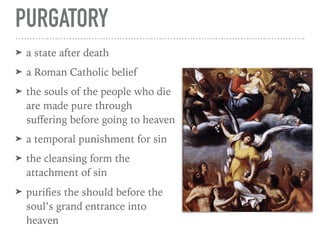
PURGATORY
➤ a state after death
➤ a Roman Catholic belief
➤ the souls of the people who die
are made pure through
suffering before going to heaven
➤ a temporal punishment for sin
➤ the cleansing form the
attachment of sin
➤ purifies the should before the
soul’s grand entrance into
heaven
PURGATORY
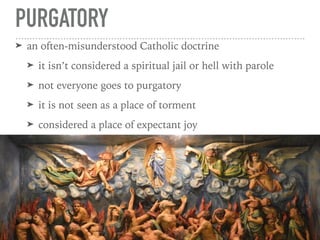
➤ an often-misunderstood Catholic doctrine
➤ it isn’t considered a spiritual jail or hell with parole
➤ not everyone goes to purgatory
➤ it is not seen as a place of torment
➤ considered a place of expectant joy
THE SEVEN
DEADLY SINS
Teachings
PAPACY AND HIERARCHY
➤ the pope is the bishop of
Rome
➤ Papacy came from the word
“pappas”
➤ Popes are considered the
“father” of the early church
➤ Beliefs
➤ The bishop of Rome is the
successor of St. Peter
➤ Jesus gave St. Peter
authority over the church
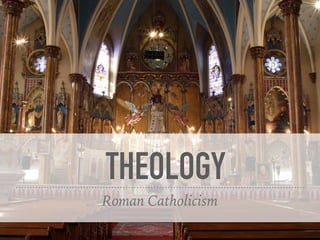
THEOLOGY
Roman Catholicism
EVANGELICAL CATHOLICS
➤ Believe in the trinity
➤ Believe in the full deity and full humanity of Jesus Christ
➤ Believe in the virgin birth
➤ Believe in the inspiration of the Scripture
➤ Believe in Christ’s atonement and his bodily resurrection
➤ Believe that God is angry with people
➤ Believe that we would be brought back to life and be judged
➤ Believe that Jesus came to earth to solve a problem by dying
on the cross and resurrecting two days after.
NON-EVANGELICAL
CATHOLICS
Those who don’t believe in God.
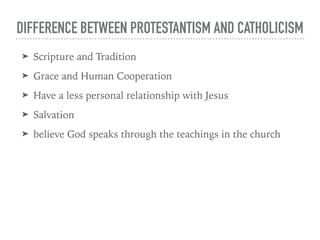
DIFFERENCE BETWEEN PROTESTANTISM AND CATHOLICISM
➤ Scripture and Tradition
➤ Grace and Human Cooperation
➤ Have a less personal relationship with Jesus
➤ Salvation
➤ believe God speaks through the teachings in the church
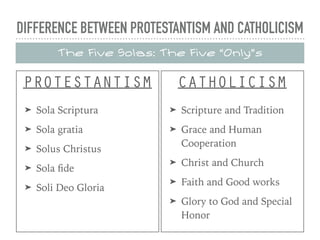
DIFFERENCE BETWEEN PROTESTANTISM AND CATHOLICISM
CATHOLICISMPROTESTANTISM
➤ Scripture and Tradition
➤ Grace and Human
Cooperation
➤ Christ and Church
➤ Faith and Good works
➤ Glory to God and Special
Honor
The Five Solas: The Five “Only”s
➤ Sola Scriptura
➤ Sola gratia
➤ Solus Christus
➤ Sola fide
➤ Soli Deo Gloria
DIFFERENCE BETWEEN PROTESTANTISM AND CATHOLICISM
AREA ISSUE PROTESTANT POSITION CATHOLIC POSITION
SCRIPTURE
SUFFICIENCY Sola Scriptura
Tradition of equal
authority with Scripture
APOCRYPHA Rejected Accepted
ANTHROPOLOGY
ORIGINAL SIN
Total depravity and
guilt inherited from
Adam
Corruption and
predisposition to evil
inherited from Adam
HUMAN WILL In bondage to sin Free to do spiritual good
ECCLESIOLOGY
CHURCH AND
SALVATION
Distinction between
visible and invisible
church
Outside the (visible)
church, there is no
salvation
SACRAMENTS
Means of grace
only as received by
faith
Conveying justifying
and sanctifying grace
ex opera operator
PRIESTHOOD All believers are priests
Mediator between God
and man
TRANSUBSTATIOATION Rejected Affirmed
DIFFERENCE BETWEEN PROTESTANTISM AND CATHOLICISM
AREA ISSUE
PROTESTANT
POSITIOIN
CATHOLIC POSITION
S
O
T
E
R
I
O
L
O
G
Y
PREDESTINATION
Rooted in God’s
decrees
Rooted in God’s
foreknowledge
ATONEMENT
Christ’s death a
substitutionary
penal sacrifice
Christ’s death the merit for
blessings of salvation —
blessings passed on to
sinners through sacraments
GRACE OF GOD
Common grace
given to all;
saving grace given
to elect
Prevention grace, given at
baptism, enabling one to
believe; efficacious grace
cooperating with the will
enabling one to obey
DIFFERENCE BETWEEN PROTESTANTISM AND CATHOLICISM
AREA ISSUE PROTESTANT POSITION CATHOLIC POSITION
S
O
T
E
R
I
O
L
O
G
Y
GOOD WORKS
Produced by the
grace of God,
unworthy of merit
of any kind
Meritorious
REGENERATION
Work of the Holy
Spirit in the elect
Grace infused at
baptism
JUSTIFICATION
Objective, final,
judicial act of God
Forgiveness of sins
received at baptism,
may be lost by
committing mortal
sin, regained by
penance
ESCHATOLOGY PURGATORY Denied Affirmed
PHILOSOPHY
Roman Catholicism
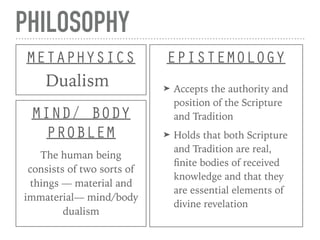
PHILOSOPHY
METAPHYSICS
Dualism
EPISTEMOLOGY
➤ Accepts the authority and
position of the Scripture
and Tradition
➤ Holds that both Scripture
and Tradition are real,
finite bodies of received
knowledge and that they
are essential elements of
divine revelation
MIND/ BODY
PROBLEM
The human being
consists of two sorts of
things — material and
immaterial— mind/body
dualism
ETHICS
Roman Catholicism
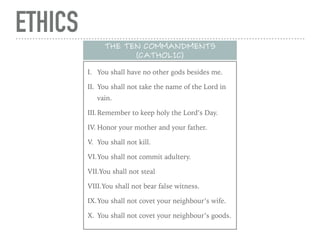
ETHICS
I. You shall have no other gods besides me.
II. You shall not take the name of the Lord in
vain.
III.Remember to keep holy the Lord’s Day.
IV. Honor your mother and your father.
V. You shall not kill.
VI.You shall not commit adultery.
VII.You shall not steal
VIII.You shall not bear false witness.
IX.You shall not covet your neighbour’s wife.
X. You shall not covet your neighbour’s goods.
THE TEN COMMANDMENTS
(CATHOLIC)
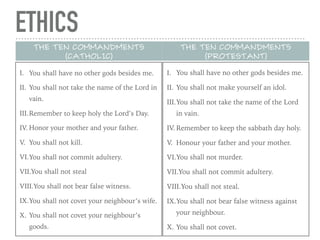
ETHICS
THE TEN COMMANDMENTS
(CATHOLIC)
I. You shall have no other gods besides me.
II. You shall not take the name of the Lord in
vain.
III.Remember to keep holy the Lord’s Day.
IV. Honor your mother and your father.
V. You shall not kill.
VI.You shall not commit adultery.
VII.You shall not steal
VIII.You shall not bear false witness.
IX.You shall not covet your neighbour’s wife.
X. You shall not covet your neighbour’s
goods.
THE TEN COMMANDMENTS
(PROTESTANT)
I. You shall have no other gods besides me.
II. You shall not make yourself an idol.
III.You shall not take the name of the Lord
in vain.
IV. Remember to keep the sabbath day holy.
V. Honour your father and your mother.
VI.You shall not murder.
VII.You shall not commit adultery.
VIII.You shall not steal.
IX.You shall not bear false witness against
your neighbour.
X. You shall not covet.
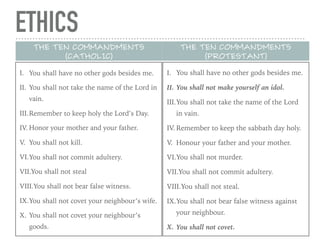
ETHICS
THE TEN COMMANDMENTS
(CATHOLIC)
I. You shall have no other gods besides me.
II. You shall not take the name of the Lord in
vain.
III.Remember to keep holy the Lord’s Day.
IV. Honor your mother and your father.
V. You shall not kill.
VI.You shall not commit adultery.
VII.You shall not steal
VIII.You shall not bear false witness.
IX.You shall not covet your neighbour’s wife.
X. You shall not covet your neighbour’s
goods.
THE TEN COMMANDMENTS
(PROTESTANT)
I. You shall have no other gods besides me.
II. You shall not make yourself an idol.
III.You shall not take the name of the Lord
in vain.
IV. Remember to keep the sabbath day holy.
V. Honour your father and your mother.
VI.You shall not murder.
VII.You shall not commit adultery.
VIII.You shall not steal.
IX.You shall not bear false witness against
your neighbour.
X. You shall not covet.
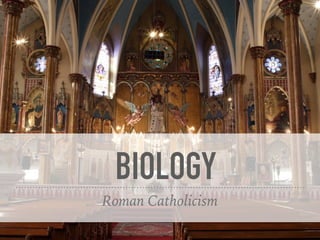
BIOLOGY
Roman Catholicism
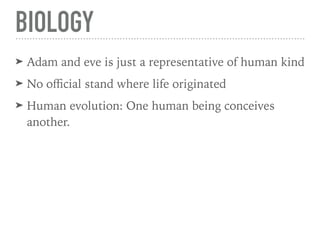
➤ Adam and eve is just a representative of human kind
➤ No official stand where life originated
➤ Human evolution: One human being conceives
another.
BIOLOGY
SOCIOLOGY
Roman Catholicism
SOCIOLOGY: HIERARCHY
What is it?
The hierarchy of the Catholic church shows the power of important people in
the Catholic community.
POPE
➤ leader of the Catholic Church
➤ referred to as the Vicar of Christ or the
Supreme Pontiff
➤ located in the Vatican, Rome
CARDINAL
➤ 178 cardinals worldwide
➤ a group of men who advice the Pope
➤ appoints a new pope
ARCHBISHOP BISHOP
➤ a bishop who is divided into
diocese, which is divided into
parishes.
➤ teacher of the church doctrine
➤ priest of sacred worship
➤ minister of the church government
SOCIOLOGY: HIERARCHY
PRIEST
➤ ordained minister
➤ administers most of the sacraments
➤ may take part in a religious order or
serve to a congregation
DEACON
➤ a seminarist studying for priesthood
➤ a permanent deacon may get
married and assist the priest in
performing the sacraments
CATHOLICS
➤ don’t hold a position in the church
➤ followers of Christ who believe in the
Catholic beliefs
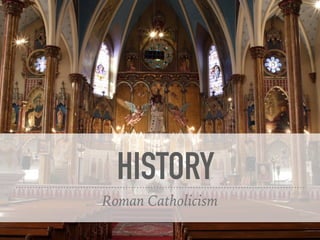
HISTORY
Roman Catholicism
HISTORY
The Roman Catholic Church started in
Matthew 16:18.
OBJECTIVE AND HONEST VIEW:
The foundation of the Roman Catholic
Church is none other than the pagan
mystery religion of ancient Babylon.
HISTORY
DURING THE PERSECUTION
➤ gradual departure from the New Testament Doctrine
➤ church government
➤ worship
➤ practice
➤ local churches stopped being autonomous
BEST DEFINITION:
SPRINKLED PAGANISM
HISTORY
BELIEFS AND PRACTICES OF CHRISTIANITY THAT
CONFLICTED THE WORLDVIEW OF THE PAGAN ROME:
➤ Christians only worship one God.
➤ Christians are believed to be engaged in some sort
of Cannibalism in their Eucharistic Rite.
➤ Public spectacles of bloody games were condemned
by Christians.
➤ Christians refused to serve in the army and
protested against war.
➤ Christians showed disloyalty to the state.
➤ Constantine established himself as the head of the church.
➤ The first actual Pope in Rome is probably Leo I, but some
claim that it was Gregory I.
➤ This system was eventually introduced the “Dark Ages.”
➤ Biblical Christianity became illegal.
HISTORY
SALVATION
Roman Catholicism
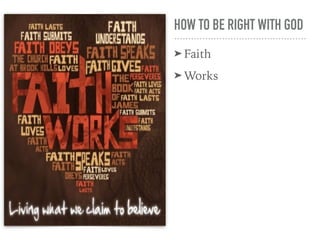
HOW TO BE RIGHT WITH GOD
➤ Faith
➤ Works
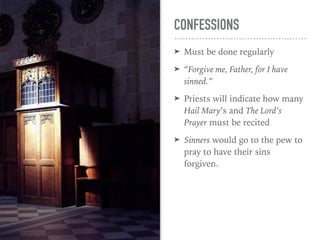
CONFESSIONS
➤ Must be done regularly
➤ “Forgive me, Father, for I have
sinned.”
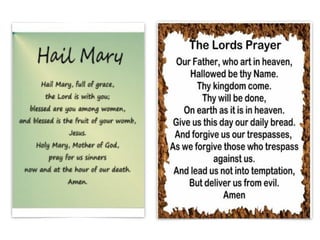
➤ Priests will indicate how many
Hail Mary’s and The Lord’s
Prayer must be recited
➤ Sinners would go to the pew to
pray to have their sins
forgiven.
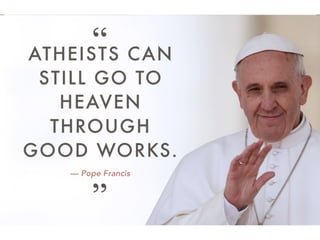
WORKS
➤ Good works
➤ Indulgence
Roman Catholicism in a Nutshell

Roman Catholicism in a Nutshell

  • 1.
  • 2.
    ROMAN CATHOLICISM ➤ partof the Christian church ➤ acknowledges the Pope as its head ➤ largest Christian church ➤ South America ➤ Southern Europe
  • 3.
    ROMAN CATHOLICISM ➤ differsfrom Protestantism ➤ importance it grants to tradition, ritual, and authority of the Pope ➤ doctrines of papal infallibility and of the Eucharist ➤ celibate male priesthood ➤ emphasis on confession ➤ veneration of the Virgin Mary and other saints
  • 4.
    ROMAN CATHOLICISM ➤ practicearises from scholastic theology and response to reformation ➤ became less rigid after the Second Vatican Council * Second Vatican Council: addressed relations between the Roman Catholic Church and the modern world.
  • 5.
  • 6.
    AREAS OF INFLUENCE ➤Cathedral Schools in Middle Ages ➤ Universities
  • 7.
    CATHEDRAL SCHOOLS INMIDDLE AGES ➤ set up by the parish clergy ➤ prepared the sons of nobles ➤ trained government workers, lawyers, and teachers ➤ seven subjects were taught ➤ students paid a fee ➤ teachers usually rent a hall ➤ books were expensive ➤ students memorised their work
  • 8.
    UNIVERSITIES ➤ Students andteachers formed unions to create universities ➤ Universities were teachers and students devoted to learning ➤ Universities were widespread in Europe ➤ A church official headed each university ➤ Students were punished if mass was missed, peace was disturbed, or gambling to place
  • 9.
  • 10.
  • 11.
    TEACHINGS 1. Purgatory 2. TheSeven Deadly Sins 3. Papacy and Hierarchy in the Catholic Church
  • 12.
    PURGATORY ➤ a stateafter death ➤ a Roman Catholic belief ➤ the souls of the people who die are made pure through suffering before going to heaven ➤ a temporal punishment for sin ➤ the cleansing form the attachment of sin ➤ purifies the should before the soul’s grand entrance into heaven
  • 13.
    PURGATORY ➤ an often-misunderstoodCatholic doctrine ➤ it isn’t considered a spiritual jail or hell with parole ➤ not everyone goes to purgatory ➤ it is not seen as a place of torment ➤ considered a place of expectant joy
  • 14.
  • 15.
    PAPACY AND HIERARCHY ➤the pope is the bishop of Rome ➤ Papacy came from the word “pappas” ➤ Popes are considered the “father” of the early church ➤ Beliefs ➤ The bishop of Rome is the successor of St. Peter ➤ Jesus gave St. Peter authority over the church
  • 16.
  • 17.
    EVANGELICAL CATHOLICS ➤ Believein the trinity ➤ Believe in the full deity and full humanity of Jesus Christ ➤ Believe in the virgin birth ➤ Believe in the inspiration of the Scripture ➤ Believe in Christ’s atonement and his bodily resurrection ➤ Believe that God is angry with people ➤ Believe that we would be brought back to life and be judged ➤ Believe that Jesus came to earth to solve a problem by dying on the cross and resurrecting two days after.
  • 18.
  • 19.
    DIFFERENCE BETWEEN PROTESTANTISMAND CATHOLICISM ➤ Scripture and Tradition ➤ Grace and Human Cooperation ➤ Have a less personal relationship with Jesus ➤ Salvation ➤ believe God speaks through the teachings in the church
  • 20.
    DIFFERENCE BETWEEN PROTESTANTISMAND CATHOLICISM CATHOLICISMPROTESTANTISM ➤ Scripture and Tradition ➤ Grace and Human Cooperation ➤ Christ and Church ➤ Faith and Good works ➤ Glory to God and Special Honor The Five Solas: The Five “Only”s ➤ Sola Scriptura ➤ Sola gratia ➤ Solus Christus ➤ Sola fide ➤ Soli Deo Gloria
  • 21.
    DIFFERENCE BETWEEN PROTESTANTISMAND CATHOLICISM AREA ISSUE PROTESTANT POSITION CATHOLIC POSITION SCRIPTURE SUFFICIENCY Sola Scriptura Tradition of equal authority with Scripture APOCRYPHA Rejected Accepted ANTHROPOLOGY ORIGINAL SIN Total depravity and guilt inherited from Adam Corruption and predisposition to evil inherited from Adam HUMAN WILL In bondage to sin Free to do spiritual good ECCLESIOLOGY CHURCH AND SALVATION Distinction between visible and invisible church Outside the (visible) church, there is no salvation SACRAMENTS Means of grace only as received by faith Conveying justifying and sanctifying grace ex opera operator PRIESTHOOD All believers are priests Mediator between God and man TRANSUBSTATIOATION Rejected Affirmed
  • 22.
    DIFFERENCE BETWEEN PROTESTANTISMAND CATHOLICISM AREA ISSUE PROTESTANT POSITIOIN CATHOLIC POSITION S O T E R I O L O G Y PREDESTINATION Rooted in God’s decrees Rooted in God’s foreknowledge ATONEMENT Christ’s death a substitutionary penal sacrifice Christ’s death the merit for blessings of salvation — blessings passed on to sinners through sacraments GRACE OF GOD Common grace given to all; saving grace given to elect Prevention grace, given at baptism, enabling one to believe; efficacious grace cooperating with the will enabling one to obey
  • 23.
    DIFFERENCE BETWEEN PROTESTANTISMAND CATHOLICISM AREA ISSUE PROTESTANT POSITION CATHOLIC POSITION S O T E R I O L O G Y GOOD WORKS Produced by the grace of God, unworthy of merit of any kind Meritorious REGENERATION Work of the Holy Spirit in the elect Grace infused at baptism JUSTIFICATION Objective, final, judicial act of God Forgiveness of sins received at baptism, may be lost by committing mortal sin, regained by penance ESCHATOLOGY PURGATORY Denied Affirmed
  • 24.
  • 25.
    PHILOSOPHY METAPHYSICS Dualism EPISTEMOLOGY ➤ Accepts theauthority and position of the Scripture and Tradition ➤ Holds that both Scripture and Tradition are real, finite bodies of received knowledge and that they are essential elements of divine revelation MIND/ BODY PROBLEM The human being consists of two sorts of things — material and immaterial— mind/body dualism
  • 26.
  • 27.
    ETHICS I. You shallhave no other gods besides me. II. You shall not take the name of the Lord in vain. III.Remember to keep holy the Lord’s Day. IV. Honor your mother and your father. V. You shall not kill. VI.You shall not commit adultery. VII.You shall not steal VIII.You shall not bear false witness. IX.You shall not covet your neighbour’s wife. X. You shall not covet your neighbour’s goods. THE TEN COMMANDMENTS (CATHOLIC)
  • 28.
    ETHICS THE TEN COMMANDMENTS (CATHOLIC) I.You shall have no other gods besides me. II. You shall not take the name of the Lord in vain. III.Remember to keep holy the Lord’s Day. IV. Honor your mother and your father. V. You shall not kill. VI.You shall not commit adultery. VII.You shall not steal VIII.You shall not bear false witness. IX.You shall not covet your neighbour’s wife. X. You shall not covet your neighbour’s goods. THE TEN COMMANDMENTS (PROTESTANT) I. You shall have no other gods besides me. II. You shall not make yourself an idol. III.You shall not take the name of the Lord in vain. IV. Remember to keep the sabbath day holy. V. Honour your father and your mother. VI.You shall not murder. VII.You shall not commit adultery. VIII.You shall not steal. IX.You shall not bear false witness against your neighbour. X. You shall not covet.
  • 29.
    ETHICS THE TEN COMMANDMENTS (CATHOLIC) I.You shall have no other gods besides me. II. You shall not take the name of the Lord in vain. III.Remember to keep holy the Lord’s Day. IV. Honor your mother and your father. V. You shall not kill. VI.You shall not commit adultery. VII.You shall not steal VIII.You shall not bear false witness. IX.You shall not covet your neighbour’s wife. X. You shall not covet your neighbour’s goods. THE TEN COMMANDMENTS (PROTESTANT) I. You shall have no other gods besides me. II. You shall not make yourself an idol. III.You shall not take the name of the Lord in vain. IV. Remember to keep the sabbath day holy. V. Honour your father and your mother. VI.You shall not murder. VII.You shall not commit adultery. VIII.You shall not steal. IX.You shall not bear false witness against your neighbour. X. You shall not covet.
  • 30.
  • 31.
    ➤ Adam andeve is just a representative of human kind ➤ No official stand where life originated ➤ Human evolution: One human being conceives another. BIOLOGY
  • 32.
  • 33.
    SOCIOLOGY: HIERARCHY What isit? The hierarchy of the Catholic church shows the power of important people in the Catholic community. POPE ➤ leader of the Catholic Church ➤ referred to as the Vicar of Christ or the Supreme Pontiff ➤ located in the Vatican, Rome CARDINAL ➤ 178 cardinals worldwide ➤ a group of men who advice the Pope ➤ appoints a new pope ARCHBISHOP BISHOP ➤ a bishop who is divided into diocese, which is divided into parishes. ➤ teacher of the church doctrine ➤ priest of sacred worship ➤ minister of the church government
  • 34.
    SOCIOLOGY: HIERARCHY PRIEST ➤ ordainedminister ➤ administers most of the sacraments ➤ may take part in a religious order or serve to a congregation DEACON ➤ a seminarist studying for priesthood ➤ a permanent deacon may get married and assist the priest in performing the sacraments CATHOLICS ➤ don’t hold a position in the church ➤ followers of Christ who believe in the Catholic beliefs
  • 35.
  • 36.
    HISTORY The Roman CatholicChurch started in Matthew 16:18. OBJECTIVE AND HONEST VIEW: The foundation of the Roman Catholic Church is none other than the pagan mystery religion of ancient Babylon.
  • 37.
    HISTORY DURING THE PERSECUTION ➤gradual departure from the New Testament Doctrine ➤ church government ➤ worship ➤ practice ➤ local churches stopped being autonomous BEST DEFINITION: SPRINKLED PAGANISM
  • 38.
    HISTORY BELIEFS AND PRACTICESOF CHRISTIANITY THAT CONFLICTED THE WORLDVIEW OF THE PAGAN ROME: ➤ Christians only worship one God. ➤ Christians are believed to be engaged in some sort of Cannibalism in their Eucharistic Rite. ➤ Public spectacles of bloody games were condemned by Christians. ➤ Christians refused to serve in the army and protested against war. ➤ Christians showed disloyalty to the state.
  • 39.
    ➤ Constantine establishedhimself as the head of the church. ➤ The first actual Pope in Rome is probably Leo I, but some claim that it was Gregory I. ➤ This system was eventually introduced the “Dark Ages.” ➤ Biblical Christianity became illegal. HISTORY
  • 40.
  • 41.
    HOW TO BERIGHT WITH GOD ➤ Faith ➤ Works
  • 43.
    CONFESSIONS ➤ Must bedone regularly ➤ “Forgive me, Father, for I have sinned.” ➤ Priests will indicate how many Hail Mary’s and The Lord’s Prayer must be recited ➤ Sinners would go to the pew to pray to have their sins forgiven.
  • 45.