
The Practice
of Confession
The Practice of Confession
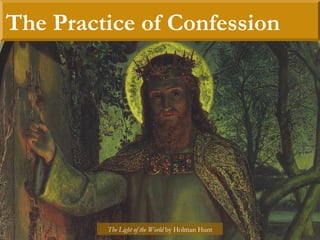
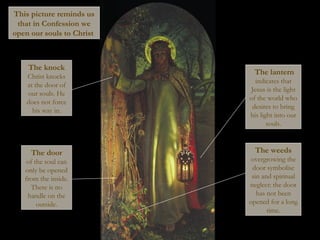
The Light of the World by Holman Hunt
The Practice of Confession
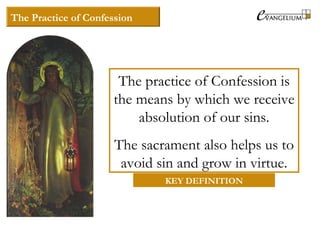
The practice of Confession is
the means by which we receive
absolution of our sins.
The sacrament also helps us to
avoid sin and grow in virtue.
KEY DEFINITION
The lantern
indicates that
Jesus is the light
of the world who
desires to bring
his light into our
souls.
The door
of the soul can
only be opened
from the inside.
There is no
handle on the
outside.
The weeds
overgrowing the
door symbolise
sin and spiritual
neglect: the door
has not been
opened for a long
time.
The knock
Christ knocks
at the door of
our souls. He
does not force
his way in.
This picture reminds us
that in Confession we
open our souls to Christ
When should we go to Confession?
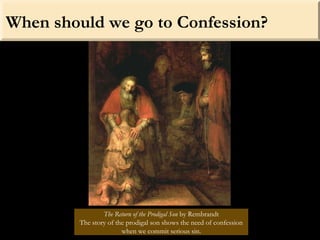
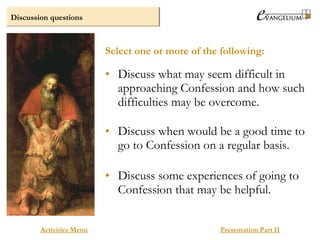
The Return of the Prodigal Son by Rembrandt
The story of the prodigal son shows the need of confession
when we commit serious sin.
When should we go to Confession?
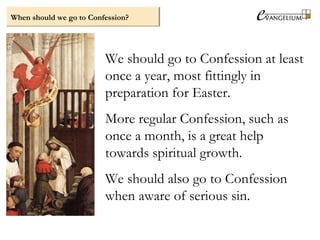
We should go to Confession at least
once a year, most fittingly in
preparation for Easter.
More regular Confession, such as
once a month, is a great help
towards spiritual growth.
We should also go to Confession
when aware of serious sin.
When should we go to Confession?
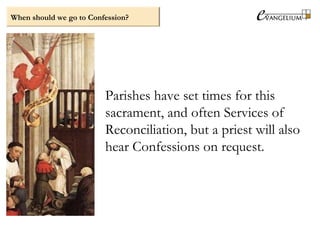
Parishes have set times for this
sacrament, and often Services of
Reconciliation, but a priest will also
hear Confessions on request.
Difficulties about Confession
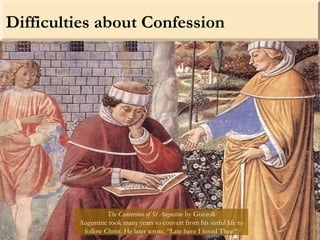
The Conversion of St Augustine by Gozzoli
Augustine took many years to convert from his sinful life to
follow Christ. He later wrote, “Late have I loved Thee.”
 Fear
Both God and the priest welcome
sinners with joy.
The priest is bound by a seal of
absolute secrecy. He will not be
shocked by sins, and, as a sinner,
goes to Confession himself.
Difficulties about Confession
 No sense of sin
Even the saints practised
Confession regularly.
A properly formed and examined
conscience will give a true
understanding of our sins (c.f. 1 Jn 1:8).
Difficulties about Confession
 Unfamiliar
The basic formula is very simple
and is good to learn.
The priest will also guide those
out of practice.
Difficulties about Confession
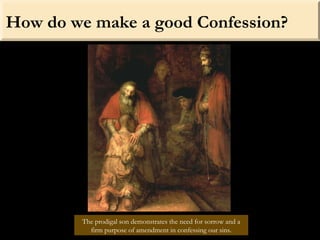
How do we make a good Confession?
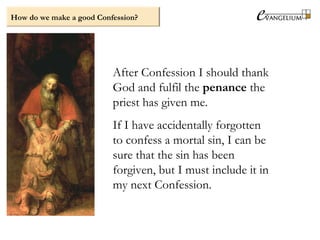
The prodigal son demonstrates the need for sorrow and a
firm purpose of amendment in confessing our sins.
How do we make a good Confession?
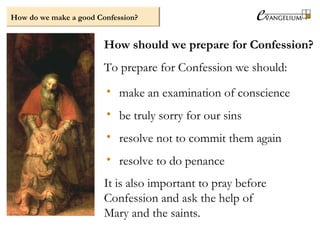
How should we prepare for Confession?
To prepare for Confession we should:
• make an examination of conscience
• be truly sorry for our sins
• resolve not to commit them again
• resolve to do penance
It is also important to pray before
Confession and ask the help of
Mary and the saints.
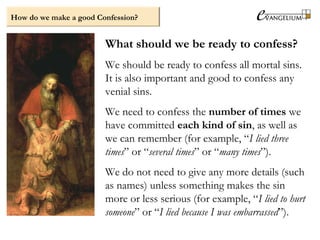
What should we be ready to confess?
We should be ready to confess all mortal sins.
It is also important and good to confess any
venial sins.
We need to confess the number of times we
have committed each kind of sin, as well as
we can remember (for example, “I lied three
times” or “several times” or “many times”).
We do not need to give any more details (such
as names) unless something makes the sin
more or less serious (for example, “I lied to hurt
someone” or “I lied because I was embarrassed”).
How do we make a good Confession?
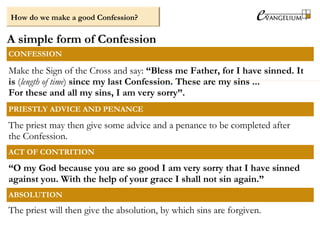
A simple form of Confession
How do we make a good Confession?
CONFESSION
Make the Sign of the Cross and say: “Bless me Father, for I have sinned. It
is (length of time) since my last Confession. These are my sins ...
For these and all my sins, I am very sorry”.
PRIESTLY ADVICE AND PENANCE
The priest may then give some advice and a penance to be completed after
the Confession.
ACT OF CONTRITION
“O my God because you are so good I am very sorry that I have sinned
against you. With the help of your grace I shall not sin again.”
ABSOLUTION
The priest will then give the absolution, by which sins are forgiven.
After Confession I should thank
God and fulfil the penance the
priest has given me.
If I have accidentally forgotten
to confess a mortal sin, I can be
sure that the sin has been
forgiven, but I must include it in
my next Confession.
How do we make a good Confession?
Summary
Questions
to reinforce
key points
Discussion
questions
Practical
activities
Presentation Part II
Summary Activities I
Please select an activity or go immediately
to part II of the presentation
Summary
Activities Menu Presentation Part II
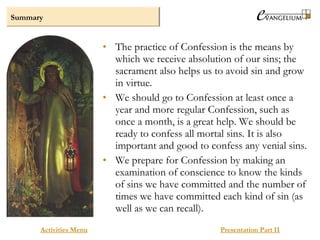
• The practice of Confession is the means by
which we receive absolution of our sins; the
sacrament also helps us to avoid sin and grow
in virtue.
• We should go to Confession at least once a
year and more regular Confession, such as
once a month, is a great help. We should be
ready to confess all mortal sins. It is also
important and good to confess any venial sins.
• We prepare for Confession by making an
examination of conscience to know the kinds
of sins we have committed and the number of
times we have committed each kind of sin (as
well as we can recall).
Questions to reinforce key points
Confession of sins
Advice and penance given by the priest.
The act of contrition
Absolution
What is the sequence of actions
in making a Confession?
Activities Menu Presentation Part II
1
2
3
4
Click on a box to reveal one
of the answers
Discussion questions
Activities Menu Presentation Part II
• Discuss what may seem difficult in
approaching Confession and how such
difficulties may be overcome.
• Discuss when would be a good time to
go to Confession on a regular basis.
• Discuss some experiences of going to
Confession that may be helpful.
Select one or more of the following:
Practical activities
Activities Menu Presentation Part II
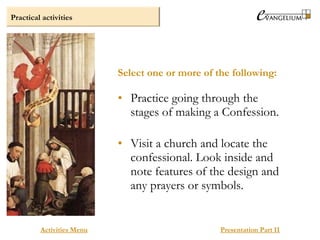
• Practice going through the
stages of making a Confession.
• Visit a church and locate the
confessional. Look inside and
note features of the design and
any prayers or symbols.
Select one or more of the following:
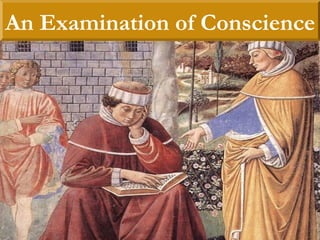
An Examination of Conscience
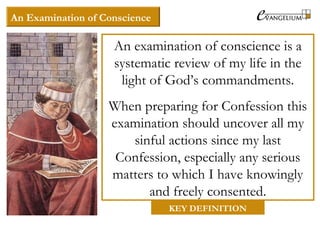
An examination of conscience is a
systematic review of my life in the
light of God’s commandments.
When preparing for Confession this
examination should uncover all my
sinful actions since my last
Confession, especially any serious
matters to which I have knowingly
and freely consented.
KEY DEFINITION
Sinful actions regarding God
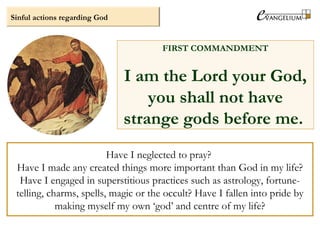
Have I neglected to pray?
Have I made any created things more important than God in my life?
Have I engaged in superstitious practices such as astrology, fortune-
telling, charms, spells, magic or the occult? Have I fallen into pride by
making myself my own ‘god’ and centre of my life?
Sinful actions regarding God
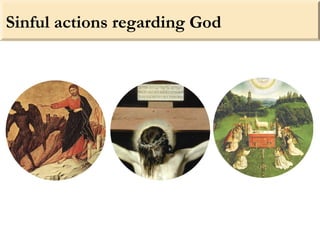
FIRST COMMANDMENT
I am the Lord your God,
you shall not have
strange gods before me.
Sinful actions regarding God
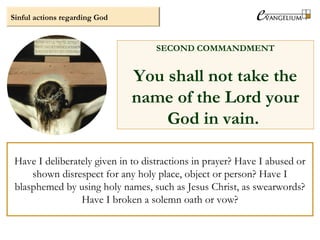
SECOND COMMANDMENT
You shall not take the
name of the Lord your
God in vain.
Have I deliberately given in to distractions in prayer? Have I abused or
shown disrespect for any holy place, object or person? Have I
blasphemed by using holy names, such as Jesus Christ, as swearwords?
Have I broken a solemn oath or vow?
Sinful actions regarding God
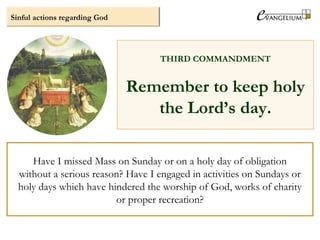
THIRD COMMANDMENT
Remember to keep holy
the Lord’s day.
Have I missed Mass on Sunday or on a holy day of obligation
without a serious reason? Have I engaged in activities on Sundays or
holy days which have hindered the worship of God, works of charity
or proper recreation?
Sinful actions regarding others
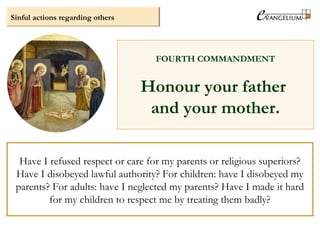
FOURTH COMMANDMENT
Honour your father
and your mother.
Have I refused respect or care for my parents or religious superiors?
Have I disobeyed lawful authority? For children: have I disobeyed my
parents? For adults: have I neglected my parents? Have I made it hard
for my children to respect me by treating them badly?
Sinful actions regarding others
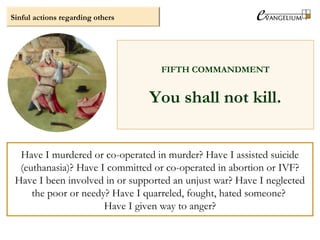
FIFTH COMMANDMENT
You shall not kill.
Have I murdered or co-operated in murder? Have I assisted suicide
(euthanasia)? Have I committed or co-operated in abortion or IVF?
Have I been involved in or supported an unjust war? Have I neglected
the poor or needy? Have I quarreled, fought, hated someone?
Have I given way to anger?
Sinful actions regarding others
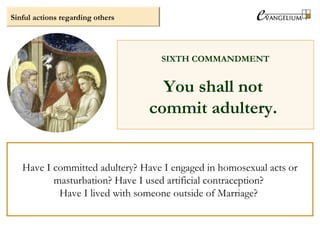
SIXTH COMMANDMENT
You shall not
commit adultery.
Have I committed adultery? Have I engaged in homosexual acts or
masturbation? Have I used artificial contraception?
Have I lived with someone outside of Marriage?
Sinful actions regarding others
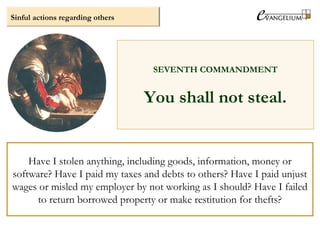
SEVENTH COMMANDMENT
You shall not steal.
Have I stolen anything, including goods, information, money or
software? Have I paid my taxes and debts to others? Have I paid unjust
wages or misled my employer by not working as I should? Have I failed
to return borrowed property or make restitution for thefts?
Sinful actions regarding others
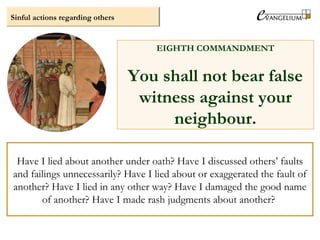
EIGHTH COMMANDMENT
You shall not bear false
witness against your
neighbour.
Have I lied about another under oath? Have I discussed others’ faults
and failings unnecessarily? Have I lied about or exaggerated the fault of
another? Have I lied in any other way? Have I damaged the good name
of another? Have I made rash judgments about another?
Sinful actions regarding desires
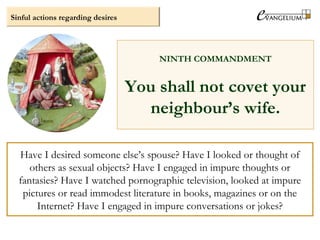
NINTH COMMANDMENT
You shall not covet your
neighbour’s wife.
Have I desired someone else’s spouse? Have I looked or thought of
others as sexual objects? Have I engaged in impure thoughts or
fantasies? Have I watched pornographic television, looked at impure
pictures or read immodest literature in books, magazines or on the
Internet? Have I engaged in impure conversations or jokes?
Sinful actions regarding desires
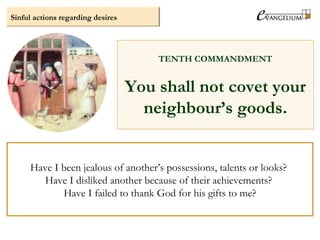
TENTH COMMANDMENT
You shall not covet your
neighbour’s goods.
Have I been jealous of another’s possessions, talents or looks?
Have I disliked another because of their achievements?
Have I failed to thank God for his gifts to me?
Summary
Questions
to reinforce
key points
Discussion
questions
Practical
activities
Summary Activities II
Please select an activity or go immediately
to the final summary and prayer
Concluding Prayer
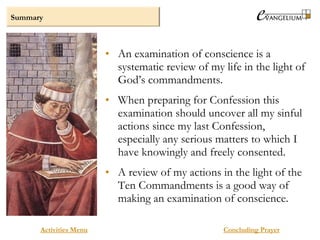
Summary
Activities Menu
• An examination of conscience is a
systematic review of my life in the light of
God’s commandments.
• When preparing for Confession this
examination should uncover all my sinful
actions since my last Confession,
especially any serious matters to which I
have knowingly and freely consented.
• A review of my actions in the light of the
Ten Commandments is a good way of
making an examination of conscience.
Concluding Prayer
Questions to reinforce key points
A systematic review of my life
since my last Confession
My actions seen in the light
of God’s commandments
The uncovering of any serious matters to which
I have knowingly and freely consented
What is needed for a good examination of conscience
before Confession?
Activities Menu Concluding Prayer
1
Click on a box to reveal one
of the answers
2
3
Discussion questions
Activities Menu
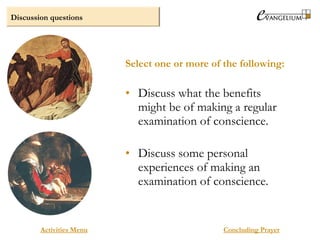
• Discuss what the benefits
might be of making a regular
examination of conscience.
• Discuss some personal
experiences of making an
examination of conscience.
Select one or more of the following:
Concluding Prayer
Practical activities
Activities Menu
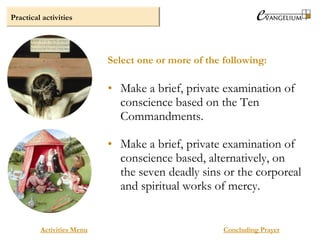
• Make a brief, private examination of
conscience based on the Ten
Commandments.
• Make a brief, private examination of
conscience based, alternatively, on
the seven deadly sins or the corporeal
and spiritual works of mercy.
Select one or more of the following:
Concluding Prayer
Final Prayer
An Act of Contrition
O my God, because you are so good I am very
sorry that I have sinned against you, but with
the help of your grace, I will not sin again.
Amen.

the practice of confession

  • 1.
  • 2.
    The Practice ofConfession The Light of the World by Holman Hunt
  • 3.
    The Practice ofConfession The practice of Confession is the means by which we receive absolution of our sins. The sacrament also helps us to avoid sin and grow in virtue. KEY DEFINITION
  • 5.
    The lantern indicates that Jesusis the light of the world who desires to bring his light into our souls. The door of the soul can only be opened from the inside. There is no handle on the outside. The weeds overgrowing the door symbolise sin and spiritual neglect: the door has not been opened for a long time. The knock Christ knocks at the door of our souls. He does not force his way in. This picture reminds us that in Confession we open our souls to Christ
  • 6.
    When should wego to Confession? The Return of the Prodigal Son by Rembrandt The story of the prodigal son shows the need of confession when we commit serious sin.
  • 7.
    When should wego to Confession? We should go to Confession at least once a year, most fittingly in preparation for Easter. More regular Confession, such as once a month, is a great help towards spiritual growth. We should also go to Confession when aware of serious sin.
  • 8.
    When should wego to Confession? Parishes have set times for this sacrament, and often Services of Reconciliation, but a priest will also hear Confessions on request.
  • 9.
    Difficulties about Confession TheConversion of St Augustine by Gozzoli Augustine took many years to convert from his sinful life to follow Christ. He later wrote, “Late have I loved Thee.”
  • 10.
     Fear Both Godand the priest welcome sinners with joy. The priest is bound by a seal of absolute secrecy. He will not be shocked by sins, and, as a sinner, goes to Confession himself. Difficulties about Confession
  • 11.
     No senseof sin Even the saints practised Confession regularly. A properly formed and examined conscience will give a true understanding of our sins (c.f. 1 Jn 1:8). Difficulties about Confession
  • 12.
     Unfamiliar The basicformula is very simple and is good to learn. The priest will also guide those out of practice. Difficulties about Confession
  • 13.
    How do wemake a good Confession? The prodigal son demonstrates the need for sorrow and a firm purpose of amendment in confessing our sins.
  • 14.
    How do wemake a good Confession? How should we prepare for Confession? To prepare for Confession we should: • make an examination of conscience • be truly sorry for our sins • resolve not to commit them again • resolve to do penance It is also important to pray before Confession and ask the help of Mary and the saints.
  • 15.
    What should webe ready to confess? We should be ready to confess all mortal sins. It is also important and good to confess any venial sins. We need to confess the number of times we have committed each kind of sin, as well as we can remember (for example, “I lied three times” or “several times” or “many times”). We do not need to give any more details (such as names) unless something makes the sin more or less serious (for example, “I lied to hurt someone” or “I lied because I was embarrassed”). How do we make a good Confession?
  • 16.
    A simple formof Confession How do we make a good Confession? CONFESSION Make the Sign of the Cross and say: “Bless me Father, for I have sinned. It is (length of time) since my last Confession. These are my sins ... For these and all my sins, I am very sorry”. PRIESTLY ADVICE AND PENANCE The priest may then give some advice and a penance to be completed after the Confession. ACT OF CONTRITION “O my God because you are so good I am very sorry that I have sinned against you. With the help of your grace I shall not sin again.” ABSOLUTION The priest will then give the absolution, by which sins are forgiven.
  • 17.
    After Confession Ishould thank God and fulfil the penance the priest has given me. If I have accidentally forgotten to confess a mortal sin, I can be sure that the sin has been forgiven, but I must include it in my next Confession. How do we make a good Confession?
  • 18.
    Summary Questions to reinforce key points Discussion questions Practical activities PresentationPart II Summary Activities I Please select an activity or go immediately to part II of the presentation
  • 19.
    Summary Activities Menu PresentationPart II • The practice of Confession is the means by which we receive absolution of our sins; the sacrament also helps us to avoid sin and grow in virtue. • We should go to Confession at least once a year and more regular Confession, such as once a month, is a great help. We should be ready to confess all mortal sins. It is also important and good to confess any venial sins. • We prepare for Confession by making an examination of conscience to know the kinds of sins we have committed and the number of times we have committed each kind of sin (as well as we can recall).
  • 20.
    Questions to reinforcekey points Confession of sins Advice and penance given by the priest. The act of contrition Absolution What is the sequence of actions in making a Confession? Activities Menu Presentation Part II 1 2 3 4 Click on a box to reveal one of the answers
  • 21.
    Discussion questions Activities MenuPresentation Part II • Discuss what may seem difficult in approaching Confession and how such difficulties may be overcome. • Discuss when would be a good time to go to Confession on a regular basis. • Discuss some experiences of going to Confession that may be helpful. Select one or more of the following:
  • 22.
    Practical activities Activities MenuPresentation Part II • Practice going through the stages of making a Confession. • Visit a church and locate the confessional. Look inside and note features of the design and any prayers or symbols. Select one or more of the following:
  • 23.
  • 24.
    An Examination ofConscience An examination of conscience is a systematic review of my life in the light of God’s commandments. When preparing for Confession this examination should uncover all my sinful actions since my last Confession, especially any serious matters to which I have knowingly and freely consented. KEY DEFINITION
  • 25.
  • 26.
    Have I neglectedto pray? Have I made any created things more important than God in my life? Have I engaged in superstitious practices such as astrology, fortune- telling, charms, spells, magic or the occult? Have I fallen into pride by making myself my own ‘god’ and centre of my life? Sinful actions regarding God FIRST COMMANDMENT I am the Lord your God, you shall not have strange gods before me.
  • 27.
    Sinful actions regardingGod SECOND COMMANDMENT You shall not take the name of the Lord your God in vain. Have I deliberately given in to distractions in prayer? Have I abused or shown disrespect for any holy place, object or person? Have I blasphemed by using holy names, such as Jesus Christ, as swearwords? Have I broken a solemn oath or vow?
  • 28.
    Sinful actions regardingGod THIRD COMMANDMENT Remember to keep holy the Lord’s day. Have I missed Mass on Sunday or on a holy day of obligation without a serious reason? Have I engaged in activities on Sundays or holy days which have hindered the worship of God, works of charity or proper recreation?
  • 29.
  • 30.
    Sinful actions regardingothers FOURTH COMMANDMENT Honour your father and your mother. Have I refused respect or care for my parents or religious superiors? Have I disobeyed lawful authority? For children: have I disobeyed my parents? For adults: have I neglected my parents? Have I made it hard for my children to respect me by treating them badly?
  • 31.
    Sinful actions regardingothers FIFTH COMMANDMENT You shall not kill. Have I murdered or co-operated in murder? Have I assisted suicide (euthanasia)? Have I committed or co-operated in abortion or IVF? Have I been involved in or supported an unjust war? Have I neglected the poor or needy? Have I quarreled, fought, hated someone? Have I given way to anger?
  • 32.
    Sinful actions regardingothers SIXTH COMMANDMENT You shall not commit adultery. Have I committed adultery? Have I engaged in homosexual acts or masturbation? Have I used artificial contraception? Have I lived with someone outside of Marriage?
  • 33.
    Sinful actions regardingothers SEVENTH COMMANDMENT You shall not steal. Have I stolen anything, including goods, information, money or software? Have I paid my taxes and debts to others? Have I paid unjust wages or misled my employer by not working as I should? Have I failed to return borrowed property or make restitution for thefts?
  • 34.
    Sinful actions regardingothers EIGHTH COMMANDMENT You shall not bear false witness against your neighbour. Have I lied about another under oath? Have I discussed others’ faults and failings unnecessarily? Have I lied about or exaggerated the fault of another? Have I lied in any other way? Have I damaged the good name of another? Have I made rash judgments about another?
  • 35.
  • 36.
    Sinful actions regardingdesires NINTH COMMANDMENT You shall not covet your neighbour’s wife. Have I desired someone else’s spouse? Have I looked or thought of others as sexual objects? Have I engaged in impure thoughts or fantasies? Have I watched pornographic television, looked at impure pictures or read immodest literature in books, magazines or on the Internet? Have I engaged in impure conversations or jokes?
  • 37.
    Sinful actions regardingdesires TENTH COMMANDMENT You shall not covet your neighbour’s goods. Have I been jealous of another’s possessions, talents or looks? Have I disliked another because of their achievements? Have I failed to thank God for his gifts to me?
  • 38.
    Summary Questions to reinforce key points Discussion questions Practical activities SummaryActivities II Please select an activity or go immediately to the final summary and prayer Concluding Prayer
  • 39.
    Summary Activities Menu • Anexamination of conscience is a systematic review of my life in the light of God’s commandments. • When preparing for Confession this examination should uncover all my sinful actions since my last Confession, especially any serious matters to which I have knowingly and freely consented. • A review of my actions in the light of the Ten Commandments is a good way of making an examination of conscience. Concluding Prayer
  • 40.
    Questions to reinforcekey points A systematic review of my life since my last Confession My actions seen in the light of God’s commandments The uncovering of any serious matters to which I have knowingly and freely consented What is needed for a good examination of conscience before Confession? Activities Menu Concluding Prayer 1 Click on a box to reveal one of the answers 2 3
  • 41.
    Discussion questions Activities Menu •Discuss what the benefits might be of making a regular examination of conscience. • Discuss some personal experiences of making an examination of conscience. Select one or more of the following: Concluding Prayer
  • 42.
    Practical activities Activities Menu •Make a brief, private examination of conscience based on the Ten Commandments. • Make a brief, private examination of conscience based, alternatively, on the seven deadly sins or the corporeal and spiritual works of mercy. Select one or more of the following: Concluding Prayer
  • 43.
    Final Prayer An Actof Contrition O my God, because you are so good I am very sorry that I have sinned against you, but with the help of your grace, I will not sin again. Amen.