Role-playing in Virtual Worlds:
  Learning a New Language -
   Communities of practice to
Enhance Literacies and Creativity
    Presented by: Dr. Doris Molero
                                                     Artstonia


                     6th Slanguages 2012
              Language & culture in virtual worlds
                Fri-Sun, 28-30 September 2012
                    Twitter hashtag #slang12
          Conference Themes: Games and Machinima
Agenda
• What’s Role playing about?
   – Role player’s definitions of role play
• Basics of Role playing
   – Emotes, Vocabulary and Expressions
   – Character Development
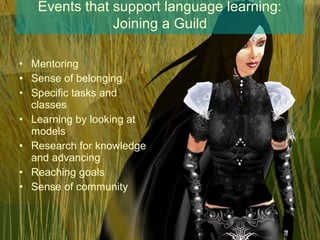
• Role Play Sims: Communities of Practice
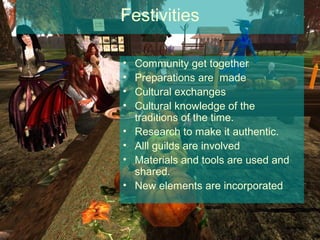
• Role play Community Activities: Community of Practice Activities
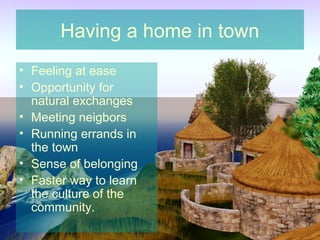
• Meet the Role player and the EFL Professor: Pionia Destiny
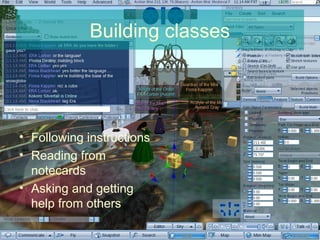
• Role play situations as Language Learning Tool
• The cooking class a role play to learn a new language.
• Going on a hunt


                                                 Avilion: Harvest Festival
What’s Roleplaying about?


                                                                                                                        ng
                                                                             e     r


                                                                                                                     ini
                                                                          ast
     "consider role plays for,,,,,.                                    dis


                                                                                                                 tra
                                                                    al
                                                                 tur


                                                                                                            ills
                                                               na
                                                                             ment


                                                                                                         sk
                                                                    se treat
                                                           t respon


                                                                                                       e
                                                                                                     al
                                                   firs


                                                                                                    or
                                           ery and


                                                                                                  on


                                                                                                  m
                                      recov


                                                                                             ers


                                                                                                d
                                                                                             an
                                                                                         erp
                                             language training


                                                                                          ls
                                                                                       ve
                                                                                     int

                                                                                    no
                                         fire


                                                                                  e
                                                                               iv
                                              figh


                                                                                  ct
(RP) is simply pretending to be                   ter


                                                                                ra
                                                        trai


                                                                              te
someone or something to simulate                            nin    lea


                                                                            in
                                                               g       de
an experience, usually interacting                                       rsh
                                                                            ip
with others doing the same.                                                    t   rai
                                                                                         nin
                                                                                            g
Role play is a well established           The best way to learn something is not
principle of education,                   to read or hear about it, but do it, even if
psychotherapy, self-exploration, and      simulated. The corporate world trains
entertainment. We pretend to remove       employees globally using this technique,
those limitations when simulating an      while others enjoy it for entertainment. It's
experience.                               all about immersion."
Role players’ view of Roleplay
MAGGIE (magdalena.easterwood): Taking part in an
interaction between people each of whom are playing a role in
a continuing story. This story can take place during a certain
time period or under certain circumstances. It might include
roleplay based on a time in history.

                                         Dawnbeam Dreamscape:
               Rhi                       Role Playing like is being an
               (rhiannon.skinstad):      actress in an improv that never
                                         ends. As we grow with our
               Well, essentially, it's   skills...our characters grow in
               acting out a role         richness...soon it is easy to
               according to your         "play" the role you have chosen
               interpretation of it.

                                                    (gadget.cyberstar)
Daza Mistwalker: geee....I                          : roleplay is pretty
suppose it is playing a part in a                   much acting with a
giant medieval                                      keyboard... you
psychodrama...a lot like role                       assume a role and
playing anywhere just in a time                     play it out to the
period that includes magic.                         best of your ability
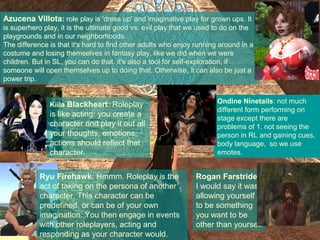
Azucena Villota: role play is 'dress up' and imaginative play for grown ups. It
is superhero play, it is the ultimate good vs. evil play that we used to do on the
playgrounds and in our neighborhoods.
The difference is that it's hard to find other adults who enjoy running around in a
costume and losing themselves in fantasy play, like we did when we were
children. But in SL, you can do that. it's also a tool for self-exploration, if
someone will open themselves up to doing that. Otherwise, it can also be just a
power trip.


               Kiila Blackheart: Roleplay                             Ondine Ninetails: not much
                                                                      different form performing on
               is like acting: you create a                           stage except there are
               character and play it out all                          problems of 1. not seeing the
               your thoughts, emotions,                               person in RL and gaining cues,
               actions should reflect that                            body language, so we use
               character.                                             emotes.


            Ryu Firehawk: Hmmm. Roleplay is the                Rogan Farstrider:
            act of taking on the persona of another            I would say it was
            character. This character can be                   allowing yourself
            predefined, or can be of your own                  to be something
            imagination. You then engage in events             you want to be
            with other roleplayers, acting and                 other than yourself
            responding as your character would.
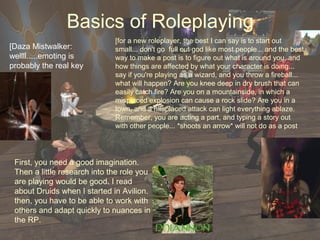
Basics of Roleplaying
                              [for a new roleplayer, the best I can say is to start out
[Daza Mistwalker:             small... don't go full out god like most people... and the best
wellll.....emoting is         way to make a post is to figure out what is around you, and
probably the real key         how things are affected by what your character is doing...
                              say if you're playing as a wizard, and you throw a fireball...
                              what will happen? Are you knee deep in dry brush that can
                              easily catch fire? Are you on a mountainside, in which a
                              misplaced explosion can cause a rock slide? Are you in a
                              town, and a misplaced attack can light everything ablaze.
                              Remember, you are acting a part, and typing a story out
                              with other people... *shoots an arrow* will not do as a post


 First, you need a good imagination.
 Then a little research into the role you
 are playing would be good. I read
 about Druids when I started in Avilion.
 then, you have to be able to work with
 others and adapt quickly to nuances in
 the RP.
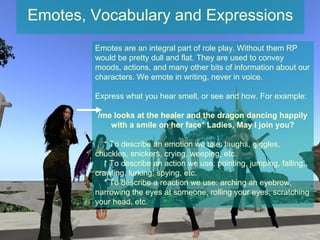
Emotes, Vocabulary and Expressions
        Emotes are an integral part of role play. Without them RP
        would be pretty dull and flat. They are used to convey
        moods, actions, and many other bits of information about our
        characters. We emote in writing, never in voice.

        Express what you hear smell, or see and how. For example:

         /me looks at the healer and the dragon dancing happily
            with a smile on her face* Ladies, May I join you?

           * To describe an emotion we use: laughs, giggles,
        chuckles, snickers, crying, weeping, etc.
           * To describe an action we use: pointing, jumping, falling,
        crawling, lurking, spying, etc.
           * To describe a reaction we use: arching an eyebrow,
        narrowing the eyes at someone, rolling your eyes, scratching
        your head, etc.
Character Development
    Races:                                           Clases:

•   Each race has a set of specific           •   Can you hit a target with a bow from
    features, abilities and                       one-hundred meters like a Ranger?
    weaknesses.                               •   Perhaps you are skilled with the blade
•   Centaurs, Elves, Drow,                        as much as you are with honor and are
    Halflings, Dragons, Dwarves,                  a Knight?
    Ents, Fawns/Satyrs, Mermaids,             •   Do you feel the power of magic
    Humans, Faes/Fairies/Pixies,                  coursing through you and are a Magi?
    wildlife such as birds and
                                              •   Perhaps you can feel the life force from
    wolves, demons, spirits of the
    forest, and many more.                        the earth and are a Druid?
                                              •   Or perhaps you prefer to stay in the
                                                  shadows like a Rogue?
     Aligment                                 •   Maybe you enjoy the art of song and
•   It is the moral or ethical perspective        weaving stories and enjoy being a
    of the character. This helps guide what       Bard?
    your character will or will not do.       •   Or maybe you're tricky and cunning like
     Some basic alignments for characters         a Gypsy and enjoy keeping secrets?
    include.
•   Are you Good, Evil, or Neutral? Are
    you Lawful, Chaotic, or Neutral?
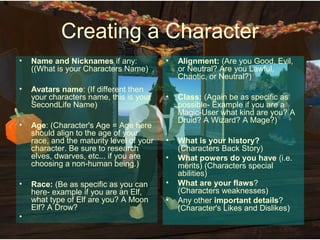
Creating a Character
•   Name and Nicknames if any:             •   Alignment: (Are you Good, Evil,
    ((What is your Characters Name)            or Neutral? Are you Lawful,
                                               Chaotic, or Neutral?)
•   Avatars name: (If different then
    your characters name, this is your     •   Class: (Again be as specific as
    SecondLife Name)                           possible- Example if you are a
                                               Magic-User what kind are you? A
                                               Druid? A Wizard? A Mage?)
•   Age: (Character's Age = Age here
    should align to the age of your
    race, and the maturity level of your   •   What is your history?
    character. Be sure to research             (Characters Back Story)
    elves, dwarves, etc... if you are      •   What powers do you have (i.e.
    choosing a non-human being.)               merits) (Characters special
                                               abilities)
•   Race: (Be as specific as you can       •   What are your flaws?
    here- example if you are an Elf,           (Characters weaknesses)
    what type of Elf are you? A Moon       •   Any other important details?
    Elf? A Drow?                               (Character's Likes and Dislikes)
•
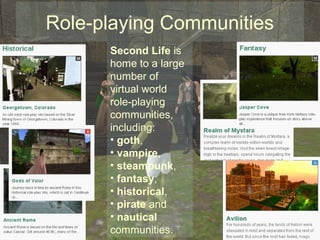
Role-playing Communities
      Second Life is
      home to a large
      number of
      virtual world
      role-playing
      communities,
      including:
      • goth,
      • vampire,
      • steampunk,
      • fantasy,
      • historical,
      • pirate and
      • nautical
      communities.
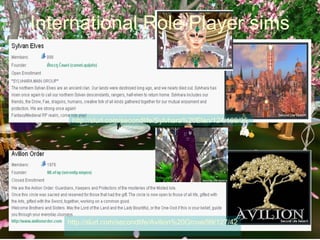
International Role Player sims


     http://slurl.com/secondlife/Sylvhara%20Elen/124/168/35


    http://slurl.com/secondlife/Avilion%20Grove/99/127/42
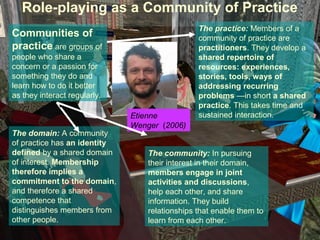
Role-playing as a Community of Practice
                                                The practice: Members of a
Communities of                                  community of practice are
practice are groups of                          practitioners. They develop a
people who share a                              shared repertoire of
concern or a passion for                        resources: experiences,
something they do and                           stories, tools, ways of
learn how to do it better                       addressing recurring
as they interact regularly.                     problems —in short a shared
                                                practice. This takes time and
                              Etienne           sustained interaction.
                              Wenger (2006)
The domain: A community
of practice has an identity
defined by a shared domain        The community: In pursuing
of interest. Membership           their interest in their domain,
therefore implies a               members engage in joint
commitment to the domain,         activities and discussions,
and therefore a shared            help each other, and share
competence that                   information. They build
distinguishes members from        relationships that enable them to
other people.                     learn from each other.
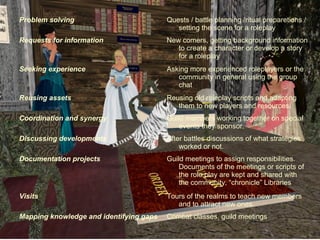
Problem solving                          Quests / battle planning /ritual preparetions /
                                            setting the scene for a roleplay
Requests for information                 New comers, getting background information
                                            to create a character or develop a story
                                            for a roleplay
Seeking experience                       Asking more experienced roleplayers or the
                                            community in general using the group
                                            chat
Reusing assets                           Reusing old roleplay scripts and adapting
                                            them to new players and resources.
Coordination and synergy                 Guild members working together on special
                                             events they sponsor.
Discussing developments                  After battles discussions of what strategies
                                             worked or not.
Documentation projects                   Guild meetings to assign responsibilities.
                                             Documents of the meetings or scripts of
                                             the role play are kept and shared with
                                             the community. “chronicle” Libraries
Visits                                   Tours of the realms to teach new members
                                            and to attract new ones.
Mapping knowledge and identifying gaps   Combat classes, guild meetings
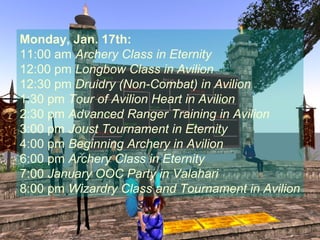
Monday, Jan. 17th:
11:00 am Archery Class in Eternity
12:00 pm Longbow Class in Avilion
12:30 pm Druidry (Non-Combat) in Avilion
1:30 pm Tour of Avilion Heart in Avilion
2:30 pm Advanced Ranger Training in Avilion
3:00 pm Joust Tournament in Eternity
4:00 pm Beginning Archery in Avilion
6:00 pm Archery Class in Eternity
7:00 January OOC Party in Valahari
8:00 pm Wizardry Class and Tournament in Avilion
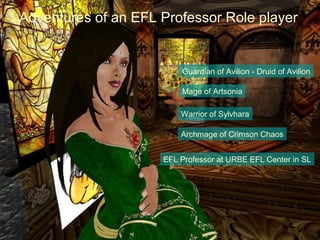
Adventures of an EFL Professor Role player


                         Guardian of Avilion - Druid of Avilion

                         Mage of Artsonia

                         Warrior of Sylvhara

                         Archmage of Crimson Chaos


                     EFL Professor at URBE EFL Center in SL
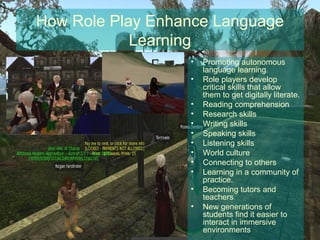
How Role Play Enhance Language
            Learning
                  •   Promoting autonomous
                      language learning.
                  •   Role players develop
                      critical skills that allow
                      them to get digitally literate.
                  •   Reading comprehension
                  •   Research skills
                  •   Writing skills
                  •   Speaking skills
                  •   Listening skills
                  •   World culture
                  •   Connecting to others
                  •   Learning in a community of
                      practice.
                  •   Becoming tutors and
                      teachers
                  •   New generations of
                      students find it easier to
                      interact in immersive
                      environments
Events that support language learning:
               Joining a Guild

• Mentoring
• Sense of belonging
• Specific tasks and
  classes
• Learning by looking at
  models
• Research for knowledge
  and advancing
• Reaching goals
• Sense of community
Festivities

•   Community get together
•   Preparations are made
•   Cultural exchanges
•   Cultural knowledge of the
    traditions of the time.
•   Research to make it authentic.
•   Alll guilds are involved
•   Materials and tools are used and
    shared.
•   New elements are incorporated
Having a home in town
• Feeling at ease
• Opportunity for
  natural exchanges
• Meeting neigbors
• Running errands in
  the town
• Sense of belonging
• Faster way to learn
  the culture of the
  community.
Building classes


• Following instructions
• Reading from
  notecards
• Asking and getting
  help from others
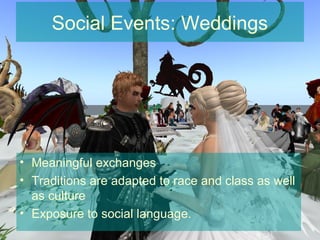
Social Events: Weddings


• Meaningful exchanges
• Traditions are adapted to race and class as well
  as culture
• Exposure to social language.
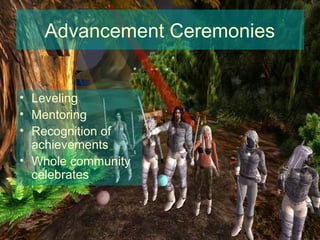
Advancement Ceremonies


• Leveling
• Mentoring
• Recognition of
  achievements
• Whole community
  celebrates
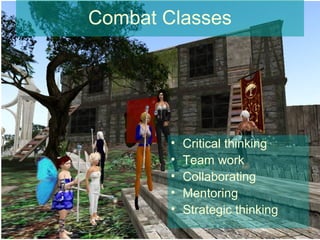
Combat Classes


        •   Critical thinking
        •   Team work
        •   Collaborating
        •   Mentoring
        •   Strategic thinking
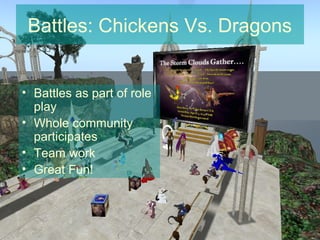
Battles: Chickens Vs. Dragons


• Battles as part of role
  play
• Whole community
  participates
• Team work
• Great Fun!
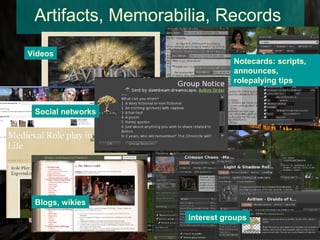
Artifacts, Memorabilia, Records
Videos
                               Notecards: scripts,
                               announces,
                               rolepalying tips


 Social networks


 Blogs, wikies
                    Interest groups
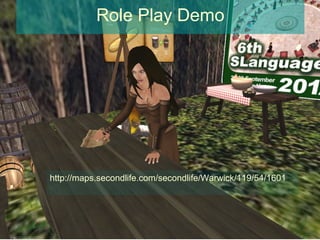
Role Play Demo


http://maps.secondlife.com/secondlife/Warwick/119/54/1601
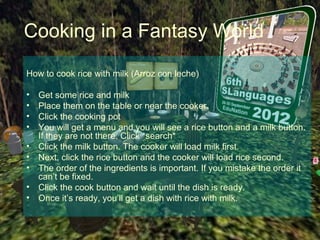
Cooking in a Fantasy World

How to cook rice with milk (Arroz con leche)

•   Get some rice and milk
•   Place them on the table or near the cooker.
•   Click the cooking pot
•   You will get a menu and you will see a rice button and a milk button.
    If they are not there. Click *search*
•   Click the milk button. The cooker will load milk first.
•   Next, click the rice button and the cooker will load rice second.
•   The order of the ingredients is important. If you mistake the order it
    can’t be fixed.
•   Click the cook button and wait until the dish is ready.
•   Once it’s ready, you’ll get a dish with rice with milk.
References
• Communties of practice: http://www.ewenger.com/theory
  /
• Language and Learning in the Digital Age James Paul
  Gee, Elisabeth Hayes, Elisabeth R. Hayes
• Digital Genres, New Literacies and Autonomy in
  Language Learning http://www.c-s-p.org/flyers/978-1-
  4438-2341-8-sample.pdf
• What is role play?
  http://wiki.secondlife.com/wiki/Role_play
• Role Play sims
  http://medievaltimesinsl.wordpress.com/rp-sims/
Blogs:
                                       http://medievalroleplay.blogspot.com/
                                                          EFL Professor in SL
                                                         Doris3m EFL Center
                                                             Twitter: doris3m
                                                     Facebook: Doris Molero
                                                 Second Life: Pionia Destiny
                                                        Google talk: doris3m
                                                          Skype: Dorismolero
                                                 Wikieducator: Doris molero


Dr. Doris Molero
University Professor
Rafael Belloso Chacin University
doris3m@gmail.com
doris.molero@urbe.edu

     Role-playing in Virtual Worlds: Learning a New Language - Communities of
                     practice to Enhance Literacies and Creativity
                                  6th Slanguages 2012

Roleplaying in virtual worlds

  • 1.
    Role-playing in VirtualWorlds: Learning a New Language - Communities of practice to Enhance Literacies and Creativity Presented by: Dr. Doris Molero Artstonia 6th Slanguages 2012 Language & culture in virtual worlds Fri-Sun, 28-30 September 2012 Twitter hashtag #slang12 Conference Themes: Games and Machinima
  • 2.
    Agenda • What’s Roleplaying about? – Role player’s definitions of role play • Basics of Role playing – Emotes, Vocabulary and Expressions – Character Development • Role Play Sims: Communities of Practice • Role play Community Activities: Community of Practice Activities • Meet the Role player and the EFL Professor: Pionia Destiny • Role play situations as Language Learning Tool • The cooking class a role play to learn a new language. • Going on a hunt Avilion: Harvest Festival
  • 3.
    What’s Roleplaying about? ng e r ini ast "consider role plays for,,,,,. dis tra al tur ills na ment sk se treat t respon e al firs or ery and on m recov ers d an erp language training ls ve int no fire e iv figh ct (RP) is simply pretending to be ter ra trai te someone or something to simulate nin lea in g de an experience, usually interacting rsh ip with others doing the same. t rai nin g Role play is a well established The best way to learn something is not principle of education, to read or hear about it, but do it, even if psychotherapy, self-exploration, and simulated. The corporate world trains entertainment. We pretend to remove employees globally using this technique, those limitations when simulating an while others enjoy it for entertainment. It's experience. all about immersion."
  • 4.
    Role players’ viewof Roleplay MAGGIE (magdalena.easterwood): Taking part in an interaction between people each of whom are playing a role in a continuing story. This story can take place during a certain time period or under certain circumstances. It might include roleplay based on a time in history. Dawnbeam Dreamscape: Rhi Role Playing like is being an (rhiannon.skinstad): actress in an improv that never ends. As we grow with our Well, essentially, it's skills...our characters grow in acting out a role richness...soon it is easy to according to your "play" the role you have chosen interpretation of it. (gadget.cyberstar) Daza Mistwalker: geee....I : roleplay is pretty suppose it is playing a part in a much acting with a giant medieval keyboard... you psychodrama...a lot like role assume a role and playing anywhere just in a time play it out to the period that includes magic. best of your ability
  • 5.
    Azucena Villota: roleplay is 'dress up' and imaginative play for grown ups. It is superhero play, it is the ultimate good vs. evil play that we used to do on the playgrounds and in our neighborhoods. The difference is that it's hard to find other adults who enjoy running around in a costume and losing themselves in fantasy play, like we did when we were children. But in SL, you can do that. it's also a tool for self-exploration, if someone will open themselves up to doing that. Otherwise, it can also be just a power trip. Kiila Blackheart: Roleplay Ondine Ninetails: not much different form performing on is like acting: you create a stage except there are character and play it out all problems of 1. not seeing the your thoughts, emotions, person in RL and gaining cues, actions should reflect that body language, so we use character. emotes. Ryu Firehawk: Hmmm. Roleplay is the Rogan Farstrider: act of taking on the persona of another I would say it was character. This character can be allowing yourself predefined, or can be of your own to be something imagination. You then engage in events you want to be with other roleplayers, acting and other than yourself responding as your character would.
  • 6.
    Basics of Roleplaying [for a new roleplayer, the best I can say is to start out [Daza Mistwalker: small... don't go full out god like most people... and the best wellll.....emoting is way to make a post is to figure out what is around you, and probably the real key how things are affected by what your character is doing... say if you're playing as a wizard, and you throw a fireball... what will happen? Are you knee deep in dry brush that can easily catch fire? Are you on a mountainside, in which a misplaced explosion can cause a rock slide? Are you in a town, and a misplaced attack can light everything ablaze. Remember, you are acting a part, and typing a story out with other people... *shoots an arrow* will not do as a post First, you need a good imagination. Then a little research into the role you are playing would be good. I read about Druids when I started in Avilion. then, you have to be able to work with others and adapt quickly to nuances in the RP.
  • 7.
    Emotes, Vocabulary andExpressions Emotes are an integral part of role play. Without them RP would be pretty dull and flat. They are used to convey moods, actions, and many other bits of information about our characters. We emote in writing, never in voice. Express what you hear smell, or see and how. For example: /me looks at the healer and the dragon dancing happily with a smile on her face* Ladies, May I join you? * To describe an emotion we use: laughs, giggles, chuckles, snickers, crying, weeping, etc. * To describe an action we use: pointing, jumping, falling, crawling, lurking, spying, etc. * To describe a reaction we use: arching an eyebrow, narrowing the eyes at someone, rolling your eyes, scratching your head, etc.
  • 8.
    Character Development Races: Clases: • Each race has a set of specific • Can you hit a target with a bow from features, abilities and one-hundred meters like a Ranger? weaknesses. • Perhaps you are skilled with the blade • Centaurs, Elves, Drow, as much as you are with honor and are Halflings, Dragons, Dwarves, a Knight? Ents, Fawns/Satyrs, Mermaids, • Do you feel the power of magic Humans, Faes/Fairies/Pixies, coursing through you and are a Magi? wildlife such as birds and • Perhaps you can feel the life force from wolves, demons, spirits of the forest, and many more. the earth and are a Druid? • Or perhaps you prefer to stay in the shadows like a Rogue? Aligment • Maybe you enjoy the art of song and • It is the moral or ethical perspective weaving stories and enjoy being a of the character. This helps guide what Bard? your character will or will not do. • Or maybe you're tricky and cunning like Some basic alignments for characters a Gypsy and enjoy keeping secrets? include. • Are you Good, Evil, or Neutral? Are you Lawful, Chaotic, or Neutral?
  • 9.
    Creating a Character • Name and Nicknames if any: • Alignment: (Are you Good, Evil, ((What is your Characters Name) or Neutral? Are you Lawful, Chaotic, or Neutral?) • Avatars name: (If different then your characters name, this is your • Class: (Again be as specific as SecondLife Name) possible- Example if you are a Magic-User what kind are you? A Druid? A Wizard? A Mage?) • Age: (Character's Age = Age here should align to the age of your race, and the maturity level of your • What is your history? character. Be sure to research (Characters Back Story) elves, dwarves, etc... if you are • What powers do you have (i.e. choosing a non-human being.) merits) (Characters special abilities) • Race: (Be as specific as you can • What are your flaws? here- example if you are an Elf, (Characters weaknesses) what type of Elf are you? A Moon • Any other important details? Elf? A Drow? (Character's Likes and Dislikes) •
  • 10.
    Role-playing Communities Second Life is home to a large number of virtual world role-playing communities, including: • goth, • vampire, • steampunk, • fantasy, • historical, • pirate and • nautical communities.
  • 11.
    International Role Playersims http://slurl.com/secondlife/Sylvhara%20Elen/124/168/35 http://slurl.com/secondlife/Avilion%20Grove/99/127/42
  • 12.
    Role-playing as aCommunity of Practice The practice: Members of a Communities of community of practice are practice are groups of practitioners. They develop a people who share a shared repertoire of concern or a passion for resources: experiences, something they do and stories, tools, ways of learn how to do it better addressing recurring as they interact regularly. problems —in short a shared practice. This takes time and Etienne sustained interaction. Wenger (2006) The domain: A community of practice has an identity defined by a shared domain The community: In pursuing of interest. Membership their interest in their domain, therefore implies a members engage in joint commitment to the domain, activities and discussions, and therefore a shared help each other, and share competence that information. They build distinguishes members from relationships that enable them to other people. learn from each other.
  • 13.
    Problem solving Quests / battle planning /ritual preparetions / setting the scene for a roleplay Requests for information New comers, getting background information to create a character or develop a story for a roleplay Seeking experience Asking more experienced roleplayers or the community in general using the group chat Reusing assets Reusing old roleplay scripts and adapting them to new players and resources. Coordination and synergy Guild members working together on special events they sponsor. Discussing developments After battles discussions of what strategies worked or not. Documentation projects Guild meetings to assign responsibilities. Documents of the meetings or scripts of the role play are kept and shared with the community. “chronicle” Libraries Visits Tours of the realms to teach new members and to attract new ones. Mapping knowledge and identifying gaps Combat classes, guild meetings
  • 14.
    Monday, Jan. 17th: 11:00am Archery Class in Eternity 12:00 pm Longbow Class in Avilion 12:30 pm Druidry (Non-Combat) in Avilion 1:30 pm Tour of Avilion Heart in Avilion 2:30 pm Advanced Ranger Training in Avilion 3:00 pm Joust Tournament in Eternity 4:00 pm Beginning Archery in Avilion 6:00 pm Archery Class in Eternity 7:00 January OOC Party in Valahari 8:00 pm Wizardry Class and Tournament in Avilion
  • 15.
    Adventures of anEFL Professor Role player Guardian of Avilion - Druid of Avilion Mage of Artsonia Warrior of Sylvhara Archmage of Crimson Chaos EFL Professor at URBE EFL Center in SL
  • 16.
    How Role PlayEnhance Language Learning • Promoting autonomous language learning. • Role players develop critical skills that allow them to get digitally literate. • Reading comprehension • Research skills • Writing skills • Speaking skills • Listening skills • World culture • Connecting to others • Learning in a community of practice. • Becoming tutors and teachers • New generations of students find it easier to interact in immersive environments
  • 17.
    Events that supportlanguage learning: Joining a Guild • Mentoring • Sense of belonging • Specific tasks and classes • Learning by looking at models • Research for knowledge and advancing • Reaching goals • Sense of community
  • 18.
    Festivities • Community get together • Preparations are made • Cultural exchanges • Cultural knowledge of the traditions of the time. • Research to make it authentic. • Alll guilds are involved • Materials and tools are used and shared. • New elements are incorporated
  • 19.
    Having a homein town • Feeling at ease • Opportunity for natural exchanges • Meeting neigbors • Running errands in the town • Sense of belonging • Faster way to learn the culture of the community.
  • 20.
    Building classes • Followinginstructions • Reading from notecards • Asking and getting help from others
  • 21.
    Social Events: Weddings •Meaningful exchanges • Traditions are adapted to race and class as well as culture • Exposure to social language.
  • 22.
    Advancement Ceremonies • Leveling •Mentoring • Recognition of achievements • Whole community celebrates
  • 23.
    Combat Classes • Critical thinking • Team work • Collaborating • Mentoring • Strategic thinking
  • 24.
    Battles: Chickens Vs.Dragons • Battles as part of role play • Whole community participates • Team work • Great Fun!
  • 25.
    Artifacts, Memorabilia, Records Videos Notecards: scripts, announces, rolepalying tips Social networks Blogs, wikies Interest groups
  • 27.
  • 28.
    Cooking in aFantasy World How to cook rice with milk (Arroz con leche) • Get some rice and milk • Place them on the table or near the cooker. • Click the cooking pot • You will get a menu and you will see a rice button and a milk button. If they are not there. Click *search* • Click the milk button. The cooker will load milk first. • Next, click the rice button and the cooker will load rice second. • The order of the ingredients is important. If you mistake the order it can’t be fixed. • Click the cook button and wait until the dish is ready. • Once it’s ready, you’ll get a dish with rice with milk.
  • 29.
    References • Communties ofpractice: http://www.ewenger.com/theory / • Language and Learning in the Digital Age James Paul Gee, Elisabeth Hayes, Elisabeth R. Hayes • Digital Genres, New Literacies and Autonomy in Language Learning http://www.c-s-p.org/flyers/978-1- 4438-2341-8-sample.pdf • What is role play? http://wiki.secondlife.com/wiki/Role_play • Role Play sims http://medievaltimesinsl.wordpress.com/rp-sims/
  • 30.
    Blogs: http://medievalroleplay.blogspot.com/ EFL Professor in SL Doris3m EFL Center Twitter: doris3m Facebook: Doris Molero Second Life: Pionia Destiny Google talk: doris3m Skype: Dorismolero Wikieducator: Doris molero Dr. Doris Molero University Professor Rafael Belloso Chacin University doris3m@gmail.com doris.molero@urbe.edu Role-playing in Virtual Worlds: Learning a New Language - Communities of practice to Enhance Literacies and Creativity 6th Slanguages 2012

Editor's Notes

  • #3 What’s Role playing about? Role player’s definitions of role play Basics of Role playing Emotes, Vocabulary and Expressions Character Development Role Play Sims: Communities of Practice Role play Community Activities: Community of Practice Activities Meet the Role player and the EFL Professor: Pionia Destiny Role play situations as Language Learning Tool The cooking class a role play to learn a new language. Going on a hunt