Understand the Development and Principles of Editing
Development
There is a big difference now between camera editing in the early 20th centaury and
now. It is considered an art and a very skilled technique, assembling shots into a
cohesive order and combing shots into sequences. People consider it an art form,calling
it the ‘invisible art’, as if done right and properly, nobody can see it.
In early cinema there was little shot variation and the camera had a habit of following
the action going on. This is where you follow the movements made by the actors on
screen or even the subject. This is called ‘Followingthe Action’. They wouldn’t just do
this withone camera, they would use various cameras and switch between them, using
the different angles depending what exactly is going on. It was very straight forwardas
whenever a subject moves, the cameras wouldmove along withit. An example of this is
EdwinS. Porter’s classic, Life of an American Fireman, where the camera followsthe
fireman in the action of the house being on fire and him saving the girl.
Another thing is in-camera editing, whichwas used before they had editing. This is
where the editing forthe film wouldbe done by the filmmaker pausing the camera and
then wouldset up the next shot. This meant that not only did they have to film the
scenes they wanted, they wouldalso have to edit it as they went along withit, making it
quite hard and stressful. The first people to use in-camera editing were the Lumiere
brothers. They made history by using this technique in their motion picture, Exiting the
Factory (1895). To people back in this time, this was something amazing, as they’d never
seen anything like this before. Although the film is short and simple as it’s just a bunch
of workers leaving their workfactory,this filmmade the twobrothers pioneers. They
had to plan in advance what they wanted to shoot due to no editing really existing.
Another film that broke the rules was A Trip to the Moon (1902) directed by Georges
Melies, whowas born in Paris, France and was an illusionist and filmmaker. When
filming this, Melies would play around diegetic time and space as well as making early
special effectsnever seen before in films backin its time. When one of Melies cameras
jammed, he realised that if different scenes were stitched together, youreyes wouldfill
in the blanks and witness the film as just one long continuous story. He combined this
technique along with his knowledgeof illusion and created the first ever cinematic
special effect,making him a very important man when it comes to film. He also used shot
variation, whichis where you use a variety of different shots when filming, this includes
long shots, medium shots, close ups and extreme long shots. This technique is so
important in film as it creates tension or maybe even suspense. It adds effectand makes
the audience understand what’s going on better.
Manipulation of diegetic time and space is where the editor of a film changes the speed
of the film so a long period of time in the film, is short to the audience. The filmmakers
do this to skip through minutes, days, hours, years etc. they do this so it doesn’t bore the
audience, as it wouldtake a very long time to show all the time in the film, plus it keeps
them engaged because they’ll want to see the end result. A good example of this is The
Karate Kid (2010), whichshows the character training forhis big performance. He’s
gone fromnot knowinganything about karate, to being really good and talented at it,
whichthe audience now know because of the manipulation of the diegetic time and
space. It also keeps them engaged as it has music in the background and has a lot of fast
paced action and some humour of him not quite grasping a move.
The development of analogue and digital editing has improved vastly throughout the
years. Many filmmakers howeveronly like to use one and not the other. One advantage
for using digital is post-production. This is where the end productis put together with
the various pieces in the order frombeginning to end. Whereas with analogue you have
to edit the film with tape, slice it with a razor and then combine it with all the other, like
film.
Purposes
Editing has come along way since the early 20th centaury. The editor has the power to
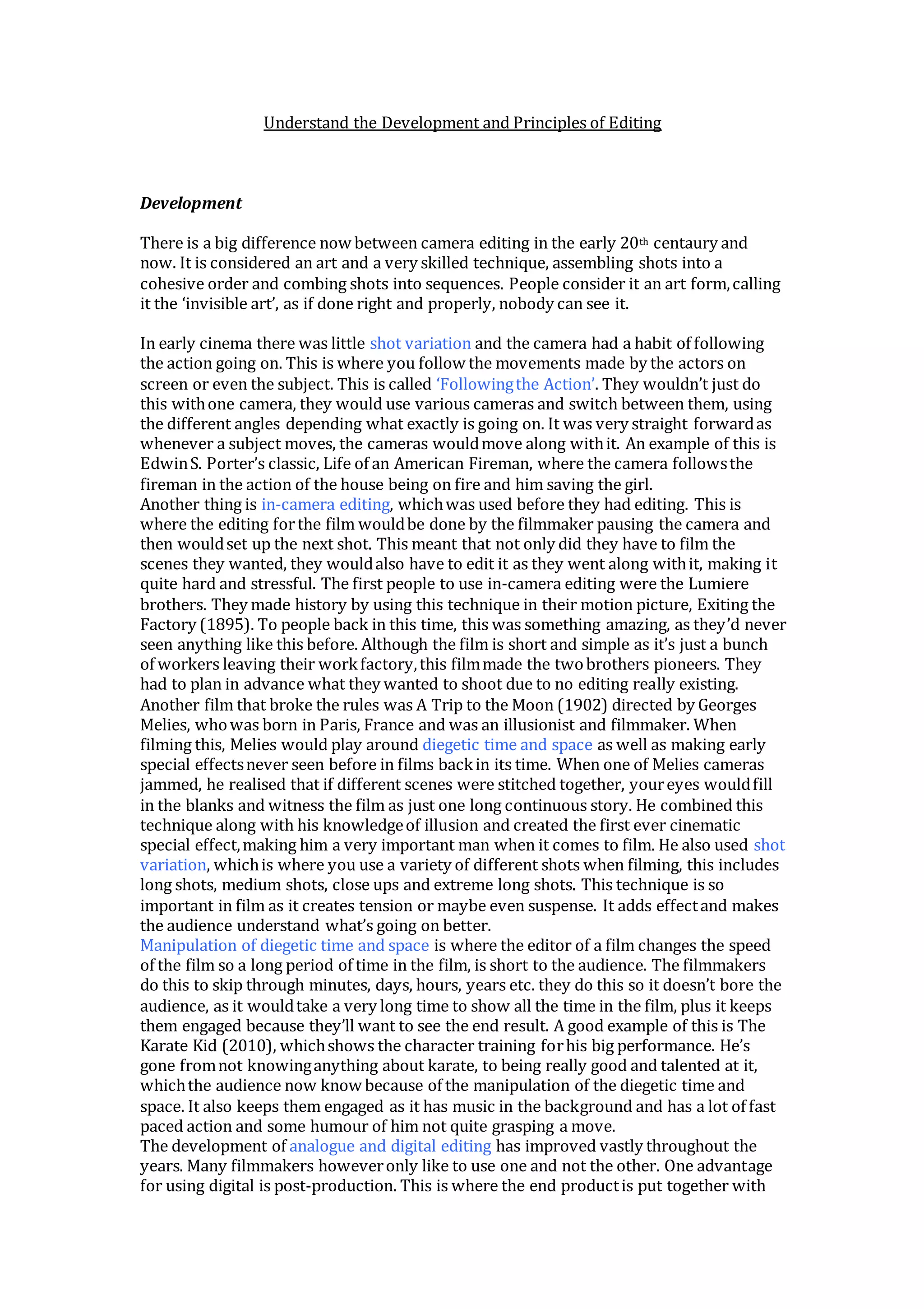
shape a story for a multitude of purposes. For example in Mad Max: Fury Road, the
sequences create a lot of pace and are quite short shots, this gives off the effectthat
there is a lot of things happening. This keeps the audience entertained, as there is a lot of
action happening in a lot of scenes. With the
eye trace Mad Max uses, allowing the
viewerto not have to movetheir heads
from one side of the screen tothe other.
The action going on is seamless and keeps
the viewer glued to the screen, as they
literally do not have to move to see any
action going on in the scene.
The opposite of fast paced is slow. This is
usually used in film to add suspense or to build up tension, usually seen in a lot of horror
or action films. Sometimes slow pace is used after something unexpected has happened,
this is done to not only add effect,but to allow the audience to take in what’s happened
and time to think. A good example of this is a scene from The Shining (1980). The scene
where Danny is playing on his bike and runs into the dead twins. This scene is a perfect
example of building tension as you feel like youhave no choice but to see what Danny is
seeing as the camera is placed on his bicycle.This makes the viewer feel quite
uncomfortable and edgy. This is why slow pace is very useful. It’s used in a lot of
romance movies too, when you see a couple talking to each other with the dim lighting,
the long pauses are forthe audience to projectthemselves into that moment. Maybe it
reminds them of a specific time of their life. It allows the viewer to feel what’s
happening.
Editing can engage the viewer in many ways, like I said in my above paragraph with
pace, it can create tension by using slow shots that can gradually speed up. This is the
opposite of a fast paced scene like in a chase scene or a fight. These scenes, along with
good fitted music, influences what the audience see and how they feel. For example in a
horror film, if the scene is slow paced and not much is going on then this makes the
viewerfeel quite uneasy and builds tension, it makes them want to carry on watching to
see what may happen. If the camera is at a low point during the scene, then the audience
feel fear and makes them feel like they’re the small people and something bad is going to
happen.
Conventions and Techniques
Seamless-The predominant style of film editing and video editing in the post-
production process of filmmaking of narrative films and television programs. This is also
knownas the ‘invisible editing’, it is were the cuts between the shots in a film were
matched to the action going on on the screen. DWGriffiths was the first to do this
making him a pioneer forhis time. If correctly done, the viewercould watchthe final
piece that’s been created and not realize that it has been edited. It was created to make a
clear and smooth flow between the clips so the audience can clearly understand whatis
happening withoutany interruptions. I think this technique is one of the most important
ones as without it the audience would be quite confused and may not even know what is
going on.
ContinuityEditing -The purpose of this is to smooth over the inherit discontinuity of
the editing process and to establish a logical coherence between shots. With this youcan
make sure that there is jump cuts to make sure that people don’t get too confused. In my
opinion, the main focusof this technique is to keep the audience focused on what’s
happening in the film and the story instead of trying to find out the techniques that are
used.
Motivated- Where shots are carefully chosen to push a story along and make the
audience believe what they are seeing. It is when the scene cuts to another objectthat
was not in the previous shot. This is done in discreet so that it does not break the
illusion forthe audience. An example of this is a flashback; this creates a sense of tension
and reverse shots. A good example of this is in Michael Curtiz’s Casablanca (1942). It
shows a flashback of when Rickand Ilsa are in Paris and shows how they met and fell in
love. This is an example of a linear series of complete scenes inserted in the film fora
narrative flow of the storyline.
Montage- It is used to compress time and shows a lot of information in a relatively
short period. Usually shot with music. A perfectexample of this is in Sylvester Stallone’s
Rocky Balboa (2006), starring and directed by him. In the film there is a training
montage of Rocky and his opponent training for their big fight at the end of the movie.
The shots in the scene are juxtaposed in quite a fast paced fashion that compresses time
and gives the audience a lot of information in a relatively short period. It has quite a
positive effecton the viewer,as the music in the background is quite powerfuland
motivational, connecting the film and the audience together. It shows the struggle Rocky
has to go through since he has just came out of retirement. This is quite an opposite to
his opponent in the scene as he is young and fresh and ready to go. So the scene shows
the difference between the twocharacters.
Jump Cutting - Is where twosequential shots of the same subject are taken from
camera positions that vary only slightly. Gives the effectof jumping forwardin time. A
good example is in Jean-Luc Godard’s Breathless (1960). This is when jump cuts were
first used extensively. It gives the appearance of continuous time and space in the story.
It draws attention to the constructed nature of the film.
Parallel Editing/CrossCutting -The technique of alternating twoor more scenes that
are oftenhappening simultaneously but in different locations. In Christopher Nolan’s
Inception (2010) there is a scene were it shows a car chase but also shows Joseph
Gordon-Levitt’s character in a hotel. Both scenarios are happening at the same time and
the audience get to see it all enfolding at the same time. I think this technique is very
useful as it helps the audience have a better understanding of what is exactly happening
in the film and the story.
180DegreeRule - It is when you film a scene using separate shots and helps people
understand where everything is in the scene. This technique is very important as it
helps the viewer understand the scene more. Without this, people would not only be
confused but would loose focuson whatis happening.
Splicing -Youphysically cut out unwanted words, sounds and phrases and re-join the
remaining pieces with splice tape. This technique is the most popular way to join
polyester prints in theatre. A lot of filmmakers do not like this way of editing the shots
together as they find it very confusing. Most directors today don’t use it fortheir films
now but was very popular before digital editing.
Transitions -Refers to how one-shot ends and the next begin and the filmic device that
bridge one to the other. Fading usually signals the beginning or end of a scene
(especially if its fading toor fromblack). This is the most common way. A cutaway is
when the director moves fromone bit of action to something else and then coming back
to the original action. It adds pace and/or adds action. Wipe is the opposite of the
dissolve and draws attention to it. It is usually found in silent old films. Star Wars uses
lots of Wipe’s in its chase scene with the spaceships. Dissolving is when one clip
dissolves into another or fades on to the next. The first clip is fading out and getting
lighter and the second clip starts fading in becoming more prominent.
Cutaways - The interruption of a continuously filmed action by inserting a view of
something else. For example there could be a chase scene between tworival gangs and
could show the audience the chase then cutaway to some people about to cross the
street, showing the viewerthat they are in danger.
Shot Reverse Shot - Where one character is shown looking at another character and
then the other character is shown looking backat the first character. Since the
characters are shown looking in opposite directions, the viewergets the feeling that
they are looking back and forthat each other.
Providing and Withholding Information - When youtry making the narrative
more dramatic by giving the audience more information or taking away information.
Filmmakers use this technique to decide when it is the right time for the audience to find
things out. An example of this is in The Sixth Sense, we discover that Dr Crowe is in fact
dead and has been in denial about his demise. We see subtle little clues throughout the
film of this.
Editing Rhythm - Is what editors use to keep pace of the film up to match the action
that is going on in the film. If the pace is rapid then this gives off the feeling of intensity
and excitement but if the pace is slow and sluggish then it is more relaxed and
thoughtful.
Cutting to Soundtrack - When the pace of the cuts are motivated by how fast the
song is. This can attract the audience because if the beat is fast and cuts fast it can make
them interested about what will happen next.

Final assignment media

  • 1.
    Understand the Developmentand Principles of Editing Development There is a big difference now between camera editing in the early 20th centaury and now. It is considered an art and a very skilled technique, assembling shots into a cohesive order and combing shots into sequences. People consider it an art form,calling it the ‘invisible art’, as if done right and properly, nobody can see it. In early cinema there was little shot variation and the camera had a habit of following the action going on. This is where you follow the movements made by the actors on screen or even the subject. This is called ‘Followingthe Action’. They wouldn’t just do this withone camera, they would use various cameras and switch between them, using the different angles depending what exactly is going on. It was very straight forwardas whenever a subject moves, the cameras wouldmove along withit. An example of this is EdwinS. Porter’s classic, Life of an American Fireman, where the camera followsthe fireman in the action of the house being on fire and him saving the girl. Another thing is in-camera editing, whichwas used before they had editing. This is where the editing forthe film wouldbe done by the filmmaker pausing the camera and then wouldset up the next shot. This meant that not only did they have to film the scenes they wanted, they wouldalso have to edit it as they went along withit, making it quite hard and stressful. The first people to use in-camera editing were the Lumiere brothers. They made history by using this technique in their motion picture, Exiting the Factory (1895). To people back in this time, this was something amazing, as they’d never seen anything like this before. Although the film is short and simple as it’s just a bunch of workers leaving their workfactory,this filmmade the twobrothers pioneers. They had to plan in advance what they wanted to shoot due to no editing really existing. Another film that broke the rules was A Trip to the Moon (1902) directed by Georges Melies, whowas born in Paris, France and was an illusionist and filmmaker. When filming this, Melies would play around diegetic time and space as well as making early special effectsnever seen before in films backin its time. When one of Melies cameras jammed, he realised that if different scenes were stitched together, youreyes wouldfill in the blanks and witness the film as just one long continuous story. He combined this technique along with his knowledgeof illusion and created the first ever cinematic special effect,making him a very important man when it comes to film. He also used shot variation, whichis where you use a variety of different shots when filming, this includes long shots, medium shots, close ups and extreme long shots. This technique is so important in film as it creates tension or maybe even suspense. It adds effectand makes the audience understand what’s going on better. Manipulation of diegetic time and space is where the editor of a film changes the speed of the film so a long period of time in the film, is short to the audience. The filmmakers do this to skip through minutes, days, hours, years etc. they do this so it doesn’t bore the audience, as it wouldtake a very long time to show all the time in the film, plus it keeps them engaged because they’ll want to see the end result. A good example of this is The Karate Kid (2010), whichshows the character training forhis big performance. He’s gone fromnot knowinganything about karate, to being really good and talented at it, whichthe audience now know because of the manipulation of the diegetic time and space. It also keeps them engaged as it has music in the background and has a lot of fast paced action and some humour of him not quite grasping a move. The development of analogue and digital editing has improved vastly throughout the years. Many filmmakers howeveronly like to use one and not the other. One advantage for using digital is post-production. This is where the end productis put together with
  • 2.
    the various piecesin the order frombeginning to end. Whereas with analogue you have to edit the film with tape, slice it with a razor and then combine it with all the other, like film. Purposes Editing has come along way since the early 20th centaury. The editor has the power to shape a story for a multitude of purposes. For example in Mad Max: Fury Road, the sequences create a lot of pace and are quite short shots, this gives off the effectthat there is a lot of things happening. This keeps the audience entertained, as there is a lot of action happening in a lot of scenes. With the eye trace Mad Max uses, allowing the viewerto not have to movetheir heads from one side of the screen tothe other. The action going on is seamless and keeps the viewer glued to the screen, as they literally do not have to move to see any action going on in the scene. The opposite of fast paced is slow. This is usually used in film to add suspense or to build up tension, usually seen in a lot of horror or action films. Sometimes slow pace is used after something unexpected has happened, this is done to not only add effect,but to allow the audience to take in what’s happened and time to think. A good example of this is a scene from The Shining (1980). The scene where Danny is playing on his bike and runs into the dead twins. This scene is a perfect example of building tension as you feel like youhave no choice but to see what Danny is seeing as the camera is placed on his bicycle.This makes the viewer feel quite uncomfortable and edgy. This is why slow pace is very useful. It’s used in a lot of romance movies too, when you see a couple talking to each other with the dim lighting, the long pauses are forthe audience to projectthemselves into that moment. Maybe it reminds them of a specific time of their life. It allows the viewer to feel what’s happening. Editing can engage the viewer in many ways, like I said in my above paragraph with pace, it can create tension by using slow shots that can gradually speed up. This is the opposite of a fast paced scene like in a chase scene or a fight. These scenes, along with good fitted music, influences what the audience see and how they feel. For example in a horror film, if the scene is slow paced and not much is going on then this makes the viewerfeel quite uneasy and builds tension, it makes them want to carry on watching to see what may happen. If the camera is at a low point during the scene, then the audience feel fear and makes them feel like they’re the small people and something bad is going to happen.
  • 3.
    Conventions and Techniques Seamless-Thepredominant style of film editing and video editing in the post- production process of filmmaking of narrative films and television programs. This is also knownas the ‘invisible editing’, it is were the cuts between the shots in a film were matched to the action going on on the screen. DWGriffiths was the first to do this making him a pioneer forhis time. If correctly done, the viewercould watchthe final piece that’s been created and not realize that it has been edited. It was created to make a clear and smooth flow between the clips so the audience can clearly understand whatis happening withoutany interruptions. I think this technique is one of the most important ones as without it the audience would be quite confused and may not even know what is going on. ContinuityEditing -The purpose of this is to smooth over the inherit discontinuity of the editing process and to establish a logical coherence between shots. With this youcan make sure that there is jump cuts to make sure that people don’t get too confused. In my opinion, the main focusof this technique is to keep the audience focused on what’s happening in the film and the story instead of trying to find out the techniques that are used. Motivated- Where shots are carefully chosen to push a story along and make the audience believe what they are seeing. It is when the scene cuts to another objectthat was not in the previous shot. This is done in discreet so that it does not break the illusion forthe audience. An example of this is a flashback; this creates a sense of tension and reverse shots. A good example of this is in Michael Curtiz’s Casablanca (1942). It shows a flashback of when Rickand Ilsa are in Paris and shows how they met and fell in love. This is an example of a linear series of complete scenes inserted in the film fora narrative flow of the storyline. Montage- It is used to compress time and shows a lot of information in a relatively short period. Usually shot with music. A perfectexample of this is in Sylvester Stallone’s Rocky Balboa (2006), starring and directed by him. In the film there is a training montage of Rocky and his opponent training for their big fight at the end of the movie. The shots in the scene are juxtaposed in quite a fast paced fashion that compresses time and gives the audience a lot of information in a relatively short period. It has quite a positive effecton the viewer,as the music in the background is quite powerfuland motivational, connecting the film and the audience together. It shows the struggle Rocky has to go through since he has just came out of retirement. This is quite an opposite to his opponent in the scene as he is young and fresh and ready to go. So the scene shows the difference between the twocharacters. Jump Cutting - Is where twosequential shots of the same subject are taken from camera positions that vary only slightly. Gives the effectof jumping forwardin time. A good example is in Jean-Luc Godard’s Breathless (1960). This is when jump cuts were first used extensively. It gives the appearance of continuous time and space in the story. It draws attention to the constructed nature of the film. Parallel Editing/CrossCutting -The technique of alternating twoor more scenes that are oftenhappening simultaneously but in different locations. In Christopher Nolan’s Inception (2010) there is a scene were it shows a car chase but also shows Joseph Gordon-Levitt’s character in a hotel. Both scenarios are happening at the same time and
  • 4.
    the audience getto see it all enfolding at the same time. I think this technique is very useful as it helps the audience have a better understanding of what is exactly happening in the film and the story. 180DegreeRule - It is when you film a scene using separate shots and helps people understand where everything is in the scene. This technique is very important as it helps the viewer understand the scene more. Without this, people would not only be confused but would loose focuson whatis happening. Splicing -Youphysically cut out unwanted words, sounds and phrases and re-join the remaining pieces with splice tape. This technique is the most popular way to join polyester prints in theatre. A lot of filmmakers do not like this way of editing the shots together as they find it very confusing. Most directors today don’t use it fortheir films now but was very popular before digital editing. Transitions -Refers to how one-shot ends and the next begin and the filmic device that bridge one to the other. Fading usually signals the beginning or end of a scene (especially if its fading toor fromblack). This is the most common way. A cutaway is when the director moves fromone bit of action to something else and then coming back to the original action. It adds pace and/or adds action. Wipe is the opposite of the dissolve and draws attention to it. It is usually found in silent old films. Star Wars uses lots of Wipe’s in its chase scene with the spaceships. Dissolving is when one clip dissolves into another or fades on to the next. The first clip is fading out and getting lighter and the second clip starts fading in becoming more prominent. Cutaways - The interruption of a continuously filmed action by inserting a view of something else. For example there could be a chase scene between tworival gangs and could show the audience the chase then cutaway to some people about to cross the street, showing the viewerthat they are in danger. Shot Reverse Shot - Where one character is shown looking at another character and then the other character is shown looking backat the first character. Since the characters are shown looking in opposite directions, the viewergets the feeling that they are looking back and forthat each other. Providing and Withholding Information - When youtry making the narrative more dramatic by giving the audience more information or taking away information. Filmmakers use this technique to decide when it is the right time for the audience to find things out. An example of this is in The Sixth Sense, we discover that Dr Crowe is in fact dead and has been in denial about his demise. We see subtle little clues throughout the film of this. Editing Rhythm - Is what editors use to keep pace of the film up to match the action that is going on in the film. If the pace is rapid then this gives off the feeling of intensity and excitement but if the pace is slow and sluggish then it is more relaxed and thoughtful. Cutting to Soundtrack - When the pace of the cuts are motivated by how fast the song is. This can attract the audience because if the beat is fast and cuts fast it can make them interested about what will happen next.