Introduction to
Pharmaceutical Management
Amrita Sutradhar
Lecturer
Department of Pharmacy
Southeast University
Dhaka, Bangladesh
What is Organization?
Organization is defined as a group of people working
together in a structured and coordinated fashion to
achieve a set of goals. The goals may include profit, the
discovery of knowledge, national defense, coordination
of various local charities or social satisfaction (a
sorority).
As organizations play such a major role in our lives,
understanding how they operate and how they are
managed is important.
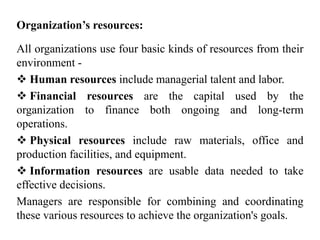
Organization’s resources:
All organizations use four basic kinds of resources from their
environment -
 Human resources include managerial talent and labor.
 Financial resources are the capital used by the
organization to finance both ongoing and long-term
operations.
 Physical resources include raw materials, office and
production facilities, and equipment.
 Information resources are usable data needed to take
effective decisions.
Managers are responsible for combining and coordinating
these various resources to achieve the organization's goals.
Who is a manager?
A manager is someone whose primary responsibility is
to carry out the management process. In particular, a
manager is someone who plans and makes decisions,
organizes, leads, and controls human, financial, physical,
and information resources.
The manager‘s job is unpredictable and fraught with
challenges, but it is also filled with opportunities to
make a difference. Good managers can propel an
organization into unprecedented realms of success
whereas poor managers can devastate even the strongest
of organizations
What is management?
Management is defined as a set of activities (including
planning and decision making, organizing, leading, and
controlling) directed at an organization‘s resources
(human, financial, physical, and information), with the
aim of achieving organizational goals in an efficient and
effective manner.
Effective: Making the right decisions and successfully
implementing them
Efficient: Using resources wisely and in a cost-effective
way
Management in organizations:
Basic managerial activities include planning and decision
making, organizing, leading, and controlling. Managers
engage in these activities to combine human, financial,
physical, and information resources efficiently and
effectively and to work toward achieving the goals of the
organization.
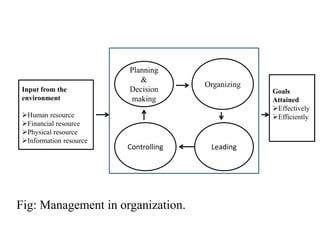
Fig: Management in organization.
Input from the
environment
Human resource
Financial resource
Physical resource
Information resource
Planning
&
Decision
making
Organizing
Controlling Leading
Goals
Attained
Effectively
Efficiently
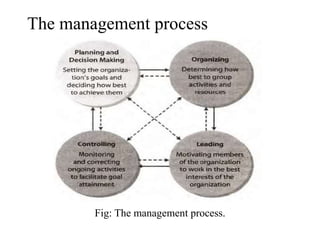
The management process
Fig: The management process.
1. Planning and Decision Making: Determining
Courses of Action
Planning means setting an organization's goals and
deciding how best to achieve them.
Decision making involves selecting a course of action
from a set of alternatives.
Planning and decision making help maintain managerial
effectiveness by serving as guides for future activities. In
other words, the organization's goals and plans clearly
help managers know how to allocate their time and
resources.
2. Organizing: Coordinating Activities and
Resources
Once a manager has set goals and developed a workable
plan, the next management function is to organize people
and the other resources necessary to carry out the plan.
Specifically, organizing involves determining how
activities and resources are to be grouped.
3. Leading: Motivating and Managing People
Leading is the set of processes used to get members of
the organization to work together to further the interests
of the organization.
4. Controlling: Monitoring and Evaluating Activities
The final phase of the management process is
controlling, or monitoring the organization's progress
toward its goals. As the organization moves toward its
goals, managers must monitor progress to ensure that it is
performing in such a way as to arrive at its "destination''
at the appointed time.
Kinds of managers:
There are three basic levels:
 Top manager
 Middle manager
 First line manager
Top managers:
Top managers make up the relatively small group of
executives who manage the overall organization. Titles
found in this group include president, vice president, and
chief executive officer (CEO). Top managers create the
organization’s goals, overall strategy and operating
policies. They also officially represent the organization to
the external environment by meeting with government
officials, executives of other organizations, and so forth.
Middle managers:
Middle management is probably the largest group of
managers in most organizations. Common middle-
management titles include plant manager, operations
manager, and division head. Middle managers are
responsible primarily for implementing the policies and
plans developed by top managers and for supervising and
coordinating the activities of lower-level managers.
First line managers:
First-line managers supervise and coordinate the
activities of operating employees. Common titles for
first-line managers are supervisor, coordinator and office
manager.
Managerial roles:
Research by Henry Mintzberg suggests that managers
play ten basic managerial roles and that these roles fall
into three basic categories:
 Interpersonal
 Informational and
 Decisional
Interpersonal Roles:
There are three interpersonal roles inherent in the
manager's job.
 Figure head: taking visitors to dinner, attending
ribbon-cutting ceremonies, and the like. These
activities are typically more ceremonial and
symbolic than substantive.
 Leader: hiring, training, and motivating employees.
A manager who formally or informally shows
subordinates how to do things and how to perform
under pressure is leading.
 Liaison: This role often involves serving as a
coordinator or link among people, groups, or
organizations.
Informational Roles:
The process of carrying out these roles places the manager at
a strategic point to gather and disseminate information.
 Monitor: A manager actively seeks information that may
be of value. The manager questions subordinates, is
receptive to unsolicited information and attempts to be as
well informed as possible.
 Disseminator: A manager transmits relevant
information back to others in the workplace. When the
roles of monitor and disseminator are viewed together,
the manager emerges as a vital link in the organization's
chain of communication.
 Spokesperson: This informational role focuses on
external communication. The spokesperson formally
relays information to people outside the unit or outside
the organization.
Decisional Roles:
Mintzberg identified four decisional roles.
 Entrepreneur: A manager acts as an initiator of
change.
 Disturbance handler: The manager has to handle
problems such as strikes, copyright infringements or
problems in public relations or corporate image.
 Resource allocator: As resource allocator, the
manager decides how resources are distributed and
with whom s/he will work most closely.
 Negotiator: In this role the manager enters into
negotiations with other groups or organizations as a
representative of the company. Negotiations may also
be internal to the organization.
Managerial Skills:
A good manager must have some fundamental
management skills. Such as –
 Technical skill
 Interpersonal skill
 Conceptual skill
 Diagnostic skill
 Communication skill
 Decision making skill
 Time management skill
1. Technical skill:
Technical skills are the skills necessary to accomplish or
understand the specific kind of work being done in an
organization. Technical skills are especially important for
first- line managers. These managers spend much of their
time training subordinates and answering questions about
work-related problems.
2. Interpersonal skill:
It is the ability to communicate with, understand and
motivate both individuals and groups. As a manager
climbs the organizational ladder, s/he must be able to
get along with subordinates as well as those at higher
levels of the organization. A manager must also be able
to work with suppliers, customers, investors and others
outside of the organization.
3. Conceptual skill:
It is the manager's ability to think in the abstract.
Managers need the mental capacity to understand the
over all workings of the organization and its
environment, to grasp how all the parts of the
organization fit together, and to view the organization in
a holistic manner. This allows them to think
strategically, to see the "big picture," and to make
broad-based decisions that serve the overall
organization.
4. Diagnostic skill:
It is the skill that enables a manager to visualize the
most appropriate response to a situation.
A manager can diagnose and analyze a problem in the
organization by studying its symptoms and then
developing a solution.
Good diagnostic skill enables a manager to understand
both why the current business model is not working and
how to construct a better one.
5. Communication skill:
It is the manager's ability both to effectively convey
ideas and information to others and to effectively
receive ideas and information from others. These skills
enable a manager to transmit ideas to subordinates so
that they know what is expected, to coordinate work
with peers and colleagues so that they work well
together properly, and to keep higher-level managers
informed about what is going on.
6. Decision-making skill:
It is the manager's ability to correctly recognize and
define problems and opportunities and to then select an
appropriate course of action to solve problems and
capitalize on opportunities. An effective managers make
good decision most of the time. In case of any bad
decision, they usually recognize their mistake quickly
and then make good decisions to recover with as little
cost or damage to their organization as possible.
7. Time management skill:
It is the manager's ability to prioritize work, to work
efficiently and to delegate appropriately. A manager
faces different pressures and challenges. It is too easy
for a manager to get bogged down doing work that can
easily be postponed or delegated to others.
When this happens, unfortunately, more pressing and
higher-priority work may get neglected.
Management: Science or Art?
Effective management is a blend of both science and art.
The Science of Management:
Technical, diagnostic and decision-making skills are
important when practicing the science of management.
Managers can use quantitative models and decision-
making techniques to arrive at "correct" decisions. And
they need to take such a scientific approach to solving
problems whenever possible especially when they are
dealing with relatively routine and straightforward
issues.
The Art of Management:
Even though managers may try to be scientific as much
as possible, they must often make decisions and solve
problems on the basis of intuition, experience, instinct,
and personal insights. Relying heavily on conceptual,
communication, interpersonal and time-management
skills, for example, a manager may have to decide
among multiple courses of action that look equally
attractive.
Thank You

Introduction to management

  • 1.
    Introduction to Pharmaceutical Management AmritaSutradhar Lecturer Department of Pharmacy Southeast University Dhaka, Bangladesh
  • 2.
    What is Organization? Organizationis defined as a group of people working together in a structured and coordinated fashion to achieve a set of goals. The goals may include profit, the discovery of knowledge, national defense, coordination of various local charities or social satisfaction (a sorority). As organizations play such a major role in our lives, understanding how they operate and how they are managed is important.
  • 3.
    Organization’s resources: All organizationsuse four basic kinds of resources from their environment -  Human resources include managerial talent and labor.  Financial resources are the capital used by the organization to finance both ongoing and long-term operations.  Physical resources include raw materials, office and production facilities, and equipment.  Information resources are usable data needed to take effective decisions. Managers are responsible for combining and coordinating these various resources to achieve the organization's goals.
  • 4.
    Who is amanager? A manager is someone whose primary responsibility is to carry out the management process. In particular, a manager is someone who plans and makes decisions, organizes, leads, and controls human, financial, physical, and information resources. The manager‘s job is unpredictable and fraught with challenges, but it is also filled with opportunities to make a difference. Good managers can propel an organization into unprecedented realms of success whereas poor managers can devastate even the strongest of organizations
  • 5.
    What is management? Managementis defined as a set of activities (including planning and decision making, organizing, leading, and controlling) directed at an organization‘s resources (human, financial, physical, and information), with the aim of achieving organizational goals in an efficient and effective manner. Effective: Making the right decisions and successfully implementing them Efficient: Using resources wisely and in a cost-effective way
  • 6.
    Management in organizations: Basicmanagerial activities include planning and decision making, organizing, leading, and controlling. Managers engage in these activities to combine human, financial, physical, and information resources efficiently and effectively and to work toward achieving the goals of the organization.
  • 7.
    Fig: Management inorganization. Input from the environment Human resource Financial resource Physical resource Information resource Planning & Decision making Organizing Controlling Leading Goals Attained Effectively Efficiently
  • 8.
    The management process Fig:The management process.
  • 9.
    1. Planning andDecision Making: Determining Courses of Action Planning means setting an organization's goals and deciding how best to achieve them. Decision making involves selecting a course of action from a set of alternatives. Planning and decision making help maintain managerial effectiveness by serving as guides for future activities. In other words, the organization's goals and plans clearly help managers know how to allocate their time and resources.
  • 10.
    2. Organizing: CoordinatingActivities and Resources Once a manager has set goals and developed a workable plan, the next management function is to organize people and the other resources necessary to carry out the plan. Specifically, organizing involves determining how activities and resources are to be grouped. 3. Leading: Motivating and Managing People Leading is the set of processes used to get members of the organization to work together to further the interests of the organization.
  • 11.
    4. Controlling: Monitoringand Evaluating Activities The final phase of the management process is controlling, or monitoring the organization's progress toward its goals. As the organization moves toward its goals, managers must monitor progress to ensure that it is performing in such a way as to arrive at its "destination'' at the appointed time.
  • 12.
    Kinds of managers: Thereare three basic levels:  Top manager  Middle manager  First line manager
  • 13.
    Top managers: Top managersmake up the relatively small group of executives who manage the overall organization. Titles found in this group include president, vice president, and chief executive officer (CEO). Top managers create the organization’s goals, overall strategy and operating policies. They also officially represent the organization to the external environment by meeting with government officials, executives of other organizations, and so forth.
  • 14.
    Middle managers: Middle managementis probably the largest group of managers in most organizations. Common middle- management titles include plant manager, operations manager, and division head. Middle managers are responsible primarily for implementing the policies and plans developed by top managers and for supervising and coordinating the activities of lower-level managers.
  • 15.
    First line managers: First-linemanagers supervise and coordinate the activities of operating employees. Common titles for first-line managers are supervisor, coordinator and office manager.
  • 16.
    Managerial roles: Research byHenry Mintzberg suggests that managers play ten basic managerial roles and that these roles fall into three basic categories:  Interpersonal  Informational and  Decisional
  • 17.
    Interpersonal Roles: There arethree interpersonal roles inherent in the manager's job.  Figure head: taking visitors to dinner, attending ribbon-cutting ceremonies, and the like. These activities are typically more ceremonial and symbolic than substantive.  Leader: hiring, training, and motivating employees. A manager who formally or informally shows subordinates how to do things and how to perform under pressure is leading.  Liaison: This role often involves serving as a coordinator or link among people, groups, or organizations.
  • 18.
    Informational Roles: The processof carrying out these roles places the manager at a strategic point to gather and disseminate information.  Monitor: A manager actively seeks information that may be of value. The manager questions subordinates, is receptive to unsolicited information and attempts to be as well informed as possible.  Disseminator: A manager transmits relevant information back to others in the workplace. When the roles of monitor and disseminator are viewed together, the manager emerges as a vital link in the organization's chain of communication.  Spokesperson: This informational role focuses on external communication. The spokesperson formally relays information to people outside the unit or outside the organization.
  • 19.
    Decisional Roles: Mintzberg identifiedfour decisional roles.  Entrepreneur: A manager acts as an initiator of change.  Disturbance handler: The manager has to handle problems such as strikes, copyright infringements or problems in public relations or corporate image.  Resource allocator: As resource allocator, the manager decides how resources are distributed and with whom s/he will work most closely.  Negotiator: In this role the manager enters into negotiations with other groups or organizations as a representative of the company. Negotiations may also be internal to the organization.
  • 20.
    Managerial Skills: A goodmanager must have some fundamental management skills. Such as –  Technical skill  Interpersonal skill  Conceptual skill  Diagnostic skill  Communication skill  Decision making skill  Time management skill
  • 21.
    1. Technical skill: Technicalskills are the skills necessary to accomplish or understand the specific kind of work being done in an organization. Technical skills are especially important for first- line managers. These managers spend much of their time training subordinates and answering questions about work-related problems.
  • 22.
    2. Interpersonal skill: Itis the ability to communicate with, understand and motivate both individuals and groups. As a manager climbs the organizational ladder, s/he must be able to get along with subordinates as well as those at higher levels of the organization. A manager must also be able to work with suppliers, customers, investors and others outside of the organization.
  • 23.
    3. Conceptual skill: Itis the manager's ability to think in the abstract. Managers need the mental capacity to understand the over all workings of the organization and its environment, to grasp how all the parts of the organization fit together, and to view the organization in a holistic manner. This allows them to think strategically, to see the "big picture," and to make broad-based decisions that serve the overall organization.
  • 24.
    4. Diagnostic skill: Itis the skill that enables a manager to visualize the most appropriate response to a situation. A manager can diagnose and analyze a problem in the organization by studying its symptoms and then developing a solution. Good diagnostic skill enables a manager to understand both why the current business model is not working and how to construct a better one.
  • 25.
    5. Communication skill: Itis the manager's ability both to effectively convey ideas and information to others and to effectively receive ideas and information from others. These skills enable a manager to transmit ideas to subordinates so that they know what is expected, to coordinate work with peers and colleagues so that they work well together properly, and to keep higher-level managers informed about what is going on.
  • 26.
    6. Decision-making skill: Itis the manager's ability to correctly recognize and define problems and opportunities and to then select an appropriate course of action to solve problems and capitalize on opportunities. An effective managers make good decision most of the time. In case of any bad decision, they usually recognize their mistake quickly and then make good decisions to recover with as little cost or damage to their organization as possible.
  • 27.
    7. Time managementskill: It is the manager's ability to prioritize work, to work efficiently and to delegate appropriately. A manager faces different pressures and challenges. It is too easy for a manager to get bogged down doing work that can easily be postponed or delegated to others. When this happens, unfortunately, more pressing and higher-priority work may get neglected.
  • 28.
    Management: Science orArt? Effective management is a blend of both science and art. The Science of Management: Technical, diagnostic and decision-making skills are important when practicing the science of management. Managers can use quantitative models and decision- making techniques to arrive at "correct" decisions. And they need to take such a scientific approach to solving problems whenever possible especially when they are dealing with relatively routine and straightforward issues.
  • 29.
    The Art ofManagement: Even though managers may try to be scientific as much as possible, they must often make decisions and solve problems on the basis of intuition, experience, instinct, and personal insights. Relying heavily on conceptual, communication, interpersonal and time-management skills, for example, a manager may have to decide among multiple courses of action that look equally attractive.
  • 30.