Humanistic School
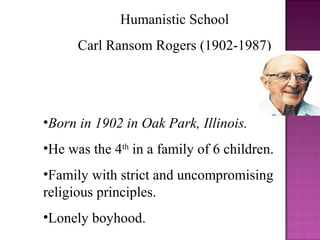
Carl Ransom Rogers (1902-1987)
•Born in 1902 in Oak Park, Illinois.
•He was the 4th
in a family of 6 children.
•Family with strict and uncompromising
religious principles.
•Lonely boyhood.
•After graduation, entered Union Theological
Seminary in New York city.
•Took Doctorate degree in 1928 (Rochester
University).
•Lecturer of psychology at the University of
Zurich.
•Senior psychiatrist at the Psychiatric Clinic
in Switzerland.
•Started Counseling centre at Chicago
University.
Major Concepts
1.Human beings are basically good.
2.All creatures strive to make the very
best of their existence- everyone has
the potential for self-actualization.
(The built-in motivation present in every
life form to develop its potentials to the
fullest extent possible.
3. This development (actualization) can only
be achieved through “Unconditional Positive
Regard”.
 Each person has a need for Unconditional
Positive Regard = acceptance, respect,
sympathy and love regardless of their
performance.
Most people receive conditional positive
regard = acceptance only for doing what
parent or society insists upon: the person is
valued for what he/she does, nor for who is
she or he.
 Messages that we give to ourselves
have a strong impact.
 You are stupid!
 Unconditional positive--- winner
 Negative --- loser
5
The Humanistic Tradition:The Humanistic Tradition:
Carl RogersCarl Rogers
 The Motive to Self-Actualize
 Main Beliefs
 Actualization
 Self-actualization
 Fully-functioning person
 Positive Regard
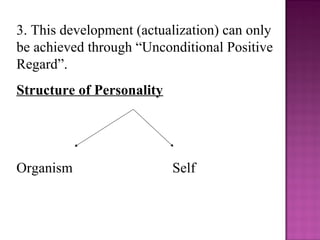
3. This development (actualization) can only
be achieved through “Unconditional Positive
Regard”.
Structure of Personality
Organism Self
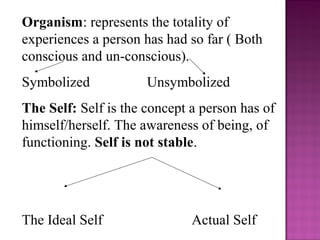
Organism: represents the totality of
experiences a person has had so far ( Both
conscious and un-conscious).
Symbolized Unsymbolized
The Self: Self is the concept a person has of
himself/herself. The awareness of being, of
functioning. Self is not stable.
The Ideal Self Actual Self
Rogers as a “Self” TheoristRogers as a “Self” Theorist
 How perspectives on the Self can interact
 Congruence of Self
 Incongruence of Self
Congruence vs. IncongruenceCongruence vs. Incongruence
 Congruence of “Self”
 Occurs when ideal self and actual self are
similar – when you are whom you want to be
 Occurs when actual self and real self are
similar – when you act like the person you
know yourself to be
 Both achieved by self-actualization and result
in a fully functioning person
Congruence vs. IncongruenceCongruence vs. Incongruence
 Incongruence of “Self”
 Caused by a mismatch of ideal/actual
selves or actual/real selves
 Caused by ‘conditions of worth’
 Leads to anxiety
 Defenses enacted to protect Self from
this anxiety
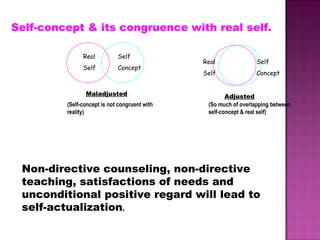
Self-concept & its congruence with real self.
Real
Self
Self
Concept
Maladjusted
(Self-concept is not congruent with
reality)
Adjusted
(So much of overlapping between
self-concept & real self)
Non-directive counseling, non-directive
teaching, satisfactions of needs and
unconditional positive regard will lead to
self-actualization.
Self
Concept
Real
Self
Rogerian Client-CenteredRogerian Client-Centered
TherapyTherapy
 Focus on the client’s topics of
discussion
 Clarify feelings
 Restatement of content
 Client is responsible for therapy’s
progress and coming to own
conclusions, solving own problems

Rogers

  • 1.
    Humanistic School Carl RansomRogers (1902-1987) •Born in 1902 in Oak Park, Illinois. •He was the 4th in a family of 6 children. •Family with strict and uncompromising religious principles. •Lonely boyhood.
  • 2.
    •After graduation, enteredUnion Theological Seminary in New York city. •Took Doctorate degree in 1928 (Rochester University). •Lecturer of psychology at the University of Zurich. •Senior psychiatrist at the Psychiatric Clinic in Switzerland. •Started Counseling centre at Chicago University.
  • 3.
    Major Concepts 1.Human beingsare basically good. 2.All creatures strive to make the very best of their existence- everyone has the potential for self-actualization. (The built-in motivation present in every life form to develop its potentials to the fullest extent possible.
  • 4.
    3. This development(actualization) can only be achieved through “Unconditional Positive Regard”.  Each person has a need for Unconditional Positive Regard = acceptance, respect, sympathy and love regardless of their performance. Most people receive conditional positive regard = acceptance only for doing what parent or society insists upon: the person is valued for what he/she does, nor for who is she or he.
  • 5.
     Messages thatwe give to ourselves have a strong impact.  You are stupid!  Unconditional positive--- winner  Negative --- loser 5
  • 6.
    The Humanistic Tradition:TheHumanistic Tradition: Carl RogersCarl Rogers  The Motive to Self-Actualize  Main Beliefs  Actualization  Self-actualization  Fully-functioning person  Positive Regard
  • 7.
    3. This development(actualization) can only be achieved through “Unconditional Positive Regard”. Structure of Personality Organism Self
  • 8.
    Organism: represents thetotality of experiences a person has had so far ( Both conscious and un-conscious). Symbolized Unsymbolized The Self: Self is the concept a person has of himself/herself. The awareness of being, of functioning. Self is not stable. The Ideal Self Actual Self
  • 9.
    Rogers as a“Self” TheoristRogers as a “Self” Theorist  How perspectives on the Self can interact  Congruence of Self  Incongruence of Self
  • 10.
    Congruence vs. IncongruenceCongruencevs. Incongruence  Congruence of “Self”  Occurs when ideal self and actual self are similar – when you are whom you want to be  Occurs when actual self and real self are similar – when you act like the person you know yourself to be  Both achieved by self-actualization and result in a fully functioning person
  • 11.
    Congruence vs. IncongruenceCongruencevs. Incongruence  Incongruence of “Self”  Caused by a mismatch of ideal/actual selves or actual/real selves  Caused by ‘conditions of worth’  Leads to anxiety  Defenses enacted to protect Self from this anxiety
  • 12.
    Self-concept & itscongruence with real self. Real Self Self Concept Maladjusted (Self-concept is not congruent with reality) Adjusted (So much of overlapping between self-concept & real self) Non-directive counseling, non-directive teaching, satisfactions of needs and unconditional positive regard will lead to self-actualization. Self Concept Real Self
  • 13.
    Rogerian Client-CenteredRogerian Client-Centered TherapyTherapy Focus on the client’s topics of discussion  Clarify feelings  Restatement of content  Client is responsible for therapy’s progress and coming to own conclusions, solving own problems