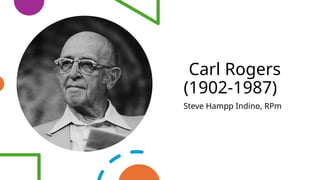
Carl Rogers
(1902-1987)
Steve Hampp Indino, RPm
Biography
Born in 1902 in Oak Park,
Illinois, USA.
Raised in a strict,
religious household.
Initially studied
agriculture, then shifted
to theology, but
eventually moved to
psychology.
Influenced by his work
with troubled children at
the Society for the
Prevention of Cruelty to
Children.
Died in 1987 after major
contributions to
counseling, education,
and peace efforts.
ROGER’S
SELF
THEORY
Carl Rogers dealt with college
students with adjustment
problems
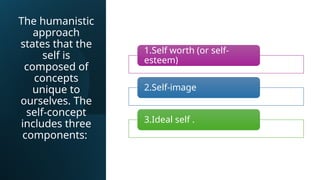
The humanistic
approach
states that the
self is
composed of
concepts
unique to
ourselves. The
self-concept
includes three
components:
1.Self worth (or self-
esteem)
2.Self-image
3.Ideal self .
Self worth
(or self-
esteem)
what we think about
ourselves.
Rogers believed feelings of self-
worth developed in early
childhood and were formed
from the interaction of the child
with the mother and father.
Self-image
How we see ourselves, which is
important to good psychological health.
Self-image includes the influence of our
body image on inner personality.
At a simple level, we might perceive
ourselves as a good or bad person,
beautiful or ugly.
Self-image has an effect on how a person
thinks, feels and behaves in the world.
Ideal self
This is the person we would like
to be.
It consists of our goals and
ambitions in life, and is dynamic
– i.e., forever changing.
The ideal self in childhood is not
the ideal self in our teens or late
twenties, etc.
Humanistic
Perspective
s
Carl Rogers: Person-Centered
Therapy
Viewed personality structure in
terms of “self-concept” or the beliefs
about one’s own behavior, nature,
and qualities
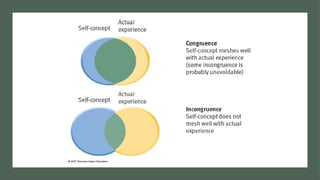
Incongruence is the degree of
difference b/w self-concept and
actual experience (if it is accurate, it
is congruent)
Self-
Concept
An important tool in human
self-actualization is the
development of an image of
oneself, or the self-concept.
Self or Self-
Concept
🔵 Positive Self-Concept: We act, feel, and think
optimistically. We behave constructively —
meaning: We believe we can solve problems. We
pursue goals confidently. We handle failures as
learning experiences.
🔴 Negative Self-Concept: We act, feel, and think
pessimistically. We behave destructively —
meaning: We doubt ourselves. We expect failure
or rejection. We may give up easily or harm our
own progress.
Short Version: Self-concept is how we see
ourselves —if positive, we think and act
constructively; if negative, we think and act
destructively.
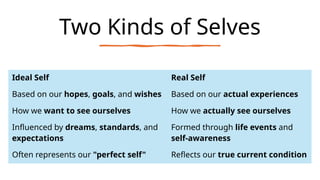
Two Kinds of Selves
Ideal Self Real Self
Based on our hopes, goals, and wishes Based on our actual experiences
How we want to see ourselves How we actually see ourselves
Influenced by dreams, standards, and
expectations
Formed through life events and
self-awareness
Often represents our "perfect self" Reflects our true current condition
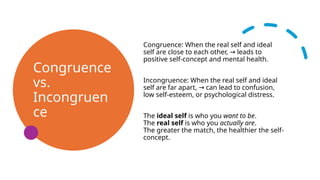
Congruence
vs.
Incongruen
ce
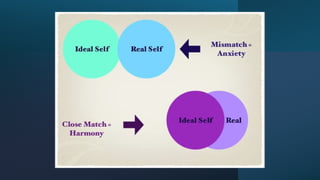
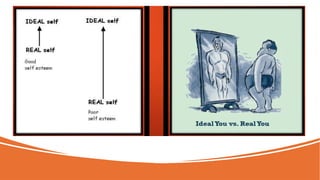
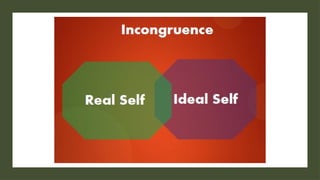
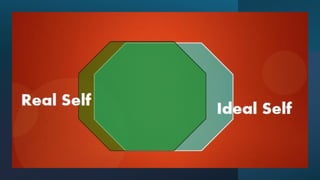
Congruence: When the real self and ideal
self are close to each other, leads to
→
positive self-concept and mental health.
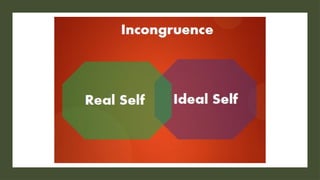
Incongruence: When the real self and ideal
self are far apart, can lead to confusion,
→
low self-esteem, or psychological distress.
The ideal self is who you want to be.
The real self is who you actually are.
The greater the match, the healthier the self-
concept.
Carl
Rogers’s
Person-
Centered
Perspectiv
e
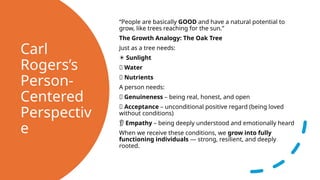
“People are basically GOOD and have a natural potential to
grow, like trees reaching for the sun.”
The Growth Analogy: The Oak Tree
Just as a tree needs:
☀️Sunlight
💧 Water
🌿 Nutrients
A person needs:
🤝 Genuineness – being real, honest, and open
💗 Acceptance – unconditional positive regard (being loved
without conditions)
👂 Empathy – being deeply understood and emotionally heard
When we receive these conditions, we grow into fully
functioning individuals — strong, resilient, and deeply
rooted.
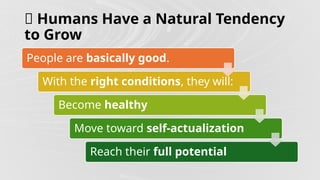
🌱 Humans Have a Natural Tendency
to Grow
People are basically good.
With the right conditions, they will:
Become healthy
Move toward self-actualization
Reach their full potential
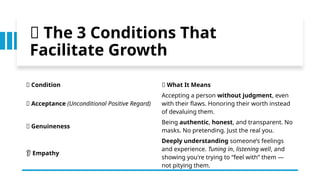
🌳 The 3 Conditions That
Facilitate Growth
🌿 Condition 🧠 What It Means
🤝 Acceptance (Unconditional Positive Regard)
Accepting a person without judgment, even
with their flaws. Honoring their worth instead
of devaluing them.
💬 Genuineness
Being authentic, honest, and transparent. No
masks. No pretending. Just the real you.
👂 Empathy
Deeply understanding someone’s feelings
and experience. Tuning in, listening well, and
showing you're trying to “feel with” them —
not pitying them.
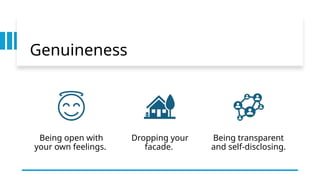
Genuineness
Being open with
your own feelings.
Dropping your
facade.
Being transparent
and self-disclosing.
Acceptance / Unconditional
Positive Regard
An attitude of acceptance regardless of circumstances. Accepting
yourself or others completely.
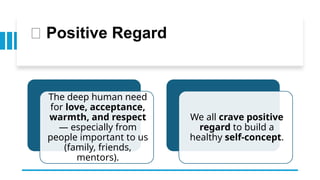
💖 Positive Regard
The deep human need
for love, acceptance,
warmth, and respect
— especially from
people important to us
(family, friends,
mentors).
We all crave positive
regard to build a
healthy self-concept.
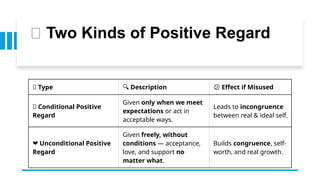
🔁 Two Kinds of Positive Regard
🔹 Type 🔍 Description 😕 Effect if Misused
💡 Conditional Positive
Regard
Given only when we meet
expectations or act in
acceptable ways.
Leads to incongruence
between real & ideal self.
❤️Unconditional Positive
Regard
Given freely, without
conditions — acceptance,
love, and support no
matter what.
Builds congruence, self-
worth, and real growth.
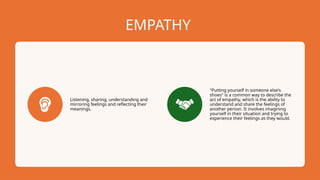
EMPATHY
Listening, sharing, understanding and
mirroring feelings and reflecting their
meanings.
"Putting yourself in someone else's
shoes" is a common way to describe the
act of empathy, which is the ability to
understand and share the feelings of
another person. It involves imagining
yourself in their situation and trying to
experience their feelings as they would.
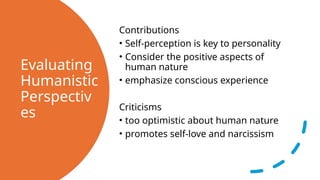
Evaluating
Humanistic
Perspectiv
es
Contributions
• Self-perception is key to personality
• Consider the positive aspects of
human nature
• emphasize conscious experience
Criticisms
• too optimistic about human nature
• promotes self-love and narcissism
CARL ROGERS................................pptx

CARL ROGERS................................pptx

  • 1.
  • 2.
    Biography Born in 1902in Oak Park, Illinois, USA. Raised in a strict, religious household. Initially studied agriculture, then shifted to theology, but eventually moved to psychology. Influenced by his work with troubled children at the Society for the Prevention of Cruelty to Children. Died in 1987 after major contributions to counseling, education, and peace efforts.
  • 3.
    ROGER’S SELF THEORY Carl Rogers dealtwith college students with adjustment problems
  • 4.
    The humanistic approach states thatthe self is composed of concepts unique to ourselves. The self-concept includes three components: 1.Self worth (or self- esteem) 2.Self-image 3.Ideal self .
  • 5.
    Self worth (or self- esteem) whatwe think about ourselves. Rogers believed feelings of self- worth developed in early childhood and were formed from the interaction of the child with the mother and father.
  • 6.
    Self-image How we seeourselves, which is important to good psychological health. Self-image includes the influence of our body image on inner personality. At a simple level, we might perceive ourselves as a good or bad person, beautiful or ugly. Self-image has an effect on how a person thinks, feels and behaves in the world.
  • 7.
    Ideal self This isthe person we would like to be. It consists of our goals and ambitions in life, and is dynamic – i.e., forever changing. The ideal self in childhood is not the ideal self in our teens or late twenties, etc.
  • 8.
    Humanistic Perspective s Carl Rogers: Person-Centered Therapy Viewedpersonality structure in terms of “self-concept” or the beliefs about one’s own behavior, nature, and qualities Incongruence is the degree of difference b/w self-concept and actual experience (if it is accurate, it is congruent)
  • 9.
    Self- Concept An important toolin human self-actualization is the development of an image of oneself, or the self-concept.
  • 10.
    Self or Self- Concept 🔵Positive Self-Concept: We act, feel, and think optimistically. We behave constructively — meaning: We believe we can solve problems. We pursue goals confidently. We handle failures as learning experiences. 🔴 Negative Self-Concept: We act, feel, and think pessimistically. We behave destructively — meaning: We doubt ourselves. We expect failure or rejection. We may give up easily or harm our own progress. Short Version: Self-concept is how we see ourselves —if positive, we think and act constructively; if negative, we think and act destructively.
  • 11.
    Two Kinds ofSelves Ideal Self Real Self Based on our hopes, goals, and wishes Based on our actual experiences How we want to see ourselves How we actually see ourselves Influenced by dreams, standards, and expectations Formed through life events and self-awareness Often represents our "perfect self" Reflects our true current condition
  • 12.
    Congruence vs. Incongruen ce Congruence: When thereal self and ideal self are close to each other, leads to → positive self-concept and mental health. Incongruence: When the real self and ideal self are far apart, can lead to confusion, → low self-esteem, or psychological distress. The ideal self is who you want to be. The real self is who you actually are. The greater the match, the healthier the self- concept.
  • 19.
    Carl Rogers’s Person- Centered Perspectiv e “People are basicallyGOOD and have a natural potential to grow, like trees reaching for the sun.” The Growth Analogy: The Oak Tree Just as a tree needs: ☀️Sunlight 💧 Water 🌿 Nutrients A person needs: 🤝 Genuineness – being real, honest, and open 💗 Acceptance – unconditional positive regard (being loved without conditions) 👂 Empathy – being deeply understood and emotionally heard When we receive these conditions, we grow into fully functioning individuals — strong, resilient, and deeply rooted.
  • 20.
    🌱 Humans Havea Natural Tendency to Grow People are basically good. With the right conditions, they will: Become healthy Move toward self-actualization Reach their full potential
  • 21.
    🌳 The 3Conditions That Facilitate Growth 🌿 Condition 🧠 What It Means 🤝 Acceptance (Unconditional Positive Regard) Accepting a person without judgment, even with their flaws. Honoring their worth instead of devaluing them. 💬 Genuineness Being authentic, honest, and transparent. No masks. No pretending. Just the real you. 👂 Empathy Deeply understanding someone’s feelings and experience. Tuning in, listening well, and showing you're trying to “feel with” them — not pitying them.
  • 22.
    Genuineness Being open with yourown feelings. Dropping your facade. Being transparent and self-disclosing.
  • 23.
    Acceptance / Unconditional PositiveRegard An attitude of acceptance regardless of circumstances. Accepting yourself or others completely.
  • 24.
    💖 Positive Regard Thedeep human need for love, acceptance, warmth, and respect — especially from people important to us (family, friends, mentors). We all crave positive regard to build a healthy self-concept.
  • 25.
    🔁 Two Kindsof Positive Regard 🔹 Type 🔍 Description 😕 Effect if Misused 💡 Conditional Positive Regard Given only when we meet expectations or act in acceptable ways. Leads to incongruence between real & ideal self. ❤️Unconditional Positive Regard Given freely, without conditions — acceptance, love, and support no matter what. Builds congruence, self- worth, and real growth.
  • 26.
    EMPATHY Listening, sharing, understandingand mirroring feelings and reflecting their meanings. "Putting yourself in someone else's shoes" is a common way to describe the act of empathy, which is the ability to understand and share the feelings of another person. It involves imagining yourself in their situation and trying to experience their feelings as they would.

  • 27.
    Evaluating Humanistic Perspectiv es Contributions • Self-perception iskey to personality • Consider the positive aspects of human nature • emphasize conscious experience Criticisms • too optimistic about human nature • promotes self-love and narcissism