THE ROCKET
GAMES
CULTUREWho we are
and what we want to be
Culture is a set of shared behaviors,
symbols, systems, practices and norms.
What is
CULTURE? beliefs, values working language,
Once a culture has formed, it is hard to change.
Whether you plan for it or not.
And culture spreads. It is generational,
and is passed on to new employees.
Culture
HAPPENS.
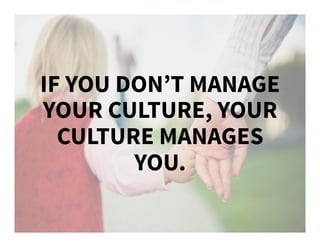
IF YOU DON’T MANAGE
YOUR CULTURE, YOUR
CULTURE MANAGES
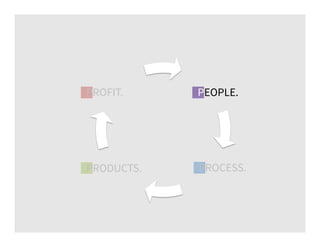
YOU.
The best organizations understand that
culture can be the most sustainable
source of competitive advantage.COMPETITIVE ADVANTAGE.
CULTURE	
  
eats strategy for breakfast.	
  
PETER DRUCKER	
  
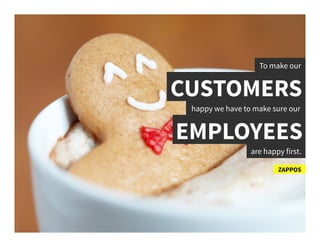
To make our	
  
CUSTOMERS	
  
happy we have to make sure our	
  
EMPLOYEES	
  
are happy first. 	
  
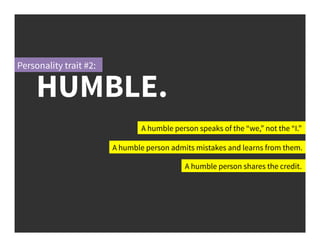
ZAPPOS	
  
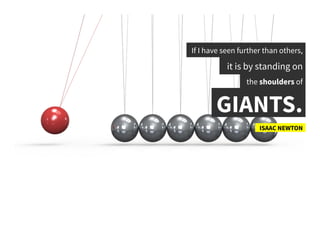
OUR GOAL IS TO
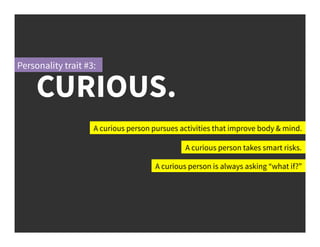
NURTURE A CULTURE
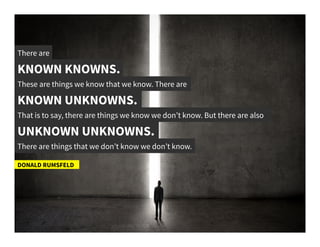
THAT CAN SERVE AS A
GUIDE ON OUR LONG-
TERM MISSION.
A bit of who we’d like to be.
A bit of who we are.
This document is
US.
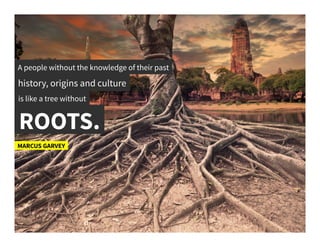
A people without the knowledge of their past	
  
history, origins and culture	
  
is like a tree without 	
  
ROOTS.	
  
MARCUS GARVEY	
  
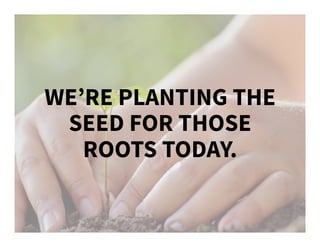
WE’RE PLANTING THE
SEED FOR THOSE
ROOTS TODAY.
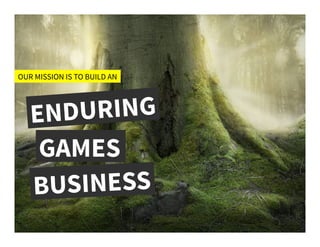
OUR MISSION IS TO BUILD AN
ENDURING
GAMES
BUSINESS
mission, and reinforces our shared values.
Culture orients us towards our long-term
What role does
CULTURE
play?
What do we value?VALUE?
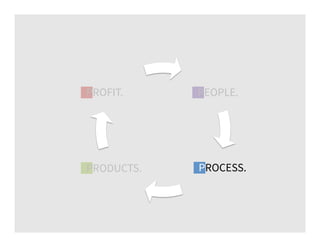
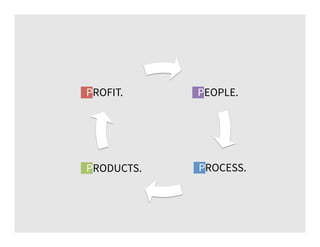
We value the 4 Ps.4 Ps.
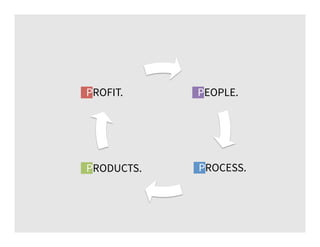
PEOPLE.
PROCESS.PRODUCTS.
PROFIT.
THE 4 Ps MAKE (OUR)
WORLD GO ROUND.
PEOPLE.
Only hire the best. Continue to invest in them.
It all starts with great people.
Empower our people, and give them autonomy to operate.
1.
PROCESS.
Eliminate wasteful practices.
Develop the right processes to maximize productivity.
Continually improve by questioning the “why?”
2.
PRODUCTS.
Build games our customers will love.
Build the right games for the right markets.
3.
PROFIT.
Develop and operate each game we make profitably.
Balance creative appetite with business needs.
Re-invest profits for the long-term success of the business.
4.
THE 4 Ps SERVE AS THE
SHARED LENS
THROUGH WHICH WE
VIEW THE WORLD.
PEOPLE.
PROCESS.PRODUCTS.
PROFIT.
1PEOPLE
We want to work with great
What makes someone a great person?
What makes someone great for Rocket Games?
But what are
GREAT
PEOPLE?
Great people are	
  
diverse and complex.	
  
3	
  
But there are	
  
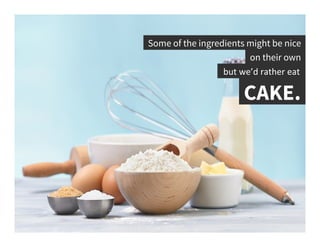
traits in particular that we look for. 	
  
IMPACTFUL.
An impactful person gets stuff done.
An impactful person focuses on results.
An impactful person always finds a way.
Personality trait #1:
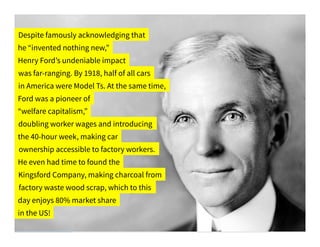
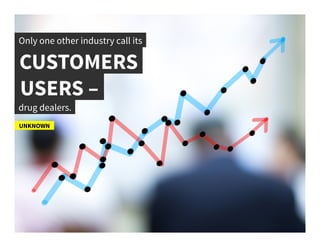
Despite famously acknowledging that
he “invented nothing new,”
Henry Ford’s undeniable impact
was far-ranging. By 1918, half of all cars
in America were Model Ts. At the same time,
Ford was a pioneer of
“welfare capitalism,”
doubling worker wages and introducing
the 40-hour week, making car
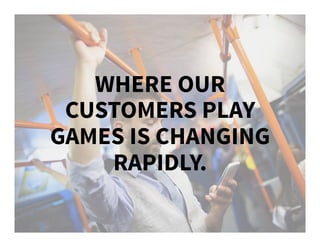
ownership accessible to factory workers.
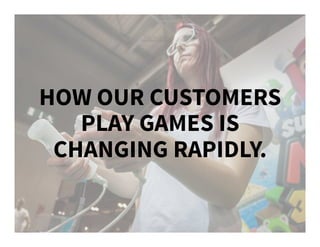
He even had time to found the
Kingsford Company, making charcoal from
factory waste wood scrap, which to this
day enjoys 80% market share
in the US!
A humble person speaks of the “we,” not the “I.”
A humble person admits mistakes and learns from them.
A humble person shares the credit.
HUMBLE.
Personality trait #2:
If I have seen further than others, 	
  
it is by standing on	
  
the shoulders of	
  
GIANTS.	
  
ISAAC NEWTON	
  
A curious person pursues activities that improve body & mind.
A curious person takes smart risks.
A curious person is always asking “what if?”
CURIOUS.
Personality trait #3:
There are	
  
KNOWN KNOWNS.	
  
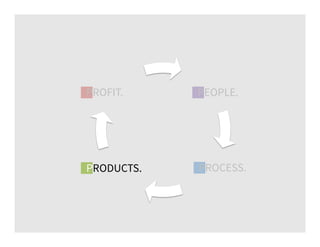
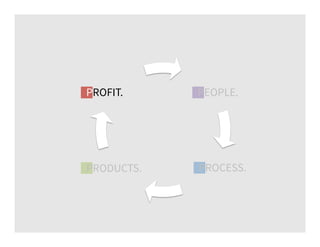
These are things we know that we know. There are 	
  
DONALD RUMSFELD	
  
KNOWN UNKNOWNS.	
  
That is to say, there are things we know we don’t know. But there are also	
  
UNKNOWN UNKNOWNS.	
  
There are things that we don’t know we don’t know. 	
  
Curious people relish in figuring out the
unknown unknowns.
FIGURING OUT
Curious people thrive outside
their comfort zone.COMFORT ZONE.
A ship in a harbor is safe. 	
  
SHIPS ARE BUILT FOR. 	
  
But that is not what	
  
UNKNOWN	
  
We like interesting people.INTERESTING
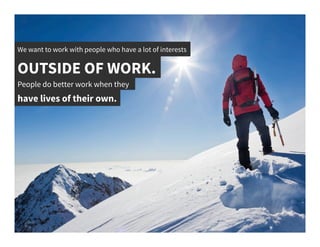
We want to work with people who have a lot of interests	
  
OUTSIDE OF WORK.	
  
People do better work when they	
  
have lives of their own. 	
  
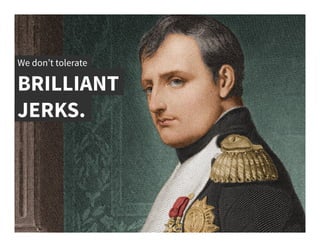
We don’t tolerate	
  
BRILLIANT	
  
JERKS.	
  
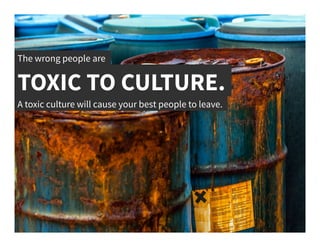
The wrong people are	
  
TOXIC TO CULTURE.	
  
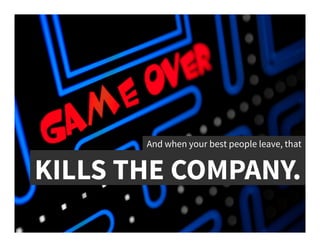
A toxic culture will cause your best people to leave.	
  
And when your best people leave, that	
  
KILLS THE COMPANY.	
  
Never
COMPROMISE
on people.
Hiring the wrong person is 10X
more expensive than not hiring the right person.
And talking about 10X…10X…
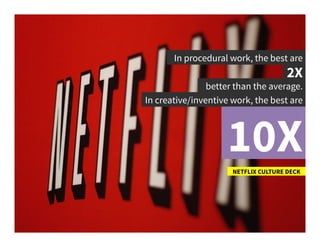
In procedural work, the best are	
  
2X	
  
NETFLIX CULTURE DECK	
  
better than the average.	
  
In creative/inventive work, the best are	
  
10X	
  
Great people need to be empowered. And
empowerment means trust.
EMPOWERED.
TRUST.
TRUST
goes both ways.
For great people to reach their full potential,
you need to trust them 100%.
And they need to trust that you will allow them to
do their jobs. And remove obstacles in their way.
WHAT ARE THESE
OBSTACLES?
Recognize
some of
THESE?
Unnecessary meetings, too many
Arbitrary manager approvals, MVPs designed
Pointless policies, forms to fill in, TPS reports.
decision-makers, email justifications.
for execs instead of customers.
WE PREFER TO DO
WORK RATHER THAN
TALK (OR WRITE)
ABOUT IT.
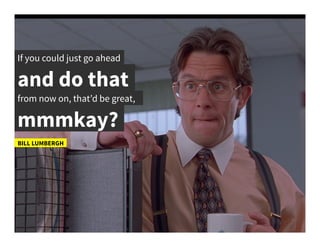
If you could just go ahead	
  
and do that	
  
BILL LUMBERGH	
  
from now on, that’d be great, 	
  
mmmkay?	
  
Do the
RIGHT
THING.
That’s our only policy.
Do what’s best for the customer.
Do what’s best for the company.
Do what’s best for your team.
Make
GOOD
MISTAKES.
Don’t try to avoid failure.
Instead, embrace it.
Fail fast, fail often, and learn.
Great people need to be informed.INFORMED.
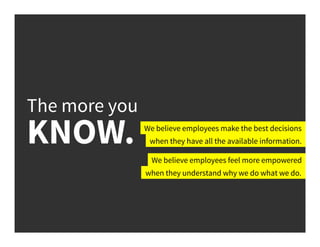
The more you
KNOW. We believe employees make the best decisions
when they have all the available information.
We believe employees feel more empowered
when they understand why we do what we do.
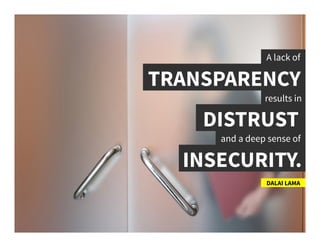
A lack of	
  
TRANSPARENCY	
  
DALAI LAMA	
  
results in	
  
DISTRUST	
  
and a deep sense of	
  
INSECURITY.	
  
That is why we make pretty much every bit of
information about the company available to
everyone at the company.
INFORMATION AVAILABLE
PEOPLE.
PROCESS.PRODUCTS.
PROFIT.
2PROCESS
We value the right
OK! Great people, trusted, empowered and
informed, where now?WHERE NOW?
OK!
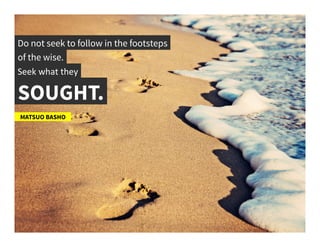
Do not seek to follow in the footsteps	
  
of the wise.	
  
Seek	
  what	
  they	
  
SOUGHT.	
  
MATSUO BASHO	
  
Seek to
understand the
WHY.
“Why” is such a powerful little word.
QUESTIONING	
  
As children, we are constantly	
  
the world around us.	
  
But as we grow up, we
stop questioning.STOP QUESTIONING.
And we start to accept that the answer is
“just because.”“JUST BECAUSE.”
We start to accept the
status quo.STATUS QUO.
We believe it is
never
“JUST
BECAUSE.”
We believe you should always question the status quo.
We believe you should always question “why?”
Only by challenging the status quo
can we get better.
CHALLENGING
(Seriously. The definition of status quo is
“the existing state of affairs.”)
SERIOUSLY.
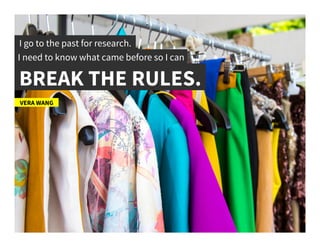
I go to the past for research.	
  
I need to know what came before so I can	
  
BREAK THE RULES.	
  
VERA WANG	
  
“BEST
PRACTICES”
aren’t always
that.
Each product is unique. Each market is unique.
Understanding why something worked somewhere else
is much more important than imitating it.
Each team is unique.
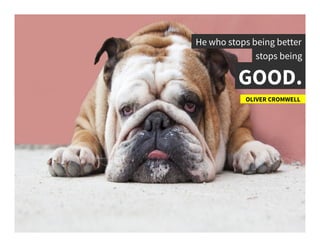
He who stops being better	
  
stops being	
  
GOOD. 	
  
OLIVER CROMWELL	
  
Only through continuous improvement at the
individual level can the entire organization
stay nimble enough to navigate change.
CONTINUOUS IMPROVEMENT
And as we all know…
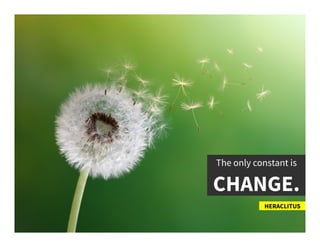
The only constant is	
  
CHANGE. 	
  
HERACLITUS	
  
In a changing market, it is critical to know
which direction to head in.WHICH DIRECTION
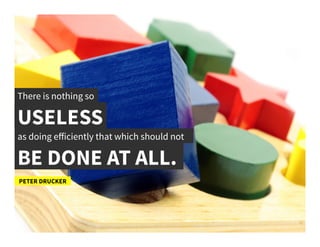
There is nothing so	
  
USELESS	
  
PETER DRUCKER	
  
as doing efficiently that which should not	
  
BE DONE AT ALL.	
  
This is why we try to work lean.LEAN.
What does
LEANreally mean?
Lean software development is an adaptation of
lean manufacturing principles, based on the
It is designed to eliminate waste
Toyota Production System.
through continuous improvement.
Lean development adheres to 7 key principles.7 KEY PRINCIPLES.
Anything that does not add customer value is waste.
Unnecessary functionality is waste. Managerial overhead is waste.
Defects and lower quality are waste.
ELIMINATE WASTE.
Lean principle 1 of 7:
We hold regular retrospectives to identify and
eliminate waste from our processes, in order
to continually improve the products we put in
the hands of our customers.
Lean principle 1 of 7:
ELIMINATE WASTE.
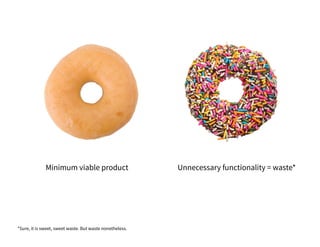
Minimum viable product Unnecessary functionality = waste*
*Sure, it is sweet, sweet waste. But waste nonetheless.
AMPLIFY LEARNING.
Development is a journey in discovery to see what works, while production is
Development is like creating a recipe while production is like making the dish.
an exercise in reducing variability.
Lean principle 2 of 7:
We believe that practice makes perfect and
that the best products are built when their
creators iterate and learn from what
customers love.
Lean principle 2 of 7:
AMPLIFY LEARNING.
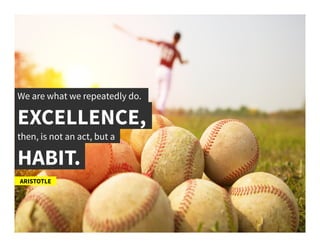
We are what we repeatedly do.	
  
EXCELLENCE,	
  
ARISTOTLE	
  
then, is not an act, but a 	
  
HABIT.	
  
3-Michelin star restaurant El Bulli was only open 6 months
of the year. The other 6 months were spent
by chef Ferran Adria devising, practicing and perfecting
the following season’s recipes.
DECIDE AS LATE AS POSSIBLE.
Lean principle 3 of 7:
The best decisions are based on fact, not speculation.
The longer you wait to commit, the more information you have.
Conversely, the earlier you commit, the less flexible you can be.
DECIDE AS LATE AS POSSIBLE.
Lean principle 3 of 7:
We build the capacity for change into our
systems and processes, and try to keep as
many options open as possible.
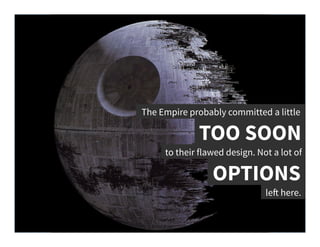
The Empire probably committed a little	
  
TOO SOON	
  
to their flawed design. Not a lot of	
  
OPTIONS	
  
left here.	
  
DELIVER AS FAST AS POSSIBLE.
Lean principle 4 of 7:
Speed is critical for learning – the shorter the feedback loops, the more
can be learned and the better our decision-making.
Speed also assures that customers get what they need now,
not what they needed yesterday.
DELIVER AS FAST AS POSSIBLE.
Lean principle 4 of 7:
Our approach is informed by data (but not
driven by it), and we strive to get better and
better products in the hands of customers
quickly, regularly, and at high quality.
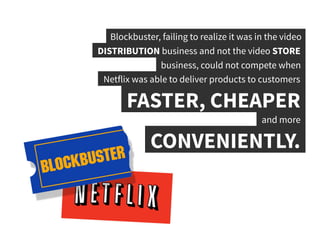
Blockbuster, failing to realize it was in the video	
  
DISTRIBUTION business and not the video STORE	
  
business, could not compete when 	
  
Netflix was able to deliver products to customers	
  
FASTER, CHEAPER	
  
and more	
  
CONVENIENTLY.	
  
EMPOWER THE TEAM.
Lean principle 5 of 7:
World-class execution lies in getting the details right.
And only those closest to the product have all the details.
We hire the best people and let them get on with their jobs.
EMPOWER THE TEAM.
Lean principle 5 of 7:
We use “pull” techniques to coordinate work
from within the team, rather than employing
managers to “push” orders from above.
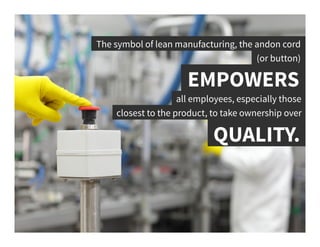
The symbol of lean manufacturing, the andon cord	
  
EMPOWERS	
  
(or button)	
  
all employees, especially those	
  
closest to the product, to take ownership over 	
  
QUALITY.	
  
BUILD INTEGRITY IN.
Lean principle 6 of 7:
When a customer squeals with joy and shouts, “Yes! That’s exactly what I
wanted, how did they know?” – that’s perceived integrity.
When your software scales and evolves gracefully with customers and time –
that’s conceptual integrity.
BUILD INTEGRITY IN.
Lean principle 6 of 7:
We try to maintain integrity, both perceived
and conceptual, by focusing on customer
needs, keeping things simple and eliminating
waste wherever we find it.
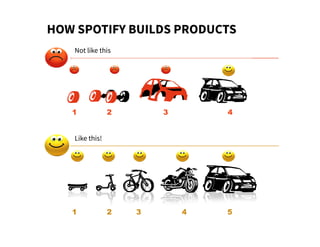
HOW SPOTIFY BUILDS PRODUCTS
NOT LIKE THIS
LIKE THIS
HOW SPOTIFY BUILDS PRODUCTS
Not like this
Like this!
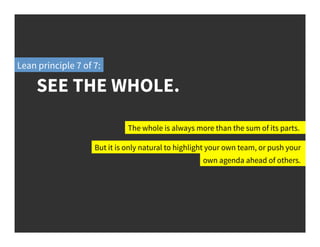
SEE THE WHOLE.
Lean principle 7 of 7:
The whole is always more than the sum of its parts.
But it is only natural to highlight your own team, or push your
own agenda ahead of others.
SEE THE WHOLE.
Lean principle 7 of 7:
We try to optimize for the whole, think for the
long-term, and prioritize
CUSTOMER > COMPANY > TEAM > SELF.
Some of the ingredients might be nice	
  
on their own	
  
but	
  we’d	
  rather	
  eat	
  
CAKE.	
  
PEOPLE.
PROCESS.PRODUCTS.
PROFIT.
3PRODUCTS
We want our customers to love our
We are all
GAMERS. We hate sucky games.
We hate games that sell you too hard.
We hate games that were designed by committee.
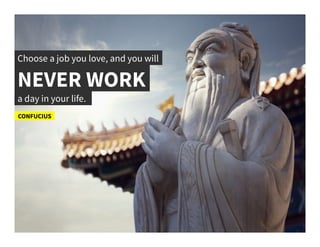
Choose a job you love, and you will	
  
NEVER WORK	
  
CONFUCIUS	
  
a day in your life.	
  
We try to treat our customers with
respect.RESPECT.
Only one other industry call its 	
  
CUSTOMERS	
  
UNKNOWN	
  
USERS –	
  
drug dealers. 	
  
We are
CUSTOMER
CENTRIC.
The term “users” is so abstract.
We prefer the term “players.”
Or, simply, “customers.”
We like the term “customer” because it implies
a formal relationship, and an expectation that
we deliver value.VALUE.
FORMAL RELATIONSHIP,
The best
GAMES,
made by
GAMERS.
We obsess over customers, not competitors.
We listen to customer feedback.
We act on customer feedback.
We are our own customers. And we are our own
harshest critics.
OWN CUSTOMERS.
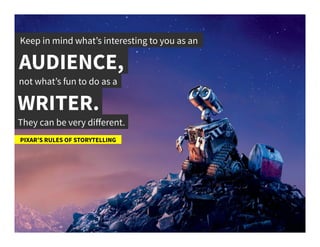
Keep in mind what’s interesting to you as an	
  
AUDIENCE,	
  
PIXAR’S RULES OF STORYTELLING	
  
not what’s fun to do as a	
  
WRITER.	
  
They can be very different.	
  
We try to anticipate
what the customer wants.
ANTICIPATE
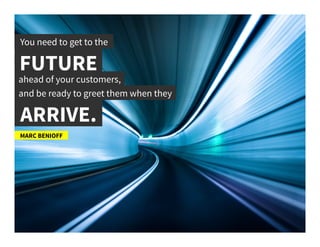
You need to get to the 	
  
FUTURE	
  
MARC BENIOFF	
  
and be ready to greet them when they	
  
ARRIVE.	
  
ahead of your customers,	
  
This is a Golden Age for gaming.GOLDEN AGE
WHERE OUR
CUSTOMERS PLAY
GAMES IS CHANGING
RAPIDLY.
HOW OUR CUSTOMERS
PLAY GAMES IS
CHANGING RAPIDLY.
And we want to be where the
CUSTOMER
is.
We embrace new platforms.
We embrace new form factors.
We constantly try new things.
We are platform- agnostic.PLATFORM-
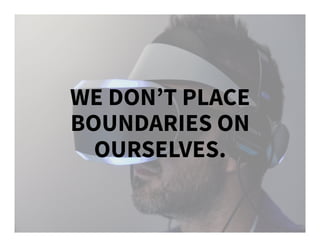
WE DON’T PLACE
BOUNDARIES ON
OURSELVES.
And how do we know if our
customers love us?
KNOW
They tell us.TELL US.
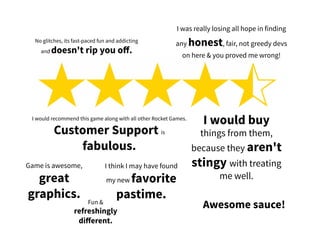
I was really losing all hope in finding
any honest, fair, not greedy devs
on here & you proved me wrong!
I would buy
things from them,
because they aren't
stingy with treating
me well.
I think I may have found
my new favorite
pastime.
Game is awesome,
great
graphics.
No glitches, its fast-paced fun and addicting
and doesn't rip you off.
Awesome sauce!Fun &
refreshingly
different.
I would recommend this game along with all other Rocket Games.
Customer Support is
fabulous.
PEOPLE.
PROCESS.PRODUCTS.
PROFIT.
4PROFIT
This is not a dirty word.
Our mission is to build an enduring games
business, that will outlast any of us.BUSINESS,
So how will we
ENDURE? We need to balance great game-making
with the business of game-making.
But all too often “profit” used in conjunction
with creative works (like games) is treated like
a dirty word.DIRTY WORD.
“PROFIT”
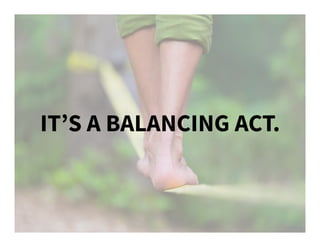
IT’S A BALANCING ACT.
We treat our games like
INVESTMENTS,
on which we
expect to make a
RETURN.
They take capital to make.
They take time to make.
They might succeed or fail.
And just like investing, we believe the best way
to approach game-making as a business is to
diversify our portfolio.PORTFOLIO.DIVERSIFY
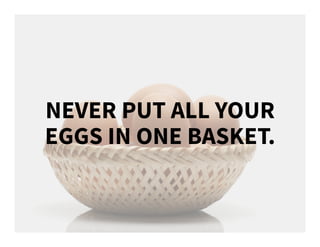
NEVER PUT ALL YOUR
EGGS IN ONE BASKET.
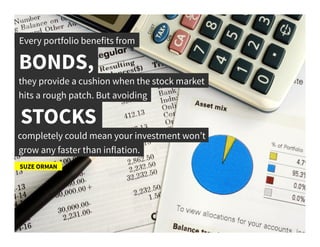
Every portfolio benefits from	
  
BONDS,	
  
SUZE ORMAN	
  
they provide a cushion when the stock market	
  
STOCKS	
  
hits a rough patch. But avoiding	
  
completely could mean your investment won’t	
  
grow any faster than inflation.	
  
We want to build a
BALANCED
PORTFOLIO.
A mix of long and short, risky and safe.
The more experience we develop, the bigger
the investments we are prepared to make.
PRACTICE
makes
PERFECT.
The more games we make,
the better we get at making games.
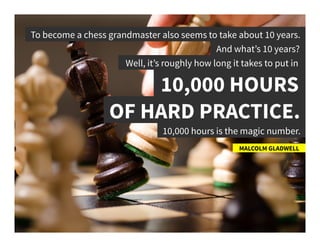
To become a chess grandmaster also seems to take about 10 years.	
  
MALCOLM GLADWELL	
  
And what’s 10 years?	
  
Well, it’s roughly how long it takes to put in	
  
10,000 HOURS	
  
OF HARD PRACTICE.	
  
10,000 hours is the magic number.	
  
So to recap…
OUR MISSION IS TO BUILD AN
ENDURING
GAMES
BUSINESS
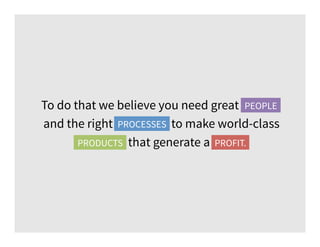
To do that we believe you need great people
and the right processes to make world-class
products that generate a profit.
PROCESSES
PRODUCTS PROFIT.
PEOPLE
THE 4 Ps MAKE (OUR)
WORLD GO ROUND.
And our shared values can foster a culture
that serves as a guide on our mission.
PEOPLE.
PROCESS.PRODUCTS.
PROFIT.
PLEASE CONTACT US!
culture@rocketgames.com
@rocketgames
WE WERE DEEPLY INSPIRED BY:
The Netflix Culture Deck (Patty McCord & Reed Hastings)
The Hubspot Culture Code Deck (Dharmesh Shah)
How Spotify Builds Products (Henrik Kniberg)
Buffer’s radical transparency
The Toyota Way
The Valve Employee Handbook
“Certain to Win” (Chet Richards)
“Lean Software Development” (Mary and Tom Poppendieck)
“The Lean Startup” (Eric Ries)

The Rocket Games company culture

  • 1.
    THE ROCKET GAMES CULTUREWho weare and what we want to be
  • 2.
    Culture is aset of shared behaviors, symbols, systems, practices and norms. What is CULTURE? beliefs, values working language,
  • 3.
    Once a culturehas formed, it is hard to change. Whether you plan for it or not. And culture spreads. It is generational, and is passed on to new employees. Culture HAPPENS.
  • 4.
    IF YOU DON’TMANAGE YOUR CULTURE, YOUR CULTURE MANAGES YOU.
  • 5.
    The best organizationsunderstand that culture can be the most sustainable source of competitive advantage.COMPETITIVE ADVANTAGE.
  • 6.
    CULTURE   eats strategyfor breakfast.   PETER DRUCKER  
  • 7.
    To make our   CUSTOMERS   happy we have to make sure our   EMPLOYEES   are happy first.   ZAPPOS  
  • 8.
    OUR GOAL ISTO NURTURE A CULTURE THAT CAN SERVE AS A GUIDE ON OUR LONG- TERM MISSION.
  • 9.
    A bit ofwho we’d like to be. A bit of who we are. This document is US.
  • 10.
    A people withoutthe knowledge of their past   history, origins and culture   is like a tree without   ROOTS.   MARCUS GARVEY  
  • 11.
    WE’RE PLANTING THE SEEDFOR THOSE ROOTS TODAY.
  • 12.
    OUR MISSION ISTO BUILD AN ENDURING GAMES BUSINESS
  • 13.
    mission, and reinforcesour shared values. Culture orients us towards our long-term What role does CULTURE play?
  • 14.
    What do wevalue?VALUE?
  • 15.
    We value the4 Ps.4 Ps.
  • 16.
  • 17.
    THE 4 PsMAKE (OUR) WORLD GO ROUND.
  • 18.
    PEOPLE. Only hire thebest. Continue to invest in them. It all starts with great people. Empower our people, and give them autonomy to operate. 1.
  • 19.
    PROCESS. Eliminate wasteful practices. Developthe right processes to maximize productivity. Continually improve by questioning the “why?” 2.
  • 20.
    PRODUCTS. Build games ourcustomers will love. Build the right games for the right markets. 3.
  • 21.
    PROFIT. Develop and operateeach game we make profitably. Balance creative appetite with business needs. Re-invest profits for the long-term success of the business. 4.
  • 22.
    THE 4 PsSERVE AS THE SHARED LENS THROUGH WHICH WE VIEW THE WORLD.
  • 23.
  • 24.
    1PEOPLE We want towork with great
  • 25.
    What makes someonea great person? What makes someone great for Rocket Games? But what are GREAT PEOPLE?
  • 26.
    Great people are   diverse and complex.   3   But there are   traits in particular that we look for.  
  • 27.
    IMPACTFUL. An impactful persongets stuff done. An impactful person focuses on results. An impactful person always finds a way. Personality trait #1:
  • 28.
    Despite famously acknowledgingthat he “invented nothing new,” Henry Ford’s undeniable impact was far-ranging. By 1918, half of all cars in America were Model Ts. At the same time, Ford was a pioneer of “welfare capitalism,” doubling worker wages and introducing the 40-hour week, making car ownership accessible to factory workers. He even had time to found the Kingsford Company, making charcoal from factory waste wood scrap, which to this day enjoys 80% market share in the US!
  • 29.
    A humble personspeaks of the “we,” not the “I.” A humble person admits mistakes and learns from them. A humble person shares the credit. HUMBLE. Personality trait #2:
  • 30.
    If I haveseen further than others,   it is by standing on   the shoulders of   GIANTS.   ISAAC NEWTON  
  • 31.
    A curious personpursues activities that improve body & mind. A curious person takes smart risks. A curious person is always asking “what if?” CURIOUS. Personality trait #3:
  • 32.
    There are   KNOWNKNOWNS.   These are things we know that we know. There are   DONALD RUMSFELD   KNOWN UNKNOWNS.   That is to say, there are things we know we don’t know. But there are also   UNKNOWN UNKNOWNS.   There are things that we don’t know we don’t know.  
  • 33.
    Curious people relishin figuring out the unknown unknowns. FIGURING OUT
  • 34.
    Curious people thriveoutside their comfort zone.COMFORT ZONE.
  • 35.
    A ship ina harbor is safe.   SHIPS ARE BUILT FOR.   But that is not what   UNKNOWN  
  • 36.
    We like interestingpeople.INTERESTING
  • 37.
    We want towork with people who have a lot of interests   OUTSIDE OF WORK.   People do better work when they   have lives of their own.  
  • 38.
    We don’t tolerate   BRILLIANT   JERKS.  
  • 39.
    The wrong peopleare   TOXIC TO CULTURE.   A toxic culture will cause your best people to leave.  
  • 40.
    And when yourbest people leave, that   KILLS THE COMPANY.  
  • 41.
    Never COMPROMISE on people. Hiring thewrong person is 10X more expensive than not hiring the right person.
  • 42.
    And talking about10X…10X…
  • 43.
    In procedural work,the best are   2X   NETFLIX CULTURE DECK   better than the average.   In creative/inventive work, the best are   10X  
  • 44.
    Great people needto be empowered. And empowerment means trust. EMPOWERED. TRUST.
  • 45.
    TRUST goes both ways. Forgreat people to reach their full potential, you need to trust them 100%. And they need to trust that you will allow them to do their jobs. And remove obstacles in their way.
  • 46.
  • 47.
    Recognize some of THESE? Unnecessary meetings,too many Arbitrary manager approvals, MVPs designed Pointless policies, forms to fill in, TPS reports. decision-makers, email justifications. for execs instead of customers.
  • 48.
    WE PREFER TODO WORK RATHER THAN TALK (OR WRITE) ABOUT IT.
  • 49.
    If you couldjust go ahead   and do that   BILL LUMBERGH   from now on, that’d be great,   mmmkay?  
  • 50.
    Do the RIGHT THING. That’s ouronly policy. Do what’s best for the customer. Do what’s best for the company. Do what’s best for your team.
  • 51.
    Make GOOD MISTAKES. Don’t try toavoid failure. Instead, embrace it. Fail fast, fail often, and learn.
  • 52.
    Great people needto be informed.INFORMED.
  • 53.
    The more you KNOW.We believe employees make the best decisions when they have all the available information. We believe employees feel more empowered when they understand why we do what we do.
  • 54.
    A lack of   TRANSPARENCY   DALAI LAMA   results in   DISTRUST   and a deep sense of   INSECURITY.  
  • 55.
    That is whywe make pretty much every bit of information about the company available to everyone at the company. INFORMATION AVAILABLE
  • 56.
  • 57.
  • 58.
    OK! Great people,trusted, empowered and informed, where now?WHERE NOW? OK!
  • 59.
    Do not seekto follow in the footsteps   of the wise.   Seek  what  they   SOUGHT.   MATSUO BASHO  
  • 60.
    Seek to understand the WHY. “Why”is such a powerful little word.
  • 61.
    QUESTIONING   As children,we are constantly   the world around us.  
  • 62.
    But as wegrow up, we stop questioning.STOP QUESTIONING.
  • 63.
    And we startto accept that the answer is “just because.”“JUST BECAUSE.”
  • 64.
    We start toaccept the status quo.STATUS QUO.
  • 65.
    We believe itis never “JUST BECAUSE.” We believe you should always question the status quo. We believe you should always question “why?”
  • 66.
    Only by challengingthe status quo can we get better. CHALLENGING
  • 67.
    (Seriously. The definitionof status quo is “the existing state of affairs.”) SERIOUSLY.
  • 68.
    I go tothe past for research.   I need to know what came before so I can   BREAK THE RULES.   VERA WANG  
  • 69.
    “BEST PRACTICES” aren’t always that. Each productis unique. Each market is unique. Understanding why something worked somewhere else is much more important than imitating it. Each team is unique.
  • 70.
    He who stopsbeing better   stops being   GOOD.   OLIVER CROMWELL  
  • 71.
    Only through continuousimprovement at the individual level can the entire organization stay nimble enough to navigate change. CONTINUOUS IMPROVEMENT
  • 72.
    And as weall know…
  • 73.
    The only constantis   CHANGE.   HERACLITUS  
  • 74.
    In a changingmarket, it is critical to know which direction to head in.WHICH DIRECTION
  • 75.
    There is nothingso   USELESS   PETER DRUCKER   as doing efficiently that which should not   BE DONE AT ALL.  
  • 76.
    This is whywe try to work lean.LEAN.
  • 77.
    What does LEANreally mean? Leansoftware development is an adaptation of lean manufacturing principles, based on the It is designed to eliminate waste Toyota Production System. through continuous improvement.
  • 78.
    Lean development adheresto 7 key principles.7 KEY PRINCIPLES.
  • 79.
    Anything that doesnot add customer value is waste. Unnecessary functionality is waste. Managerial overhead is waste. Defects and lower quality are waste. ELIMINATE WASTE. Lean principle 1 of 7:
  • 80.
    We hold regularretrospectives to identify and eliminate waste from our processes, in order to continually improve the products we put in the hands of our customers. Lean principle 1 of 7: ELIMINATE WASTE.
  • 81.
    Minimum viable productUnnecessary functionality = waste* *Sure, it is sweet, sweet waste. But waste nonetheless.
  • 82.
    AMPLIFY LEARNING. Development isa journey in discovery to see what works, while production is Development is like creating a recipe while production is like making the dish. an exercise in reducing variability. Lean principle 2 of 7:
  • 83.
    We believe thatpractice makes perfect and that the best products are built when their creators iterate and learn from what customers love. Lean principle 2 of 7: AMPLIFY LEARNING.
  • 84.
    We are whatwe repeatedly do.   EXCELLENCE,   ARISTOTLE   then, is not an act, but a   HABIT.  
  • 85.
    3-Michelin star restaurantEl Bulli was only open 6 months of the year. The other 6 months were spent by chef Ferran Adria devising, practicing and perfecting the following season’s recipes.
  • 86.
    DECIDE AS LATEAS POSSIBLE. Lean principle 3 of 7: The best decisions are based on fact, not speculation. The longer you wait to commit, the more information you have. Conversely, the earlier you commit, the less flexible you can be.
  • 87.
    DECIDE AS LATEAS POSSIBLE. Lean principle 3 of 7: We build the capacity for change into our systems and processes, and try to keep as many options open as possible.
  • 88.
    The Empire probablycommitted a little   TOO SOON   to their flawed design. Not a lot of   OPTIONS   left here.  
  • 89.
    DELIVER AS FASTAS POSSIBLE. Lean principle 4 of 7: Speed is critical for learning – the shorter the feedback loops, the more can be learned and the better our decision-making. Speed also assures that customers get what they need now, not what they needed yesterday.
  • 90.
    DELIVER AS FASTAS POSSIBLE. Lean principle 4 of 7: Our approach is informed by data (but not driven by it), and we strive to get better and better products in the hands of customers quickly, regularly, and at high quality.
  • 91.
    Blockbuster, failing torealize it was in the video   DISTRIBUTION business and not the video STORE   business, could not compete when   Netflix was able to deliver products to customers   FASTER, CHEAPER   and more   CONVENIENTLY.  
  • 92.
    EMPOWER THE TEAM. Leanprinciple 5 of 7: World-class execution lies in getting the details right. And only those closest to the product have all the details. We hire the best people and let them get on with their jobs.
  • 93.
    EMPOWER THE TEAM. Leanprinciple 5 of 7: We use “pull” techniques to coordinate work from within the team, rather than employing managers to “push” orders from above.
  • 94.
    The symbol oflean manufacturing, the andon cord   EMPOWERS   (or button)   all employees, especially those   closest to the product, to take ownership over   QUALITY.  
  • 95.
    BUILD INTEGRITY IN. Leanprinciple 6 of 7: When a customer squeals with joy and shouts, “Yes! That’s exactly what I wanted, how did they know?” – that’s perceived integrity. When your software scales and evolves gracefully with customers and time – that’s conceptual integrity.
  • 96.
    BUILD INTEGRITY IN. Leanprinciple 6 of 7: We try to maintain integrity, both perceived and conceptual, by focusing on customer needs, keeping things simple and eliminating waste wherever we find it.
  • 97.
    HOW SPOTIFY BUILDSPRODUCTS NOT LIKE THIS LIKE THIS HOW SPOTIFY BUILDS PRODUCTS Not like this Like this!
  • 98.
    SEE THE WHOLE. Leanprinciple 7 of 7: The whole is always more than the sum of its parts. But it is only natural to highlight your own team, or push your own agenda ahead of others.
  • 99.
    SEE THE WHOLE. Leanprinciple 7 of 7: We try to optimize for the whole, think for the long-term, and prioritize CUSTOMER > COMPANY > TEAM > SELF.
  • 100.
    Some of theingredients might be nice   on their own   but  we’d  rather  eat   CAKE.  
  • 101.
  • 102.
    3PRODUCTS We want ourcustomers to love our
  • 103.
    We are all GAMERS.We hate sucky games. We hate games that sell you too hard. We hate games that were designed by committee.
  • 104.
    Choose a jobyou love, and you will   NEVER WORK   CONFUCIUS   a day in your life.  
  • 105.
    We try totreat our customers with respect.RESPECT.
  • 106.
    Only one otherindustry call its   CUSTOMERS   UNKNOWN   USERS –   drug dealers.  
  • 107.
    We are CUSTOMER CENTRIC. The term“users” is so abstract. We prefer the term “players.” Or, simply, “customers.”
  • 108.
    We like theterm “customer” because it implies a formal relationship, and an expectation that we deliver value.VALUE. FORMAL RELATIONSHIP,
  • 109.
    The best GAMES, made by GAMERS. Weobsess over customers, not competitors. We listen to customer feedback. We act on customer feedback.
  • 110.
    We are ourown customers. And we are our own harshest critics. OWN CUSTOMERS.
  • 111.
    Keep in mindwhat’s interesting to you as an   AUDIENCE,   PIXAR’S RULES OF STORYTELLING   not what’s fun to do as a   WRITER.   They can be very different.  
  • 112.
    We try toanticipate what the customer wants. ANTICIPATE
  • 113.
    You need toget to the   FUTURE   MARC BENIOFF   and be ready to greet them when they   ARRIVE.   ahead of your customers,  
  • 114.
    This is aGolden Age for gaming.GOLDEN AGE
  • 115.
    WHERE OUR CUSTOMERS PLAY GAMESIS CHANGING RAPIDLY.
  • 116.
    HOW OUR CUSTOMERS PLAYGAMES IS CHANGING RAPIDLY.
  • 117.
    And we wantto be where the CUSTOMER is. We embrace new platforms. We embrace new form factors. We constantly try new things.
  • 118.
    We are platform-agnostic.PLATFORM-
  • 119.
  • 120.
    And how dowe know if our customers love us? KNOW
  • 121.
  • 122.
    I was reallylosing all hope in finding any honest, fair, not greedy devs on here & you proved me wrong! I would buy things from them, because they aren't stingy with treating me well. I think I may have found my new favorite pastime. Game is awesome, great graphics. No glitches, its fast-paced fun and addicting and doesn't rip you off. Awesome sauce!Fun & refreshingly different. I would recommend this game along with all other Rocket Games. Customer Support is fabulous.
  • 123.
  • 124.
    4PROFIT This is nota dirty word.
  • 125.
    Our mission isto build an enduring games business, that will outlast any of us.BUSINESS,
  • 126.
    So how willwe ENDURE? We need to balance great game-making with the business of game-making.
  • 127.
    But all toooften “profit” used in conjunction with creative works (like games) is treated like a dirty word.DIRTY WORD. “PROFIT”
  • 128.
  • 129.
    We treat ourgames like INVESTMENTS, on which we expect to make a RETURN. They take capital to make. They take time to make. They might succeed or fail.
  • 130.
    And just likeinvesting, we believe the best way to approach game-making as a business is to diversify our portfolio.PORTFOLIO.DIVERSIFY
  • 131.
    NEVER PUT ALLYOUR EGGS IN ONE BASKET.
  • 132.
    Every portfolio benefitsfrom   BONDS,   SUZE ORMAN   they provide a cushion when the stock market   STOCKS   hits a rough patch. But avoiding   completely could mean your investment won’t   grow any faster than inflation.  
  • 133.
    We want tobuild a BALANCED PORTFOLIO. A mix of long and short, risky and safe. The more experience we develop, the bigger the investments we are prepared to make.
  • 134.
    PRACTICE makes PERFECT. The more gameswe make, the better we get at making games.
  • 135.
    To become achess grandmaster also seems to take about 10 years.   MALCOLM GLADWELL   And what’s 10 years?   Well, it’s roughly how long it takes to put in   10,000 HOURS   OF HARD PRACTICE.   10,000 hours is the magic number.  
  • 136.
  • 137.
    OUR MISSION ISTO BUILD AN ENDURING GAMES BUSINESS
  • 138.
    To do thatwe believe you need great people and the right processes to make world-class products that generate a profit. PROCESSES PRODUCTS PROFIT. PEOPLE
  • 139.
    THE 4 PsMAKE (OUR) WORLD GO ROUND.
  • 140.
    And our sharedvalues can foster a culture that serves as a guide on our mission.
  • 141.
  • 142.
  • 143.
    WE WERE DEEPLYINSPIRED BY: The Netflix Culture Deck (Patty McCord & Reed Hastings) The Hubspot Culture Code Deck (Dharmesh Shah) How Spotify Builds Products (Henrik Kniberg) Buffer’s radical transparency The Toyota Way The Valve Employee Handbook “Certain to Win” (Chet Richards) “Lean Software Development” (Mary and Tom Poppendieck) “The Lean Startup” (Eric Ries)