International Research Journal of Engineering and Technology (IRJET) e-ISSN: 2395-0056
Volume: 10 Issue: 03 | Mar 2023 www.irjet.net p-ISSN: 2395-0072
© 2023, IRJET | Impact Factor value: 8.226 | ISO 9001:2008 Certified Journal | Page 1126
Multipurpose Solar Powered Agribot
Murali. R 1, Mohamed Thoufiq. M 2, Venkatesh Rohan. P 3, Dr.V. Hamsadhwani4
1, 2, 3 B.Tech Students, Dept. of EEE, PMIST, Thanjavur
4 Associate Professor
Department of Electrical and Electronics Engineering,
Periyar Maniammai Institute of Science and Technology, Thanjavur, Tamil Nadu, India
---------------------------------------------------------------------***---------------------------------------------------------------------
ABSTRACT: The biggest problems faced by farmers,
especially in rural areas, are low productivity rates and less
exposure to appropriate technologiesintheagriculturesector.
Hence, additional support is required to carry out certain
tasks on agricultural land. There are many modern methods
and machines available in the market, but all farmers cannot
afford to buy them. In this paper, a multi-purpose solar-
powered Agribot for supportingagriculturepurposeshasbeen
designed. This robot has four modes of operation:1. Ploughing
2. Seed sowing 3. Soil moisture monitoring 4. Weed removal.
The robot is instructed to carry out these processes with
details about the total land surface dimensions as well as the
distance between plants. The variables are sent as SMS by the
user to the GSM Module. A PIC Microcontroller receives the
information. For the ploughing operation, the rotating blade
and Plough will be activated. During the seed sowing mode,
the robot starts to drop the seed by first loosening the soil and
then covering the seed and then followed by dropping the
seeds and covering the seed with loosened soil.SolarPanel has
been provided to recharge these batteries. During the Weed-
removing mode, a spinning blade removes the unwanted
plants in between the sown seeds. During the soil moisture
monitoring mode, sensors determine the exact moisture
content of the land. Accordingly, it will switch the ON the
water pump kept in the agriculture field. This highly cost-
effective robot can be shared by a large group of farmers.
Keywords: weed remover, soil moisture monitoring robot,
weeding mechanism, seed sowing mechanism, ploughing
mechanism
1. INTRODUCTION
The base of the Indian economy is mainly dependent on the
Agriculture sector. Food production has always been on the
rise. But sometimes due to a lack of appropriate supervision
and as well as natural calamities, huge portions of cultivated
crops are affected which leads to lesser production thereby
raising the selling price due to higher demand. There should
be sufficient labourers in the field. But, nowadays,
Landowners are starting to sell their property because they
are not getting labourers for doing some work. In case they
get labourers, they charge very high wages. Many
landowners could not afford such paying high wages.
The conventional method of agriculture isusuallyverytime-
consuming and highly labour dependent. There are many
modern methods to do some agricultural activities. But they
have a very high initial investment, most farmers cannot
afford to pay the high price. So, to simplify the farmer’swork
some agriculture robots can be used instead of the human
labourer. The idea is to make agriculture robots that can
perform the task of the labourer namely ploughing, seeding,
weed removing, and water pouring. So, the labour problem
in the agricultural sector can be reduced. Mobile phones are
used by a huge number of people globally. Here, used a
mobile phone is the interface between the robot and the
user. The GSM (Global System for Mobile communication)
supports wireless communication. The farmer can send the
appropriate instructions to the GSM module whichisfixedin
the robot.
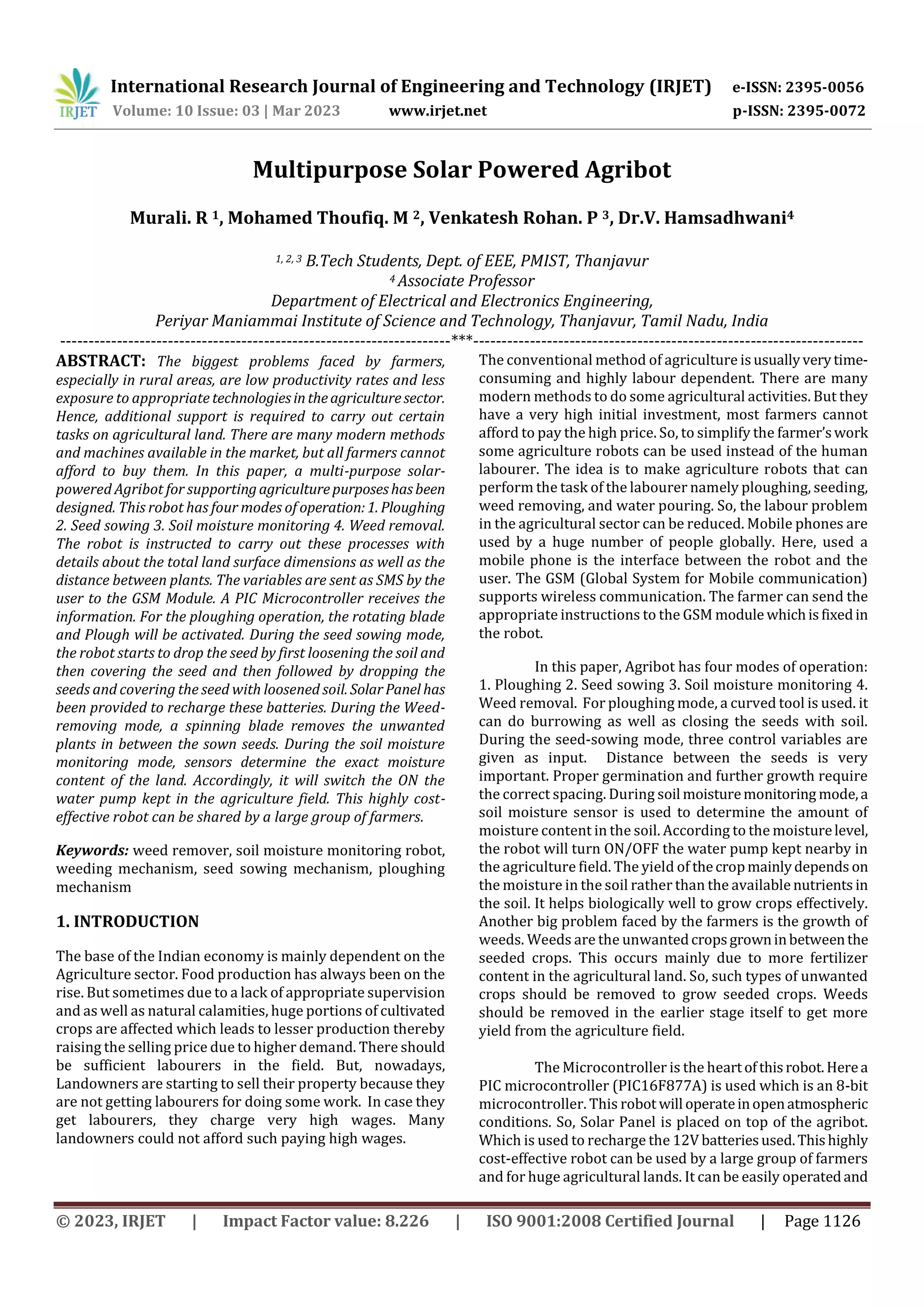
In this paper, Agribot has four modes of operation:
1. Ploughing 2. Seed sowing 3. Soil moisture monitoring 4.
Weed removal. For ploughing mode, a curved tool is used. it
can do burrowing as well as closing the seeds with soil.
During the seed-sowing mode, three control variables are
given as input. Distance between the seeds is very
important. Proper germination and further growth require
the correct spacing. During soil moisturemonitoring mode,a
soil moisture sensor is used to determine the amount of
moisture content in the soil. According to the moisturelevel,
the robot will turn ON/OFF the water pump kept nearby in
the agriculture field. The yield of thecropmainlydepends on
the moisture in the soil rather than the available nutrients in
the soil. It helps biologically well to grow crops effectively.
Another big problem faced by the farmers is the growth of
weeds. Weeds are the unwantedcropsgrowninbetweenthe
seeded crops. This occurs mainly due to more fertilizer
content in the agricultural land. So, such types of unwanted
crops should be removed to grow seeded crops. Weeds
should be removed in the earlier stage itself to get more
yield from the agriculture field.
The Microcontroller is the heartofthisrobot.Herea
PIC microcontroller (PIC16F877A) is used which is an 8-bit
microcontroller. This robot will operateinopenatmospheric
conditions. So, Solar Panel is placed on top of the agribot.
Which is used to recharge the 12V batteriesused.Thishighly
cost-effective robot can be used by a large group of farmers
and for huge agricultural lands. It can be easily operatedand
International Research Journal of Engineering and Technology (IRJET) e-ISSN: 2395-0056
Volume: 10 Issue: 03 | Mar 2023 www.irjet.net p-ISSN: 2395-0072
© 2023, IRJET | Impact Factor value: 8.226 | ISO 9001:2008 Certified Journal | Page 1127
user-friendly. By implementing such technologies in
agriculture, the yield of the crops can be increased.
2. PROPOSED SYSTEMS
In this paper, we deal with the use of automation
and robotics. This Agribot has four modes of operation. For
seed sowing operation, the length and no. of columns to be
sown seeds in the land are the agricultural twovariablesand
the distance between seeds is another variable. The
proposed robot automatically drops the seeds and covers of
soil after planting a seed in a sequence, till it reaches the end
of the proposed area. This robot is controlled by a
smartphone using GSM and PIC controller to automate the
entire function. The microcontroller is programmed to
control agricultural purposes like opening the soil,dropping
the seed in the soil, and putting the soil back We are also
programming the PIC to send the report to the remote place
through the GSM module. The report can also be monitored
on a mobile phone anywhere in the world. Thus, the main
problem faced by the farmers that lack manpower can be
manpower led by the robot. A soil moisture sensor is placed
to determine the moisture level of the land. According to it
turn ON/OFF the water pump placed in the agriculture land.
For removing the weed in the agricultural land,weedcutting
mechanism is provided here. It has a spinning blade that is
used to cut down unwanted crops. This proposed work is
done to provide better results in the field of agriculture.
3. METHODOLOGY
This paper focuses on designing a robot that is used
for various agricultural activities like ploughing, seed
sowing, soil moisture monitoring, and weed removal. Using
GSM technology, the variables are sent in the form of an SMS
to the robot. The PIC microcontroller receives the variables
from the GSM modulesanddoestheprogrammedsequences.
SMS (Short Message/Messaging Service) is only sent after
the GSM connects to the cellular network.Itcanbeknownby
the text displayed on the LCD “ENTER THE DISTANCE”. For
each mode of operation, the activating mechanisms were
different. This hardware of the robot consists of a ploughing
tool where a shovel is used to dig and loosen the soil. For the
seed-sowing mechanism where thefunnel-shapedcontainer
is used to store the seeds and a wooden plate is used to open
the bottom of the funnel to drop the seed into the land. Here
a limit switch is used to limit the position of the wooden
plate. For soil moisture monitoring, a soil moisture sensor is
used to monitor the moisture level of the soil and sent the
data to the microcontroller accordingly it will turn ON/OFF
the water pump. If the moisture level is very high means it
turns OFF the water pump and viceversa.For weedremoval,
a fan-shaped blade is placed under the robot to remove the
weeds. Users get the completion status after each operation.
Here, the GSM module transmits and receives data using AT
(ATtention) commands. This robot could be used by the
farmers to make their work even more productive.
4. BLOCK DIAGRAM
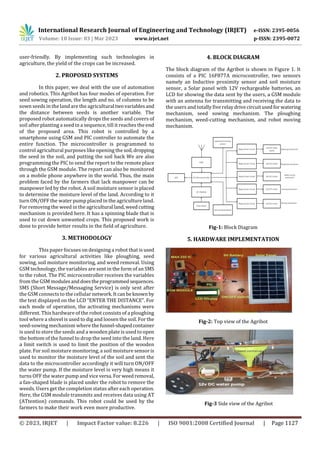
The block diagram of the Agribot is shown in Figure 1. It
consists of a PIC 16F877A microcontroller, two sensors
namely an Inductive proximity sensor and soil moisture
sensor, a Solar panel with 12V rechargeable batteries, an
LCD for showing the data sent by the users, a GSM module
with an antenna for transmitting and receiving the data to
the users and totally five relaydrivecircuitusedforwatering
mechanism, seed sowing mechanism. The ploughing
mechanism, weed-cutting mechanism, and robot moving
mechanism.
Fig-1: Block Diagram
5. HARDWARE IMPLEMENTATION
Fig-2: Top view of the Agribot
Fig-3 Side view of the Agribot
International Research Journal of Engineering and Technology (IRJET) e-ISSN: 2395-0056
Volume: 10 Issue: 03 | Mar 2023 www.irjet.net p-ISSN: 2395-0072
© 2023, IRJET | Impact Factor value: 8.226 | ISO 9001:2008 Certified Journal | Page 1128
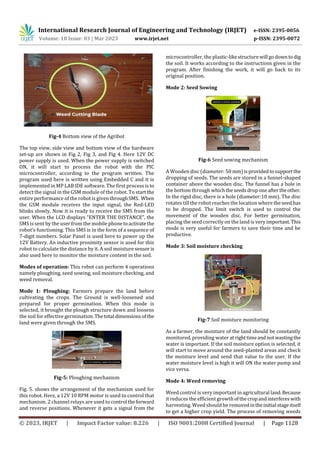
Fig-4 Bottom view of the Agribot
The top view, side view and bottom view of the hardware
set-up are shown in Fig 2, Fig 3, and Fig 4. Here 12V DC
power supply is used. When the power supply is switched
ON, it will start to process the robot with the PIC
microcontroller, according to the program written. The
program used here is written using Embedded C and it is
implemented in MP LAB IDE software. The first process is to
detect the signal in the GSM module of the robot. To start the
entire performance of the robot is given throughSMS. When
the GSM module receives the input signal, the Red-LED
blinks slowly. Now it is ready to receive the SMS from the
user. When the LCD displays “ENTER THE DISTANCE”, the
SMS is sent by the user from the mobile phonetoactivatethe
robot’s functioning. This SMS is in the form of a sequence of
7-digit numbers. Solar Panel is used here to power up the
12V Battery. An inductive proximity sensor is used for this
robot to calculate the distance by it. A soil moisture sensor is
also used here to monitor the moisture content in the soil.
Modes of operation: This robot can perform 4 operations
namely ploughing, seed sowing, soil moisture checking, and
weed removal.
Mode 1: Ploughing: Farmers prepare the land before
cultivating the crops. The Ground is well-loosened and
prepared for proper germination. When this mode is
selected, it brought the plough structure down and loosens
the soil for effective germination.Thetotal dimensionsof the
land were given through the SMS.
Fig-5: Ploughing mechanism
Fig. 5. shows the arrangement of the mechanism used for
this robot. Here, a 12V 10 RPM motor is used to control that
mechanism. 2 channel relays are used to control theforward
and reverse positions. Whenever it gets a signal from the
microcontroller, the plastic-likestructurewill godownto dig
the soil. It works according to the instructions given in the
program. After finishing the work, it will go back to its
original position.
Mode 2: Seed Sowing
Fig-6 Seed sowing mechanism
A Wooden disc (diameter: 50 mm)isprovidedtosupportthe
dropping of seeds. The seeds are stored in a funnel-shaped
container above the wooden disc. The funnel has a hole in
the bottom through which theseedsdroponeaftertheother.
In the rigid disc, there is a hole (diameter:10 mm). The disc
rotates till the robot reaches the location where theseedhas
to be dropped. The limit switch is used to control the
movement of the wooden disc. For better germination,
placing the seed correctly on the land is very important.This
mode is very useful for farmers to save their time and be
productive.
Mode 3: Soil moisture checking
Fig-7 Soil moisture monitoring
As a farmer, the moisture of the land should be constantly
monitored, providing water at righttimeandnotwastingthe
water is important. If the soil moisture option is selected, it
will start to move around the seed-planted areas and check
the moisture level and send that value to the user. If the
water moisture level is high it will ON the water pump and
vice versa.
Mode 4: Weed removing
Weed control is very important in agricultural land.Because
it reduces the efficient growthofthecropandinterfereswith
harvesting. Weed should be removedintheinitial stageitself
to get a higher crop yield. The process of removing weeds
International Research Journal of Engineering and Technology (IRJET) e-ISSN: 2395-0056
Volume: 10 Issue: 03 | Mar 2023 www.irjet.net p-ISSN: 2395-0072
© 2023, IRJET | Impact Factor value: 8.226 | ISO 9001:2008 Certified Journal | Page 1129
from agricultural land is called weeding. The weed removal
mechanism consists of a rotary blade that will cut down the
unwanted crops grown on the land. Here, the 12V DC motor
is used to drive the blade. This whole mechanism is placed
on the bottom side of the robot for efficient cuttingof weeds.
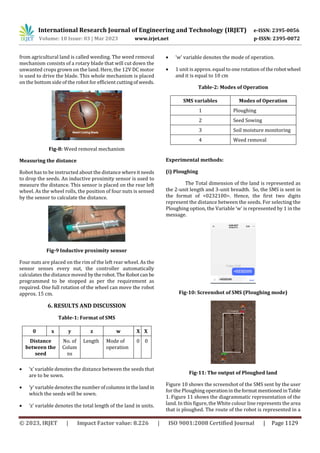
Fig-8: Weed removal mechanism
Measuring the distance
Robot has to be instructed about the distance whereitneeds
to drop the seeds. An inductive proximity sensor is used to
measure the distance. This sensor is placed on the rear left
wheel. As the wheel rolls, the position of four nuts is sensed
by the sensor to calculate the distance.
Fig-9 Inductive proximity sensor
Four nuts are placed on the rim of the left rear wheel. As the
sensor senses every nut, the controller automatically
calculates the distance moved bytherobot.TheRobotcan be
programmed to be stopped as per the requirement as
required. One full rotation of the wheel can move the robot
approx. 15 cm.
6. RESULTS AND DISCUSSION
Table-1: Format of SMS
0 x y z w X X
Distance
between the
seed
No. of
Colum
ns
Length Mode of
operation
0 0
 ‘x’ variable denotes the distance between the seeds that
are to be sown.
 ‘y’ variable denotes the numberofcolumnsinthe landin
which the seeds will be sown.
 ‘z’ variable denotes the total length of the land in units.
 ‘w’ variable denotes the mode of operation.
 1 unit is approx. equal to one rotation of therobotwheel
and it is equal to 10 cm
Table-2: Modes of Operation
SMS variables Modes of Operation
1 Ploughing
2 Seed Sowing
3 Soil moisture monitoring
4 Weed removal
Experimental methods:
(i) Ploughing
The Total dimension of the land is represented as
the 2-unit length and 3-unit breadth. So, the SMS is sent in
the format of <0232100>. Hence, the first two digits
represent the distance between the seeds. For selecting the
Ploughing option, the Variable ‘w’ is represented by 1 in the
message.
Fig-10: Screenshot of SMS (Ploughing mode)
Fig-11: The output of Ploughed land
Figure 10 shows the screenshot of the SMS sent by the user
for the Ploughing operationintheformatmentionedinTable
1. Figure 11 shows the diagrammatic representation of the
land. In this figure, the White colour line represents the area
that is ploughed. The route of the robot is represented in a
International Research Journal of Engineering and Technology (IRJET) e-ISSN: 2395-0056
Volume: 10 Issue: 03 | Mar 2023 www.irjet.net p-ISSN: 2395-0072
© 2023, IRJET | Impact Factor value: 8.226 | ISO 9001:2008 Certified Journal | Page 1130
dark brown colour. The entire process is explained in the
following steps
STEP 1: The first step of the programmed sequence is to
receive the values from the user through GSM in the form of
SMS. This is then transmitted to the microcontroller.
STEP 2: Based on the variables given by the user, the
Distance to be travelled by the robot in the first column is
supported by a proximity sensor which allows the wheel
rotation in the forward rotation. When it completes the
length given by the user it stops and turns right and
continues the ploughing process in the next column.
STEP 3: During this process, the ploughing shovel remains
down and in addition to cleaning unwanted plants, the
rotating blade also rotates to cut down them. The rotary
blade is kept in the basement of the robot. A 12V DC motor is
used for the purpose.
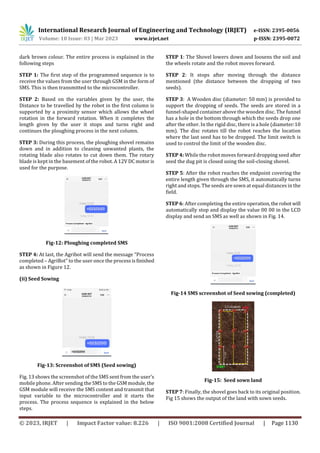
Fig-12: Ploughing completed SMS
STEP 4: At last, the Agribot will send the message “Process
completed – AgriBot” to the user once the processisfinished
as shown in Figure 12.
(ii) Seed Sowing
Fig-13: Screenshot of SMS (Seed sowing)
Fig. 13 shows the screenshot of the SMS sent from the user’s
mobile phone. After sending the SMS to the GSM module,the
GSM module will receive the SMS content and transmit that
input variable to the microcontroller and it starts the
process. The process sequence is explained in the below
steps.
STEP 1: The Shovel lowers down and loosens the soil and
the wheels rotate and the robot moves forward.
STEP 2: It stops after moving through the distance
mentioned (the distance between the dropping of two
seeds).
STEP 3: A Wooden disc (diameter: 50 mm) is provided to
support the dropping of seeds. The seeds are stored in a
funnel-shaped container above the wooden disc. The funnel
has a hole in the bottom through which the seeds drop one
after the other. In the rigid disc, there is a hole (diameter:10
mm). The disc rotates till the robot reaches the location
where the last seed has to be dropped. The limit switch is
used to control the limit of the wooden disc.
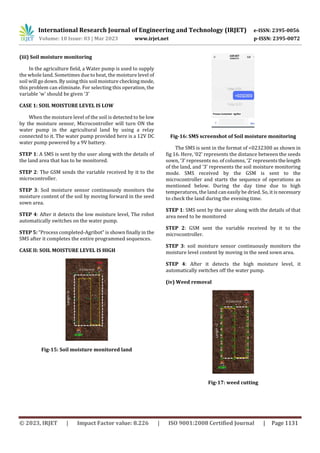
STEP 4: While the robot moves forward dropping seed after
seed the dug pit is closed using the soil-closing shovel.
STEP 5: After the robot reaches the endpoint covering the
entire length given through the SMS, it automatically turns
right and stops. The seeds are sown at equal distances in the
field.
STEP 6: After completing the entire operation,the robot will
automatically stop and display the value 00 00 in the LCD
display and send an SMS as well as shown in Fig. 14.
Fig-14 SMS screenshot of Seed sowing (completed)
Fig-15: Seed sown land
STEP 7: Finally, the shovel goes back to its original position.
Fig 15 shows the output of the land with sown seeds.
International Research Journal of Engineering and Technology (IRJET) e-ISSN: 2395-0056
Volume: 10 Issue: 03 | Mar 2023 www.irjet.net p-ISSN: 2395-0072
© 2023, IRJET | Impact Factor value: 8.226 | ISO 9001:2008 Certified Journal | Page 1131
(iii) Soil moisture monitoring
In the agriculture field, a Water pump is used to supply
the whole land. Sometimes due to heat, the moisture level of
soil will go down. By using this soil moisture checkingmode,
this problem can eliminate. For selecting this operation, the
variable ‘w’ should be given ‘3’
CASE 1: SOIL MOISTURE LEVEL IS LOW
When the moisture level of the soil is detected to be low
by the moisture sensor, Microcontroller will turn ON the
water pump in the agricultural land by using a relay
connected to it. The water pump provided here is a 12V DC
water pump powered by a 9V battery.
STEP 1: A SMS is sent by the user along with the details of
the land area that has to be monitored.
STEP 2: The GSM sends the variable received by it to the
microcontroller.
STEP 3: Soil moisture sensor continuously monitors the
moisture content of the soil by moving forward in the seed
sown area.
STEP 4: After it detects the low moisture level, The robot
automatically switches on the water pump.
STEP 5: “Process completed-Agribot” is shown finally in the
SMS after it completes the entire programmed sequences.
CASE II: SOIL MOISTURE LEVEL IS HIGH
Fig-15: Soil moisture monitored land
Fig-16: SMS screenshot of Soil moisture monitoring
The SMS is sent in the format of <0232300 as shown in
fig 16. Here, ‘02’ represents the distance between the seeds
sown, ‘3’ represents no. of columns, ‘2’ represents thelength
of the land, and ‘3’ represents the soil moisture monitoring
mode. SMS received by the GSM is sent to the
microcontroller and starts the sequence of operations as
mentioned below. During the day time due to high
temperatures, the land can easily be dried. So, it is necessary
to check the land during the evening time.
STEP 1: SMS sent by the user along with the details of that
area need to be monitored
STEP 2: GSM sent the variable received by it to the
microcontroller.
STEP 3: soil moisture sensor continuously monitors the
moisture level content by moving in the seed sown area.
STEP 4: After it detects the high moisture level, it
automatically switches off the water pump.
(iv) Weed removal
Fig-17: weed cutting
International Research Journal of Engineering and Technology (IRJET) e-ISSN: 2395-0056
Volume: 10 Issue: 03 | Mar 2023 www.irjet.net p-ISSN: 2395-0072
© 2023, IRJET | Impact Factor value: 8.226 | ISO 9001:2008 Certified Journal | Page 1132
Fig-18: SMS screenshot of Weed cutting
STEP 1: SMS with control variablesissent bytheusershown
in fig. 18
STEP 2: After receiving the SMS fromtheGSMitwill forward
it to the PIC microcontroller.
STEP 3: In the bottom of the robot it has a rotary bladefixed,
which rotates and will cut down all weeds. Thesebladesalso
work during ploughing.
STEP 4: After finishing all the work the robot will stop at the
end location shown in fig .17
STEP 5: After completing all operations, an SMS will be sent
by Agribot to the user.
6. CONCLUSION
In this paper, A robot has been proposed to perform specific
agricultural activities namely ploughing, seed sowing,
weeding, and soil moisture monitoring. The robot is
designed to perform these activities using program
sequences. It drops the seed without wasting any of them at
equal distances as mentioned by the user. The GSM module
is used as an interface between the user and the robot. Land
dimensions are given to the robot using the mobile phone.
All the activities are carried out accordingtotheinstructions
given by the user. The robot has beentestedsuccessfullyand
performed all mentioned activities. This robot will be very
helpful to the farmers who cannot afford to pay high wages
to the labourers. Hence, large groups of farmers can use this
cost-effective robot for huge agricultural lands. This project
may be improved with more agricultural activities. Spike
wheels can be placed for more mechanical strength.Also,the
Usage of IoT and machine learning algorithms in thisproject
can be done as a fully autonomousrobot.Otherfeaturessuch
as detecting types of weeds and diseases and the percentage
of the growth of the vegetables can be included.
REFERENCES
[1] Abdulrahman, Mangesh Koli, Umesh Kori, Ahmadakbar,
et al proposed (2017) “Seed Sowing Robot” -
International Journal of Computer Science Trends and
Technology (IJCST) – Volume 5 Issue 2, Mar-Apr 2017
[2] Retheep Raj, Ajay Aravind, Akshay V.S, Mariya Chandy,
Sharun N.D, et al proposed (2019) “A Seed Planting
Robot with Two Control Variables”- Trends in
Electronics and Informatics (ICOEI 2019)
[3] Pankaj Kumar, G. Ashok et al proposed (2020) “Design
and fabrication of smart seed sowing robot” - Materials
Today: Proceedings
[4] TanmayNagdeve,PranayJangde,HrushikeshTandulkar,
Sushobhit Dhara, Neema Ukani, Saurabh Chakole et al
proposed (2020) “Design of Automated Seed Sowing
Robot for BT Cotton Seed”-Inventive Research in
Computing Applications (ICIRCA-2020)
[5] Albert Francis A, Aravindh R,AjithM,BarathKumarMet
al proposed (2017) “Weed removing machine for
agriculture” -International Journal of Engineering
Sciences & Research Technology
[6] Beza Negash Getu, Hussain A. Attia et al proposed
(2015) “Automatic Control of Agricultural PumpsBased
on Soil Moisture Sensing”-IEEE (2015)

Multipurpose Solar Powered Agribot

  • 1.
    International Research Journalof Engineering and Technology (IRJET) e-ISSN: 2395-0056 Volume: 10 Issue: 03 | Mar 2023 www.irjet.net p-ISSN: 2395-0072 © 2023, IRJET | Impact Factor value: 8.226 | ISO 9001:2008 Certified Journal | Page 1126 Multipurpose Solar Powered Agribot Murali. R 1, Mohamed Thoufiq. M 2, Venkatesh Rohan. P 3, Dr.V. Hamsadhwani4 1, 2, 3 B.Tech Students, Dept. of EEE, PMIST, Thanjavur 4 Associate Professor Department of Electrical and Electronics Engineering, Periyar Maniammai Institute of Science and Technology, Thanjavur, Tamil Nadu, India ---------------------------------------------------------------------***--------------------------------------------------------------------- ABSTRACT: The biggest problems faced by farmers, especially in rural areas, are low productivity rates and less exposure to appropriate technologiesintheagriculturesector. Hence, additional support is required to carry out certain tasks on agricultural land. There are many modern methods and machines available in the market, but all farmers cannot afford to buy them. In this paper, a multi-purpose solar- powered Agribot for supportingagriculturepurposeshasbeen designed. This robot has four modes of operation:1. Ploughing 2. Seed sowing 3. Soil moisture monitoring 4. Weed removal. The robot is instructed to carry out these processes with details about the total land surface dimensions as well as the distance between plants. The variables are sent as SMS by the user to the GSM Module. A PIC Microcontroller receives the information. For the ploughing operation, the rotating blade and Plough will be activated. During the seed sowing mode, the robot starts to drop the seed by first loosening the soil and then covering the seed and then followed by dropping the seeds and covering the seed with loosened soil.SolarPanel has been provided to recharge these batteries. During the Weed- removing mode, a spinning blade removes the unwanted plants in between the sown seeds. During the soil moisture monitoring mode, sensors determine the exact moisture content of the land. Accordingly, it will switch the ON the water pump kept in the agriculture field. This highly cost- effective robot can be shared by a large group of farmers. Keywords: weed remover, soil moisture monitoring robot, weeding mechanism, seed sowing mechanism, ploughing mechanism 1. INTRODUCTION The base of the Indian economy is mainly dependent on the Agriculture sector. Food production has always been on the rise. But sometimes due to a lack of appropriate supervision and as well as natural calamities, huge portions of cultivated crops are affected which leads to lesser production thereby raising the selling price due to higher demand. There should be sufficient labourers in the field. But, nowadays, Landowners are starting to sell their property because they are not getting labourers for doing some work. In case they get labourers, they charge very high wages. Many landowners could not afford such paying high wages. The conventional method of agriculture isusuallyverytime- consuming and highly labour dependent. There are many modern methods to do some agricultural activities. But they have a very high initial investment, most farmers cannot afford to pay the high price. So, to simplify the farmer’swork some agriculture robots can be used instead of the human labourer. The idea is to make agriculture robots that can perform the task of the labourer namely ploughing, seeding, weed removing, and water pouring. So, the labour problem in the agricultural sector can be reduced. Mobile phones are used by a huge number of people globally. Here, used a mobile phone is the interface between the robot and the user. The GSM (Global System for Mobile communication) supports wireless communication. The farmer can send the appropriate instructions to the GSM module whichisfixedin the robot. In this paper, Agribot has four modes of operation: 1. Ploughing 2. Seed sowing 3. Soil moisture monitoring 4. Weed removal. For ploughing mode, a curved tool is used. it can do burrowing as well as closing the seeds with soil. During the seed-sowing mode, three control variables are given as input. Distance between the seeds is very important. Proper germination and further growth require the correct spacing. During soil moisturemonitoring mode,a soil moisture sensor is used to determine the amount of moisture content in the soil. According to the moisturelevel, the robot will turn ON/OFF the water pump kept nearby in the agriculture field. The yield of thecropmainlydepends on the moisture in the soil rather than the available nutrients in the soil. It helps biologically well to grow crops effectively. Another big problem faced by the farmers is the growth of weeds. Weeds are the unwantedcropsgrowninbetweenthe seeded crops. This occurs mainly due to more fertilizer content in the agricultural land. So, such types of unwanted crops should be removed to grow seeded crops. Weeds should be removed in the earlier stage itself to get more yield from the agriculture field. The Microcontroller is the heartofthisrobot.Herea PIC microcontroller (PIC16F877A) is used which is an 8-bit microcontroller. This robot will operateinopenatmospheric conditions. So, Solar Panel is placed on top of the agribot. Which is used to recharge the 12V batteriesused.Thishighly cost-effective robot can be used by a large group of farmers and for huge agricultural lands. It can be easily operatedand
  • 2.
    International Research Journalof Engineering and Technology (IRJET) e-ISSN: 2395-0056 Volume: 10 Issue: 03 | Mar 2023 www.irjet.net p-ISSN: 2395-0072 © 2023, IRJET | Impact Factor value: 8.226 | ISO 9001:2008 Certified Journal | Page 1127 user-friendly. By implementing such technologies in agriculture, the yield of the crops can be increased. 2. PROPOSED SYSTEMS In this paper, we deal with the use of automation and robotics. This Agribot has four modes of operation. For seed sowing operation, the length and no. of columns to be sown seeds in the land are the agricultural twovariablesand the distance between seeds is another variable. The proposed robot automatically drops the seeds and covers of soil after planting a seed in a sequence, till it reaches the end of the proposed area. This robot is controlled by a smartphone using GSM and PIC controller to automate the entire function. The microcontroller is programmed to control agricultural purposes like opening the soil,dropping the seed in the soil, and putting the soil back We are also programming the PIC to send the report to the remote place through the GSM module. The report can also be monitored on a mobile phone anywhere in the world. Thus, the main problem faced by the farmers that lack manpower can be manpower led by the robot. A soil moisture sensor is placed to determine the moisture level of the land. According to it turn ON/OFF the water pump placed in the agriculture land. For removing the weed in the agricultural land,weedcutting mechanism is provided here. It has a spinning blade that is used to cut down unwanted crops. This proposed work is done to provide better results in the field of agriculture. 3. METHODOLOGY This paper focuses on designing a robot that is used for various agricultural activities like ploughing, seed sowing, soil moisture monitoring, and weed removal. Using GSM technology, the variables are sent in the form of an SMS to the robot. The PIC microcontroller receives the variables from the GSM modulesanddoestheprogrammedsequences. SMS (Short Message/Messaging Service) is only sent after the GSM connects to the cellular network.Itcanbeknownby the text displayed on the LCD “ENTER THE DISTANCE”. For each mode of operation, the activating mechanisms were different. This hardware of the robot consists of a ploughing tool where a shovel is used to dig and loosen the soil. For the seed-sowing mechanism where thefunnel-shapedcontainer is used to store the seeds and a wooden plate is used to open the bottom of the funnel to drop the seed into the land. Here a limit switch is used to limit the position of the wooden plate. For soil moisture monitoring, a soil moisture sensor is used to monitor the moisture level of the soil and sent the data to the microcontroller accordingly it will turn ON/OFF the water pump. If the moisture level is very high means it turns OFF the water pump and viceversa.For weedremoval, a fan-shaped blade is placed under the robot to remove the weeds. Users get the completion status after each operation. Here, the GSM module transmits and receives data using AT (ATtention) commands. This robot could be used by the farmers to make their work even more productive. 4. BLOCK DIAGRAM The block diagram of the Agribot is shown in Figure 1. It consists of a PIC 16F877A microcontroller, two sensors namely an Inductive proximity sensor and soil moisture sensor, a Solar panel with 12V rechargeable batteries, an LCD for showing the data sent by the users, a GSM module with an antenna for transmitting and receiving the data to the users and totally five relaydrivecircuitusedforwatering mechanism, seed sowing mechanism. The ploughing mechanism, weed-cutting mechanism, and robot moving mechanism. Fig-1: Block Diagram 5. HARDWARE IMPLEMENTATION Fig-2: Top view of the Agribot Fig-3 Side view of the Agribot
  • 3.
    International Research Journalof Engineering and Technology (IRJET) e-ISSN: 2395-0056 Volume: 10 Issue: 03 | Mar 2023 www.irjet.net p-ISSN: 2395-0072 © 2023, IRJET | Impact Factor value: 8.226 | ISO 9001:2008 Certified Journal | Page 1128 Fig-4 Bottom view of the Agribot The top view, side view and bottom view of the hardware set-up are shown in Fig 2, Fig 3, and Fig 4. Here 12V DC power supply is used. When the power supply is switched ON, it will start to process the robot with the PIC microcontroller, according to the program written. The program used here is written using Embedded C and it is implemented in MP LAB IDE software. The first process is to detect the signal in the GSM module of the robot. To start the entire performance of the robot is given throughSMS. When the GSM module receives the input signal, the Red-LED blinks slowly. Now it is ready to receive the SMS from the user. When the LCD displays “ENTER THE DISTANCE”, the SMS is sent by the user from the mobile phonetoactivatethe robot’s functioning. This SMS is in the form of a sequence of 7-digit numbers. Solar Panel is used here to power up the 12V Battery. An inductive proximity sensor is used for this robot to calculate the distance by it. A soil moisture sensor is also used here to monitor the moisture content in the soil. Modes of operation: This robot can perform 4 operations namely ploughing, seed sowing, soil moisture checking, and weed removal. Mode 1: Ploughing: Farmers prepare the land before cultivating the crops. The Ground is well-loosened and prepared for proper germination. When this mode is selected, it brought the plough structure down and loosens the soil for effective germination.Thetotal dimensionsof the land were given through the SMS. Fig-5: Ploughing mechanism Fig. 5. shows the arrangement of the mechanism used for this robot. Here, a 12V 10 RPM motor is used to control that mechanism. 2 channel relays are used to control theforward and reverse positions. Whenever it gets a signal from the microcontroller, the plastic-likestructurewill godownto dig the soil. It works according to the instructions given in the program. After finishing the work, it will go back to its original position. Mode 2: Seed Sowing Fig-6 Seed sowing mechanism A Wooden disc (diameter: 50 mm)isprovidedtosupportthe dropping of seeds. The seeds are stored in a funnel-shaped container above the wooden disc. The funnel has a hole in the bottom through which theseedsdroponeaftertheother. In the rigid disc, there is a hole (diameter:10 mm). The disc rotates till the robot reaches the location where theseedhas to be dropped. The limit switch is used to control the movement of the wooden disc. For better germination, placing the seed correctly on the land is very important.This mode is very useful for farmers to save their time and be productive. Mode 3: Soil moisture checking Fig-7 Soil moisture monitoring As a farmer, the moisture of the land should be constantly monitored, providing water at righttimeandnotwastingthe water is important. If the soil moisture option is selected, it will start to move around the seed-planted areas and check the moisture level and send that value to the user. If the water moisture level is high it will ON the water pump and vice versa. Mode 4: Weed removing Weed control is very important in agricultural land.Because it reduces the efficient growthofthecropandinterfereswith harvesting. Weed should be removedintheinitial stageitself to get a higher crop yield. The process of removing weeds
  • 4.
    International Research Journalof Engineering and Technology (IRJET) e-ISSN: 2395-0056 Volume: 10 Issue: 03 | Mar 2023 www.irjet.net p-ISSN: 2395-0072 © 2023, IRJET | Impact Factor value: 8.226 | ISO 9001:2008 Certified Journal | Page 1129 from agricultural land is called weeding. The weed removal mechanism consists of a rotary blade that will cut down the unwanted crops grown on the land. Here, the 12V DC motor is used to drive the blade. This whole mechanism is placed on the bottom side of the robot for efficient cuttingof weeds. Fig-8: Weed removal mechanism Measuring the distance Robot has to be instructed about the distance whereitneeds to drop the seeds. An inductive proximity sensor is used to measure the distance. This sensor is placed on the rear left wheel. As the wheel rolls, the position of four nuts is sensed by the sensor to calculate the distance. Fig-9 Inductive proximity sensor Four nuts are placed on the rim of the left rear wheel. As the sensor senses every nut, the controller automatically calculates the distance moved bytherobot.TheRobotcan be programmed to be stopped as per the requirement as required. One full rotation of the wheel can move the robot approx. 15 cm. 6. RESULTS AND DISCUSSION Table-1: Format of SMS 0 x y z w X X Distance between the seed No. of Colum ns Length Mode of operation 0 0  ‘x’ variable denotes the distance between the seeds that are to be sown.  ‘y’ variable denotes the numberofcolumnsinthe landin which the seeds will be sown.  ‘z’ variable denotes the total length of the land in units.  ‘w’ variable denotes the mode of operation.  1 unit is approx. equal to one rotation of therobotwheel and it is equal to 10 cm Table-2: Modes of Operation SMS variables Modes of Operation 1 Ploughing 2 Seed Sowing 3 Soil moisture monitoring 4 Weed removal Experimental methods: (i) Ploughing The Total dimension of the land is represented as the 2-unit length and 3-unit breadth. So, the SMS is sent in the format of <0232100>. Hence, the first two digits represent the distance between the seeds. For selecting the Ploughing option, the Variable ‘w’ is represented by 1 in the message. Fig-10: Screenshot of SMS (Ploughing mode) Fig-11: The output of Ploughed land Figure 10 shows the screenshot of the SMS sent by the user for the Ploughing operationintheformatmentionedinTable 1. Figure 11 shows the diagrammatic representation of the land. In this figure, the White colour line represents the area that is ploughed. The route of the robot is represented in a
  • 5.
    International Research Journalof Engineering and Technology (IRJET) e-ISSN: 2395-0056 Volume: 10 Issue: 03 | Mar 2023 www.irjet.net p-ISSN: 2395-0072 © 2023, IRJET | Impact Factor value: 8.226 | ISO 9001:2008 Certified Journal | Page 1130 dark brown colour. The entire process is explained in the following steps STEP 1: The first step of the programmed sequence is to receive the values from the user through GSM in the form of SMS. This is then transmitted to the microcontroller. STEP 2: Based on the variables given by the user, the Distance to be travelled by the robot in the first column is supported by a proximity sensor which allows the wheel rotation in the forward rotation. When it completes the length given by the user it stops and turns right and continues the ploughing process in the next column. STEP 3: During this process, the ploughing shovel remains down and in addition to cleaning unwanted plants, the rotating blade also rotates to cut down them. The rotary blade is kept in the basement of the robot. A 12V DC motor is used for the purpose. Fig-12: Ploughing completed SMS STEP 4: At last, the Agribot will send the message “Process completed – AgriBot” to the user once the processisfinished as shown in Figure 12. (ii) Seed Sowing Fig-13: Screenshot of SMS (Seed sowing) Fig. 13 shows the screenshot of the SMS sent from the user’s mobile phone. After sending the SMS to the GSM module,the GSM module will receive the SMS content and transmit that input variable to the microcontroller and it starts the process. The process sequence is explained in the below steps. STEP 1: The Shovel lowers down and loosens the soil and the wheels rotate and the robot moves forward. STEP 2: It stops after moving through the distance mentioned (the distance between the dropping of two seeds). STEP 3: A Wooden disc (diameter: 50 mm) is provided to support the dropping of seeds. The seeds are stored in a funnel-shaped container above the wooden disc. The funnel has a hole in the bottom through which the seeds drop one after the other. In the rigid disc, there is a hole (diameter:10 mm). The disc rotates till the robot reaches the location where the last seed has to be dropped. The limit switch is used to control the limit of the wooden disc. STEP 4: While the robot moves forward dropping seed after seed the dug pit is closed using the soil-closing shovel. STEP 5: After the robot reaches the endpoint covering the entire length given through the SMS, it automatically turns right and stops. The seeds are sown at equal distances in the field. STEP 6: After completing the entire operation,the robot will automatically stop and display the value 00 00 in the LCD display and send an SMS as well as shown in Fig. 14. Fig-14 SMS screenshot of Seed sowing (completed) Fig-15: Seed sown land STEP 7: Finally, the shovel goes back to its original position. Fig 15 shows the output of the land with sown seeds.
  • 6.
    International Research Journalof Engineering and Technology (IRJET) e-ISSN: 2395-0056 Volume: 10 Issue: 03 | Mar 2023 www.irjet.net p-ISSN: 2395-0072 © 2023, IRJET | Impact Factor value: 8.226 | ISO 9001:2008 Certified Journal | Page 1131 (iii) Soil moisture monitoring In the agriculture field, a Water pump is used to supply the whole land. Sometimes due to heat, the moisture level of soil will go down. By using this soil moisture checkingmode, this problem can eliminate. For selecting this operation, the variable ‘w’ should be given ‘3’ CASE 1: SOIL MOISTURE LEVEL IS LOW When the moisture level of the soil is detected to be low by the moisture sensor, Microcontroller will turn ON the water pump in the agricultural land by using a relay connected to it. The water pump provided here is a 12V DC water pump powered by a 9V battery. STEP 1: A SMS is sent by the user along with the details of the land area that has to be monitored. STEP 2: The GSM sends the variable received by it to the microcontroller. STEP 3: Soil moisture sensor continuously monitors the moisture content of the soil by moving forward in the seed sown area. STEP 4: After it detects the low moisture level, The robot automatically switches on the water pump. STEP 5: “Process completed-Agribot” is shown finally in the SMS after it completes the entire programmed sequences. CASE II: SOIL MOISTURE LEVEL IS HIGH Fig-15: Soil moisture monitored land Fig-16: SMS screenshot of Soil moisture monitoring The SMS is sent in the format of <0232300 as shown in fig 16. Here, ‘02’ represents the distance between the seeds sown, ‘3’ represents no. of columns, ‘2’ represents thelength of the land, and ‘3’ represents the soil moisture monitoring mode. SMS received by the GSM is sent to the microcontroller and starts the sequence of operations as mentioned below. During the day time due to high temperatures, the land can easily be dried. So, it is necessary to check the land during the evening time. STEP 1: SMS sent by the user along with the details of that area need to be monitored STEP 2: GSM sent the variable received by it to the microcontroller. STEP 3: soil moisture sensor continuously monitors the moisture level content by moving in the seed sown area. STEP 4: After it detects the high moisture level, it automatically switches off the water pump. (iv) Weed removal Fig-17: weed cutting
  • 7.
    International Research Journalof Engineering and Technology (IRJET) e-ISSN: 2395-0056 Volume: 10 Issue: 03 | Mar 2023 www.irjet.net p-ISSN: 2395-0072 © 2023, IRJET | Impact Factor value: 8.226 | ISO 9001:2008 Certified Journal | Page 1132 Fig-18: SMS screenshot of Weed cutting STEP 1: SMS with control variablesissent bytheusershown in fig. 18 STEP 2: After receiving the SMS fromtheGSMitwill forward it to the PIC microcontroller. STEP 3: In the bottom of the robot it has a rotary bladefixed, which rotates and will cut down all weeds. Thesebladesalso work during ploughing. STEP 4: After finishing all the work the robot will stop at the end location shown in fig .17 STEP 5: After completing all operations, an SMS will be sent by Agribot to the user. 6. CONCLUSION In this paper, A robot has been proposed to perform specific agricultural activities namely ploughing, seed sowing, weeding, and soil moisture monitoring. The robot is designed to perform these activities using program sequences. It drops the seed without wasting any of them at equal distances as mentioned by the user. The GSM module is used as an interface between the user and the robot. Land dimensions are given to the robot using the mobile phone. All the activities are carried out accordingtotheinstructions given by the user. The robot has beentestedsuccessfullyand performed all mentioned activities. This robot will be very helpful to the farmers who cannot afford to pay high wages to the labourers. Hence, large groups of farmers can use this cost-effective robot for huge agricultural lands. This project may be improved with more agricultural activities. Spike wheels can be placed for more mechanical strength.Also,the Usage of IoT and machine learning algorithms in thisproject can be done as a fully autonomousrobot.Otherfeaturessuch as detecting types of weeds and diseases and the percentage of the growth of the vegetables can be included. REFERENCES [1] Abdulrahman, Mangesh Koli, Umesh Kori, Ahmadakbar, et al proposed (2017) “Seed Sowing Robot” - International Journal of Computer Science Trends and Technology (IJCST) – Volume 5 Issue 2, Mar-Apr 2017 [2] Retheep Raj, Ajay Aravind, Akshay V.S, Mariya Chandy, Sharun N.D, et al proposed (2019) “A Seed Planting Robot with Two Control Variables”- Trends in Electronics and Informatics (ICOEI 2019) [3] Pankaj Kumar, G. Ashok et al proposed (2020) “Design and fabrication of smart seed sowing robot” - Materials Today: Proceedings [4] TanmayNagdeve,PranayJangde,HrushikeshTandulkar, Sushobhit Dhara, Neema Ukani, Saurabh Chakole et al proposed (2020) “Design of Automated Seed Sowing Robot for BT Cotton Seed”-Inventive Research in Computing Applications (ICIRCA-2020) [5] Albert Francis A, Aravindh R,AjithM,BarathKumarMet al proposed (2017) “Weed removing machine for agriculture” -International Journal of Engineering Sciences & Research Technology [6] Beza Negash Getu, Hussain A. Attia et al proposed (2015) “Automatic Control of Agricultural PumpsBased on Soil Moisture Sensing”-IEEE (2015)