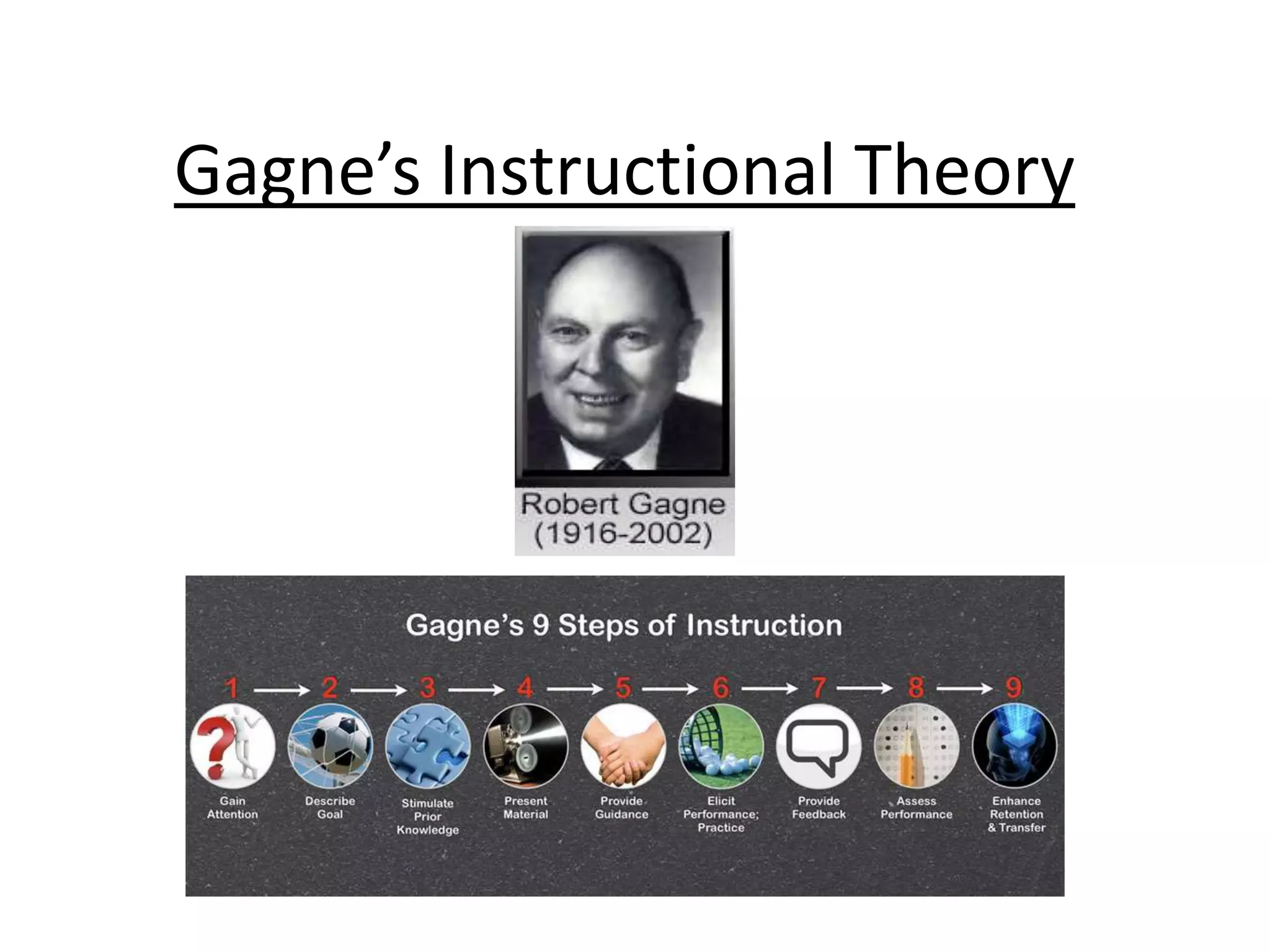
Gagne’s Instructional Theory
Who was Robert Gagne and what are
his credentials?
• Robert Mills Gagne (b.1916) served in the US
Army Air Corps as an Educational Officer
teaching pilots. He later became an
Educational Psychologist.
• He developed a series of works leading to
simplified instructional techniques dependant
on learning styles.
• His works have been summarized as “The
Gagne Assumption.”
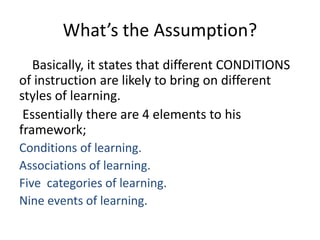
What’s the Assumption?
Basically, it states that different CONDITIONS
of instruction are likely to bring on different
styles of learning.
Essentially there are 4 elements to his
framework;
Conditions of learning.
Associations of learning.
Five categories of learning.
Nine events of learning.
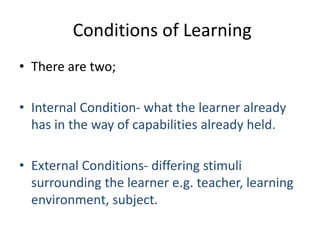
Conditions of Learning
• There are two;
• Internal Condition- what the learner already
has in the way of capabilities already held.
• External Conditions- differing stimuli
surrounding the learner e.g. teacher, learning
environment, subject.
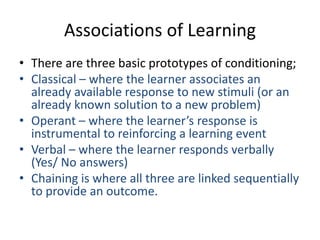
Associations of Learning
• There are three basic prototypes of conditioning;
• Classical – where the learner associates an
already available response to new stimuli (or an
already known solution to a new problem)
• Operant – where the learner’s response is
instrumental to reinforcing a learning event
• Verbal – where the learner responds verbally
(Yes/ No answers)
• Chaining is where all three are linked sequentially
to provide an outcome.
Five categories of learning
• Intellectual skills – learner’s know how or
procedural knowledge
• Verbal information – where the learner states
ideas
• Cognitive strategies – thinking, analytical &
problem solving abilities.
• Motor skills – movement skills e.g. driving,
playing sports.
• Attitude – mental state influences personal
actions.
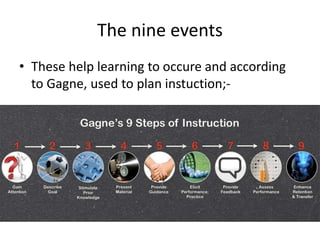
The nine events
• These help learning to occure and according
to Gagne, used to plan instuction;-
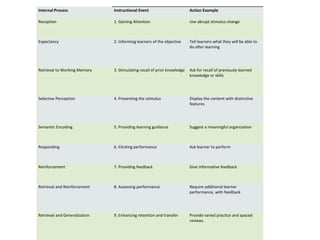
Internal Process Instructional Event Action Example
Reception 1. Gaining Attention Use abrupt stimulus change
Expectancy 2. Informing learners of the objective Tell learners what they will be able to
do after learning
Retrieval to Working Memory 3. Stimulating recall of prior knowledge Ask for recall of previously learned
knowledge or skills
Selective Perception 4. Presenting the stimulus Display the content with distinctive
features
Semantic Encoding 5. Providing learning guidance Suggest a meaningful organization
Responding 6. Eliciting performance Ask learner to perform
Reinforcement 7. Providing feedback Give informative feedback
Retrieval and Reinforcement 8. Assessing performance Require additional learner
performance, with feedback
Retrieval and Generalization 9. Enhancing retention and transfer Provide varied practice and spaced
reviews

Gagne’s instructional theory

  • 1.
  • 2.
    Who was RobertGagne and what are his credentials? • Robert Mills Gagne (b.1916) served in the US Army Air Corps as an Educational Officer teaching pilots. He later became an Educational Psychologist. • He developed a series of works leading to simplified instructional techniques dependant on learning styles. • His works have been summarized as “The Gagne Assumption.”
  • 3.
    What’s the Assumption? Basically,it states that different CONDITIONS of instruction are likely to bring on different styles of learning. Essentially there are 4 elements to his framework; Conditions of learning. Associations of learning. Five categories of learning. Nine events of learning.
  • 4.
    Conditions of Learning •There are two; • Internal Condition- what the learner already has in the way of capabilities already held. • External Conditions- differing stimuli surrounding the learner e.g. teacher, learning environment, subject.
  • 5.
    Associations of Learning •There are three basic prototypes of conditioning; • Classical – where the learner associates an already available response to new stimuli (or an already known solution to a new problem) • Operant – where the learner’s response is instrumental to reinforcing a learning event • Verbal – where the learner responds verbally (Yes/ No answers) • Chaining is where all three are linked sequentially to provide an outcome.
  • 6.
    Five categories oflearning • Intellectual skills – learner’s know how or procedural knowledge • Verbal information – where the learner states ideas • Cognitive strategies – thinking, analytical & problem solving abilities. • Motor skills – movement skills e.g. driving, playing sports. • Attitude – mental state influences personal actions.
  • 7.
    The nine events •These help learning to occure and according to Gagne, used to plan instuction;-
  • 8.
    Internal Process InstructionalEvent Action Example Reception 1. Gaining Attention Use abrupt stimulus change Expectancy 2. Informing learners of the objective Tell learners what they will be able to do after learning Retrieval to Working Memory 3. Stimulating recall of prior knowledge Ask for recall of previously learned knowledge or skills Selective Perception 4. Presenting the stimulus Display the content with distinctive features Semantic Encoding 5. Providing learning guidance Suggest a meaningful organization Responding 6. Eliciting performance Ask learner to perform Reinforcement 7. Providing feedback Give informative feedback Retrieval and Reinforcement 8. Assessing performance Require additional learner performance, with feedback Retrieval and Generalization 9. Enhancing retention and transfer Provide varied practice and spaced reviews

Editor's Notes

  • #8  Internal Process Instructional Event Action Example Reception 1. Gaining Attention Use abrupt stimulus change Expectancy 2. Informing learners of the objective Tell learners what they will be able to do after learning Retrieval to Working Memory 3. Stimulating recall of prior knowledge Ask for recall of previously learned knowledge or skills Selective Perception 4. Presenting the stimulus Display the content with distinctive features Semantic Encoding 5. Providing learning guidance Suggest a meaningful organization Responding 6. Eliciting performance Ask learner to perform Reinforcement 7. Providing feedback Give informative feedback Retrieval and Reinforcement 8. Assessing performance Require additional learner performance, with feedback Retrieval and Generalization 9. Enhancing retention and transfer Provide varied practice and spaced reviews