

TRENDS IN ECONOMIC
DEVELOPMENT
Tennessee Basic Economic Development
Course
Rob Bencini, MBA, CEcD
April 28, 2014
Rob Bencini, MBA, CEcD
• Achieved CEcD Designation in 2008
• Author of ED Plans and Policies
• Economic Futurist
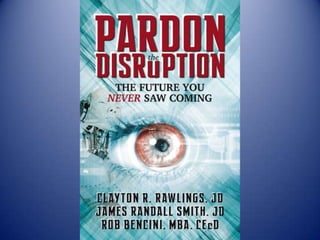
• Author: “Pardon the Disruption. The
Future You Never Saw Coming”
P
Baseline
• You will hear things in this presentation today
that you have never heard before (and may never
hear again). Put it in context for your benefit.
• Presentation style
– My speech
– Interactive/Questions
• I tried to use TN examples where I could.
Otherwise, I use NC data to make the point.
• Some of the economic projections are less than
cheery. Don’t regard that as negative. Better to
be prepared than blindsided.
What Will We Cover Today?
• Basic Economic Development Themes
• STEEP Trends Affecting the ED Landscape
• View Historic Economic Development
Practices Through the Lens of Current Trends
• Your new role you never expected to fill
• Developing your Economic Development
persona
• Areas of Opportunity
Definition of Economic Development
• Economic development is the application of
public resources to stimulate private sector
investment.
• Economic development is the intersection at
which public policy and the private sector
come together for jobs, business and wealth
creation.
Definition of Economic Development
• Economic development is the creation of an
environment in which communities and their
citizens prosper and improve their quality of
life.
• Economic development is not simply an event,
it is an ongoing community process.
Six Key Economic Development
Concepts
• Globalization
• Sustainable Development
• Regionalism
• Cluster Development
• Workforce Capacity/Talent
• Community
Regionalism
• Benefits
– Greater capacity and resources
– Economy of scale
• Effective?
– Largely meaningless boundaries
– Lead city loses recognition to regional “brand”
– Unspoken competition still exists
Regionalism
AS LONG AS LOCATION MATTERS…
LOCATION MATTERS!
Cluster Development
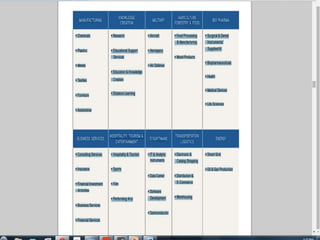
1) When companies have the benefit of many or
all of the related components of what they
use nearby, raising efficiencies and synergies
among industry suppliers and, more so,
2) When they are surrounded by like companies,
creating a level of shared, yet competitive,
expertise and an ever-evolving higher level
of competence in that industry.
3) Interdependence is a critical factor.
Cluster Development
• Preferable clusters to consider for increased
emphasis is traditionally done through
Location Quotient (LQ) analysis.
• WARNING: Be sure that the industry you are
considering to develop is in a growth pattern –
or have a real good reason why it is being
chosen.
Cluster Development
• Cluster Benefits
– Focus local and regional resources
– Develop local expertise
– Develop industrial dominance
• Cluster Downsides
– Cluster evaporation
– Lack of business diversity
– Resources may prove to be badly allocated
– Poor understanding of cluster intent
Workforce Development
• Projected in 2010: By 2015, 85% of all jobs will
need post-secondary education.
• 40% of all recent college graduates are doing
work that takes no more than a high school
education.
• Clearly, we are in a period of transition.
• Talent Clusters vs. Industrial Cluster
Workforce Development
• “if you focus on jobs – not talent – you will
fail.” - Jon Roberts, TIP Strategies
• If the primary workplace attribute of your
citizens is the willingness to show up for work,
join 40 million other Americans competing in
the same role.
Community
Does Your Community Stand Out?
Demonstration Exercise
Quality of Place
How others, outside of your area,
think of you and your community.
(Everyone has a high “Quality of Life.” Just ask
them.)
TRENDS
• The trends we are about to discuss may not be
in the awareness zone – much less consistent
with the belief system – of the leaders you will
work with.
TRENDS
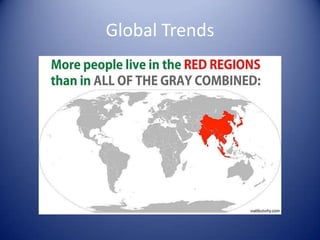
• Rise of the Global Economy
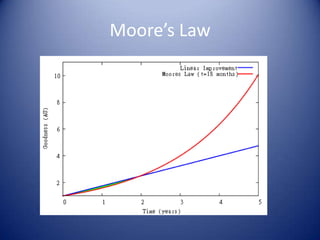
• Technological Advances Disrupting Old Models
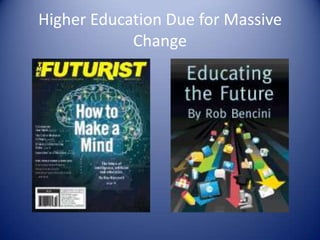
• Revolution in Higher Education
• Real Estate Woes
• Huge Demographic Changes
• Urban Migration in the U.S.
• Private Sector Aversion to Hiring Full-Time Labor
• Rise of the “Proprietor” or “Gig” Economy
Global Trends
Global Economic Trends
• Technological advances have helped “flatten”
the world.
• China and India are growing faster than the
U.S.
• Europe and Japan are having difficulty
maintaining their populations and are
experiencing many of the same issues of an
aging population as the U.S.
Moore’s Law
Higher Education Due for Massive
Change
Massive Open Online Courses
• Khan Academy
• Udacity (Thrun)
• Coursera (100 partners, including Vanderbilt)
• EdX
• Saylor
• iTunes U
• Others (13 and counting)
Key Issues Moving Forward
DEGREE
or
KNOWLEDGE?
• How does a
potential
employer
ASSESS what
she needs?
How about the
student?
Real Estate Woes
• Internet sales growing 3x that of storefront
operations (more if gas and cars are left out).
• U.S. has 22 sf of retail space per person. #2 in
the world is Sweden, with 3 sf/person.
• The U.S. simply has an overbuilt retail
presence.
• Industrial. Got any empty space?
• Housing. Multi-generations in one.
Apartments.
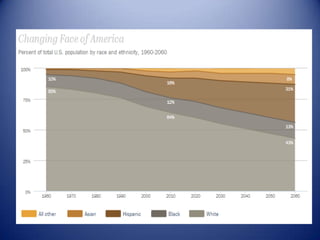
DEMOGRAPHIC CHANGES
• The U.S. is getting:
– Older
– Browner
– More Urban
• Millennials (aka Gen Y or Echo Boomers) will
dominate the workplace in ten years.
POPULATION MOBILITY
• Since the 2010 U.S. Census, North Carolina has
grown by 300,000 people. One half of the
population gain has been in two counties:
Wake (Raleigh) and Mecklenburg (Charlotte).
50 of the state’s 100 counties have lost
population since the census.
POPULATION MOBILITY
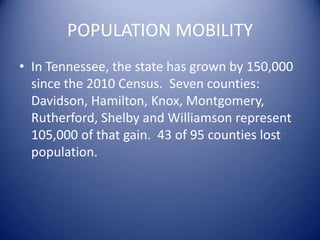
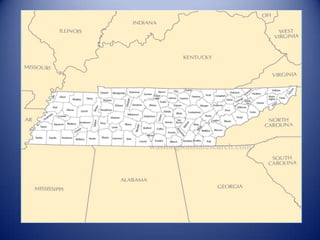
• In Tennessee, the state has grown by 150,000
since the 2010 Census. Seven counties:
Davidson, Hamilton, Knox, Montgomery,
Rutherford, Shelby and Williamson represent
105,000 of that gain. 43 of 95 counties lost
population.
Millennials
• Born between 1982 and 2000.
• Civic-minded, more liberal, not as money-
obsessed, networked, techno-savvy.
• Ditching television to watch on other devices.
• Not going to movies.
• Not getting drivers licenses or buying cars.
• Many still living with mom and dad.
• Not getting married and having kids.
• Not buying homes.
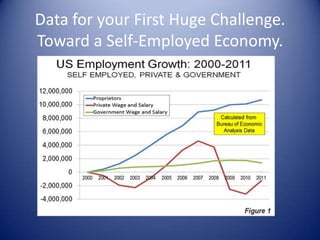
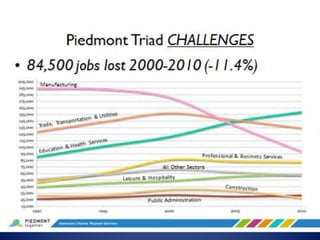
Data for your First Huge Challenge.
Toward a Self-Employed Economy.
Your First Huge Challenge
• The Economy has changed.
• The “Job” paradigm that began with the
Industrial Revolution is diminishing.
• There is a rapidly rising alternate
“workforce engagement” in lieu of
“jobs”.
• You now know this.
Your First Huge Challenge
• And your bosses still adhere to their
belief system to “create jobs” – which is
most unlikely.
• You must navigate between their virtually
unfulfillable demands - and where the
economy is actually headed.
• Sail wisely, captain.
Your Second Huge Challenge
Demonstration Exercise
Your Second Huge Challenge
• Your role of Economic Developer will be parts:
• Diplomat
• Networker
• Social media / tech expert
• Talent Manager
• Teacher
• Futurist / Driver of Change
Your Second Huge Challenge
• Community Developer
• Talent Developer
• Entrepreneurial advocate
• Oh, and then all that recruitment, retention,
existing business, site development, project
finance, marketing, regional, cluster, branding
stuff that’s already expected of you.
Establish Who You Are
• As we enter a new economic era, you will be
facing a different set of challenges than your
predecessors.
• Your skill set will need to be different – more
expansive.
• Most leaders’ expectations are based in the
old economy.
• What do you stand for?
Looking Around the Corner: The
Future of Economic Development
Changing Practices
This section highlights the changing nature of the
role of the economic developer. For example,
economic developers will take a larger role in
increasing and managing talent in their
communities, a skill that is related to demographics.
They will be called upon to harness the growing
power of technology, especially when it comes to
marketing. And they should develop and improve
their skills in systems management to facilitate new
kinds of incentives in a global economy.
Changing Metrics
In the future, metrics for economic development
will not be focused solely on job numbers. This
is especially important in terms of
understanding the freelancing and
entrepreneurial economy. Similarly, typical
measurements of human capital, such as
number of college degrees, will fade in
importance with new developments in
education. Sustainability will also become a
metric for competitiveness.
Changing Skills
In the future, economic developers will need to
take a lead role in leading change, in order to
connect their community to larger trends.
Economic developers will increasingly be the
drivers of change, enabling their communities to
identify big trends and take advantage of them,
while managing associated risks.
Changing Competition
In a changing global economy, economic
developers will need (to) keep their
communities needs met, while also scanning the
larger scene for opportunities and hazards. The
global competition for talent will be fierce, and
smart economic developers will build on their
communities’ strengths to attract and retain
human capital. Education and quality of place
are two main strengths to build upon.
Conclusion
• In the next 10 to 15 years, it is probable that the
accelerated pace of worldwide development will continue,
aided by digital technology and a rising global middle class.
These changes in the worldwide economy and structure
will impact local economic developers differently. However,
EDOs and economic developers can incorporate tactics into
their practice to help prepare for the future.
• Cultivating an organizational and professional attitude of
nimbleness will keep EDOs ahead of trends and able to
adopt. The ability to pivot into different roles ensures that
EDOs will stay relevant. And, though it is a cornerstone of
economic development today, the ability to collaborate will
become even more important on a global scale.
Age of Uncertainty
• We are transitioning from one economy to
another.
• Technological advances are moving so rapidly we
can’t keep up with them
• Old style thinking is trying to regain their footing
by re-affirming the past - with what used to work.
• And because of the uncertainty, no one can say
for certain what actually will work to improve
conditions, so we succumb to the pressures and
the known commodity of the old think setting.
ED Don’ts
• Don’t try to induce a tourism cluster by
spending tons of money on an obscure
historical site or museum thinking it will
generate bill travel dollars. It won’t.
• Don’t undertake an ED planning process with
a company that will only encourage the
development of a business park. If you can do
it, you know it already. Save your money.
ED Don’ts
• Unless you subscribe to the idea that every
job is a good job, be careful what you
incentivize.
“Incentivize what you want to look like –
what you want to become.” - Rob Bencini
• Don’t spend your limited marketing dollars on
building a “brand,” DVD’s to mail out,
pamphlets or magazine advertising.
Recap
• We are entering a new economic era – one
where rapid changes in technological
advances disrupt what we are used to.
• The old rules – the old ways of doing things -
will apply less and less. And we don’t know
what the new rules will be.
• The Job Paradigm is diminishing, largely
replaced by the Proprietor Economy.
Recap
• Consequently, the role of the Economic
Developer will change, to one that looks to
build community, network, focus on
entrepreneurial development, developing
talent (over jobs), and being a visionary for
his/her community.
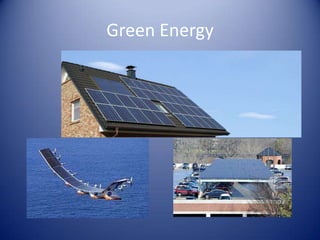
Green Energy
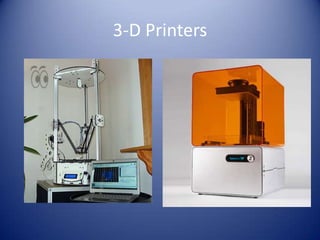
3-D Printers
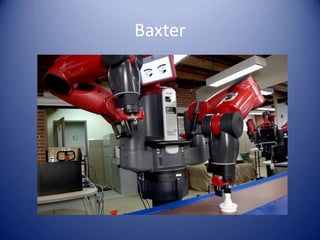
Baxter
Coding
Jobs of the Future
• Atmospheric Water Harvesters
• Sharability Auditors – People who analyze
homes and businesses for sharable assets.
• Super Baby Designers
• Drone Traffic Optimizers
• Avatar Relationship Managers
• Bio-Meat Factory Engineers
• Hospital and Healthcare Dismantlers
Reading List
Wall Street Journal
The Economist
Wired
The Futurist
Good Morning Silicon
Valley
Kauffman Foundation
Thomas Frey
Next Big Future
The Elliott Wave Theorist
• Thomas Friedman
– The World is Flat
– Hot, Flat and Crowded
• Tom Peters
– Re-Imagine!
• Peter Diamandis/Kottler
– Abundance
• Rob Bencini
– Pardon the Disruption. The
Future You Never Saw
Coming.
Thank you!
• Contact Information:
• rbencini@earthlink.net
• www.robbencini.com
• @robbencini
• 336.215-1995
• Futurist advances

Rob bencini trends in economic development tennessee basic ed course 042814

  • 1.
    TRENDS IN ECONOMIC DEVELOPMENT TennesseeBasic Economic Development Course Rob Bencini, MBA, CEcD April 28, 2014
  • 2.
    Rob Bencini, MBA,CEcD • Achieved CEcD Designation in 2008 • Author of ED Plans and Policies • Economic Futurist • Author: “Pardon the Disruption. The Future You Never Saw Coming”
  • 3.
  • 4.
    Baseline • You willhear things in this presentation today that you have never heard before (and may never hear again). Put it in context for your benefit. • Presentation style – My speech – Interactive/Questions • I tried to use TN examples where I could. Otherwise, I use NC data to make the point. • Some of the economic projections are less than cheery. Don’t regard that as negative. Better to be prepared than blindsided.
  • 5.
    What Will WeCover Today? • Basic Economic Development Themes • STEEP Trends Affecting the ED Landscape • View Historic Economic Development Practices Through the Lens of Current Trends • Your new role you never expected to fill • Developing your Economic Development persona • Areas of Opportunity
  • 6.
    Definition of EconomicDevelopment • Economic development is the application of public resources to stimulate private sector investment. • Economic development is the intersection at which public policy and the private sector come together for jobs, business and wealth creation.
  • 7.
    Definition of EconomicDevelopment • Economic development is the creation of an environment in which communities and their citizens prosper and improve their quality of life. • Economic development is not simply an event, it is an ongoing community process.
  • 8.
    Six Key EconomicDevelopment Concepts • Globalization • Sustainable Development • Regionalism • Cluster Development • Workforce Capacity/Talent • Community
  • 9.
    Regionalism • Benefits – Greatercapacity and resources – Economy of scale • Effective? – Largely meaningless boundaries – Lead city loses recognition to regional “brand” – Unspoken competition still exists
  • 10.
    Regionalism AS LONG ASLOCATION MATTERS… LOCATION MATTERS!
  • 11.
    Cluster Development 1) Whencompanies have the benefit of many or all of the related components of what they use nearby, raising efficiencies and synergies among industry suppliers and, more so, 2) When they are surrounded by like companies, creating a level of shared, yet competitive, expertise and an ever-evolving higher level of competence in that industry. 3) Interdependence is a critical factor.
  • 12.
    Cluster Development • Preferableclusters to consider for increased emphasis is traditionally done through Location Quotient (LQ) analysis. • WARNING: Be sure that the industry you are considering to develop is in a growth pattern – or have a real good reason why it is being chosen.
  • 13.
    Cluster Development • ClusterBenefits – Focus local and regional resources – Develop local expertise – Develop industrial dominance • Cluster Downsides – Cluster evaporation – Lack of business diversity – Resources may prove to be badly allocated – Poor understanding of cluster intent
  • 15.
    Workforce Development • Projectedin 2010: By 2015, 85% of all jobs will need post-secondary education. • 40% of all recent college graduates are doing work that takes no more than a high school education. • Clearly, we are in a period of transition. • Talent Clusters vs. Industrial Cluster
  • 16.
    Workforce Development • “ifyou focus on jobs – not talent – you will fail.” - Jon Roberts, TIP Strategies • If the primary workplace attribute of your citizens is the willingness to show up for work, join 40 million other Americans competing in the same role.
  • 17.
    Community Does Your CommunityStand Out? Demonstration Exercise
  • 18.
    Quality of Place Howothers, outside of your area, think of you and your community. (Everyone has a high “Quality of Life.” Just ask them.)
  • 19.
    TRENDS • The trendswe are about to discuss may not be in the awareness zone – much less consistent with the belief system – of the leaders you will work with.
  • 20.
    TRENDS • Rise ofthe Global Economy • Technological Advances Disrupting Old Models • Revolution in Higher Education • Real Estate Woes • Huge Demographic Changes • Urban Migration in the U.S. • Private Sector Aversion to Hiring Full-Time Labor • Rise of the “Proprietor” or “Gig” Economy
  • 21.
  • 22.
    Global Economic Trends •Technological advances have helped “flatten” the world. • China and India are growing faster than the U.S. • Europe and Japan are having difficulty maintaining their populations and are experiencing many of the same issues of an aging population as the U.S.
  • 23.
  • 24.
    Higher Education Duefor Massive Change
  • 31.
    Massive Open OnlineCourses • Khan Academy • Udacity (Thrun) • Coursera (100 partners, including Vanderbilt) • EdX • Saylor • iTunes U • Others (13 and counting)
  • 32.
    Key Issues MovingForward DEGREE or KNOWLEDGE? • How does a potential employer ASSESS what she needs? How about the student?
  • 33.
    Real Estate Woes •Internet sales growing 3x that of storefront operations (more if gas and cars are left out). • U.S. has 22 sf of retail space per person. #2 in the world is Sweden, with 3 sf/person. • The U.S. simply has an overbuilt retail presence. • Industrial. Got any empty space? • Housing. Multi-generations in one. Apartments.
  • 34.
    DEMOGRAPHIC CHANGES • TheU.S. is getting: – Older – Browner – More Urban • Millennials (aka Gen Y or Echo Boomers) will dominate the workplace in ten years.
  • 36.
    POPULATION MOBILITY • Sincethe 2010 U.S. Census, North Carolina has grown by 300,000 people. One half of the population gain has been in two counties: Wake (Raleigh) and Mecklenburg (Charlotte). 50 of the state’s 100 counties have lost population since the census.
  • 37.
    POPULATION MOBILITY • InTennessee, the state has grown by 150,000 since the 2010 Census. Seven counties: Davidson, Hamilton, Knox, Montgomery, Rutherford, Shelby and Williamson represent 105,000 of that gain. 43 of 95 counties lost population.
  • 38.
    Millennials • Born between1982 and 2000. • Civic-minded, more liberal, not as money- obsessed, networked, techno-savvy. • Ditching television to watch on other devices. • Not going to movies. • Not getting drivers licenses or buying cars. • Many still living with mom and dad. • Not getting married and having kids. • Not buying homes.
  • 39.
    Data for yourFirst Huge Challenge. Toward a Self-Employed Economy.
  • 42.
    Your First HugeChallenge • The Economy has changed. • The “Job” paradigm that began with the Industrial Revolution is diminishing. • There is a rapidly rising alternate “workforce engagement” in lieu of “jobs”. • You now know this.
  • 43.
    Your First HugeChallenge • And your bosses still adhere to their belief system to “create jobs” – which is most unlikely. • You must navigate between their virtually unfulfillable demands - and where the economy is actually headed. • Sail wisely, captain.
  • 44.
    Your Second HugeChallenge Demonstration Exercise
  • 46.
    Your Second HugeChallenge • Your role of Economic Developer will be parts: • Diplomat • Networker • Social media / tech expert • Talent Manager • Teacher • Futurist / Driver of Change
  • 47.
    Your Second HugeChallenge • Community Developer • Talent Developer • Entrepreneurial advocate • Oh, and then all that recruitment, retention, existing business, site development, project finance, marketing, regional, cluster, branding stuff that’s already expected of you.
  • 48.
    Establish Who YouAre • As we enter a new economic era, you will be facing a different set of challenges than your predecessors. • Your skill set will need to be different – more expansive. • Most leaders’ expectations are based in the old economy. • What do you stand for?
  • 49.
    Looking Around theCorner: The Future of Economic Development
  • 50.
    Changing Practices This sectionhighlights the changing nature of the role of the economic developer. For example, economic developers will take a larger role in increasing and managing talent in their communities, a skill that is related to demographics. They will be called upon to harness the growing power of technology, especially when it comes to marketing. And they should develop and improve their skills in systems management to facilitate new kinds of incentives in a global economy.
  • 51.
    Changing Metrics In thefuture, metrics for economic development will not be focused solely on job numbers. This is especially important in terms of understanding the freelancing and entrepreneurial economy. Similarly, typical measurements of human capital, such as number of college degrees, will fade in importance with new developments in education. Sustainability will also become a metric for competitiveness.
  • 52.
    Changing Skills In thefuture, economic developers will need to take a lead role in leading change, in order to connect their community to larger trends. Economic developers will increasingly be the drivers of change, enabling their communities to identify big trends and take advantage of them, while managing associated risks.
  • 53.
    Changing Competition In achanging global economy, economic developers will need (to) keep their communities needs met, while also scanning the larger scene for opportunities and hazards. The global competition for talent will be fierce, and smart economic developers will build on their communities’ strengths to attract and retain human capital. Education and quality of place are two main strengths to build upon.
  • 54.
    Conclusion • In thenext 10 to 15 years, it is probable that the accelerated pace of worldwide development will continue, aided by digital technology and a rising global middle class. These changes in the worldwide economy and structure will impact local economic developers differently. However, EDOs and economic developers can incorporate tactics into their practice to help prepare for the future. • Cultivating an organizational and professional attitude of nimbleness will keep EDOs ahead of trends and able to adopt. The ability to pivot into different roles ensures that EDOs will stay relevant. And, though it is a cornerstone of economic development today, the ability to collaborate will become even more important on a global scale.
  • 55.
    Age of Uncertainty •We are transitioning from one economy to another. • Technological advances are moving so rapidly we can’t keep up with them • Old style thinking is trying to regain their footing by re-affirming the past - with what used to work. • And because of the uncertainty, no one can say for certain what actually will work to improve conditions, so we succumb to the pressures and the known commodity of the old think setting.
  • 56.
    ED Don’ts • Don’ttry to induce a tourism cluster by spending tons of money on an obscure historical site or museum thinking it will generate bill travel dollars. It won’t. • Don’t undertake an ED planning process with a company that will only encourage the development of a business park. If you can do it, you know it already. Save your money.
  • 57.
    ED Don’ts • Unlessyou subscribe to the idea that every job is a good job, be careful what you incentivize. “Incentivize what you want to look like – what you want to become.” - Rob Bencini • Don’t spend your limited marketing dollars on building a “brand,” DVD’s to mail out, pamphlets or magazine advertising.
  • 58.
    Recap • We areentering a new economic era – one where rapid changes in technological advances disrupt what we are used to. • The old rules – the old ways of doing things - will apply less and less. And we don’t know what the new rules will be. • The Job Paradigm is diminishing, largely replaced by the Proprietor Economy.
  • 59.
    Recap • Consequently, therole of the Economic Developer will change, to one that looks to build community, network, focus on entrepreneurial development, developing talent (over jobs), and being a visionary for his/her community.
  • 60.
  • 61.
  • 62.
  • 63.
  • 64.
    Jobs of theFuture • Atmospheric Water Harvesters • Sharability Auditors – People who analyze homes and businesses for sharable assets. • Super Baby Designers • Drone Traffic Optimizers • Avatar Relationship Managers • Bio-Meat Factory Engineers • Hospital and Healthcare Dismantlers
  • 65.
    Reading List Wall StreetJournal The Economist Wired The Futurist Good Morning Silicon Valley Kauffman Foundation Thomas Frey Next Big Future The Elliott Wave Theorist • Thomas Friedman – The World is Flat – Hot, Flat and Crowded • Tom Peters – Re-Imagine! • Peter Diamandis/Kottler – Abundance • Rob Bencini – Pardon the Disruption. The Future You Never Saw Coming.
  • 66.
    Thank you! • ContactInformation: • rbencini@earthlink.net • www.robbencini.com • @robbencini • 336.215-1995
  • 68.

Editor's Notes

  • #3 I design plans for local and regional jurisdictions to take advantage – and avoid the pitfalls – of a rapidly changing economy.
  • #5 I kept changing this presentation up to the last minute, because there are so many concepts – so many trends – that I want to share and emphasize.
  • #6 Any questions so far?
  • #9 These concepts – and how they are applied – give a filter for examining relevant trends.We will cover all of these either now or in the trend section.The first I want to explore in some depth is …
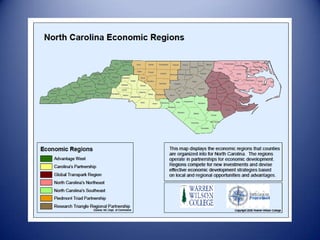
  • #10 Explain Piedmont Triad region
  • #11 I can teach regions to act regionally, but it takes some really forward-thinking leaders to accept what needs to be done.Any questions about regionalism?
  • #12 Gas stations, drug stores and self-storage units do not comprise a cluster.
  • #14 NC GlobalTranspark in Lenoir County. Greensboro’s 24 industrial clusters.
  • #15 NC Plan 38 clusters. “Advanced Manufacturing”Any questions about clusters?
  • #17 Foxconn
  • #18 Pair off with another attendee. Person 1 is the one from the larger jurisdiction. Person 1 tells Person 2 what they know of Person 2’s community. Person 2 then explains all the great attributes of their community. Report back. How much did Person 1 know about Person 2’s community? What traits did Person 2 mention?
  • #19 Schools? Workforce quality? Roads? Water? Electricity?Marketing: High quality website. No pamphlets or DVDs.Any questions about workforce or community?
  • #20 This is a thread woven through much of this presentation.
  • #24 Technology has a large hand in virtually all of these disruptive trends.
  • #25 Important for a lot of reasons. Among them, the education industry itself and the significance we place on education to turn the economy around.
  • #33 Any questions about globalization or higher education?
  • #34 Any questions about real estate?
  • #35 10,000 people a day are turning 65 in the U.S.Lowest birth rate since 1970
  • #36 Any questions about changing demographics?
  • #38 Any questions about population mobility?
  • #39 “Trophy Kids” Think this has any impact on the workplace? On the economy?For the Millennials in the room: Can you tell me the television show that had the characters Edith, Archie and Meathead? Matt, Miss Kitty and Festus? Richie Cunningham, Potsie, Ralph? Does adding the Fonz help?For those in the room older than 50: Do you knowOur points of reference are different. That’s not inherently a bad thing. In fact, it can be good to add different thinking. But it shouldn’t be ignored.Any questions about generational differences?
  • #40 Payroll expense
  • #41 Describe Piedmont Triad region. Wake. Mecklenburg.
  • #43 “Payroll expense”How many of you get a W-2? A 1099?
  • #44 Four excellent economic developers I know have resigned, retired or been fired in the last two months. The leaders they reported to seem to believe that economic developers can control the outcome of recruitment projects and are holding them accountable. Now the revolving door of hiring the next rainmaker begins.
  • #45 Person 1 represents a local ED leader – the Chamber Board Chair, the Mayor, the County Commission Chair, the EDC chair. Pretend you have heard nothing today – play the role of someone you are familiar with in that position. Person 2 represents the new economic development hire. The point of the meeting is for Person 1 to explain to Person 2 precisely what his/her expectations are for work performance. Goals, tasks, focus areas – what he/she wants to see accomplished. Person 2 is to report back to the group. What common themes did we have?
  • #46 In unfamiliar territory, you can’t move forward looking in the rear view mirror. In many cases that is what we are up against.
  • #49 Old vs. New Business Practices The way we market, produce and the workplace itselfOld vs. New Businesses Newspapers vs. Promoting through social media Tesla Craft Beer Environmental Issues Fracking Asphalt plant Equity IssuesIndustrial land rezoning for a housing subdivisionRecruiting low wage jobs. Are all jobs good jobs?
  • #58 Get a first-class website. It is the one thing that outsiders look at. If it’s bad, you are eliminated from any consideration.
  • #61 Canola
  • #65 Thomas Frey 162 Future Jobs: Preparing for Jobs that Don’t Yet Exist
  • #66 Thomas Frey Jobs of the Future