
A Summary of
Talking About
My Generation:
Exploring the Benefits Engagement Challenge
September 2013
3
Why read this report?
	 In-depth research into the financial aspirations,
concerns and priorities of today’s workplace generations
	Insight into benefits currently on offer and what
employees really want
	 The risks of getting benefits strategy wrong
	A toolkit to help HR professionals provide more
generationally-appropriate benefits packages
	Tips for how best to communicate with a
multigenerational workforce
For the first time in history, we are seeing up to five different generations in
the workplace. These generations share the same managers, rub shoulders
in the same spaces and collaborate on the same projects — but that is where
the similarities end. With the age gap between these individuals reaching up
to 50 years, we see just how far apart the values, drivers and needs of these
different generations can be.
Meanwhile, for the past decade, a “perfect storm” has been raging in the
workplace that has brought together a confluence of economic uncertainty, global competition,
falling prices, ubiquitous and ever-evolving technology, and shortages in staff and resources.
Throw in the changing “psychological contract” that now exists between different generations and
their employers, and it is no surprise that HR professionals are rethinking how they reward their
employees, looking beyond the “one size fits all” approach and assessing the effectiveness of
traditional flexible benefits.
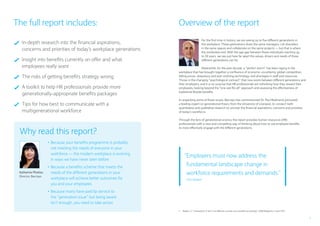
In unpacking some of these issues, Barclays has commissioned Dr. Paul Redmond (pictured),
a leading expert on generational theory from the University of Liverpool, to conduct both
quantitative and qualitative research to uncover the financial aspirations, concerns and priorities
of today’s workforce.
Through the lens of generational science, the report provides human resources (HR)
professionals with a new and compelling way of thinking about how to use employee benefits
to more effectively engage with the different generations.
Overview of the reportThe full report includes:
“Employers must now address the
fundamental landscape change in
workforce requirements and demands.”
Zain Wadee1
1	 Wadee, Z., “Generations X and Y are different, so tailor your benefits accordingly,” HRM Magazine, 4 April 2011
Katharine Photiou
Director, Barclays
•	Because your benefits programme is probably
not meeting the needs of everyone in your
workforce — the modern workplace is evolving
in ways we have never seen before
•	Because a benefits scheme that meets the
needs of the different generations in your
workplace will achieve better outcomes for
you and your employees
•	Because many have paid lip service to
the “generation issue” but being aware
isn’t enough, you need to take action
4 5
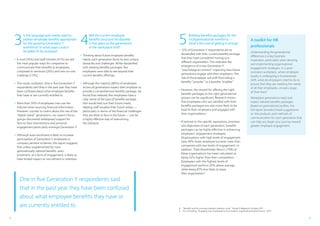
Does the current employee benefits structure suit
the needs of the vast majority of the workforce?
How do these needs contrast and compare between
the three key generational groups?
Is the language and media used to explain employee
benefits appropriate for the growing Generation Y
workforce? In what ways could it be better fit for purpose?
Will the current employee benefits structure be obsolete
in five years as the generations in the workplace shift?
Building benefits packages for the multigenerational
workforce — what’s the cost of getting it wrong?
1
2
3
4
5
Does the current employee benefits
structure suit the needs of the vast
majority of the workforce?
The report highlights that current benefits
packages are too inflexible for today’s employees
•	Six-out-of-ten employees claim that a
comprehensive benefits package is a key
factor when looking for a new job.
•	However, 85% felt that their current employee
benefits packages failed to provide the support
and flexibility required to meet present and
future financial needs — a major finding
suggesting that across the UK a serious
discrepancy exists between the needs of
employees and the benefits packages provided.
•	Despite recognising the value of work-based
financial guidance, over 90% of employees
from all generations had no access to any form
of work-based financial guidance.
How do these needs contrast and
compare between the three key
generational groups?
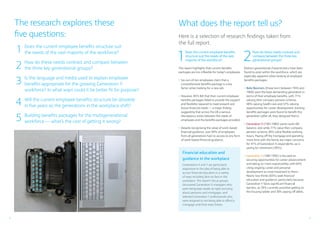
Distinct generational characteristics have been
found to exist within the workforce, which are
especially apparent when looking at employee
benefits packages:
•	Baby Boomers (those born between 1945 and
1960) were the least demanding generation in
terms of their employee benefits, with 71%
valuing their company pension scheme,
48% valuing health care and 57% valuing
opportunities for career development. Existing
benefits packages were found to benefit this
generation (after all, they designed them).
•	Generation X (1961-1980) wants work-life
balance, and while 71% value their company
pension scheme, 69% value flexible working
hours. Paying off the mortgage and spending
more time with the family are major concerns
for 41% of Generation X respondents, as is
saving for retirement (30%).
•	 Generation Y (1981-1995) is focused on
securing opportunities for career advancement
and taking on more responsibility, with 64%
citing ongoing career and personal
development as most important to them.
Nearly two thirds (65%) seek financial
education and guidance, particularly because
Generation Y faces significant financial
barriers, as 29% currently prioritise getting on
the housing ladder and 30% paying off debts.
What does the report tell us?The research explores these
five questions: Here is a selection of research findings taken from
the full report.
1 2
Financial education and
guidance in the workplace
Generations X and Y are particularly
responsive to the idea of being able to
access financial education in a variety
of ways including face-to-face in the
workplace. The report’s focus groups
discovered Generation X managers who
were being kept awake at night worrying
about pensions and mortgages, and
talented Generation Y professionals who
were resigned to not being able to afford a
mortgage until their early forties.
6 7
Characteristics
Maturists
(pre-1945)
Baby Boomers
(1945-1960)
Formative experiences Second World War
Rationing
Fixed-gender roles
Rock ‘n’ Roll
Nuclear families
Defined gender roles —
particularly for women
Cold War
Post-War boom
“Swinging Sixties”
Apollo Moon landings
Youth culture
Woodstock
Family-orientated
Rise of the teenager
Percentage in
U.K. workforce*
3% 33%
Aspiration
Home ownership Job security
Attitude toward
technology
Largely disengaged
Early information
technology (IT) adaptors
Attitude toward
career Jobs are for life
Organisational — careers
are defined by employers
Signature product
Automobile Television
Communication media
Formal letter Telephone
Communication
preference
Face-to-face
Face-to-face ideally, but
telephone or e-mail if required
Preference when making
financial decisions
Face-to-face meetings
Face-to-face ideally, but
increasingly will go online
Generation X
(1961-1980)
Generation Y
(1981-1995)
Generation Z
(Born after 1995)
End of Cold War
Fall of Berlin Wall
Reagan / Gorbachev
Thatcherism
Live Aid
Introduction of first PC
Early mobile technology
Latch-key kids;
rising levels of divorce
9/11 terrorist attacks
PlayStation
Social media
Invasion of Iraq
Reality TV
Google Earth
Glastonbury
Economic downturn
Global warming
Global focus
Mobile devices
Energy crisis
Arab Spring
Produce own media
Cloud computing
Wiki-leaks
35% 29%
Currently employed in
either part-time jobs or
new apprenticeships
Work-life balance
Freedom
and flexibility
Security
and stability
Digital Immigrants Digital Natives
“Technoholics” – entirely dependent
on IT; limited grasp of alternatives
Early “portfolio” careers
— loyal to profession, not
necessarily to employer
Digital entrepreneurs —
work “with” organisations
not “for”
Career multitaskers — will move
seamlessly between organisations
and “pop-up” businesses
Personal Computer Tablet/Smart Phone
Google glass, graphene,
nano-computing,
3-D printing, driverless cars
E-mail and text message Text or social media
Hand-held (or integrated into
clothing) communication devices
Text messaging or e-mail
Online and mobile
(text messaging)
Facetime
Online — would prefer
face-to-face if time permitting
Face-to-face
Solutions will be digitally
crowd-sourced
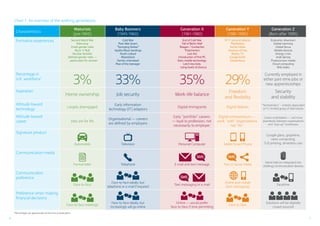
Chart 1: An overview of the working generations
*Percentages are approximate at the time of publication.
8 9
Will the current employee
benefits structure be obsolete
in five years as the generations
in the workplace shift?
•	 Thinking about future employee benefits
needs, each generation faces its own unique
obstacles and challenges. While dissatisfied
with existing benefits packages, few
employees were able to see beyond their
current benefits offerings.
•	Although the majority (80%) of employees
across all generations expect their employer to
provide a comprehensive benefits package, we
found that relatively few employees have a
clear sense of the type of benefits package
that would best suit their future needs.
Helping staff visualise their future selves —
particularly in terms of the financial challenges
they are likely to face in the future — can be
a highly effective way of overcoming
this obstacle.
43
Is the language and media used to
explain employee benefits appropriate
for the growing Generation Y
workforce? In what ways could it
be better fit for purpose?
•	E-mail (45%) and staff intranet (41%) are still
the most popular ways for companies to
communicate their benefits to employees,
compared to seminars (20%) and one-on-one
meetings (13%).
•	The result: confusion. One in five Generation Y
respondents said that in the past year they have
been confused about what employee benefits
they have or are currently entitled to.
•	More than 50% of employees now use the
Internet when sourcing financial information.
However, counter to claims about the rise of the
“digital native” generations, our report’s focus
groups discovered widespread support for
face-to-face interventions and personal
engagement particularly amongst Generation Y.
•	Although auto-enrolment is likely to increase
participation of Generation Y employees in
company pension schemes, this report suggests
that unless supplemented by more
generationally-tailored benefits, auto-
enrolment, as a form of engagement, is likely to
have limited impact on recruitment or retention.
One in five Generation Y respondents said
that in the past year they have been confused
about what employee benefits they have or
are currently entitled to.
•	 12% of Generation Y respondents are so
dissatisfied with their current benefits package
that they have considered moving to a
different organisation. This indicates the
emergence of a new Generation Y
“psychological contract” impacting how future
generations engage with their employers: The
role of the employer will shift from being a
benefits “provider” to a benefits “enabler.”
•	 However, the reward for offering the right
benefits packages to the right generational
groups can be significant. Research shows
that employees who are satisfied with their
benefits packages are also more likely to be
loyal to their employers and engaged with
their organisations.2
•	 If tailored to the specific aspirations, priorities
and objectives of each generation, benefits
packages can be highly effective in enhancing
employers’ engagement strategies.
Organisations with high levels of engagement
have 40% lower employee turnover rates than
companies with low levels of engagement. In
addition, Total Shareholder Return (TSR) at
these organisations has been calculated as
being 42% higher than their competitors.
Employees with the highest levels of
engagement perform 20% above average,
while being 87% less likely to leave
their organisation.3
5
Building benefits packages for the
multigenerational workforce —
what’s the cost of getting it wrong?
2	 “Benefits and the coming employee retention crisis,” Trends E-Magazine, October 2011
3	 P.A. Consulting, “Engaging your employees to drive superior organisational performance,” 2013
A toolkit for HR
professionals
Understanding the generational
differences is a key business
imperative, particularly when devising
and implementing organisational
engagement strategies. In a post-
recession workplace, where employee
loyalty is undergoing a fundamental
shift, what do employers need to do to
ensure that they are meeting the needs
of all their employees, at every stage
of their lives?
Workplace generations need and
expect tailored benefits packages.
Based on generational profiles, the
full report provides broad suggestions
on the products and methods of
communication for each generation that
can help you begin your journey toward
greater employee engagement.
1110
Legal note
Whilst every effort has been taken to verify the accuracy of this information, neither Dr. Paul
Redmond, YouGov nor Barclays can accept any responsibility or liability for reliance by any person
on this report or any of the information, opinions or conclusions set out in the report. This document
is intended solely for informational purposes, and is not intended to be a solicitation or offer, or
recommendation to acquire or dispose of any investment or to engage in any other transaction,
or to provide any investment advice or service.
 
This item can be provided in Braille, large print or audio by calling 0800 400 100* (via TextDirect if
appropriate). If outside the U.K. call +44 (0)1624 684 444*. Calls made to 0800 numbers are free
if made from a U.K. landline. Other call costs may vary, please check with your telecoms provider.
Lines are open from 8 a.m. to 6 p.m. U.K. time Monday to Friday.
*Calls may be recorded so that we can monitor the quality of our service and for security purposes.
“Barclays” refers to any company in the Barclays PLC group of companies.
Barclays Bank PLC is registered in England and authorized by the Prudential Regulation Authority and regulated by the
Financial Conduct Authority and the Prudential Regulation Authority. Registered No. 1026167. Registered Office:
1 Churchill Place, London E14 5HP.
 
© Barclays September 2013. All rights reserved.
The full report, Talking About My Generation:
Exploring the Benefits Engagement Challenge,
is available from Barclays:
Richard Hilton
Richard.x.hilton@barclays.com
+44 (0) 203 555 3206
Item ref: IBIM2328. Sept 2013.
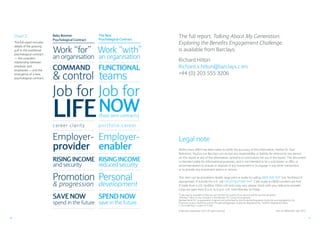
Work “for” Work “with”
Promotion Personal
COMMAND FUNCTIONAL
LIFENOW
Job for Job for
an organisation an organisation
 progression development
career clarity portfolio career
spend in the future save in the future
provider enabler
 control teams
SAVE NOW SPEND NOW
RISING INCOME RISING INCOME
and security reduced security
(fixed term contracts)
Baby Boomer
Psychological Contract
The New
Psychological Contract
Employer- Employer-
Chart 2:
The full report includes
details of the growing
gulf in the traditional
psychological contract
— the unspoken
relationship between
employer and
employees — and the
emergence of a new
psychological contract.
Barclays_precis FINAL 06.09.13

Barclays_precis FINAL 06.09.13

  • 1.
    A Summary of TalkingAbout My Generation: Exploring the Benefits Engagement Challenge September 2013
  • 2.
    3 Why read thisreport? In-depth research into the financial aspirations, concerns and priorities of today’s workplace generations Insight into benefits currently on offer and what employees really want The risks of getting benefits strategy wrong A toolkit to help HR professionals provide more generationally-appropriate benefits packages Tips for how best to communicate with a multigenerational workforce For the first time in history, we are seeing up to five different generations in the workplace. These generations share the same managers, rub shoulders in the same spaces and collaborate on the same projects — but that is where the similarities end. With the age gap between these individuals reaching up to 50 years, we see just how far apart the values, drivers and needs of these different generations can be. Meanwhile, for the past decade, a “perfect storm” has been raging in the workplace that has brought together a confluence of economic uncertainty, global competition, falling prices, ubiquitous and ever-evolving technology, and shortages in staff and resources. Throw in the changing “psychological contract” that now exists between different generations and their employers, and it is no surprise that HR professionals are rethinking how they reward their employees, looking beyond the “one size fits all” approach and assessing the effectiveness of traditional flexible benefits. In unpacking some of these issues, Barclays has commissioned Dr. Paul Redmond (pictured), a leading expert on generational theory from the University of Liverpool, to conduct both quantitative and qualitative research to uncover the financial aspirations, concerns and priorities of today’s workforce. Through the lens of generational science, the report provides human resources (HR) professionals with a new and compelling way of thinking about how to use employee benefits to more effectively engage with the different generations. Overview of the reportThe full report includes: “Employers must now address the fundamental landscape change in workforce requirements and demands.” Zain Wadee1 1 Wadee, Z., “Generations X and Y are different, so tailor your benefits accordingly,” HRM Magazine, 4 April 2011 Katharine Photiou Director, Barclays • Because your benefits programme is probably not meeting the needs of everyone in your workforce — the modern workplace is evolving in ways we have never seen before • Because a benefits scheme that meets the needs of the different generations in your workplace will achieve better outcomes for you and your employees • Because many have paid lip service to the “generation issue” but being aware isn’t enough, you need to take action
  • 3.
    4 5 Does thecurrent employee benefits structure suit the needs of the vast majority of the workforce? How do these needs contrast and compare between the three key generational groups? Is the language and media used to explain employee benefits appropriate for the growing Generation Y workforce? In what ways could it be better fit for purpose? Will the current employee benefits structure be obsolete in five years as the generations in the workplace shift? Building benefits packages for the multigenerational workforce — what’s the cost of getting it wrong? 1 2 3 4 5 Does the current employee benefits structure suit the needs of the vast majority of the workforce? The report highlights that current benefits packages are too inflexible for today’s employees • Six-out-of-ten employees claim that a comprehensive benefits package is a key factor when looking for a new job. • However, 85% felt that their current employee benefits packages failed to provide the support and flexibility required to meet present and future financial needs — a major finding suggesting that across the UK a serious discrepancy exists between the needs of employees and the benefits packages provided. • Despite recognising the value of work-based financial guidance, over 90% of employees from all generations had no access to any form of work-based financial guidance. How do these needs contrast and compare between the three key generational groups? Distinct generational characteristics have been found to exist within the workforce, which are especially apparent when looking at employee benefits packages: • Baby Boomers (those born between 1945 and 1960) were the least demanding generation in terms of their employee benefits, with 71% valuing their company pension scheme, 48% valuing health care and 57% valuing opportunities for career development. Existing benefits packages were found to benefit this generation (after all, they designed them). • Generation X (1961-1980) wants work-life balance, and while 71% value their company pension scheme, 69% value flexible working hours. Paying off the mortgage and spending more time with the family are major concerns for 41% of Generation X respondents, as is saving for retirement (30%). • Generation Y (1981-1995) is focused on securing opportunities for career advancement and taking on more responsibility, with 64% citing ongoing career and personal development as most important to them. Nearly two thirds (65%) seek financial education and guidance, particularly because Generation Y faces significant financial barriers, as 29% currently prioritise getting on the housing ladder and 30% paying off debts. What does the report tell us?The research explores these five questions: Here is a selection of research findings taken from the full report. 1 2 Financial education and guidance in the workplace Generations X and Y are particularly responsive to the idea of being able to access financial education in a variety of ways including face-to-face in the workplace. The report’s focus groups discovered Generation X managers who were being kept awake at night worrying about pensions and mortgages, and talented Generation Y professionals who were resigned to not being able to afford a mortgage until their early forties.
  • 4.
    6 7 Characteristics Maturists (pre-1945) Baby Boomers (1945-1960) Formativeexperiences Second World War Rationing Fixed-gender roles Rock ‘n’ Roll Nuclear families Defined gender roles — particularly for women Cold War Post-War boom “Swinging Sixties” Apollo Moon landings Youth culture Woodstock Family-orientated Rise of the teenager Percentage in U.K. workforce* 3% 33% Aspiration Home ownership Job security Attitude toward technology Largely disengaged Early information technology (IT) adaptors Attitude toward career Jobs are for life Organisational — careers are defined by employers Signature product Automobile Television Communication media Formal letter Telephone Communication preference Face-to-face Face-to-face ideally, but telephone or e-mail if required Preference when making financial decisions Face-to-face meetings Face-to-face ideally, but increasingly will go online Generation X (1961-1980) Generation Y (1981-1995) Generation Z (Born after 1995) End of Cold War Fall of Berlin Wall Reagan / Gorbachev Thatcherism Live Aid Introduction of first PC Early mobile technology Latch-key kids; rising levels of divorce 9/11 terrorist attacks PlayStation Social media Invasion of Iraq Reality TV Google Earth Glastonbury Economic downturn Global warming Global focus Mobile devices Energy crisis Arab Spring Produce own media Cloud computing Wiki-leaks 35% 29% Currently employed in either part-time jobs or new apprenticeships Work-life balance Freedom and flexibility Security and stability Digital Immigrants Digital Natives “Technoholics” – entirely dependent on IT; limited grasp of alternatives Early “portfolio” careers — loyal to profession, not necessarily to employer Digital entrepreneurs — work “with” organisations not “for” Career multitaskers — will move seamlessly between organisations and “pop-up” businesses Personal Computer Tablet/Smart Phone Google glass, graphene, nano-computing, 3-D printing, driverless cars E-mail and text message Text or social media Hand-held (or integrated into clothing) communication devices Text messaging or e-mail Online and mobile (text messaging) Facetime Online — would prefer face-to-face if time permitting Face-to-face Solutions will be digitally crowd-sourced Chart 1: An overview of the working generations *Percentages are approximate at the time of publication.
  • 5.
    8 9 Will thecurrent employee benefits structure be obsolete in five years as the generations in the workplace shift? • Thinking about future employee benefits needs, each generation faces its own unique obstacles and challenges. While dissatisfied with existing benefits packages, few employees were able to see beyond their current benefits offerings. • Although the majority (80%) of employees across all generations expect their employer to provide a comprehensive benefits package, we found that relatively few employees have a clear sense of the type of benefits package that would best suit their future needs. Helping staff visualise their future selves — particularly in terms of the financial challenges they are likely to face in the future — can be a highly effective way of overcoming this obstacle. 43 Is the language and media used to explain employee benefits appropriate for the growing Generation Y workforce? In what ways could it be better fit for purpose? • E-mail (45%) and staff intranet (41%) are still the most popular ways for companies to communicate their benefits to employees, compared to seminars (20%) and one-on-one meetings (13%). • The result: confusion. One in five Generation Y respondents said that in the past year they have been confused about what employee benefits they have or are currently entitled to. • More than 50% of employees now use the Internet when sourcing financial information. However, counter to claims about the rise of the “digital native” generations, our report’s focus groups discovered widespread support for face-to-face interventions and personal engagement particularly amongst Generation Y. • Although auto-enrolment is likely to increase participation of Generation Y employees in company pension schemes, this report suggests that unless supplemented by more generationally-tailored benefits, auto- enrolment, as a form of engagement, is likely to have limited impact on recruitment or retention. One in five Generation Y respondents said that in the past year they have been confused about what employee benefits they have or are currently entitled to. • 12% of Generation Y respondents are so dissatisfied with their current benefits package that they have considered moving to a different organisation. This indicates the emergence of a new Generation Y “psychological contract” impacting how future generations engage with their employers: The role of the employer will shift from being a benefits “provider” to a benefits “enabler.” • However, the reward for offering the right benefits packages to the right generational groups can be significant. Research shows that employees who are satisfied with their benefits packages are also more likely to be loyal to their employers and engaged with their organisations.2 • If tailored to the specific aspirations, priorities and objectives of each generation, benefits packages can be highly effective in enhancing employers’ engagement strategies. Organisations with high levels of engagement have 40% lower employee turnover rates than companies with low levels of engagement. In addition, Total Shareholder Return (TSR) at these organisations has been calculated as being 42% higher than their competitors. Employees with the highest levels of engagement perform 20% above average, while being 87% less likely to leave their organisation.3 5 Building benefits packages for the multigenerational workforce — what’s the cost of getting it wrong? 2 “Benefits and the coming employee retention crisis,” Trends E-Magazine, October 2011 3 P.A. Consulting, “Engaging your employees to drive superior organisational performance,” 2013 A toolkit for HR professionals Understanding the generational differences is a key business imperative, particularly when devising and implementing organisational engagement strategies. In a post- recession workplace, where employee loyalty is undergoing a fundamental shift, what do employers need to do to ensure that they are meeting the needs of all their employees, at every stage of their lives? Workplace generations need and expect tailored benefits packages. Based on generational profiles, the full report provides broad suggestions on the products and methods of communication for each generation that can help you begin your journey toward greater employee engagement.
  • 6.
    1110 Legal note Whilst everyeffort has been taken to verify the accuracy of this information, neither Dr. Paul Redmond, YouGov nor Barclays can accept any responsibility or liability for reliance by any person on this report or any of the information, opinions or conclusions set out in the report. This document is intended solely for informational purposes, and is not intended to be a solicitation or offer, or recommendation to acquire or dispose of any investment or to engage in any other transaction, or to provide any investment advice or service.   This item can be provided in Braille, large print or audio by calling 0800 400 100* (via TextDirect if appropriate). If outside the U.K. call +44 (0)1624 684 444*. Calls made to 0800 numbers are free if made from a U.K. landline. Other call costs may vary, please check with your telecoms provider. Lines are open from 8 a.m. to 6 p.m. U.K. time Monday to Friday. *Calls may be recorded so that we can monitor the quality of our service and for security purposes. “Barclays” refers to any company in the Barclays PLC group of companies. Barclays Bank PLC is registered in England and authorized by the Prudential Regulation Authority and regulated by the Financial Conduct Authority and the Prudential Regulation Authority. Registered No. 1026167. Registered Office: 1 Churchill Place, London E14 5HP.   © Barclays September 2013. All rights reserved. The full report, Talking About My Generation: Exploring the Benefits Engagement Challenge, is available from Barclays: Richard Hilton Richard.x.hilton@barclays.com +44 (0) 203 555 3206 Item ref: IBIM2328. Sept 2013. Work “for” Work “with” Promotion Personal COMMAND FUNCTIONAL LIFENOW Job for Job for an organisation an organisation progression development career clarity portfolio career spend in the future save in the future provider enabler control teams SAVE NOW SPEND NOW RISING INCOME RISING INCOME and security reduced security (fixed term contracts) Baby Boomer Psychological Contract The New Psychological Contract Employer- Employer- Chart 2: The full report includes details of the growing gulf in the traditional psychological contract — the unspoken relationship between employer and employees — and the emergence of a new psychological contract.