Entrepreneurship in China: Stimulus for Discussion Jim Cook Cook-Hauptman Associates, Inc. Sponsored by :  The Kauffman Foundation
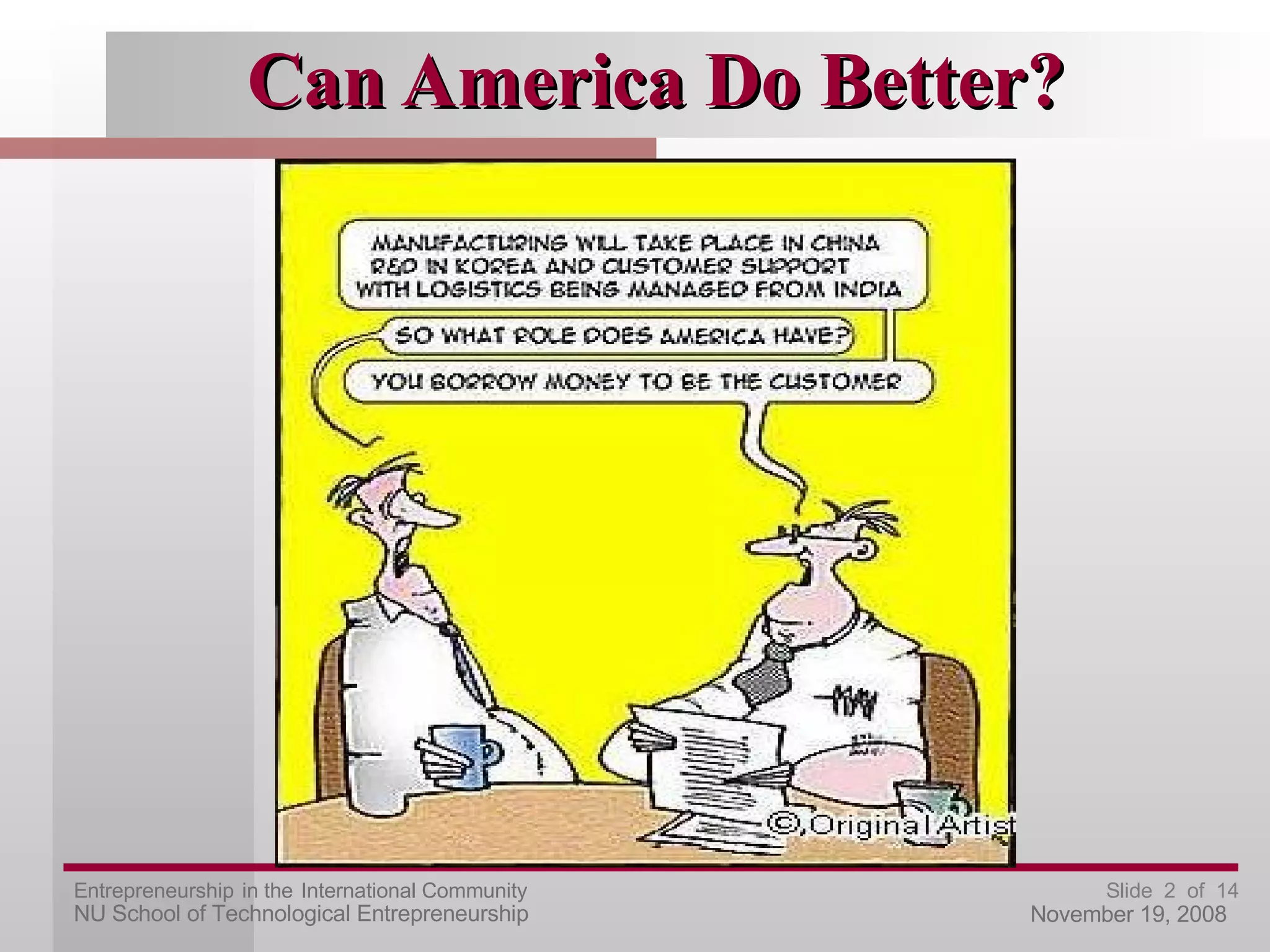
Can America Do Better?
Contents Qualifying for the China Challenge Chinese Society/Culture Basics China’s “Chinese Characteristics” Meet the People, Generation by Generation Opportunity Segmentation of China Sourcing/Selling Opportunity Templates “ On the Ground Nitty-Gritty” Tips OK, let’s open up China (to discussion)!
Yes, America can do Better! How’s our chances (as Americans) in China? Decision must come from deep inside you, not infatuation Get a native partner who has bonded to you and your goals Understand, respect , and exploit the cultural differences Be ready to substitute “trust” for contracts and recourse Use “Chinese Characteristics” to build competitive advantage Flow with the government policies and serve ignored markets Be prepared for setbacks, delays, and disappointments Getting Started Sourcing or selling, you must understand your market Acquaint yourself with the legal/administrative landscape Raise value adding investment capital, not just cash
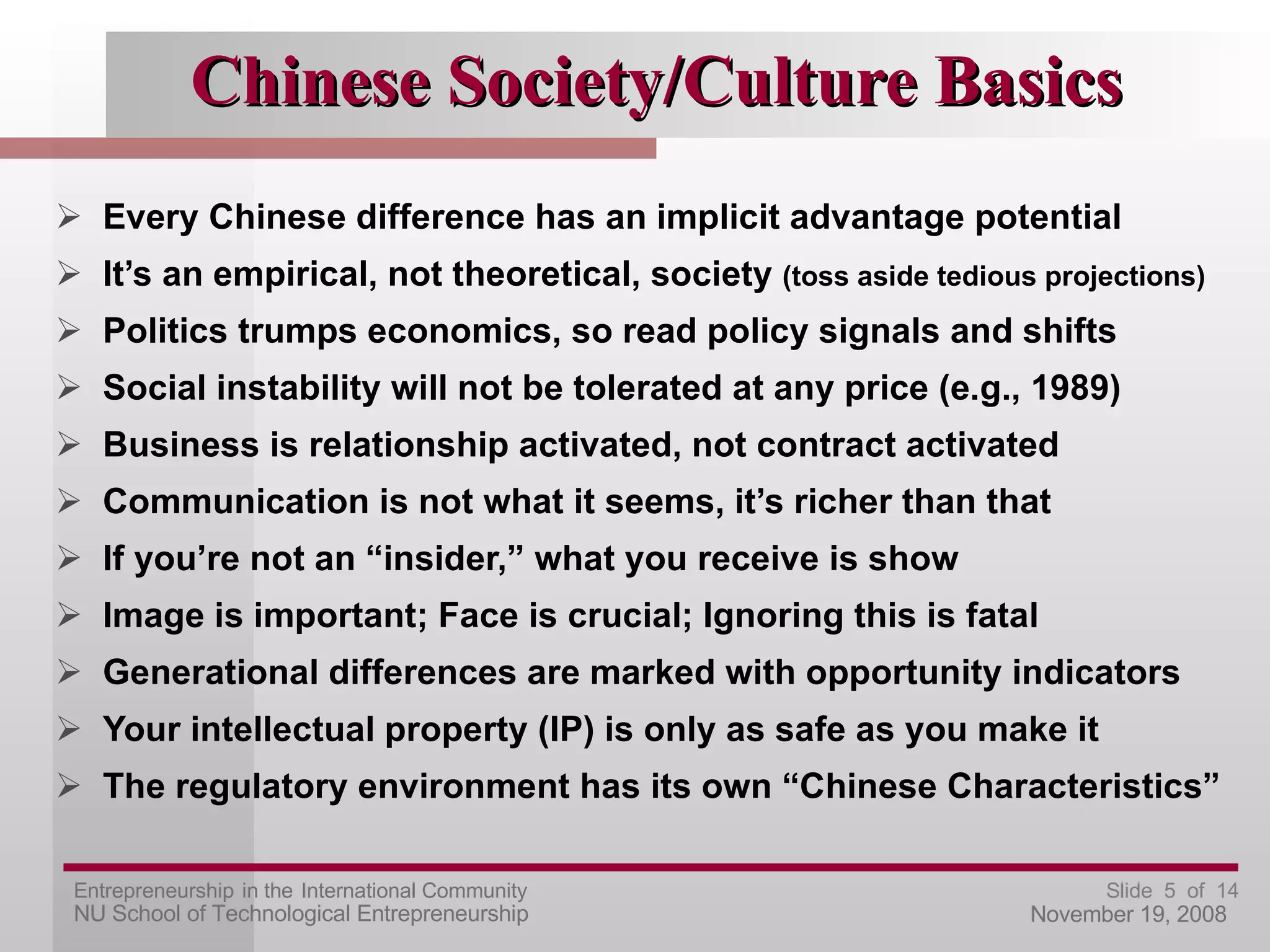
Chinese Society/Culture Basics Every Chinese difference has an implicit advantage potential It’s an empirical, not theoretical, society  (toss aside tedious projections) Politics trumps economics, so read policy signals and shifts Social instability will not be tolerated at any price (e.g., 1989) Business is relationship activated, not contract activated Communication is not what it seems, it’s richer than that  If you’re not an “insider,” what you receive is show Image is important; Face is crucial; Ignoring this is fatal Generational differences are marked with opportunity indicators Your intellectual property (IP) is only as safe as you make it The regulatory environment has its own “Chinese Characteristics”
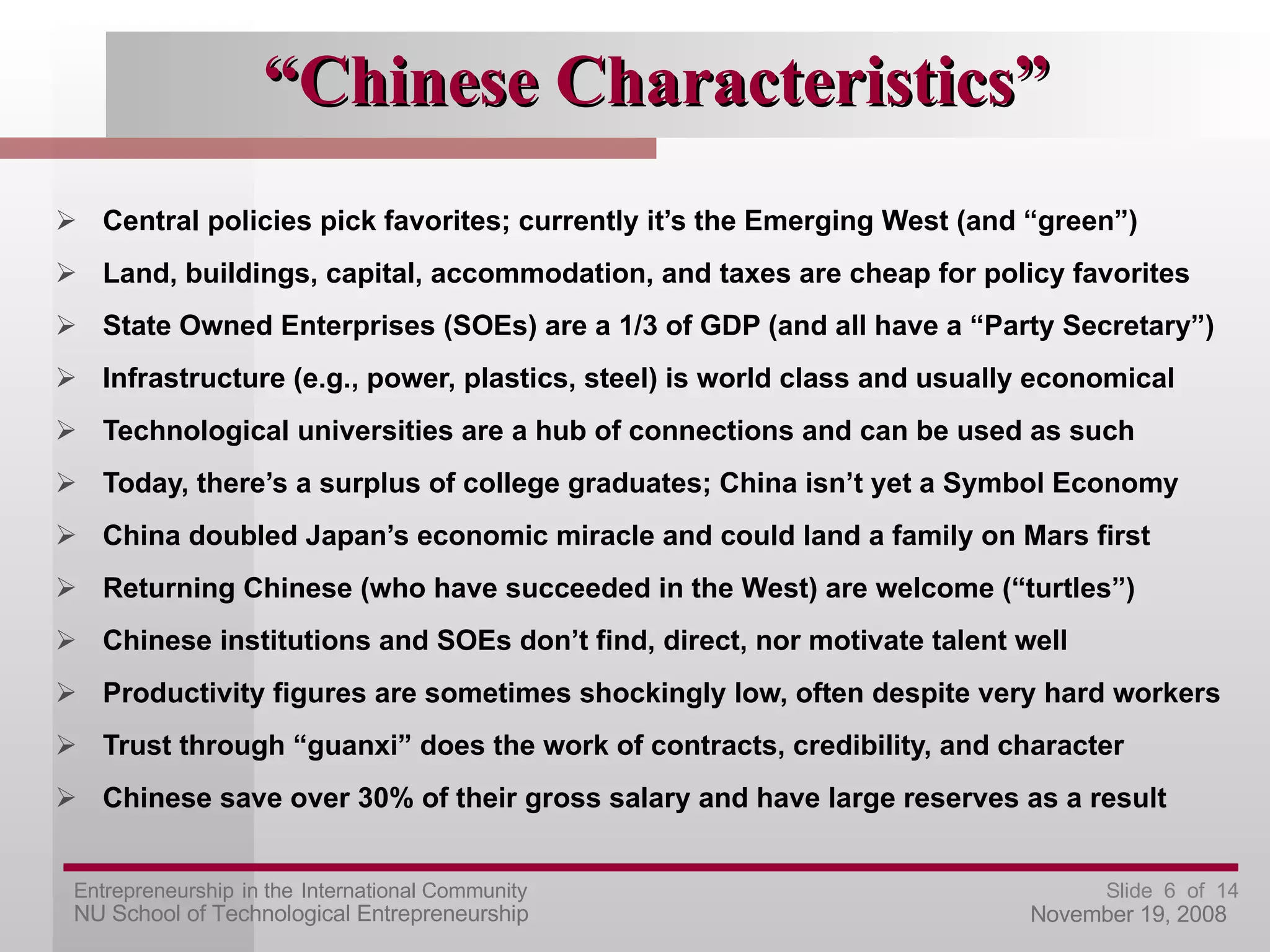
“ Chinese Characteristics” Central policies pick favorites; currently it’s the Emerging West (and “green”) Land, buildings, capital, accommodation, and taxes are cheap for policy favorites State Owned Enterprises (SOEs) are a 1/3 of GDP (and all have a “Party Secretary”) Infrastructure (e.g., power, plastics, steel) is world class and usually economical Technological universities are a hub of connections and can be used as such Today, there’s a surplus of college graduates; China isn’t yet a Symbol Economy China doubled Japan’s economic miracle and could land a family on Mars first Returning Chinese (who have succeeded in the West) are welcome (“turtles”) Chinese institutions and SOEs don’t find, direct, nor motivate talent well Productivity figures are sometimes shockingly low, often despite very hard workers Trust through “guanxi” does the work of contracts, credibility, and character Chinese save over 30% of their gross salary and have large reserves as a result
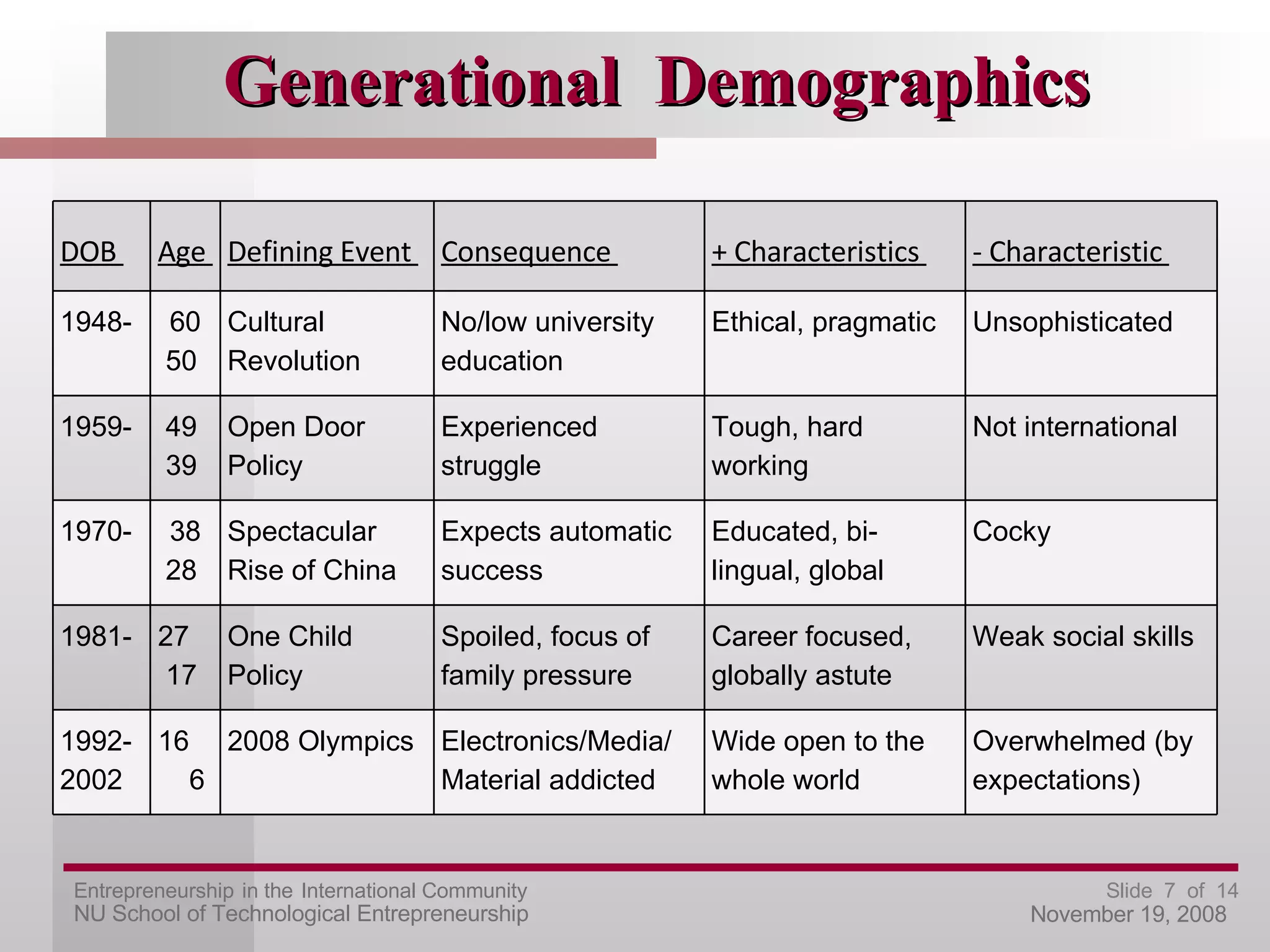
Generational  Demographics DOB  Age  Defining Event  Consequence  + Characteristics  - Characteristic  1948-  60 50  Cultural Revolution  No/low university education  Ethical, pragmatic  Unsophisticated  1959-  49  39  Open Door Policy  Experienced struggle  Tough, hard working  Not international  1970-  38 28  Spectacular Rise of China  Expects automatic success  Educated, bi-lingual, global  Cocky  1981-  27  17  One Child Policy  Spoiled, focus of family pressure  Career focused,  globally astute  Weak social skills  1992-2002  16  6  2008 Olympics  Electronics/Media/ Material addicted  Wide open to the whole world  Overwhelmed (by expectations)
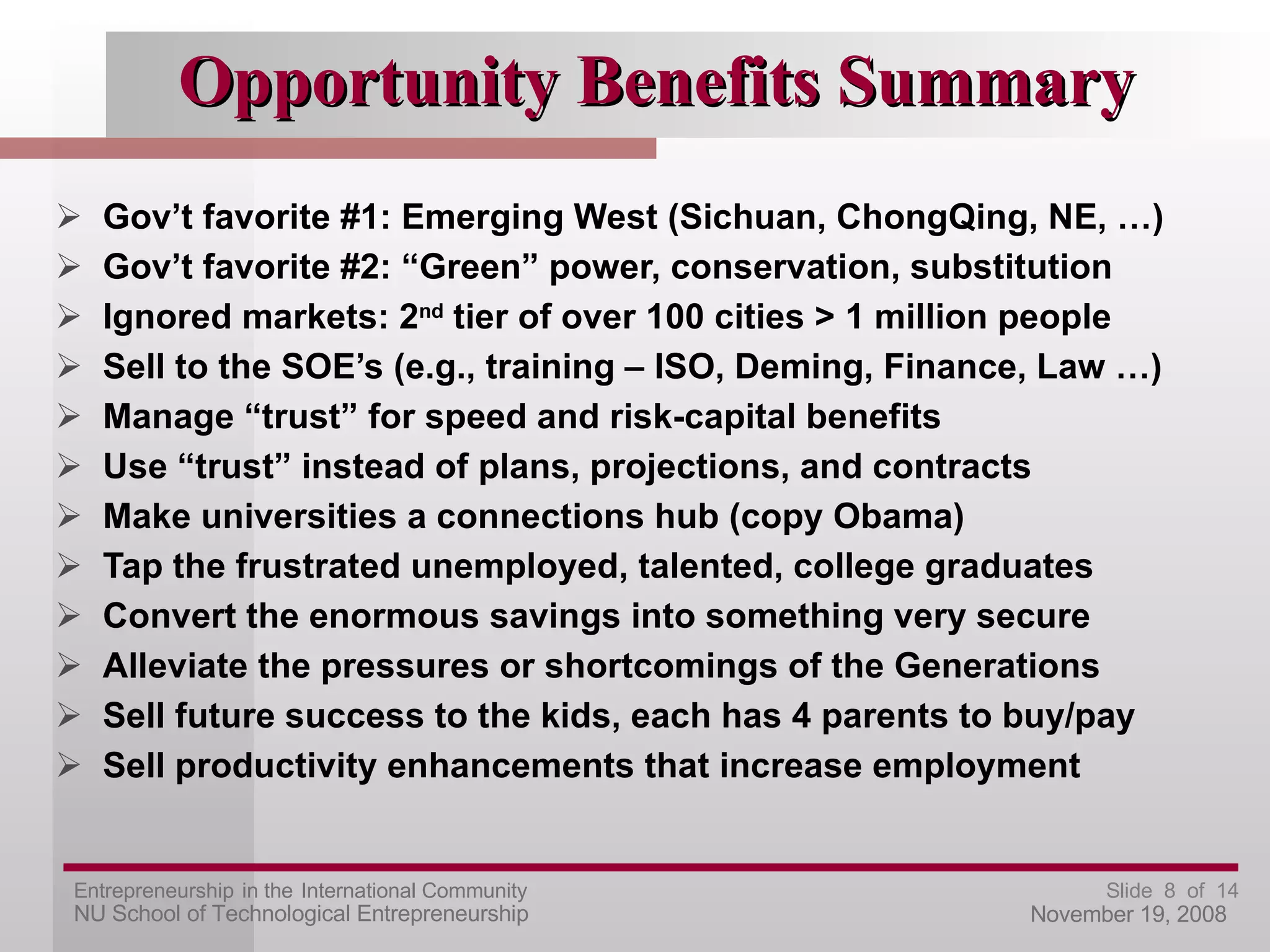
Opportunity Benefits Summary Gov’t favorite #1: Emerging West (Sichuan, ChongQing, NE, …) Gov’t favorite #2: “Green” power, conservation, substitution Ignored markets: 2 nd  tier of over 100 cities > 1 million people Sell to the SOE’s (e.g., training – ISO, Deming, Finance, Law …) Manage “trust” for speed and risk-capital benefits Use “trust” instead of plans, projections, and contracts Make universities a connections hub (copy Obama) Tap the frustrated unemployed, talented, college graduates Convert the enormous savings into something very secure Alleviate the pressures or shortcomings of the Generations Sell future success to the kids, each has 4 parents to buy/pay Sell productivity enhancements that increase employment
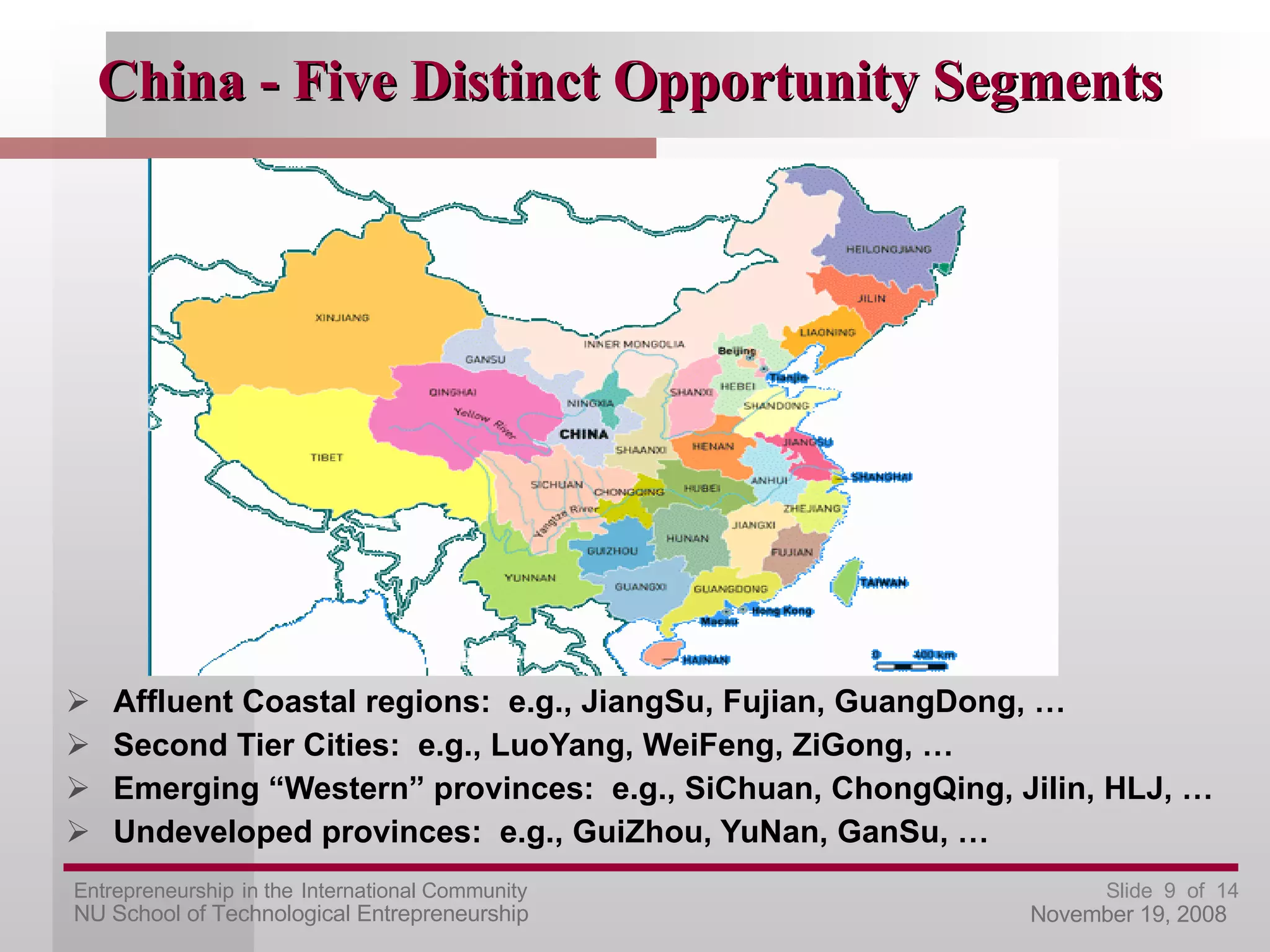
China - Five Distinct Opportunity Segments Affluent Coastal regions:  e.g., JiangSu, Fujian, GuangDong, … Second Tier Cities:  e.g., LuoYang, WeiFeng, ZiGong, … Emerging “Western” provinces:  e.g., SiChuan, ChongQing, Jilin, HLJ, … Undeveloped provinces:  e.g., GuiZhou, YuNan, GanSu, …
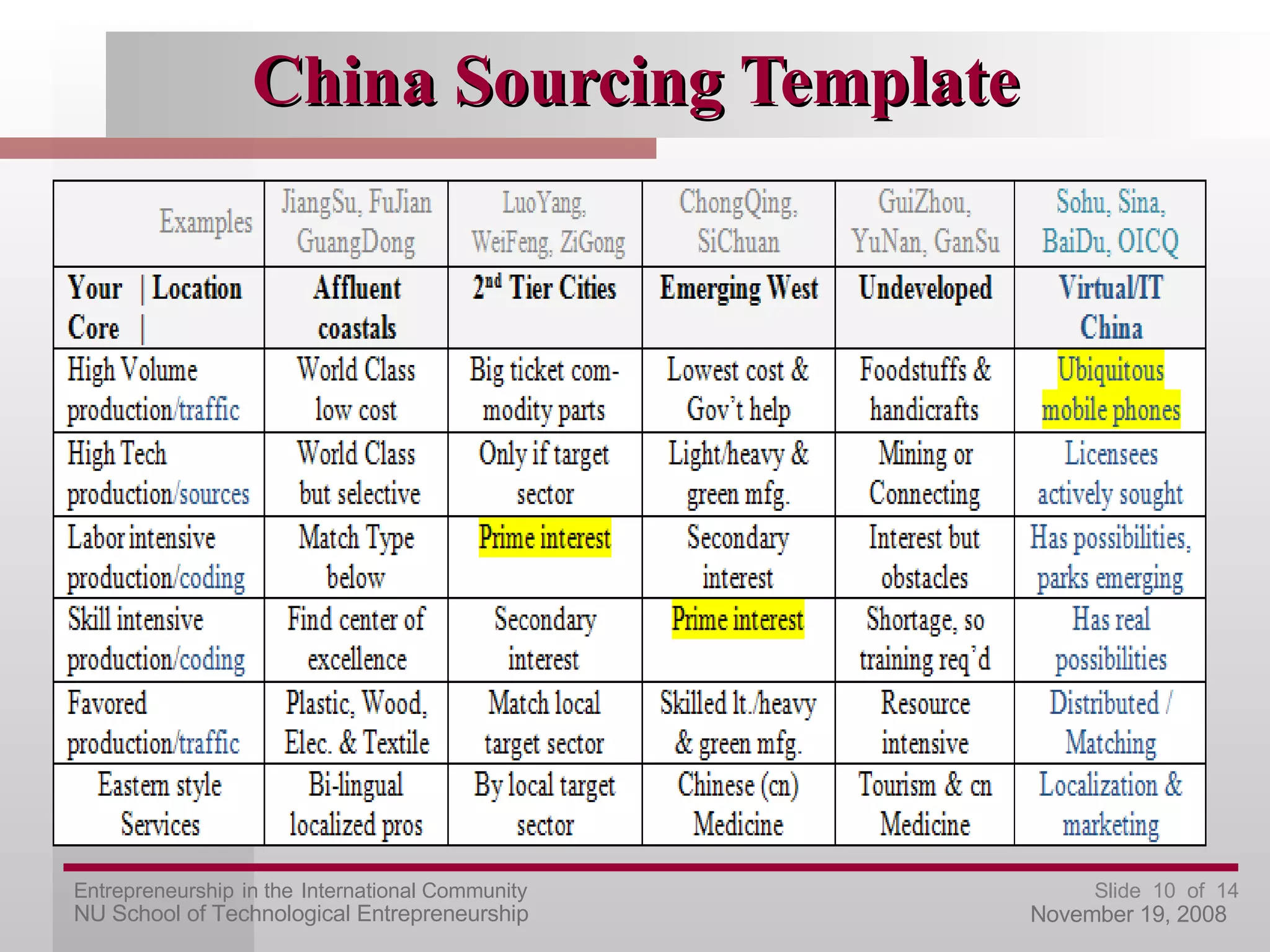
China Sourcing Template
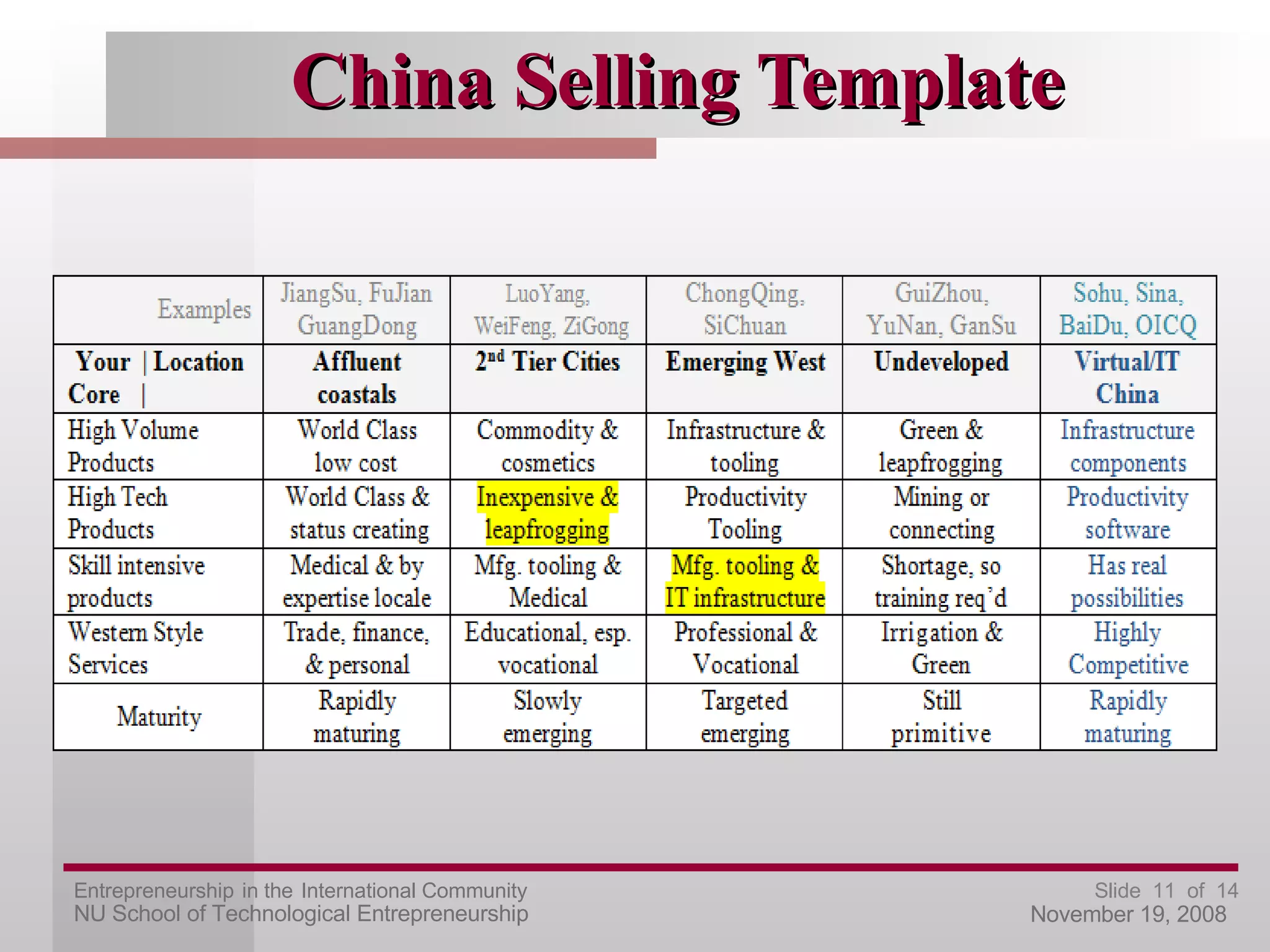
China Selling Template
Sourcing/Selling Summary Emerging West for skill intensive production and selling infrastructure and second wave of upscaling (repeat of Affluent coastals of the past twenty years) 2 nd  Tier Cities for labor intensive sourcing and selling American product access/franchises (below the Western radar) Gov’t  favors: Emerging West (central gov’t), green technology (central gov’t), and centers of excellence (local)  [Note: this “West” includes North East and Central China, too] You can count on: High receptivity to locating in government industrial/technology parks Every consumer having a cell phone, credit card, and access to the internet Typically, college graduates having had over 8 years of English schooling
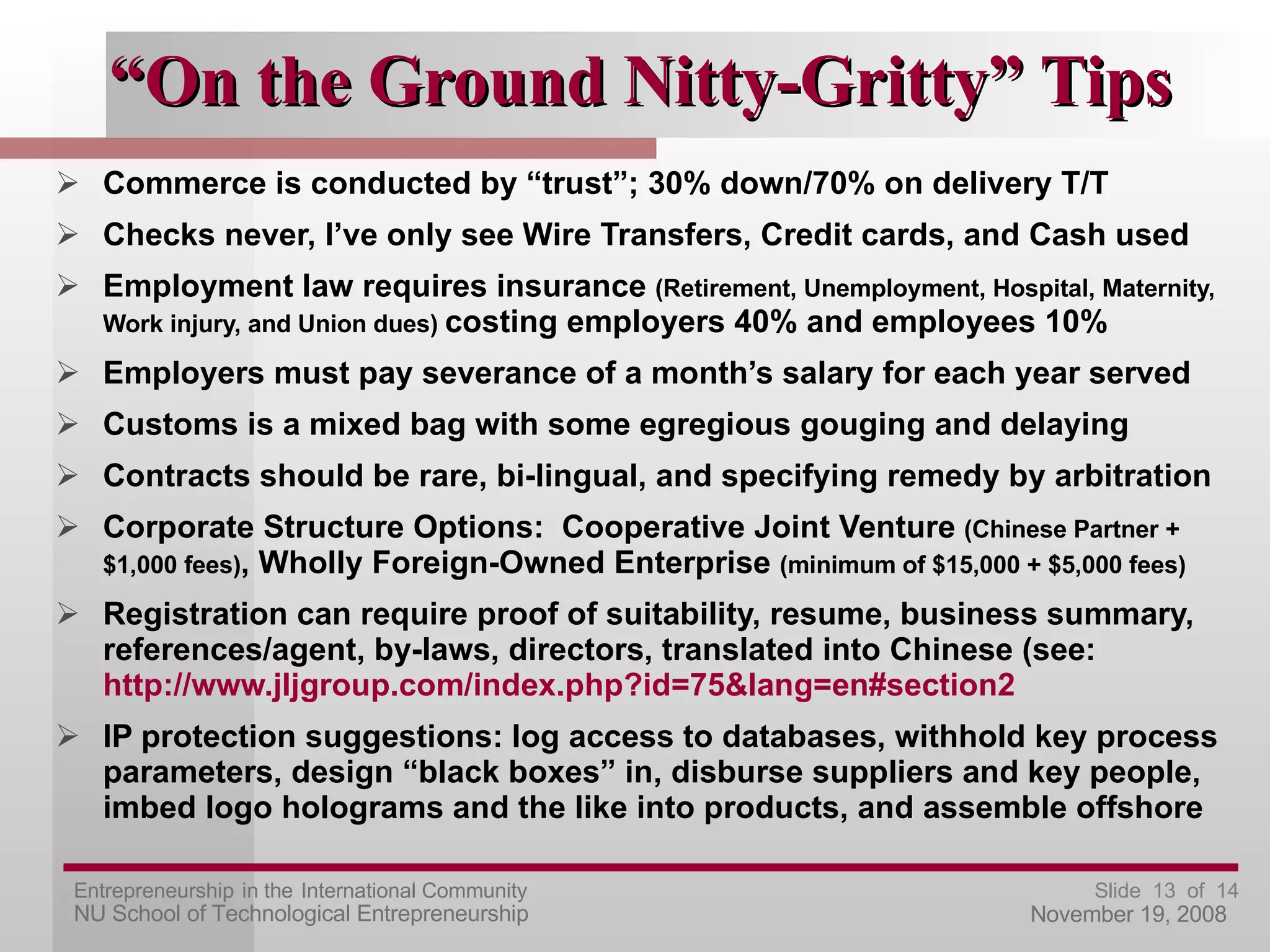
“ On the Ground Nitty-Gritty” Tips Commerce is conducted by “trust”; 30% down/70% on delivery T/T Checks never, I’ve only see Wire Transfers, Credit cards, and Cash used Employment law requires insurance  (Retirement, Unemployment, Hospital, Maternity, Work injury, and Union dues)  costing employers 40% and employees 10% Employers must pay severance of a month’s salary for each year served Customs is a mixed bag with some egregious gouging and delaying Contracts should be rare, bi-lingual, and specifying remedy by arbitration Corporate Structure Options:  Cooperative Joint Venture  (Chinese Partner + $1,000 fees) , Wholly Foreign-Owned Enterprise  (minimum of $15,000 + $5,000 fees) Registration can require proof of suitability, resume, business summary, references/agent, by-laws, directors, translated into Chinese (see:  http://www.jljgroup.com/index.php?id=75&lang=en#section2   IP protection suggestions: log access to databases, withhold key process parameters, design “black boxes” in, disburse suppliers and key people, imbed logo holograms and the like into products, and assemble offshore
Finally China’s Open (for discussion)! Questions and Comments Thank you, again. On the Internet  (roughly 460 KB)  at: http://cha4mot.com/entrepreneurship-in-china.ppt
Jim Cook’s Journeys President, CEO of NASDAQ Listed Company (Software Tools) and on the board of two publicly held and numerous private companies, all high technology President, CEO of Exxon-Mobil financed venture (Electronics) President, CEO of Globatech, Inc.  in Beijing (Japanese financial portal) Vice President (Technology) Computervision,  Fortune 500  Company (CAD/CAM) Taught MBAs at UCSD (Economics of Mfg.), Worcester Polytechnic Institute (Advanced Mfg.) and U. of Melbourne (Entrepreneuring) Lectured on management at: MIT, NU, People’s University, and Chinese Academy of Sciences; BS math RPI, graduate math MIT, on CCTV news with Jiang Ze Min Consulted on management to: DuPont, Motorola, Bell Labs, D & B, … Interviewed 6 times on FNN (now, CNN Financial) about High Tech investing

Entrepreneurship in China

  • 1.
    Entrepreneurship in China:Stimulus for Discussion Jim Cook Cook-Hauptman Associates, Inc. Sponsored by : The Kauffman Foundation
  • 2.
  • 3.
    Contents Qualifying forthe China Challenge Chinese Society/Culture Basics China’s “Chinese Characteristics” Meet the People, Generation by Generation Opportunity Segmentation of China Sourcing/Selling Opportunity Templates “ On the Ground Nitty-Gritty” Tips OK, let’s open up China (to discussion)!
  • 4.
    Yes, America cando Better! How’s our chances (as Americans) in China? Decision must come from deep inside you, not infatuation Get a native partner who has bonded to you and your goals Understand, respect , and exploit the cultural differences Be ready to substitute “trust” for contracts and recourse Use “Chinese Characteristics” to build competitive advantage Flow with the government policies and serve ignored markets Be prepared for setbacks, delays, and disappointments Getting Started Sourcing or selling, you must understand your market Acquaint yourself with the legal/administrative landscape Raise value adding investment capital, not just cash
  • 5.
    Chinese Society/Culture BasicsEvery Chinese difference has an implicit advantage potential It’s an empirical, not theoretical, society (toss aside tedious projections) Politics trumps economics, so read policy signals and shifts Social instability will not be tolerated at any price (e.g., 1989) Business is relationship activated, not contract activated Communication is not what it seems, it’s richer than that If you’re not an “insider,” what you receive is show Image is important; Face is crucial; Ignoring this is fatal Generational differences are marked with opportunity indicators Your intellectual property (IP) is only as safe as you make it The regulatory environment has its own “Chinese Characteristics”
  • 6.
    “ Chinese Characteristics”Central policies pick favorites; currently it’s the Emerging West (and “green”) Land, buildings, capital, accommodation, and taxes are cheap for policy favorites State Owned Enterprises (SOEs) are a 1/3 of GDP (and all have a “Party Secretary”) Infrastructure (e.g., power, plastics, steel) is world class and usually economical Technological universities are a hub of connections and can be used as such Today, there’s a surplus of college graduates; China isn’t yet a Symbol Economy China doubled Japan’s economic miracle and could land a family on Mars first Returning Chinese (who have succeeded in the West) are welcome (“turtles”) Chinese institutions and SOEs don’t find, direct, nor motivate talent well Productivity figures are sometimes shockingly low, often despite very hard workers Trust through “guanxi” does the work of contracts, credibility, and character Chinese save over 30% of their gross salary and have large reserves as a result
  • 7.
    Generational DemographicsDOB Age Defining Event Consequence + Characteristics - Characteristic 1948- 60 50 Cultural Revolution No/low university education Ethical, pragmatic Unsophisticated 1959- 49 39 Open Door Policy Experienced struggle Tough, hard working Not international 1970- 38 28 Spectacular Rise of China Expects automatic success Educated, bi-lingual, global Cocky 1981- 27 17 One Child Policy Spoiled, focus of family pressure Career focused, globally astute Weak social skills 1992-2002 16 6 2008 Olympics Electronics/Media/ Material addicted Wide open to the whole world Overwhelmed (by expectations)
  • 8.
    Opportunity Benefits SummaryGov’t favorite #1: Emerging West (Sichuan, ChongQing, NE, …) Gov’t favorite #2: “Green” power, conservation, substitution Ignored markets: 2 nd tier of over 100 cities > 1 million people Sell to the SOE’s (e.g., training – ISO, Deming, Finance, Law …) Manage “trust” for speed and risk-capital benefits Use “trust” instead of plans, projections, and contracts Make universities a connections hub (copy Obama) Tap the frustrated unemployed, talented, college graduates Convert the enormous savings into something very secure Alleviate the pressures or shortcomings of the Generations Sell future success to the kids, each has 4 parents to buy/pay Sell productivity enhancements that increase employment
  • 9.
    China - FiveDistinct Opportunity Segments Affluent Coastal regions: e.g., JiangSu, Fujian, GuangDong, … Second Tier Cities: e.g., LuoYang, WeiFeng, ZiGong, … Emerging “Western” provinces: e.g., SiChuan, ChongQing, Jilin, HLJ, … Undeveloped provinces: e.g., GuiZhou, YuNan, GanSu, …
  • 10.
  • 11.
  • 12.
    Sourcing/Selling Summary EmergingWest for skill intensive production and selling infrastructure and second wave of upscaling (repeat of Affluent coastals of the past twenty years) 2 nd Tier Cities for labor intensive sourcing and selling American product access/franchises (below the Western radar) Gov’t favors: Emerging West (central gov’t), green technology (central gov’t), and centers of excellence (local) [Note: this “West” includes North East and Central China, too] You can count on: High receptivity to locating in government industrial/technology parks Every consumer having a cell phone, credit card, and access to the internet Typically, college graduates having had over 8 years of English schooling
  • 13.
    “ On theGround Nitty-Gritty” Tips Commerce is conducted by “trust”; 30% down/70% on delivery T/T Checks never, I’ve only see Wire Transfers, Credit cards, and Cash used Employment law requires insurance (Retirement, Unemployment, Hospital, Maternity, Work injury, and Union dues) costing employers 40% and employees 10% Employers must pay severance of a month’s salary for each year served Customs is a mixed bag with some egregious gouging and delaying Contracts should be rare, bi-lingual, and specifying remedy by arbitration Corporate Structure Options: Cooperative Joint Venture (Chinese Partner + $1,000 fees) , Wholly Foreign-Owned Enterprise (minimum of $15,000 + $5,000 fees) Registration can require proof of suitability, resume, business summary, references/agent, by-laws, directors, translated into Chinese (see: http://www.jljgroup.com/index.php?id=75&lang=en#section2 IP protection suggestions: log access to databases, withhold key process parameters, design “black boxes” in, disburse suppliers and key people, imbed logo holograms and the like into products, and assemble offshore
  • 14.
    Finally China’s Open(for discussion)! Questions and Comments Thank you, again. On the Internet (roughly 460 KB) at: http://cha4mot.com/entrepreneurship-in-china.ppt
  • 15.
    Jim Cook’s JourneysPresident, CEO of NASDAQ Listed Company (Software Tools) and on the board of two publicly held and numerous private companies, all high technology President, CEO of Exxon-Mobil financed venture (Electronics) President, CEO of Globatech, Inc. in Beijing (Japanese financial portal) Vice President (Technology) Computervision, Fortune 500 Company (CAD/CAM) Taught MBAs at UCSD (Economics of Mfg.), Worcester Polytechnic Institute (Advanced Mfg.) and U. of Melbourne (Entrepreneuring) Lectured on management at: MIT, NU, People’s University, and Chinese Academy of Sciences; BS math RPI, graduate math MIT, on CCTV news with Jiang Ze Min Consulted on management to: DuPont, Motorola, Bell Labs, D & B, … Interviewed 6 times on FNN (now, CNN Financial) about High Tech investing