Through the Lens of T.L. Friedman’s  “ The World is Flat” Team 3 Eric Atkinson, Tammy Bankus, Rhonda Canerday,  Cindi Dean, Erika Draper, Dee Oos, Doug Porter, Brandy Rogers, Chanda White
Early Life and Personal Life Early Life  Born July 20, 1953  In high school, he interviewed Ariel Sharon, then an Israeli general and future Prime Minister, for his school newspaper,  The Echo During his undergraduate years, he spent semesters abroad at the Hebrew University of Jerusalem and the American University in Cairo Personal Life Lives in Bethesda, Maryland, with his wife, Ann, and his daughters, Orly and Natalie Member of the Board of Trustees of Brandeis University Member of the Advisory Board of the Marshall Scholarship Commission Awarded honorary degrees from Brandeis, Macalester, Haverford and Hebrew Union College
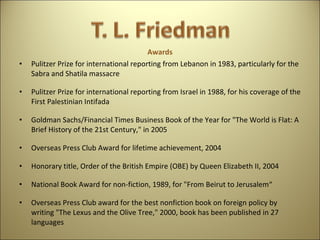
Awards Pulitzer Prize for international reporting from Lebanon in 1983, particularly for the Sabra and Shatila massacre Pulitzer Prize for international reporting from Israel in 1988, for his coverage of the First Palestinian Intifada Goldman Sachs/Financial Times Business Book of the Year for "The World is Flat: A Brief History of the 21st Century," in 2005 Overseas Press Club Award for lifetime achievement, 2004  Honorary title, Order of the British Empire (OBE) by Queen Elizabeth II, 2004 National Book Award for non-fiction, 1989, for "From Beirut to Jerusalem“ Overseas Press Club award for the best nonfiction book on foreign policy by writing "The Lexus and the Olive Tree," 2000, book has been published in 27 languages
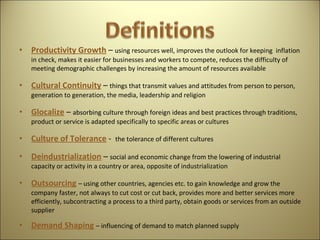
Productivity Growth   –  using resources well, improves the outlook for keeping  inflation in check, makes it easier for businesses and workers to compete, reduces the difficulty of meeting demographic challenges by increasing the amount of resources available Cultural Continuity   –  things that transmit values and attitudes from person to person, generation to generation, the media, leadership and religion Glocalize  –  absorbing culture through foreign ideas and best practices through traditions, product or service is adapted specifically to specific areas or cultures Culture of Tolerance   -  the tolerance of different cultures  Deindustrialization  –  social and economic change from the lowering of industrial capacity or activity in a country or area, opposite of industrialization  Outsourcing   – using other countries, agencies etc. to gain knowledge and grow the company faster, not always to cut cost or cut back, provides more and better services more efficiently, subcontracting a process to a third party, obtain goods or services from an outside supplier Demand Shaping   – influencing of demand to match planned supply
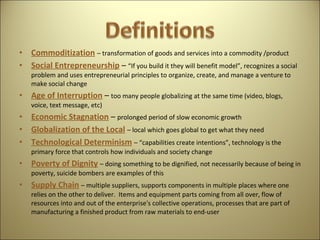
Commoditization   – transformation of goods and services into a commodity /product Social Entrepreneurship   –  “If you build it they will benefit model”, recognizes a social problem and uses entrepreneurial principles to organize, create, and manage a venture to make social change Age of Interruption   –  too many people globalizing at the same time (video, blogs, voice, text message, etc)  Economic Stagnation   –  prolonged period of slow economic growth  Globalization of the Local   – local which goes global to get what they need  Technological Determinism   – “capabilities create intentions”, technology is the primary force that controls how individuals and society change Poverty of Dignity   – doing something to be dignified, not necessarily because of being in poverty, suicide bombers are examples of this Supply Chain   – multiple suppliers, supports components in multiple places where one relies on the other to deliver.  Items and equipment parts coming from all over, flow of resources into and out of the enterprise's collective operations, processes that are part of manufacturing a finished product from raw materials to end-user
Thomas Friedman combines narrative story elements with case studies and interviews to “paint” a picture of how progress and technology is leading to a flattening of the world.  Through his presentation he brings home a clear message that the world is changing and we must change with it. Curiosity and innovation are key to this change.  He stresses this message through the use of historical references that outline major points, which have had an impact on the world today and where we will go tomorrow.  This journey begins in the past and moves the reader toward the future.  He uses his style to explain how forces are driving the flattening world.  Through his presentation, he brings about a reality check and offers suggestions for change if we are to continue to compete in the future within this global market.
If America is to succeed in a global environment, we must upgrade our educational skills and get ready to compete. There is a quiet crisis going on that involves a steady erosion of our scientific and engineering base. Our competitors are running a marathon while we are running a sprint.   We need to encourage people to: Focus on productive outcomes that advance & unite Celebrate interdependence rather than self-sufficiency  Celebrate inclusion rather than exclusion  Celebrate openness, opportunity & hope rather than limits, suspicion, & grievance
To be successful in a flat world, countries will need to develop in several areas:   Leadership – We need the right governance for a flat world. American politicians don’t have a clue about flatism. We need politicians who are willing and able to explain and inspire.   Education & Knowledge Skills (Muscle building) – We need to expand not only in high-end research universities, but also community colleges and technical schools. We need a wide array of learning opportunities so in the global talent search we can retain the best. Infrastructure & Technology – We need to develop a national broadband policy   Cushioning – We need to add wage insurance to social security as something called good fat. We also need better parenting, less dependence on social entitlement systems, and more character building. We need a society that keeps inventing the future with unfettered imagination.
Rules for companies to live by in a flat world: Whatever can be done, will be done – but will it be done  by  you or  to  you? The most important competition is between you and your own imagination. Individuals and small groups can now act and compete globally. You need to act big and implement what you imagine Big companies need to act small in order to empower their customers The best companies are the best collaborators. The best companies are constantly self-evaluating The best companies outsource to get better, not to shrink or save money How a company does things matters now more than ever We need to dig inside ourselves, not build walls around ourselves  
Upsides: A flat world will allow local cultures to be preserved, since people will be able to innovate and participate without having to emigrate. A side benefit may be that in a flat world, the global supply chains may make countries hesitate to engage in anything but a war of self-defense   Downsides: There are some social downsides – how do we get away from it all? It also allows irresponsible and extreme voices to be heard more than ever (terrorists)    
Flat World Platform  Because the world keeps learning, the diffusion of knowledge happens faster leading to change.   When organizations collaborate better, they become extremely competitive.   Technology allows people to affect change from anywhere at anytime.   Technology provides a global platform and global audience to make significant change.  “ Perfect storm” brewing happens when multiple, complex forces are at work: Demographic Political Economic Cultural Social
Culture can change: i.e. China is imagining the next new thing by unleashing more creative, innovative juices among its youth to create positive, sustained change.   In order to thrive in a world of challenge and change: organizations require more research, education and innovation.   A sense of crisis or urgency: “No institution (organization) will go through fundamental change unless it believes it is in deep trouble and needs to something different to survive” (p. 381).   Outlined four basic developmental/change focuses: Right infrastructure to connect people Right education system – innovation and collaboration Right governance – quality bureaucracy: fiscal policy to rule of law Need right environment
“ Glocalize” – how outward is your organizational culture? To what degree is it open to other influences and ideas that will facilitate organizational change?   Globalization change is a broader, deeper, more complex phenomenon, involving new forms of communication and innovation   Organizational answers lie not in what has changed but in recognizing what has not changed.  Only through this recognition can organizations begin to focus on the truly critical issues.   As the world changes, lives are powerfully shaped (i.e. 11/9 spread of Hope vs. 9/11 spread of Fear)   Characteristics needed to create the right environment for organizational change: Motivation Inspiration Brutally honest introspection Deep collaboration within and between organizations Social connectedness 
Although the author expresses concern about the effect of a ‘flat world’ on both the US jobs and society, he gives some specific items he feels need to be changed in order to maintain US strengths. Friedman points out that each country needs to be aware of where they stand in the ever changing world, which gives the responsibility of change to each one, instead of to the US. Friedman’s company rules for a flat world are good theoretical guidelines for any company concerned with the way the world is changing.  The suggested process for using the marketplace and the flat world to enact social change shows some interesting possibilities that could be applied to current business processes.  The author’s writing style continued to be easy to read and more interesting than some texts. His use of specific examples and the retelling of conversational vignettes also contributed to the flow of the book.
Friedman's style in the last half of the book is rhetorical and repetitious as opposed to the first half where he expresses his ideas and argument well in addition to getting to his points quickly.  Friedman's theories would have more validity if he were to include interviews with reputable economists rather than businessmen such as Bill Gates who will profit greatly on the theory of global "flattening.“  Although it is true that other countries have many more people currently seeking degrees, it might be more realistic if Freidman were to compare percentage of the population earning degrees in the U.S. as opposed to over-populated areas of the world rather than concrete numbers of degrees.  The second half of the work fully supports globalism, but it fails to explain complexities behind this theory.  The work is limited when discussion benefits of world flattening for members of the population who are extremely poor and destitute in countries benefitting from globalism.
Friedman uses the metaphor of the "flat" world meaning the world's economic playing field is leveled as a result of technological forces such as the .com bust and the ability to connect to the internet at relatively the same cost anywhere in the world.  The work supports the idea of China and India being the two countries which benefit the most in a flattening world due to their ability to provide better quality goods and services at a lower cost than in the U.S.  Individuals and/or companies anywhere can compete globally as demonstrated by recent expansions of Microsoft in China and Infosys in India.  Friedman suggests several solutions as to how Americans can counteract against being left out in the flattening of the world including national funding of scientific studies, emphasizing more specialized skills in our workforce, and encouraging our young people to focus on science and engineering degrees.  Ultimately, Friedman's work suggests that global flattening is already in the forefront and there is nothing we can do to stop it. Additionally the work suggests that the biggest piece for the U.S. in being successful in this new economy is not to isolate and protect ourselves in trying to prevent another 9/11. He suggests that that we as Americans must accept and embrace our new economic competition and use our imaginations to shape and use global flattening to our advantage as a nation.

Team 3 Ppt Presentation[1]

  • 1.
    Through the Lensof T.L. Friedman’s “ The World is Flat” Team 3 Eric Atkinson, Tammy Bankus, Rhonda Canerday, Cindi Dean, Erika Draper, Dee Oos, Doug Porter, Brandy Rogers, Chanda White
  • 2.
    Early Life andPersonal Life Early Life Born July 20, 1953 In high school, he interviewed Ariel Sharon, then an Israeli general and future Prime Minister, for his school newspaper, The Echo During his undergraduate years, he spent semesters abroad at the Hebrew University of Jerusalem and the American University in Cairo Personal Life Lives in Bethesda, Maryland, with his wife, Ann, and his daughters, Orly and Natalie Member of the Board of Trustees of Brandeis University Member of the Advisory Board of the Marshall Scholarship Commission Awarded honorary degrees from Brandeis, Macalester, Haverford and Hebrew Union College
  • 3.
    Awards Pulitzer Prizefor international reporting from Lebanon in 1983, particularly for the Sabra and Shatila massacre Pulitzer Prize for international reporting from Israel in 1988, for his coverage of the First Palestinian Intifada Goldman Sachs/Financial Times Business Book of the Year for "The World is Flat: A Brief History of the 21st Century," in 2005 Overseas Press Club Award for lifetime achievement, 2004 Honorary title, Order of the British Empire (OBE) by Queen Elizabeth II, 2004 National Book Award for non-fiction, 1989, for "From Beirut to Jerusalem“ Overseas Press Club award for the best nonfiction book on foreign policy by writing "The Lexus and the Olive Tree," 2000, book has been published in 27 languages
  • 4.
    Productivity Growth – using resources well, improves the outlook for keeping inflation in check, makes it easier for businesses and workers to compete, reduces the difficulty of meeting demographic challenges by increasing the amount of resources available Cultural Continuity – things that transmit values and attitudes from person to person, generation to generation, the media, leadership and religion Glocalize – absorbing culture through foreign ideas and best practices through traditions, product or service is adapted specifically to specific areas or cultures Culture of Tolerance - the tolerance of different cultures Deindustrialization – social and economic change from the lowering of industrial capacity or activity in a country or area, opposite of industrialization Outsourcing – using other countries, agencies etc. to gain knowledge and grow the company faster, not always to cut cost or cut back, provides more and better services more efficiently, subcontracting a process to a third party, obtain goods or services from an outside supplier Demand Shaping – influencing of demand to match planned supply
  • 5.
    Commoditization – transformation of goods and services into a commodity /product Social Entrepreneurship – “If you build it they will benefit model”, recognizes a social problem and uses entrepreneurial principles to organize, create, and manage a venture to make social change Age of Interruption – too many people globalizing at the same time (video, blogs, voice, text message, etc) Economic Stagnation – prolonged period of slow economic growth Globalization of the Local – local which goes global to get what they need Technological Determinism – “capabilities create intentions”, technology is the primary force that controls how individuals and society change Poverty of Dignity – doing something to be dignified, not necessarily because of being in poverty, suicide bombers are examples of this Supply Chain – multiple suppliers, supports components in multiple places where one relies on the other to deliver. Items and equipment parts coming from all over, flow of resources into and out of the enterprise's collective operations, processes that are part of manufacturing a finished product from raw materials to end-user
  • 6.
    Thomas Friedman combinesnarrative story elements with case studies and interviews to “paint” a picture of how progress and technology is leading to a flattening of the world. Through his presentation he brings home a clear message that the world is changing and we must change with it. Curiosity and innovation are key to this change. He stresses this message through the use of historical references that outline major points, which have had an impact on the world today and where we will go tomorrow. This journey begins in the past and moves the reader toward the future. He uses his style to explain how forces are driving the flattening world. Through his presentation, he brings about a reality check and offers suggestions for change if we are to continue to compete in the future within this global market.
  • 7.
    If America isto succeed in a global environment, we must upgrade our educational skills and get ready to compete. There is a quiet crisis going on that involves a steady erosion of our scientific and engineering base. Our competitors are running a marathon while we are running a sprint.   We need to encourage people to: Focus on productive outcomes that advance & unite Celebrate interdependence rather than self-sufficiency Celebrate inclusion rather than exclusion Celebrate openness, opportunity & hope rather than limits, suspicion, & grievance
  • 8.
    To be successfulin a flat world, countries will need to develop in several areas:   Leadership – We need the right governance for a flat world. American politicians don’t have a clue about flatism. We need politicians who are willing and able to explain and inspire.   Education & Knowledge Skills (Muscle building) – We need to expand not only in high-end research universities, but also community colleges and technical schools. We need a wide array of learning opportunities so in the global talent search we can retain the best. Infrastructure & Technology – We need to develop a national broadband policy   Cushioning – We need to add wage insurance to social security as something called good fat. We also need better parenting, less dependence on social entitlement systems, and more character building. We need a society that keeps inventing the future with unfettered imagination.
  • 9.
    Rules for companiesto live by in a flat world: Whatever can be done, will be done – but will it be done by you or to you? The most important competition is between you and your own imagination. Individuals and small groups can now act and compete globally. You need to act big and implement what you imagine Big companies need to act small in order to empower their customers The best companies are the best collaborators. The best companies are constantly self-evaluating The best companies outsource to get better, not to shrink or save money How a company does things matters now more than ever We need to dig inside ourselves, not build walls around ourselves  
  • 10.
    Upsides: A flatworld will allow local cultures to be preserved, since people will be able to innovate and participate without having to emigrate. A side benefit may be that in a flat world, the global supply chains may make countries hesitate to engage in anything but a war of self-defense   Downsides: There are some social downsides – how do we get away from it all? It also allows irresponsible and extreme voices to be heard more than ever (terrorists)    
  • 11.
    Flat World Platform Because the world keeps learning, the diffusion of knowledge happens faster leading to change.   When organizations collaborate better, they become extremely competitive.   Technology allows people to affect change from anywhere at anytime.   Technology provides a global platform and global audience to make significant change.  “ Perfect storm” brewing happens when multiple, complex forces are at work: Demographic Political Economic Cultural Social
  • 12.
    Culture can change:i.e. China is imagining the next new thing by unleashing more creative, innovative juices among its youth to create positive, sustained change.   In order to thrive in a world of challenge and change: organizations require more research, education and innovation.   A sense of crisis or urgency: “No institution (organization) will go through fundamental change unless it believes it is in deep trouble and needs to something different to survive” (p. 381).   Outlined four basic developmental/change focuses: Right infrastructure to connect people Right education system – innovation and collaboration Right governance – quality bureaucracy: fiscal policy to rule of law Need right environment
  • 13.
    “ Glocalize” –how outward is your organizational culture? To what degree is it open to other influences and ideas that will facilitate organizational change?   Globalization change is a broader, deeper, more complex phenomenon, involving new forms of communication and innovation   Organizational answers lie not in what has changed but in recognizing what has not changed. Only through this recognition can organizations begin to focus on the truly critical issues.   As the world changes, lives are powerfully shaped (i.e. 11/9 spread of Hope vs. 9/11 spread of Fear)   Characteristics needed to create the right environment for organizational change: Motivation Inspiration Brutally honest introspection Deep collaboration within and between organizations Social connectedness 
  • 14.
    Although the authorexpresses concern about the effect of a ‘flat world’ on both the US jobs and society, he gives some specific items he feels need to be changed in order to maintain US strengths. Friedman points out that each country needs to be aware of where they stand in the ever changing world, which gives the responsibility of change to each one, instead of to the US. Friedman’s company rules for a flat world are good theoretical guidelines for any company concerned with the way the world is changing. The suggested process for using the marketplace and the flat world to enact social change shows some interesting possibilities that could be applied to current business processes. The author’s writing style continued to be easy to read and more interesting than some texts. His use of specific examples and the retelling of conversational vignettes also contributed to the flow of the book.
  • 15.
    Friedman's style inthe last half of the book is rhetorical and repetitious as opposed to the first half where he expresses his ideas and argument well in addition to getting to his points quickly. Friedman's theories would have more validity if he were to include interviews with reputable economists rather than businessmen such as Bill Gates who will profit greatly on the theory of global "flattening.“ Although it is true that other countries have many more people currently seeking degrees, it might be more realistic if Freidman were to compare percentage of the population earning degrees in the U.S. as opposed to over-populated areas of the world rather than concrete numbers of degrees. The second half of the work fully supports globalism, but it fails to explain complexities behind this theory. The work is limited when discussion benefits of world flattening for members of the population who are extremely poor and destitute in countries benefitting from globalism.
  • 16.
    Friedman uses themetaphor of the "flat" world meaning the world's economic playing field is leveled as a result of technological forces such as the .com bust and the ability to connect to the internet at relatively the same cost anywhere in the world. The work supports the idea of China and India being the two countries which benefit the most in a flattening world due to their ability to provide better quality goods and services at a lower cost than in the U.S. Individuals and/or companies anywhere can compete globally as demonstrated by recent expansions of Microsoft in China and Infosys in India. Friedman suggests several solutions as to how Americans can counteract against being left out in the flattening of the world including national funding of scientific studies, emphasizing more specialized skills in our workforce, and encouraging our young people to focus on science and engineering degrees. Ultimately, Friedman's work suggests that global flattening is already in the forefront and there is nothing we can do to stop it. Additionally the work suggests that the biggest piece for the U.S. in being successful in this new economy is not to isolate and protect ourselves in trying to prevent another 9/11. He suggests that that we as Americans must accept and embrace our new economic competition and use our imaginations to shape and use global flattening to our advantage as a nation.