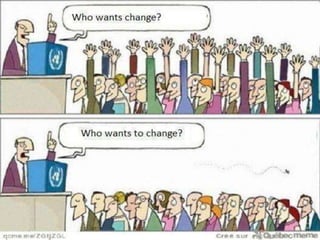















Good Enough Is No Longer Good Enough:
The New Reality of Economic Development
and Its Impact on the Dan River Region
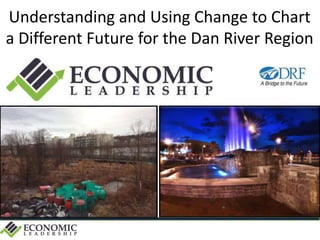
Understanding and Using Change to Chart
a Different Future for the Dan River Region
Economic Leadership’s task
“to review existing economic development
plans and to develop a global trends
analysis for the region.”
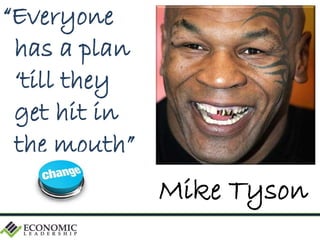
“Everyone
has a plan
‘till they
get hit in
the mouth”
Mike Tyson
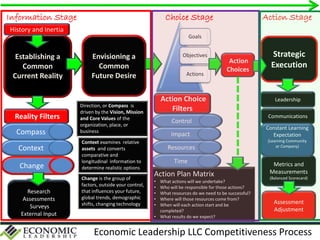
Economic Leadership LLC Competitiveness Process6
Establishing a
Common
Current Reality
Envisioning a
Common
Future Desire
Direction, or Compass is
driven by the Vision, Mission
and Core Values of the
organization, place, or
business
Context examines relative
assets and converts
comparative and
longitudinal information to
determine realistic options
Change is the group of
factors, outside your control,
that influences your future,
global trends, demographic
shifts, changing technology
Goals
Objectives
Actions
Action Plan Matrix
• What actions will we undertake?
• Who will be responsible for those actions?
• What resources do we need to be successful?
• Where will those resources come from?
• When will each action start and be
completed?
• What results do we expect?
Strategic
Execution
Reality Filters
Compass
Context
Change
Control
Impact
Resources
Time
Action Choice
Filters
History and Inertia
Assessment
Adjustment
Metrics and
Measurements
(Balanced Scorecard)
Communications
Constant Learning
Expectation
(Learning Community
or Company)
Action
Choices
Research
Assessments
Surveys
External Input
Leadership
Information Stage Choice Stage Action Stage
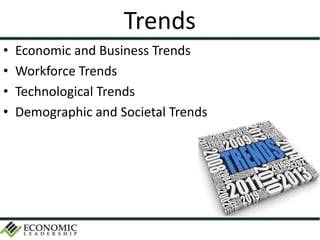
Trends
• Economic and Business Trends
• Workforce Trends
• Technological Trends
• Demographic and Societal Trends
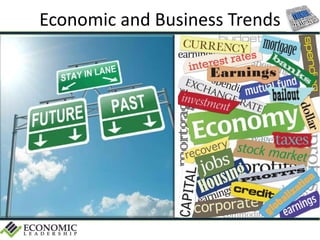
Economic and Business Trends
Competition
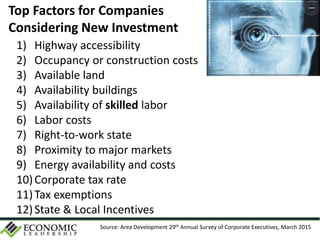
Top Factors for Companies
Considering New Investment
1) Highway accessibility
2) Occupancy or construction costs
3) Available land
4) Availability buildings
5) Availability of skilled labor
6) Labor costs
7) Right-to-work state
8) Proximity to major markets
9) Energy availability and costs
10)Corporate tax rate
11)Tax exemptions
12)State & Local Incentives
Source: Area Development 29th Annual Survey of Corporate Executives, March 2015
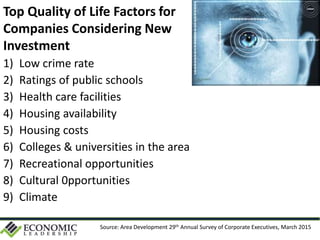
Top Quality of Life Factors for
Companies Considering New
Investment
1) Low crime rate
2) Ratings of public schools
3) Health care facilities
4) Housing availability
5) Housing costs
6) Colleges & universities in the area
7) Recreational opportunities
8) Cultural 0pportunities
9) Climate
Source: Area Development 29th Annual Survey of Corporate Executives, March 2015
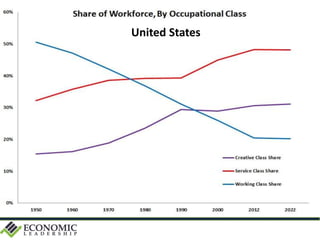
United States
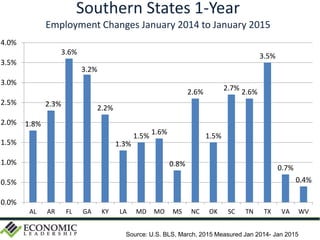
Southern States 1-Year
Employment Changes January 2014 to January 2015
1.8%
2.3%
3.6%
3.2%
2.2%
1.3%
1.5%
1.6%
0.8%
2.6%
1.5%
2.7% 2.6%
3.5%
0.7%
0.4%
0.0%
0.5%
1.0%
1.5%
2.0%
2.5%
3.0%
3.5%
4.0%
AL AR FL GA KY LA MD MO MS NC OK SC TN TX VA WV
Source: U.S. BLS, March, 2015 Measured Jan 2014- Jan 2015
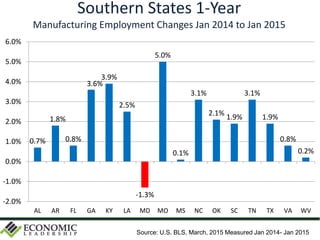
Southern States 1-Year
Manufacturing Employment Changes Jan 2014 to Jan 2015
0.7%
1.8%
0.8%
3.6%
3.9%
2.5%
-1.3%
5.0%
0.1%
3.1%
2.1% 1.9%
3.1%
1.9%
0.8%
0.2%
-2.0%
-1.0%
0.0%
1.0%
2.0%
3.0%
4.0%
5.0%
6.0%
AL AR FL GA KY LA MD MO MS NC OK SC TN TX VA WV
Source: U.S. BLS, March, 2015 Measured Jan 2014- Jan 2015
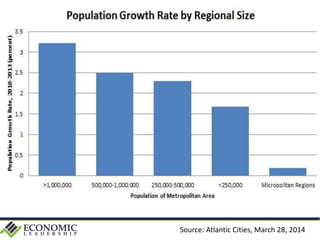
Urbanization
Source: Atlantic Cities, March 28, 2014
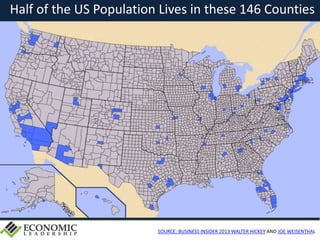
Half of the US Population Lives in these 146 Counties
SOURCE: BUSINESS INSIDER 2013 WALTER HICKEY AND JOE WEISENTHAL
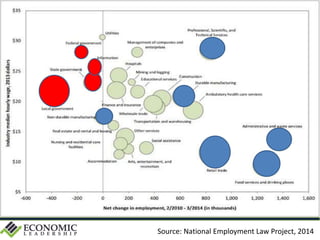
Source: National Employment Law Project, 2014
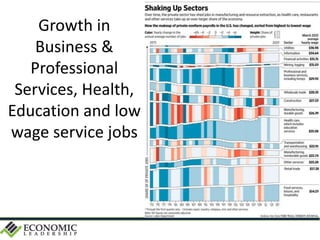
Growth in
Business &
Professional
Services, Health,
Education and low
wage service jobs
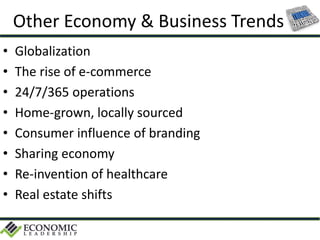
Other Economy & Business Trends
• Globalization
• The rise of e-commerce
• 24/7/365 operations
• Home-grown, locally sourced
• Consumer influence of branding
• Sharing economy
• Re-invention of healthcare
• Real estate shifts
Workforce Trends
The Rising
Talent Bar
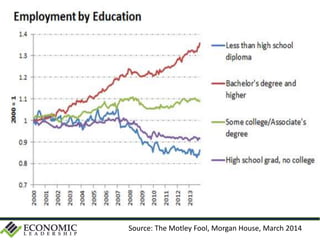
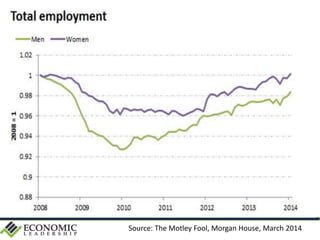
Source: U.S. Bureau of Labor Statistics.
Source: The Motley Fool, Morgan House, March 2014
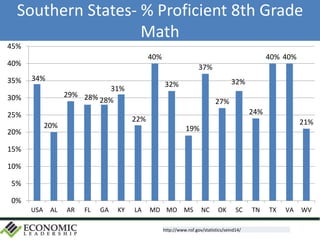
Southern States- % Proficient 8th Grade
Math
34%
20%
29% 28% 28%
31%
22%
40%
32%
19%
37%
27%
32%
24%
40% 40%
21%
0%
5%
10%
15%
20%
25%
30%
35%
40%
45%
USA AL AR FL GA KY LA MD MO MS NC OK SC TN TX VA WV
http://www.nsf.gov/statistics/seind14/
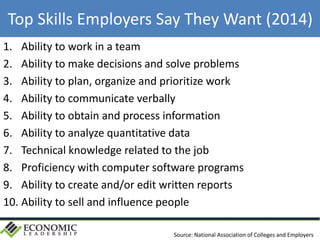
Top Skills Employers Say They Want (2014)
1. Ability to work in a team
2. Ability to make decisions and solve problems
3. Ability to plan, organize and prioritize work
4. Ability to communicate verbally
5. Ability to obtain and process information
6. Ability to analyze quantitative data
7. Technical knowledge related to the job
8. Proficiency with computer software programs
9. Ability to create and/or edit written reports
10. Ability to sell and influence people
Source: National Association of Colleges and Employers
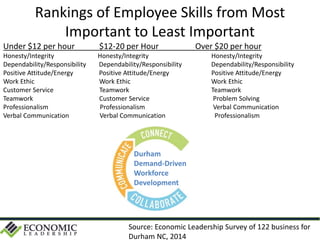
Rankings of Employee Skills from Most
Important to Least Important
Under $12 per hour $12-20 per Hour Over $20 per hour
Honesty/Integrity Honesty/Integrity Honesty/Integrity
Dependability/Responsibility Dependability/Responsibility Dependability/Responsibility
Positive Attitude/Energy Positive Attitude/Energy Positive Attitude/Energy
Work Ethic Work Ethic Work Ethic
Customer Service Teamwork Teamwork
Teamwork Customer Service Problem Solving
Professionalism Professionalism Verbal Communication
Verbal Communication Verbal Communication Professionalism
Source: Economic Leadership Survey of 122 business for
Durham NC, 2014
Durham
Demand-Driven
Workforce
Development
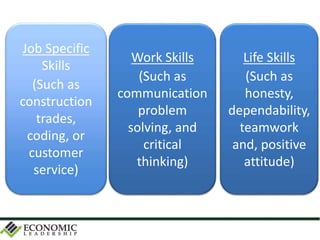
Job Specific
Skills
(Such as
construction
trades,
coding, or
customer
service)
Life Skills
(Such as
honesty,
dependability,
teamwork
and, positive
attitude)
Work Skills
(Such as
communication
problem
solving, and
critical
thinking)
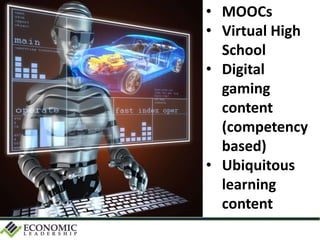
• MOOCs
• Virtual High
School
• Digital
gaming
content
(competency
based)
• Ubiquitous
learning
content
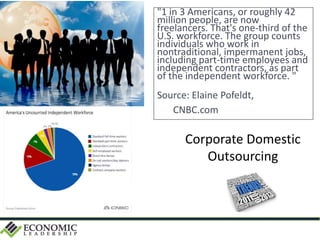
Corporate Domestic
Outsourcing
"1 in 3 Americans, or roughly 42
million people, are now
freelancers. That's one-third of the
U.S. workforce. The group counts
individuals who work in
nontraditional, impermanent jobs,
including part-time employees and
independent contractors, as part
of the independent workforce. "
Source: Elaine Pofeldt,
CNBC.com
Other Workforce Trends
• Multigenerational
workplaces
• Slow “prime” labor
force growth
• Lifelong self-
learning
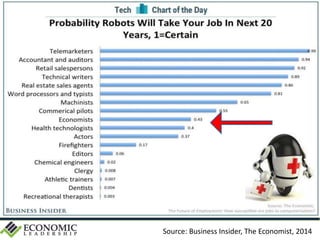
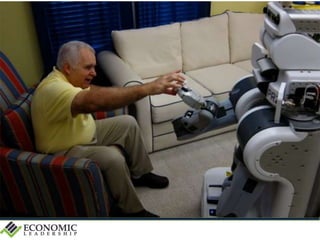
Technology Trends
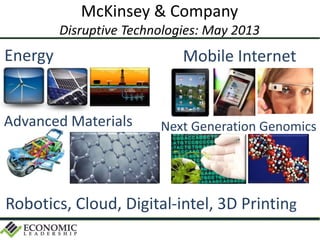
McKinsey & Company
Disruptive Technologies: May 2013
Energy Mobile Internet
Advanced Materials Next Generation Genomics
Robotics, Cloud, Digital-intel, 3D Printing
Source: Business Insider, The Economist, 2014
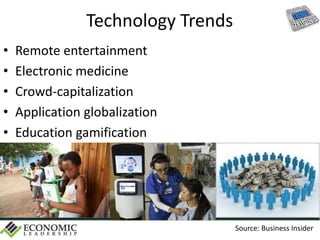
Technology Trends
• Remote entertainment
• Electronic medicine
• Crowd-capitalization
• Application globalization
• Education gamification
Source: Business Insider
Demographic
and Societal
Trends
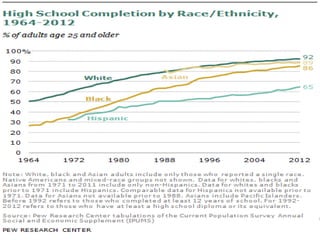
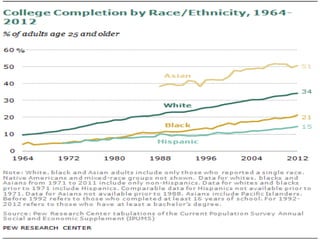
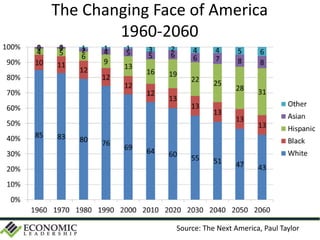
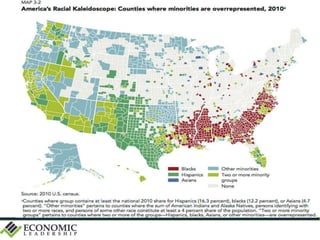
The Changing Face of America
1960-2060
Source: The Next America, Paul Taylor
Source: The Motley Fool, Morgan House, March 2014
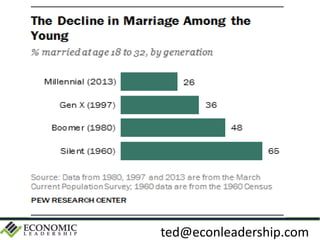
ted@econleadership.com
Demographic
and Societal
Trends
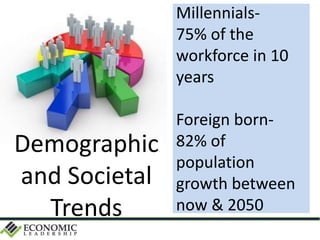
Millennials-
75% of the
workforce in 10
years
Foreign born-
82% of
population
growth between
now & 2050
Demographic
and Societal
Trends
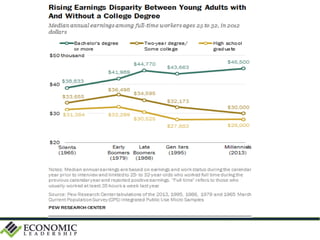
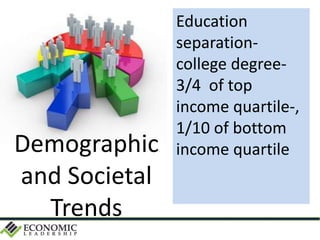
Education
separation-
college degree-
3/4 of top
income quartile-,
1/10 of bottom
income quartileDemographic
and Societal
Trends
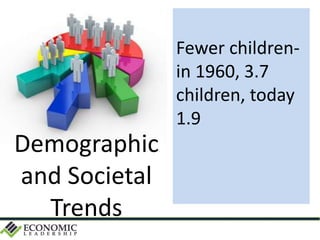
Fewer children-
in 1960, 3.7
children, today
1.9
Demographic
and Societal
Trends
Current Economic Reality
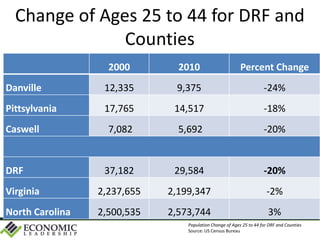
Change of Ages 25 to 44 for DRF and
Counties
2000 2010 Percent Change
Danville 12,335 9,375 -24%
Pittsylvania 17,765 14,517 -18%
Caswell 7,082 5,692 -20%
DRF 37,182 29,584 -20%
Virginia 2,237,655 2,199,347 -2%
North Carolina 2,500,535 2,573,744 3%
Population Change of Ages 25 to 44 for DRF and Counties
Source: US Census Bureau
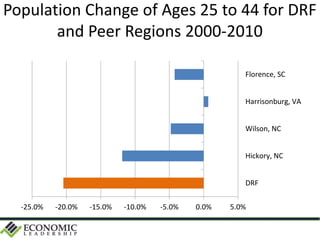
Population Change of Ages 25 to 44 for DRF
and Peer Regions 2000-2010
-25.0% -20.0% -15.0% -10.0% -5.0% 0.0% 5.0%
DRF
Hickory, NC
Wilson, NC
Harrisonburg, VA
Florence, SC
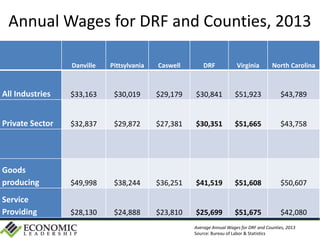
Annual Wages for DRF and Counties, 2013
Danville Pittsylvania Caswell DRF Virginia North Carolina
All Industries $33,163 $30,019 $29,179 $30,841 $51,923 $43,789
Private Sector $32,837 $29,872 $27,381 $30,351 $51,665 $43,758
Goods
producing $49,998 $38,244 $36,251 $41,519 $51,608 $50,607
Service
Providing $28,130 $24,888 $23,810 $25,699 $51,675 $42,080
Average Annual Wages for DRF and Counties, 2013
Source: Bureau of Labor & Statistics
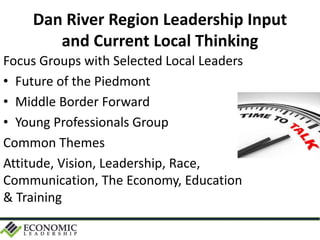
Dan River Region Leadership Input
and Current Local Thinking
Focus Groups with Selected Local Leaders
• Future of the Piedmont
• Middle Border Forward
• Young Professionals Group
Common Themes
Attitude, Vision, Leadership, Race,
Communication, The Economy, Education
& Training
Dan River Region Leadership Input
and Current Local Thinking
• Need to articulate an alternative vision for the
future
• Lack of leadership- as a barrier to
improvement
• Lack of inclusion of young professionals or
minorities into decisions
• Still a lot of work to do to bridge race divides
exacerbated by economic divides
Dan River Region Leadership Input
and Current Local Thinking
The Economy
More positive comments and seemed to energize the
conversations.
– The River District investments are growing and successful
– Entrepreneurship is growing and seems to have found some niche
success
– Strong broadband infrastructure
– Low cost of living and a low cost of doing business
– Agriculture is still important
– Great natural beauty, attractive to tourists and retirees
– Pride in their public art
– The river
Dan River Region Leadership Input
and Current Local Thinking
The Economy
On the negative side people mentioned:
• There are very few mid-level jobs, especially white
collar, non-government jobs
• The loss of young people, especially educated young
professionals is a major problem
• The city and the university are geographically
separated
• There is still 4 million square feet of vacant space along
the river (an opportunity and a constant reminder of so
much more to do)
Dan River Region Leadership Input
and Current Local Thinking
• Wide agreement that no matter what else is
done, that everyone needed to focus on
raising the skill level of young people and the
workforce
Recent Reports
• CFED , A Community and Economic Development Assessment of
the Danville Region (2007)
• UNC Chapel Hill's Urban Investment Strategies Center, Kenan
Institute, and Kenan-Flagler Business School authored Assessing
the Economic Competitiveness of the Danville, Virginia Region
(2008)
• SRI, working for the Virginia Economic Development Partnership,
completed a Target Market Assessment for Western Southern
Virginia (SOVA) ,(2010)
• Southern Virginia, Building a Competitive Advantage, prepared
by Civic Change Incorporated, (2010)
• The Virginia Economic Development Partnership Western SOVA -
Brief Assessment of Regional Assets and Targeted Industries
(2010)
• Vanessa Garber and Jamie Gutter of UNC examined Attracting
Young Entrepreneurs to Danville (2010)
• Entrepreneurial Places LLC looked at Retiree Attraction in the
Danville Region (2013).
• MDC’s The Only Way Out Is Up, How MDC helped Danville, VA.,
chart a new vision for its future (2013)
Recent Reports- Common Themes
• The Dan River Region needs to shed its old manufacturing image, focus
on a new future and intentionally create a new image internally and
externally
• To attract the people and companies that are needed for a brighter
future, investments in creating a better place to live and work are
mandatory
• Downtown reinvention is necessary to attract and retain younger and
more educated people
• For current regional citizens to prosper in the changing economy their
skills and educational attainment must be improved
• Entrepreneurial attraction and development is a priority for future job
growth
• A regional approach to economic development could yield better results
• A collaborative approach among public and private entities would yield
better results
• Leadership diversification, support and engagement are imperative
Our Additional Recommendations
1) Build the infrastructure to excite, inform,
engage and diversify regional leadership
• a more consistent and formal effort to understand, anticipate and
react to the future is needed
• begin a formalized multi-year effort to incorporate future thinking
into leadership development.
• position the region through an annual event as the home of future
thinking for micropolitan regions that must reinvent themselves
• Increased efforts to identify, educate, mentor, support and
empower young leaders.
• A specific program to engage older and younger, white and
minority, and urban and city leaders together
• DRF should take the lead in identifying, digesting and presenting
relevant information
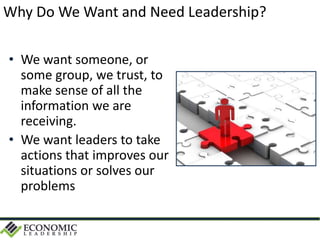
• We want someone, or
some group, we trust, to
make sense of all the
information we are
receiving.
• We want leaders to take
actions that improves our
situations or solves our
problems
Why Do We Want and Need Leadership?
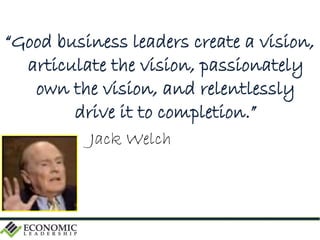
“Good business leaders create a vision,
articulate the vision, passionately
own the vision, and relentlessly
drive it to completion.”
Jack Welch
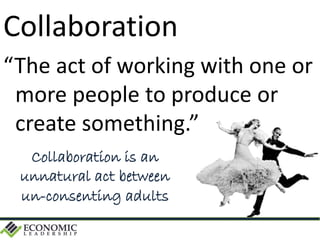
Collaboration
“The act of working with one or
more people to produce or
create something.”
Collaboration is an
unnatural act between
un-consenting adults
What is a Commitment to Collaborate?
Recommendations
2) Define a new vision and declare intentional
strategic actions for economic & workforce
development
• the DRF take the lead to initiate and fund the
development of a regional vision and a
comprehensive, collaborative strategic action agenda
(a new 5-year comprehensive, multi-organization,
regional, public-private economic and workforce
development strategic action plan with delineated
responsibilities and outcome expectations.)
Recommendations
3) Maximize the opportunities that change is creating
• Buy local
• Demise of distance
• Retiree entrepreneurship
• Freelance economy
Summary
• Doing what you used to do, no matter how well you
do it, will not work.
• Many trends are working against you, but some
may be beginning to work for you
• The key to a better future is strong, informed,
diverse, leadership, collaboration, a new clear
vision, and the will and capacity to implement.
• Building a place that can attract talent and money,
improving the education and skills of local
residents, and multiple economic development
strategies
So What!
Follow on twitter @tedabernathy or
LinkedIn Ted Abernathy

Good Enough is No Longer Good Enough

  • 1.
    Good Enough IsNo Longer Good Enough: The New Reality of Economic Development and Its Impact on the Dan River Region
  • 2.
    Understanding and UsingChange to Chart a Different Future for the Dan River Region
  • 3.
    Economic Leadership’s task “toreview existing economic development plans and to develop a global trends analysis for the region.”
  • 4.
    “Everyone has a plan ‘tillthey get hit in the mouth” Mike Tyson
  • 6.
    Economic Leadership LLCCompetitiveness Process6 Establishing a Common Current Reality Envisioning a Common Future Desire Direction, or Compass is driven by the Vision, Mission and Core Values of the organization, place, or business Context examines relative assets and converts comparative and longitudinal information to determine realistic options Change is the group of factors, outside your control, that influences your future, global trends, demographic shifts, changing technology Goals Objectives Actions Action Plan Matrix • What actions will we undertake? • Who will be responsible for those actions? • What resources do we need to be successful? • Where will those resources come from? • When will each action start and be completed? • What results do we expect? Strategic Execution Reality Filters Compass Context Change Control Impact Resources Time Action Choice Filters History and Inertia Assessment Adjustment Metrics and Measurements (Balanced Scorecard) Communications Constant Learning Expectation (Learning Community or Company) Action Choices Research Assessments Surveys External Input Leadership Information Stage Choice Stage Action Stage
  • 7.
    Trends • Economic andBusiness Trends • Workforce Trends • Technological Trends • Demographic and Societal Trends
  • 8.
  • 9.
    Economic and BusinessTrends Competition
  • 10.
    Top Factors forCompanies Considering New Investment 1) Highway accessibility 2) Occupancy or construction costs 3) Available land 4) Availability buildings 5) Availability of skilled labor 6) Labor costs 7) Right-to-work state 8) Proximity to major markets 9) Energy availability and costs 10)Corporate tax rate 11)Tax exemptions 12)State & Local Incentives Source: Area Development 29th Annual Survey of Corporate Executives, March 2015
  • 11.
    Top Quality ofLife Factors for Companies Considering New Investment 1) Low crime rate 2) Ratings of public schools 3) Health care facilities 4) Housing availability 5) Housing costs 6) Colleges & universities in the area 7) Recreational opportunities 8) Cultural 0pportunities 9) Climate Source: Area Development 29th Annual Survey of Corporate Executives, March 2015
  • 12.
  • 15.
    Southern States 1-Year EmploymentChanges January 2014 to January 2015 1.8% 2.3% 3.6% 3.2% 2.2% 1.3% 1.5% 1.6% 0.8% 2.6% 1.5% 2.7% 2.6% 3.5% 0.7% 0.4% 0.0% 0.5% 1.0% 1.5% 2.0% 2.5% 3.0% 3.5% 4.0% AL AR FL GA KY LA MD MO MS NC OK SC TN TX VA WV Source: U.S. BLS, March, 2015 Measured Jan 2014- Jan 2015
  • 16.
    Southern States 1-Year ManufacturingEmployment Changes Jan 2014 to Jan 2015 0.7% 1.8% 0.8% 3.6% 3.9% 2.5% -1.3% 5.0% 0.1% 3.1% 2.1% 1.9% 3.1% 1.9% 0.8% 0.2% -2.0% -1.0% 0.0% 1.0% 2.0% 3.0% 4.0% 5.0% 6.0% AL AR FL GA KY LA MD MO MS NC OK SC TN TX VA WV Source: U.S. BLS, March, 2015 Measured Jan 2014- Jan 2015
  • 17.
  • 19.
  • 20.
    Half of theUS Population Lives in these 146 Counties SOURCE: BUSINESS INSIDER 2013 WALTER HICKEY AND JOE WEISENTHAL
  • 22.
    Source: National EmploymentLaw Project, 2014
  • 23.
    Growth in Business & Professional Services,Health, Education and low wage service jobs
  • 25.
    Other Economy &Business Trends • Globalization • The rise of e-commerce • 24/7/365 operations • Home-grown, locally sourced • Consumer influence of branding • Sharing economy • Re-invention of healthcare • Real estate shifts
  • 26.
  • 27.
  • 28.
    Source: U.S. Bureauof Labor Statistics.
  • 29.
    Source: The MotleyFool, Morgan House, March 2014
  • 33.
    Southern States- %Proficient 8th Grade Math 34% 20% 29% 28% 28% 31% 22% 40% 32% 19% 37% 27% 32% 24% 40% 40% 21% 0% 5% 10% 15% 20% 25% 30% 35% 40% 45% USA AL AR FL GA KY LA MD MO MS NC OK SC TN TX VA WV http://www.nsf.gov/statistics/seind14/
  • 34.
    Top Skills EmployersSay They Want (2014) 1. Ability to work in a team 2. Ability to make decisions and solve problems 3. Ability to plan, organize and prioritize work 4. Ability to communicate verbally 5. Ability to obtain and process information 6. Ability to analyze quantitative data 7. Technical knowledge related to the job 8. Proficiency with computer software programs 9. Ability to create and/or edit written reports 10. Ability to sell and influence people Source: National Association of Colleges and Employers
  • 35.
    Rankings of EmployeeSkills from Most Important to Least Important Under $12 per hour $12-20 per Hour Over $20 per hour Honesty/Integrity Honesty/Integrity Honesty/Integrity Dependability/Responsibility Dependability/Responsibility Dependability/Responsibility Positive Attitude/Energy Positive Attitude/Energy Positive Attitude/Energy Work Ethic Work Ethic Work Ethic Customer Service Teamwork Teamwork Teamwork Customer Service Problem Solving Professionalism Professionalism Verbal Communication Verbal Communication Verbal Communication Professionalism Source: Economic Leadership Survey of 122 business for Durham NC, 2014 Durham Demand-Driven Workforce Development
  • 36.
    Job Specific Skills (Such as construction trades, coding,or customer service) Life Skills (Such as honesty, dependability, teamwork and, positive attitude) Work Skills (Such as communication problem solving, and critical thinking)
  • 37.
    • MOOCs • VirtualHigh School • Digital gaming content (competency based) • Ubiquitous learning content
  • 39.
    Corporate Domestic Outsourcing "1 in3 Americans, or roughly 42 million people, are now freelancers. That's one-third of the U.S. workforce. The group counts individuals who work in nontraditional, impermanent jobs, including part-time employees and independent contractors, as part of the independent workforce. " Source: Elaine Pofeldt, CNBC.com
  • 40.
    Other Workforce Trends •Multigenerational workplaces • Slow “prime” labor force growth • Lifelong self- learning
  • 41.
  • 42.
    McKinsey & Company DisruptiveTechnologies: May 2013 Energy Mobile Internet Advanced Materials Next Generation Genomics Robotics, Cloud, Digital-intel, 3D Printing
  • 43.
    Source: Business Insider,The Economist, 2014
  • 49.
    Technology Trends • Remoteentertainment • Electronic medicine • Crowd-capitalization • Application globalization • Education gamification Source: Business Insider
  • 50.
  • 51.
    The Changing Faceof America 1960-2060 Source: The Next America, Paul Taylor
  • 53.
    Source: The MotleyFool, Morgan House, March 2014
  • 55.
  • 58.
  • 59.
    Millennials- 75% of the workforcein 10 years Foreign born- 82% of population growth between now & 2050 Demographic and Societal Trends
  • 60.
    Education separation- college degree- 3/4 oftop income quartile-, 1/10 of bottom income quartileDemographic and Societal Trends
  • 61.
    Fewer children- in 1960,3.7 children, today 1.9 Demographic and Societal Trends
  • 62.
  • 63.
    Change of Ages25 to 44 for DRF and Counties 2000 2010 Percent Change Danville 12,335 9,375 -24% Pittsylvania 17,765 14,517 -18% Caswell 7,082 5,692 -20% DRF 37,182 29,584 -20% Virginia 2,237,655 2,199,347 -2% North Carolina 2,500,535 2,573,744 3% Population Change of Ages 25 to 44 for DRF and Counties Source: US Census Bureau
  • 64.
    Population Change ofAges 25 to 44 for DRF and Peer Regions 2000-2010 -25.0% -20.0% -15.0% -10.0% -5.0% 0.0% 5.0% DRF Hickory, NC Wilson, NC Harrisonburg, VA Florence, SC
  • 65.
    Annual Wages forDRF and Counties, 2013 Danville Pittsylvania Caswell DRF Virginia North Carolina All Industries $33,163 $30,019 $29,179 $30,841 $51,923 $43,789 Private Sector $32,837 $29,872 $27,381 $30,351 $51,665 $43,758 Goods producing $49,998 $38,244 $36,251 $41,519 $51,608 $50,607 Service Providing $28,130 $24,888 $23,810 $25,699 $51,675 $42,080 Average Annual Wages for DRF and Counties, 2013 Source: Bureau of Labor & Statistics
  • 66.
    Dan River RegionLeadership Input and Current Local Thinking Focus Groups with Selected Local Leaders • Future of the Piedmont • Middle Border Forward • Young Professionals Group Common Themes Attitude, Vision, Leadership, Race, Communication, The Economy, Education & Training
  • 67.
    Dan River RegionLeadership Input and Current Local Thinking • Need to articulate an alternative vision for the future • Lack of leadership- as a barrier to improvement • Lack of inclusion of young professionals or minorities into decisions • Still a lot of work to do to bridge race divides exacerbated by economic divides
  • 68.
    Dan River RegionLeadership Input and Current Local Thinking The Economy More positive comments and seemed to energize the conversations. – The River District investments are growing and successful – Entrepreneurship is growing and seems to have found some niche success – Strong broadband infrastructure – Low cost of living and a low cost of doing business – Agriculture is still important – Great natural beauty, attractive to tourists and retirees – Pride in their public art – The river
  • 69.
    Dan River RegionLeadership Input and Current Local Thinking The Economy On the negative side people mentioned: • There are very few mid-level jobs, especially white collar, non-government jobs • The loss of young people, especially educated young professionals is a major problem • The city and the university are geographically separated • There is still 4 million square feet of vacant space along the river (an opportunity and a constant reminder of so much more to do)
  • 70.
    Dan River RegionLeadership Input and Current Local Thinking • Wide agreement that no matter what else is done, that everyone needed to focus on raising the skill level of young people and the workforce
  • 71.
    Recent Reports • CFED, A Community and Economic Development Assessment of the Danville Region (2007) • UNC Chapel Hill's Urban Investment Strategies Center, Kenan Institute, and Kenan-Flagler Business School authored Assessing the Economic Competitiveness of the Danville, Virginia Region (2008) • SRI, working for the Virginia Economic Development Partnership, completed a Target Market Assessment for Western Southern Virginia (SOVA) ,(2010) • Southern Virginia, Building a Competitive Advantage, prepared by Civic Change Incorporated, (2010) • The Virginia Economic Development Partnership Western SOVA - Brief Assessment of Regional Assets and Targeted Industries (2010) • Vanessa Garber and Jamie Gutter of UNC examined Attracting Young Entrepreneurs to Danville (2010) • Entrepreneurial Places LLC looked at Retiree Attraction in the Danville Region (2013). • MDC’s The Only Way Out Is Up, How MDC helped Danville, VA., chart a new vision for its future (2013)
  • 72.
    Recent Reports- CommonThemes • The Dan River Region needs to shed its old manufacturing image, focus on a new future and intentionally create a new image internally and externally • To attract the people and companies that are needed for a brighter future, investments in creating a better place to live and work are mandatory • Downtown reinvention is necessary to attract and retain younger and more educated people • For current regional citizens to prosper in the changing economy their skills and educational attainment must be improved • Entrepreneurial attraction and development is a priority for future job growth • A regional approach to economic development could yield better results • A collaborative approach among public and private entities would yield better results • Leadership diversification, support and engagement are imperative
  • 73.
    Our Additional Recommendations 1)Build the infrastructure to excite, inform, engage and diversify regional leadership • a more consistent and formal effort to understand, anticipate and react to the future is needed • begin a formalized multi-year effort to incorporate future thinking into leadership development. • position the region through an annual event as the home of future thinking for micropolitan regions that must reinvent themselves • Increased efforts to identify, educate, mentor, support and empower young leaders. • A specific program to engage older and younger, white and minority, and urban and city leaders together • DRF should take the lead in identifying, digesting and presenting relevant information
  • 74.
    • We wantsomeone, or some group, we trust, to make sense of all the information we are receiving. • We want leaders to take actions that improves our situations or solves our problems Why Do We Want and Need Leadership?
  • 75.
    “Good business leaderscreate a vision, articulate the vision, passionately own the vision, and relentlessly drive it to completion.” Jack Welch
  • 76.
    Collaboration “The act ofworking with one or more people to produce or create something.” Collaboration is an unnatural act between un-consenting adults
  • 77.
    What is aCommitment to Collaborate?
  • 78.
    What is aCommitment to Collaborate?
  • 79.
    Recommendations 2) Define anew vision and declare intentional strategic actions for economic & workforce development • the DRF take the lead to initiate and fund the development of a regional vision and a comprehensive, collaborative strategic action agenda (a new 5-year comprehensive, multi-organization, regional, public-private economic and workforce development strategic action plan with delineated responsibilities and outcome expectations.)
  • 80.
    Recommendations 3) Maximize theopportunities that change is creating • Buy local • Demise of distance • Retiree entrepreneurship • Freelance economy
  • 81.
    Summary • Doing whatyou used to do, no matter how well you do it, will not work. • Many trends are working against you, but some may be beginning to work for you • The key to a better future is strong, informed, diverse, leadership, collaboration, a new clear vision, and the will and capacity to implement. • Building a place that can attract talent and money, improving the education and skills of local residents, and multiple economic development strategies
  • 82.
  • 83.
    Follow on twitter@tedabernathy or LinkedIn Ted Abernathy