RELAX NG to DTD and XSD 
using the Open Toolkit 
Using RELAX NG for DITA shells and 
modules 
Eliot Kimber 
Contrext, LLC 
DITA OT Day Munich 2014 
11/24/2014 Contrext, LLC 1
About the Author 
• Responsible for DITA 1.3 grammar files 
• Independent consultant focusing on DITA analysis, 
design, and implementation 
• Doing SGML and XML for cough 30 years cough 
• Founding member of the DITA Technical Committee 
• Founding member of the XML Working Group 
• Co-editor of HyTime standard (ISO/IEC 10744) 
• Primary developer and founder of the DITA for 
Publishers project 
• Author of DITA for Practitioners, Vol 1 (XML Press) 
11/24/2014 Contrext, LLC 2
Agenda 
• A brief demonstration 
• What is RELAX NG? 
• RELAX NG and DITA 
• DITA document types and modules 
• Anatomy of a RELAX NG shell 
• See how easy: generating DTD and XSD shells 
11/24/2014 Contrext, LLC 3
Executive Summary 
• RELAX NG makes XML vocabulary definition 
much, much easier 
• RELAX NG is a good match to DITA 
requirements 
• Can generate conforming DITA DTD and XSD 
files from RELAX NG 
• Makes creating DITA document type shells 
about as easy as it can be 
• No more need to fight with DTD or XSD syntax 
11/24/2014 Contrext, LLC 4
Demonstration 
• Create a new document type shell 
• Create a new domain specialization 
• Create a new topic speicalization 
• Generate DTD and XSD versions of all of these 
grammars 
11/24/2014 Contrext, LLC 5
WHAT IS RELAX NG? 
11/24/2014 Contrext, LLC 6
RELAX NG is 
• A grammar (or schema) language for XML 
documents 
• An OASIS and ISO/IEC standard (ISO/IEC 
19757-2) 
• Most like XML DTDs but easier to use 
• Designed to be as simple as possible 
• Used for other XML standards, most 
prominently DocBook 
11/24/2014 Contrext, LLC 7
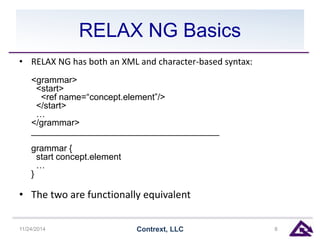
RELAX NG Basics 
• RELAX NG has both an XML and character-based syntax: 
<grammar> 
<start> 
<ref name=“concept.element”/> 
</start> 
… 
</grammar> 
______________________________________ 
grammar { 
start concept.element 
… 
} 
• The two are functionally equivalent 
11/24/2014 Contrext, LLC 8
RELAX NG Basics (cont.) 
• A RELAX NG grammar defines a set of 
“patterns” that documents must match 
• Patterns can have names (analagous to DTD 
parameter entities) 
• Pattern combination mechanisms are more 
flexible than DTD parameter entities or XSD 
groups 
• Grammars can be modularized into multiple 
files 
11/24/2014 Contrext, LLC 9
RELAX NG AND DITA 
11/24/2014 Contrext, LLC 10
Good Match to DITA Requirements 
• RELAX NG’s pattern-based approach works 
well with DITA’s modular vocabulary 
• Patterns can allow extension by other patterns 
• Patterns can unilaterally extend other 
patterns: the extending pattern names the 
pattern it extends 
• Makes combining vocabularies as easy as it 
could be 
11/24/2014 Contrext, LLC 11
No Added Overhead 
• Unlike DTDs, RELAX NG has much simpler and 
easier-to-use syntax 
• Avoids the conceptual and syntactic 
complexity of XSD 
• Close semantic match to existing DTD-defined 
rules 
11/24/2014 Contrext, LLC 12
Does require DTD Compatibility 
Feature 
• Base RELAX NG standard does not provide for 
defining attribute defaults 
• Companion standard RELAX NG DTD 
Compatibility provides attribute defaults 
• DITA depends on default attribute values 
• George Bina (oXygenXML) has implemented 
DTD compatibility in Java for use with Xerces 
XML parser (open source) 
11/24/2014 Contrext, LLC 13
Result: Everything is Awesome 
• RELAX NG makes DITA document type shells 
as easy to create as it can be 
• Can generate DITA-conforming DTDs and XSDs 
from the RELAX NG grammars 
• Makes it possible, if not in fact easy, for 
anybody to configure their own DITA 
document types 
11/24/2014 Contrext, LLC 14
DITA DOCUMENT TYPES AND 
SHELLS 
11/24/2014 Contrext, LLC 15
DITA Document Types 
• A DITA document type is a unique set of 
vocabulary and constraint modules 
• Modules are invariant 
– Every copy of a given module should be identical 
– You never modify modules directly 
• You implement DITA document types by 
integrating vocabulary and constraint 
modules using a document type shell 
11/24/2014 Contrext, LLC 16
Document Type Shells 
• Integrate modules to form a working 
document schema 
• Refer to the vocabulary and constraint 
modules of the DITA document type 
• Do any configuration required 
• Two document type shells that integrate the 
same same set of modules implement the 
same DITA document type 
11/24/2014 Contrext, LLC 17
ANATOMY OF A RELAX NG 
SHELL 
11/24/2014 Contrext, LLC 18
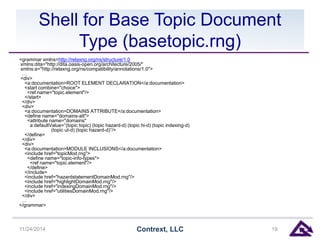
Shell for Base Topic Document 
Type (basetopic.rng) 
<grammar xmlns=http://relaxng.org/ns/structure/1.0 
xmlns:dita="http://dita.oasis-open.org/architecture/2005/" 
xmlns:a="http://relaxng.org/ns/compatibility/annotations/1.0"> 
… 
<div> 
<a:documentation>ROOT ELEMENT DECLARATION</a:documentation> 
<start combine="choice"> 
<ref name="topic.element"/> 
</start> 
</div> 
<div> 
<a:documentation>DOMAINS ATTRIBUTE</a:documentation> 
<define name="domains-att"> 
<attribute name="domains" 
a:defaultValue=”(topic topic) (topic hazard-d) (topic hi-d) (topic indexing-d) 
(topic ut-d) (topic hazard-d)”/> 
</define> 
</div> 
<div> 
<a:documentation>MODULE INCLUSIONS</a:documentation> 
<include href="topicMod.rng"> 
<define name="topic-info-types"> 
<ref name="topic.element"/> 
</define> 
</include> 
<include href="hazardstatementDomainMod.rng"/> 
<include href="highlightDomainMod.rng"/> 
<include href="indexingDomainMod.rng"/> 
<include href="utilitiesDomainMod.rng"/> 
</div> 
… 
</grammar> 
11/24/2014 Contrext, LLC 19
Integration: Just Include the 
Module 
• All you do is include the module you want to 
integrate: 
<include href="topicMod.rng"> 
<define name="topic-info-types"> 
<ref name="topic.element"/> 
</define> 
</include> 
<include href="hazardstatementDomainMod.rng"/> 
<include href="highlightDomainMod.rng"/> 
<include href="indexingDomainMod.rng"/> 
<include href="utilitiesDomainMod.rng"/> 
11/24/2014 Contrext, LLC 20
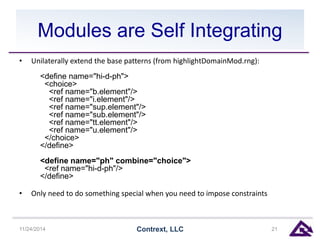
Modules are Self Integrating 
• Unilaterally extend the base patterns (from highlightDomainMod.rng): 
<define name="hi-d-ph"> 
<choice> 
<ref name="b.element"/> 
<ref name="i.element"/> 
<ref name="sup.element"/> 
<ref name="sub.element"/> 
<ref name="tt.element"/> 
<ref name="u.element"/> 
</choice> 
</define> 
<define name="ph" combine="choice"> 
<ref name="hi-d-ph"/> 
</define> 
• Only need to do something special when you need to impose constraints 
11/24/2014 Contrext, LLC 21
Compare With DTD 
<!-- ============================================================= --> 
<!-- TOPIC NESTING OVERRIDE --> 
<!-- ============================================================= --> 
<!ENTITY % topic-info-types 
"topic" 
> 
<!-- ============================================================= --> 
<!-- DOMAINS ATTRIBUTE OVERRIDE --> 
<!-- ============================================================= --> 
<!ENTITY included-domains 
"&hazard-d-att; 
&hi-d-att; 
&indexing-d-att; 
&ut-d-att; 
" 
> 
<!-- ============================================================= --> 
<!-- CONTENT CONSTRAINT INTEGRATION --> 
<!-- ============================================================= --> 
<!-- ============================================================= --> 
<!-- TOPIC ELEMENT INTEGRATION --> 
<!-- ============================================================= --> 
<!ENTITY % topic-type 
SYSTEM "topic.mod" 
>%topic-type; 
<!-- ============================================================= --> 
<!-- DOMAIN ELEMENT INTEGRATION --> 
<!-- ============================================================= --> 
<!ENTITY % hazard-d-def 
SYSTEM "hazardstatementDomain.mod" 
>%hazard-d-def; 
<!ENTITY % hi-d-def 
SYSTEM "highlightDomain.mod" 
>%hi-d-def; 
<!ENTITY % indexing-d-def 
SYSTEM "indexingDomain.mod" 
>%indexing-d-def; 
<!ENTITY % ut-d-def 
SYSTEM "utilitiesDomain.mod" 
>%ut-d-def; 
<!-- ============================================================= --> 
<!-- DOMAIN ENTITY DECLARATIONS --> 
<!-- ============================================================= --> 
<!ENTITY % hazard-d-dec 
SYSTEM "hazardstatementDomain.ent" 
>%hazard-d-dec; 
<!ENTITY % hi-d-dec 
SYSTEM "highlightDomain.ent" 
>%hi-d-dec; 
<!ENTITY % indexing-d-dec 
SYSTEM "indexingDomain.ent" 
>%indexing-d-dec; 
<!ENTITY % ut-d-dec 
SYSTEM "utilitiesDomain.ent" 
>%ut-d-dec; 
<!-- ============================================================= --> 
<!-- DOMAIN ATTRIBUTES DECLARATIONS --> 
<!-- ============================================================= --> 
<!-- ============================================================= --> 
<!-- DOMAIN EXTENSIONS --> 
<!-- ============================================================= --> 
<!-- One for each extended base element, with 
the name of the domain(s) in which the 
extension was declared --> 
<!ENTITY % note "note | 
%hazard-d-note; 
"> 
<!ENTITY % ph "ph | 
%hi-d-ph; 
"> 
<!ENTITY % index-base "index-base | 
%indexing-d-index-base; 
"> 
<!ENTITY % fig "fig | 
%ut-d-fig; 
"> 
<!-- ============================================================= --> 
<!-- DOMAIN ATTRIBUTE EXTENSIONS --> 
<!-- ============================================================= --> 
<!ENTITY % props-attribute-extensions 
"" 
> 
<!ENTITY % base-attribute-extensions 
"" 
> 
11/24/2014 Contrext, LLC 22
SEE HOW EASY: GENERATING 
DTD AND XSD SHELLS 
11/24/2014 Contrext, LLC 23
RNG-to-DITA DTD and XSD 
Converters 
• Generate conforming DTD and XSD shells and 
modules from DITA RELAX NG modules 
• Require DITA-specific metadata in the shells 
and modules 
• Maintained by the DITA Community under 
direction of the DITA TC 
– Eliot writes and maintains the code, the TC 
determines what the code needs to do to be 
correct and complete. 
11/24/2014 Contrext, LLC 24
DITA OT RNG Conversion Plugin 
• TC currently provides: 
– OT plugin for DITA 1.3 grammars: 
org.oasis-open.dita.dita13.doctypes 
– OT plugin for RNG conversion: 
org.oasis-open.dita.rng.converter 
• Defines transformation types: 
– rng2dtd 
– Rng2all 
• Requires Saxon 9.6+ 
11/24/2014 Contrext, LLC 25
File Organization Requirements 
• RNG files must be organized in the same way as 
the TC-provided files: 
– Top-level directory to hold all grammars types: 
• doctypes/ 
– Directory named “rng/” for RNG grammars: 
• doctypes/rng 
– Directory for each group of grammars (e.g., one per 
shell): 
• doctypes/rng/indirector 
– Directory named “rng” under that: 
• doctypes/rng/indirectory/rng 
11/24/2014 Contrext, LLC 26
Running The DTD Generator 
• Use transtype “rng2dtd” 
• Apply transform to file in parent directory 
containing all RNG modules: 
– E.g., catalog.xml in your doctypes/rng/ directory 
• By default, only generates shells 
11/24/2014 Contrext, LLC 27
Plugin Parameters 
• generateModules=true|false 
– Default is “false” (only generate shells) 
• usePublicIDsInShell=true|false 
– Default is true 
• generateCatalogs=true|false 
– Default is true 
11/24/2014 Contrext, LLC 28
Resources 
• RELAX NG specifications: http://relaxng.org 
• DITA 1.3 spec: http://tools.oasis-open. 
org/version-control/svn/dita/spec/ 
• DITA RELAX NG conversion tools: 
http://tools.oasis-open.org/version-control/ 
svn/dita/doctypes/tools/relaxng/ 
• Me: ekimber@contrext.com, 
http://contrext.com 
11/24/2014 Contrext, LLC 29

RELAX NG to DTD and XSD Using the Open Toolkit

  • 1.
    RELAX NG toDTD and XSD using the Open Toolkit Using RELAX NG for DITA shells and modules Eliot Kimber Contrext, LLC DITA OT Day Munich 2014 11/24/2014 Contrext, LLC 1
  • 2.
    About the Author • Responsible for DITA 1.3 grammar files • Independent consultant focusing on DITA analysis, design, and implementation • Doing SGML and XML for cough 30 years cough • Founding member of the DITA Technical Committee • Founding member of the XML Working Group • Co-editor of HyTime standard (ISO/IEC 10744) • Primary developer and founder of the DITA for Publishers project • Author of DITA for Practitioners, Vol 1 (XML Press) 11/24/2014 Contrext, LLC 2
  • 3.
    Agenda • Abrief demonstration • What is RELAX NG? • RELAX NG and DITA • DITA document types and modules • Anatomy of a RELAX NG shell • See how easy: generating DTD and XSD shells 11/24/2014 Contrext, LLC 3
  • 4.
    Executive Summary •RELAX NG makes XML vocabulary definition much, much easier • RELAX NG is a good match to DITA requirements • Can generate conforming DITA DTD and XSD files from RELAX NG • Makes creating DITA document type shells about as easy as it can be • No more need to fight with DTD or XSD syntax 11/24/2014 Contrext, LLC 4
  • 5.
    Demonstration • Createa new document type shell • Create a new domain specialization • Create a new topic speicalization • Generate DTD and XSD versions of all of these grammars 11/24/2014 Contrext, LLC 5
  • 6.
    WHAT IS RELAXNG? 11/24/2014 Contrext, LLC 6
  • 7.
    RELAX NG is • A grammar (or schema) language for XML documents • An OASIS and ISO/IEC standard (ISO/IEC 19757-2) • Most like XML DTDs but easier to use • Designed to be as simple as possible • Used for other XML standards, most prominently DocBook 11/24/2014 Contrext, LLC 7
  • 8.
    RELAX NG Basics • RELAX NG has both an XML and character-based syntax: <grammar> <start> <ref name=“concept.element”/> </start> … </grammar> ______________________________________ grammar { start concept.element … } • The two are functionally equivalent 11/24/2014 Contrext, LLC 8
  • 9.
    RELAX NG Basics(cont.) • A RELAX NG grammar defines a set of “patterns” that documents must match • Patterns can have names (analagous to DTD parameter entities) • Pattern combination mechanisms are more flexible than DTD parameter entities or XSD groups • Grammars can be modularized into multiple files 11/24/2014 Contrext, LLC 9
  • 10.
    RELAX NG ANDDITA 11/24/2014 Contrext, LLC 10
  • 11.
    Good Match toDITA Requirements • RELAX NG’s pattern-based approach works well with DITA’s modular vocabulary • Patterns can allow extension by other patterns • Patterns can unilaterally extend other patterns: the extending pattern names the pattern it extends • Makes combining vocabularies as easy as it could be 11/24/2014 Contrext, LLC 11
  • 12.
    No Added Overhead • Unlike DTDs, RELAX NG has much simpler and easier-to-use syntax • Avoids the conceptual and syntactic complexity of XSD • Close semantic match to existing DTD-defined rules 11/24/2014 Contrext, LLC 12
  • 13.
    Does require DTDCompatibility Feature • Base RELAX NG standard does not provide for defining attribute defaults • Companion standard RELAX NG DTD Compatibility provides attribute defaults • DITA depends on default attribute values • George Bina (oXygenXML) has implemented DTD compatibility in Java for use with Xerces XML parser (open source) 11/24/2014 Contrext, LLC 13
  • 14.
    Result: Everything isAwesome • RELAX NG makes DITA document type shells as easy to create as it can be • Can generate DITA-conforming DTDs and XSDs from the RELAX NG grammars • Makes it possible, if not in fact easy, for anybody to configure their own DITA document types 11/24/2014 Contrext, LLC 14
  • 15.
    DITA DOCUMENT TYPESAND SHELLS 11/24/2014 Contrext, LLC 15
  • 16.
    DITA Document Types • A DITA document type is a unique set of vocabulary and constraint modules • Modules are invariant – Every copy of a given module should be identical – You never modify modules directly • You implement DITA document types by integrating vocabulary and constraint modules using a document type shell 11/24/2014 Contrext, LLC 16
  • 17.
    Document Type Shells • Integrate modules to form a working document schema • Refer to the vocabulary and constraint modules of the DITA document type • Do any configuration required • Two document type shells that integrate the same same set of modules implement the same DITA document type 11/24/2014 Contrext, LLC 17
  • 18.
    ANATOMY OF ARELAX NG SHELL 11/24/2014 Contrext, LLC 18
  • 19.
    Shell for BaseTopic Document Type (basetopic.rng) <grammar xmlns=http://relaxng.org/ns/structure/1.0 xmlns:dita="http://dita.oasis-open.org/architecture/2005/" xmlns:a="http://relaxng.org/ns/compatibility/annotations/1.0"> … <div> <a:documentation>ROOT ELEMENT DECLARATION</a:documentation> <start combine="choice"> <ref name="topic.element"/> </start> </div> <div> <a:documentation>DOMAINS ATTRIBUTE</a:documentation> <define name="domains-att"> <attribute name="domains" a:defaultValue=”(topic topic) (topic hazard-d) (topic hi-d) (topic indexing-d) (topic ut-d) (topic hazard-d)”/> </define> </div> <div> <a:documentation>MODULE INCLUSIONS</a:documentation> <include href="topicMod.rng"> <define name="topic-info-types"> <ref name="topic.element"/> </define> </include> <include href="hazardstatementDomainMod.rng"/> <include href="highlightDomainMod.rng"/> <include href="indexingDomainMod.rng"/> <include href="utilitiesDomainMod.rng"/> </div> … </grammar> 11/24/2014 Contrext, LLC 19
  • 20.
    Integration: Just Includethe Module • All you do is include the module you want to integrate: <include href="topicMod.rng"> <define name="topic-info-types"> <ref name="topic.element"/> </define> </include> <include href="hazardstatementDomainMod.rng"/> <include href="highlightDomainMod.rng"/> <include href="indexingDomainMod.rng"/> <include href="utilitiesDomainMod.rng"/> 11/24/2014 Contrext, LLC 20
  • 21.
    Modules are SelfIntegrating • Unilaterally extend the base patterns (from highlightDomainMod.rng): <define name="hi-d-ph"> <choice> <ref name="b.element"/> <ref name="i.element"/> <ref name="sup.element"/> <ref name="sub.element"/> <ref name="tt.element"/> <ref name="u.element"/> </choice> </define> <define name="ph" combine="choice"> <ref name="hi-d-ph"/> </define> • Only need to do something special when you need to impose constraints 11/24/2014 Contrext, LLC 21
  • 22.
    Compare With DTD <!-- ============================================================= --> <!-- TOPIC NESTING OVERRIDE --> <!-- ============================================================= --> <!ENTITY % topic-info-types "topic" > <!-- ============================================================= --> <!-- DOMAINS ATTRIBUTE OVERRIDE --> <!-- ============================================================= --> <!ENTITY included-domains "&hazard-d-att; &hi-d-att; &indexing-d-att; &ut-d-att; " > <!-- ============================================================= --> <!-- CONTENT CONSTRAINT INTEGRATION --> <!-- ============================================================= --> <!-- ============================================================= --> <!-- TOPIC ELEMENT INTEGRATION --> <!-- ============================================================= --> <!ENTITY % topic-type SYSTEM "topic.mod" >%topic-type; <!-- ============================================================= --> <!-- DOMAIN ELEMENT INTEGRATION --> <!-- ============================================================= --> <!ENTITY % hazard-d-def SYSTEM "hazardstatementDomain.mod" >%hazard-d-def; <!ENTITY % hi-d-def SYSTEM "highlightDomain.mod" >%hi-d-def; <!ENTITY % indexing-d-def SYSTEM "indexingDomain.mod" >%indexing-d-def; <!ENTITY % ut-d-def SYSTEM "utilitiesDomain.mod" >%ut-d-def; <!-- ============================================================= --> <!-- DOMAIN ENTITY DECLARATIONS --> <!-- ============================================================= --> <!ENTITY % hazard-d-dec SYSTEM "hazardstatementDomain.ent" >%hazard-d-dec; <!ENTITY % hi-d-dec SYSTEM "highlightDomain.ent" >%hi-d-dec; <!ENTITY % indexing-d-dec SYSTEM "indexingDomain.ent" >%indexing-d-dec; <!ENTITY % ut-d-dec SYSTEM "utilitiesDomain.ent" >%ut-d-dec; <!-- ============================================================= --> <!-- DOMAIN ATTRIBUTES DECLARATIONS --> <!-- ============================================================= --> <!-- ============================================================= --> <!-- DOMAIN EXTENSIONS --> <!-- ============================================================= --> <!-- One for each extended base element, with the name of the domain(s) in which the extension was declared --> <!ENTITY % note "note | %hazard-d-note; "> <!ENTITY % ph "ph | %hi-d-ph; "> <!ENTITY % index-base "index-base | %indexing-d-index-base; "> <!ENTITY % fig "fig | %ut-d-fig; "> <!-- ============================================================= --> <!-- DOMAIN ATTRIBUTE EXTENSIONS --> <!-- ============================================================= --> <!ENTITY % props-attribute-extensions "" > <!ENTITY % base-attribute-extensions "" > 11/24/2014 Contrext, LLC 22
  • 23.
    SEE HOW EASY:GENERATING DTD AND XSD SHELLS 11/24/2014 Contrext, LLC 23
  • 24.
    RNG-to-DITA DTD andXSD Converters • Generate conforming DTD and XSD shells and modules from DITA RELAX NG modules • Require DITA-specific metadata in the shells and modules • Maintained by the DITA Community under direction of the DITA TC – Eliot writes and maintains the code, the TC determines what the code needs to do to be correct and complete. 11/24/2014 Contrext, LLC 24
  • 25.
    DITA OT RNGConversion Plugin • TC currently provides: – OT plugin for DITA 1.3 grammars: org.oasis-open.dita.dita13.doctypes – OT plugin for RNG conversion: org.oasis-open.dita.rng.converter • Defines transformation types: – rng2dtd – Rng2all • Requires Saxon 9.6+ 11/24/2014 Contrext, LLC 25
  • 26.
    File Organization Requirements • RNG files must be organized in the same way as the TC-provided files: – Top-level directory to hold all grammars types: • doctypes/ – Directory named “rng/” for RNG grammars: • doctypes/rng – Directory for each group of grammars (e.g., one per shell): • doctypes/rng/indirector – Directory named “rng” under that: • doctypes/rng/indirectory/rng 11/24/2014 Contrext, LLC 26
  • 27.
    Running The DTDGenerator • Use transtype “rng2dtd” • Apply transform to file in parent directory containing all RNG modules: – E.g., catalog.xml in your doctypes/rng/ directory • By default, only generates shells 11/24/2014 Contrext, LLC 27
  • 28.
    Plugin Parameters •generateModules=true|false – Default is “false” (only generate shells) • usePublicIDsInShell=true|false – Default is true • generateCatalogs=true|false – Default is true 11/24/2014 Contrext, LLC 28
  • 29.
    Resources • RELAXNG specifications: http://relaxng.org • DITA 1.3 spec: http://tools.oasis-open. org/version-control/svn/dita/spec/ • DITA RELAX NG conversion tools: http://tools.oasis-open.org/version-control/ svn/dita/doctypes/tools/relaxng/ • Me: ekimber@contrext.com, http://contrext.com 11/24/2014 Contrext, LLC 29