The T-BioInfo Platform
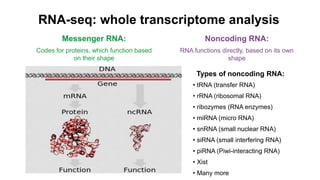
RNA-seq: whole transcriptome analysis
Noncoding RNA:
RNA functions directly, based on its own
shape
Messenger RNA:
Codes for proteins, which function based
on their shape
Types of noncoding RNA:
• tRNA (transfer RNA)
• rRNA (ribosomal RNA)
• ribozymes (RNA enzymes)
• miRNA (micro RNA)
• snRNA (small nuclear RNA)
• siRNA (small interfering RNA)
• piRNA (Piwi-interacting RNA)
• Xist
• Many more
Exons, introns, and isoforms from NGS data
Alternative splicing can generate different isoforms from the same
RNA gene product:
* Noncoding RNAs can have introns, too! Examples: Xist, HOTAIR, other lincRNAs
Why do a whole transcriptome analysis?
• Unknown disease correlations
Finding what you’re looking for when you don’t know exactly what you are
looking for. “Hypothesis Free Approach”
Example: 70% treatment efficacy = 30% poor response/no response
–Whole transcriptome analysis- compare responders and non-responders
–Computer can identify differences, even in the absence of a hypothesis
–Computer can present unexpected results that a researcher would not look for
due to preconceptions about the disease biology
• Disease correlations with post-transcription events
e.g. gene fusions and alternative splicing
• Species without a reference genome (GTF)
unsequenced species, poorly annotated genome, environmental sequencing
• Power: can outperform microarrays
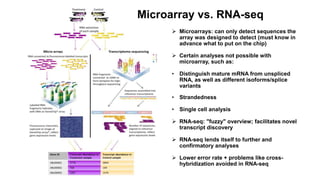
Microarray vs. RNA-seq
 Microarrays: can only detect sequences the
array was designed to detect (must know in
advance what to put on the chip)
 Certain analyses not possible with
microarray, such as:
• Distinguish mature mRNA from unspliced
RNA, as well as different isoforms/splice
variants
• Strandedness
• Single cell analysis
 RNA-seq: "fuzzy" overview; facilitates novel
transcript discovery
 RNA-seq lends itself to further and
confirmatory analyses
 Lower error rate + problems like cross-
hybridization avoided in RNA-seq
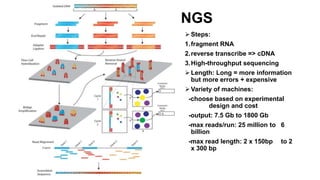
NGS
Steps:
1.fragment RNA
2.reverse transcribe => cDNA
3.High-throughput sequencing
Length: Long = more information
but more errors + expensive
Variety of machines:
-choose based on experimental
design and cost
-output: 7.5 Gb to 1800 Gb
-max reads/run: 25 million to 6
billion
-max read length: 2 x 150bp to 2
x 300 bp
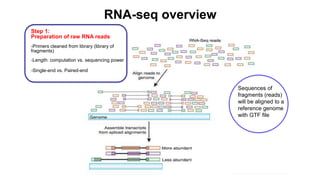
RNA-seq overview
de novo
Step 1:
Preparation of raw RNA reads
-Primers cleaned from library (library of
fragments)
-Length: computation vs. sequencing power
-Single-end vs. Paired-end
Sequences of
fragments (reads)
will be aligned to a
reference genome
with GTF file
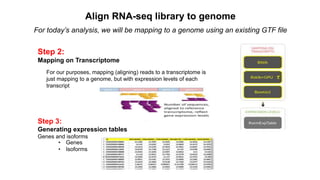
Align RNA-seq library to genome
For today’s analysis, we will be mapping to a genome using an existing GTF file
• Genes
• Isoforms
Step 2:
Mapping on Transcriptome
Step 3:
Generating expression tables
Genes and isoforms
For our purposes, mapping (aligning) reads to a transcriptome is
just mapping to a genome, but with expression levels of each
transcript
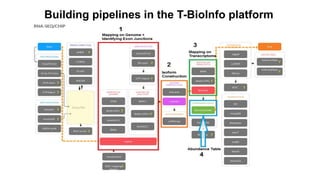
Building pipelines in the T-BioInfo platform
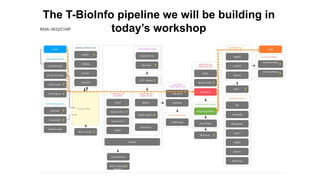
The T-BioInfo pipeline we will be building in
today’s workshop
So, the pipeline will give us a table of transcripts.
Now what?
• Normalization: Methods for overcoming variance due to
technical issues or other issues not related to the experiment
• Post-processing:
• Principal Component Analysis (PCA): provides visual overview
of the data
• Statistical analysis (e.g. T-test)
• Machine learning techniques
• Biological interpretation of results: use databases to find out
more about the identified genes, e.g. publications,
correlations
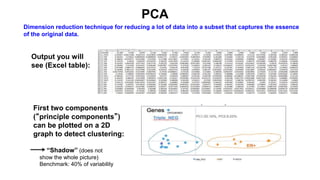
Output you will
see (Excel table):
First two components
(“principle components”)
can be plotted on a 2D
graph to detect clustering:
“Shadow” (does not
show the whole picture)
Benchmark: 40% of variability
PCA
Dimension reduction technique for reducing a lot of data into a subset that captures the essence
of the original data.
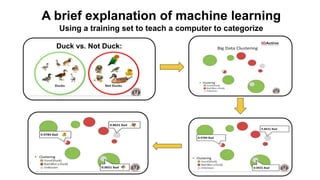
A brief explanation of machine learning
Using a training set to teach a computer to categorize
Duck vs. Not Duck:
Three subtypes of breast cancer
1. ER+ Positive for the estrogen receptor, treatment includes hormone therapy and drug
treatments targeting the estrogen receptor. The most common subtype of diagnosed breast
cancer. Positive outlook in the short term.
1. HER2+ Overexpress human epidermal growth factor, HER2/neu, a growth-promoting protein.
This type of cancer tends to be more aggressive than ER+ or PR+ breast cancer. Cannot be
treated with hormone therapy, but there are targeted drug treatments.
1. Triple Negative Negative for estrogen receptor and progesterone receptor, and does not
overexpress HER2/neu. Most cancers with mutated BRCA1 genes are triple negative. This type
responds to surgery/chemotherapy, but tends to recur later. No targeted therapy, although some
treatments in development. Survival rates lower than for other breast cancer subtypes. This
cancer type occurs in 15-20% of those diagnosed with breast cancer in the United States.
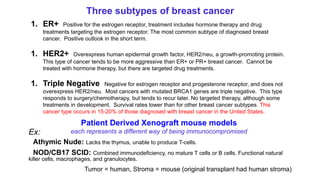
Patient Derived Xenograft mouse models
each represents a different way of being immunocompromisedEx:
Athymic Nude: Lacks the thymus, unable to produce T-cells.
NOD/CB17 SCID: Combined immunodeficiency, no mature T cells or B cells. Functional natural
killer cells, macrophages, and granulocytes.
Tumor = human, Stroma = mouse (original transplant had human stroma)
Whole Transcriptome Profiling of
Cancer Tumors in Mouse PDX Models
http://www.impactjournals.com/oncotarget/index.php?journal=oncotarget&page=article&op=view&path%5B%5D=80
14
Based on breast cancer samples taken from the publication “Whole transcriptome profiling
of patient-derived xenograft models as a tool to identify both tumor and stromal specific
biomarkers” (James R. Bradford et. al.; DOI: 10.18632/oncotarget.8014)
Introduction
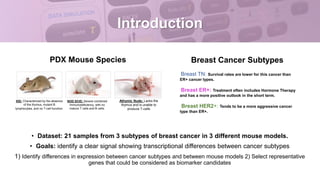
• Dataset: 21 samples from 3 subtypes of breast cancer in 3 different mouse models.
• Goals: identify a clear signal showing transcriptional differences between cancer subtypes
1) Identify differences in expression between cancer subtypes and between mouse models 2) Select representative
genes that could be considered as biomarker candidates
PDX Mouse Species
XID: Characterized by the absence
of the thymus, mutant B
lymphocytes, and no T-cell function.
NOD SCID: Severe combined
immunodeficiency, with no
mature T cells and B cells.
Athymic Nude: Lacks the
thymus and is unable to
produce T-cells
Breast TN: Survival rates are lower for this cancer than
ER+ cancer types.
Breast ER+: Treatment often includes Hormone Therapy
and has a more positive outlook in the short term.
Breast HER2+: Tends to be a more aggressive cancer
type than ER+.
Breast Cancer Subtypes
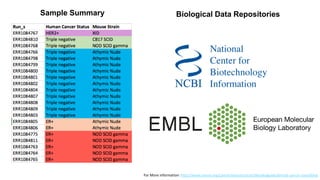
Sample Summary
For More information: http://www.cancer.org/cancer/breastcancer/detailedguide/breast-cancer-classifying
Biological Data Repositories
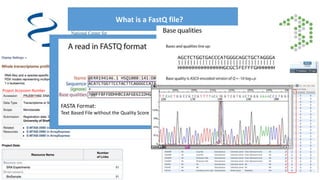
What is a FastQ file?
Project Accession Number
FASTA Format:
Text Based File without the Quality Score
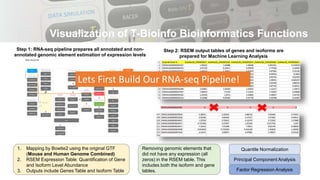
Step 1: RNA-seq pipeline prepares all annotated and non-
annotated genomic element estimation of expression levels
Removing genomic elements that
did not have any expression (all
zeros) in the RSEM table. This
includes both the isoform and gene
tables.
Quantile Normalization
Principal Component Analysis
Step 2: RSEM output tables of genes and isoforms are
prepared for Machine Learning Analysis
1. Mapping by Bowtie2 using the original GTF
(Mouse and Human Genome Combined)
2. RSEM Expression Table: Quantification of Gene
and Isoform Level Abundance
3. Outputs include Genes Table and Isoform Table Factor Regression Analysis
Visualization of T-Bioinfo Bioinformatics Functions
Lets First Build Our RNA-seq Pipeline!
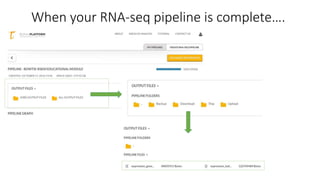
When your RNA-seq pipeline is complete….
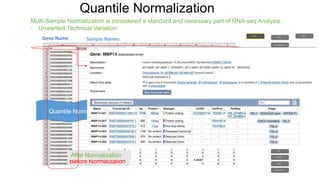
Quantile Normalization
Before Normalization
After Normalization
Gene Name Sample Names
Multi-Sample Normalization is considered a standard and necessary part of RNA-seq Analysis.
- Unwanted Technical Variation
Quantile Normalization
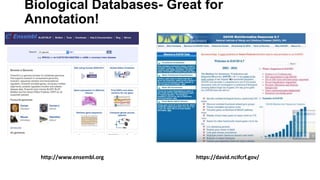
Biological Databases- Great for
Annotation!
https://david.ncifcrf.gov/http://www.ensembl.org
Now back to the T-BioInfo Platform!
1. Start a PCA Pipeline
2. Create a Scatter Plot Image from our Results
3. Utilize DAVID and ENSEMBL to investigate Biological Meaning
4. Learn about other Machine Learning Methods
5. Understand a “real” RNA-seq project timeline
T-Bio.Info Platform: http://tbioinfopb1.pine-biotech.com:3000
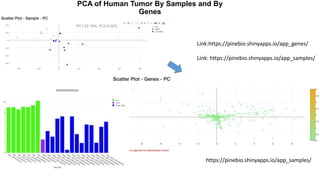
PCA of Human Tumor By Samples and By
Genes
Link:https://pinebio.shinyapps.io/app_genes/
Link: https://pinebio.shinyapps.io/app_samples/
https://pinebio.shinyapps.io/app_samples/
PC1:22.16%, PC2:9.22%
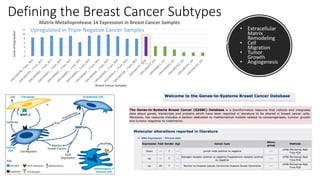
• Extracellular
Matrix
Remodeling
• Cell
Migration
• Tumor
Growth
• Angiogenesis
0
2
4
6
8
10
12
LevelofExpression
Breast Cancer Samples
Matrix Metalloprotease 14 Expression in Breast Cancer Samples
Upregulated in Triple Negative Cancer Samples
Defining the Breast Cancer Subtypes
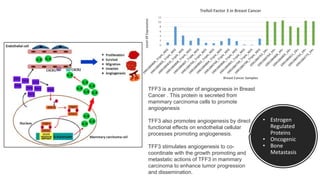
• Estrogen
Regulated
Proteins
• Oncogenic
• Bone
Metastasis
TFF3 is a promoter of angiogenesis in Breast
Cancer . This protein is secreted from
mammary carcinoma cells to promote
angiogenesis
TFF3 also promotes angiogenesis by direct
functional effects on endothelial cellular
processes promoting angiogenesis.
TFF3 stimulates angiogenesis to co-
coordinate with the growth promoting and
metastatic actions of TFF3 in mammary
carcinoma to enhance tumor progression
and dissemination.
0
2
4
6
8
10
12
LevelOfExpression
Breast Cancer Samples
Trefoil Factor 3 in Breast Cancer
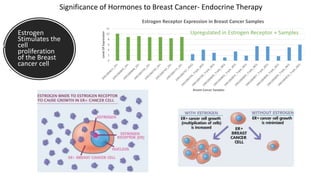
Upregulated in Estrogen Receptor + Samples
Significance of Hormones to Breast Cancer- Endocrine Therapy
0
2
4
6
8
10
12
LevelOfExpression
Breast Cancer Samples
Estrogen Receptor Expression in Breast Cancer Samples
Estrogen
Stimulates the
cell
proliferation
of the Breast
cancer cell
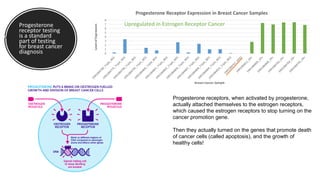
Progesterone
receptor testing
is a standard
part of testing
for breast cancer
diagnosis 0
1
2
3
4
5
6
7
8
LevelofExpression
Breast Cancer Sample
Progesterone Receptor Expression in Breast Cancer Samples
Progesterone receptors, when activated by progesterone,
actually attached themselves to the estrogen receptors,
which caused the estrogen receptors to stop turning on the
cancer promotion gene.
Then they actually turned on the genes that promote death
of cancer cells (called apoptosis), and the growth of
healthy cells!
Upregulated in Estrogen Receptor Cancer
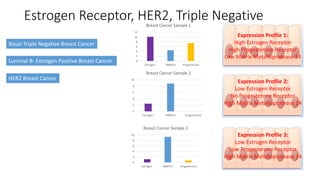
Estrogen Receptor, HER2, Triple Negative
Expression Profile 1:
High Estrogen Receptor
High Progesterone Receptor
Low Matrix Metalloprotease 14
Expression Profile 2:
Low Estrogen Receptor
No Progesterone Receptor
High Matrix Metalloprotease 14
Expression Profile 3:
Low Estrogen Receptor
Low Progesterone Receptor
High Matrix Metalloprotease 14
HER2 Breast Cancer
Luminal B- Estrogen Positive Breast Cancer
Basal-Triple Negative Breast Cancer
0
2
4
6
8
10
12
Estrogen MMP14 Progesterone
Breast Cancer Sample 1
0
2
4
6
8
10
Estrogen MMP14 Progesterone
Breast Cancer Sample 3
0
2
4
6
8
10
Estrogen MMP14 Progesterone
Breast Cancer Sample 2
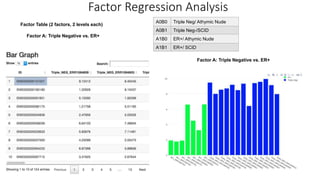
Factor Regression Analysis
A0B0 Triple Neg/ Athymic Nude
A0B1 Triple Neg-/SCID
A1B0 ER+/ Athymic Nude
A1B1 ER+/ SCID
Factor Table (2 factors, 2 levels each)
Factor A: Triple Negative vs. ER+
RNA-Seq Experiment Overview
Based on Breast Cancer Samples taken from the publication “Whole transcriptome profiling of patient-derived xenograft models
as a tool to identify both tumor and stromal specific biomarkers” (James R. Bradford et. al.; DOI: 10.18632/oncotarget.8014)
HER2 ER+TNBC
NOD SCID XID Athymic CB17 SCID
1. Ribosomal Depleted RNA
2. Fragment RNA
3. TruSeq RNA Sample
Preparation Kit
4. Concatenated Genome
(Mouse/Human)
5. Indexed with star align
Secondary Analysis
Tertiary Analysis
Gene Summary and Ontology Report
1. Mapping using TopHat
2. Finding Isoforms using Cufflinks
3. GTF file of isoforms using Cuffmerge
4. Mapping Bowtie-2t on new transcriptome
Cancer Subtypes
Mouse Species
Thanks for Listening!
Any Questions?
Contact: Info@pine-biotech.com
T-Bioinfo Platform : http://tbioinfopb1.pine-biotech.com:3000
Pine Biotech Website: http://pine-biotech.com
Pine Biotech Education Website: http://edu.t-bio.info
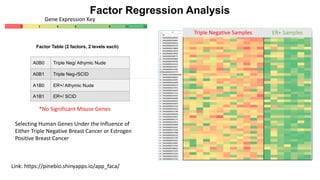
Factor Regression Analysis
A0B0 Triple Neg/ Athymic Nude
A0B1 Triple Neg-/SCID
A1B0 ER+/ Athymic Nude
A1B1 ER+/ SCID
Factor Table (2 factors, 2 levels each)
Triple Negative Samples ER+ Samples
Selecting Human Genes Under the Influence of
Either Triple Negative Breast Cancer or Estrogen
Positive Breast Cancer
Gene Expression Key
*No Significant Mouse Genes
Link: https://pinebio.shinyapps.io/app_faca/

Rna seq

  • 1.
  • 2.
    RNA-seq: whole transcriptomeanalysis Noncoding RNA: RNA functions directly, based on its own shape Messenger RNA: Codes for proteins, which function based on their shape Types of noncoding RNA: • tRNA (transfer RNA) • rRNA (ribosomal RNA) • ribozymes (RNA enzymes) • miRNA (micro RNA) • snRNA (small nuclear RNA) • siRNA (small interfering RNA) • piRNA (Piwi-interacting RNA) • Xist • Many more
  • 3.
    Exons, introns, andisoforms from NGS data Alternative splicing can generate different isoforms from the same RNA gene product: * Noncoding RNAs can have introns, too! Examples: Xist, HOTAIR, other lincRNAs
  • 4.
    Why do awhole transcriptome analysis? • Unknown disease correlations Finding what you’re looking for when you don’t know exactly what you are looking for. “Hypothesis Free Approach” Example: 70% treatment efficacy = 30% poor response/no response –Whole transcriptome analysis- compare responders and non-responders –Computer can identify differences, even in the absence of a hypothesis –Computer can present unexpected results that a researcher would not look for due to preconceptions about the disease biology • Disease correlations with post-transcription events e.g. gene fusions and alternative splicing • Species without a reference genome (GTF) unsequenced species, poorly annotated genome, environmental sequencing • Power: can outperform microarrays
  • 5.
    Microarray vs. RNA-seq Microarrays: can only detect sequences the array was designed to detect (must know in advance what to put on the chip)  Certain analyses not possible with microarray, such as: • Distinguish mature mRNA from unspliced RNA, as well as different isoforms/splice variants • Strandedness • Single cell analysis  RNA-seq: "fuzzy" overview; facilitates novel transcript discovery  RNA-seq lends itself to further and confirmatory analyses  Lower error rate + problems like cross- hybridization avoided in RNA-seq
  • 6.
    NGS Steps: 1.fragment RNA 2.reverse transcribe=> cDNA 3.High-throughput sequencing Length: Long = more information but more errors + expensive Variety of machines: -choose based on experimental design and cost -output: 7.5 Gb to 1800 Gb -max reads/run: 25 million to 6 billion -max read length: 2 x 150bp to 2 x 300 bp
  • 7.
    RNA-seq overview de novo Step1: Preparation of raw RNA reads -Primers cleaned from library (library of fragments) -Length: computation vs. sequencing power -Single-end vs. Paired-end Sequences of fragments (reads) will be aligned to a reference genome with GTF file
  • 8.
    Align RNA-seq libraryto genome For today’s analysis, we will be mapping to a genome using an existing GTF file • Genes • Isoforms Step 2: Mapping on Transcriptome Step 3: Generating expression tables Genes and isoforms For our purposes, mapping (aligning) reads to a transcriptome is just mapping to a genome, but with expression levels of each transcript
  • 9.
    Building pipelines inthe T-BioInfo platform
  • 10.
    The T-BioInfo pipelinewe will be building in today’s workshop
  • 11.
    So, the pipelinewill give us a table of transcripts. Now what? • Normalization: Methods for overcoming variance due to technical issues or other issues not related to the experiment • Post-processing: • Principal Component Analysis (PCA): provides visual overview of the data • Statistical analysis (e.g. T-test) • Machine learning techniques • Biological interpretation of results: use databases to find out more about the identified genes, e.g. publications, correlations
  • 12.
    Output you will see(Excel table): First two components (“principle components”) can be plotted on a 2D graph to detect clustering: “Shadow” (does not show the whole picture) Benchmark: 40% of variability PCA Dimension reduction technique for reducing a lot of data into a subset that captures the essence of the original data.
  • 13.
    A brief explanationof machine learning Using a training set to teach a computer to categorize Duck vs. Not Duck:
  • 14.
    Three subtypes ofbreast cancer 1. ER+ Positive for the estrogen receptor, treatment includes hormone therapy and drug treatments targeting the estrogen receptor. The most common subtype of diagnosed breast cancer. Positive outlook in the short term. 1. HER2+ Overexpress human epidermal growth factor, HER2/neu, a growth-promoting protein. This type of cancer tends to be more aggressive than ER+ or PR+ breast cancer. Cannot be treated with hormone therapy, but there are targeted drug treatments. 1. Triple Negative Negative for estrogen receptor and progesterone receptor, and does not overexpress HER2/neu. Most cancers with mutated BRCA1 genes are triple negative. This type responds to surgery/chemotherapy, but tends to recur later. No targeted therapy, although some treatments in development. Survival rates lower than for other breast cancer subtypes. This cancer type occurs in 15-20% of those diagnosed with breast cancer in the United States. Patient Derived Xenograft mouse models each represents a different way of being immunocompromisedEx: Athymic Nude: Lacks the thymus, unable to produce T-cells. NOD/CB17 SCID: Combined immunodeficiency, no mature T cells or B cells. Functional natural killer cells, macrophages, and granulocytes. Tumor = human, Stroma = mouse (original transplant had human stroma)
  • 15.
    Whole Transcriptome Profilingof Cancer Tumors in Mouse PDX Models http://www.impactjournals.com/oncotarget/index.php?journal=oncotarget&page=article&op=view&path%5B%5D=80 14 Based on breast cancer samples taken from the publication “Whole transcriptome profiling of patient-derived xenograft models as a tool to identify both tumor and stromal specific biomarkers” (James R. Bradford et. al.; DOI: 10.18632/oncotarget.8014)
  • 16.
    Introduction • Dataset: 21samples from 3 subtypes of breast cancer in 3 different mouse models. • Goals: identify a clear signal showing transcriptional differences between cancer subtypes 1) Identify differences in expression between cancer subtypes and between mouse models 2) Select representative genes that could be considered as biomarker candidates PDX Mouse Species XID: Characterized by the absence of the thymus, mutant B lymphocytes, and no T-cell function. NOD SCID: Severe combined immunodeficiency, with no mature T cells and B cells. Athymic Nude: Lacks the thymus and is unable to produce T-cells Breast TN: Survival rates are lower for this cancer than ER+ cancer types. Breast ER+: Treatment often includes Hormone Therapy and has a more positive outlook in the short term. Breast HER2+: Tends to be a more aggressive cancer type than ER+. Breast Cancer Subtypes
  • 17.
    Sample Summary For Moreinformation: http://www.cancer.org/cancer/breastcancer/detailedguide/breast-cancer-classifying Biological Data Repositories
  • 18.
    What is aFastQ file? Project Accession Number FASTA Format: Text Based File without the Quality Score
  • 19.
    Step 1: RNA-seqpipeline prepares all annotated and non- annotated genomic element estimation of expression levels Removing genomic elements that did not have any expression (all zeros) in the RSEM table. This includes both the isoform and gene tables. Quantile Normalization Principal Component Analysis Step 2: RSEM output tables of genes and isoforms are prepared for Machine Learning Analysis 1. Mapping by Bowtie2 using the original GTF (Mouse and Human Genome Combined) 2. RSEM Expression Table: Quantification of Gene and Isoform Level Abundance 3. Outputs include Genes Table and Isoform Table Factor Regression Analysis Visualization of T-Bioinfo Bioinformatics Functions Lets First Build Our RNA-seq Pipeline!
  • 20.
    When your RNA-seqpipeline is complete….
  • 21.
    Quantile Normalization Before Normalization AfterNormalization Gene Name Sample Names Multi-Sample Normalization is considered a standard and necessary part of RNA-seq Analysis. - Unwanted Technical Variation Quantile Normalization
  • 22.
    Biological Databases- Greatfor Annotation! https://david.ncifcrf.gov/http://www.ensembl.org
  • 23.
    Now back tothe T-BioInfo Platform! 1. Start a PCA Pipeline 2. Create a Scatter Plot Image from our Results 3. Utilize DAVID and ENSEMBL to investigate Biological Meaning 4. Learn about other Machine Learning Methods 5. Understand a “real” RNA-seq project timeline T-Bio.Info Platform: http://tbioinfopb1.pine-biotech.com:3000
  • 24.
    PCA of HumanTumor By Samples and By Genes Link:https://pinebio.shinyapps.io/app_genes/ Link: https://pinebio.shinyapps.io/app_samples/ https://pinebio.shinyapps.io/app_samples/ PC1:22.16%, PC2:9.22%
  • 25.
    • Extracellular Matrix Remodeling • Cell Migration •Tumor Growth • Angiogenesis 0 2 4 6 8 10 12 LevelofExpression Breast Cancer Samples Matrix Metalloprotease 14 Expression in Breast Cancer Samples Upregulated in Triple Negative Cancer Samples Defining the Breast Cancer Subtypes
  • 26.
    • Estrogen Regulated Proteins • Oncogenic •Bone Metastasis TFF3 is a promoter of angiogenesis in Breast Cancer . This protein is secreted from mammary carcinoma cells to promote angiogenesis TFF3 also promotes angiogenesis by direct functional effects on endothelial cellular processes promoting angiogenesis. TFF3 stimulates angiogenesis to co- coordinate with the growth promoting and metastatic actions of TFF3 in mammary carcinoma to enhance tumor progression and dissemination. 0 2 4 6 8 10 12 LevelOfExpression Breast Cancer Samples Trefoil Factor 3 in Breast Cancer
  • 27.
    Upregulated in EstrogenReceptor + Samples Significance of Hormones to Breast Cancer- Endocrine Therapy 0 2 4 6 8 10 12 LevelOfExpression Breast Cancer Samples Estrogen Receptor Expression in Breast Cancer Samples Estrogen Stimulates the cell proliferation of the Breast cancer cell
  • 28.
    Progesterone receptor testing is astandard part of testing for breast cancer diagnosis 0 1 2 3 4 5 6 7 8 LevelofExpression Breast Cancer Sample Progesterone Receptor Expression in Breast Cancer Samples Progesterone receptors, when activated by progesterone, actually attached themselves to the estrogen receptors, which caused the estrogen receptors to stop turning on the cancer promotion gene. Then they actually turned on the genes that promote death of cancer cells (called apoptosis), and the growth of healthy cells! Upregulated in Estrogen Receptor Cancer
  • 29.
    Estrogen Receptor, HER2,Triple Negative Expression Profile 1: High Estrogen Receptor High Progesterone Receptor Low Matrix Metalloprotease 14 Expression Profile 2: Low Estrogen Receptor No Progesterone Receptor High Matrix Metalloprotease 14 Expression Profile 3: Low Estrogen Receptor Low Progesterone Receptor High Matrix Metalloprotease 14 HER2 Breast Cancer Luminal B- Estrogen Positive Breast Cancer Basal-Triple Negative Breast Cancer 0 2 4 6 8 10 12 Estrogen MMP14 Progesterone Breast Cancer Sample 1 0 2 4 6 8 10 Estrogen MMP14 Progesterone Breast Cancer Sample 3 0 2 4 6 8 10 Estrogen MMP14 Progesterone Breast Cancer Sample 2
  • 30.
    Factor Regression Analysis A0B0Triple Neg/ Athymic Nude A0B1 Triple Neg-/SCID A1B0 ER+/ Athymic Nude A1B1 ER+/ SCID Factor Table (2 factors, 2 levels each) Factor A: Triple Negative vs. ER+ Factor A: Triple Negative vs. ER+
  • 31.
    RNA-Seq Experiment Overview Basedon Breast Cancer Samples taken from the publication “Whole transcriptome profiling of patient-derived xenograft models as a tool to identify both tumor and stromal specific biomarkers” (James R. Bradford et. al.; DOI: 10.18632/oncotarget.8014) HER2 ER+TNBC NOD SCID XID Athymic CB17 SCID 1. Ribosomal Depleted RNA 2. Fragment RNA 3. TruSeq RNA Sample Preparation Kit 4. Concatenated Genome (Mouse/Human) 5. Indexed with star align Secondary Analysis Tertiary Analysis Gene Summary and Ontology Report 1. Mapping using TopHat 2. Finding Isoforms using Cufflinks 3. GTF file of isoforms using Cuffmerge 4. Mapping Bowtie-2t on new transcriptome Cancer Subtypes Mouse Species
  • 32.
    Thanks for Listening! AnyQuestions? Contact: Info@pine-biotech.com T-Bioinfo Platform : http://tbioinfopb1.pine-biotech.com:3000 Pine Biotech Website: http://pine-biotech.com Pine Biotech Education Website: http://edu.t-bio.info
  • 33.
    Factor Regression Analysis A0B0Triple Neg/ Athymic Nude A0B1 Triple Neg-/SCID A1B0 ER+/ Athymic Nude A1B1 ER+/ SCID Factor Table (2 factors, 2 levels each) Triple Negative Samples ER+ Samples Selecting Human Genes Under the Influence of Either Triple Negative Breast Cancer or Estrogen Positive Breast Cancer Gene Expression Key *No Significant Mouse Genes Link: https://pinebio.shinyapps.io/app_faca/