1
Formulation of Hypothesis:
1. Level of Significance
The level of significance is the probability of rejecting a true null hypothesis that is the
probability of “Type I error” and is denoted by α. The frequently used values of α are 0.05; 0.01;
0.1 etc.
When, α = 0.05 it means that level of significance is 5%.In fact α specifies the critical region. A
competed value of the test statistic that falls in the critical region (CR) is said to be significant.
So, α is called the level of significance.
2. Critical/ Rejection Region
The critical region (CR) or rejection region (RR) is the area under the curve beyond certain limits
in which the population value is unlikely to fall by chance only when the null hypothesis is
assumed to be true. If an observed value falls in this region H0 is rejected and the observed
value is said to be significant. In a word, the region for which H0 is rejected is called critical
region or rejection region.
3. Confidence Interval
Confidence interval is the interval marked by limits within which the population value lies by
chance and the hypothesis is consider to be tenable. If an observed value falls in confidence
interval H0 is accepted.
4. Critical Values
The values of the test statistic which separates critical region from confidence region
(acceptance region) are called critical values.
2
5. Standard Deviation
The standard deviation is the most frequently calculated measure of variability or dispersion in
a set of data points. The standard deviation value represents the average distance of a set of
scores from the mean or average score.
6. Standard Error
The standard error is an estimate of the standard deviation of a statistic. The standard error is
important because it is used to compute other measures, like confidence intervals and margins
of error. The standard error is computed from known sample statistics, and it provides an
unbiased estimate of the standard deviation of the statistic.
7. Degree of Freedom
Degree of freedom refers to the number of values which are free to vary after we have given
the number of restrictions imposed upon the data. It is commonly abbreviated by df. For
example, if you have to take ten different courses to graduate, and only ten different courses
are offered, then you have nine degrees of freedom. Nine semesters you will be able to choose
which class to take; the tenth semester, there will only be one class left to take - there is no
choice, if you want to graduate.
8. One-tailed and Two-tailed Tests
One-tailed Test: A test in which the critical region is located in one tail of the distribution of
test of statistic is called one-tailed test. There are two types of one-tailed test in test of
hypothesis –
(a) Right tailed test and (b) Left tailed test.
A test in which critical region is located in right tail of the distribution of test statistic is called
right tailed test or upper one tailed test. A test in which critical region is located in left tail of
the distribution of test statistic is called left tailed test or lower one tailed test.
3
Procedure for/ Steps of Hypothesis Testing: All hypothesis tests are conducted the same way.
The researcher states a hypothesis to be tested, formulates an analysis plan, analyzes sample
data according to the plan, and accepts or rejects the null hypothesis, based on results of the
analysis.
1. Assumption: If there are any assumption about the normality of the population distribution
equality of variance, independence of samples, etc. they should be stated.
2. State the Hypotheses: Every hypothesis test requires the analyst to state a null hypothesis
(H0) and an alternative hypothesis (H1). The hypotheses are stated in such a way that they are
mutually exclusive. That is, if one is true, the other must be false; and vice versa.
3. Set up a Statistical Significance Level: Set the significance level (α) if not already given. Α
specifies the critical region. Often, researchers choose significance levels equal to 0.01, 0.05, or
0.10; but any value between 0 and 1 can be used.
4. Determination of a Suitable Test Statistic: Test statistic is a formula or function on sample
data. A general formula for test statistic – When the null hypothesis involves a mean or
proportion, use either of the following equations to compute the test statistic.
Test statistic = (Statistic - Parameter) / (Standard deviation of statistic)
Test statistic = (Statistic - Parameter) / (Standard error of statistic)
5. Determine the Critical Region: It is important to specify the acceptance (confidence interval)
and rejection (critical) region before the sample is taken, which values of the test statistic will
lead to a rejection or acceptance of H0.
6. Doing Computations: Compute the appropriate test statistic based on sample information.
7. Interpret the Results: Examine whether the calculated test statistic falls in the acceptance or
rejection region. If it falls in the rejection region (critical region), the null hypothesis is rejected.
If it falls in the accepted region, the null hypothesis is accepted.
8. Making Decision: Make the suitable conclusion for the problem under study.
4
Sampling Design:
A process of selecting a subset of randomized number of members of the population of a study
and collecting the data about the attributes.
In other words, a sample design is a definite plan for obtaining a sample from a given
population. The elements of sample are called as Units or Observations.
Advantages:
A systematic plan that concentrates on how a sample should be selected and what size it would
be. Sampling Design has the following advantages,
• Less time to collect data
• More Accuracy
• Less cost for data collection
Methods:
Sampling Methods are classified into two broad categories. They are
A. Probability Sampling Methods
B. Non-Probability Sampling Methods
A. Probability Sampling Methods:
The Probability Sampling Methods are sub classified into;
1. Systematic Sampling:
Systematic sampling means selecting the ith
element on a list. It is employed if
the complete lists of sampling units are available. Systematic sampling concentrates on
selecting the first element.
Positives:
• It is very convenient
• It is too economical.
5
Negatives:
• It is less representative.
• Selection of first element is strictly at random.
2. Cluster Sampling:
In cluster sampling, total population is divided into a number of relatively small sub divisions
(Clusters) and some are randomly selected for the study. Cluster sampling is known as Area
sampling if the sub divisions are geographical locations.
The main advantage is economical and the main disadvantage is less precise.
3. Stratified random Sampling:
Under this type, the heterogeneous population is divided into homogenous groups (Strata or
Stratum) and some are randomly selected for research.
Merits:
• Covers a mass population
• Gives more accurate information.
Demerits:
▪ Requires lot of care
▪ Requires Auxiliary Information.
4. Multi stage Sampling:
This technique is meant for large enquiries. Under this one, the first stage may be able to select
large primary sampling units such as States, then Districts and then Towns and finally Certain
Families.
Pros:
• It is highly flexible
• Very useful in formulating policies.
Cons:
▪ Less Accurate
▪ Division is somewhat tough.
6
B. Non – Probability Sampling:
The Non - Probability Sampling Methods are sub classified into;
1. Convenience Sampling:
Interviewers will decide the choice of sampling units based on their convenience. Generally
sampling units are selected from
• Telephone directory
• Departmental stores
• News paper subscriber’s list.
2. Judgment sampling:
Sampling units are selected on the advice of some expert or by the opinions of the researcher
himself.
3. Quota sampling:
Population is divided into number of groups based on some criterion,
• Old age
• Middle age
• Young age
7
Data:
The search for answer to research questions requires certain collection of data. The reliability
of managerial decisions depends on the quality of data.
There are two types of data namely:
Primary data:
Data which is collected from the field under the control and supervision of an investigator. This
type of data is generally a fresh data and collected for the first time.
Secondary data:
Data which is already collected by someone else and been passed through the statistical
process. Normally secondary data is collected from journals, magazines, annual reports etc.
Primary Data Vs Secondary Data:
The distinction between primary data and secondary data is only relative. The primary data of
one study will serve as secondary data for another study.
Data Collection Methods:
As stated earlier , the secondary data is collected through journals, online sites, magazines ,
annual reports of the company etc. but the Primary data is collected through various methods
namely;
1. Observation method:
It is the most commonly used method and in this method, the information is sought by
way of investigator’s own direct observation without asking from the respondent.
Observation method can be either controlled or uncontrolled.
a. Controlled Observation Method:
If the observation takes place according to definite pre-arranged plans,
then it is termed as Controlled Observation.
8
b. Uncontrolled Observation Method:
If the observation takes place in the natural setting, it is termed as an
Uncontrollable Observation method.
2. Interview Method:
Data collection in interview method involves presentation of oral verbal stimuli and reply
in oral verbal responses.
a. Personal Interview: Requires a person known as interviewer asking questions
generally in a face – to – face contact to the other person. It is very expensive and it is
not possible in case of peer members.
b. Telephone Interview: Collecting information through contacting respondents on
telephone itself. It is widely used industrial surveys and it is faster, flexible and
cheaper.
c. Questionnaire: set of questions in a structured manner. Generally the questions are
of
1. Open Ended Questions: No alternatives are given. The answer can be in the
respondents own words
2. Multiple Choice Questions: The respondents have to choose from more than two
given alternatives.
3. Dichotomous Questions: the respondents has to choose between two given
alternatives
Essential factors while designing a questionnaire:
The following considerations should be kept in mind while preparing a
questionnaire:
1. The person conducting the survey must introduce himself and state the primary
objective of survey.
9
2. The questions must be arranged in a logical order.
3. The questions should be short and simple.
4. Personal Questions should be avoided.
5. Open ended Questions should be minimized.
6. Questions regarding the number based on the type of survey.
7. Questions requiring calculations should be avoided.
SAMPLE QUESTIONNAIRE:
Questionnaire on “Workers Participation in Management” Kothagudem Thermal Power Station
Name: Department:
Designation: Age:
Years of Service in KTPS: Grade:
I. WORKERS PARTICIPATION IN MANAGEMENT
1) Workers participation would lead to improvement in production/ productivity?
a) Agree b) Neutral c) Disagree
2) Workers participation would result in better understanding among managers, supervisors and
workers?
a) Agree b) Neutral c) Disagree
3) Workers participation would help in improving Industrial Relations?
a) Agree b) Neutral c) Disagree
4) In your organization the worker is genuinely interested in participation at various levels?
a) Agree b) Neutral c) Disagree
5) In your organization managers at various levels are adequately involved in decision-making?
10
a) Agree b) Neutral c) Disagree
6) Are sure interested to participate in the management activities?
a) YES b) NO
7) Please give your opinion about the effectiveness of existing workers participation in
management in your organization?
a) Excellent b) Good c) Average d) Poor
8) Do you think that workers participation would really help to maintain harmonious
relationship between workers and employer?
a) Yes b) No
II) WORKING CONDITIONS:
1. Give your opinion about the superiors role at work spot?
a) Excellent b) Good c) Average d) Poor
2. What is your opinion about welfare facilities implemented by the KTPS Management ?
a) Excellent b) Good c) Average d) Poor
3. What is your opinion about lighting at work location?
a) Excellent b) Good c) Average d) Poor
III) WAGE & SALARY :
1. Are you sure of your present wage structure?
a) Yes b) No
2. Are you satisfied with the present wage/salary package and other attendant benefits
11
a) Yes b) No
3. If yes, please indicate the satisfaction level ?
a) Excellent b) Good c) Average d) Poor
IV) TRADE UNIONS
1. Give your opinion on trade unions part in WPM in your organization?
a)Excellent b)Good c) Average d) poor
2 . How union management relationship in KTPS?
a)Excellent b)Good c) Average d) poor
3. How is the employee-employee relation in KTPS?
a) Excellent b) Good c) Average d) Poor
‘V) COLLECTIVE BARGAINING:
1. Collective bargaining in KTPS has strengthened both the management and trade unions?
a) Yes b) No
2. Do you feel that collective bargaining can solve the problems?
a) Yes b) No
3. Do unions consult you (members) before they sit around the collective bargaining?
a) Yes b) No
Give your suggestions to improve “WPM” programme in your Organization
Measurement and Scales Techniques:
12
Scaling technique is a method of placing respondents in continuation of gradual change in the
pre-assigned values, symbols or numbers based on the features of a particular object as per the
defined rules. All the scaling techniques are based on four pillars, i.e., order, description,
distance and origin. The marketing research is highly dependable upon the scaling techniques,
without which no market analysis can be performed.
Measurement scales are the mappings used for representing the empirical relation system. It
is mainly of 5 types −
A. Nominal Scale:
It places the elements in a classification scheme. The classes will not be ordered. Each and
every entity should be placed in a particular class or category based on the value of the
attribute.
Types of Nominal Scales:
1. Dichotomous: A nominal scale that has only two labels is called ‘dichotomous’; for
example, Yes/No.
2. Nominal with Order: The labels on a nominal scale arranged in an ascending or descending
order is termed as ‘nominal with order’; for example, Excellent, Good, Average, Poor,
Worst.
3. Nominal without Order: Such nominal scale which has no sequence, is called ‘nominal
without order’; for example, Black, White.
B. Ordinal Scale:
It places the elements in an ordered classification scheme. It has the following characteristics −
• The empirical relation system consists of classes that are ordered with respect to the
attribute.
• Any mapping that preserves the ordering is acceptable.
13
• The numbers represent ranking only. Hence, addition, subtraction, and other arithmetic
operations have no meaning.
For example, At Amazon. in, every product has a customer review section where the buyers
rate the listed product according to their buying experience, product features, quality, usage,
etc.
The ratings so provided are as follows:
• 5 Star – Excellent
• 4 Star – Good
• 3 Star – Average
• 2 Star – Poor
• 1 Star – Worst
C. Interval Scale:
This scale captures the information about the size of the intervals that separate the
classification. Hence, it is more powerful than the nominal scale and the ordinal scale.
It has the following characteristics −
• It preserves order like the ordinal scale.
• It preserves the differences but not the ratio.
• Addition and subtraction can be performed on this scale but not multiplication or
division.
For example; A survey conducted by an automobile company to know the number of vehicles
owned by the people living in a particular area who can be its prospective customers in future.
It adopted the interval scaling technique for the purpose and provided the units as 1, 2, 3, 4, 5,
6 to select from.
14
In the scale mentioned above, every unit has the same difference, i.e., 1, whether it is between
2 and 3 or between 4 and 5.
D. Ratio Scale
This is the most useful scale of measurement. Here, an empirical relation exists to capture
ratios. It has the following characteristics −
• It is a measurement mapping that preserves ordering, the size of intervals between the
entities and the ratio between the entities.
• There is a zero element, representing total lack of the attributes.
• The measurement mapping must start at zero and increase at equal intervals, known as
units.
• All arithmetic operations can be applied.
For example, A health product manufacturing company surveyed to identify the level of obesity
in a particular locality. It released the following survey questionnaire:
Select a category to which your weight belongs to:
Less than 40 kilograms
• 40-59 Kilograms
• 60-79 Kilograms
• 80-99 Kilograms
• 100-119 Kilograms
• 120 Kilograms and more
15
E. Absolute Scale:
On this scale, there will be only one possible measure for an attribute. Hence, the only
possible transformation will be the identity transformation.
It has the following characteristics −
• The measurement is made by counting the number of elements in the entity set.
• The attribute always takes the form “number of occurrences of x in the entity”.
• There is only one possible measurement mapping, namely the actual count.
• All arithmetic operations can be performed on the resulting count.
F. Likert Scale: In the Likert scale, the researcher provides some statements and asks the
respondents to mark their level of agreement or disagreement over these statements by
selecting any one of the options from the five given alternatives.
For example, A shoes manufacturing company adopted the Likert scale technique for its
new sports shoe range named Z sports shoes. The purpose is to know the agreement or
disagreement of the respondents. For this, the researcher asked the respondents to circle a
number representing the most suitable answer according to them, in the following
representation:
• 1 – Strongly Disagree
• 2 – Disagree
• 3 – Neither Agree Nor Disagree
• 4 – Agree
• 5 – Strongly Agree
16
STATEMENT S D D NA NOR ND A S A
Z sports shoes are very light weight 1 2 3 4 5
Z sports shoes are extremely comfortable 1 2 3 4 5
Z sports shoes look too trendy 1 2 3 4 5
I will definitely recommend Z sports shoes 1 2 3 4 5
NOTE:
SD – STRONGLY DISAGREE
D – DISAGREE
NA NOR ND – NEITHER AGREE NOR NEITHER DISAGREE
A – AGREE
SA – STRONGLY AGREE
G. Semantic Differential Scale: A bi-polar seven-point non-comparative rating scale is
where the respondent can mark on any of the seven points for each given attribute of the
object as per personal choice.
Thus, depicting the respondent’s attitude or perception towards the object.
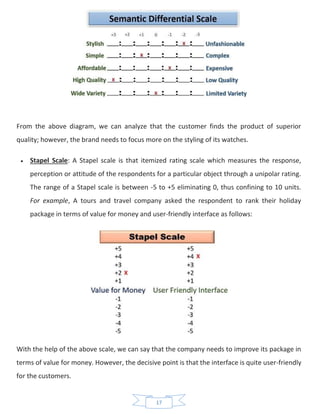
For example, A well-known brand for watches, carried out semantic differential scaling to
understand the customer’s attitude towards its product. The pictorial representation of this
technique is as follows:
17
From the above diagram, we can analyze that the customer finds the product of superior
quality; however, the brand needs to focus more on the styling of its watches.
• Stapel Scale: A Stapel scale is that itemized rating scale which measures the response,
perception or attitude of the respondents for a particular object through a unipolar rating.
The range of a Stapel scale is between -5 to +5 eliminating 0, thus confining to 10 units.
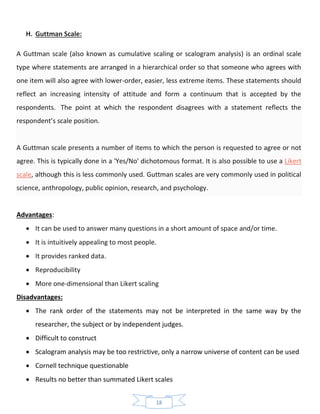
For example, A tours and travel company asked the respondent to rank their holiday
package in terms of value for money and user-friendly interface as follows:
With the help of the above scale, we can say that the company needs to improve its package in
terms of value for money. However, the decisive point is that the interface is quite user-friendly
for the customers.
18
H. Guttman Scale:
A Guttman scale (also known as cumulative scaling or scalogram analysis) is an ordinal scale
type where statements are arranged in a hierarchical order so that someone who agrees with
one item will also agree with lower-order, easier, less extreme items. These statements should
reflect an increasing intensity of attitude and form a continuum that is accepted by the
respondents. The point at which the respondent disagrees with a statement reflects the
respondent’s scale position.
A Guttman scale presents a number of items to which the person is requested to agree or not
agree. This is typically done in a 'Yes/No' dichotomous format. It is also possible to use a Likert
scale, although this is less commonly used. Guttman scales are very commonly used in political
science, anthropology, public opinion, research, and psychology.
Advantages:
• It can be used to answer many questions in a short amount of space and/or time.
• It is intuitively appealing to most people.
• It provides ranked data.
• Reproducibility
• More one-dimensional than Likert scaling
Disadvantages:
• The rank order of the statements may not be interpreted in the same way by the
researcher, the subject or by independent judges.
• Difficult to construct
• Scalogram analysis may be too restrictive, only a narrow universe of content can be used
• Cornell technique questionable
• Results no better than summated Likert scales
19
Example
The ideal Guttman scale is such that if the respondent disagrees, for example, with statement 4
(having agreed with statements 1 to 3) then the respondent will disagree with statement 5 and
higher as these represent more extreme expressions of the attitude being investigated.
For example, a series of items on attitude could be
"I am willing to be near a cat"
"I am willing to have a cat"
"I love to have a cat"
"I am willing to touch a cat"
Processing of Data:
After collecting the data, the method of converting raw data into meaningful information is
called as Processing of Data which consists of,
1. Editing of data:
Editing is very important since data gathered during the collection may lack
uniformity. Data collected through a questionnaire and schedules may have answers which
may not be ticked at proper places. Sometimes data may be given in a form which needs
reconstructing, say converting daily income into annual income.
2. Coding:
Coding of data means translating answers into numeric values. Assigning
numbers to the various categories of a varialble to be used in data analysis.
3. Classification:
It is also known as Distribution and it is of the following types,
a. Frequency Distribution:
It presents the frequency of occurrences of certain categories.
20
b. Percentage Distribution:
It is also possible to give frequencies not in absolute numbers but in percentages. Instead of
saying 200 respondents of total 2000 had a monthly income of less than Rs. 5.00 we can say
10% of respondents have a monthly income of less than 500.
c. Cumulative Distribution:
It tells how often a value of a random variable is less than or equal to a particular reference
value.
d.Statistical Distribution:
Some measure of average ids found out of a sample of respondents.
For viz, Median, Mode, Mean.
4. Tabulation:
After editing the data, it should put together in some kinds of tables.
Uses:
• Tables are very useful and they are very helpful in research in so many ways;
• Overall view of findings in a simpler way.
• Identify the trends
5. Charts: data is represented in pictorial representation such as bar charts pie
charts, cone etc. Charts are often used to ease understanding of large quantities of data and
relationship between parts of data.
Types:
a. Histogram: consists of tabular frequencies.
b. Bar chart: rectangular bars with lengths proportional to values.
c. Pie chart: percentage values as a slice of the values.
Report Writing:
Report Writing makes the final stage of a research study. The purpose of a report writing is to
tell the interested readers the problem investigated, the methods used to solve the problems,
the results of the investigations and the conclusion inferred from the results.
21
Precautionary Measures – Presentation of a Report:
The following precautionary measures should e taken while presenting effective
report writing,
1. Length of the report should be precise and sufficiently long
2. The report should be in such a manner to convey the matter to the maximum
extent.
3. Care must be taken to verify whether the visual illustrations, tables, charts are
properly inserted at appropriate places.
4. The report should be in logical analysis of the subject matter.
Layout:
A comprehensive layout should mainly consist of
A. Preliminary Pages:
• Title page
• Acknowledgement
• Table of contents
• List of Tables
• List of Graphs
B. Main Text:
• Introduction
• Review of related literature
• Design of Study
• Presentation & Analysis of data
C. End Matter
• Summary
• Conclusion
• Bibliography

Rmm

  • 1.
    1 Formulation of Hypothesis: 1.Level of Significance The level of significance is the probability of rejecting a true null hypothesis that is the probability of “Type I error” and is denoted by α. The frequently used values of α are 0.05; 0.01; 0.1 etc. When, α = 0.05 it means that level of significance is 5%.In fact α specifies the critical region. A competed value of the test statistic that falls in the critical region (CR) is said to be significant. So, α is called the level of significance. 2. Critical/ Rejection Region The critical region (CR) or rejection region (RR) is the area under the curve beyond certain limits in which the population value is unlikely to fall by chance only when the null hypothesis is assumed to be true. If an observed value falls in this region H0 is rejected and the observed value is said to be significant. In a word, the region for which H0 is rejected is called critical region or rejection region. 3. Confidence Interval Confidence interval is the interval marked by limits within which the population value lies by chance and the hypothesis is consider to be tenable. If an observed value falls in confidence interval H0 is accepted. 4. Critical Values The values of the test statistic which separates critical region from confidence region (acceptance region) are called critical values.
  • 2.
    2 5. Standard Deviation Thestandard deviation is the most frequently calculated measure of variability or dispersion in a set of data points. The standard deviation value represents the average distance of a set of scores from the mean or average score. 6. Standard Error The standard error is an estimate of the standard deviation of a statistic. The standard error is important because it is used to compute other measures, like confidence intervals and margins of error. The standard error is computed from known sample statistics, and it provides an unbiased estimate of the standard deviation of the statistic. 7. Degree of Freedom Degree of freedom refers to the number of values which are free to vary after we have given the number of restrictions imposed upon the data. It is commonly abbreviated by df. For example, if you have to take ten different courses to graduate, and only ten different courses are offered, then you have nine degrees of freedom. Nine semesters you will be able to choose which class to take; the tenth semester, there will only be one class left to take - there is no choice, if you want to graduate. 8. One-tailed and Two-tailed Tests One-tailed Test: A test in which the critical region is located in one tail of the distribution of test of statistic is called one-tailed test. There are two types of one-tailed test in test of hypothesis – (a) Right tailed test and (b) Left tailed test. A test in which critical region is located in right tail of the distribution of test statistic is called right tailed test or upper one tailed test. A test in which critical region is located in left tail of the distribution of test statistic is called left tailed test or lower one tailed test.
  • 3.
    3 Procedure for/ Stepsof Hypothesis Testing: All hypothesis tests are conducted the same way. The researcher states a hypothesis to be tested, formulates an analysis plan, analyzes sample data according to the plan, and accepts or rejects the null hypothesis, based on results of the analysis. 1. Assumption: If there are any assumption about the normality of the population distribution equality of variance, independence of samples, etc. they should be stated. 2. State the Hypotheses: Every hypothesis test requires the analyst to state a null hypothesis (H0) and an alternative hypothesis (H1). The hypotheses are stated in such a way that they are mutually exclusive. That is, if one is true, the other must be false; and vice versa. 3. Set up a Statistical Significance Level: Set the significance level (α) if not already given. Α specifies the critical region. Often, researchers choose significance levels equal to 0.01, 0.05, or 0.10; but any value between 0 and 1 can be used. 4. Determination of a Suitable Test Statistic: Test statistic is a formula or function on sample data. A general formula for test statistic – When the null hypothesis involves a mean or proportion, use either of the following equations to compute the test statistic. Test statistic = (Statistic - Parameter) / (Standard deviation of statistic) Test statistic = (Statistic - Parameter) / (Standard error of statistic) 5. Determine the Critical Region: It is important to specify the acceptance (confidence interval) and rejection (critical) region before the sample is taken, which values of the test statistic will lead to a rejection or acceptance of H0. 6. Doing Computations: Compute the appropriate test statistic based on sample information. 7. Interpret the Results: Examine whether the calculated test statistic falls in the acceptance or rejection region. If it falls in the rejection region (critical region), the null hypothesis is rejected. If it falls in the accepted region, the null hypothesis is accepted. 8. Making Decision: Make the suitable conclusion for the problem under study.
  • 4.
    4 Sampling Design: A processof selecting a subset of randomized number of members of the population of a study and collecting the data about the attributes. In other words, a sample design is a definite plan for obtaining a sample from a given population. The elements of sample are called as Units or Observations. Advantages: A systematic plan that concentrates on how a sample should be selected and what size it would be. Sampling Design has the following advantages, • Less time to collect data • More Accuracy • Less cost for data collection Methods: Sampling Methods are classified into two broad categories. They are A. Probability Sampling Methods B. Non-Probability Sampling Methods A. Probability Sampling Methods: The Probability Sampling Methods are sub classified into; 1. Systematic Sampling: Systematic sampling means selecting the ith element on a list. It is employed if the complete lists of sampling units are available. Systematic sampling concentrates on selecting the first element. Positives: • It is very convenient • It is too economical.
  • 5.
    5 Negatives: • It isless representative. • Selection of first element is strictly at random. 2. Cluster Sampling: In cluster sampling, total population is divided into a number of relatively small sub divisions (Clusters) and some are randomly selected for the study. Cluster sampling is known as Area sampling if the sub divisions are geographical locations. The main advantage is economical and the main disadvantage is less precise. 3. Stratified random Sampling: Under this type, the heterogeneous population is divided into homogenous groups (Strata or Stratum) and some are randomly selected for research. Merits: • Covers a mass population • Gives more accurate information. Demerits: ▪ Requires lot of care ▪ Requires Auxiliary Information. 4. Multi stage Sampling: This technique is meant for large enquiries. Under this one, the first stage may be able to select large primary sampling units such as States, then Districts and then Towns and finally Certain Families. Pros: • It is highly flexible • Very useful in formulating policies. Cons: ▪ Less Accurate ▪ Division is somewhat tough.
  • 6.
    6 B. Non –Probability Sampling: The Non - Probability Sampling Methods are sub classified into; 1. Convenience Sampling: Interviewers will decide the choice of sampling units based on their convenience. Generally sampling units are selected from • Telephone directory • Departmental stores • News paper subscriber’s list. 2. Judgment sampling: Sampling units are selected on the advice of some expert or by the opinions of the researcher himself. 3. Quota sampling: Population is divided into number of groups based on some criterion, • Old age • Middle age • Young age
  • 7.
    7 Data: The search foranswer to research questions requires certain collection of data. The reliability of managerial decisions depends on the quality of data. There are two types of data namely: Primary data: Data which is collected from the field under the control and supervision of an investigator. This type of data is generally a fresh data and collected for the first time. Secondary data: Data which is already collected by someone else and been passed through the statistical process. Normally secondary data is collected from journals, magazines, annual reports etc. Primary Data Vs Secondary Data: The distinction between primary data and secondary data is only relative. The primary data of one study will serve as secondary data for another study. Data Collection Methods: As stated earlier , the secondary data is collected through journals, online sites, magazines , annual reports of the company etc. but the Primary data is collected through various methods namely; 1. Observation method: It is the most commonly used method and in this method, the information is sought by way of investigator’s own direct observation without asking from the respondent. Observation method can be either controlled or uncontrolled. a. Controlled Observation Method: If the observation takes place according to definite pre-arranged plans, then it is termed as Controlled Observation.
  • 8.
    8 b. Uncontrolled ObservationMethod: If the observation takes place in the natural setting, it is termed as an Uncontrollable Observation method. 2. Interview Method: Data collection in interview method involves presentation of oral verbal stimuli and reply in oral verbal responses. a. Personal Interview: Requires a person known as interviewer asking questions generally in a face – to – face contact to the other person. It is very expensive and it is not possible in case of peer members. b. Telephone Interview: Collecting information through contacting respondents on telephone itself. It is widely used industrial surveys and it is faster, flexible and cheaper. c. Questionnaire: set of questions in a structured manner. Generally the questions are of 1. Open Ended Questions: No alternatives are given. The answer can be in the respondents own words 2. Multiple Choice Questions: The respondents have to choose from more than two given alternatives. 3. Dichotomous Questions: the respondents has to choose between two given alternatives Essential factors while designing a questionnaire: The following considerations should be kept in mind while preparing a questionnaire: 1. The person conducting the survey must introduce himself and state the primary objective of survey.
  • 9.
    9 2. The questionsmust be arranged in a logical order. 3. The questions should be short and simple. 4. Personal Questions should be avoided. 5. Open ended Questions should be minimized. 6. Questions regarding the number based on the type of survey. 7. Questions requiring calculations should be avoided. SAMPLE QUESTIONNAIRE: Questionnaire on “Workers Participation in Management” Kothagudem Thermal Power Station Name: Department: Designation: Age: Years of Service in KTPS: Grade: I. WORKERS PARTICIPATION IN MANAGEMENT 1) Workers participation would lead to improvement in production/ productivity? a) Agree b) Neutral c) Disagree 2) Workers participation would result in better understanding among managers, supervisors and workers? a) Agree b) Neutral c) Disagree 3) Workers participation would help in improving Industrial Relations? a) Agree b) Neutral c) Disagree 4) In your organization the worker is genuinely interested in participation at various levels? a) Agree b) Neutral c) Disagree 5) In your organization managers at various levels are adequately involved in decision-making?
  • 10.
    10 a) Agree b)Neutral c) Disagree 6) Are sure interested to participate in the management activities? a) YES b) NO 7) Please give your opinion about the effectiveness of existing workers participation in management in your organization? a) Excellent b) Good c) Average d) Poor 8) Do you think that workers participation would really help to maintain harmonious relationship between workers and employer? a) Yes b) No II) WORKING CONDITIONS: 1. Give your opinion about the superiors role at work spot? a) Excellent b) Good c) Average d) Poor 2. What is your opinion about welfare facilities implemented by the KTPS Management ? a) Excellent b) Good c) Average d) Poor 3. What is your opinion about lighting at work location? a) Excellent b) Good c) Average d) Poor III) WAGE & SALARY : 1. Are you sure of your present wage structure? a) Yes b) No 2. Are you satisfied with the present wage/salary package and other attendant benefits
  • 11.
    11 a) Yes b)No 3. If yes, please indicate the satisfaction level ? a) Excellent b) Good c) Average d) Poor IV) TRADE UNIONS 1. Give your opinion on trade unions part in WPM in your organization? a)Excellent b)Good c) Average d) poor 2 . How union management relationship in KTPS? a)Excellent b)Good c) Average d) poor 3. How is the employee-employee relation in KTPS? a) Excellent b) Good c) Average d) Poor ‘V) COLLECTIVE BARGAINING: 1. Collective bargaining in KTPS has strengthened both the management and trade unions? a) Yes b) No 2. Do you feel that collective bargaining can solve the problems? a) Yes b) No 3. Do unions consult you (members) before they sit around the collective bargaining? a) Yes b) No Give your suggestions to improve “WPM” programme in your Organization Measurement and Scales Techniques:
  • 12.
    12 Scaling technique isa method of placing respondents in continuation of gradual change in the pre-assigned values, symbols or numbers based on the features of a particular object as per the defined rules. All the scaling techniques are based on four pillars, i.e., order, description, distance and origin. The marketing research is highly dependable upon the scaling techniques, without which no market analysis can be performed. Measurement scales are the mappings used for representing the empirical relation system. It is mainly of 5 types − A. Nominal Scale: It places the elements in a classification scheme. The classes will not be ordered. Each and every entity should be placed in a particular class or category based on the value of the attribute. Types of Nominal Scales: 1. Dichotomous: A nominal scale that has only two labels is called ‘dichotomous’; for example, Yes/No. 2. Nominal with Order: The labels on a nominal scale arranged in an ascending or descending order is termed as ‘nominal with order’; for example, Excellent, Good, Average, Poor, Worst. 3. Nominal without Order: Such nominal scale which has no sequence, is called ‘nominal without order’; for example, Black, White. B. Ordinal Scale: It places the elements in an ordered classification scheme. It has the following characteristics − • The empirical relation system consists of classes that are ordered with respect to the attribute. • Any mapping that preserves the ordering is acceptable.
  • 13.
    13 • The numbersrepresent ranking only. Hence, addition, subtraction, and other arithmetic operations have no meaning. For example, At Amazon. in, every product has a customer review section where the buyers rate the listed product according to their buying experience, product features, quality, usage, etc. The ratings so provided are as follows: • 5 Star – Excellent • 4 Star – Good • 3 Star – Average • 2 Star – Poor • 1 Star – Worst C. Interval Scale: This scale captures the information about the size of the intervals that separate the classification. Hence, it is more powerful than the nominal scale and the ordinal scale. It has the following characteristics − • It preserves order like the ordinal scale. • It preserves the differences but not the ratio. • Addition and subtraction can be performed on this scale but not multiplication or division. For example; A survey conducted by an automobile company to know the number of vehicles owned by the people living in a particular area who can be its prospective customers in future. It adopted the interval scaling technique for the purpose and provided the units as 1, 2, 3, 4, 5, 6 to select from.
  • 14.
    14 In the scalementioned above, every unit has the same difference, i.e., 1, whether it is between 2 and 3 or between 4 and 5. D. Ratio Scale This is the most useful scale of measurement. Here, an empirical relation exists to capture ratios. It has the following characteristics − • It is a measurement mapping that preserves ordering, the size of intervals between the entities and the ratio between the entities. • There is a zero element, representing total lack of the attributes. • The measurement mapping must start at zero and increase at equal intervals, known as units. • All arithmetic operations can be applied. For example, A health product manufacturing company surveyed to identify the level of obesity in a particular locality. It released the following survey questionnaire: Select a category to which your weight belongs to: Less than 40 kilograms • 40-59 Kilograms • 60-79 Kilograms • 80-99 Kilograms • 100-119 Kilograms • 120 Kilograms and more
  • 15.
    15 E. Absolute Scale: Onthis scale, there will be only one possible measure for an attribute. Hence, the only possible transformation will be the identity transformation. It has the following characteristics − • The measurement is made by counting the number of elements in the entity set. • The attribute always takes the form “number of occurrences of x in the entity”. • There is only one possible measurement mapping, namely the actual count. • All arithmetic operations can be performed on the resulting count. F. Likert Scale: In the Likert scale, the researcher provides some statements and asks the respondents to mark their level of agreement or disagreement over these statements by selecting any one of the options from the five given alternatives. For example, A shoes manufacturing company adopted the Likert scale technique for its new sports shoe range named Z sports shoes. The purpose is to know the agreement or disagreement of the respondents. For this, the researcher asked the respondents to circle a number representing the most suitable answer according to them, in the following representation: • 1 – Strongly Disagree • 2 – Disagree • 3 – Neither Agree Nor Disagree • 4 – Agree • 5 – Strongly Agree
  • 16.
    16 STATEMENT S DD NA NOR ND A S A Z sports shoes are very light weight 1 2 3 4 5 Z sports shoes are extremely comfortable 1 2 3 4 5 Z sports shoes look too trendy 1 2 3 4 5 I will definitely recommend Z sports shoes 1 2 3 4 5 NOTE: SD – STRONGLY DISAGREE D – DISAGREE NA NOR ND – NEITHER AGREE NOR NEITHER DISAGREE A – AGREE SA – STRONGLY AGREE G. Semantic Differential Scale: A bi-polar seven-point non-comparative rating scale is where the respondent can mark on any of the seven points for each given attribute of the object as per personal choice. Thus, depicting the respondent’s attitude or perception towards the object. For example, A well-known brand for watches, carried out semantic differential scaling to understand the customer’s attitude towards its product. The pictorial representation of this technique is as follows:
  • 17.
    17 From the abovediagram, we can analyze that the customer finds the product of superior quality; however, the brand needs to focus more on the styling of its watches. • Stapel Scale: A Stapel scale is that itemized rating scale which measures the response, perception or attitude of the respondents for a particular object through a unipolar rating. The range of a Stapel scale is between -5 to +5 eliminating 0, thus confining to 10 units. For example, A tours and travel company asked the respondent to rank their holiday package in terms of value for money and user-friendly interface as follows: With the help of the above scale, we can say that the company needs to improve its package in terms of value for money. However, the decisive point is that the interface is quite user-friendly for the customers.
  • 18.
    18 H. Guttman Scale: AGuttman scale (also known as cumulative scaling or scalogram analysis) is an ordinal scale type where statements are arranged in a hierarchical order so that someone who agrees with one item will also agree with lower-order, easier, less extreme items. These statements should reflect an increasing intensity of attitude and form a continuum that is accepted by the respondents. The point at which the respondent disagrees with a statement reflects the respondent’s scale position. A Guttman scale presents a number of items to which the person is requested to agree or not agree. This is typically done in a 'Yes/No' dichotomous format. It is also possible to use a Likert scale, although this is less commonly used. Guttman scales are very commonly used in political science, anthropology, public opinion, research, and psychology. Advantages: • It can be used to answer many questions in a short amount of space and/or time. • It is intuitively appealing to most people. • It provides ranked data. • Reproducibility • More one-dimensional than Likert scaling Disadvantages: • The rank order of the statements may not be interpreted in the same way by the researcher, the subject or by independent judges. • Difficult to construct • Scalogram analysis may be too restrictive, only a narrow universe of content can be used • Cornell technique questionable • Results no better than summated Likert scales
  • 19.
    19 Example The ideal Guttmanscale is such that if the respondent disagrees, for example, with statement 4 (having agreed with statements 1 to 3) then the respondent will disagree with statement 5 and higher as these represent more extreme expressions of the attitude being investigated. For example, a series of items on attitude could be "I am willing to be near a cat" "I am willing to have a cat" "I love to have a cat" "I am willing to touch a cat" Processing of Data: After collecting the data, the method of converting raw data into meaningful information is called as Processing of Data which consists of, 1. Editing of data: Editing is very important since data gathered during the collection may lack uniformity. Data collected through a questionnaire and schedules may have answers which may not be ticked at proper places. Sometimes data may be given in a form which needs reconstructing, say converting daily income into annual income. 2. Coding: Coding of data means translating answers into numeric values. Assigning numbers to the various categories of a varialble to be used in data analysis. 3. Classification: It is also known as Distribution and it is of the following types, a. Frequency Distribution: It presents the frequency of occurrences of certain categories.
  • 20.
    20 b. Percentage Distribution: Itis also possible to give frequencies not in absolute numbers but in percentages. Instead of saying 200 respondents of total 2000 had a monthly income of less than Rs. 5.00 we can say 10% of respondents have a monthly income of less than 500. c. Cumulative Distribution: It tells how often a value of a random variable is less than or equal to a particular reference value. d.Statistical Distribution: Some measure of average ids found out of a sample of respondents. For viz, Median, Mode, Mean. 4. Tabulation: After editing the data, it should put together in some kinds of tables. Uses: • Tables are very useful and they are very helpful in research in so many ways; • Overall view of findings in a simpler way. • Identify the trends 5. Charts: data is represented in pictorial representation such as bar charts pie charts, cone etc. Charts are often used to ease understanding of large quantities of data and relationship between parts of data. Types: a. Histogram: consists of tabular frequencies. b. Bar chart: rectangular bars with lengths proportional to values. c. Pie chart: percentage values as a slice of the values. Report Writing: Report Writing makes the final stage of a research study. The purpose of a report writing is to tell the interested readers the problem investigated, the methods used to solve the problems, the results of the investigations and the conclusion inferred from the results.
  • 21.
    21 Precautionary Measures –Presentation of a Report: The following precautionary measures should e taken while presenting effective report writing, 1. Length of the report should be precise and sufficiently long 2. The report should be in such a manner to convey the matter to the maximum extent. 3. Care must be taken to verify whether the visual illustrations, tables, charts are properly inserted at appropriate places. 4. The report should be in logical analysis of the subject matter. Layout: A comprehensive layout should mainly consist of A. Preliminary Pages: • Title page • Acknowledgement • Table of contents • List of Tables • List of Graphs B. Main Text: • Introduction • Review of related literature • Design of Study • Presentation & Analysis of data C. End Matter • Summary • Conclusion • Bibliography