Residential Life
Engagement Model
Purpose of former
Programming Model
1. To get students out of their rooms/living
arrangements and into the community
2. To get students connected to the institution
3. To standardize the work of student employees
4. To ensure that students had equitable access to
programs
5. FUN!

2
and then…

3
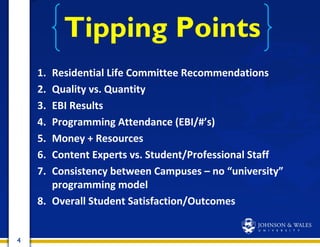
Tipping Points
1.
2.
3.
4.
5.
6.
7.

Residential Life Committee Recommendations
Quality vs. Quantity
EBI Results
Programming Attendance (EBI/#’s)
Money + Resources
Content Experts vs. Student/Professional Staff
Consistency between Campuses – no “university”
programming model
8. Overall Student Satisfaction/Outcomes

4
Connect
Explore
Evolve
5
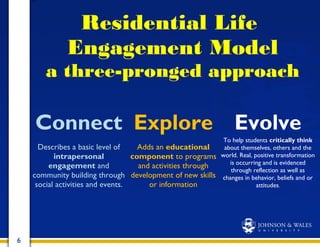
Residential Life
Engagement Model

a three-pronged approach

Connect Explore Evolve
Describes a basic level of
Adds an educational
intrapersonal
component to programs
engagement and
and activities through
community building through development of new skills
social activities and events.
or information

6

To help students critically think
about themselves, others and the
world. Real, positive transformation
is occurring and is evidenced
through reflection as well as
changes in behavior, beliefs and or
attitudes.
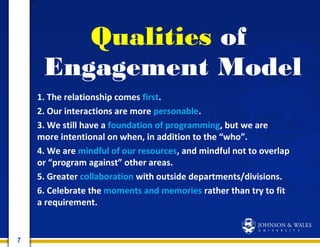
Qualities of
Engagement Model
1. The relationship comes first.
2. Our interactions are more personable.
3. We still have a foundation of programming, but we are
more intentional on when, in addition to the “who”.
4. We are mindful of our resources, and mindful not to overlap
or “program against” other areas.
5. Greater collaboration with outside departments/divisions.
6. Celebrate the moments and memories rather than try to fit
a requirement.

7
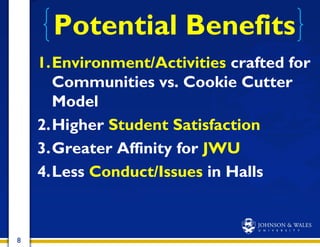
Potential Benefits
1.Environment/Activities crafted for
Communities vs. Cookie Cutter
Model
2.Higher Student Satisfaction
3.Greater Affinity for JWU
4.Less Conduct/Issues in Halls

8
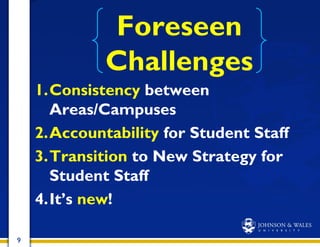
Foreseen
Challenges
1.Consistency between
Areas/Campuses
2.Accountability for Student Staff
3.Transition to New Strategy for
Student Staff
4.It’s new!
9
Questions?

10

Residential Life Engagement Model

  • 1.
  • 2.
    Purpose of former ProgrammingModel 1. To get students out of their rooms/living arrangements and into the community 2. To get students connected to the institution 3. To standardize the work of student employees 4. To ensure that students had equitable access to programs 5. FUN! 2
  • 3.
  • 4.
    Tipping Points 1. 2. 3. 4. 5. 6. 7. Residential LifeCommittee Recommendations Quality vs. Quantity EBI Results Programming Attendance (EBI/#’s) Money + Resources Content Experts vs. Student/Professional Staff Consistency between Campuses – no “university” programming model 8. Overall Student Satisfaction/Outcomes 4
  • 5.
  • 6.
    Residential Life Engagement Model athree-pronged approach Connect Explore Evolve Describes a basic level of Adds an educational intrapersonal component to programs engagement and and activities through community building through development of new skills social activities and events. or information 6 To help students critically think about themselves, others and the world. Real, positive transformation is occurring and is evidenced through reflection as well as changes in behavior, beliefs and or attitudes.
  • 7.
    Qualities of Engagement Model 1.The relationship comes first. 2. Our interactions are more personable. 3. We still have a foundation of programming, but we are more intentional on when, in addition to the “who”. 4. We are mindful of our resources, and mindful not to overlap or “program against” other areas. 5. Greater collaboration with outside departments/divisions. 6. Celebrate the moments and memories rather than try to fit a requirement. 7
  • 8.
    Potential Benefits 1.Environment/Activities craftedfor Communities vs. Cookie Cutter Model 2.Higher Student Satisfaction 3.Greater Affinity for JWU 4.Less Conduct/Issues in Halls 8
  • 9.
    Foreseen Challenges 1.Consistency between Areas/Campuses 2.Accountability forStudent Staff 3.Transition to New Strategy for Student Staff 4.It’s new! 9
  • 10.

Editor's Notes

  • #3 There are lots of reasons behind programming in student affairs (particularly), but these are most evident
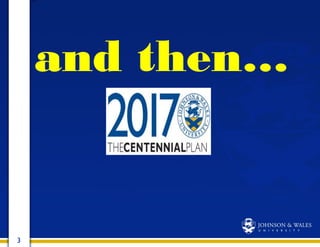
  • #4 Along with the Centennial Plan, the trickle down effect of the emphasis on student engagement and affinity for the institution called for a higher level of interaction from Student Affairs, including Residential Life.
  • #5 During our Functional Head Meeting this past March, we talked about these topics as ways to ask – why use this current Residential Life programming model? And then to ask “why DON’T we look at something new and innovative?”