Sarah Klionsky
Cooperative Education Faculty Member
Northeastern University College of Science
s.klionsky@neu.edu
Transition from College to Career:
the role of experiential education
Massachusetts Sustainable
Campuses Conference
15 April 2016
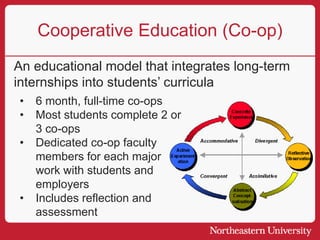
Cooperative Education (Co-op)
An educational model that integrates long-term
internships into students’ curricula
• 6 month, full-time co-ops
• Most students complete 2 or
3 co-ops
• Dedicated co-op faculty
members for each major
work with students and
employers
• Includes reflection and
assessment
Perspective
• Co-op faculty
– Approach co-op from an educational
perspective, not just job placement
– Teach students in the classroom
– Meet with each student before each co-op,
often >1 time
– Lead reflection activities
– Read student and employer assessments
– Work with employers to develop positions
– Visit work sites
– Maintain employer relationships and
receive feedback on program
• Track outcomes over time
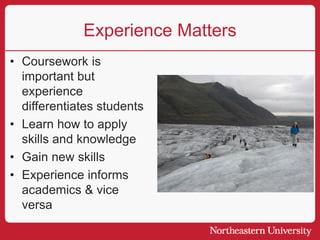
Experience Matters
• Coursework is
important but
experience
differentiates students
• Learn how to apply
skills and knowledge
• Gain new skills
• Experience informs
academics & vice
versa
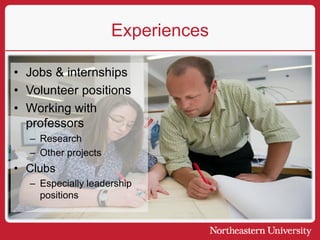
Experiences
• Jobs & internships
• Volunteer positions
• Working with
professors
– Research
– Other projects
• Clubs
– Especially leadership
positions
Work up to Goals
• Focus on content of
positions, not titles
• Qualifications are the sum
of experiences
• Learn what you like and
don’t like
• Develop a professional
network
Employers Value
• Consistent hard work
• Interest in learning
• Problem solving &
critical thinking
• Willingness to take on
exciting and less exciting
tasks
• Written and verbal
communication skills
• Eagerness to improve &
ability to accept criticism
• Technical skills
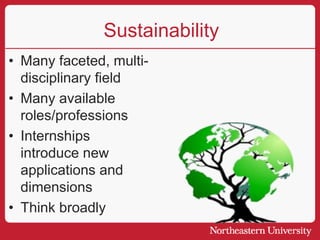
Sustainability
• Many faceted, multi-
disciplinary field
• Many available
roles/professions
• Internships
introduce new
applications and
dimensions
• Think broadly
Opportunities
• Companies, organizations, agencies, institutions
– Campus sustainability
– Sustainable living
– Environmental remediation/restoration
– Sustainable food systems
– Environmental health
– Environmental advocacy, policy, and law
– City planning
– Scientific research
– Socially responsible investing
– Corporate Social/Environmental responsibility (triple bottom line)
– Renewable energy & energy assessment
– Conservation
– Community organizing
– Environmental education
Student Testimonial
“Northeastern’s coop program provided me with the
opportunity to travel throughout the country- and the
world- experiencing a vast variety of subjects in all
different work environments. From working at a winery
in Napa, CA, to volunteering on organic farms in New
Zealand, and finally working at a solar energy developer
right outside of Boston, every single job has taught me
something new and changed me as an
individual. Working outside of the classroom allows you
to apply things that you learn in class and integrate them
into your studies as well as your life. Coop is the best
thing that I could have done at college, I feel prepared for
the post-college world and am confident in my abilities to
land a job.”
Student Testimonial
“My coop experience at Heart Capital in Cape Town,
South Africa involved putting together an impact
measurement system to help Heart's entrepreneurs
track and measure their social and environmental
impact using specific indicators. It was a formative
experience for me, giving me confidence in tackling
and organizing my own project. I look back on that
coop as my favorite one due to the position, the
wonderful team and company, the gorgeous
setting, and its distance from my comfort zone back
home.”
Student Testimonial
"The co-op program has helped me figure out my
strengths and skills, and let me gain work experience in
different fields. I found my passion for research though
my second co-op at Woods Hole Oceanographic
Institution, and I learned valuable laboratory skills and
critical thinking skills that will help me as I move on to
graduate school in the future.“
“Co-op was the greatest asset in the success of my career.
Without my internships in both clinical and research
fields, I would never have had the competitive edge
necessary to be admitted to veterinary school. “
Student Testimonial
“There are days that I miss the energy of having
an on-campus network at my disposal. However,
although I’m not taking classes, I’m learning
more than ever here. In just a few months, I’ve
built tons of mini-knowledge bases, of public
relations software, of mine excavation work, of
questions in interviews that don’t have
immediate responses, of environmental health,
public health and income inequality coalescing. I
am grateful. Here, I have many teachers.
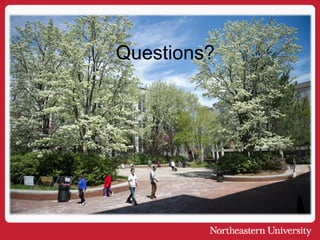
Questions?

sarahklionsky2016

  • 2.
    Sarah Klionsky Cooperative EducationFaculty Member Northeastern University College of Science s.klionsky@neu.edu Transition from College to Career: the role of experiential education Massachusetts Sustainable Campuses Conference 15 April 2016
  • 3.
    Cooperative Education (Co-op) Aneducational model that integrates long-term internships into students’ curricula • 6 month, full-time co-ops • Most students complete 2 or 3 co-ops • Dedicated co-op faculty members for each major work with students and employers • Includes reflection and assessment
  • 4.
    Perspective • Co-op faculty –Approach co-op from an educational perspective, not just job placement – Teach students in the classroom – Meet with each student before each co-op, often >1 time – Lead reflection activities – Read student and employer assessments – Work with employers to develop positions – Visit work sites – Maintain employer relationships and receive feedback on program • Track outcomes over time
  • 5.
    Experience Matters • Courseworkis important but experience differentiates students • Learn how to apply skills and knowledge • Gain new skills • Experience informs academics & vice versa
  • 6.
    Experiences • Jobs &internships • Volunteer positions • Working with professors – Research – Other projects • Clubs – Especially leadership positions
  • 7.
    Work up toGoals • Focus on content of positions, not titles • Qualifications are the sum of experiences • Learn what you like and don’t like • Develop a professional network
  • 8.
    Employers Value • Consistenthard work • Interest in learning • Problem solving & critical thinking • Willingness to take on exciting and less exciting tasks • Written and verbal communication skills • Eagerness to improve & ability to accept criticism • Technical skills
  • 9.
    Sustainability • Many faceted,multi- disciplinary field • Many available roles/professions • Internships introduce new applications and dimensions • Think broadly
  • 10.
    Opportunities • Companies, organizations,agencies, institutions – Campus sustainability – Sustainable living – Environmental remediation/restoration – Sustainable food systems – Environmental health – Environmental advocacy, policy, and law – City planning – Scientific research – Socially responsible investing – Corporate Social/Environmental responsibility (triple bottom line) – Renewable energy & energy assessment – Conservation – Community organizing – Environmental education
  • 11.
    Student Testimonial “Northeastern’s coopprogram provided me with the opportunity to travel throughout the country- and the world- experiencing a vast variety of subjects in all different work environments. From working at a winery in Napa, CA, to volunteering on organic farms in New Zealand, and finally working at a solar energy developer right outside of Boston, every single job has taught me something new and changed me as an individual. Working outside of the classroom allows you to apply things that you learn in class and integrate them into your studies as well as your life. Coop is the best thing that I could have done at college, I feel prepared for the post-college world and am confident in my abilities to land a job.”
  • 12.
    Student Testimonial “My coopexperience at Heart Capital in Cape Town, South Africa involved putting together an impact measurement system to help Heart's entrepreneurs track and measure their social and environmental impact using specific indicators. It was a formative experience for me, giving me confidence in tackling and organizing my own project. I look back on that coop as my favorite one due to the position, the wonderful team and company, the gorgeous setting, and its distance from my comfort zone back home.”
  • 13.
    Student Testimonial "The co-opprogram has helped me figure out my strengths and skills, and let me gain work experience in different fields. I found my passion for research though my second co-op at Woods Hole Oceanographic Institution, and I learned valuable laboratory skills and critical thinking skills that will help me as I move on to graduate school in the future.“ “Co-op was the greatest asset in the success of my career. Without my internships in both clinical and research fields, I would never have had the competitive edge necessary to be admitted to veterinary school. “
  • 14.
    Student Testimonial “There aredays that I miss the energy of having an on-campus network at my disposal. However, although I’m not taking classes, I’m learning more than ever here. In just a few months, I’ve built tons of mini-knowledge bases, of public relations software, of mine excavation work, of questions in interviews that don’t have immediate responses, of environmental health, public health and income inequality coalescing. I am grateful. Here, I have many teachers.
  • 15.