- Residential LifeSlideContent BoxResidential Education ReconsideredACPA 2011 ConferenceMarch 30, 2011
- Residential LifeResidential Education, ReconsideredStan DuraResidential Life CoordinatorDoctoral Student, Educational PsychologyUNLVResidential Education ReconsideredACPA 2011 ConferenceMarch 30, 2011
- Residential LifeOverviewEngaging residents in cognitive activity that better supports academic success Look at Residential Education, past and present
Look at Learning Theory, past and present
 Introduce the Reflective Engagement Model
Look at comparative data
Wrap upResidential Education ReconsideredACPA 2011 ConferenceMarch 30, 2011
- Residential LifeResidential EducationResidential Education has evolved from: Inherent and naturalistic -  Oxford, Cambridge, Harvard and Yale style “residential houses” (early 1900’s and prior)
Parental in nature – rise and dominance of “in loco parentis”  (mid 1900’s)
 Practically non-existent  -  diversification of residents and demise of “in loco parentis” (1970’s, and 80’s)
 Pervasive, complex, and often superficial – plethora of contexts and models Residential Education ReconsideredACPA 2011 ConferenceMarch 30, 2011
- Residential LifeLearning TheoryLearning theory has evolved from: Elitist – (1700’s -1800’s) Only the elite were considered worthy of education, and learning consisted of logic, religion, and philosophy via rote-learning
Empiricism – (1800’s – 1900’s) The modern day Research University started with German empiricists, focusing on faculty research and inductive reasoning more so than student learning
Introspectionism –  (late 1800’s – early 1900’s) Wundt began to focus on   “what is happening in the mind”; rebirth of interest in the philosophy of Education (i.e. John Dewey)Residential Education ReconsideredACPA 2011 ConferenceMarch 30, 2011
- Residential LifeLearning TheoryLearning theory has evolved from: Behaviorism – (early 1900’s – 1990’s)  Learning was more or less strictly about environmental stimuli soliciting reflexive response.  Little or no mental activity.
 Cognitive Science  - (1960’s - ????) Recognized learning as a complex cognitive process involving perception, memory, emotion, and active construction
 Socio-Cognitive – (2000’s - ????) Builds on Cognitive Science but emphasizes the influence of environmental, social, and cultural factors on cognitionResidential Education ReconsideredACPA 2011 ConferenceMarch 30, 2011
- Residential LifeWhat is going on in the mind? Student affairs has done a great job of understanding how students change over time, and we associate the long term change as learning.
 But we know little of what happens inside the mind of the student as they are learning and developing.
 We know even less of howlearning and development occurs inside the mind.Residential Education ReconsideredACPA 2011 ConferenceMarch 30, 2011
- Residential LifeWhat is going on in the mind?Assimilation & IntegrationSchemaAttentionAssociationismActive ConstructionEpisodic memoryMetacognitionImmediate MemoryDual CodingExpertise reversalWorking memoryDual processingTransferParallel Processing“Cold Cognition” and “Hot Cognition”Sensory RegisterVisual/Spatial sketchpadCognitive Belief SystemResidential Education ReconsideredACPA 2011 ConferenceMarch 30, 2011
- Residential LifeWhat is going on in the mind?“Cold Cognition” and “Hot Cognition”Cognitive Belief SystemMotivationSelf-efficacyEmotionsProblem SolvingCritical ThinkingCreativityResidential Education ReconsideredACPA 2011 ConferenceMarch 30, 2011
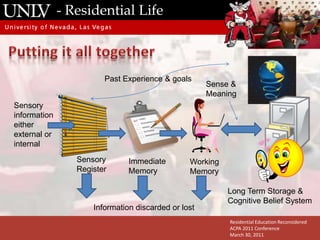
- Residential LifeHow does it all fit together?"If the brain were simple enough for us to understand it, we would be too simple to understand it."~Ken Hill We’re still trying to figure the brain/mind out, but here is a basic part of it…An Information Processing ModelResidential Education ReconsideredACPA 2011 ConferenceMarch 30, 2011
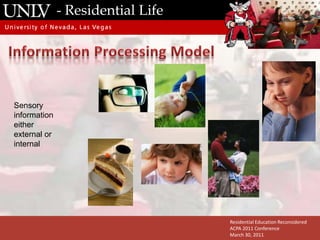
- Residential LifeInformation Processing ModelSensory information either external or internalResidential Education ReconsideredACPA 2011 ConferenceMarch 30, 2011
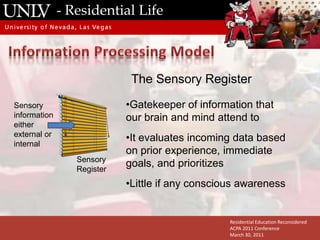
- Residential LifeInformation Processing ModelThe Sensory RegisterGatekeeper of information that our brain and mind attend to
It evaluates incoming data based on prior experience, immediate goals, and prioritizes
Little if any conscious awarenessSensory information either external or internalSensory RegisterResidential Education ReconsideredACPA 2011 ConferenceMarch 30, 2011
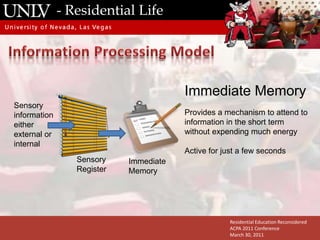
- Residential LifeInformation Processing ModelImmediate Memory Provides a mechanism to attend to information in the short term without expending much energyActive for just a few secondsSensory information either external or internalSensory RegisterImmediate MemoryResidential Education ReconsideredACPA 2011 ConferenceMarch 30, 2011
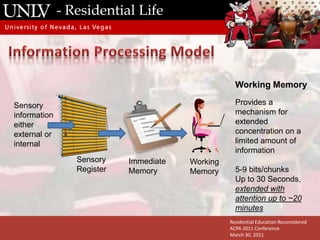
- Residential LifeInformation Processing ModelWorking Memory Provides a mechanism for extended concentration on a limited amount of information5-9 bits/chunksUp to 30 Seconds, extended with attention up to ~20 minutesSensory information either external or internalSensory RegisterImmediate MemoryWorking MemoryResidential Education ReconsideredACPA 2011 ConferenceMarch 30, 2011
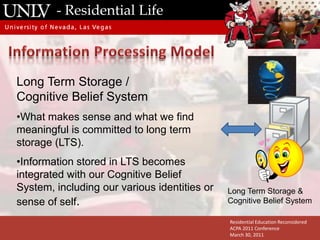
- Residential LifeInformation Processing ModelLong Term Storage /Cognitive Belief SystemWhat makes sense and what we find meaningful is committed to long term storage (LTS).
Information stored in LTS becomes integrated with our Cognitive Belief System, including our various identities or sense of self.Long Term Storage & Cognitive Belief SystemResidential Education ReconsideredACPA 2011 ConferenceMarch 30, 2011
- Residential LifePutting it all togetherPast Experience & goalsSense & MeaningSensory information either external or internalSensory RegisterImmediate MemoryWorking MemoryLong Term Storage & Cognitive Belief SystemInformation discarded or lostResidential Education ReconsideredACPA 2011 ConferenceMarch 30, 2011
- Residential LifeWhat is going on in the mind?A LOT!!!!Meaningful learning involves a lot of mental activity and consideration of prior knowledge, mental models, active construction, and more.Traditional residential programming, though, doesn’t account for many of these factors…Residential Education ReconsideredACPA 2011 ConferenceMarch 30, 2011
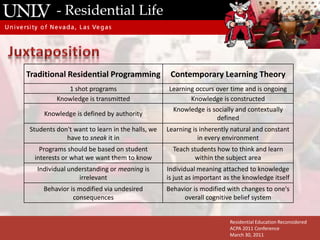
- Residential LifeJuxtapositionResidential Education ReconsideredACPA 2011 ConferenceMarch 30, 2011
- Residential LifeWhat might this mean?Expertise in student development does not equate to expertise in learning
Student Staff, perhaps even Masters level staff, may not have the understanding of learning required to design effective learning experiences
Traditional programs may be too superficial to consistently facilitate effective learning

Residential Education Reconsidered.Acpa

  • 1.
    - Residential LifeSlideContentBoxResidential Education ReconsideredACPA 2011 ConferenceMarch 30, 2011
  • 2.
    - Residential LifeResidentialEducation, ReconsideredStan DuraResidential Life CoordinatorDoctoral Student, Educational PsychologyUNLVResidential Education ReconsideredACPA 2011 ConferenceMarch 30, 2011
  • 3.
    - Residential LifeOverviewEngagingresidents in cognitive activity that better supports academic success Look at Residential Education, past and present
  • 4.
    Look at LearningTheory, past and present
  • 5.
    Introduce theReflective Engagement Model
  • 6.
  • 7.
    Wrap upResidential EducationReconsideredACPA 2011 ConferenceMarch 30, 2011
  • 8.
    - Residential LifeResidentialEducationResidential Education has evolved from: Inherent and naturalistic - Oxford, Cambridge, Harvard and Yale style “residential houses” (early 1900’s and prior)
  • 9.
    Parental in nature– rise and dominance of “in loco parentis” (mid 1900’s)
  • 10.
    Practically non-existent - diversification of residents and demise of “in loco parentis” (1970’s, and 80’s)
  • 11.
    Pervasive, complex,and often superficial – plethora of contexts and models Residential Education ReconsideredACPA 2011 ConferenceMarch 30, 2011
  • 12.
    - Residential LifeLearningTheoryLearning theory has evolved from: Elitist – (1700’s -1800’s) Only the elite were considered worthy of education, and learning consisted of logic, religion, and philosophy via rote-learning
  • 13.
    Empiricism – (1800’s– 1900’s) The modern day Research University started with German empiricists, focusing on faculty research and inductive reasoning more so than student learning
  • 14.
    Introspectionism – (late 1800’s – early 1900’s) Wundt began to focus on “what is happening in the mind”; rebirth of interest in the philosophy of Education (i.e. John Dewey)Residential Education ReconsideredACPA 2011 ConferenceMarch 30, 2011
  • 15.
    - Residential LifeLearningTheoryLearning theory has evolved from: Behaviorism – (early 1900’s – 1990’s) Learning was more or less strictly about environmental stimuli soliciting reflexive response. Little or no mental activity.
  • 16.
    Cognitive Science - (1960’s - ????) Recognized learning as a complex cognitive process involving perception, memory, emotion, and active construction
  • 17.
    Socio-Cognitive –(2000’s - ????) Builds on Cognitive Science but emphasizes the influence of environmental, social, and cultural factors on cognitionResidential Education ReconsideredACPA 2011 ConferenceMarch 30, 2011
  • 18.
    - Residential LifeWhatis going on in the mind? Student affairs has done a great job of understanding how students change over time, and we associate the long term change as learning.
  • 19.
    But weknow little of what happens inside the mind of the student as they are learning and developing.
  • 20.
    We knoweven less of howlearning and development occurs inside the mind.Residential Education ReconsideredACPA 2011 ConferenceMarch 30, 2011
  • 21.
    - Residential LifeWhatis going on in the mind?Assimilation & IntegrationSchemaAttentionAssociationismActive ConstructionEpisodic memoryMetacognitionImmediate MemoryDual CodingExpertise reversalWorking memoryDual processingTransferParallel Processing“Cold Cognition” and “Hot Cognition”Sensory RegisterVisual/Spatial sketchpadCognitive Belief SystemResidential Education ReconsideredACPA 2011 ConferenceMarch 30, 2011
  • 22.
    - Residential LifeWhatis going on in the mind?“Cold Cognition” and “Hot Cognition”Cognitive Belief SystemMotivationSelf-efficacyEmotionsProblem SolvingCritical ThinkingCreativityResidential Education ReconsideredACPA 2011 ConferenceMarch 30, 2011
  • 23.
    - Residential LifeHowdoes it all fit together?"If the brain were simple enough for us to understand it, we would be too simple to understand it."~Ken Hill We’re still trying to figure the brain/mind out, but here is a basic part of it…An Information Processing ModelResidential Education ReconsideredACPA 2011 ConferenceMarch 30, 2011
  • 24.
    - Residential LifeInformationProcessing ModelSensory information either external or internalResidential Education ReconsideredACPA 2011 ConferenceMarch 30, 2011
  • 25.
    - Residential LifeInformationProcessing ModelThe Sensory RegisterGatekeeper of information that our brain and mind attend to
  • 26.
    It evaluates incomingdata based on prior experience, immediate goals, and prioritizes
  • 27.
    Little if anyconscious awarenessSensory information either external or internalSensory RegisterResidential Education ReconsideredACPA 2011 ConferenceMarch 30, 2011
  • 28.
    - Residential LifeInformationProcessing ModelImmediate Memory Provides a mechanism to attend to information in the short term without expending much energyActive for just a few secondsSensory information either external or internalSensory RegisterImmediate MemoryResidential Education ReconsideredACPA 2011 ConferenceMarch 30, 2011
  • 29.
    - Residential LifeInformationProcessing ModelWorking Memory Provides a mechanism for extended concentration on a limited amount of information5-9 bits/chunksUp to 30 Seconds, extended with attention up to ~20 minutesSensory information either external or internalSensory RegisterImmediate MemoryWorking MemoryResidential Education ReconsideredACPA 2011 ConferenceMarch 30, 2011
  • 30.
    - Residential LifeInformationProcessing ModelLong Term Storage /Cognitive Belief SystemWhat makes sense and what we find meaningful is committed to long term storage (LTS).
  • 31.
    Information stored inLTS becomes integrated with our Cognitive Belief System, including our various identities or sense of self.Long Term Storage & Cognitive Belief SystemResidential Education ReconsideredACPA 2011 ConferenceMarch 30, 2011
  • 32.
    - Residential LifePuttingit all togetherPast Experience & goalsSense & MeaningSensory information either external or internalSensory RegisterImmediate MemoryWorking MemoryLong Term Storage & Cognitive Belief SystemInformation discarded or lostResidential Education ReconsideredACPA 2011 ConferenceMarch 30, 2011
  • 33.
    - Residential LifeWhatis going on in the mind?A LOT!!!!Meaningful learning involves a lot of mental activity and consideration of prior knowledge, mental models, active construction, and more.Traditional residential programming, though, doesn’t account for many of these factors…Residential Education ReconsideredACPA 2011 ConferenceMarch 30, 2011
  • 34.
    - Residential LifeJuxtapositionResidentialEducation ReconsideredACPA 2011 ConferenceMarch 30, 2011
  • 35.
    - Residential LifeWhatmight this mean?Expertise in student development does not equate to expertise in learning
  • 36.
    Student Staff, perhapseven Masters level staff, may not have the understanding of learning required to design effective learning experiences
  • 37.
    Traditional programs maybe too superficial to consistently facilitate effective learning

Editor's Notes

  • #6 Foundations of contemporary learning theory can be seen in much of the philosophy of learning and the mind from this eraThus, understanding how students learn was not of primary importance, unless that was the professor’s field of interest to begin with.With Wundt’s work, combined with rebirth of interest in the philosophy of education, a call to focus on the mind of the individual, however it was largely ignored for some time
  • #12 See, hear, smell, taste, touch, and THINK
  • #13 Gatekeeper of information that our brain and mind attend toIt evaluates incoming data based on prior experience and prioritizesLittle if any conscious awareness
  • #14 Provides a mechanism to attend to information in the short term without expending much energyActive for about 30 seconds
  • #15 Provides a mechanism for extended concentration on a limited amount of information5-9 bits/chunksUp to 20 minutes (with some exceptions)NOTE: Augmentation
  • #16 Long Term Storage /Cognitive Belief SystemWhat makes sense and what we find meaningful is committed to long term storage (LTS).Information stored in LTS becomes integrated with our Cognitive Belief System, including our sense of self or our Identity.
  • #18 Meaningful learning – lots of mental activityTraditiona residential programing doesn’t account for many of these
  • #21 How do our methods of educating students in our halls match with contemporary theory?What assumptions or beliefs might we need to re-assess?How can we re-think our approaches to educating our residents?
  • #22 How do our methods of educating students in our halls match with contemporary theory?What assumptions or beliefs might we need to re-assess?How can we re-think our approaches to educating our residents?
  • #23 How can we better reach every student in our programmatic efforts?How can we better engage them in meaningful and effective learning experiences?
  • #24 Metacognitive – engaging them repeatedly in “thinking about their thinking” and constructing and re-constructing meaning around individual experiences.Social – engaging them in an extended and ongoing mentoring and social relationship.
  • #25 We looked at learning outcomes for the UNLV General Education program and those developed for Student Affairs at UNLV that were based on Learning Reconsidered.We considered which of those were essential to being “self-directed.”
  • #26 Cognitive Complexity Resident will identify, reflect on and analyze a problem/source of conflict from different perspectives, question his/her role, and develop potential solutions Resident will reflect on and integrate their experiences, values, beliefs, strengths, weaknesses, and their personal perspectives and style, and articulate themselves in terms of a unique, evolving and self directed cultural being.
  • #27 Self Management and Relationship with Others Resident will identify and commit to personal goals in the areas of (a) Academic, emphasizing academic skills and career exploration and development, (b) Community Involvement and Leadership, (c) Personal Wellness, and (d) Time Management Resident will reflect on their successful and unsuccessful personal relationships with friends, faculty, and staff, and/or parents and family, and identify aspects that make those relationships meaningful, including what they themselves bring to their relationships.
  • #28 Aesthetic Sensitivity and Cultural Competence Resident will explore different perspectives on local, national, and/or global issues and reflect on their interrelatedness and explore issues of leadership, civic engagement, and/or environmental and social justice ethics, etc. related to them. Resident will reflect on and integrate the values, beliefs, strengths, weaknesses, perspectives and styles of others, and articulate an appreciation for them in terms of unique, evolving and self directed cultural beings.
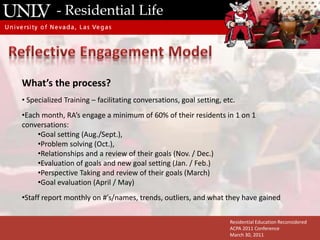
  • #29 What’s the process? Specialized Training – facilitating conversations, goal setting, etc.Each month, RA’s engage a minimum of 60% of their residents in 1 on 1 conversations:Goal setting (Aug./Sept.), Problem solving (Oct.),Relationships and a review of their goals (Nov. / Dec.)Evaluation of goals and new goal setting (Jan. / Feb.)Perspective Taking and review of their goals (March)Goal evaluation (April / May)Staff report monthly on #’s, trends, outliers, and what they have gained

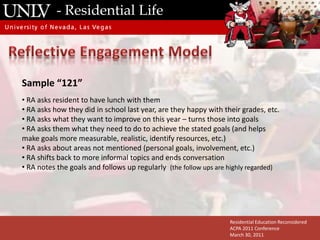
  • #30 RA asks resident to have lunch with them RA asks how they did in school last year, are they happy with their grades, etc. RA asks what they want to improve on this year – turns those into goals RA asks them what they need to do to achieve the stated goals (and helps make goals more measurable, realistic, identify resources, etc.) RA asks about areas not mentioned (personal goals, involvement, etc.) RA shifts back to more informal topics and ends conversation RA notes the goals and follows up regularly (the follow ups are highly regarded)
  • #39 Any questions?