IAEA
International Atomic Energy Agency
Safety of Laboratory Staff
and
Quality Assurance Programmes
Lecture
Module 11
IAEA
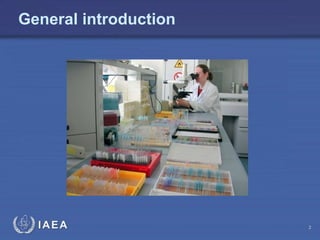
General introduction
2
IAEA
Laboratory safety
Two basic objectives:
• To ensure safety of laboratory staff
• To ensure that no hazardous materials leave
laboratory
These are both achieved by well controlled
safe working practices
3
IAEA
Background information
• WHO Laboratory Biosafety Manual 3rd
edition
• In addition, staff should conform to their
national and institutional legislation on
regulations regarding safe working generally
in laboratories
4
IAEA
Specifics
There are some particular features concerning
safety in cytogenetics laboratories that are
worth highlighting.
• Risk of blood borne infections
• Risk from use of ultra-violet light
• Risk from use of specialised chemicals
5
IAEA
Infection risk
Two broad principles:
• Containment of materials -
Universal precautions
• Staff health preventative measures -
Vaccinations
6
IAEA
Optical risk
Ultraviolet lamps may be used in:
• Sterilizing interior of class 2
microbiological safety cabinets
• Exposing slides during FPG staining
procedure
• UV fluorescence microscopes
7
IAEA
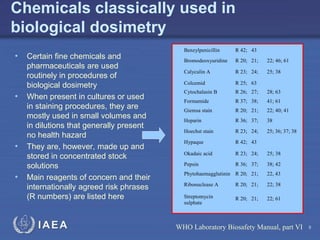
Chemicals classically used in
biological dosimetry
• Certain fine chemicals and
pharmaceuticals are used
routinely in procedures of
biological dosimetry
• When present in cultures or used
in staining procedures, they are
mostly used in small volumes and
in dilutions that generally present
no health hazard
• They are, however, made up and
stored in concentrated stock
solutions
• Main reagents of concern and their
internationally agreed risk phrases
(R numbers) are listed here
Benzylpenicillin R 42; 43
Bromodeoxyuridine R 20; 21; 22; 46; 61
Calyculin A R 23; 24; 25; 38
Colcemid R 25; 63
Cytochalasin B R 26; 27; 28; 63
Formamide R 37; 38; 41; 61
Giemsa stain R 20; 21; 22; 40; 41
Heparin R 36; 37; 38
Hoechst stain R 23; 24; 25; 36; 37; 38
Hypaque R 42; 43
Okadaic acid R 23; 24; 25; 38
Pepsin R 36; 37; 38; 42
Phytohaemagglutinin R 20; 21; 22, 43
Ribonuclease A R 20; 21; 22; 38
Streptomycin
sulphate
R 20; 21; 22; 61
1
WHO Laboratory Biosafety Manual, part VI 8
IAEA
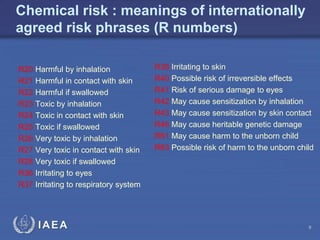
Chemical risk : meanings of internationally
agreed risk phrases (R numbers)
R20 Harmful by inhalation
R21 Harmful in contact with skin
R22 Harmful if swallowed
R23 Toxic by inhalation
R24 Toxic in contact with skin
R25 Toxic if swallowed
R26 Very toxic by inhalation
R27 Very toxic in contact with skin
R28 Very toxic if swallowed
R36 Irritating to eyes
R37 Irritating to respiratory system
R38 Irritating to skin
R40 Possible risk of irreversible effects
R41 Risk of serious damage to eyes
R42 May cause sensitization by inhalation
R43 May cause sensitization by skin contact
R46 May cause heritable genetic damage
R61 May cause harm to the unborn child
R63 Possible risk of harm to the unborn child
9
IAEA
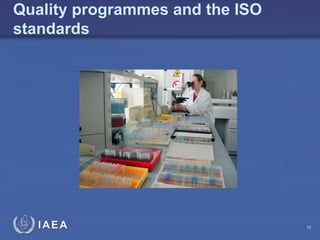
Quality programmes and the ISO
standards
10
IAEA
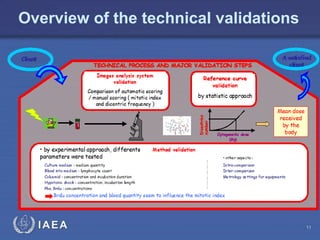
Overview of the technical validations
11
IAEA
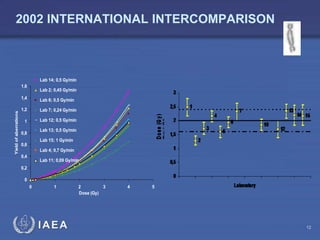
2002 INTERNATIONAL INTERCOMPARISON
0
0,2
0,4
0,6
0,8
1
1,2
1,4
1,6
0 1 2 3 4 5
Dose (Gy)
Yield
of
aberrations
Lab 14; 0,5 Gy/min
Lab 2; 0,45 Gy/min
Lab 6; 0,5 Gy/min
Lab 7; 0,24 Gy/min
Lab 12; 0,5 Gy/min
Lab 13; 0,5 Gy/min
Lab 15; 1 Gy/min
Lab 4; 0,7 Gy/min
Lab 11; 0,09 Gy/min
Polynomial (Lab 15; 1
Gy/min)
Polynomial (Lab 14; 0,5
Gy/min)
Polynomial (Lab 12; 0,5
Gy/min)
Polynomial (Lab 6; 0,5
Gy/min)
Polynomial (Lab 13; 0,5
Gy/min)
Polynomial (Lab 7; 0,24
Gy/min)
Polynomial (Lab 2; 0,45
Gy/min)
12
IAEA
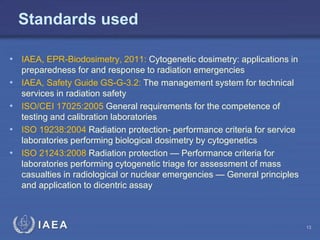
Standards used
• IAEA, EPR-Biodosimetry, 2011: Cytogenetic dosimetry: applications in
preparedness for and response to radiation emergencies
• IAEA, Safety Guide GS-G-3.2: The management system for technical
services in radiation safety
• ISO/CEI 17025:2005 General requirements for the competence of
testing and calibration laboratories
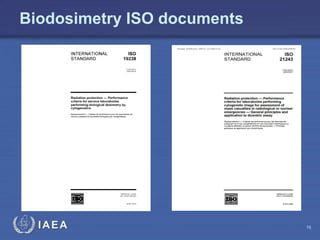
• ISO 19238:2004 Radiation protection- performance criteria for service
laboratories performing biological dosimetry by cytogenetics
• ISO 21243:2008 Radiation protection — Performance criteria for
laboratories performing cytogenetic triage for assessment of mass
casualties in radiological or nuclear emergencies — General principles
and application to dicentric assay
13
IAEA
Standard must cover these aspects
• What you are trying to achieve
• What you do
• How do you make sure it is right
• What do you do when it is not right
• And, lastly, how do you check that
system works
14
IAEA
ISO Standard general approach
• Why a quality assurance approach ?
• To satisfy the requirements of professionalism
• To point out its qualification and its competence
• To develop the competence by inquiring and informing
• Quality assurance approach can be divided into two parts:
• First, internal mechanisms such as “ internal audit” or “total quality
management”, which are processes of professional self-review and quality
awareness, respectively.
• Second, certification (accreditation) which applies to processes more under
the direct control of managers and operated by an external agency, in other
words an external standards approach.
• How ISO can help to achieve the standardization aims ?
• Large consensus from scientists to industrials
• Participation on a voluntary basis
• To develop the competence by inquiring and informing
15
IAEA
Biodosimetry ISO documents
16
IAEA
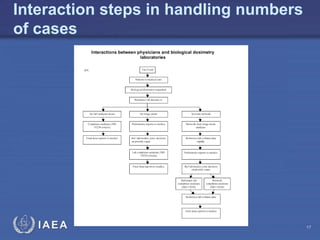
Interaction steps in handling numbers
of cases
17
IAEA
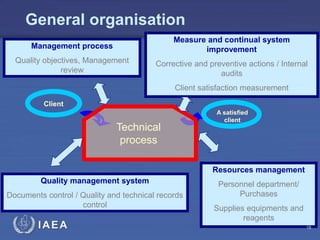
General organisation
Quality management system
Documents control / Quality and technical records
control
Resources management
Personnel department/
Purchases
Supplies equipments and
reagents
Measure and continual system
improvement
Corrective and preventive actions / Internal
audits
Client satisfaction measurement
Management process
Quality objectives, Management
review
Client
A satisfied
client
Technical
process
18
IAEA
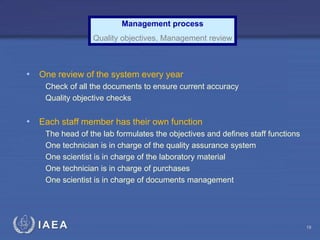
• One review of the system every year
Check of all the documents to ensure current accuracy
Quality objective checks
• Each staff member has their own function
The head of the lab formulates the objectives and defines staff functions
One technician is in charge of the quality assurance system
One scientist is in charge of the laboratory material
One technician is in charge of purchases
One scientist is in charge of documents management
Management process
Quality objectives, Management review
19
IAEA
Measure and continual system improvement
Corrective and preventive actions / Internal audits
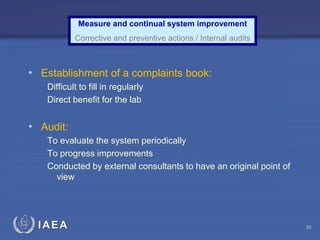
• Establishment of a complaints book:
Difficult to fill in regularly
Direct benefit for the lab
• Audit:
To evaluate the system periodically
To progress improvements
Conducted by external consultants to have an original point of
view
20
IAEA
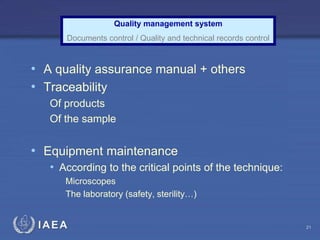
• A quality assurance manual + others
• Traceability
Of products
Of the sample
• Equipment maintenance
• According to the critical points of the technique:
Microscopes
The laboratory (safety, sterility…)
Quality management system
Documents control / Quality and technical records control
21
IAEA
Resources management
Personnel department/ Purchases Supplies
equipments and reagents
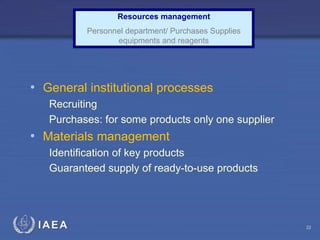
• General institutional processes
Recruiting
Purchases: for some products only one supplier
• Materials management
Identification of key products
Guaranteed supply of ready-to-use products
22
IAEA
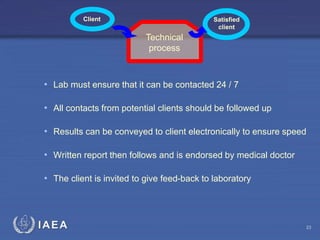
• Lab must ensure that it can be contacted 24 / 7
• All contacts from potential clients should be followed up
• Results can be conveyed to client electronically to ensure speed
• Written report then follows and is endorsed by medical doctor
• The client is invited to give feed-back to laboratory
Client Satisfied
client
Technical
process
23
IAEA
List of documents linked to case
investigation
• When medical doctor contacts the lab
• Fill in contact details form
• Send instructions sheet for blood sampling and transport
conditions
• Send questionnaire for explaining accident circumstances
(contract)
• When sample(s) arrive(s)
• Record of details of sample and its coding
• Record of culture details
• Record reagents specifications e.g., batch numbers
24
IAEA
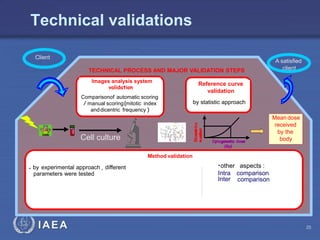
Technical validations
Reference curve
validation
by statistic approach
Cytogenetic dose
(Gy)
Dicentrics
number
Mean dose
received
by the
body
Client
A satisfied
client
Images analysis system
validation
Comparisonof automatic scoring
/ manual scoring(mitotic index
anddicentric frequency )
Method validation
•other aspects :
Intra comparison
Inter comparison
TECHNICAL PROCESS AND MAJOR VALIDATION STEPS
• by experimental approach , different
parameters were tested
Reference curve
validation
by statistic approach
Reference curve
validation
by statistic approach
Cytogenetic dose
(Gy)
Dicentrics
number
Mean dose
received
by the
body
Cell culture
25
IAEA
Approach through audits
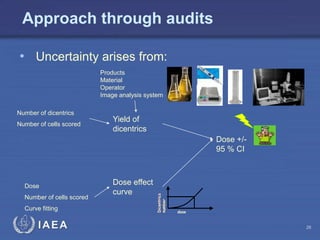
• Uncertainty arises from:
Dose effect
curve
Yield of
dicentrics
Dose
Number of cells scored
Curve fitting
Number of dicentrics
Number of cells scored
Products
Material
Operator
Image analysis system
Dose +/-
95 % CI
dose
Dicentrics
number
dose
Dicentrics
number
26
IAEA
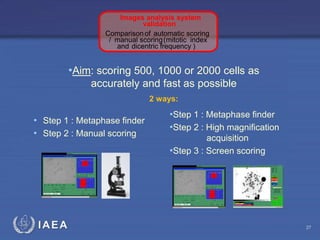
• Step 1 : Metaphase finder
• Step 2 : Manual scoring
•Step 1 : Metaphase finder
•Step 2 : High magnification
acquisition
•Step 3 : Screen scoring
•Aim: scoring 500, 1000 or 2000 cells as
accurately and fast as possible
2 ways:
Images analysis system
validation
Comparisonof automatic scoring
/ manual scoring(mitotic index
and dicentric frequency )
27
IAEA
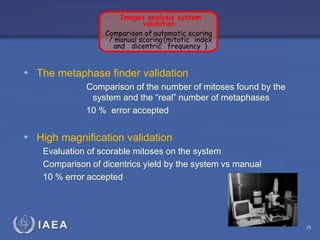
• The metaphase finder validation
Comparison of the number of mitoses found by the
system and the “real” number of metaphases
10 % error accepted
• High magnification validation
Evaluation of scorable mitoses on the system
Comparison of dicentrics yield by the system vs manual
10 % error accepted
Images analysis system
validation
Comparison of automatic scoring
/ manual scoring(mitotic index
and dicentric frequency )
28
IAEA
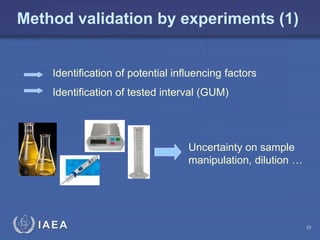
Identification of potential influencing factors
Identification of tested interval (GUM)
Uncertainty on sample
manipulation, dilution …
Method validation by experiments (1)
29
IAEA
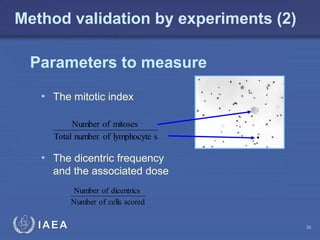
Parameters to measure
s
lymphocyte
of
number
Total
mitoses
of
Number
scored
cells
of
Number
dicentrics
of
Number
• The mitotic index
• The dicentric frequency
and the associated dose
Method validation by experiments (2)
30
IAEA
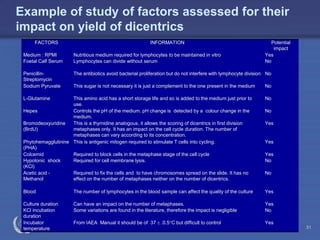
Example of study of factors assessed for their
impact on yield of dicentrics
FACTORS INFORMATION Potential
impact
Medium : RPMI Nutritious medium required for lymphocytes to be maintained in vitro Yes
Foetal Calf Serum Lymphocytes can divide without serum No
Penicillin-
Streptomycin
The antibiotics avoid bacterial proliferation but do not interfere with lymphocyte division No
Sodium Pyruvate This sugar is not necessary it is just a complement to the one present in the medium No
L-Glutamine This amino acid has a short storage life and so is added to the medium just prior to
use.
No
Hepes Controls the pH of the medium. pH change is detected by a colour change in the
medium.
No
Bromodeoxyuridine
(BrdU)
This is a thymidine analogous, it allows the scoring of dicentrics in first division
metaphases only. It has an impact on the cell cycle duration. The number of
metaphases can vary according to its concentration.
Yes
Phytohemagglutinine
(PHA)
This is antigenic mitogen required to stimulate T cells into cycling. Yes
Colcemid Required to block cells in the metaphase stage of the cell cycle Yes
Hypotonic shock
(KCl)
Required for cell membrane lysis. No
Acetic acid -
Methanol
Required to fix the cells and to have chromosomes spread on the slide. It has no
effect on the number of metaphases neither on the number of dicentrics.
No
Blood The number of lymphocytes in the blood sample can affect the quality of the culture Yes
Culture duration Can have an impact on the number of metaphases. Yes
KCl incubation
duration
Some variations are found in the literature, therefore the impact is negligible No
Incubator
temperature
From IAEA Manual it should be of 37  .0.5°C but difficult to control Yes
31
IAEA
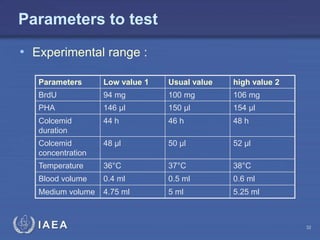
Parameters Low value 1 Usual value high value 2
BrdU 94 mg 100 mg 106 mg
PHA 146 µl 150 µl 154 µl
Colcemid
duration
44 h 46 h 48 h
Colcemid
concentration
48 µl 50 µl 52 µl
Temperature 36°C 37°C 38°C
Blood volume 0.4 ml 0.5 ml 0.6 ml
Medium volume 4.75 ml 5 ml 5.25 ml
Parameters to test
• Experimental range :
32
IAEA
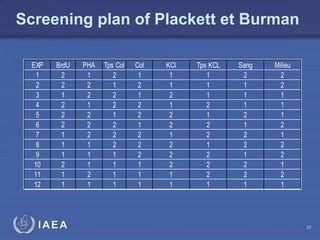
EXP BrdU PHA Tps Col Col KCl Tps KCL Sang Milieu
1 2 1 2 1 1 1 2 2
2 2 2 1 2 1 1 1 2
3 1 2 2 1 2 1 1 1
4 2 1 2 2 1 2 1 1
5 2 2 1 2 2 1 2 1
6 2 2 2 1 2 2 1 2
7 1 2 2 2 1 2 2 1
8 1 1 2 2 2 1 2 2
9 1 1 1 2 2 2 1 2
10 2 1 1 1 2 2 2 1
11 1 2 1 1 1 2 2 2
12 1 1 1 1 1 1 1 1
Screening plan of Plackett et Burman
33
IAEA
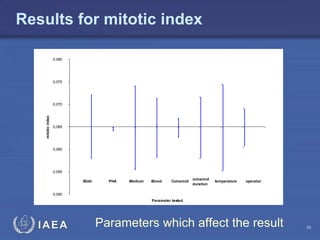
Results for mitotic index
Parameters which affect the result
0,050
0,055
0,060
0,065
0,070
0,075
0,080
Parameter tested
mitotic
index
BUdr PHA Medium Blood Colcemid
colcemid
duration
temperature operator
34
IAEA
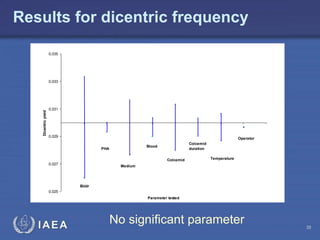
Results for dicentric frequency
No significant parameter
0,025
0,027
0,029
0,031
0,033
0,035
Parameter tested
Dicentric
yield
BUdr
PHA
Medium
Blood
Colcemid
Colcemid
duration
Temperature
Operator
35
IAEA
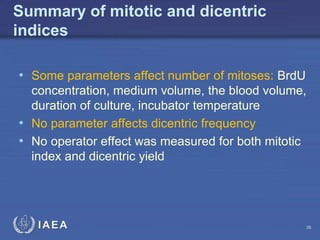
Summary of mitotic and dicentric
indices
• Some parameters affect number of mitoses: BrdU
concentration, medium volume, the blood volume,
duration of culture, incubator temperature
• No parameter affects dicentric frequency
• No operator effect was measured for both mitotic
index and dicentric yield
36
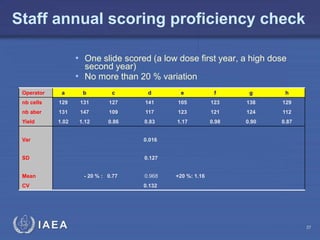
IAEA
• One slide scored (a low dose first year, a high dose
second year)
• No more than 20 % variation
Operator a b c d e f g h
nb cells 129 131 127 141 105 123 138 129
nb aber 131 147 109 117 123 121 124 112
Yield 1.02 1.12 0.86 0.83 1.17 0.98 0.90 0.87
Var 0.016
SD 0.127
Mean - 20 % : 0.77 0.968 +20 %: 1.16
CV 0.132
Staff annual scoring proficiency check
37
IAEA
Final thought: convince staff to follow
QA&QC programme
The main difficulties :
• to convince people of importance of such project
• to change their way of working
• all staff members have to be involved in project
• the method validation is time consuming
• generation of many documents
To have efficient system it is important to build it as light as possible
The benefits are improvement in :
• technical process quality
• raising standing of service in eyes of requestors and any legal outcomes
Whole process is constantly evaluated and changes are made for
improved efficiency
38

Safety and Quality Assurance .ppt

  • 1.
    IAEA International Atomic EnergyAgency Safety of Laboratory Staff and Quality Assurance Programmes Lecture Module 11
  • 2.
  • 3.
    IAEA Laboratory safety Two basicobjectives: • To ensure safety of laboratory staff • To ensure that no hazardous materials leave laboratory These are both achieved by well controlled safe working practices 3
  • 4.
    IAEA Background information • WHOLaboratory Biosafety Manual 3rd edition • In addition, staff should conform to their national and institutional legislation on regulations regarding safe working generally in laboratories 4
  • 5.
    IAEA Specifics There are someparticular features concerning safety in cytogenetics laboratories that are worth highlighting. • Risk of blood borne infections • Risk from use of ultra-violet light • Risk from use of specialised chemicals 5
  • 6.
    IAEA Infection risk Two broadprinciples: • Containment of materials - Universal precautions • Staff health preventative measures - Vaccinations 6
  • 7.
    IAEA Optical risk Ultraviolet lampsmay be used in: • Sterilizing interior of class 2 microbiological safety cabinets • Exposing slides during FPG staining procedure • UV fluorescence microscopes 7
  • 8.
    IAEA Chemicals classically usedin biological dosimetry • Certain fine chemicals and pharmaceuticals are used routinely in procedures of biological dosimetry • When present in cultures or used in staining procedures, they are mostly used in small volumes and in dilutions that generally present no health hazard • They are, however, made up and stored in concentrated stock solutions • Main reagents of concern and their internationally agreed risk phrases (R numbers) are listed here Benzylpenicillin R 42; 43 Bromodeoxyuridine R 20; 21; 22; 46; 61 Calyculin A R 23; 24; 25; 38 Colcemid R 25; 63 Cytochalasin B R 26; 27; 28; 63 Formamide R 37; 38; 41; 61 Giemsa stain R 20; 21; 22; 40; 41 Heparin R 36; 37; 38 Hoechst stain R 23; 24; 25; 36; 37; 38 Hypaque R 42; 43 Okadaic acid R 23; 24; 25; 38 Pepsin R 36; 37; 38; 42 Phytohaemagglutinin R 20; 21; 22, 43 Ribonuclease A R 20; 21; 22; 38 Streptomycin sulphate R 20; 21; 22; 61 1 WHO Laboratory Biosafety Manual, part VI 8
  • 9.
    IAEA Chemical risk :meanings of internationally agreed risk phrases (R numbers) R20 Harmful by inhalation R21 Harmful in contact with skin R22 Harmful if swallowed R23 Toxic by inhalation R24 Toxic in contact with skin R25 Toxic if swallowed R26 Very toxic by inhalation R27 Very toxic in contact with skin R28 Very toxic if swallowed R36 Irritating to eyes R37 Irritating to respiratory system R38 Irritating to skin R40 Possible risk of irreversible effects R41 Risk of serious damage to eyes R42 May cause sensitization by inhalation R43 May cause sensitization by skin contact R46 May cause heritable genetic damage R61 May cause harm to the unborn child R63 Possible risk of harm to the unborn child 9
  • 10.
    IAEA Quality programmes andthe ISO standards 10
  • 11.
    IAEA Overview of thetechnical validations 11
  • 12.
    IAEA 2002 INTERNATIONAL INTERCOMPARISON 0 0,2 0,4 0,6 0,8 1 1,2 1,4 1,6 01 2 3 4 5 Dose (Gy) Yield of aberrations Lab 14; 0,5 Gy/min Lab 2; 0,45 Gy/min Lab 6; 0,5 Gy/min Lab 7; 0,24 Gy/min Lab 12; 0,5 Gy/min Lab 13; 0,5 Gy/min Lab 15; 1 Gy/min Lab 4; 0,7 Gy/min Lab 11; 0,09 Gy/min Polynomial (Lab 15; 1 Gy/min) Polynomial (Lab 14; 0,5 Gy/min) Polynomial (Lab 12; 0,5 Gy/min) Polynomial (Lab 6; 0,5 Gy/min) Polynomial (Lab 13; 0,5 Gy/min) Polynomial (Lab 7; 0,24 Gy/min) Polynomial (Lab 2; 0,45 Gy/min) 12
  • 13.
    IAEA Standards used • IAEA,EPR-Biodosimetry, 2011: Cytogenetic dosimetry: applications in preparedness for and response to radiation emergencies • IAEA, Safety Guide GS-G-3.2: The management system for technical services in radiation safety • ISO/CEI 17025:2005 General requirements for the competence of testing and calibration laboratories • ISO 19238:2004 Radiation protection- performance criteria for service laboratories performing biological dosimetry by cytogenetics • ISO 21243:2008 Radiation protection — Performance criteria for laboratories performing cytogenetic triage for assessment of mass casualties in radiological or nuclear emergencies — General principles and application to dicentric assay 13
  • 14.
    IAEA Standard must coverthese aspects • What you are trying to achieve • What you do • How do you make sure it is right • What do you do when it is not right • And, lastly, how do you check that system works 14
  • 15.
    IAEA ISO Standard generalapproach • Why a quality assurance approach ? • To satisfy the requirements of professionalism • To point out its qualification and its competence • To develop the competence by inquiring and informing • Quality assurance approach can be divided into two parts: • First, internal mechanisms such as “ internal audit” or “total quality management”, which are processes of professional self-review and quality awareness, respectively. • Second, certification (accreditation) which applies to processes more under the direct control of managers and operated by an external agency, in other words an external standards approach. • How ISO can help to achieve the standardization aims ? • Large consensus from scientists to industrials • Participation on a voluntary basis • To develop the competence by inquiring and informing 15
  • 16.
  • 17.
    IAEA Interaction steps inhandling numbers of cases 17
  • 18.
    IAEA General organisation Quality managementsystem Documents control / Quality and technical records control Resources management Personnel department/ Purchases Supplies equipments and reagents Measure and continual system improvement Corrective and preventive actions / Internal audits Client satisfaction measurement Management process Quality objectives, Management review Client A satisfied client Technical process 18
  • 19.
    IAEA • One reviewof the system every year Check of all the documents to ensure current accuracy Quality objective checks • Each staff member has their own function The head of the lab formulates the objectives and defines staff functions One technician is in charge of the quality assurance system One scientist is in charge of the laboratory material One technician is in charge of purchases One scientist is in charge of documents management Management process Quality objectives, Management review 19
  • 20.
    IAEA Measure and continualsystem improvement Corrective and preventive actions / Internal audits • Establishment of a complaints book: Difficult to fill in regularly Direct benefit for the lab • Audit: To evaluate the system periodically To progress improvements Conducted by external consultants to have an original point of view 20
  • 21.
    IAEA • A qualityassurance manual + others • Traceability Of products Of the sample • Equipment maintenance • According to the critical points of the technique: Microscopes The laboratory (safety, sterility…) Quality management system Documents control / Quality and technical records control 21
  • 22.
    IAEA Resources management Personnel department/Purchases Supplies equipments and reagents • General institutional processes Recruiting Purchases: for some products only one supplier • Materials management Identification of key products Guaranteed supply of ready-to-use products 22
  • 23.
    IAEA • Lab mustensure that it can be contacted 24 / 7 • All contacts from potential clients should be followed up • Results can be conveyed to client electronically to ensure speed • Written report then follows and is endorsed by medical doctor • The client is invited to give feed-back to laboratory Client Satisfied client Technical process 23
  • 24.
    IAEA List of documentslinked to case investigation • When medical doctor contacts the lab • Fill in contact details form • Send instructions sheet for blood sampling and transport conditions • Send questionnaire for explaining accident circumstances (contract) • When sample(s) arrive(s) • Record of details of sample and its coding • Record of culture details • Record reagents specifications e.g., batch numbers 24
  • 25.
    IAEA Technical validations Reference curve validation bystatistic approach Cytogenetic dose (Gy) Dicentrics number Mean dose received by the body Client A satisfied client Images analysis system validation Comparisonof automatic scoring / manual scoring(mitotic index anddicentric frequency ) Method validation •other aspects : Intra comparison Inter comparison TECHNICAL PROCESS AND MAJOR VALIDATION STEPS • by experimental approach , different parameters were tested Reference curve validation by statistic approach Reference curve validation by statistic approach Cytogenetic dose (Gy) Dicentrics number Mean dose received by the body Cell culture 25
  • 26.
    IAEA Approach through audits •Uncertainty arises from: Dose effect curve Yield of dicentrics Dose Number of cells scored Curve fitting Number of dicentrics Number of cells scored Products Material Operator Image analysis system Dose +/- 95 % CI dose Dicentrics number dose Dicentrics number 26
  • 27.
    IAEA • Step 1: Metaphase finder • Step 2 : Manual scoring •Step 1 : Metaphase finder •Step 2 : High magnification acquisition •Step 3 : Screen scoring •Aim: scoring 500, 1000 or 2000 cells as accurately and fast as possible 2 ways: Images analysis system validation Comparisonof automatic scoring / manual scoring(mitotic index and dicentric frequency ) 27
  • 28.
    IAEA • The metaphasefinder validation Comparison of the number of mitoses found by the system and the “real” number of metaphases 10 % error accepted • High magnification validation Evaluation of scorable mitoses on the system Comparison of dicentrics yield by the system vs manual 10 % error accepted Images analysis system validation Comparison of automatic scoring / manual scoring(mitotic index and dicentric frequency ) 28
  • 29.
    IAEA Identification of potentialinfluencing factors Identification of tested interval (GUM) Uncertainty on sample manipulation, dilution … Method validation by experiments (1) 29
  • 30.
    IAEA Parameters to measure s lymphocyte of number Total mitoses of Number scored cells of Number dicentrics of Number •The mitotic index • The dicentric frequency and the associated dose Method validation by experiments (2) 30
  • 31.
    IAEA Example of studyof factors assessed for their impact on yield of dicentrics FACTORS INFORMATION Potential impact Medium : RPMI Nutritious medium required for lymphocytes to be maintained in vitro Yes Foetal Calf Serum Lymphocytes can divide without serum No Penicillin- Streptomycin The antibiotics avoid bacterial proliferation but do not interfere with lymphocyte division No Sodium Pyruvate This sugar is not necessary it is just a complement to the one present in the medium No L-Glutamine This amino acid has a short storage life and so is added to the medium just prior to use. No Hepes Controls the pH of the medium. pH change is detected by a colour change in the medium. No Bromodeoxyuridine (BrdU) This is a thymidine analogous, it allows the scoring of dicentrics in first division metaphases only. It has an impact on the cell cycle duration. The number of metaphases can vary according to its concentration. Yes Phytohemagglutinine (PHA) This is antigenic mitogen required to stimulate T cells into cycling. Yes Colcemid Required to block cells in the metaphase stage of the cell cycle Yes Hypotonic shock (KCl) Required for cell membrane lysis. No Acetic acid - Methanol Required to fix the cells and to have chromosomes spread on the slide. It has no effect on the number of metaphases neither on the number of dicentrics. No Blood The number of lymphocytes in the blood sample can affect the quality of the culture Yes Culture duration Can have an impact on the number of metaphases. Yes KCl incubation duration Some variations are found in the literature, therefore the impact is negligible No Incubator temperature From IAEA Manual it should be of 37  .0.5°C but difficult to control Yes 31
  • 32.
    IAEA Parameters Low value1 Usual value high value 2 BrdU 94 mg 100 mg 106 mg PHA 146 µl 150 µl 154 µl Colcemid duration 44 h 46 h 48 h Colcemid concentration 48 µl 50 µl 52 µl Temperature 36°C 37°C 38°C Blood volume 0.4 ml 0.5 ml 0.6 ml Medium volume 4.75 ml 5 ml 5.25 ml Parameters to test • Experimental range : 32
  • 33.
    IAEA EXP BrdU PHATps Col Col KCl Tps KCL Sang Milieu 1 2 1 2 1 1 1 2 2 2 2 2 1 2 1 1 1 2 3 1 2 2 1 2 1 1 1 4 2 1 2 2 1 2 1 1 5 2 2 1 2 2 1 2 1 6 2 2 2 1 2 2 1 2 7 1 2 2 2 1 2 2 1 8 1 1 2 2 2 1 2 2 9 1 1 1 2 2 2 1 2 10 2 1 1 1 2 2 2 1 11 1 2 1 1 1 2 2 2 12 1 1 1 1 1 1 1 1 Screening plan of Plackett et Burman 33
  • 34.
    IAEA Results for mitoticindex Parameters which affect the result 0,050 0,055 0,060 0,065 0,070 0,075 0,080 Parameter tested mitotic index BUdr PHA Medium Blood Colcemid colcemid duration temperature operator 34
  • 35.
    IAEA Results for dicentricfrequency No significant parameter 0,025 0,027 0,029 0,031 0,033 0,035 Parameter tested Dicentric yield BUdr PHA Medium Blood Colcemid Colcemid duration Temperature Operator 35
  • 36.
    IAEA Summary of mitoticand dicentric indices • Some parameters affect number of mitoses: BrdU concentration, medium volume, the blood volume, duration of culture, incubator temperature • No parameter affects dicentric frequency • No operator effect was measured for both mitotic index and dicentric yield 36
  • 37.
    IAEA • One slidescored (a low dose first year, a high dose second year) • No more than 20 % variation Operator a b c d e f g h nb cells 129 131 127 141 105 123 138 129 nb aber 131 147 109 117 123 121 124 112 Yield 1.02 1.12 0.86 0.83 1.17 0.98 0.90 0.87 Var 0.016 SD 0.127 Mean - 20 % : 0.77 0.968 +20 %: 1.16 CV 0.132 Staff annual scoring proficiency check 37
  • 38.
    IAEA Final thought: convincestaff to follow QA&QC programme The main difficulties : • to convince people of importance of such project • to change their way of working • all staff members have to be involved in project • the method validation is time consuming • generation of many documents To have efficient system it is important to build it as light as possible The benefits are improvement in : • technical process quality • raising standing of service in eyes of requestors and any legal outcomes Whole process is constantly evaluated and changes are made for improved efficiency 38

Editor's Notes

  • #2 Lecture: Safety of laboratory staff and quality assirance programmes Purpose: To introduce two subjects: a) The safety of laboratory staff working in biological dosimetry laboratories b) Quality assurance and control in biological dosimetry Learning objectives: Upon completion of this lecture the participants will: Appreciate the specific hazards associated with the procedures in a biological dosimetry laboratory arising from: working with human blood, using ultra violet light sources and using certain chemical reagents specific to the cytogenetic assays. Be aware of the required QA/QC documentation, particularly the relevant ISO Standards. Understand the requirements for auditing the working and output of the laboratory. Understand participation in inter laboratory control exercises. Duration: 1 hour
  • #3 The scoring of radiation-induced chromosomal aberrations, mainly dicentrics, is the "gold standard” of biodosimetry. Biological dosimetry is incorporated into radiation protection programmes of many countries to confirm or discount a suspected radiation exposure. Radiation accidents are fortunately few so that the number of laboratories performing biological dosimetry is low worldwide: generally one or two per country, sometimes none. With such scarce national capability an individual biological dosimetry service performance requires a firm basis. However there are no universally adopted procedures and some variations may occur in methods which can influence the quality of results. Therefore, it is reasonable to request that each service laboratory develops a quality assurance programme proving that biological dosimetry is assessed by accepted and standardized procedures. The lecture summarizes this requirement, not only from the safety aspects, but also from the quality point of view. It presents some experimental findings about the consequences of variations in some biological factors on the dose estimation results.
  • #5 The WHO Manual is applicable to all biomedical laboratories and indeed all industrial, research and teaching laboratories that handle biological materials. The generic information contained is highly applicable to biodosimetry cytogenetics laboratories. It needs to be supplemented with an awareness of national and institutional requirements for safe working practice in laboratories.
  • #7 Universal precautions should always be applied and adopted when handling human blood. All specimens should be regarded as being potentially infectious. even if they are known to be derived from healthy persons. Specimens should be unpacked and manipulated in appropriately maintained and tested biological safety cabinets. For handling blood, Class II cabinets are adequate. Setting up cultures in such a cabinet has the added benefit of minimizing culture failure due to microbial contamination. The use of sharps, e.g. hypodermic needles, should be limited to reduce risk of needle-stick injuries. Contaminated sharps should always be collected in puncture-proof containers fitted with covers and treated as infectious waste. Suitable disinfectants should be available to deal with spills and to decontaminate work surfaces and equipment after specimens are processed. All biological waste and used disposable plastic ware should be sterilized, for example by autoclaving, before disposal. Staff should be offered vaccination against hepatitis B. Currently, there is unfortunately no vaccine for human immunodeficiency virus (HIV). The legal and ethical position regarding HIV testing of blood samples upon receipt differs between countries, and researchers should ascertain their national requirements. It should be noted that when blood samples are accepted from abroad, depending on the country of origin, airlines may require the sender to provide a certificate confirming that the samples have tested HIV negative.
  • #8 For the safety cabinets and the FPG staining shielding and working procedures should be in place to avoid direct irradiation of the skin or eyes of laboratory staff. Periodic testing for leakage of ultra violet light should be undertaken. Fluorescence microscopes are engineered to be inherently safe during normal use and hazards are potentially present only during disassembly such as for periodic maintennance of the microscopes.
  • #9 In addition to these specific reagents one should of course also be aware of the safety requirements and hazards from a wider range of more general laboratory chemicals that are also present in the laboratory: acids; alcohol; various salt solutions.......... Information on these is often obtained from manufacturers‘ data sheets and will also be covered in general laboratory safety text books. The WHO Laboratory Biosafety Manual, part IV, contains a comprehensive list of chemicals detailing their hazards and precautions to be used.
  • #10 Examples of the internationally agreed risk phrases (R numbers) are listed in this slide.
  • #12 At the methodological level, the critical aspects are: -The collection of the blood sample and its transport to the service laboratory. -The procedures for culturing lymphocytes, preparing microscope slides and their scoring. -The procedure to ensure scoring chromosome aberrations in first in vitro metaphases. -The dose estimation and the reporting of results. -The establishment of at least one appropriate dose-effect reference curve. -The interpretation of the data according to the known circumstances of the overexposure. At the statutory level, the key points can differ according to country. Nevertheless, it is possible to stress some common elements: -The qualification of the service laboratory to undertake biological dosimetry. -The relations between the service laboratory and the requestor, who may be the doctor in charge of the patient or the patient himself. -The request form and the content of the dose estimation report issued by the laboratory . -The care taken by the service laboratory to verify the quality of its report: not only the reproducibility of the assay but also the accreditation of the entire procedure; methods, calibration curve.  From descriptions of the daily routine of some laboratories, together with examination of their scientific publications it is apparent that practices for biological dosimetry do vary considerably. This leads to: Potential problems at the procedural level -Even though biological dosimetry is based on classical cytogenetics techniques, laboratories do not use precisely the same protocol when processing blood samples. -Additionally there are slight differences in the methods used for microscope scoring and in the number of metaphases examined. Differences also arise in the formats and contents of results reports, especially if exposure was relatively complex. -Just occasionally laboratories base their dose estimations from doses-effects curves of other laboratories published in the scientific literature rather than establishing their own calibrations. This is not advisable given the inter-laboratory differences. Potential problems at the statutory level -There is no reference value for biological dosimetry, as there are, for example in methods to measure internal radionuclide contamination or blood glucose level. However the considerable work that went into the IAEA Manual has gone a considerable way towards improving homogeneity in methods. -There is no clearly defined internal or external quality assurance programme by which a service laboratory may formally support the validity of its dose estimations.  
  • #13 It is essential that the dose estimation uses the same blood processing procedures that were used in setting up the laboratory‘s reference dose response curve. An illustration of the interlaboratory differences is given by this international intercomparison which used blood irradiated at the Silene experimental reactor (Valduc, France) in 2002. During this intercomparison, blood samples were irradiatied by fission neutron and, either blood tubes or fixed cells suspension were shared between the 19 participatiing laboratories of 16 countries. These labs have used their own pre-existing calibration curves and it can be seen (from the left figure) that there is some significant discrepancy between the most extreme curves by a factor 4. Nevertheless the estimated doses showed a much closer level of agreement (the right figure) where only one lab result fell just outside the confidence interval of the reference dose measured by physical dosimetry. These results illustrated the importance of a laboratory to use the same methodology for its reference and its dose estimations.
  • #14 The IAEA first published its Manual (TRS 260) in 1986 and this was replaced by revised editions in 2001 (TRS 405) and in 2011. They give scientific and technical information about the dicentric assay, covering its advantages, field of application and demerits, statistical analysis, useful pragmatic advice for particular accident circumstances and laboratory protocols. These are written in the form of guidelines and constitute the most comprehensive reference documents in this discipline. Whilst the 2011 edition addresses quality assurance and quality control programmes, it does not go into highly prescriptive detail of the practical aspects related to accreditation of the service laboratory and evaluation of performance. There is a specific IAEA Safety Guide (GS-G-3.2) which addresses the area of management system for technical services in radiation safety. The objective of this Safety Guide is to provide guidance on meeting the requirements for development and implementation of management systems for technical service providers in radiation safety. It focuses on technical service providers in radiation safety, which deliver either consultancy and maintenance services or calibration and testing services. The ISO seemed a more appropriate organisation for promoting the definition of a set of common rules. It has followed the general criteria by which standards are developed within the ISO, namely drafting, with professional peer review, by a specialist-working group followed by wider review via the national representatives of ISO. The final approved document is the result of an agreement between the member bodies of ISO. It may be used as such, or may be implemented by incorporation into national standards.
  • #15 To ensure the quality of a biological dosimetry laboratory's output over extended periods of time, its production process must be solidly based on scientific principles, method validation, and product verification. A complete quality programme provides the strategy for safeguarding the quality of the laboratory's product, whether it is a measurement or a service. Furthermore, these requirements need periodic comparison of the laboratory's measurement capabilities with those of other certified or suitably qualified cytogenetic biodosimetry laboratories, continued stability of the laboratory process, and periodic evaluation of the final product to confirm that it meets pre-defined specifications.
  • #17 The ISO 19238 standard (left), published in 2004, provides criteria for quality assurance and quality control, evaluation of performance and the accreditation of biological dosimetry by cytogenetics service laboratories. The primary purpose is to provide a guideline to all laboratories in order to perform the dicentric assay using documented and validated procedures. Secondly, it can facilitate the comparison of results obtained in different laboratories particularly for international collaborations or intercomparison. Finally, laboratories newly commissioned to carry out the dicentric assay should conform to this standard in order to perform it reproducibly and accurately. The standard is written in the form of procedures to be adopted for biological dosimetry for overexposures involving at most a few casualties. The criteria required for such measurements usually depend upon the application of the results, radiation protection management, medical management when appropriate, record keeping and legal requirements. In the special situation of a mass radiation casualty and limited resources the technique can be applied for emergency triage analysis. This is covered by the standard 21243 (right) which is written to be read in conjunction with the earlier standard. It concentrates on the of procedures to be adopted for operating the dicentric assay in a triage mode to deal with a mass radiological casualties event.

  • #18 This chart summarises communications that can be activated depending on the scale of an event. The reference laboratory may decide that the number of cases is small enough to carry out itself all the full analyses according to ISO 19238. Alternatively the reference lab may decide to operate firstly in triage mode (ISO 21243) and later, in conjunction with the physicians, decide upon a priorities list for completing full analyses. The third option is to activate a network.
  • #19 Organisation of the quality system set up in a biological dosimetry laboratory to satisfy both ISO 17025 and ISO 19238 standards. The quality management should be developed to meet two standards. The (ISO/CEI 17025 :2005 General Requirements for the Competence of Testing and Calibration Laboratories ) is a general document relevant to many kinds of calibration laboratories whereas ISO 19238 is highly specific to the technicalities of the dicentric assay. .    
  • #26 To ensure the quality of the technical process several actions are undertaken including written protocols, performance intercomparisons, checking personnel qualification but also measuring the uncertainties on the technical process. The different parameters for which uncertainties have to be measured are presented in this figure. The process includes the following items: lymphocyte culture and arrest spreading onto slides scoring, either manually or using an image analysis system converting yield of dicentrics to dose using dose effect calibration curves.  
  • #27 The figure summarises the important parameters which affect the yield of dicentrics. The statistical factors that contribute to uncertainty, dependent on the numbers of cells scored for constructing the calibration curves and for the case investigation, have been covered elsewhere in this training course. Uncertainties on the number of dicentrics and cells scored are calculated according to Poisson statistics. Image analysis systems are checked to define the limits of their influence on uncertainty. Operators are checked regularly to avoid deviation in their proficiency in dicentrics identification. Finally, the integrity of the products used for the lymphocyte cultures is regularly audited.
  • #28 The automation in cytogenetics is a long story. However the introduction of dicentric hunting software is comparatively recent, made possible by simultaneous improvement of computer speed and algorithm efficiency. Therefore the introduction of an image analysis system into the routine of laboratory raises the problem of the quality of the dose assessment by such method. The procedure consists of an automatic metaphase search, followed by high-magnification image acquisition. Then, either the metaphases are scored for dicentrics by eye on the screen or the system analyzes automatically the chromosome profiles and proposes a list of candidate dicentrics, which the observer verifies. The result is the number of dicentrics per chromosome and not per cell. To compare these results with conventional reference curves, expressed as dicentrics per cell and based on manual scoring, the chromosomes can be placed in groups of 46 to obtain an equivalent rate of dicentrics per cell. Experiments have shown that the slope of a dose-effect curve produced from automated dicentric scoring is less steep than the equivalent curve constructed with eye scoring. This means that with dicentric hunting fewer dicentrics are observed for a given dose than when the scoring is performed manually. Some dicentrics are not recognised by the automatic scoring system because of their morphology and it needs to be established whether this is a random process or a source of bias.
  • #29 The validation of the image analysis sytem is related to the number of false positives and false negatives by comparison with manual scoring on the same slide. There are two steps: the first is the metaphase finding, the second is for the selection of observable metaphases at high magnification by the system. The two steps are based on a classifier, which is established according to the specific methodology of the laboratory.
  • #30 All the steps in sample processing are analysed to identify the factors that might have an impact on dicentrics yields. The suspected ones are included in a Placket-Burmann experimental design conducted to estimate the impact of those factors. Once the parameters to test are chosen, it is necessary to determine the range of values to test.
  • #31 Mitotic index calculation The mitotic index is calculated as the ratio of mitoses to the number of lymphocytes. Non-mitotic nuclei from lymphocytes are distinguished as far as possible from those of other types of white cell. The technique is fully explained in the IAEA Manual. Dicentric scoring Only complete first division cells containing 46 centromeres are scored. Among those cells, both dicentrics and centric rings accompanied by their fragment are recorded. Statistics analyses For both the mitotic index and the dicentric yield the same approach are used. First, based on several replicate experiments done with the standard by-eye protocol the operator effect through an ANOVA test and the repeatability of the technique through a Bartlett test are tested.
  • #32 In a recent investigation this is the list of factors that were judged to vary in the culture process due to uncertainties such as accuracy of dilutions, pipetting etc and were considered as potentially influencing either the mitotic index, the final dicentric frequency or both.
  • #33 First, from standard cell culture procedures, a review of the literature was conducted to identify the potential factors that may impact the yield of dicentrics. The suspected ones were included in the Placket-Burmann experimental design conducted to estimate their impact. In a second step, the laboratory’s working habits were analysed to identify the values ranges to be tested. For most of the reagents, pipettes were used to produce stock solutions and then further to working solutions. In some cases, a commercial phial can also be used. All the uncertainties of the dilution devices were combined to obtain the values given in this table and a further uncertainty was calculated by assuming a weighing-out factor of 2. The operator effect was also tested to determine if there is a systematic trend from one operator to another. The final result is a value for the usual method and extremity values, high and low, based on the combined error contributors.
  • #34 The Placket and Burmann screening plan was used to tests the effect of products concentration variations. It offers a good compromise between the number of experiment repetitions and the statistic power. In addition it can be easily set up and analysed. Twelve cultures were set up combining the different extremity values, 1&2, as shown in this table. In addition six tubes were cultured according to normal values. The resultant microscope slides were assessed for the mitotic index and the dicentrics were scored in 500 metaphases.
  • #35 Result of the mitotic index measurements for the different parameters tested. The horizontal line represents the mean of all the data. Vertical lines represent the difference between the mitotic index obtained with value 1 and value 2. From the statistical analysis of the results presented, five parameters have an impact on the mitotic index: the BrdU concentration, the medium volume, the blood volume, the duration of the culture, the incubator temperature. Therefore to have a good cell culture quality those parameters need to be closely controlled. An optimal mitotic index was obtained with the higher concentration of BrdU (106 mg), less volume of medium (4.75 ml), less blood (0.4 ml), the longer culture time (50 h) and the higher temperature (38 °C). Therefore when a high mitotic index is required those parameters should be adapted.
  • #36 The horizontal line represents the mean of all the data. Vertical lines represent the difference between the yield of dicentrics measured for value 1 and value 2. The second step was to measure the impact of those parameters on the yield of dicentrics. The statistical analysis of the results did not identify any parameter with a significant effect. This shows that the technique is quite robust regarding these parameters’ variations in the experimental protocol. A next step could be to perform the same experimental plan but with higher level of variations to identify the acceptable limits on protocol variations.
  • #38 An example of the result from a periodic staff scoring proficiency intercomparison.
  • #39 Setting up and maintaining a QA / QC programme requires considerable resources in staff time and budget. Nevertheless current medico-legal practice demands that quality programmes are in place. Laboratories that have set up programmes have frequently reported initial staff scepticism but all consider that the effort has been worthwhile and staff acknowledge that their work has benefited.