PRINCIPLES OF ANTIBIOTIC
THERAPY
Dr jigar mehta
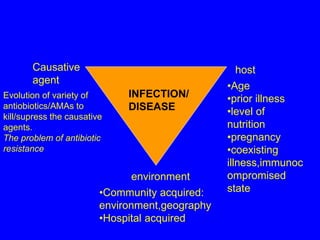
Causative
agent
host
environment
INFECTION/
DISEASE
•Age
•prior illness
•level of
nutrition
•pregnancy
•coexisting
illness,immunoc
ompromised
state
•Community acquired:
environment,geography
•Hospital acquired
Evolution of variety of
antiobiotics/AMAs to
kill/supress the causative
agents.
The problem of antibiotic
resistance
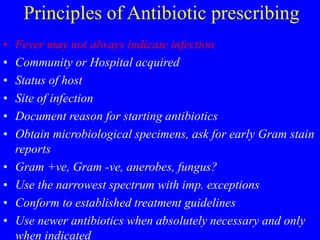
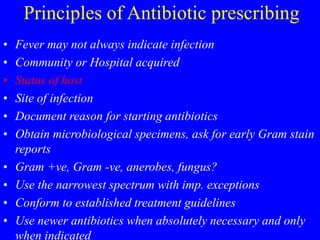
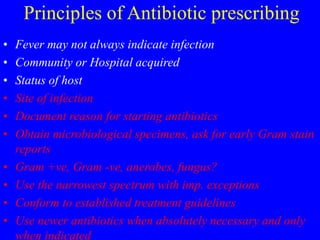
Principles of Antibiotic prescribing
• Fever may not always indicate infection
• Community or Hospital acquired
• Status of host
• Site of infection
• Document reason for starting antibiotics
• Obtain microbiological specimens, ask for early Gram stain
reports
• Gram +ve, Gram -ve, anerobes, fungus?
• Use the narrowest spectrum with imp. exceptions
• Conform to established treatment guidelines
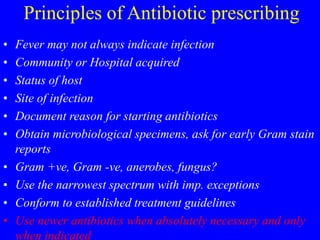
• Use newer antibiotics when absolutely necessary and only
when indicated
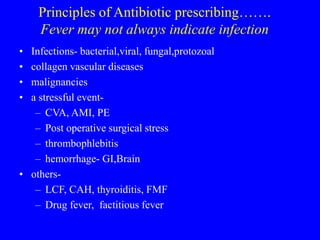
Principles of Antibiotic prescribing…….
Fever may not always indicate infection
• Infections- bacterial,viral, fungal,protozoal
• collagen vascular diseases
• malignancies
• a stressful event-
– CVA, AMI, PE
– Post operative surgical stress
– thrombophlebitis
– hemorrhage- GI,Brain
• others-
– LCF, CAH, thyroiditis, FMF
– Drug fever, factitious fever
Principles of Antibiotic prescribing
• Fever may not always indicate infection
• Community or Hospital acquired
• Status of host
• Site of infection
• Document reason for starting antibiotics
• Obtain microbiological specimens, ask for early Gram stain
reports
• Gram +ve, Gram -ve, anerobes, fungus?
• Use the narrowest spectrum with imp. exceptions
• Conform to established treatment guidelines
• Use newer antibiotics when absolutely necessary and only
when indicated
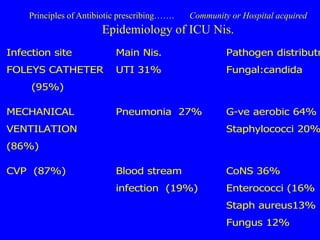
Principles of Antibiotic prescribing……. Community or Hospital acquired
Epidemiology of ICU Nis.
Infection site
FOLEYS CATHETER
(95%)
Main Nis.
UTI 31%
Pathogen distributn
Fungal:candida
MECHANICAL
VENTILATION
(86%)
Pneumonia 27% G-ve aerobic 64%
Staphylococci 20%
CVP (87%) Blood stream
infection (19%)
CoNS 36%
Enterococci (16%
Staph aureus13%
Fungus 12%
Principles of Antibiotic prescribing
• Fever may not always indicate infection
• Community or Hospital acquired
• Status of host
• Site of infection
• Document reason for starting antibiotics
• Obtain microbiological specimens, ask for early Gram stain
reports
• Gram +ve, Gram -ve, anerobes, fungus?
• Use the narrowest spectrum with imp. exceptions
• Conform to established treatment guidelines
• Use newer antibiotics when absolutely necessary and only
when indicated
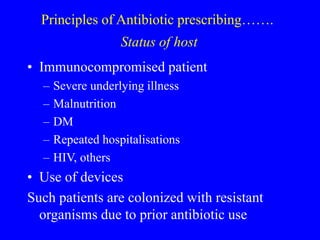
Principles of Antibiotic prescribing…….
Status of host
• Immunocompromised patient
– Severe underlying illness
– Malnutrition
– DM
– Repeated hospitalisations
– HIV, others
• Use of devices
Such patients are colonized with resistant
organisms due to prior antibiotic use
Principles of Antibiotic prescribing
• Fever may not always indicate infection
• Community or Hospital acquired
• Status of host
• Site of infection
• Document reason for starting antibiotics
• Obtain microbiological specimens, ask for early Gram stain
reports
• Gram +ve, Gram -ve, anerobes, fungus?
• Use the narrowest spectrum with imp. exceptions
• Conform to established treatment guidelines
• Use newer antibiotics when absolutely necessary and only
when indicated
• Use newer antibiotics when absolutely necessary
and only when indicated
WHY?
BECAUSE OF THE GROWING PROBLEM OF
ANTIBIOTIC RESISTANCE
Principles of Antibiotic
prescribing
“we know everything about antibiotics except
how much to give” Maxwell Finland
(The 500 mg 6hrly era)
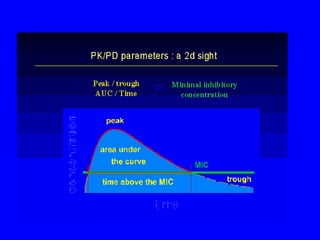
Bacterial Killing is a function of drug
concentration and time of exposure
Concentration independent Killing
Concentration dependant Killing
Optimal Dose
Time dependant killing
• B lactams
• Clindamycin
Dose more frequently rather than increasing single
dose (or continuous infusion)
Ceftriaxone 1 gm as good as higher dose for most
community acquired respiratory, uti, abdominal
infections
Optimal Duration
• Most antibiotics are being given for far
too long
• Stop antimicrobial treatment:
• -When infection is cured.
(if patient is afebrile & well for 48hrs)
• -When cultures are negative and infection is
unlikely.
OPTIMAL SELECTION
Presumed Site of infection
(e.g. respiratory tract, urinary tract, a
subdiaphragmatic collection, or whatever)
address any surgically remediable
pathology right away
Community Acquired v/s hospital
acquired
Community acquired usually sensitive (even
if severe)
Hospital acquired likely to be caused by
resistant bugs (even if mild)
e.g. pneumonia, abdominal infections, skin & soft
tissue infections
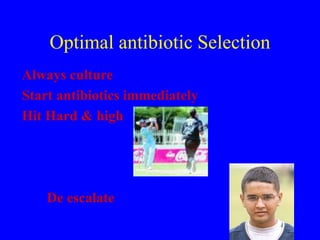
Optimal antibiotic Selection
Always culture
Start antibiotics immediately
Hit Hard & high
De escalate
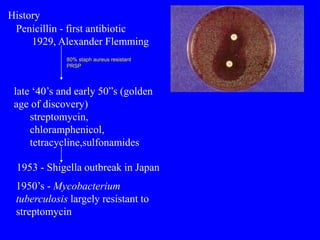
History
Penicillin - first antibiotic
1929, Alexander Flemming
late ‘40’s and early 50”s (golden
age of discovery)
streptomycin,
chloramphenicol,
tetracycline,sulfonamides
80% staph aureus resistant
PRSP
1953 - Shigella outbreak in Japan
1950’s - Mycobacterium
tuberculosis largely resistant to
streptomycin
IT IS A GLOBAL
PROBLEM
THE BUGS HAVE BEEN THERE EVER SINCE AND
THEY ARE GETTING CLEVERER BY THE MINUTE
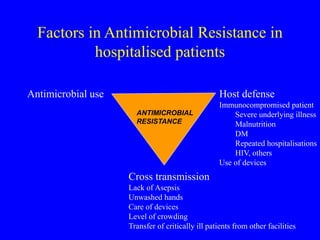
Factors in Antimicrobial Resistance in
hospitalised patients
Cross transmission
Lack of Asepsis
Unwashed hands
Care of devices
Level of crowding
Transfer of critically ill patients from other facilities
Host defense
Immunocompromised patient
Severe underlying illness
Malnutrition
DM
Repeated hospitalisations
HIV, others
Use of devices
Antimicrobial use
ANTIMICROBIAL
RESISTANCE
Antimicrobial Use
• Direct, consistent correlation between antibiotic
use and resistance patterns
• development of resistance is correlated with level
of antibiotic use
– overuse has increased the incidence of and selection
for resistance-conferring mutations
– McGowan et al Rev. Inf. Dis 1983
– Ballow C.H., Schentag J.J. - National Nosocomial Resistance
Surveillance Group 1992
– Fridkin S.K. et al Antimicrobial Resistance in ICU’s, Clinics in
Chest Medicine 1999
Evolution of Antimicrobial Resistance
in Gram-Positive Cocci
S. aureus
Penicillin
[1940s] Penicillin-resistant
S. aureus
Methicillin
[1960s] Methicillin-resistant
S. aureus (MRSA)
Vancomycin-resistant
enterococcus (VRE)
Vancomycin
[1997]
Vancomycin
(glycopeptide)
intermediate-resistant
S. aureus
Vancomycin-
resistant
S. aureus
Ciprofloxacin
1987
[2002]
Adapted from: CDC. Prevent Antimicrobial Resistance: A Campaign for Clinicians. April 2002.
What should we do?
Prevent overuse /misuse
Optimize use of antimicrobial
agents
Prevent cross-transmission
Examples of overuse/misuse
“DOES MY PATIENT NEED AN
ANTIBIOTIC?”
• prophylactic use after elective surgery
• empiric use (no known etiologic agent)
• increased use of broad spectrum agents
• antibiotics in animal feeds
• pediatric use for viral infections
• patients who do not complete course
(TB,AIDS)
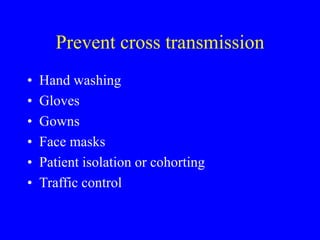
Prevent cross transmission
• Hand washing
• Gloves
• Gowns
• Face masks
• Patient isolation or cohorting
• Traffic control
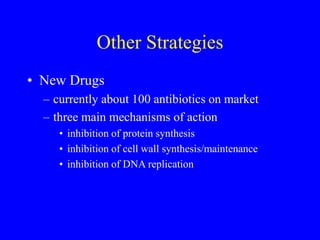
Other Strategies
• New Drugs
– currently about 100 antibiotics on market
– three main mechanisms of action
• inhibition of protein synthesis
• inhibition of cell wall synthesis/maintenance
• inhibition of DNA replication
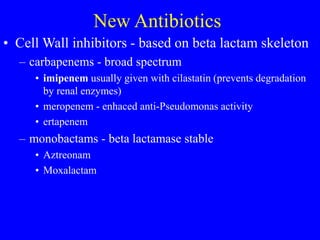
New Antibiotics
• Cell Wall inhibitors - based on beta lactam skeleton
– carbapenems - broad spectrum
• imipenem usually given with cilastatin (prevents degradation
by renal enzymes)
• meropenem - enhaced anti-Pseudomonas activity
• ertapenem
– monobactams - beta lactamase stable
• Aztreonam
• Moxalactam
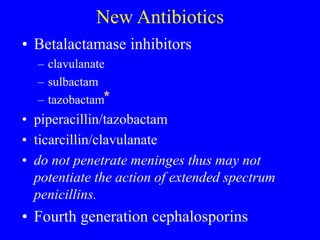
New Antibiotics
• Betalactamase inhibitors
– clavulanate
– sulbactam
– tazobactam
• piperacillin/tazobactam
• ticarcillin/clavulanate
• do not penetrate meninges thus may not
potentiate the action of extended spectrum
penicillins.
• Fourth generation cephalosporins
New Antibiotics
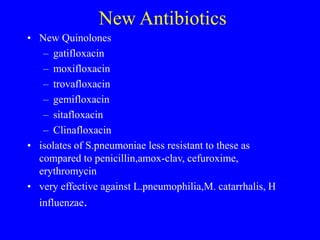
• New Quinolones
– gatifloxacin
– moxifloxacin
– trovafloxacin
– gemifloxacin
– sitafloxacin
– Clinafloxacin
• isolates of S.pneumoniae less resistant to these as
compared to penicillin,amox-clav, cefuroxime,
erythromycin
• very effective against L.pneumophilia,M. catarrhalis, H
influenzae.
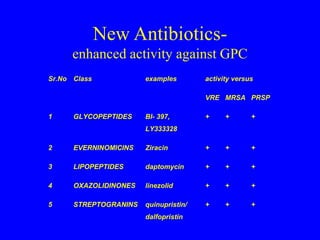
New Antibiotics-
enhanced activity against GPC
Sr.No Class examples activity versus
VRE MRSA PRSP
1 GLYCOPEPTIDES BI- 397,
LY333328
+ + +
2 EVERNINOMICINS Ziracin + + +
3 LIPOPEPTIDES daptomycin + + +
4 OXAZOLIDINONES linezolid + + +
5 STREPTOGRANINS quinupristin/
dalfopristin
+ + +
6
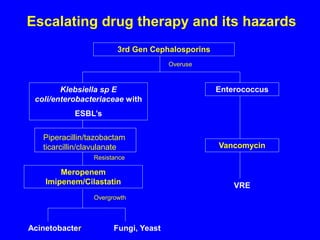
3rd Gen Cephalosporins
Enterococcus
Klebsiella sp E
coli/enterobacteriaceae with
ESBL’s
Vancomycin
Meropenem
Imipenem/Cilastatin
Acinetobacter Fungi, Yeast
VRE
Overuse
Resistance
Overgrowth
Escalating drug therapy and its hazards
Piperacillin/tazobactam
ticarcillin/clavulanate
Principles of Antibiotic prescribing
• Fever may not always indicate infection
• Community or Hospital acquired
• Status of host
• Site of infection
• Document reason for starting antibiotics
• Obtain microbiological specimens, ask for early Gram stain
reports
• Gram +ve, Gram -ve, anerobes, fungus?
• Use the narrowest spectrum with imp. exceptions
• Conform to established treatment guidelines
• Use newer antibiotics when absolutely necessary and only
when indicated
Skin, soft tissue infections
• Amoxycillin/clavulanate +
cefoxitin/cloxacillin or
• Clinda or Metro + amoxy/amoxycillin-
clavulanate + Genta
• * Penicillin treatment alone carries 30 -
50% mortality
Bone infections
• Oxacillin, nafcillin, cephalosporin like
cefpirome or glycopeptide like vanco` or
teicoplanin to cover Staph aureus well
• If Gram -ve org are suspected - 3rd gen
cephalosporin or aminoglycoside or
fluoroquinolone is added
• For P. aeruginosa :Aminglycoside like
Tobramycin + ticarcillin-clavulanate
/ceftazidime /fluoroquinolone
• Duration of therapy - 6 weeks
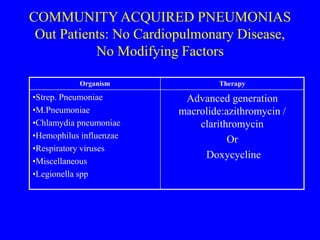
COMMUNITY ACQUIRED PNEUMONIAS
Out Patients: No Cardiopulmonary Disease,
No Modifying Factors
Advanced generation
macrolide:azithromycin /
clarithromycin
Or
Doxycycline
•Strep. Pneumoniae
•M.Pneumoniae
•Chlamydia pneumoniae
•Hemophilus influenzae
•Respiratory viruses
•Miscellaneous
•Legionella spp
Therapy
Organism
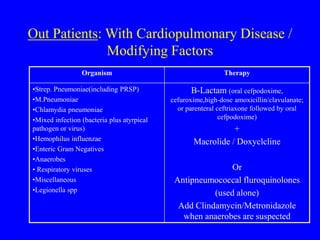
Out Patients: With Cardiopulmonary Disease /
Modifying Factors
Β-Lactam (oral cefpodoxime,
cefuroxime,high-dose amoxicillin/clavulanate;
or parenteral ceftriaxone followed by oral
cefpodoxime)
+
Macrolide / Doxyclcline
Or
Antipneumococcal fluroquinolones
(used alone)
Add Clindamycin/Metronidazole
when anaerobes are suspected
•Strep. Pneumoniae(including PRSP)
•M.Pneumoniae
•Chlamydia pneumoniae
•Mixed infection (bacteria plus atyrpical
pathogen or virus)
•Hemophilus influenzae
•Enteric Gram Negatives
•Anaerobes
• Respiratory viruses
•Miscellaneous
•Legionella spp
Therapy
Organism
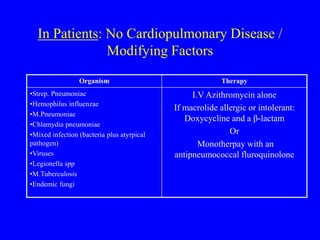
In Patients: No Cardiopulmonary Disease /
Modifying Factors
I.V Azithromycin alone
If macrolide allergic or intolerant:
Doxycycline and a β-lactam
Or
Monotherpay with an
antipneumococcal fluroquinolone
•Strep. Pneumoniae
•Hemophilus influenzae
•M.Pneumoniae
•Chlamydia pneumoniae
•Mixed infection (bacteria plus atyrpical
pathogen)
•Viruses
•Legionella spp
•M.Tuberculosis
•Endemic fungi
Therapy
Organism
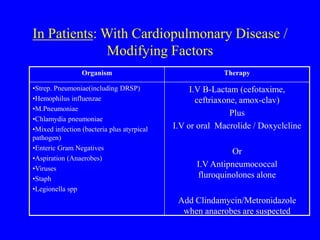
In Patients: With Cardiopulmonary Disease /
Modifying Factors
I.V Β-Lactam (cefotaxime,
ceftriaxone, amox-clav)
Plus
I.V or oral Macrolide / Doxyclcline
Or
I.V Antipneumococcal
fluroquinolones alone
Add Clindamycin/Metronidazole
when anaerobes are suspected
•Strep. Pneumoniae(including DRSP)
•Hemophilus influenzae
•M.Pneumoniae
•Chlamydia pneumoniae
•Mixed infection (bacteria plus atyrpical
pathogen)
•Enteric Gram Negatives
•Aspiration (Anaerobes)
•Viruses
•Staph
•Legionella spp
Therapy
Organism
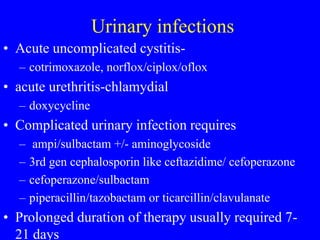
Urinary infections
• Acute uncomplicated cystitis-
– cotrimoxazole, norflox/ciplox/oflox
• acute urethritis-chlamydial
– doxycycline
• Complicated urinary infection requires
– ampi/sulbactam +/- aminoglycoside
– 3rd gen cephalosporin like ceftazidime/ cefoperazone
– cefoperazone/sulbactam
– piperacillin/tazobactam or ticarcillin/clavulanate
• Prolonged duration of therapy usually required 7-
21 days
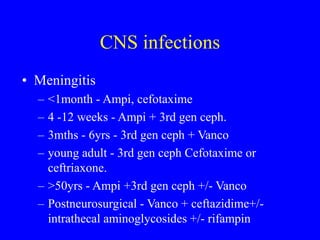
CNS infections
• Meningitis
– <1month - Ampi, cefotaxime
– 4 -12 weeks - Ampi + 3rd gen ceph.
– 3mths - 6yrs - 3rd gen ceph + Vanco
– young adult - 3rd gen ceph Cefotaxime or
ceftriaxone.
– >50yrs - Ampi +3rd gen ceph +/- Vanco
– Postneurosurgical - Vanco + ceftazidime+/-
intrathecal aminoglycosides +/- rifampin
Sepsis of unkown origin
• Broad spectrum cover
• HIT HARD HIT FAST especially severe
sepsis with septicemic shock
• Is host immunocompromised?
• What prior antibiotics has he received?
• Where was he admitted?-does he have a
nosocomial infection
• How ill is the patient?
Immunocompromised/Septic host
• III/IV gen cephalosporin + Vanco/linezolid +Metro
+Antifungal or any other broad spectrum combn
• Specific situation may require specific workup and
specific drugs
Conclusion
• Fever may not always indicate infection
• The interaction between host, agent and environment must
be understood and targeted in controlling disease
• Resistance to antimicrobials is currently and will continue to
be a problem
• Have an antibiotic policy
– To provide the most effective treatment for the individual
patient
– To advise on rational prescribing
– To limit the use of prophylactic antibiotics
– To delay the emergence of resistance
– To minimise adverse events
– To maintain a cost effective strategy
antibiotic principles.ppt

antibiotic principles.ppt

  • 1.
  • 2.
    Causative agent host environment INFECTION/ DISEASE •Age •prior illness •level of nutrition •pregnancy •coexisting illness,immunoc ompromised state •Communityacquired: environment,geography •Hospital acquired Evolution of variety of antiobiotics/AMAs to kill/supress the causative agents. The problem of antibiotic resistance
  • 3.
    Principles of Antibioticprescribing • Fever may not always indicate infection • Community or Hospital acquired • Status of host • Site of infection • Document reason for starting antibiotics • Obtain microbiological specimens, ask for early Gram stain reports • Gram +ve, Gram -ve, anerobes, fungus? • Use the narrowest spectrum with imp. exceptions • Conform to established treatment guidelines • Use newer antibiotics when absolutely necessary and only when indicated
  • 4.
    Principles of Antibioticprescribing……. Fever may not always indicate infection • Infections- bacterial,viral, fungal,protozoal • collagen vascular diseases • malignancies • a stressful event- – CVA, AMI, PE – Post operative surgical stress – thrombophlebitis – hemorrhage- GI,Brain • others- – LCF, CAH, thyroiditis, FMF – Drug fever, factitious fever
  • 5.
    Principles of Antibioticprescribing • Fever may not always indicate infection • Community or Hospital acquired • Status of host • Site of infection • Document reason for starting antibiotics • Obtain microbiological specimens, ask for early Gram stain reports • Gram +ve, Gram -ve, anerobes, fungus? • Use the narrowest spectrum with imp. exceptions • Conform to established treatment guidelines • Use newer antibiotics when absolutely necessary and only when indicated
  • 6.
    Principles of Antibioticprescribing……. Community or Hospital acquired Epidemiology of ICU Nis. Infection site FOLEYS CATHETER (95%) Main Nis. UTI 31% Pathogen distributn Fungal:candida MECHANICAL VENTILATION (86%) Pneumonia 27% G-ve aerobic 64% Staphylococci 20% CVP (87%) Blood stream infection (19%) CoNS 36% Enterococci (16% Staph aureus13% Fungus 12%
  • 7.
    Principles of Antibioticprescribing • Fever may not always indicate infection • Community or Hospital acquired • Status of host • Site of infection • Document reason for starting antibiotics • Obtain microbiological specimens, ask for early Gram stain reports • Gram +ve, Gram -ve, anerobes, fungus? • Use the narrowest spectrum with imp. exceptions • Conform to established treatment guidelines • Use newer antibiotics when absolutely necessary and only when indicated
  • 8.
    Principles of Antibioticprescribing……. Status of host • Immunocompromised patient – Severe underlying illness – Malnutrition – DM – Repeated hospitalisations – HIV, others • Use of devices Such patients are colonized with resistant organisms due to prior antibiotic use
  • 9.
    Principles of Antibioticprescribing • Fever may not always indicate infection • Community or Hospital acquired • Status of host • Site of infection • Document reason for starting antibiotics • Obtain microbiological specimens, ask for early Gram stain reports • Gram +ve, Gram -ve, anerobes, fungus? • Use the narrowest spectrum with imp. exceptions • Conform to established treatment guidelines • Use newer antibiotics when absolutely necessary and only when indicated
  • 10.
    • Use newerantibiotics when absolutely necessary and only when indicated WHY? BECAUSE OF THE GROWING PROBLEM OF ANTIBIOTIC RESISTANCE Principles of Antibiotic prescribing
  • 11.
    “we know everythingabout antibiotics except how much to give” Maxwell Finland (The 500 mg 6hrly era) Bacterial Killing is a function of drug concentration and time of exposure Concentration independent Killing Concentration dependant Killing Optimal Dose
  • 13.
    Time dependant killing •B lactams • Clindamycin Dose more frequently rather than increasing single dose (or continuous infusion) Ceftriaxone 1 gm as good as higher dose for most community acquired respiratory, uti, abdominal infections
  • 14.
    Optimal Duration • Mostantibiotics are being given for far too long • Stop antimicrobial treatment: • -When infection is cured. (if patient is afebrile & well for 48hrs) • -When cultures are negative and infection is unlikely.
  • 15.
    OPTIMAL SELECTION Presumed Siteof infection (e.g. respiratory tract, urinary tract, a subdiaphragmatic collection, or whatever) address any surgically remediable pathology right away
  • 16.
    Community Acquired v/shospital acquired Community acquired usually sensitive (even if severe) Hospital acquired likely to be caused by resistant bugs (even if mild) e.g. pneumonia, abdominal infections, skin & soft tissue infections
  • 17.
    Optimal antibiotic Selection Alwaysculture Start antibiotics immediately Hit Hard & high De escalate
  • 18.
    History Penicillin - firstantibiotic 1929, Alexander Flemming late ‘40’s and early 50”s (golden age of discovery) streptomycin, chloramphenicol, tetracycline,sulfonamides 80% staph aureus resistant PRSP 1953 - Shigella outbreak in Japan 1950’s - Mycobacterium tuberculosis largely resistant to streptomycin
  • 19.
    IT IS AGLOBAL PROBLEM THE BUGS HAVE BEEN THERE EVER SINCE AND THEY ARE GETTING CLEVERER BY THE MINUTE
  • 20.
    Factors in AntimicrobialResistance in hospitalised patients Cross transmission Lack of Asepsis Unwashed hands Care of devices Level of crowding Transfer of critically ill patients from other facilities Host defense Immunocompromised patient Severe underlying illness Malnutrition DM Repeated hospitalisations HIV, others Use of devices Antimicrobial use ANTIMICROBIAL RESISTANCE
  • 21.
    Antimicrobial Use • Direct,consistent correlation between antibiotic use and resistance patterns • development of resistance is correlated with level of antibiotic use – overuse has increased the incidence of and selection for resistance-conferring mutations – McGowan et al Rev. Inf. Dis 1983 – Ballow C.H., Schentag J.J. - National Nosocomial Resistance Surveillance Group 1992 – Fridkin S.K. et al Antimicrobial Resistance in ICU’s, Clinics in Chest Medicine 1999
  • 22.
    Evolution of AntimicrobialResistance in Gram-Positive Cocci S. aureus Penicillin [1940s] Penicillin-resistant S. aureus Methicillin [1960s] Methicillin-resistant S. aureus (MRSA) Vancomycin-resistant enterococcus (VRE) Vancomycin [1997] Vancomycin (glycopeptide) intermediate-resistant S. aureus Vancomycin- resistant S. aureus Ciprofloxacin 1987 [2002] Adapted from: CDC. Prevent Antimicrobial Resistance: A Campaign for Clinicians. April 2002.
  • 23.
    What should wedo? Prevent overuse /misuse Optimize use of antimicrobial agents Prevent cross-transmission
  • 24.
    Examples of overuse/misuse “DOESMY PATIENT NEED AN ANTIBIOTIC?” • prophylactic use after elective surgery • empiric use (no known etiologic agent) • increased use of broad spectrum agents • antibiotics in animal feeds • pediatric use for viral infections • patients who do not complete course (TB,AIDS)
  • 25.
    Prevent cross transmission •Hand washing • Gloves • Gowns • Face masks • Patient isolation or cohorting • Traffic control
  • 26.
    Other Strategies • NewDrugs – currently about 100 antibiotics on market – three main mechanisms of action • inhibition of protein synthesis • inhibition of cell wall synthesis/maintenance • inhibition of DNA replication
  • 27.
    New Antibiotics • CellWall inhibitors - based on beta lactam skeleton – carbapenems - broad spectrum • imipenem usually given with cilastatin (prevents degradation by renal enzymes) • meropenem - enhaced anti-Pseudomonas activity • ertapenem – monobactams - beta lactamase stable • Aztreonam • Moxalactam
  • 28.
    New Antibiotics • Betalactamaseinhibitors – clavulanate – sulbactam – tazobactam • piperacillin/tazobactam • ticarcillin/clavulanate • do not penetrate meninges thus may not potentiate the action of extended spectrum penicillins. • Fourth generation cephalosporins
  • 29.
    New Antibiotics • NewQuinolones – gatifloxacin – moxifloxacin – trovafloxacin – gemifloxacin – sitafloxacin – Clinafloxacin • isolates of S.pneumoniae less resistant to these as compared to penicillin,amox-clav, cefuroxime, erythromycin • very effective against L.pneumophilia,M. catarrhalis, H influenzae.
  • 30.
    New Antibiotics- enhanced activityagainst GPC Sr.No Class examples activity versus VRE MRSA PRSP 1 GLYCOPEPTIDES BI- 397, LY333328 + + + 2 EVERNINOMICINS Ziracin + + + 3 LIPOPEPTIDES daptomycin + + + 4 OXAZOLIDINONES linezolid + + + 5 STREPTOGRANINS quinupristin/ dalfopristin + + + 6
  • 31.
    3rd Gen Cephalosporins Enterococcus Klebsiellasp E coli/enterobacteriaceae with ESBL’s Vancomycin Meropenem Imipenem/Cilastatin Acinetobacter Fungi, Yeast VRE Overuse Resistance Overgrowth Escalating drug therapy and its hazards Piperacillin/tazobactam ticarcillin/clavulanate
  • 32.
    Principles of Antibioticprescribing • Fever may not always indicate infection • Community or Hospital acquired • Status of host • Site of infection • Document reason for starting antibiotics • Obtain microbiological specimens, ask for early Gram stain reports • Gram +ve, Gram -ve, anerobes, fungus? • Use the narrowest spectrum with imp. exceptions • Conform to established treatment guidelines • Use newer antibiotics when absolutely necessary and only when indicated
  • 33.
    Skin, soft tissueinfections • Amoxycillin/clavulanate + cefoxitin/cloxacillin or • Clinda or Metro + amoxy/amoxycillin- clavulanate + Genta • * Penicillin treatment alone carries 30 - 50% mortality
  • 34.
    Bone infections • Oxacillin,nafcillin, cephalosporin like cefpirome or glycopeptide like vanco` or teicoplanin to cover Staph aureus well • If Gram -ve org are suspected - 3rd gen cephalosporin or aminoglycoside or fluoroquinolone is added • For P. aeruginosa :Aminglycoside like Tobramycin + ticarcillin-clavulanate /ceftazidime /fluoroquinolone • Duration of therapy - 6 weeks
  • 35.
    COMMUNITY ACQUIRED PNEUMONIAS OutPatients: No Cardiopulmonary Disease, No Modifying Factors Advanced generation macrolide:azithromycin / clarithromycin Or Doxycycline •Strep. Pneumoniae •M.Pneumoniae •Chlamydia pneumoniae •Hemophilus influenzae •Respiratory viruses •Miscellaneous •Legionella spp Therapy Organism
  • 36.
    Out Patients: WithCardiopulmonary Disease / Modifying Factors Β-Lactam (oral cefpodoxime, cefuroxime,high-dose amoxicillin/clavulanate; or parenteral ceftriaxone followed by oral cefpodoxime) + Macrolide / Doxyclcline Or Antipneumococcal fluroquinolones (used alone) Add Clindamycin/Metronidazole when anaerobes are suspected •Strep. Pneumoniae(including PRSP) •M.Pneumoniae •Chlamydia pneumoniae •Mixed infection (bacteria plus atyrpical pathogen or virus) •Hemophilus influenzae •Enteric Gram Negatives •Anaerobes • Respiratory viruses •Miscellaneous •Legionella spp Therapy Organism
  • 37.
    In Patients: NoCardiopulmonary Disease / Modifying Factors I.V Azithromycin alone If macrolide allergic or intolerant: Doxycycline and a β-lactam Or Monotherpay with an antipneumococcal fluroquinolone •Strep. Pneumoniae •Hemophilus influenzae •M.Pneumoniae •Chlamydia pneumoniae •Mixed infection (bacteria plus atyrpical pathogen) •Viruses •Legionella spp •M.Tuberculosis •Endemic fungi Therapy Organism
  • 38.
    In Patients: WithCardiopulmonary Disease / Modifying Factors I.V Β-Lactam (cefotaxime, ceftriaxone, amox-clav) Plus I.V or oral Macrolide / Doxyclcline Or I.V Antipneumococcal fluroquinolones alone Add Clindamycin/Metronidazole when anaerobes are suspected •Strep. Pneumoniae(including DRSP) •Hemophilus influenzae •M.Pneumoniae •Chlamydia pneumoniae •Mixed infection (bacteria plus atyrpical pathogen) •Enteric Gram Negatives •Aspiration (Anaerobes) •Viruses •Staph •Legionella spp Therapy Organism
  • 39.
    Urinary infections • Acuteuncomplicated cystitis- – cotrimoxazole, norflox/ciplox/oflox • acute urethritis-chlamydial – doxycycline • Complicated urinary infection requires – ampi/sulbactam +/- aminoglycoside – 3rd gen cephalosporin like ceftazidime/ cefoperazone – cefoperazone/sulbactam – piperacillin/tazobactam or ticarcillin/clavulanate • Prolonged duration of therapy usually required 7- 21 days
  • 40.
    CNS infections • Meningitis –<1month - Ampi, cefotaxime – 4 -12 weeks - Ampi + 3rd gen ceph. – 3mths - 6yrs - 3rd gen ceph + Vanco – young adult - 3rd gen ceph Cefotaxime or ceftriaxone. – >50yrs - Ampi +3rd gen ceph +/- Vanco – Postneurosurgical - Vanco + ceftazidime+/- intrathecal aminoglycosides +/- rifampin
  • 41.
    Sepsis of unkownorigin • Broad spectrum cover • HIT HARD HIT FAST especially severe sepsis with septicemic shock • Is host immunocompromised? • What prior antibiotics has he received? • Where was he admitted?-does he have a nosocomial infection • How ill is the patient?
  • 42.
    Immunocompromised/Septic host • III/IVgen cephalosporin + Vanco/linezolid +Metro +Antifungal or any other broad spectrum combn • Specific situation may require specific workup and specific drugs
  • 43.
    Conclusion • Fever maynot always indicate infection • The interaction between host, agent and environment must be understood and targeted in controlling disease • Resistance to antimicrobials is currently and will continue to be a problem • Have an antibiotic policy – To provide the most effective treatment for the individual patient – To advise on rational prescribing – To limit the use of prophylactic antibiotics – To delay the emergence of resistance – To minimise adverse events – To maintain a cost effective strategy