The life science business of Merck KGaA,
Darmstadt, Germany operates as
MilliporeSigma in the U.S. and Canada.
Does PUPSIT reduce
risk for sterile
filtration?
Janmeet Anant, Senior Regulatory Consultant
Andrew Koch, Sterile Filtration Technology Manager
18 March 2021
The life science business
of Merck KGaA, Darmstadt,
Germany operates as
MilliporeSigma in the U.S.
and Canada
Agenda
1
2
3
Regulatory Background of Pre-Use Post
Sterilization Integrity Test (PUPSIT)
Masking study - PUPSIT
Final Filtration Assemblies –
Design/Implementation
4 Q & A
Regulatory
Background of
PUPSIT
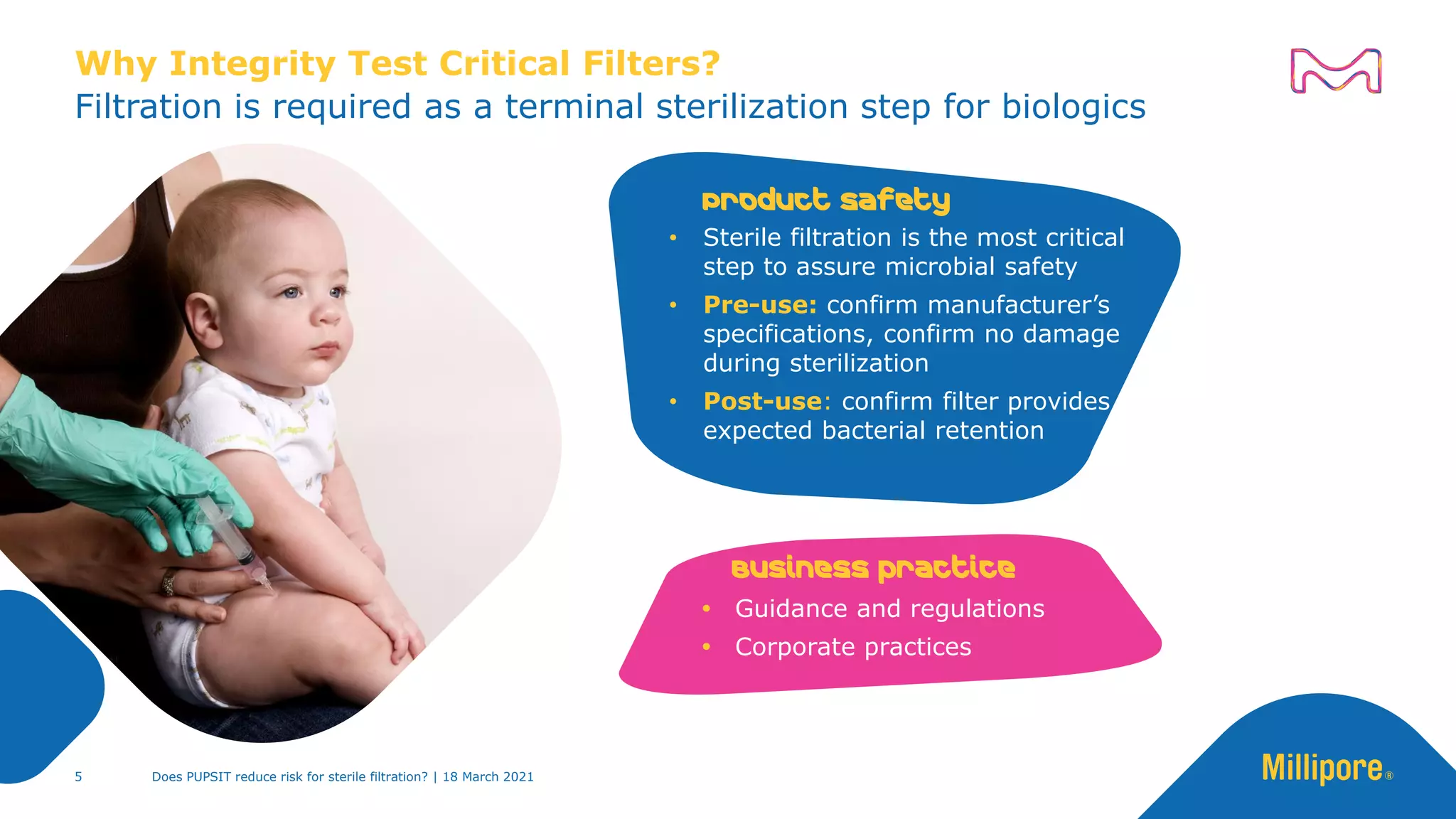
Why Integrity Test Critical Filters?
Filtration is required as a terminal sterilization step for biologics
Product Safety
• Sterile filtration is the most critical
step to assure microbial safety
• Pre-use: confirm manufacturer’s
specifications, confirm no damage
during sterilization
• Post-use: confirm filter provides
expected bacterial retention
Business practice
 Guidance and regulations
 Corporate practices
Does PUPSIT reduce risk for sterile filtration? | 18 March 2021
5
There is no common filtration set-up
Points to Consider to Design a Sterile Filtration Process
How
many?
Device
design
Filter
Design
Integrity
test
Flushing
In/out
isolator?
Product
recovery
Choosing the right
number of filters:
single, dual, redundant
Pre-use and post-use
filter integrity test
Filters in or out of the
isolator?
Stacked vs. pleated
Flush bag vs. barrier
filters
Downstream blow down
Does PUPSIT reduce risk for sterile filtration? | 18 March 2021
6
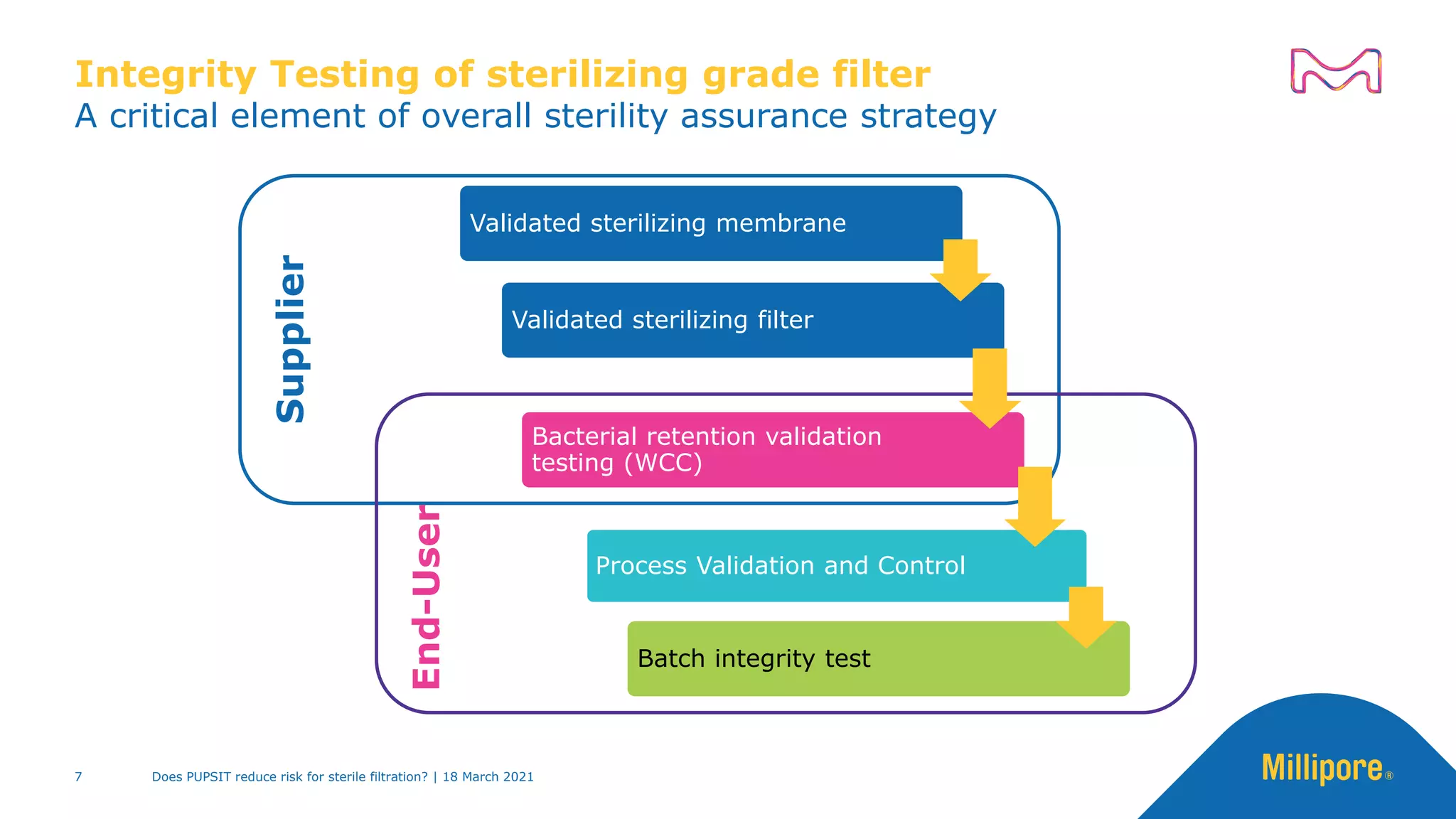
Supplier
End-User
Integrity Testing of sterilizing grade filter
A critical element of overall sterility assurance strategy
Validated sterilizing membrane
Validated sterilizing filter
Bacterial retention validation
testing (WCC)
Process Validation and Control
Batch integrity test
Does PUPSIT reduce risk for sterile filtration? | 18 March 2021
7
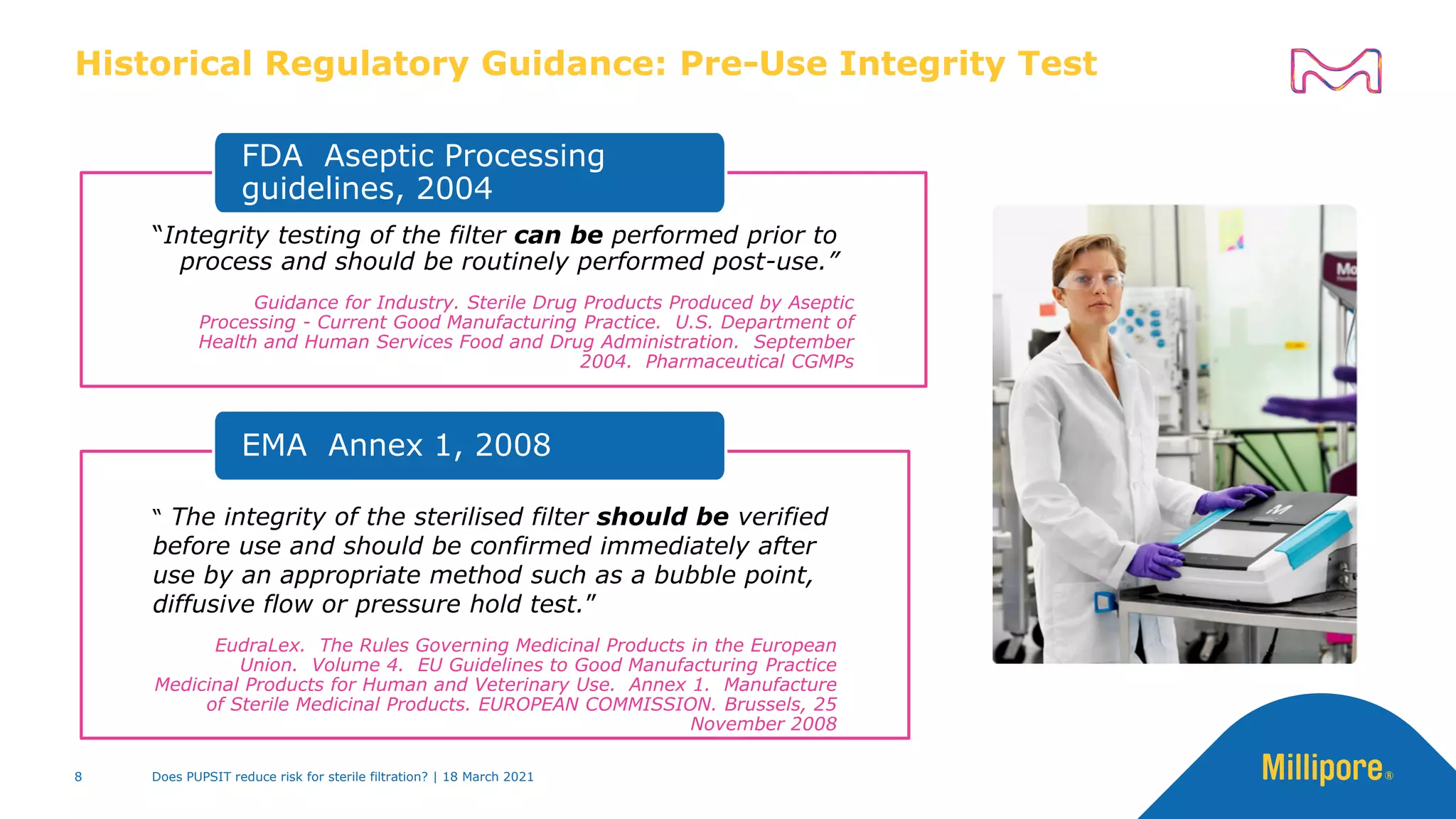
Historical Regulatory Guidance: Pre-Use Integrity Test
“Integrity testing of the filter can be performed prior to
process and should be routinely performed post-use.”
Guidance for Industry. Sterile Drug Products Produced by Aseptic
Processing - Current Good Manufacturing Practice. U.S. Department of
Health and Human Services Food and Drug Administration. September
2004. Pharmaceutical CGMPs
FDA Aseptic Processing
guidelines, 2004
“ The integrity of the sterilised filter should be verified
before use and should be confirmed immediately after
use by an appropriate method such as a bubble point,
diffusive flow or pressure hold test.”
EudraLex. The Rules Governing Medicinal Products in the European
Union. Volume 4. EU Guidelines to Good Manufacturing Practice
Medicinal Products for Human and Veterinary Use. Annex 1. Manufacture
of Sterile Medicinal Products. EUROPEAN COMMISSION. Brussels, 25
November 2008
EMA Annex 1, 2008
Does PUPSIT reduce risk for sterile filtration? | 18 March 2021
8
Critical Liquid Filters
When to Integrity Test?
Does PUPSIT reduce risk for sterile filtration? | 18 March 2021
9
Filter Integrity Testing
Protects the Patient from microbial contamination
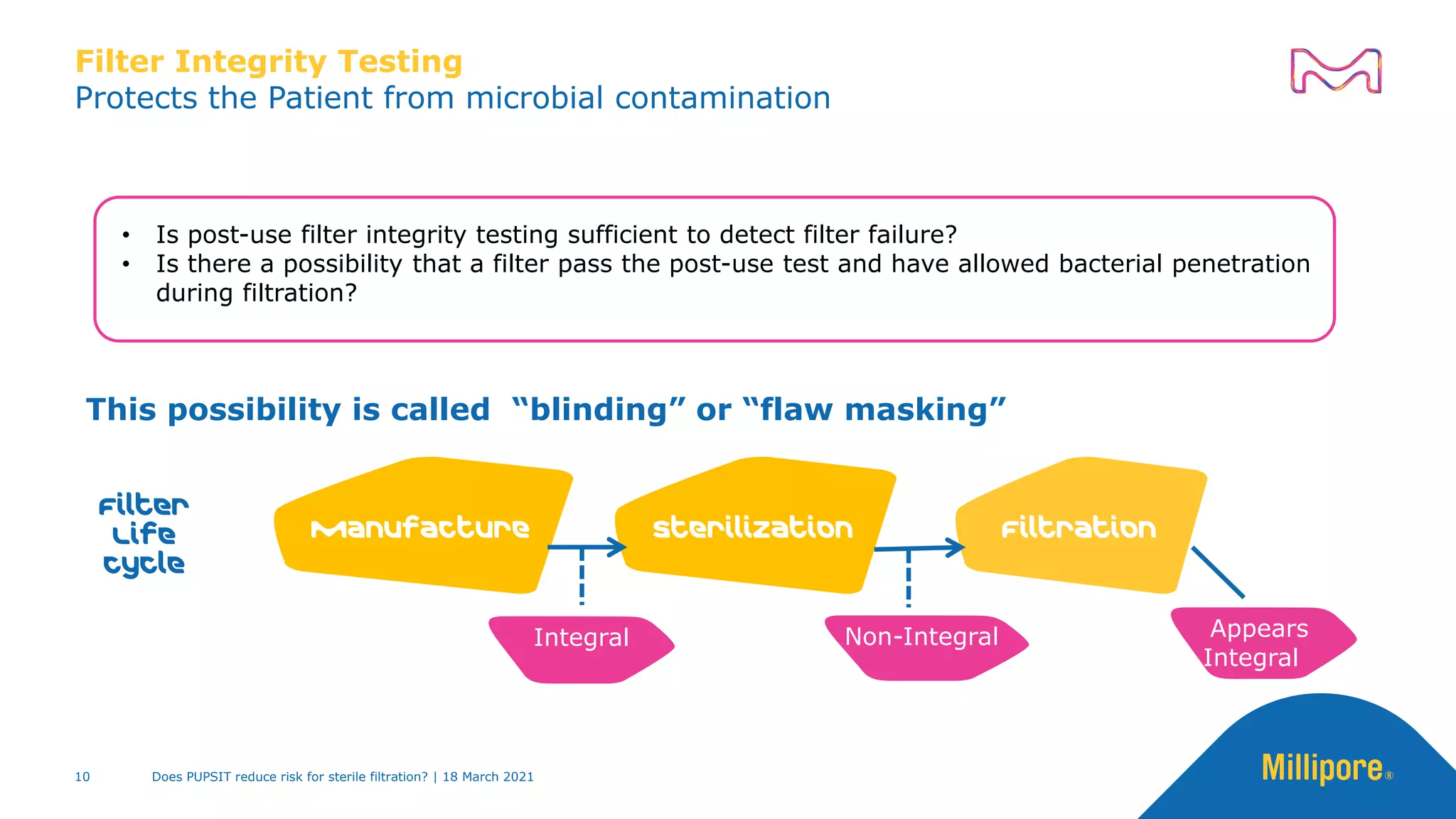
This possibility is called “blinding” or “flaw masking”
Filter
Life
Cycle
Manufacture Sterilization Filtration
Integral Non-Integral Appears
Integral
• Is post-use filter integrity testing sufficient to detect filter failure?
• Is there a possibility that a filter pass the post-use test and have allowed bacterial penetration
during filtration?
Does PUPSIT reduce risk for sterile filtration? | 18 March 2021
10
Historical Positions on PUPSIT
Industry position
• Low value, flaw masking is uncommon
• PUPSIT adds risk, may compromise aseptic pathway
• Adds complexity, stresses filter
European regulatory position
• Essential: filtration is risky, flaw masking is a risk
• Industry just does not want to do it, risk assessments are
biased
FDA position
• Nothing official
• Decisions should be risk based
11
Regulatory -
EU GMP Annex 1 draft, 2020:
 Integrity test before use and
post-use
 “…[PUPSIT] may not always
be possible after sterilization due
to process constraints (e.g. the
filtration of very small volumes of
solution). In these cases, an
alternative approach may be taken
as long as a thorough risk
assessment has been performed
and compliance is achieved by the
implementation of appropriate
controls to navigate any risk of
non-sterility.
Industry -
PDA Technical Report 26:
“Integrity testing alone is
insufficient to assure the sterility
of the filtrate. At least two other
elements must be in place:
 The production controls and
quality assurance systems
used by the filter
manufacturer ...
 And the validation studies
used to show that a particular
combination of product,
processing conditions and
sterilizing grade filter will meet
the requirements of the
bacterial challenge test.”
Establish minimum
Bubble Point
Membrane manufacturing
and testing
Device manufacturing
and testing
Validation studies
End-user integrity test
Integrity test of "sterilizing filter” alone is insufficient
Evolving Perspective – Sterility Assurance
Does PUPSIT reduce risk for sterile filtration? | 18 March 2021
12
Masking
study - PUPSIT
PUPSIT Consortium Initiated
• Biophorum and PDA Memo of
Understanding (Dec 2017)
• Goal: Gather data and evaluate potential
risks on the merit of PUPSIT to provide
guidance to industry
• Joint effort of filter suppliers and
drug manufacturers
14
 Flaw must be large enough to pass
microbiological contamination
 Flaw must be small enough to be
closed by clogging
 Material must be present that can
plug the defect to such an extent
that it is not detectible by post-use
integrity testing
Conditions Necessary for Masking
Does PUPSIT reduce risk for sterile filtration? | 18 March 2021
15
PUPSIT
Risk
Masking
Risk
• Increased complexity of the
filtration set-up
• Manipulation of the sterilized
filtrate side
• Microbial ingress of the
filtrate side
• Product dilution with wetting
fluid
• With product wetting,
unknown effects on the
product by the test gas and
time
• …
• Flawed filter will not be
detected by the post-use test
• Microbial penetration
potential not being detected
• Sterilization process
detriments are not detected
• …
The Risk Balance
We Need Data for Resolution
16
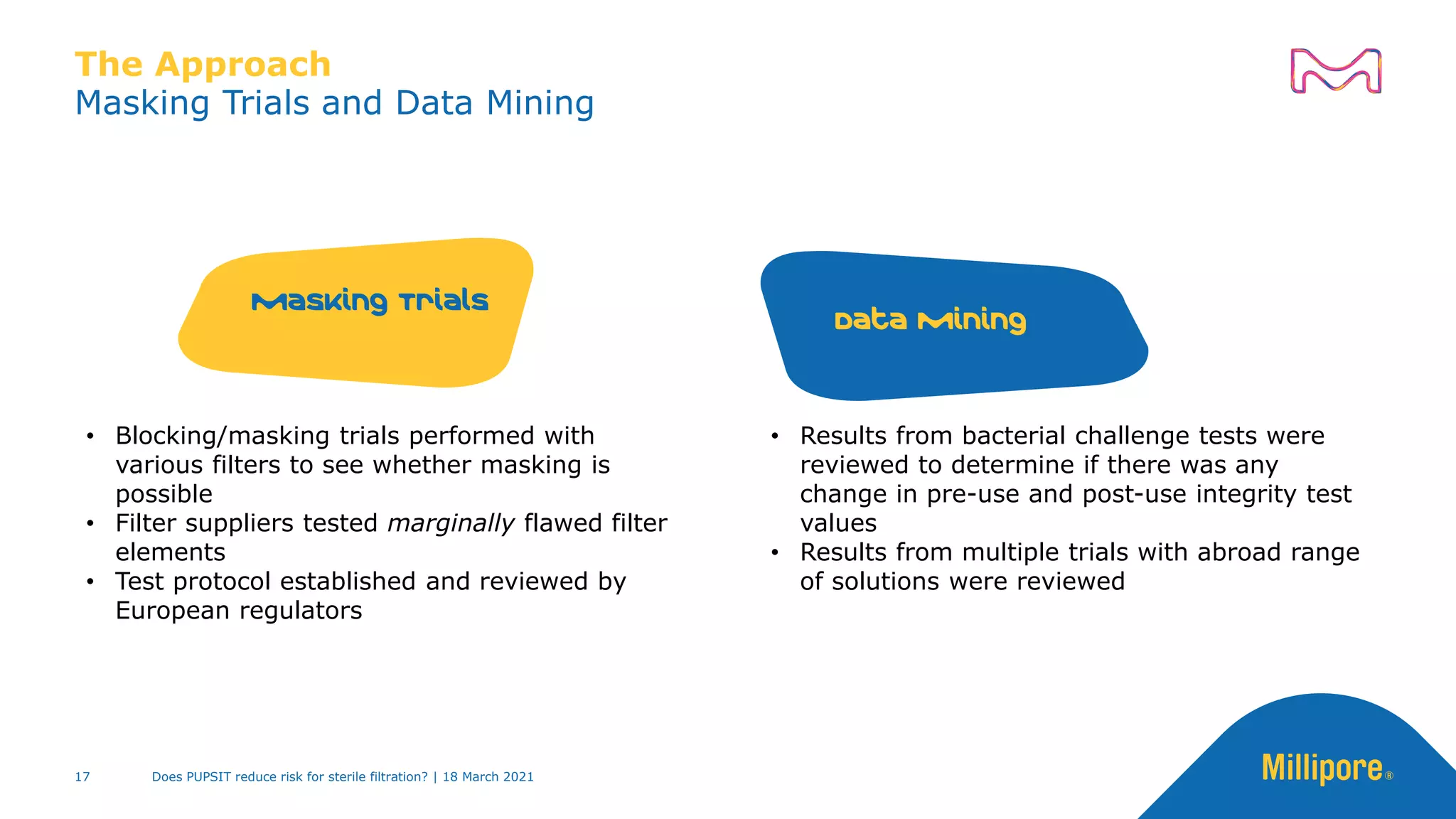
• Blocking/masking trials performed with
various filters to see whether masking is
possible
• Filter suppliers tested marginally flawed filter
elements
• Test protocol established and reviewed by
European regulators
• Results from bacterial challenge tests were
reviewed to determine if there was any
change in pre-use and post-use integrity test
values
• Results from multiple trials with abroad range
of solutions were reviewed
Masking Trials and Data Mining
Masking Trials
Data mining
The Approach
Does PUPSIT reduce risk for sterile filtration? | 18 March 2021
17
Problems and Solutions
Collaboration Team PDA/BPOG
What Has Been Done?
1. Masking studies: can masking occur?
2. Data mining of available bacterial challenge test data
3. Identifying known and potential failure modes of
sterilizing grade filters
Deliverables
1. Developing a risk assessment template to
determine if PUPSIT is warranted
2. Identify best practices for performing PUPSIT
3. Presenting findings to Regulatory
Does PUPSIT reduce risk for sterile filtration? | 18 March 2021
18
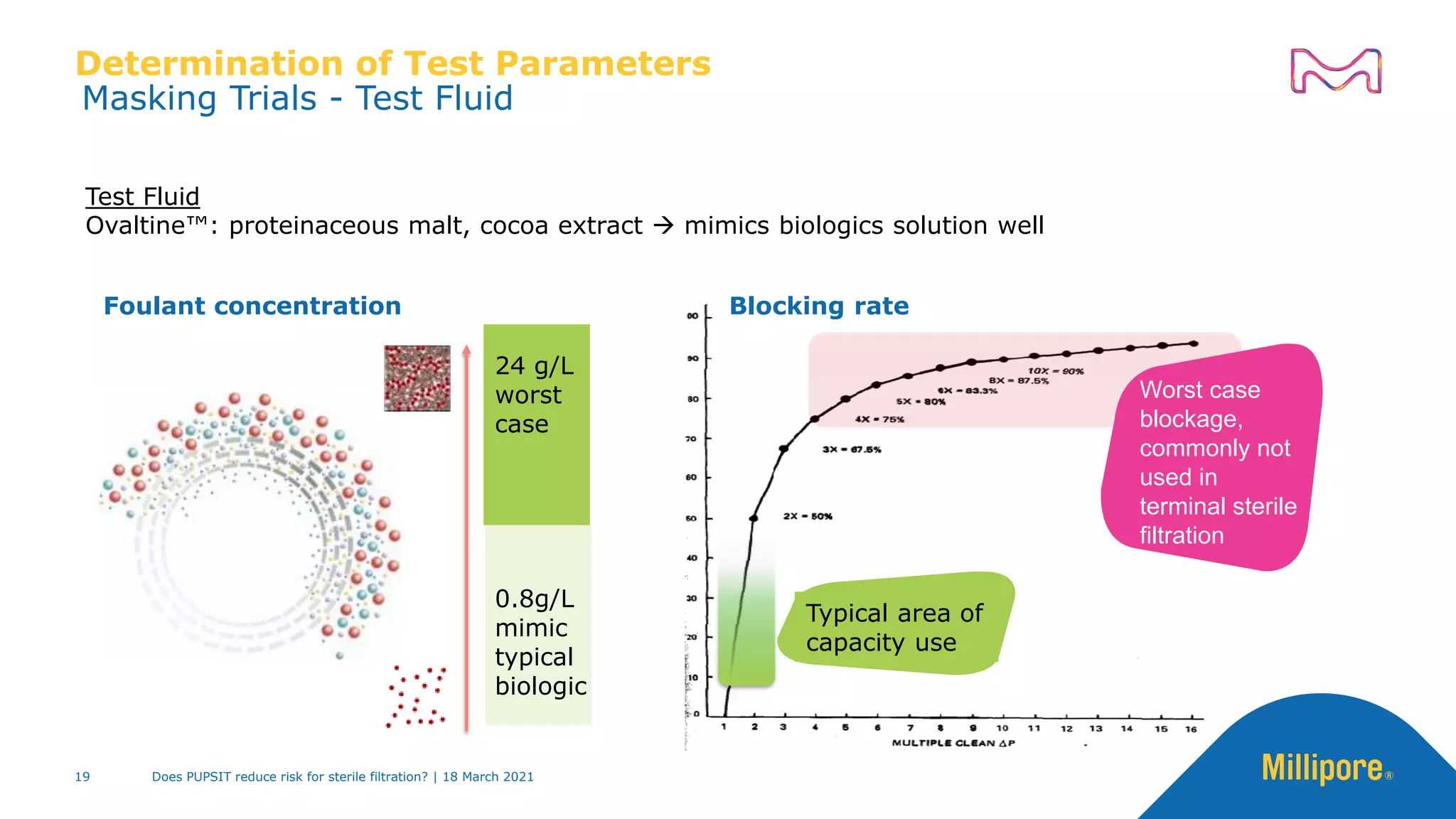
Determination of Test Parameters
Test Fluid
Ovaltine™: proteinaceous malt, cocoa extract → mimics biologics solution well
Blocking rate
Foulant concentration
24 g/L
worst
case
0.8g/L
mimic
typical
biologic
Masking Trials - Test Fluid
Typical area of
capacity use
Worst case
blockage,
commonly not
used in
terminal sterile
filtration
Does PUPSIT reduce risk for sterile filtration? | 18 March 2021
19
• Filter manufacturers collected marginal flawed 10” filter cartridges
Determination of Test Parameters
Masking Trials – Phase 1 Test Protocol
Filters wet and IT
(BP or diffusion)
All integrity tests were performed with
automated integrity test systems
Exposed to blocking
solution (24 g/L Ovaltine™)
at 10 psig to
>90% blocking
Filters
flushed with water (50
L/m2) and IT
(BP or diffusion)
24 g/L
Ovaltine™
>90%
blocking
>90%
24g/L
Worst Case
Scenario
Foulant
Concentration
Blocking
Rate
20
Masking trials of flawed 10” filters, tested under worst-case conditions (> 90% blocked)
24 filters tested → 2 passed (masking occurred) and 22 failed the post-use integrity test
Take-home messages
• Confirmed that ‘worst-case’ blocking rate and foulant concentrations
can mask minor flaws in 10% of cases
• Unlikely a high blocking rate would be seen at a terminal filtration
step
>90%
blocking
Masking Trials
Phase 1- Results
24 g/L
Ovaltine™
>90%
blocking
Next steps
• Phase 2 trials at different blocking rates and foulant concentrations
24 g/L
Ovaltine™
>90%
blocking
92%
8%
Masking Phase 1
Failed Pass
Does PUPSIT reduce risk for sterile filtration? | 18 March 2021
21
Masking Trials, 47 mm discs, laser drilled flaw
44 integrity tests were performed at 0.8 g/L
→ 2 passed the post use integrity test (masked) (81% and 97%
blockage) and 42 failed the post use integrity test
8 integrity tests were performed at 24 g/L
→ very difficult to filter through a 47 mm disk; all failed post use integrity
test
Take-home messages
• We verified, using Ovaltine, that only at very high blocking rates filter flaws
may be masked: no passing post-use integrity tests (masking) on blockage
rates less than 75% irrespective of fouling solution concentration
• Filter masking does not always happen as 16 out of 18 47 mm disc filters at a
blockage rate >80% failed the post-use test (no masking)
• Filter flaw masking is highly dependent on the product and process
conditions.
Masking Trials
Phase 2- Test Protocol
96%
4%
Masking Phase 2
Failed Pass
Does PUPSIT reduce risk for sterile filtration? | 18 March 2021
22
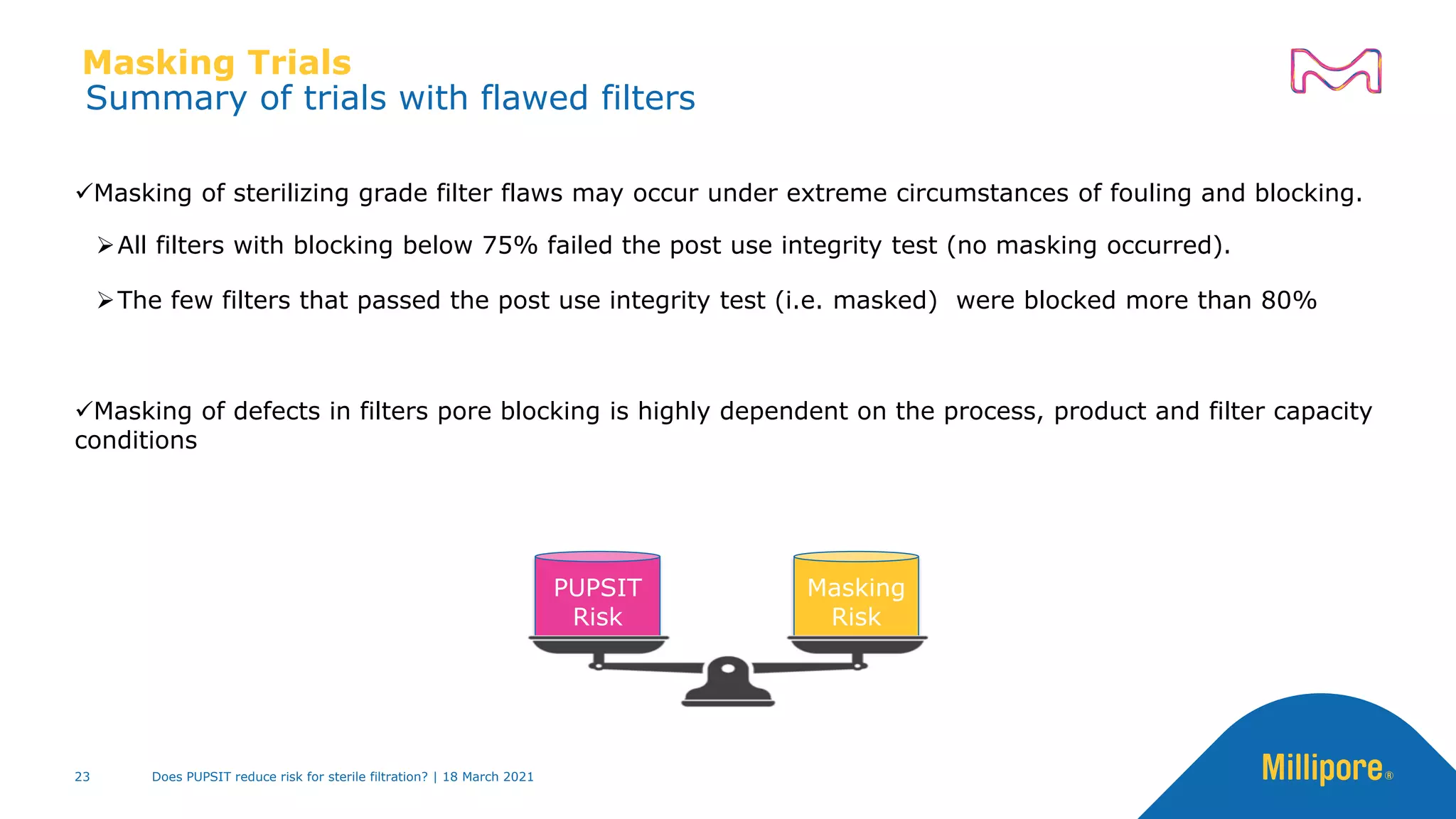
✓Masking of sterilizing grade filter flaws may occur under extreme circumstances of fouling and blocking.
➢All filters with blocking below 75% failed the post use integrity test (no masking occurred).
➢The few filters that passed the post use integrity test (i.e. masked) were blocked more than 80%
✓Masking of defects in filters pore blocking is highly dependent on the process, product and filter capacity
conditions
Masking Trials
Summary of trials with flawed filters
PUPSIT
Risk
Masking
Risk
Does PUPSIT reduce risk for sterile filtration? | 18 March 2021
23
✓Filterability trials and understanding product and process conditions could be used to determine whether
masking is a possibility or not
➢Prefilters can be used to reduce fouling of sterilizing filters will minimize the risk of filter masking
✓Decisions should balance the risks of PUPSIT implementation vs possibility of filter masking
✓More information on the Masking Studies, Data Mining Studies, Risk Assessments, and PUSPIT
Implementation Considerations are available in publications from the Task Force
Task Force Conclusions
PUPSIT
Risk
Masking
Risk
Does PUPSIT reduce risk for sterile filtration? | 18 March 2021
24
Final Filtration
Assemblies –
Design/Implementation
PUPSIT Best Practices-Things I Have Learned Along the Way…
SURF Design Considerations
Does PUPSIT reduce risk for sterile filtration? | 18 March 2021
26
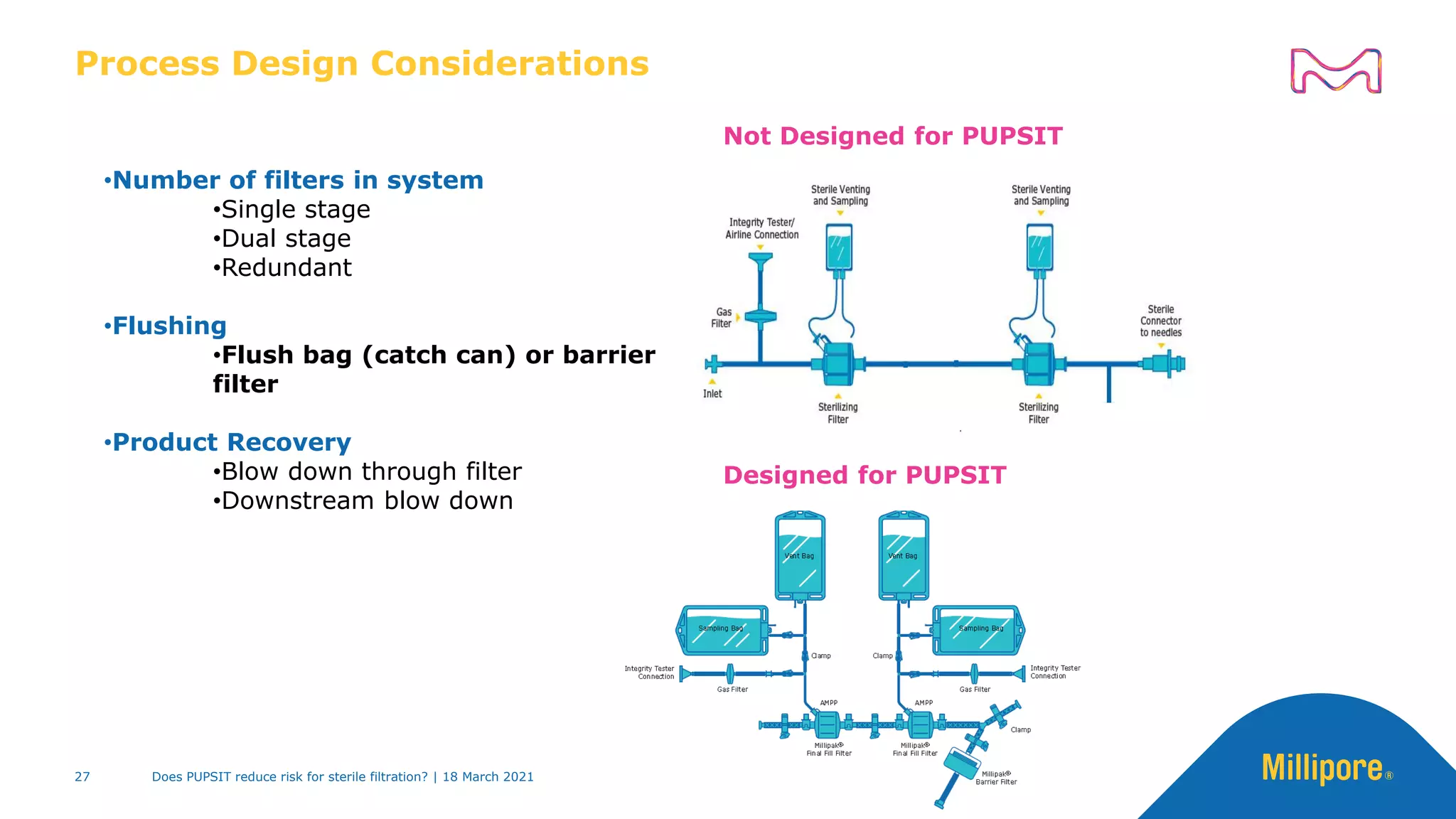
Process Design Considerations
Designed for PUPSIT
Not Designed for PUPSIT
•Number of filters in system
•Single stage
•Dual stage
•Redundant
•Flushing
•Flush bag (catch can) or barrier
filter
•Product Recovery
•Blow down through filter
•Downstream blow down
Does PUPSIT reduce risk for sterile filtration? | 18 March 2021
27
Redesigned Port Minimizes Contamination Risk
Aseptic actuation
PUPSIT & product
recovery
Aseptic sampling
Aseptic Multi-
Purpose Port
(AMPP)
Does PUPSIT reduce risk for sterile filtration? | 18 March 2021
28
Number of Filters in the System
Designs for final filtration systems
Single Filter Dual Filter Redundant
✓ Compliance with regulatory guidance
for <10 CFU/100 ml
✓ Minimizes plugging risk for secondary filter
BENEFITS
 No back-up in the event of primary
filter failure
 Higher hold-up volume
 Higher cost
 Higher system complexity
CONSIDERATIONS
✓Minimum hold-up volume
✓Minimum flushing requirements
✓Ease of handling and operation
✓Lower filter cost
BENEFITS
 No back-up in the event of primary filter failure
 Minimal feed bioburden control
 High probability of filter plugging
CONSIDERATIONS
✓Compliance with regulatory guidance for
<10 CFU/100 ml
✓Low plugging risk for primary filter
✓Potential batch recovery if one filter fails
integrity test
BENEFITS
 Higher hold-up volume
 Higher cost
 Higher system complexity
CONSIDERATIONS
Bulk
Product
Sterile
Filter
Bulk
Product
Sterile
Filter
Sterile
Filter
Intermediate
Product Hold
Bulk
Product
Sterile
Filter
Sterile
Filter
Bulk Product
Bioburden
Reduction
Filter
Sterile
Filter
Does PUPSIT reduce risk for sterile filtration? | 18 March 2021
29
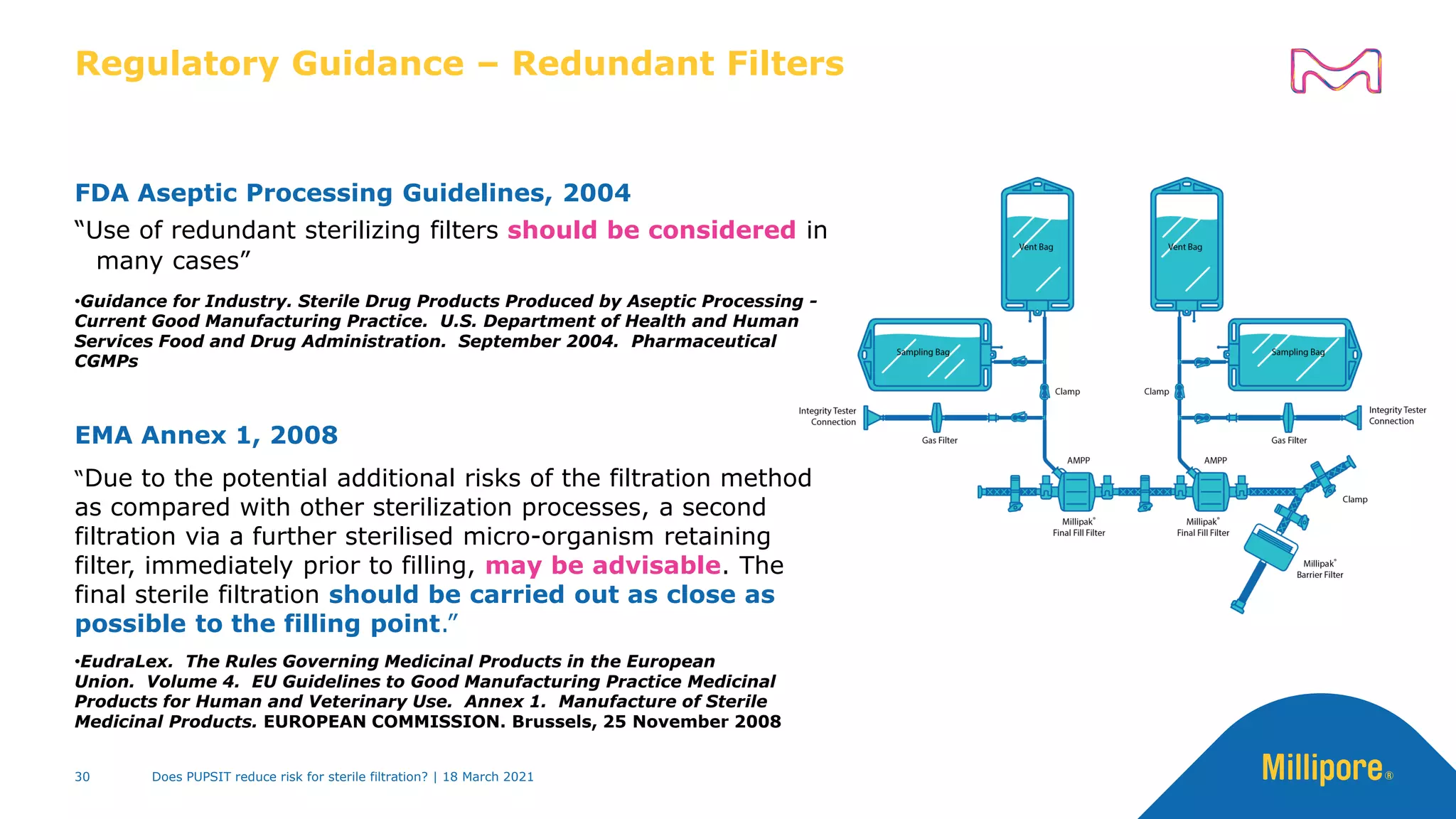
Regulatory Guidance – Redundant Filters
FDA Aseptic Processing Guidelines, 2004
“Use of redundant sterilizing filters should be considered in
many cases”
•Guidance for Industry. Sterile Drug Products Produced by Aseptic Processing -
Current Good Manufacturing Practice. U.S. Department of Health and Human
Services Food and Drug Administration. September 2004. Pharmaceutical
CGMPs
EMA Annex 1, 2008
“Due to the potential additional risks of the filtration method
as compared with other sterilization processes, a second
filtration via a further sterilised micro-organism retaining
filter, immediately prior to filling, may be advisable. The
final sterile filtration should be carried out as close as
possible to the filling point.”
•EudraLex. The Rules Governing Medicinal Products in the European
Union. Volume 4. EU Guidelines to Good Manufacturing Practice Medicinal
Products for Human and Veterinary Use. Annex 1. Manufacture of Sterile
Medicinal Products. EUROPEAN COMMISSION. Brussels, 25 November 2008
Does PUPSIT reduce risk for sterile filtration? | 18 March 2021
30
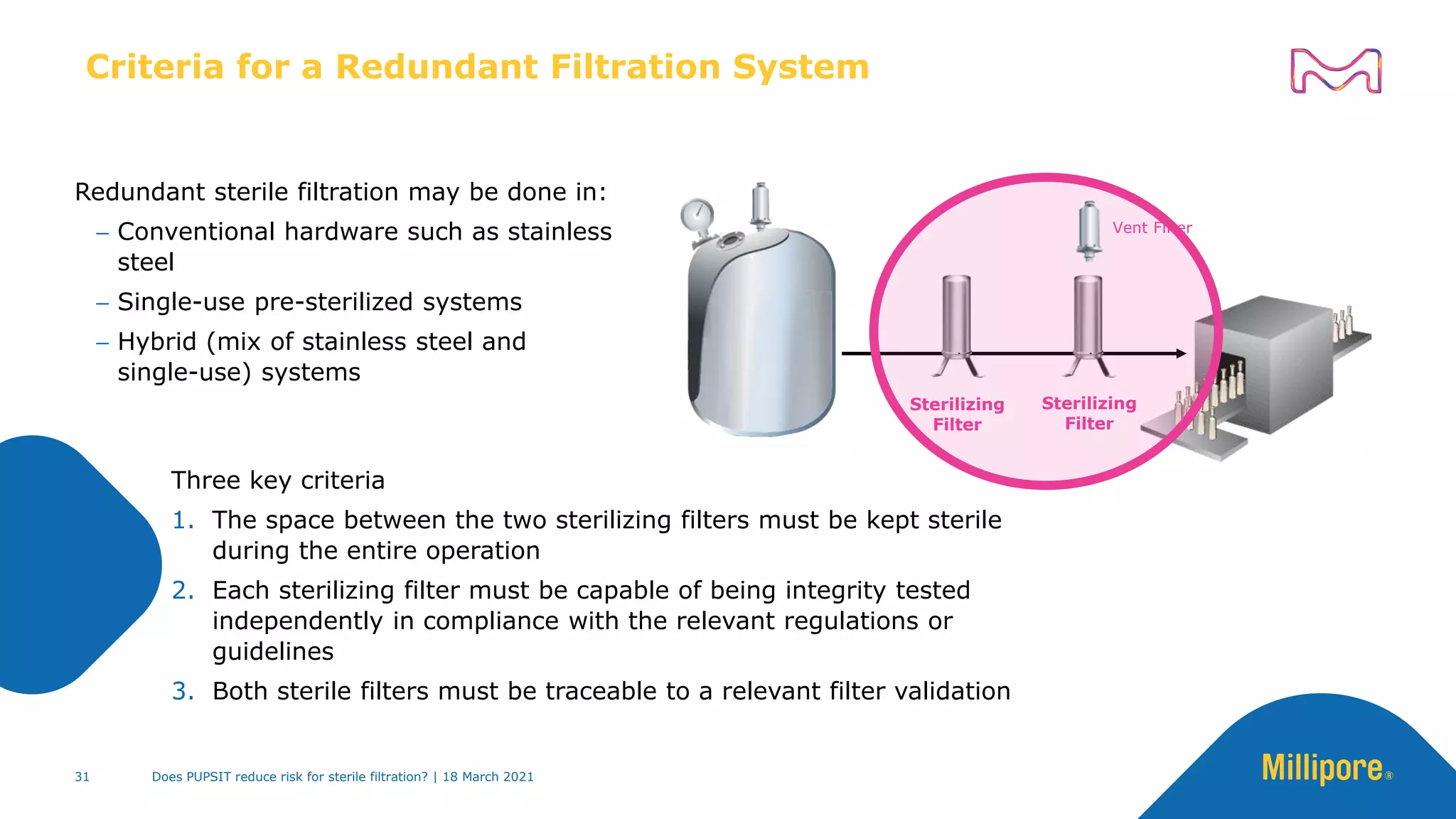
Sterilizing
Filter
Vent Filter
Sterilizing
Filter
Redundant sterile filtration may be done in:
− Conventional hardware such as stainless
steel
− Single-use pre-sterilized systems
− Hybrid (mix of stainless steel and
single-use) systems
Three key criteria
1. The space between the two sterilizing filters must be kept sterile
during the entire operation
2. Each sterilizing filter must be capable of being integrity tested
independently in compliance with the relevant regulations or
guidelines
3. Both sterile filters must be traceable to a relevant filter validation
Criteria for a Redundant Filtration System
Does PUPSIT reduce risk for sterile filtration? | 18 March 2021
31
Remove –
 Wetting Liquid
 Test Gas
While
Maintaining
downstream
 Sterility
 Atmospheric pressure
(test)
Practical Challenges when Performing PUPSIT
Class C
Filling Line
Sterilizing
Product
Filter
Water Gas
Does PUPSIT reduce risk for sterile filtration? | 18 March 2021
32
Current Practice 2
Pre-use test: to flush derivation tank
B
C
Filling Line
Sterilizing
Product
Filter
A
Catch can or
flush volume
tank
Option 1: Catch Can
✓ Extractables are removed
from filtration line
❖ Wetting volume to re-wet
and re-test is limited by flush
tank capacity
❖ Flush tank handling and
preparation is cumbersome
❖ Carboy or flush tank vent
filter to be tested
Points to consider
Does PUPSIT reduce risk for sterile filtration? | 18 March 2021
33
B
C
Filling Line
Sterilizing
Product
Filter
A
Phobic/Philic
Hybrid filter
Option 2: Barrier Filter
✓ Unlimited flush volumes
✓ Line blowdown
✓ Passive draining
✓ Lowest filtrate line complexity
✓ One filters to test off-line with
IPA/water wetting solution
❖ Breathing capacity profile linked
to Phobic material and chemistry
Points to consider
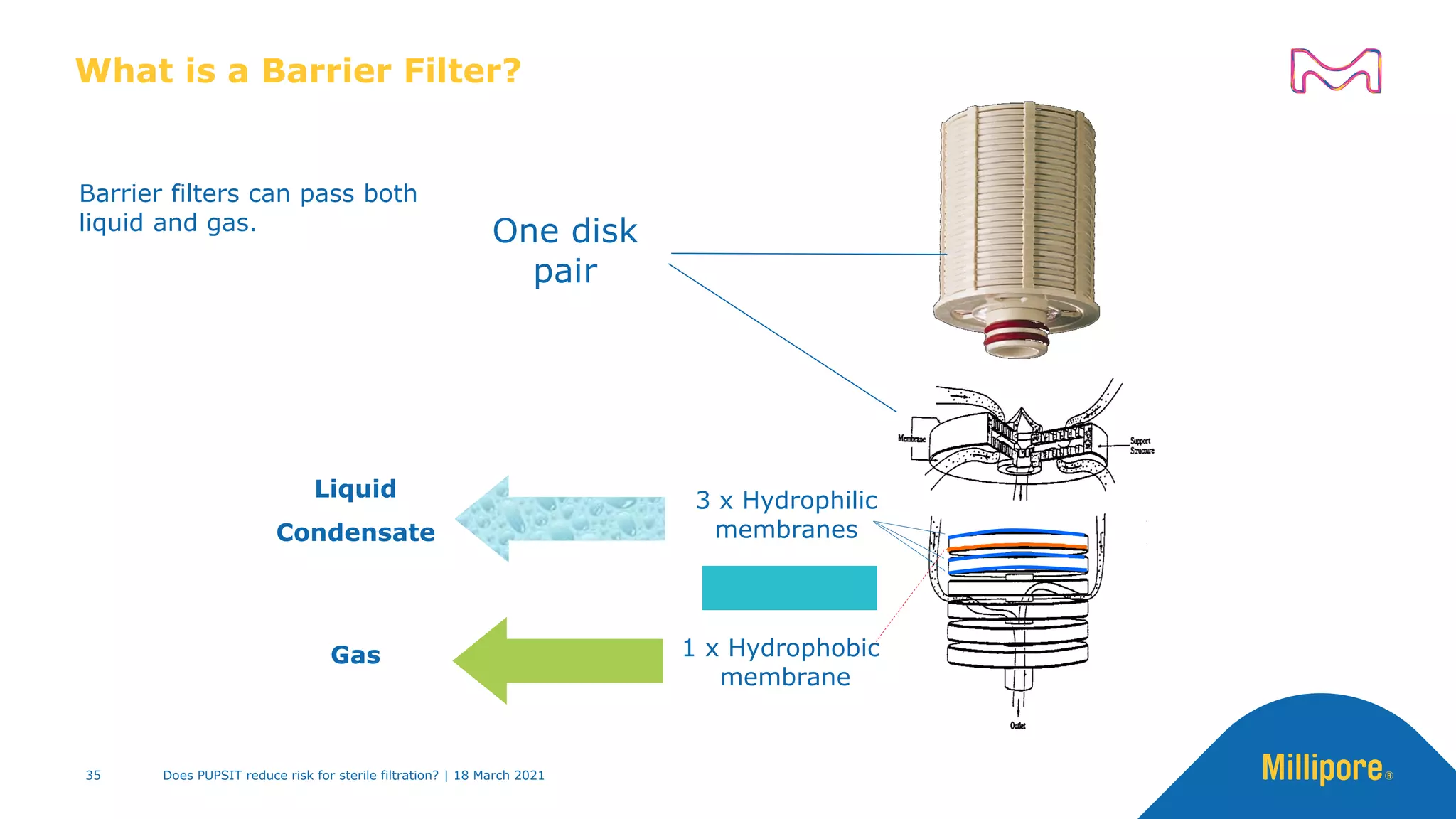
Barrier filters contain hydrophilic and hydrophobic sterilizing
membranes
Does PUPSIT reduce risk for sterile filtration? | 18 March 2021
34
What is a Barrier Filter?
One disk
pair
3 x Hydrophilic
membranes
1 x Hydrophobic
membrane
Gas
Liquid
Condensate
Barrier filters can pass both
liquid and gas.
Does PUPSIT reduce risk for sterile filtration? | 18 March 2021
35
Does PUPSIT reduce risk for sterile filtration? | 18 March 2021
36
Recovery: Post Process Product Recovery
• During processing the entire system is flooded
with product
• Gas will not pass through the wet membrane
below the bubble point pressure
• To displace downstream liquid with gas requires
either exceeding the bubble point OR applying low
pressure through the vent between the product
filters
• Displaces downstream liquid
Or Low pressure
gas
High pressure
gas
Does PUPSIT reduce risk for sterile filtration? | 18 March 2021
37
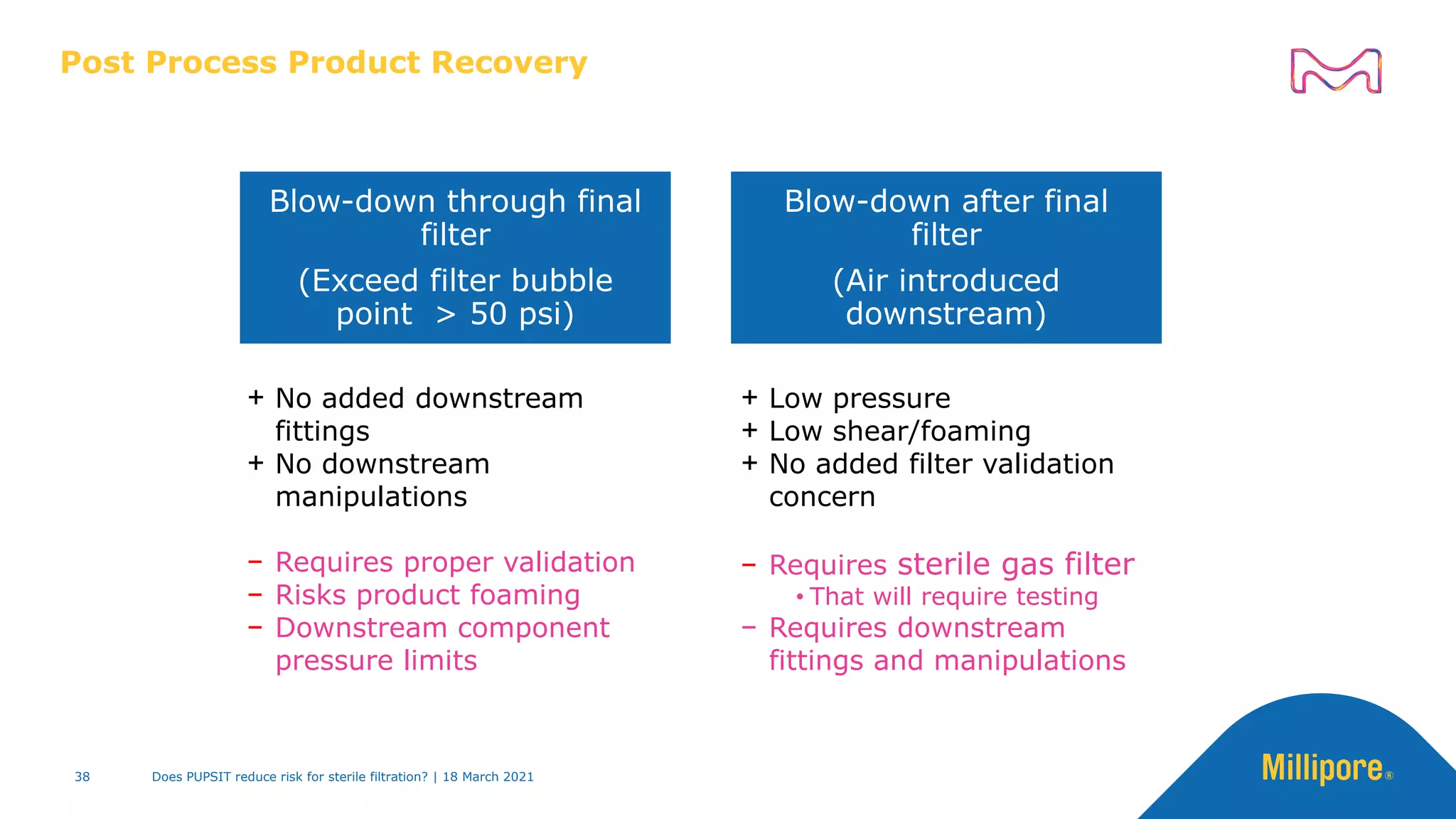
Blow-down through final
filter
(Exceed filter bubble
point > 50 psi)
Blow-down after final
filter
(Air introduced
downstream)
Post Process Product Recovery
+ No added downstream
fittings
+ No downstream
manipulations
− Requires proper validation
− Risks product foaming
− Downstream component
pressure limits
+ Low pressure
+ Low shear/foaming
+ No added filter validation
concern
− Requires sterile gas filter
• That will require testing
− Requires downstream
fittings and manipulations
Does PUPSIT reduce risk for sterile filtration? | 18 March 2021
38
▪ Filter mix-up – which filter did I test ?
▪ Clamp Sequence
 For every step, you need to make sure you know where the
liquid is going and where the air is going
▪ Make sure vent filter does not get wet. Keep it elevated
▪ Make sure vents on filters are closed at the start
▪ Make sure vents are at the high point
Learn From My Mistakes
Does PUPSIT reduce risk for sterile filtration? | 18 March 2021
39
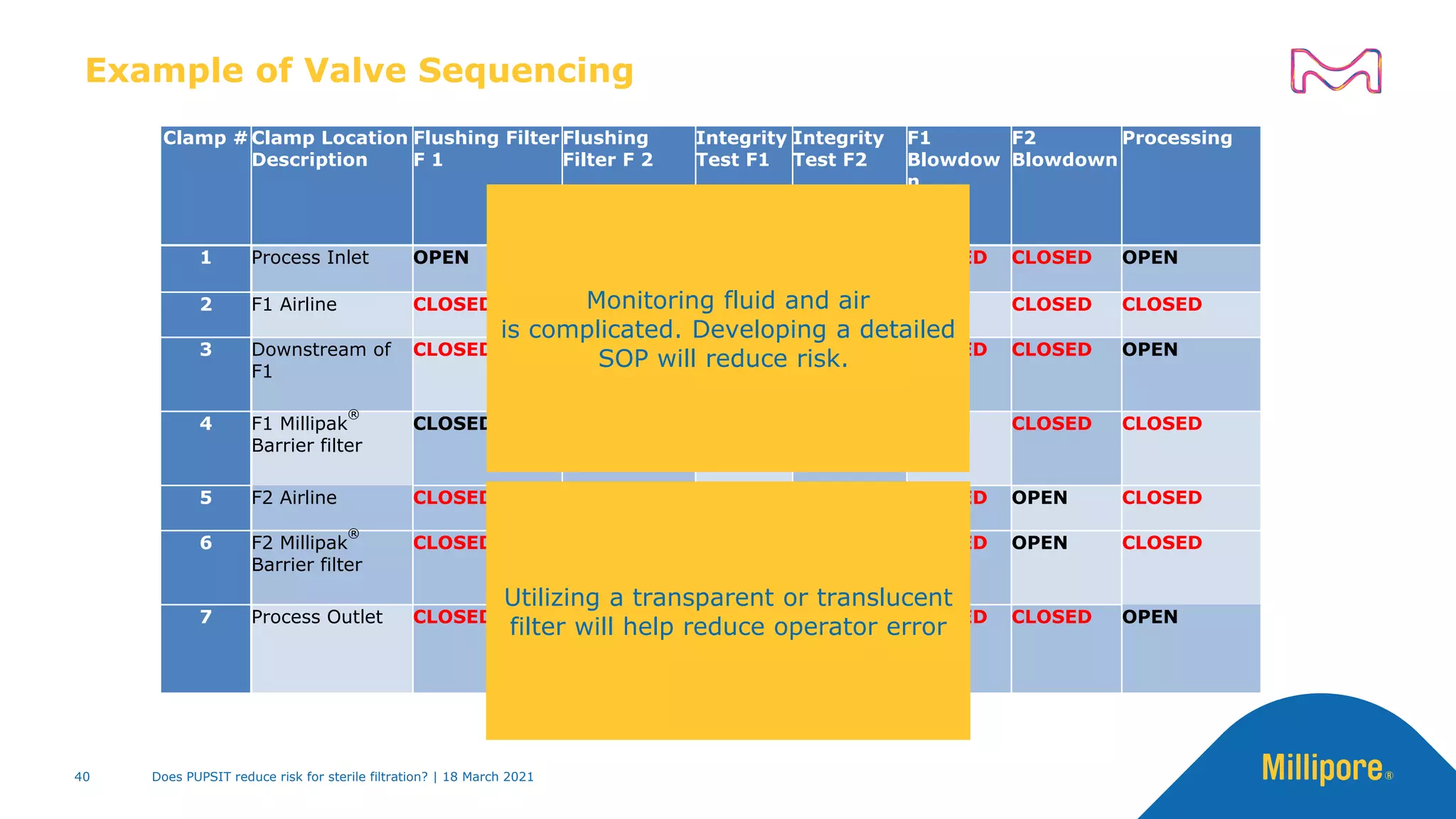
Example of Valve Sequencing
Clamp # Clamp Location
Description
Flushing Filter
F 1
Flushing
Filter F 2
Integrity
Test F1
Integrity
Test F2
F1
Blowdow
n
F2
Blowdown
Processing
1 Process Inlet OPEN OPEN CLOSED CLOSED CLOSED CLOSED OPEN
2 F1 Airline CLOSED CLOSED OPEN CLOSED OPEN CLOSED CLOSED
3 Downstream of
F1
CLOSED OPEN CLOSED CLOSED CLOSED CLOSED OPEN
4 F1 Millipak
®
Barrier filter
CLOSED CLOSED OPEN CLOSED OPEN CLOSED CLOSED
5 F2 Airline CLOSED CLOSED CLOSED OPEN CLOSED OPEN CLOSED
6 F2 Millipak
®
Barrier filter
CLOSED CLOSED CLOSED OPEN CLOSED OPEN CLOSED
7 Process Outlet CLOSED CLOSED CLOSED CLOSED CLOSED CLOSED OPEN
Monitoring fluid and air
is complicated. Developing a detailed
SOP will reduce risk.
Utilizing a transparent or translucent
filter will help reduce operator error
Does PUPSIT reduce risk for sterile filtration? | 18 March 2021
40
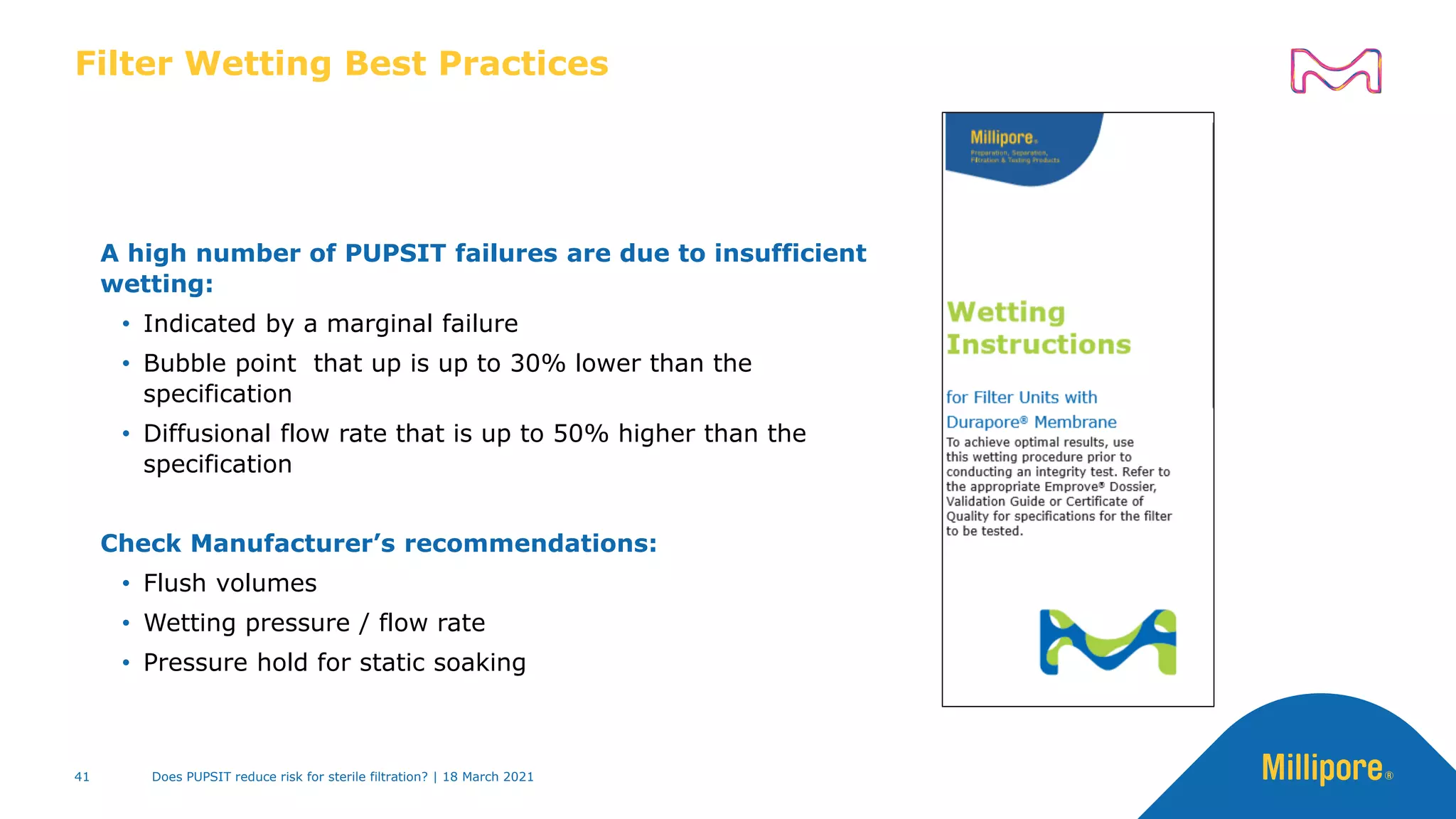
A high number of PUPSIT failures are due to insufficient
wetting:
• Indicated by a marginal failure
• Bubble point that up is up to 30% lower than the
specification
• Diffusional flow rate that is up to 50% higher than the
specification
Check Manufacturer’s recommendations:
• Flush volumes
• Wetting pressure / flow rate
• Pressure hold for static soaking
Filter Wetting Best Practices
Does PUPSIT reduce risk for sterile filtration? | 18 March 2021
41
Handling Single-use Assemblies:
Implementation
• Consider the fixture of the assemblies in relation to the
filling line
• A support frame is recommended
• Frames need to be custom-made
• Assembly is unique to the needs of each end-user
• Designs will vary from plant to plant and even from
process to process
• Difficult to have a ‘one size fits all’ approach to
assemblies
• Frames are usually stainless steel
• Easily designed and fabricated
• Creates a familiar feel for the operator
Does PUPSIT reduce risk for sterile filtration? | 18 March 2021
42
1. Flaw masking is possible with severely blocked filters
• PUPSIT mitigates the impact of masking
• For the majority of filtration operations, flaw masking is unlikely to occur
2. Users should assess the risk of flaw masking based on their fluid stream and process
conditions
3. If there is a reasonable risk of flaw masking, the default should be to perform PUPSIT
4. If there is negligible risk of flaw masking, it is recommended users consider a risk-based
approach to the implementation of PUPSIT
5. Improving the design of the final filtration assembly can simplify PUPSIT and product recovery
Conclusions
Does PUPSIT reduce risk for sterile filtration? | 18 March 2021
43
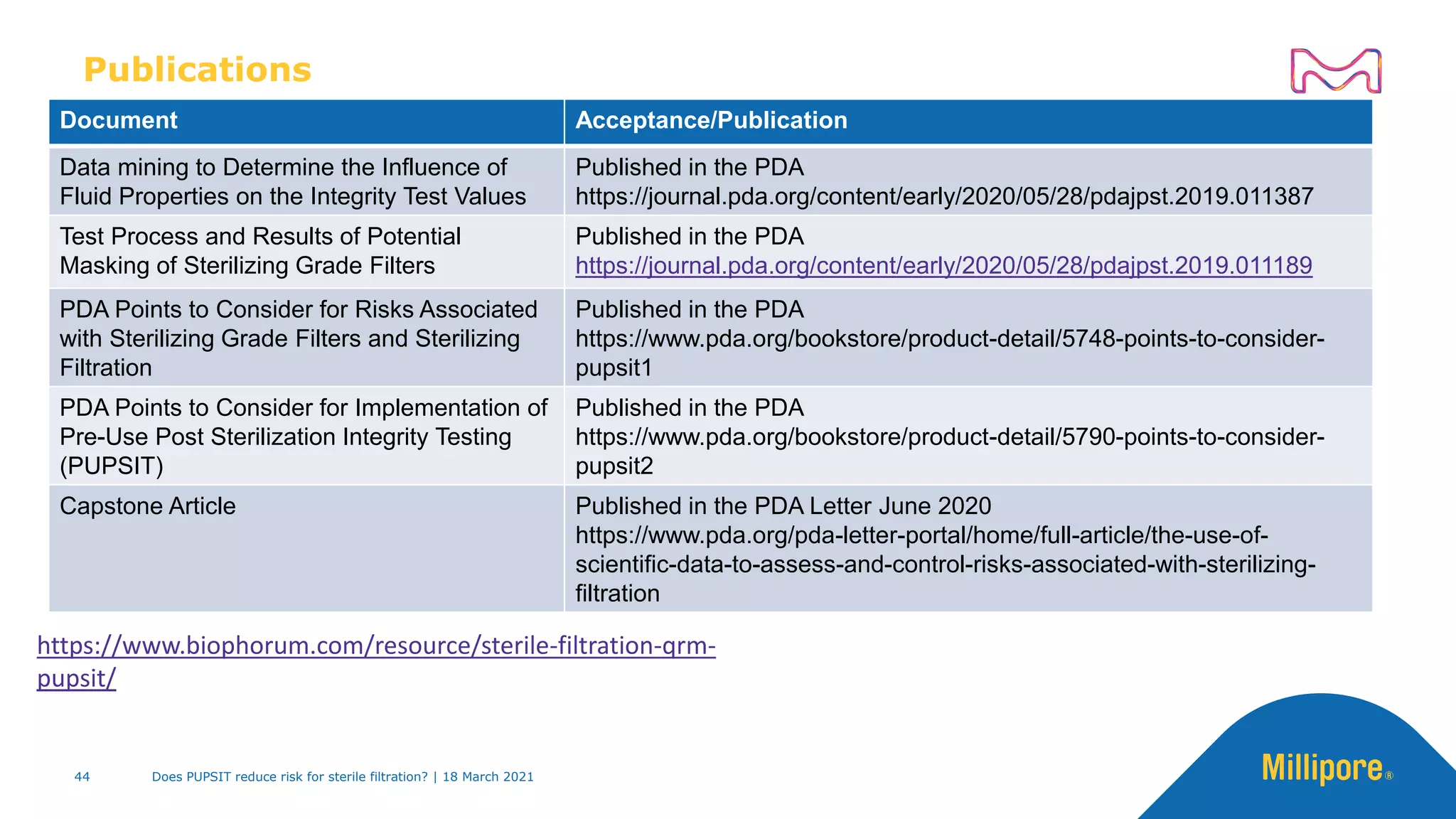
Document Acceptance/Publication
Data mining to Determine the Influence of
Fluid Properties on the Integrity Test Values
Published in the PDA
https://journal.pda.org/content/early/2020/05/28/pdajpst.2019.011387
Test Process and Results of Potential
Masking of Sterilizing Grade Filters
Published in the PDA
https://journal.pda.org/content/early/2020/05/28/pdajpst.2019.011189
PDA Points to Consider for Risks Associated
with Sterilizing Grade Filters and Sterilizing
Filtration
Published in the PDA
https://www.pda.org/bookstore/product-detail/5748-points-to-consider-
pupsit1
PDA Points to Consider for Implementation of
Pre-Use Post Sterilization Integrity Testing
(PUPSIT)
Published in the PDA
https://www.pda.org/bookstore/product-detail/5790-points-to-consider-
pupsit2
Capstone Article Published in the PDA Letter June 2020
https://www.pda.org/pda-letter-portal/home/full-article/the-use-of-
scientific-data-to-assess-and-control-risks-associated-with-sterilizing-
filtration
Publications
https://www.biophorum.com/resource/sterile-filtration-qrm-
pupsit/
Does PUPSIT reduce risk for sterile filtration? | 18 March 2021
44
Andrew Koch
Janmeet Anant
Andrew.Koch@EMDgroup.com
Janmeet.Anant@EMDgroup.com
Contact
© 2021 Merck KGaA, Darmstadt, Germany and/or its affiliates. All Rights Reserved.
Millipore, the vibrant M, and Millipak are trademarks of Merck KGaA, Darmstadt, Germany or its affiliates.
All other trademarks are the property of their respective owners. Detailed information on trademarks is available via publicly accessible
resources.

Does PUPSIT Reduce Risk for Sterile Filtration?

  • 1.
    The life sciencebusiness of Merck KGaA, Darmstadt, Germany operates as MilliporeSigma in the U.S. and Canada. Does PUPSIT reduce risk for sterile filtration? Janmeet Anant, Senior Regulatory Consultant Andrew Koch, Sterile Filtration Technology Manager 18 March 2021
  • 2.
    The life sciencebusiness of Merck KGaA, Darmstadt, Germany operates as MilliporeSigma in the U.S. and Canada
  • 3.
    Agenda 1 2 3 Regulatory Background ofPre-Use Post Sterilization Integrity Test (PUPSIT) Masking study - PUPSIT Final Filtration Assemblies – Design/Implementation 4 Q & A
  • 4.
  • 5.
    Why Integrity TestCritical Filters? Filtration is required as a terminal sterilization step for biologics Product Safety • Sterile filtration is the most critical step to assure microbial safety • Pre-use: confirm manufacturer’s specifications, confirm no damage during sterilization • Post-use: confirm filter provides expected bacterial retention Business practice  Guidance and regulations  Corporate practices Does PUPSIT reduce risk for sterile filtration? | 18 March 2021 5
  • 6.
    There is nocommon filtration set-up Points to Consider to Design a Sterile Filtration Process How many? Device design Filter Design Integrity test Flushing In/out isolator? Product recovery Choosing the right number of filters: single, dual, redundant Pre-use and post-use filter integrity test Filters in or out of the isolator? Stacked vs. pleated Flush bag vs. barrier filters Downstream blow down Does PUPSIT reduce risk for sterile filtration? | 18 March 2021 6
  • 7.
    Supplier End-User Integrity Testing ofsterilizing grade filter A critical element of overall sterility assurance strategy Validated sterilizing membrane Validated sterilizing filter Bacterial retention validation testing (WCC) Process Validation and Control Batch integrity test Does PUPSIT reduce risk for sterile filtration? | 18 March 2021 7
  • 8.
    Historical Regulatory Guidance:Pre-Use Integrity Test “Integrity testing of the filter can be performed prior to process and should be routinely performed post-use.” Guidance for Industry. Sterile Drug Products Produced by Aseptic Processing - Current Good Manufacturing Practice. U.S. Department of Health and Human Services Food and Drug Administration. September 2004. Pharmaceutical CGMPs FDA Aseptic Processing guidelines, 2004 “ The integrity of the sterilised filter should be verified before use and should be confirmed immediately after use by an appropriate method such as a bubble point, diffusive flow or pressure hold test.” EudraLex. The Rules Governing Medicinal Products in the European Union. Volume 4. EU Guidelines to Good Manufacturing Practice Medicinal Products for Human and Veterinary Use. Annex 1. Manufacture of Sterile Medicinal Products. EUROPEAN COMMISSION. Brussels, 25 November 2008 EMA Annex 1, 2008 Does PUPSIT reduce risk for sterile filtration? | 18 March 2021 8
  • 9.
    Critical Liquid Filters Whento Integrity Test? Does PUPSIT reduce risk for sterile filtration? | 18 March 2021 9
  • 10.
    Filter Integrity Testing Protectsthe Patient from microbial contamination This possibility is called “blinding” or “flaw masking” Filter Life Cycle Manufacture Sterilization Filtration Integral Non-Integral Appears Integral • Is post-use filter integrity testing sufficient to detect filter failure? • Is there a possibility that a filter pass the post-use test and have allowed bacterial penetration during filtration? Does PUPSIT reduce risk for sterile filtration? | 18 March 2021 10
  • 11.
    Historical Positions onPUPSIT Industry position • Low value, flaw masking is uncommon • PUPSIT adds risk, may compromise aseptic pathway • Adds complexity, stresses filter European regulatory position • Essential: filtration is risky, flaw masking is a risk • Industry just does not want to do it, risk assessments are biased FDA position • Nothing official • Decisions should be risk based 11
  • 12.
    Regulatory - EU GMPAnnex 1 draft, 2020:  Integrity test before use and post-use  “…[PUPSIT] may not always be possible after sterilization due to process constraints (e.g. the filtration of very small volumes of solution). In these cases, an alternative approach may be taken as long as a thorough risk assessment has been performed and compliance is achieved by the implementation of appropriate controls to navigate any risk of non-sterility. Industry - PDA Technical Report 26: “Integrity testing alone is insufficient to assure the sterility of the filtrate. At least two other elements must be in place:  The production controls and quality assurance systems used by the filter manufacturer ...  And the validation studies used to show that a particular combination of product, processing conditions and sterilizing grade filter will meet the requirements of the bacterial challenge test.” Establish minimum Bubble Point Membrane manufacturing and testing Device manufacturing and testing Validation studies End-user integrity test Integrity test of "sterilizing filter” alone is insufficient Evolving Perspective – Sterility Assurance Does PUPSIT reduce risk for sterile filtration? | 18 March 2021 12
  • 13.
  • 14.
    PUPSIT Consortium Initiated •Biophorum and PDA Memo of Understanding (Dec 2017) • Goal: Gather data and evaluate potential risks on the merit of PUPSIT to provide guidance to industry • Joint effort of filter suppliers and drug manufacturers 14
  • 15.
     Flaw mustbe large enough to pass microbiological contamination  Flaw must be small enough to be closed by clogging  Material must be present that can plug the defect to such an extent that it is not detectible by post-use integrity testing Conditions Necessary for Masking Does PUPSIT reduce risk for sterile filtration? | 18 March 2021 15
  • 16.
    PUPSIT Risk Masking Risk • Increased complexityof the filtration set-up • Manipulation of the sterilized filtrate side • Microbial ingress of the filtrate side • Product dilution with wetting fluid • With product wetting, unknown effects on the product by the test gas and time • … • Flawed filter will not be detected by the post-use test • Microbial penetration potential not being detected • Sterilization process detriments are not detected • … The Risk Balance We Need Data for Resolution 16
  • 17.
    • Blocking/masking trialsperformed with various filters to see whether masking is possible • Filter suppliers tested marginally flawed filter elements • Test protocol established and reviewed by European regulators • Results from bacterial challenge tests were reviewed to determine if there was any change in pre-use and post-use integrity test values • Results from multiple trials with abroad range of solutions were reviewed Masking Trials and Data Mining Masking Trials Data mining The Approach Does PUPSIT reduce risk for sterile filtration? | 18 March 2021 17
  • 18.
    Problems and Solutions CollaborationTeam PDA/BPOG What Has Been Done? 1. Masking studies: can masking occur? 2. Data mining of available bacterial challenge test data 3. Identifying known and potential failure modes of sterilizing grade filters Deliverables 1. Developing a risk assessment template to determine if PUPSIT is warranted 2. Identify best practices for performing PUPSIT 3. Presenting findings to Regulatory Does PUPSIT reduce risk for sterile filtration? | 18 March 2021 18
  • 19.
    Determination of TestParameters Test Fluid Ovaltine™: proteinaceous malt, cocoa extract → mimics biologics solution well Blocking rate Foulant concentration 24 g/L worst case 0.8g/L mimic typical biologic Masking Trials - Test Fluid Typical area of capacity use Worst case blockage, commonly not used in terminal sterile filtration Does PUPSIT reduce risk for sterile filtration? | 18 March 2021 19
  • 20.
    • Filter manufacturerscollected marginal flawed 10” filter cartridges Determination of Test Parameters Masking Trials – Phase 1 Test Protocol Filters wet and IT (BP or diffusion) All integrity tests were performed with automated integrity test systems Exposed to blocking solution (24 g/L Ovaltine™) at 10 psig to >90% blocking Filters flushed with water (50 L/m2) and IT (BP or diffusion) 24 g/L Ovaltine™ >90% blocking >90% 24g/L Worst Case Scenario Foulant Concentration Blocking Rate 20
  • 21.
    Masking trials offlawed 10” filters, tested under worst-case conditions (> 90% blocked) 24 filters tested → 2 passed (masking occurred) and 22 failed the post-use integrity test Take-home messages • Confirmed that ‘worst-case’ blocking rate and foulant concentrations can mask minor flaws in 10% of cases • Unlikely a high blocking rate would be seen at a terminal filtration step >90% blocking Masking Trials Phase 1- Results 24 g/L Ovaltine™ >90% blocking Next steps • Phase 2 trials at different blocking rates and foulant concentrations 24 g/L Ovaltine™ >90% blocking 92% 8% Masking Phase 1 Failed Pass Does PUPSIT reduce risk for sterile filtration? | 18 March 2021 21
  • 22.
    Masking Trials, 47mm discs, laser drilled flaw 44 integrity tests were performed at 0.8 g/L → 2 passed the post use integrity test (masked) (81% and 97% blockage) and 42 failed the post use integrity test 8 integrity tests were performed at 24 g/L → very difficult to filter through a 47 mm disk; all failed post use integrity test Take-home messages • We verified, using Ovaltine, that only at very high blocking rates filter flaws may be masked: no passing post-use integrity tests (masking) on blockage rates less than 75% irrespective of fouling solution concentration • Filter masking does not always happen as 16 out of 18 47 mm disc filters at a blockage rate >80% failed the post-use test (no masking) • Filter flaw masking is highly dependent on the product and process conditions. Masking Trials Phase 2- Test Protocol 96% 4% Masking Phase 2 Failed Pass Does PUPSIT reduce risk for sterile filtration? | 18 March 2021 22
  • 23.
    ✓Masking of sterilizinggrade filter flaws may occur under extreme circumstances of fouling and blocking. ➢All filters with blocking below 75% failed the post use integrity test (no masking occurred). ➢The few filters that passed the post use integrity test (i.e. masked) were blocked more than 80% ✓Masking of defects in filters pore blocking is highly dependent on the process, product and filter capacity conditions Masking Trials Summary of trials with flawed filters PUPSIT Risk Masking Risk Does PUPSIT reduce risk for sterile filtration? | 18 March 2021 23
  • 24.
    ✓Filterability trials andunderstanding product and process conditions could be used to determine whether masking is a possibility or not ➢Prefilters can be used to reduce fouling of sterilizing filters will minimize the risk of filter masking ✓Decisions should balance the risks of PUPSIT implementation vs possibility of filter masking ✓More information on the Masking Studies, Data Mining Studies, Risk Assessments, and PUSPIT Implementation Considerations are available in publications from the Task Force Task Force Conclusions PUPSIT Risk Masking Risk Does PUPSIT reduce risk for sterile filtration? | 18 March 2021 24
  • 25.
  • 26.
    PUPSIT Best Practices-ThingsI Have Learned Along the Way… SURF Design Considerations Does PUPSIT reduce risk for sterile filtration? | 18 March 2021 26
  • 27.
    Process Design Considerations Designedfor PUPSIT Not Designed for PUPSIT •Number of filters in system •Single stage •Dual stage •Redundant •Flushing •Flush bag (catch can) or barrier filter •Product Recovery •Blow down through filter •Downstream blow down Does PUPSIT reduce risk for sterile filtration? | 18 March 2021 27
  • 28.
    Redesigned Port MinimizesContamination Risk Aseptic actuation PUPSIT & product recovery Aseptic sampling Aseptic Multi- Purpose Port (AMPP) Does PUPSIT reduce risk for sterile filtration? | 18 March 2021 28
  • 29.
    Number of Filtersin the System Designs for final filtration systems Single Filter Dual Filter Redundant ✓ Compliance with regulatory guidance for <10 CFU/100 ml ✓ Minimizes plugging risk for secondary filter BENEFITS  No back-up in the event of primary filter failure  Higher hold-up volume  Higher cost  Higher system complexity CONSIDERATIONS ✓Minimum hold-up volume ✓Minimum flushing requirements ✓Ease of handling and operation ✓Lower filter cost BENEFITS  No back-up in the event of primary filter failure  Minimal feed bioburden control  High probability of filter plugging CONSIDERATIONS ✓Compliance with regulatory guidance for <10 CFU/100 ml ✓Low plugging risk for primary filter ✓Potential batch recovery if one filter fails integrity test BENEFITS  Higher hold-up volume  Higher cost  Higher system complexity CONSIDERATIONS Bulk Product Sterile Filter Bulk Product Sterile Filter Sterile Filter Intermediate Product Hold Bulk Product Sterile Filter Sterile Filter Bulk Product Bioburden Reduction Filter Sterile Filter Does PUPSIT reduce risk for sterile filtration? | 18 March 2021 29
  • 30.
    Regulatory Guidance –Redundant Filters FDA Aseptic Processing Guidelines, 2004 “Use of redundant sterilizing filters should be considered in many cases” •Guidance for Industry. Sterile Drug Products Produced by Aseptic Processing - Current Good Manufacturing Practice. U.S. Department of Health and Human Services Food and Drug Administration. September 2004. Pharmaceutical CGMPs EMA Annex 1, 2008 “Due to the potential additional risks of the filtration method as compared with other sterilization processes, a second filtration via a further sterilised micro-organism retaining filter, immediately prior to filling, may be advisable. The final sterile filtration should be carried out as close as possible to the filling point.” •EudraLex. The Rules Governing Medicinal Products in the European Union. Volume 4. EU Guidelines to Good Manufacturing Practice Medicinal Products for Human and Veterinary Use. Annex 1. Manufacture of Sterile Medicinal Products. EUROPEAN COMMISSION. Brussels, 25 November 2008 Does PUPSIT reduce risk for sterile filtration? | 18 March 2021 30
  • 31.
    Sterilizing Filter Vent Filter Sterilizing Filter Redundant sterilefiltration may be done in: − Conventional hardware such as stainless steel − Single-use pre-sterilized systems − Hybrid (mix of stainless steel and single-use) systems Three key criteria 1. The space between the two sterilizing filters must be kept sterile during the entire operation 2. Each sterilizing filter must be capable of being integrity tested independently in compliance with the relevant regulations or guidelines 3. Both sterile filters must be traceable to a relevant filter validation Criteria for a Redundant Filtration System Does PUPSIT reduce risk for sterile filtration? | 18 March 2021 31
  • 32.
    Remove –  WettingLiquid  Test Gas While Maintaining downstream  Sterility  Atmospheric pressure (test) Practical Challenges when Performing PUPSIT Class C Filling Line Sterilizing Product Filter Water Gas Does PUPSIT reduce risk for sterile filtration? | 18 March 2021 32
  • 33.
    Current Practice 2 Pre-usetest: to flush derivation tank B C Filling Line Sterilizing Product Filter A Catch can or flush volume tank Option 1: Catch Can ✓ Extractables are removed from filtration line ❖ Wetting volume to re-wet and re-test is limited by flush tank capacity ❖ Flush tank handling and preparation is cumbersome ❖ Carboy or flush tank vent filter to be tested Points to consider Does PUPSIT reduce risk for sterile filtration? | 18 March 2021 33
  • 34.
    B C Filling Line Sterilizing Product Filter A Phobic/Philic Hybrid filter Option2: Barrier Filter ✓ Unlimited flush volumes ✓ Line blowdown ✓ Passive draining ✓ Lowest filtrate line complexity ✓ One filters to test off-line with IPA/water wetting solution ❖ Breathing capacity profile linked to Phobic material and chemistry Points to consider Barrier filters contain hydrophilic and hydrophobic sterilizing membranes Does PUPSIT reduce risk for sterile filtration? | 18 March 2021 34
  • 35.
    What is aBarrier Filter? One disk pair 3 x Hydrophilic membranes 1 x Hydrophobic membrane Gas Liquid Condensate Barrier filters can pass both liquid and gas. Does PUPSIT reduce risk for sterile filtration? | 18 March 2021 35
  • 36.
    Does PUPSIT reducerisk for sterile filtration? | 18 March 2021 36
  • 37.
    Recovery: Post ProcessProduct Recovery • During processing the entire system is flooded with product • Gas will not pass through the wet membrane below the bubble point pressure • To displace downstream liquid with gas requires either exceeding the bubble point OR applying low pressure through the vent between the product filters • Displaces downstream liquid Or Low pressure gas High pressure gas Does PUPSIT reduce risk for sterile filtration? | 18 March 2021 37
  • 38.
    Blow-down through final filter (Exceedfilter bubble point > 50 psi) Blow-down after final filter (Air introduced downstream) Post Process Product Recovery + No added downstream fittings + No downstream manipulations − Requires proper validation − Risks product foaming − Downstream component pressure limits + Low pressure + Low shear/foaming + No added filter validation concern − Requires sterile gas filter • That will require testing − Requires downstream fittings and manipulations Does PUPSIT reduce risk for sterile filtration? | 18 March 2021 38
  • 39.
    ▪ Filter mix-up– which filter did I test ? ▪ Clamp Sequence  For every step, you need to make sure you know where the liquid is going and where the air is going ▪ Make sure vent filter does not get wet. Keep it elevated ▪ Make sure vents on filters are closed at the start ▪ Make sure vents are at the high point Learn From My Mistakes Does PUPSIT reduce risk for sterile filtration? | 18 March 2021 39
  • 40.
    Example of ValveSequencing Clamp # Clamp Location Description Flushing Filter F 1 Flushing Filter F 2 Integrity Test F1 Integrity Test F2 F1 Blowdow n F2 Blowdown Processing 1 Process Inlet OPEN OPEN CLOSED CLOSED CLOSED CLOSED OPEN 2 F1 Airline CLOSED CLOSED OPEN CLOSED OPEN CLOSED CLOSED 3 Downstream of F1 CLOSED OPEN CLOSED CLOSED CLOSED CLOSED OPEN 4 F1 Millipak ® Barrier filter CLOSED CLOSED OPEN CLOSED OPEN CLOSED CLOSED 5 F2 Airline CLOSED CLOSED CLOSED OPEN CLOSED OPEN CLOSED 6 F2 Millipak ® Barrier filter CLOSED CLOSED CLOSED OPEN CLOSED OPEN CLOSED 7 Process Outlet CLOSED CLOSED CLOSED CLOSED CLOSED CLOSED OPEN Monitoring fluid and air is complicated. Developing a detailed SOP will reduce risk. Utilizing a transparent or translucent filter will help reduce operator error Does PUPSIT reduce risk for sterile filtration? | 18 March 2021 40
  • 41.
    A high numberof PUPSIT failures are due to insufficient wetting: • Indicated by a marginal failure • Bubble point that up is up to 30% lower than the specification • Diffusional flow rate that is up to 50% higher than the specification Check Manufacturer’s recommendations: • Flush volumes • Wetting pressure / flow rate • Pressure hold for static soaking Filter Wetting Best Practices Does PUPSIT reduce risk for sterile filtration? | 18 March 2021 41
  • 42.
    Handling Single-use Assemblies: Implementation •Consider the fixture of the assemblies in relation to the filling line • A support frame is recommended • Frames need to be custom-made • Assembly is unique to the needs of each end-user • Designs will vary from plant to plant and even from process to process • Difficult to have a ‘one size fits all’ approach to assemblies • Frames are usually stainless steel • Easily designed and fabricated • Creates a familiar feel for the operator Does PUPSIT reduce risk for sterile filtration? | 18 March 2021 42
  • 43.
    1. Flaw maskingis possible with severely blocked filters • PUPSIT mitigates the impact of masking • For the majority of filtration operations, flaw masking is unlikely to occur 2. Users should assess the risk of flaw masking based on their fluid stream and process conditions 3. If there is a reasonable risk of flaw masking, the default should be to perform PUPSIT 4. If there is negligible risk of flaw masking, it is recommended users consider a risk-based approach to the implementation of PUPSIT 5. Improving the design of the final filtration assembly can simplify PUPSIT and product recovery Conclusions Does PUPSIT reduce risk for sterile filtration? | 18 March 2021 43
  • 44.
    Document Acceptance/Publication Data miningto Determine the Influence of Fluid Properties on the Integrity Test Values Published in the PDA https://journal.pda.org/content/early/2020/05/28/pdajpst.2019.011387 Test Process and Results of Potential Masking of Sterilizing Grade Filters Published in the PDA https://journal.pda.org/content/early/2020/05/28/pdajpst.2019.011189 PDA Points to Consider for Risks Associated with Sterilizing Grade Filters and Sterilizing Filtration Published in the PDA https://www.pda.org/bookstore/product-detail/5748-points-to-consider- pupsit1 PDA Points to Consider for Implementation of Pre-Use Post Sterilization Integrity Testing (PUPSIT) Published in the PDA https://www.pda.org/bookstore/product-detail/5790-points-to-consider- pupsit2 Capstone Article Published in the PDA Letter June 2020 https://www.pda.org/pda-letter-portal/home/full-article/the-use-of- scientific-data-to-assess-and-control-risks-associated-with-sterilizing- filtration Publications https://www.biophorum.com/resource/sterile-filtration-qrm- pupsit/ Does PUPSIT reduce risk for sterile filtration? | 18 March 2021 44
  • 45.
    Andrew Koch Janmeet Anant Andrew.Koch@EMDgroup.com Janmeet.Anant@EMDgroup.com Contact ©2021 Merck KGaA, Darmstadt, Germany and/or its affiliates. All Rights Reserved. Millipore, the vibrant M, and Millipak are trademarks of Merck KGaA, Darmstadt, Germany or its affiliates. All other trademarks are the property of their respective owners. Detailed information on trademarks is available via publicly accessible resources.