Risk Taking
AHaller
Risk Taking
 Time is Finite and Limited – We Age and Die
 Our Resources are Limited
 Our Endurance and Perseverance has Limits
 Our Opportunities are Limited
 Doing Nothing is still a Decision
 What is the Utility Function or Risk versus Reward?
 Risk Taking Means Change
 A Lot People See Change as a Threat are Risk
Adverse
Change
 SWOT- Strengths, Weaknesses, Opportunities, Threats
 We Are More Motivated by Threats than
Opportunity
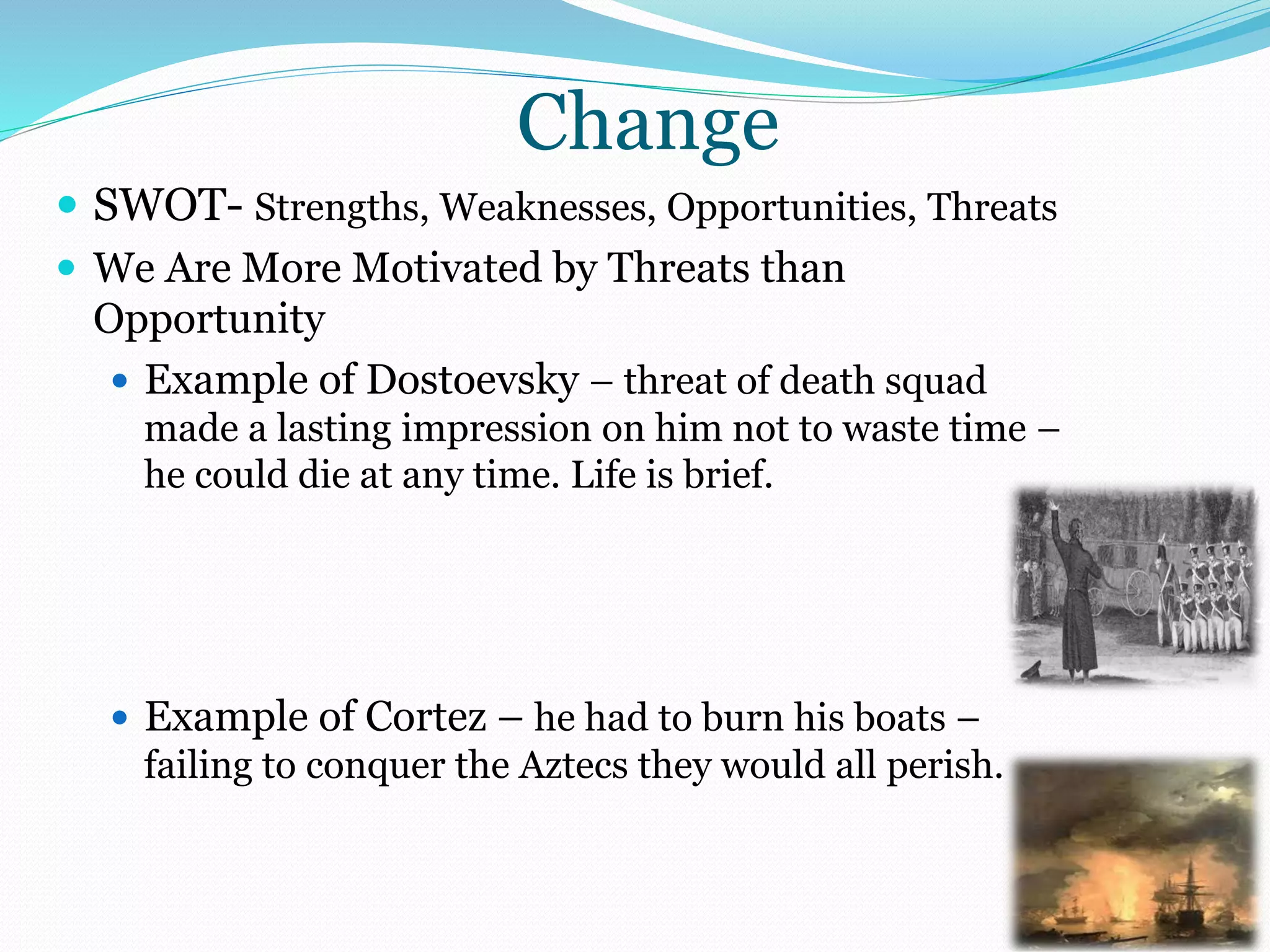
 Example of Dostoevsky – threat of death squad
made a lasting impression on him not to waste time –
he could die at any time. Life is brief.
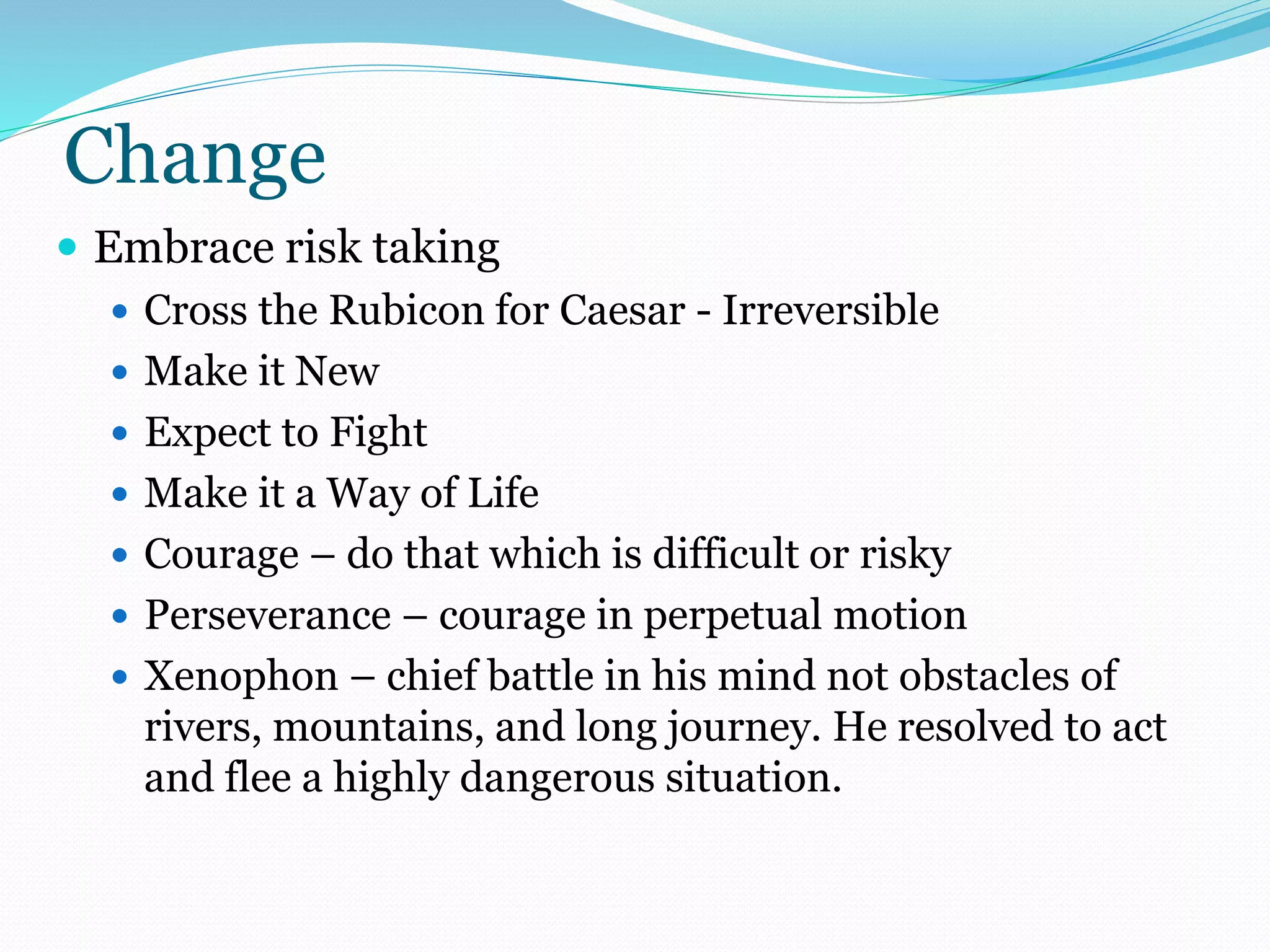
 Example of Cortez – he had to burn his boats –
failing to conquer the Aztecs they would all perish.
Change
 Embrace risk taking
 Cross the Rubicon for Caesar - Irreversible
 Make it New
 Expect to Fight
 Make it a Way of Life
 Courage – do that which is difficult or risky
 Perseverance – courage in perpetual motion
 Xenophon – chief battle in his mind not obstacles of
rivers, mountains, and long journey. He resolved to act
and flee a highly dangerous situation.
History
 From dawn of history mankind longed to peer into
the haze of the future to predict it.
 Old ancient school left it to whims of the gods,
omens, prophets, soothsayers, and seekers of oracles.
The future was outside of anyone’s ability to control.
One was left to the mystery of fate. We relied on
superstition, traditions, or an accepted fatalism
 At a practical level there was a fascination with
gambling and the thrill/profit/drama winning
brought.
World Views
 Christian West: The general population relied on the clergy
and the monarchies. The people were dependent on them
to tell them how to view life.
 Christian Reformation: The priesthood of the believer
fostered individualism. One could change their future. All
occupations of honorable work had equal validity. One
could change their future. Thrift and abstinence were
forward looking virtues of self denial.
 The rise of trade and commerce meant traders needed a
means to deal with risk. The insurance trade was given
birth. Math and the recording of math had to occur to
make this efficient and effective. The wide spread literacy
given by the printing press made this possible. Double
entry bookkeeping was invented.
Other Worldviews
 Hinduism and Buddhism: The Hindus gave the world
“zero” something that was foreign to the West until embraced.
Life was viewed as circular of a birth death rebirth cycle one
found themselves fatally caught. How could one change their
station in life?
 Islam: Time is linear. Birth, death, and resurrection.
Everything existed under the domination of the “will of Allah”.
It led to a certain fatalism. One could not control their destiny
other than through jihad or martyrdom.
 Far East: One experienced the cult like worship of the
Emperor or Emperor worship. The Emperor controlled
one’s destiny. The individual was to serve the state.
Pascal’s Wager
Wager
Assume
God
Exists
If True there would be consequences –
so find peace with Him
If False there would be no
consequences
Assume
No God
If true No consequences
If False: Fatal irreversible
consequences at stake
He showed from a pragmatic point of view to disregard God in one’s
worldview could have profound fatal consequences
How Decisions Should be Made
 Risk versus Reward
 Quantitatively – how much is gained vs lost
 Usually we can risk a little to gain a lot thus the lottery
 Usually we avoid a risk where we lose all – we are risk adverse
 Qualitatively
 What quality do we seek?
 Utility – high or low depends on the person
 Probabilities need to be calculated
 Sampling is needed to gauge risk taking or probabilities
 Poor decisions more likely if hungry, angry, lonely, tired
known as HALT
Early Examples
 Graunt’s and Halley looked at London mortality. It
gave trends and helped set life insurance premiums.
 England coffee house – Lloyds of London
 Stockbroker appeared 1688
 Wealth previously inherited now could be earned,
discovered, accumulated, invested, and yes a desire
to protect it from loss appeared
 Bernoulli’s – value of an item must not be purely its
price. What is its utility to the user? Expected value
is not enough. Subjectively enters into calculations
Assumed Good
Decision
Assumed Poor
Decision
Good Results (Gain) Example 1 90% Example 2 10%
Bad Results (Loss) Example 3 10% Example 4 90%
A Good or Poor Decision oftentimes irrevocable in nature can have good
and sometimes poor results. Four possible outcomes.
• Good Decision: Based on facts on hand the best of all possible choices
• Bad Decision: Crafted while hungry, angry, desperate, or tired done at
times impulsively, perhaps ill advised, or mistakenly informed
Example 1: Purchase a house at the right time, under the right
conditions, that proves to increase in value dramatically
Example 3: Purchase a house and a better house at a lower price appears
the following month. Or next month you lose your job or the city plans a
waste facility next door.
Example 4: Enter into an ill advised long term lease. Somehow unseen
economic conditions make you abandon the lease thus hurting your
credit.
Example 2: Enter into an ill advised long term lease. Somehow unseen
economic conditions make the landlord want to buy you out of your
lease at a premium.
Cost Versus Reward
We Are More Motivated by Threats (Cost) than Reward
Effort Pain
 Range 0% to 100%
 0% - no effort –
complacent – do
nothing
 50% half hearted
commitment
 100% all out goal
seeking which
means heighten
level of devotion
to do – burn the
boats – live or die
 Pain Range –
100% vs +100%
 0% - no
effort
 50% - mild
to annoying
 100% -
notable self
sacrifice and
denial for a
reward
Short vs Long
Time Frame
 Time Range –
 0% - no
pain – no
gain
 50% - some
pain some
gain
 100% -
short term
pain long
term gain
Paradox: Short term pleasure leads to long term pain. Prudence long term self denial leads to
pleasure.
Fools Rush in Where Angels Fear to Tread
 Prudence and Cowardice have this in common: Take no
action that could have a negative consequence. Be quiet.
Say nothing. Do Nothing. Risk nothing. Angels fear to
tread.
 Imprudence and Bravery have this in common: Take a risk
that has a host of emotional components.
 Fear of failure yet expectation of reward. Fools rush in. The
fool short term gain of pleasure long term loss. The brave
heart short term pain for long term invisible pleasure of
sustaining and rescuing a life.
 Risk appearing foolish versus brave – thus a fool impulsively
acts in a reckless fashion – a brave one places his reputation,
safety, finances, physical and mental natures at risk. Exposed.
Vulnerable.

Risk taking

  • 1.
  • 2.
    Risk Taking  Timeis Finite and Limited – We Age and Die  Our Resources are Limited  Our Endurance and Perseverance has Limits  Our Opportunities are Limited  Doing Nothing is still a Decision  What is the Utility Function or Risk versus Reward?  Risk Taking Means Change  A Lot People See Change as a Threat are Risk Adverse
  • 3.
    Change  SWOT- Strengths,Weaknesses, Opportunities, Threats  We Are More Motivated by Threats than Opportunity  Example of Dostoevsky – threat of death squad made a lasting impression on him not to waste time – he could die at any time. Life is brief.  Example of Cortez – he had to burn his boats – failing to conquer the Aztecs they would all perish.
  • 4.
    Change  Embrace risktaking  Cross the Rubicon for Caesar - Irreversible  Make it New  Expect to Fight  Make it a Way of Life  Courage – do that which is difficult or risky  Perseverance – courage in perpetual motion  Xenophon – chief battle in his mind not obstacles of rivers, mountains, and long journey. He resolved to act and flee a highly dangerous situation.
  • 5.
    History  From dawnof history mankind longed to peer into the haze of the future to predict it.  Old ancient school left it to whims of the gods, omens, prophets, soothsayers, and seekers of oracles. The future was outside of anyone’s ability to control. One was left to the mystery of fate. We relied on superstition, traditions, or an accepted fatalism  At a practical level there was a fascination with gambling and the thrill/profit/drama winning brought.
  • 6.
    World Views  ChristianWest: The general population relied on the clergy and the monarchies. The people were dependent on them to tell them how to view life.  Christian Reformation: The priesthood of the believer fostered individualism. One could change their future. All occupations of honorable work had equal validity. One could change their future. Thrift and abstinence were forward looking virtues of self denial.  The rise of trade and commerce meant traders needed a means to deal with risk. The insurance trade was given birth. Math and the recording of math had to occur to make this efficient and effective. The wide spread literacy given by the printing press made this possible. Double entry bookkeeping was invented.
  • 7.
    Other Worldviews  Hinduismand Buddhism: The Hindus gave the world “zero” something that was foreign to the West until embraced. Life was viewed as circular of a birth death rebirth cycle one found themselves fatally caught. How could one change their station in life?  Islam: Time is linear. Birth, death, and resurrection. Everything existed under the domination of the “will of Allah”. It led to a certain fatalism. One could not control their destiny other than through jihad or martyrdom.  Far East: One experienced the cult like worship of the Emperor or Emperor worship. The Emperor controlled one’s destiny. The individual was to serve the state.
  • 8.
    Pascal’s Wager Wager Assume God Exists If Truethere would be consequences – so find peace with Him If False there would be no consequences Assume No God If true No consequences If False: Fatal irreversible consequences at stake He showed from a pragmatic point of view to disregard God in one’s worldview could have profound fatal consequences
  • 9.
    How Decisions Shouldbe Made  Risk versus Reward  Quantitatively – how much is gained vs lost  Usually we can risk a little to gain a lot thus the lottery  Usually we avoid a risk where we lose all – we are risk adverse  Qualitatively  What quality do we seek?  Utility – high or low depends on the person  Probabilities need to be calculated  Sampling is needed to gauge risk taking or probabilities  Poor decisions more likely if hungry, angry, lonely, tired known as HALT
  • 10.
    Early Examples  Graunt’sand Halley looked at London mortality. It gave trends and helped set life insurance premiums.  England coffee house – Lloyds of London  Stockbroker appeared 1688  Wealth previously inherited now could be earned, discovered, accumulated, invested, and yes a desire to protect it from loss appeared  Bernoulli’s – value of an item must not be purely its price. What is its utility to the user? Expected value is not enough. Subjectively enters into calculations
  • 11.
    Assumed Good Decision Assumed Poor Decision GoodResults (Gain) Example 1 90% Example 2 10% Bad Results (Loss) Example 3 10% Example 4 90% A Good or Poor Decision oftentimes irrevocable in nature can have good and sometimes poor results. Four possible outcomes. • Good Decision: Based on facts on hand the best of all possible choices • Bad Decision: Crafted while hungry, angry, desperate, or tired done at times impulsively, perhaps ill advised, or mistakenly informed Example 1: Purchase a house at the right time, under the right conditions, that proves to increase in value dramatically Example 3: Purchase a house and a better house at a lower price appears the following month. Or next month you lose your job or the city plans a waste facility next door. Example 4: Enter into an ill advised long term lease. Somehow unseen economic conditions make you abandon the lease thus hurting your credit. Example 2: Enter into an ill advised long term lease. Somehow unseen economic conditions make the landlord want to buy you out of your lease at a premium.
  • 12.
    Cost Versus Reward WeAre More Motivated by Threats (Cost) than Reward Effort Pain  Range 0% to 100%  0% - no effort – complacent – do nothing  50% half hearted commitment  100% all out goal seeking which means heighten level of devotion to do – burn the boats – live or die  Pain Range – 100% vs +100%  0% - no effort  50% - mild to annoying  100% - notable self sacrifice and denial for a reward Short vs Long Time Frame  Time Range –  0% - no pain – no gain  50% - some pain some gain  100% - short term pain long term gain Paradox: Short term pleasure leads to long term pain. Prudence long term self denial leads to pleasure.
  • 13.
    Fools Rush inWhere Angels Fear to Tread  Prudence and Cowardice have this in common: Take no action that could have a negative consequence. Be quiet. Say nothing. Do Nothing. Risk nothing. Angels fear to tread.  Imprudence and Bravery have this in common: Take a risk that has a host of emotional components.  Fear of failure yet expectation of reward. Fools rush in. The fool short term gain of pleasure long term loss. The brave heart short term pain for long term invisible pleasure of sustaining and rescuing a life.  Risk appearing foolish versus brave – thus a fool impulsively acts in a reckless fashion – a brave one places his reputation, safety, finances, physical and mental natures at risk. Exposed. Vulnerable.