Behavioral Finance
Outlines
 Standard Theory of Finance
 Overview of Behavioral Finance
 The importance of Behavioral Finance
 Survey of behavioral characteristics
Standard Theory of Finance
 Investors
 Are rational beings
 Consider all information and accurately assess its
meaning
 Some individuals/agents may behave irrationally or
against predictions, but in the aggregate they become
irrelevant.
 Markets
 Quickly incorporate all known information
 Represent the true value of all securities
Behavioral Finance Provides an Overlay to
the Standard Theory of Finance by Stating:
 Investors
 Are not totally rational
 Often act based on imperfect information
 There are systematic patterns or cognitive errors that
do not go away in the aggregate, such that there is a
positive probability that the ‘marginal investor’ will
exhibit a cognitive bias.
 Markets
 May be difficult to beat in the long term
 In the short term, there are anomalies and excesses
Behavioral Characteristics
 Loss aversion
 Narrow framing
 Anchoring
 Mental accounting
 Diversification
 Disposition effect
 Herding
 Regret
 Media response
 Optimism
Loss Aversion
 Flip a coin.
 Heads? You lose $10,000.
 Tails? You win!
 How much would you have to win before you
take the bet?
 Write it down.
Loss Aversion
The Disproportion of Gain and Loss
 Most people want to gain between 2 and
2.5 times as much as they put at risk
 Most people will want a chance to win at
least $20,000 before they will play
 Simply put, people don’t like to lose
money
Loss Aversion
The Nature of Risk
 Your risk profile will change over time–
often based on market conditions
 Your risk pendulum can swing
dramatically
Loss Aversion
To Do List
 Devote significant attention to assessing risk
 Assess your risk tolerance at least once per
year possibly using a risk tolerance
questionnaire
 Assess your gains and losses less
frequently
Narrow Framing
 Would you accept this proposition?
A 50% chance to win $15,000
A 50% chance to lose $10,000
 Most people would say No
They want a chance to win at least twice what
they might lose (from Loss Aversion)
Narrow Framing
 Now, assume you have a net worth
of $2 million. Would you accept the
proposition now?
 Most people say Yes
People become less risk averse as their
frame of reference broadens
Narrow Framing
 Now assume you’ll flip the coin 100 times.
Would you accept the gamble now?
 Again, most people say Yes
Loss aversion is diminished by aggregation
Narrow Framing
 Investing is a series of “propositions,” not
a single event
 Performance should always be viewed
within the context of your total net worth
(as opposed to individual investments)
 Look at long-term goals, not short-term
results
Disposition Effect
 The disposition effect refers to people’s
tendency to:
Hang on to losers too long
Sell the winners too soon
 This allows them to enjoy the feeling of
winning faster and defer the pain of loss
Disposition Effect
Terrance Odeon study determined:
 Investors are 1½ times more likely to sell
winners over losers
 One-year after sale the losers under-
performed the winners that were sold by
an average of 3.5%
Disposition Effect
To Do List
 Consider some of the tax advantages
of selling losing investments
 Always measure success in terms of
progress toward long-term goals
Anchoring
 Take the last three numbers of your Social
Security number and add 400.
 Now. . .
 Attila and the Huns invaded Europe and
penetrated deep into what is now France
where they were defeated and forced to
return eastward.
 In what year did Attila’s defeat occur?
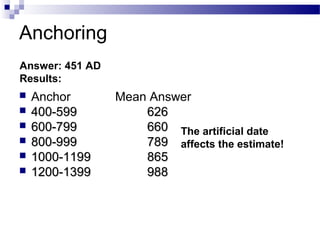
Anchoring
 Anchor Mean Answer
 400-599400-599 626626
 600-799600-799 660660
 800-999800-999 789789
 1000-11991000-1199 865865
 1200-13991200-1399 988988
Answer: 451 AD
Results:
The artificial date
affects the estimate!
Anchoring
 Anchors affect an investor’s frame
of reference
 Common investment anchors
Investment indices (DJIA, S&P 500)
CNN
Other financial advisors
Cocktail party chatter
Neighbors, relatives, co-workers
Anchoring
 Be aware of investment anchors
 Use relevant benchmarks in comparing
your investment portfolio
 Be cognizant of long-term goals, not short-
term fluctuations
Naïve Diversification
Allocation of various retirement plans:
 TIAA-CREF: One Stock Fund, One Fixed Income
50/50 Stock/Bond
 TWA Pilots: Five Stock, One Fixed Income
75/25 Stock/Bond
 University of California: One Stock, Four Fixed
Income
34/66 Stock/Bond
Naïve Diversification
 Make sure you are properly diversified
 Don’t let investment options dictate your
asset allocation
 Work with your financial advisor to
determine asset classes that will maximize
return and reduce risk
Mental Accounting
 You have just been given $300. Choose
between:
50% chance to win $100 and
50% chance to lose $100 (A)
No further bets (B)
 70% chose “A”
Mental Accounting
 You’ve not been given anything. Choose
between:
50% chance to win $400 and
50% chance to win $200 (A)
A sure gain of $300 (B)
 Now only 43% choose “A.” Why?
 The “House Money Effect”
Mental Accounting
 People often do not focus on their overall state
of wealth
 Instead they focus independently on their
different accounts
 Retirement (401(k), IRA, etc.)
 Children’s education
 Taxable investment accounts
 Dividends
 Company stock or stock options
Mental Accounting
To Do List
 Understand that keeping separate “mental
accounts” often makes investors more
conservative than they naturally are
 Measure success in terms of your overall
state of wealth
Herding
 Investors have a tendency toward “herd
behavior”
 “Line” study on the effects of herd behavior
 Disproportionate flow of money into four
and five-star rated mutual funds
 Ratings have a lack of predictive value
Regret
The Story of John and Mary
 John owns shares of Company A. He considers
selling his shares and buying stock in Company B,
but decides against it. He now finds he would have
been better off by $20,000 if he had switched to
Company B
 Mary owns shares in Company B, but switched
to Company A. She finds she would have been
better off by $20,000 if she had kept her shares of
Company B
 Who is more upset, John or Mary?
Regret
 Answer: Mary
 People typically regret errors of commission
more than errors of omission.
Media Response
 Study of the effects of news on investment
decisions:
Two groups: one received news and one did
not
The group with no news outperformed
the group that received news
Media Response
 People often feel the need to react to new
information
 News is often irrelevant to long-term
performance and is often misinterpreted
 Information overload can cause stress
Media Response
 Advice:
Stick with a long-term investment strategy
Turn your televisions off when it comes to
investment news
Don’t feel you need to react to every bit
of information you hear
Optimism
 People believe it is likely that:
 Good things will happen to them
 Bad things will happen to others
 They believe others are more likely to:
 Become an alcoholic
 Have a heart attack
 Develop cancer
 They believe others are less likely to:
 Become rich
 Become famous
Summing Up The Issues
 Physiological and emotional pain associated
with Loss Aversion and Regret
 Excessive conservatism associated with Narrow
Framing and Mental Accounting
 Loss of confidence caused by Media Response,
Herding and Anchoring
 Optimism minimizes the roles of uncertainty and
chance in investing
What you should do…
 Recognize that behavioral issues affect us all–
you are not alone
 Don’t focus on the short-term market trends, “hot
dot” products and day-to-day performance. Stick
with a long-term investment strategy
 Work with a financial professional. Financial
professionals determine how these tendencies
may be affecting the way you invest and take
steps to remedy these tendencies

Behavioral finance (2008)

  • 1.
  • 2.
    Outlines  Standard Theoryof Finance  Overview of Behavioral Finance  The importance of Behavioral Finance  Survey of behavioral characteristics
  • 3.
    Standard Theory ofFinance  Investors  Are rational beings  Consider all information and accurately assess its meaning  Some individuals/agents may behave irrationally or against predictions, but in the aggregate they become irrelevant.  Markets  Quickly incorporate all known information  Represent the true value of all securities
  • 4.
    Behavioral Finance Providesan Overlay to the Standard Theory of Finance by Stating:  Investors  Are not totally rational  Often act based on imperfect information  There are systematic patterns or cognitive errors that do not go away in the aggregate, such that there is a positive probability that the ‘marginal investor’ will exhibit a cognitive bias.  Markets  May be difficult to beat in the long term  In the short term, there are anomalies and excesses
  • 5.
    Behavioral Characteristics  Lossaversion  Narrow framing  Anchoring  Mental accounting  Diversification  Disposition effect  Herding  Regret  Media response  Optimism
  • 6.
    Loss Aversion  Flipa coin.  Heads? You lose $10,000.  Tails? You win!  How much would you have to win before you take the bet?  Write it down.
  • 7.
    Loss Aversion The Disproportionof Gain and Loss  Most people want to gain between 2 and 2.5 times as much as they put at risk  Most people will want a chance to win at least $20,000 before they will play  Simply put, people don’t like to lose money
  • 8.
    Loss Aversion The Natureof Risk  Your risk profile will change over time– often based on market conditions  Your risk pendulum can swing dramatically
  • 9.
    Loss Aversion To DoList  Devote significant attention to assessing risk  Assess your risk tolerance at least once per year possibly using a risk tolerance questionnaire  Assess your gains and losses less frequently
  • 10.
    Narrow Framing  Wouldyou accept this proposition? A 50% chance to win $15,000 A 50% chance to lose $10,000  Most people would say No They want a chance to win at least twice what they might lose (from Loss Aversion)
  • 11.
    Narrow Framing  Now,assume you have a net worth of $2 million. Would you accept the proposition now?  Most people say Yes People become less risk averse as their frame of reference broadens
  • 12.
    Narrow Framing  Nowassume you’ll flip the coin 100 times. Would you accept the gamble now?  Again, most people say Yes Loss aversion is diminished by aggregation
  • 13.
    Narrow Framing  Investingis a series of “propositions,” not a single event  Performance should always be viewed within the context of your total net worth (as opposed to individual investments)  Look at long-term goals, not short-term results
  • 14.
    Disposition Effect  Thedisposition effect refers to people’s tendency to: Hang on to losers too long Sell the winners too soon  This allows them to enjoy the feeling of winning faster and defer the pain of loss
  • 15.
    Disposition Effect Terrance Odeonstudy determined:  Investors are 1½ times more likely to sell winners over losers  One-year after sale the losers under- performed the winners that were sold by an average of 3.5%
  • 16.
    Disposition Effect To DoList  Consider some of the tax advantages of selling losing investments  Always measure success in terms of progress toward long-term goals
  • 17.
    Anchoring  Take thelast three numbers of your Social Security number and add 400.  Now. . .  Attila and the Huns invaded Europe and penetrated deep into what is now France where they were defeated and forced to return eastward.  In what year did Attila’s defeat occur?
  • 18.
    Anchoring  Anchor MeanAnswer  400-599400-599 626626  600-799600-799 660660  800-999800-999 789789  1000-11991000-1199 865865  1200-13991200-1399 988988 Answer: 451 AD Results: The artificial date affects the estimate!
  • 19.
    Anchoring  Anchors affectan investor’s frame of reference  Common investment anchors Investment indices (DJIA, S&P 500) CNN Other financial advisors Cocktail party chatter Neighbors, relatives, co-workers
  • 20.
    Anchoring  Be awareof investment anchors  Use relevant benchmarks in comparing your investment portfolio  Be cognizant of long-term goals, not short- term fluctuations
  • 21.
    Naïve Diversification Allocation ofvarious retirement plans:  TIAA-CREF: One Stock Fund, One Fixed Income 50/50 Stock/Bond  TWA Pilots: Five Stock, One Fixed Income 75/25 Stock/Bond  University of California: One Stock, Four Fixed Income 34/66 Stock/Bond
  • 22.
    Naïve Diversification  Makesure you are properly diversified  Don’t let investment options dictate your asset allocation  Work with your financial advisor to determine asset classes that will maximize return and reduce risk
  • 23.
    Mental Accounting  Youhave just been given $300. Choose between: 50% chance to win $100 and 50% chance to lose $100 (A) No further bets (B)  70% chose “A”
  • 24.
    Mental Accounting  You’venot been given anything. Choose between: 50% chance to win $400 and 50% chance to win $200 (A) A sure gain of $300 (B)  Now only 43% choose “A.” Why?  The “House Money Effect”
  • 25.
    Mental Accounting  Peopleoften do not focus on their overall state of wealth  Instead they focus independently on their different accounts  Retirement (401(k), IRA, etc.)  Children’s education  Taxable investment accounts  Dividends  Company stock or stock options
  • 26.
    Mental Accounting To DoList  Understand that keeping separate “mental accounts” often makes investors more conservative than they naturally are  Measure success in terms of your overall state of wealth
  • 27.
    Herding  Investors havea tendency toward “herd behavior”  “Line” study on the effects of herd behavior  Disproportionate flow of money into four and five-star rated mutual funds  Ratings have a lack of predictive value
  • 28.
    Regret The Story ofJohn and Mary  John owns shares of Company A. He considers selling his shares and buying stock in Company B, but decides against it. He now finds he would have been better off by $20,000 if he had switched to Company B  Mary owns shares in Company B, but switched to Company A. She finds she would have been better off by $20,000 if she had kept her shares of Company B  Who is more upset, John or Mary?
  • 29.
    Regret  Answer: Mary People typically regret errors of commission more than errors of omission.
  • 30.
    Media Response  Studyof the effects of news on investment decisions: Two groups: one received news and one did not The group with no news outperformed the group that received news
  • 31.
    Media Response  Peopleoften feel the need to react to new information  News is often irrelevant to long-term performance and is often misinterpreted  Information overload can cause stress
  • 32.
    Media Response  Advice: Stickwith a long-term investment strategy Turn your televisions off when it comes to investment news Don’t feel you need to react to every bit of information you hear
  • 33.
    Optimism  People believeit is likely that:  Good things will happen to them  Bad things will happen to others  They believe others are more likely to:  Become an alcoholic  Have a heart attack  Develop cancer  They believe others are less likely to:  Become rich  Become famous
  • 34.
    Summing Up TheIssues  Physiological and emotional pain associated with Loss Aversion and Regret  Excessive conservatism associated with Narrow Framing and Mental Accounting  Loss of confidence caused by Media Response, Herding and Anchoring  Optimism minimizes the roles of uncertainty and chance in investing
  • 35.
    What you shoulddo…  Recognize that behavioral issues affect us all– you are not alone  Don’t focus on the short-term market trends, “hot dot” products and day-to-day performance. Stick with a long-term investment strategy  Work with a financial professional. Financial professionals determine how these tendencies may be affecting the way you invest and take steps to remedy these tendencies