Risk Impact Mitigation
Lack of formal
service
portfolio
• Ill-informed decisions
• Inability to accurately assess
impact of new or changed
services
Implement Service Portfolio
Management Process
Limited
financial
information
regarding cost
of individual
services
• Inability to calculate true cost
and value of services
• Possible penalties for failure to
comply with legal, regulatory,
and requirements
Implement Financial Management for
IT Services
• More accurate accounting of
services costs
• Better understand service value
• Improved decisions and compliance
Limited
information
about
customer
usage of the
services
• Difficult to estimate impact of
usage or changing demand
• Difficult to agree to service
levels
Implement Demand Management
• Identify Pattern of Business Activity
and User Profiles
• Appropriate planning and agreed
service levels
• Support Capacity Management
process to meet changing demand
Risk Impact Mitigation
Minimal
customer
involvement
in Service
Transition
stage
• Changes are not properly
prioritized or scheduled
• Lack of User Acceptance Testing
Implement formal Business
Relationship Management process
based on existing close relationship
between IT Strategy Unit and Business
Lack of
formal
Change
Evaluation
process
• Inability to ensure expected
business value can be delivered
• Inability to ensure effectiveness
of risk mitigation and
identification of residual risk
Formalize Change Evaluation process
and identify types/levels of changes fall
under its scope
• Policy to ensure open, consistent,
fair evaluation
• Predicted vs Actual performance
Testing
focuses on
Utility only
• Failure to validate ability to
deliver against warranty
requirements
• Services fail to meet agreed
service level targets and deliver
expected value
Expand testing to validate both utility
and warranty aspects using service
level requirements and service level
targets
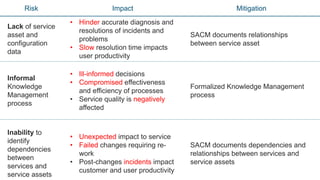
Risk Impact Mitigation
Lack of service
asset and
configuration
data
• Hinder accurate diagnosis and
resolutions of incidents and
problems
• Slow resolution time impacts
user productivity
SACM documents relationships
between service asset
Informal
Knowledge
Management
process
• Ill-informed decisions
• Compromised effectiveness
and efficiency of processes
• Service quality is negatively
affected
Formalized Knowledge Management
process
Inability to
identify
dependencies
between
services and
service assets
• Unexpected impact to service
• Failed changes requiring re-
work
• Post-changes incidents impact
customer and user productivity
SACM documents dependencies and
relationships between services and
service assets
Risk Impact Mitigation
Problem
Management
process is reactive
• Recurring incidents and
their impact to business
• Failure to identify
workaround and
improvements
Conduct proactive Problem
Management with trend analysis
Failure to focus on
all lifecycle stages
when trying to
integrate staffs and
IT of acquired
organization
• Confusion, poor morale
and performance
• Lack of adherence to
policies, processes and
procedures, and
subsequent impact on
outcomes
• Manage organizational change in all
stages
• Clear understanding of new roles &
responsibilities, policies, processes
 facilitate adoption and ensure
continued delivery of quality
services in support of business
outcomes
Risk Impact Mitigation
Lack of
involvement of
Operations
Management staffs
in Service Design
and Service
Transition activities
• Services may not fit for
purpose from an
operational perspective
• Services may not be
supportable
Engage Operations Management staffs
to ensure services are operationally fit
for purpose and supportable
• With existing resources and skills
• Without negatively impacting current
practices, processes and schedules
• Without unexpected costs, legal
complications, complex support path
with 3rd party organizations
Failure to focus
improvements at a
service level or
consider service
measurement
• Improvements may fail to
impact service quality
• Improvements may not
align to service strategy
• Implement service measurement
model
• Create scorecard that demonstrates
alignment to strategies and
business outcomes

Risk Management - ITIL MALC

  • 1.
    Risk Impact Mitigation Lackof formal service portfolio • Ill-informed decisions • Inability to accurately assess impact of new or changed services Implement Service Portfolio Management Process Limited financial information regarding cost of individual services • Inability to calculate true cost and value of services • Possible penalties for failure to comply with legal, regulatory, and requirements Implement Financial Management for IT Services • More accurate accounting of services costs • Better understand service value • Improved decisions and compliance Limited information about customer usage of the services • Difficult to estimate impact of usage or changing demand • Difficult to agree to service levels Implement Demand Management • Identify Pattern of Business Activity and User Profiles • Appropriate planning and agreed service levels • Support Capacity Management process to meet changing demand
  • 2.
    Risk Impact Mitigation Minimal customer involvement inService Transition stage • Changes are not properly prioritized or scheduled • Lack of User Acceptance Testing Implement formal Business Relationship Management process based on existing close relationship between IT Strategy Unit and Business Lack of formal Change Evaluation process • Inability to ensure expected business value can be delivered • Inability to ensure effectiveness of risk mitigation and identification of residual risk Formalize Change Evaluation process and identify types/levels of changes fall under its scope • Policy to ensure open, consistent, fair evaluation • Predicted vs Actual performance Testing focuses on Utility only • Failure to validate ability to deliver against warranty requirements • Services fail to meet agreed service level targets and deliver expected value Expand testing to validate both utility and warranty aspects using service level requirements and service level targets
  • 3.
    Risk Impact Mitigation Lackof service asset and configuration data • Hinder accurate diagnosis and resolutions of incidents and problems • Slow resolution time impacts user productivity SACM documents relationships between service asset Informal Knowledge Management process • Ill-informed decisions • Compromised effectiveness and efficiency of processes • Service quality is negatively affected Formalized Knowledge Management process Inability to identify dependencies between services and service assets • Unexpected impact to service • Failed changes requiring re- work • Post-changes incidents impact customer and user productivity SACM documents dependencies and relationships between services and service assets
  • 4.
    Risk Impact Mitigation Problem Management processis reactive • Recurring incidents and their impact to business • Failure to identify workaround and improvements Conduct proactive Problem Management with trend analysis Failure to focus on all lifecycle stages when trying to integrate staffs and IT of acquired organization • Confusion, poor morale and performance • Lack of adherence to policies, processes and procedures, and subsequent impact on outcomes • Manage organizational change in all stages • Clear understanding of new roles & responsibilities, policies, processes  facilitate adoption and ensure continued delivery of quality services in support of business outcomes
  • 5.
    Risk Impact Mitigation Lackof involvement of Operations Management staffs in Service Design and Service Transition activities • Services may not fit for purpose from an operational perspective • Services may not be supportable Engage Operations Management staffs to ensure services are operationally fit for purpose and supportable • With existing resources and skills • Without negatively impacting current practices, processes and schedules • Without unexpected costs, legal complications, complex support path with 3rd party organizations Failure to focus improvements at a service level or consider service measurement • Improvements may fail to impact service quality • Improvements may not align to service strategy • Implement service measurement model • Create scorecard that demonstrates alignment to strategies and business outcomes