Bi-level Case Management: A System Approach to Service Delivery A presentation for the  USDOL Region One  Conference on Services to Older Youth November 14-16, 2011  Boston, MA Anne C. Adams, MSW   [email_address]
WORKING DEFINITION OF  CASE MANAGEMENT A participant centered,  goal-oriented process for assessing the needs of an individual for particular  services and assisting the person to obtain those services.
Building A Case Management System What should a case management system look like? A standardized process which has been developed to achieve the primary end goal - long term employability
Building A Case Management System (cont.) Why a System is Needed : Standardization of Services   What happens to a participant should not be based upon which case manager they get Performance Objectives are More Realistically Developed, Achieved and Documented.
Building A Case Management System (cont.) Organized to: serve large numbers of participants monitor participant progress correct participant challenges or enhance participant accomplishments as they advance towards their goals
Characteristics and Advantages of a Bi-level Case Management System Definition of Bi-level Case Management A systematic approach to service delivery that:  develops a strategy for coordinating the provision of services and actively supports the implementation of that strategy [system level] utilizes a participant-centered, goal oriented process for assessing strengths and needs [participant level] assists participants to utilize necessary services to achieve individual and programmatic goals [ participant level ]
Essential Case Management Functions System Level Responsibilities:   Lead the entire case   management team in designing a   system wide strategy for service   delivery. Insure the availability of commonly needed services Insure that case managers know what they can and cannot promise participants
Essential Functions (cont.) System Level Responsibilities (cont.)   Empower case managers to “requisition” services and resources across institutional boundaries [essential to successful partnerships and collaboration] Revise traditional modes of operation when they do not work in the participants’ best interest
Essential Functions (cont.) Participant Level Responsibilities: Identify and prioritize personal strengths and needs, and translate them into a set of realistic goals Develop a plan of action for achieving the goals Access the resources needed to pursue those goals across institutions
Essential Functions (cont.) Participant Level Responsibilities: Successfully complete a “customized” set of services among a variety of institutions [real partnership in action] Help the participant access services on his or her own thereby reducing dependency on the case manager
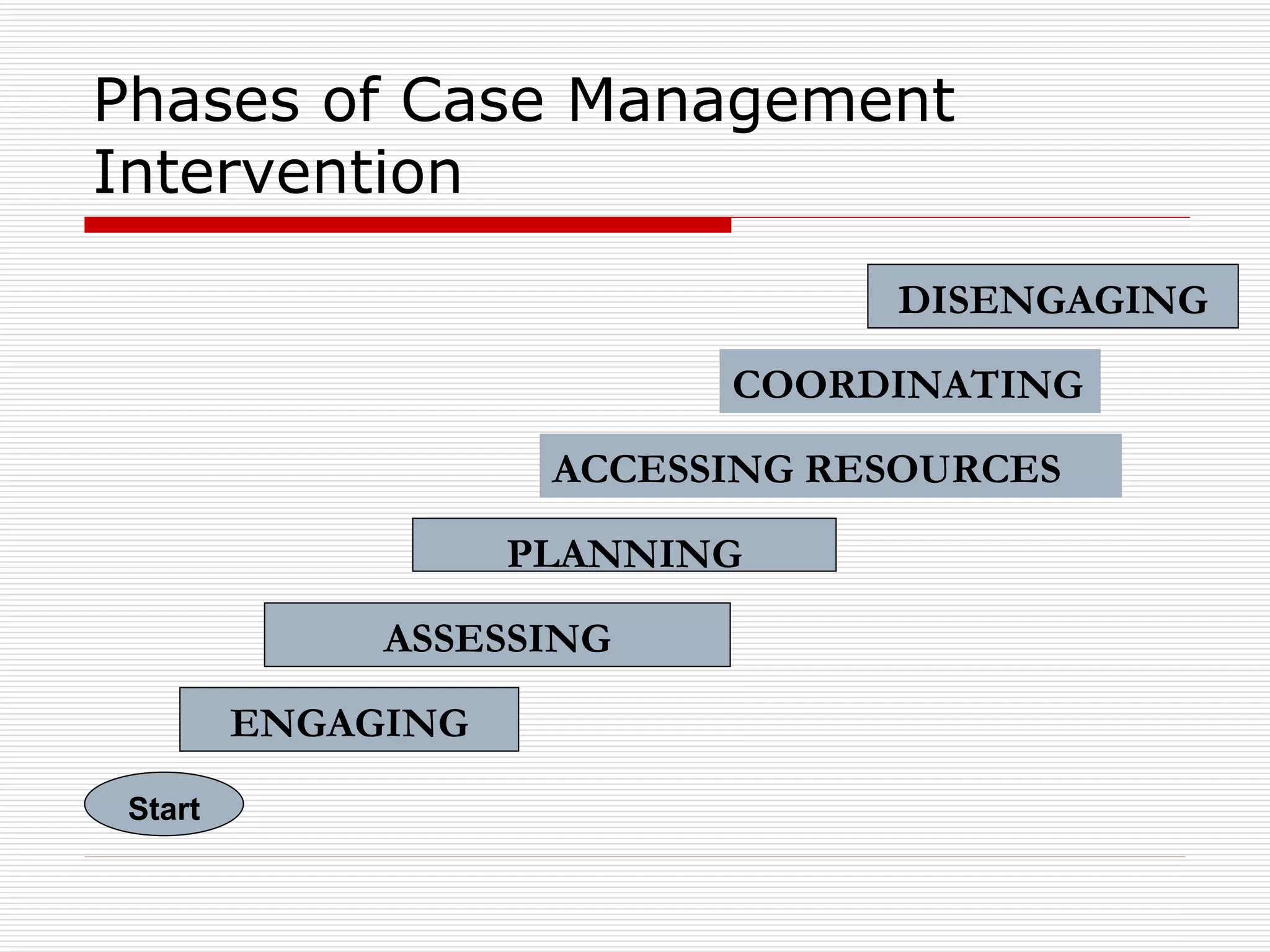
Phases of Case Management Intervention Start ENGAGING ASSESSING PLANNING ACCESSING RESOURCES COORDINATING DISENGAGING
Partnership: The Essential Case Management Relationship Establishing and maintaining a partnership with participants should be both the initial and sustaining focus and function of the case manager/participant relationship
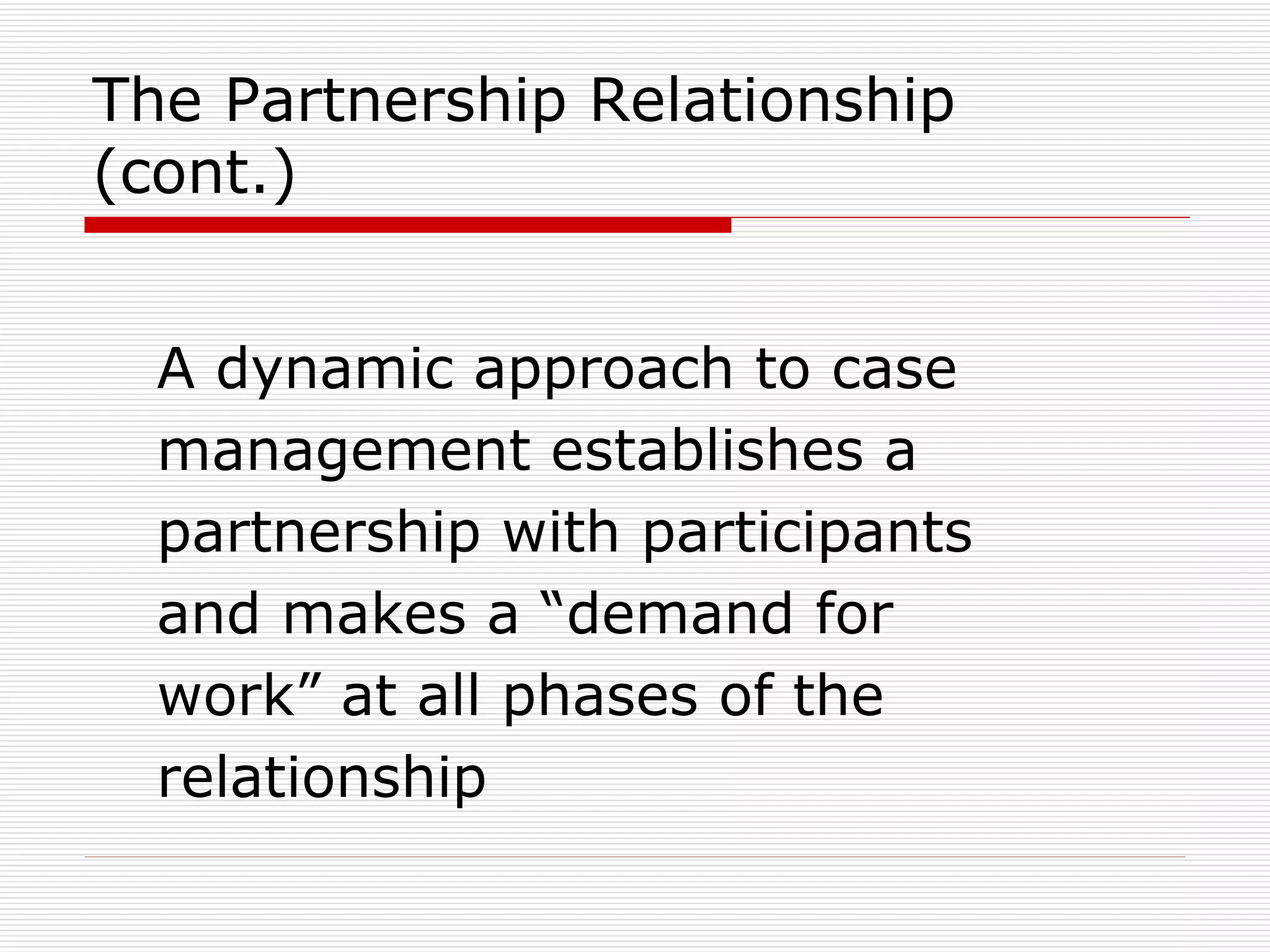
The Partnership Relationship (cont.) A dynamic approach to case management establishes a partnership with participants and makes a “demand for work” at all phases of the relationship
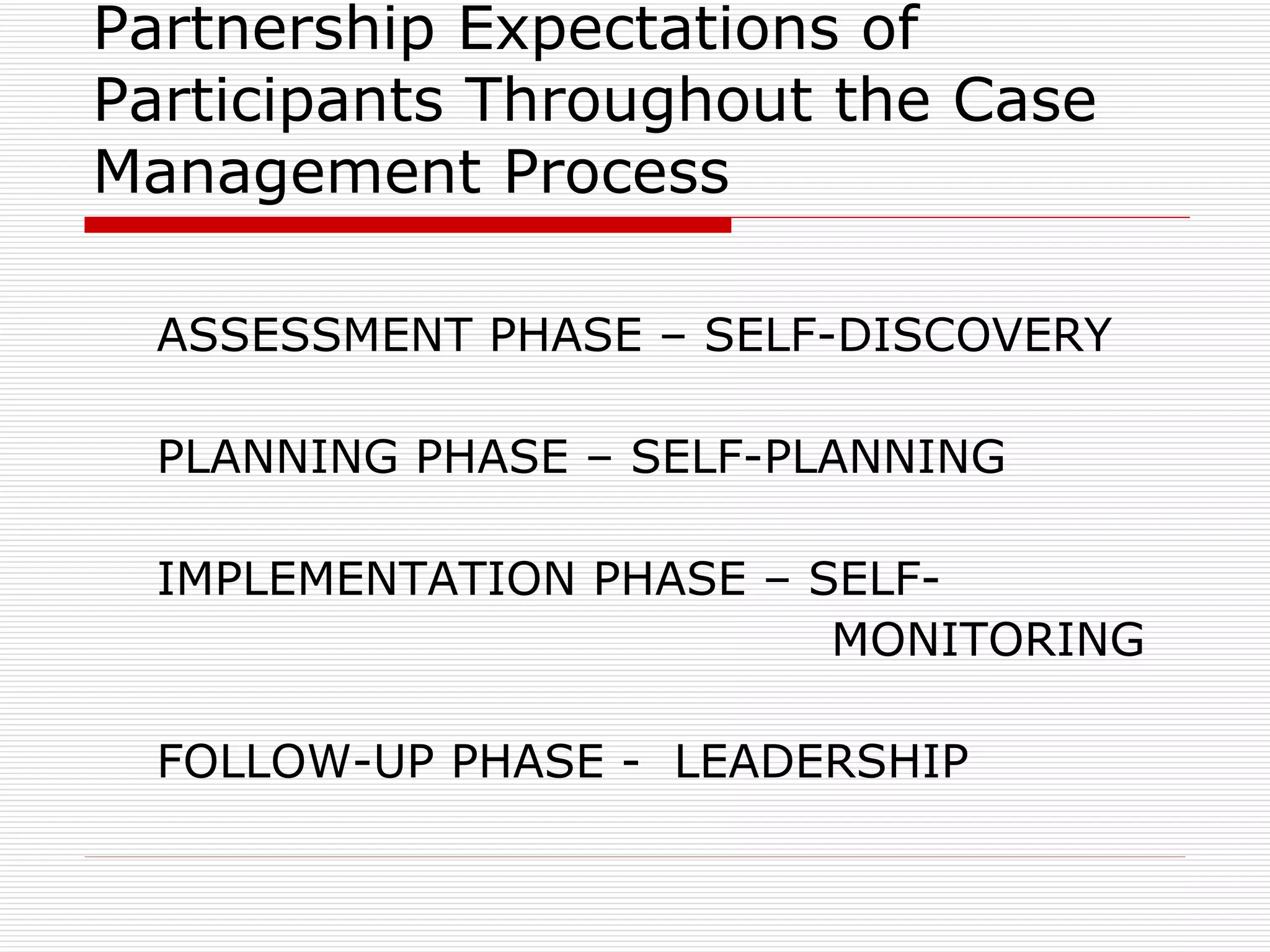
Partnership Expectations of Participants Throughout the Case Management Process ASSESSMENT PHASE – SELF-DISCOVERY PLANNING PHASE – SELF-PLANNING IMPLEMENTATION PHASE – SELF-  MONITORING FOLLOW-UP PHASE -  LEADERSHIP
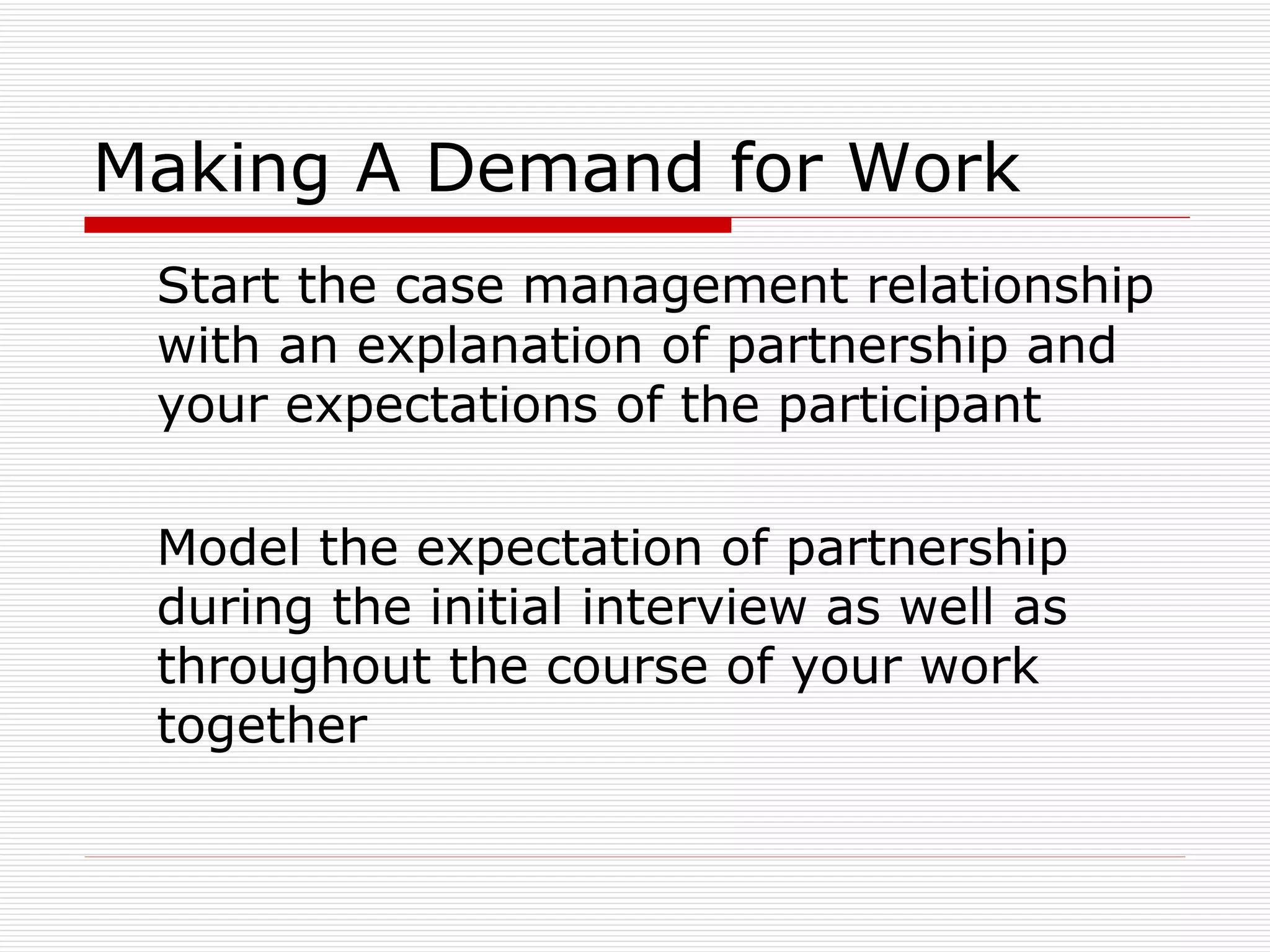
Making A Demand for Work Start the case management relationship with an explanation of partnership and your expectations of the participant Model the expectation of partnership during the initial interview as well as throughout the course of your work together
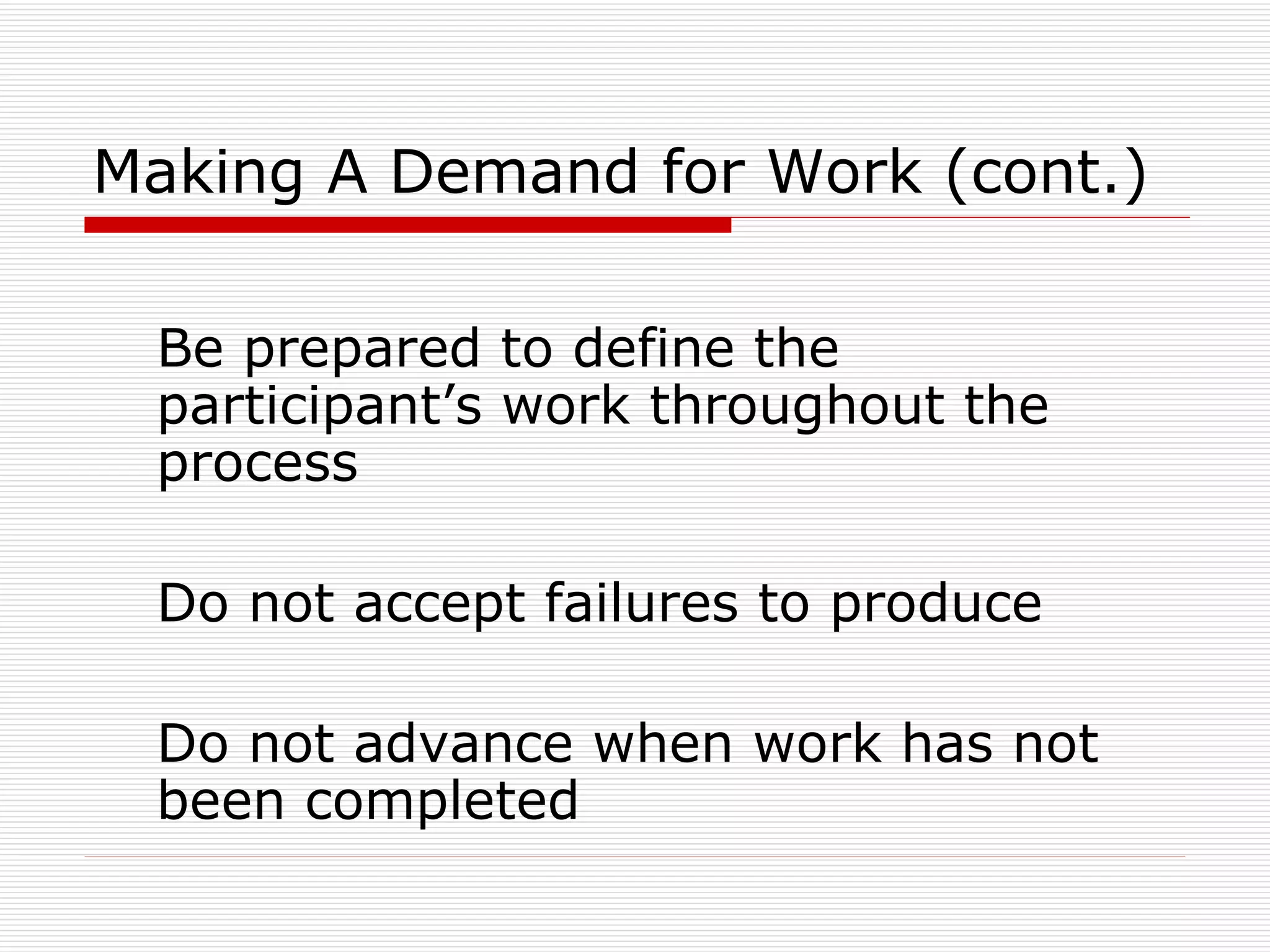
Making A Demand for Work (cont.) Be prepared to define the participant’s work throughout the process Do not accept failures to produce Do not advance when work has not been completed
Why A Partnership? Growth and change on the part of the participant is usually required to meet case management goals Personal growth and change require the active involvement of an individual Workers should not be working harder on a person’s life than they are

Learning Session 1-7 Bi-level Case Management

  • 1.
    Bi-level Case Management:A System Approach to Service Delivery A presentation for the USDOL Region One Conference on Services to Older Youth November 14-16, 2011 Boston, MA Anne C. Adams, MSW [email_address]
  • 2.
    WORKING DEFINITION OF CASE MANAGEMENT A participant centered, goal-oriented process for assessing the needs of an individual for particular services and assisting the person to obtain those services.
  • 3.
    Building A CaseManagement System What should a case management system look like? A standardized process which has been developed to achieve the primary end goal - long term employability
  • 4.
    Building A CaseManagement System (cont.) Why a System is Needed : Standardization of Services What happens to a participant should not be based upon which case manager they get Performance Objectives are More Realistically Developed, Achieved and Documented.
  • 5.
    Building A CaseManagement System (cont.) Organized to: serve large numbers of participants monitor participant progress correct participant challenges or enhance participant accomplishments as they advance towards their goals
  • 6.
    Characteristics and Advantagesof a Bi-level Case Management System Definition of Bi-level Case Management A systematic approach to service delivery that: develops a strategy for coordinating the provision of services and actively supports the implementation of that strategy [system level] utilizes a participant-centered, goal oriented process for assessing strengths and needs [participant level] assists participants to utilize necessary services to achieve individual and programmatic goals [ participant level ]
  • 7.
    Essential Case ManagementFunctions System Level Responsibilities: Lead the entire case management team in designing a system wide strategy for service delivery. Insure the availability of commonly needed services Insure that case managers know what they can and cannot promise participants
  • 8.
    Essential Functions (cont.)System Level Responsibilities (cont.) Empower case managers to “requisition” services and resources across institutional boundaries [essential to successful partnerships and collaboration] Revise traditional modes of operation when they do not work in the participants’ best interest
  • 9.
    Essential Functions (cont.)Participant Level Responsibilities: Identify and prioritize personal strengths and needs, and translate them into a set of realistic goals Develop a plan of action for achieving the goals Access the resources needed to pursue those goals across institutions
  • 10.
    Essential Functions (cont.)Participant Level Responsibilities: Successfully complete a “customized” set of services among a variety of institutions [real partnership in action] Help the participant access services on his or her own thereby reducing dependency on the case manager
  • 11.
    Phases of CaseManagement Intervention Start ENGAGING ASSESSING PLANNING ACCESSING RESOURCES COORDINATING DISENGAGING
  • 12.
    Partnership: The EssentialCase Management Relationship Establishing and maintaining a partnership with participants should be both the initial and sustaining focus and function of the case manager/participant relationship
  • 13.
    The Partnership Relationship(cont.) A dynamic approach to case management establishes a partnership with participants and makes a “demand for work” at all phases of the relationship
  • 14.
    Partnership Expectations ofParticipants Throughout the Case Management Process ASSESSMENT PHASE – SELF-DISCOVERY PLANNING PHASE – SELF-PLANNING IMPLEMENTATION PHASE – SELF- MONITORING FOLLOW-UP PHASE - LEADERSHIP
  • 15.
    Making A Demandfor Work Start the case management relationship with an explanation of partnership and your expectations of the participant Model the expectation of partnership during the initial interview as well as throughout the course of your work together
  • 16.
    Making A Demandfor Work (cont.) Be prepared to define the participant’s work throughout the process Do not accept failures to produce Do not advance when work has not been completed
  • 17.
    Why A Partnership?Growth and change on the part of the participant is usually required to meet case management goals Personal growth and change require the active involvement of an individual Workers should not be working harder on a person’s life than they are