Definitions:
• Migration: “the act of moving from one spatial unit to another“
(Baker 1978, p. 23)
• ‘true migration’ : “seasonal movement with return to starting point –
the traveller needs a return ticket”(Dingle 1996)
• Political definition: the entire population or any geographically
separate part of the population of any
species or lower taxon of wild animals, a significant proportion of
whose members cyclically and predictably cross one or more national
jurisdictional boundaries“ (CMS 1979, Article 1)
• GROMS: true migration > 100 km (excl. local migrants)
CMS
Global Register of Migratory Species (GROMS)
http://www.groms.de
A Geo-Database of migratory species at a global scale
Main results
• Identification of migratory species: bats,
terrestrial mammals, seals, sirenia, whales
and dolphins, birds, turtles, fishes
• Threat assessment (IUCN Red List 2000):
species not listed by CMS, but threatened!
• GIS „calculation“ of range states
• GIS analysis of global migrant diversity
Identification of migratory
species:
295 Mammals:
131 bats
42 terrestrial mammals
39 seals and sirenia
83 whales and dolphins
2145 Birds
10 Reptiles ( 7 marine turtles)
1895 Fishes (ray-finned fishes, lampreys, sharks and rays,
chimaeras, lobe-finned fishes)
XXL Invertebrates
(12 in GROMS, monarch butterfly on CMS App. II)
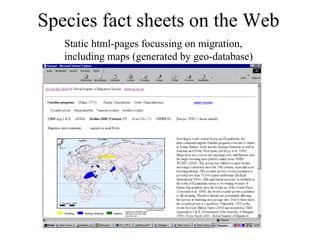
Species fact sheets on the Web
Static html-pages focussing on migration,
including maps (generated by geo-database)
Web products
Map server based on Open GIS - Open source
In cooperation with GEO-informatics, Uni Bonn.
Web-based linking of Geodata from different sources
GIS calculation of range
territories
Database import:
1,000 mapped species -
2,522 administrative units
340,000 combinations
(province – species)
GIS analysis of global migrant
diversity (540 mammals and birds)
Number of migratory species in 890 ecoregions of the World
species: 846 GROMS distribution maps
ecoregions: www-eco.shp file provided by ArcView/ESRI
Migratory Footprint of Migratory Species
occuring in Germany
Migratory Footprint of German Migrants:
breeding elsewhere
Migratory Footprint of German Migrants:
wintering elsewhere
• Geo-Database on CD-ROM
• 2 Books:
- New Perspectives for Monitoring Migratory
Animals
- Global Register of Migratory Species
• Workshops:
3 Workshops, incl. Capacity building (COP7)
• WWW publication:
http://www.groms.de
Products
Web products 6 (6)
Email discussion list (appr. 300 members)
Migration@listserv.uni-bonn.de
Perspectives: data sets
- Site data (in particular: IBA- congregation areas
BirdLife International)
- satellite tracks (for included animation tool)
Perspectives
Any information system dealing with migratory species
has to cover:
- movements of migrants, requiring a GIS with time-code,
- a higher taxonomic resolution at subspecies and/or
population level.
At present, none of the major databases covers these
aspects.
GROMS is unique because it has developed a data model
covering these aspects.
It can be used for any biodiversity information system
dealing with species distributions changing overn time

Riede marburg2003

  • 1.
    Definitions: • Migration: “theact of moving from one spatial unit to another“ (Baker 1978, p. 23) • ‘true migration’ : “seasonal movement with return to starting point – the traveller needs a return ticket”(Dingle 1996) • Political definition: the entire population or any geographically separate part of the population of any species or lower taxon of wild animals, a significant proportion of whose members cyclically and predictably cross one or more national jurisdictional boundaries“ (CMS 1979, Article 1) • GROMS: true migration > 100 km (excl. local migrants) CMS Global Register of Migratory Species (GROMS) http://www.groms.de A Geo-Database of migratory species at a global scale
  • 2.
    Main results • Identificationof migratory species: bats, terrestrial mammals, seals, sirenia, whales and dolphins, birds, turtles, fishes • Threat assessment (IUCN Red List 2000): species not listed by CMS, but threatened! • GIS „calculation“ of range states • GIS analysis of global migrant diversity
  • 3.
    Identification of migratory species: 295Mammals: 131 bats 42 terrestrial mammals 39 seals and sirenia 83 whales and dolphins 2145 Birds 10 Reptiles ( 7 marine turtles) 1895 Fishes (ray-finned fishes, lampreys, sharks and rays, chimaeras, lobe-finned fishes) XXL Invertebrates (12 in GROMS, monarch butterfly on CMS App. II)
  • 4.
    Species fact sheetson the Web Static html-pages focussing on migration, including maps (generated by geo-database)
  • 5.
    Web products Map serverbased on Open GIS - Open source In cooperation with GEO-informatics, Uni Bonn. Web-based linking of Geodata from different sources
  • 6.
    GIS calculation ofrange territories
  • 7.
    Database import: 1,000 mappedspecies - 2,522 administrative units 340,000 combinations (province – species)
  • 9.
    GIS analysis ofglobal migrant diversity (540 mammals and birds)
  • 10.
    Number of migratoryspecies in 890 ecoregions of the World species: 846 GROMS distribution maps ecoregions: www-eco.shp file provided by ArcView/ESRI
  • 11.
    Migratory Footprint ofMigratory Species occuring in Germany
  • 12.
    Migratory Footprint ofGerman Migrants: breeding elsewhere
  • 13.
    Migratory Footprint ofGerman Migrants: wintering elsewhere
  • 14.
    • Geo-Database onCD-ROM • 2 Books: - New Perspectives for Monitoring Migratory Animals - Global Register of Migratory Species • Workshops: 3 Workshops, incl. Capacity building (COP7) • WWW publication: http://www.groms.de Products
  • 15.
    Web products 6(6) Email discussion list (appr. 300 members) Migration@listserv.uni-bonn.de
  • 16.
    Perspectives: data sets -Site data (in particular: IBA- congregation areas BirdLife International) - satellite tracks (for included animation tool)
  • 17.
    Perspectives Any information systemdealing with migratory species has to cover: - movements of migrants, requiring a GIS with time-code, - a higher taxonomic resolution at subspecies and/or population level. At present, none of the major databases covers these aspects. GROMS is unique because it has developed a data model covering these aspects. It can be used for any biodiversity information system dealing with species distributions changing overn time