Great Animal MigrationsPhoto credit:  philip.bitnar - http://www.flickr.com/photos/philipbitnar/4300322083/sizes/s/in/photostream/
Migration?What does migrate or migrationmean?
Why and who studies migrations?
Are there different types of migration?
How do humans impact animal migration?
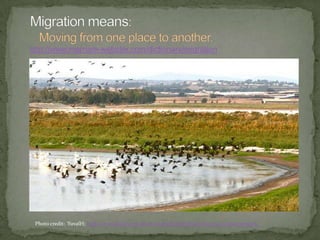
What can humans do to help animal migration?Migration means:  Moving from one place to another.http://www.merriam-webster.com/dictionary/migrationPhoto credit:  YuvalH; http://www.flickr.com/photos/yuvalh/2887261187/sizes/z/in/photostream/
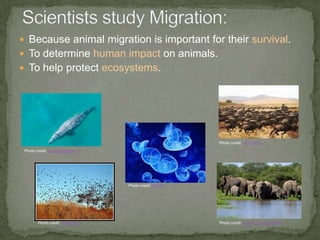
Scientists study Migration:Because animal migration is important for their survival.To determine human impact on animals.To help protect ecosystems.Photo credit:  t2min4t0rPhoto credit: charleschandlerPhoto credit: TopytiPhoto credit: moonjazzPhoto credit: Arno & Louise Wildlife
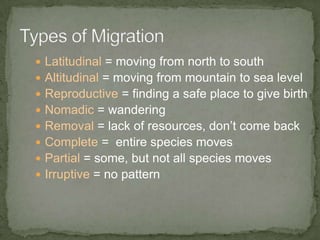
Latitudinal = moving from north to southAltitudinal= moving from mountain to sea levelReproductive = finding a safe place to give birthNomadic = wanderingRemoval = lack of resources, don’t come backComplete =  entire species movesPartial = some, but not all species movesIrruptive = no patternTypes of Migration
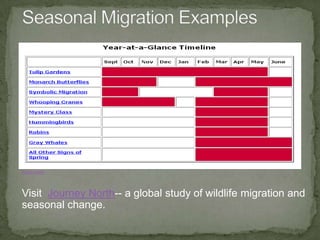
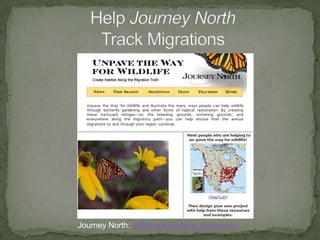
Seasonal Migration ExamplesImage creditVisit Journey North-- a global study of wildlife migration and seasonal change.
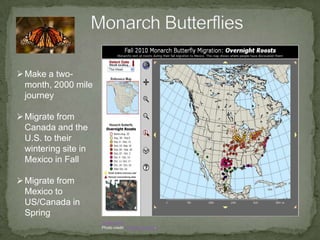
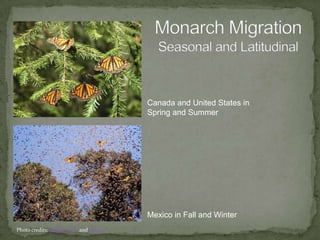
Monarch ButterfliesMake a two-month, 2000 mile journey
Migrate from Canada and the U.S. to their wintering site in Mexico in Fall
Migrate from Mexico to US/Canada in SpringImage creditPhoto credit:  Pablo Leautaud-/
Monarch Migration Seasonal and LatitudinalCanada and United States in Spring and SummerMexico in Fall and WinterPhoto credits: jndaycoulterand alexds
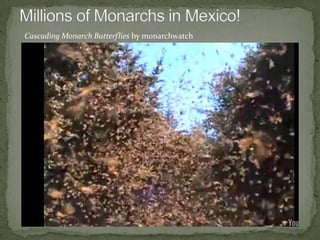
Millions of Monarchs in Mexico!Cascading Monarch Butterflies by monarchwatch
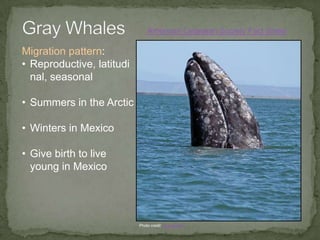
Gray WhalesAmerican Cetacean Society Fact SheetMigration pattern:Reproductive, latitudinal, seasonal
Summers in the Arctic
Winters in Mexico
Give birth to live young in MexicoPhoto credit:  jpmckenna
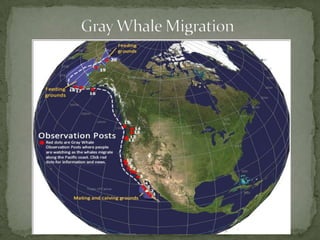
Gray Whale Migration
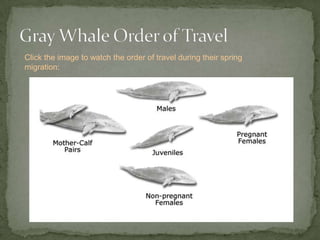
Gray Whale Order of TravelClick the image to watch the order of travel during their spring migration:
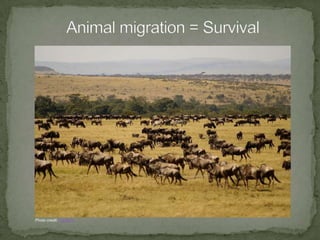
Animal migration = SurvivalPhoto credit:  bigyahu
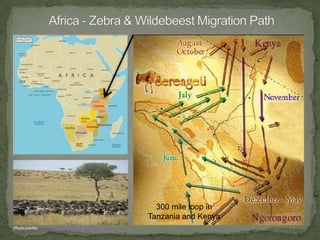
Africa - Zebra & Wildebeest Migration PathKenya & Tanzania300 mile loop in Tanzania and KenyaPhoto credits:  Pull-out by Planethopia;  Herd by jntolva
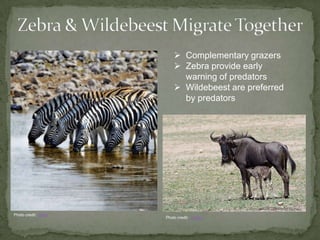
Zebra & Wildebeest Migrate TogetherComplementary grazers
Zebra provide early warning of predators
Wildebeest are preferred by predatorsPhoto credit:  aftabPhoto credit:  Jo Mur
On the Move – Wildebeest and Zebra Migration

Ewing Edtech541 Presentation

Editor's Notes

  • #5 http://channel.nationalgeographic.com/channel/great-migrations-science
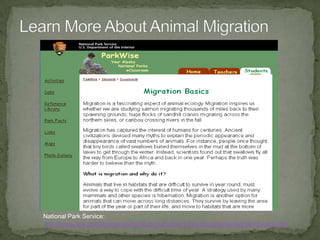
  • #6 http://www.nps.gov/akso/parkwise/students/ReferenceLibrary/general/MigrationBasics.htm
  • #8 Monarch butterflies make a two-month, 2000 mile journey from Canada and the U.S. to their wintering site in Mexico each October-December. They spend the winter in Mexico, and then begin the journey back in early spring.Make a monarch moveable object to drag on the map
  • #10 Monarchs at their wintering homeMexico.
  • #11 American Cetacean Society Fact Sheet: http://www.acsonline.org/factpack/graywhl.htmAs spring approaches, the days grow longer. Hungry whales know it's time to leave the warm waters of Mexico. They will swim nonstop northward until they reach the food-filled, icy waters of the Arctic. Time to Go AgainAfter a few short months in the Arctic, the seasons are changing again. Northern days grow shorter. Water temperatures drop. Ice starts to form. The food supply dwindles in fewer hours of sunlight. Gray whales know what to do. They head for Mexico's warm waters, thousands of miles to the south.
  • #12 Journey North Gray Whale Migration Route: http://www.learner.org/jnorth/tm/gwhale/map/route.htmlStarting in February, gray whales begin their 5,000 mile migration from their winter calving grounds in Mexico to their summer feeding grounds in the Arctic. Thanks to its nearshore migration route, we can observe the gray whale along its journey. Journey North reports the migration and timing from the Observation Posts (red dots). moveable object of gray whale
  • #14 For migratory species, “migration is crucial for survival,” “It allows animals to spend their life in two or more different areas, usually because a lack of food or a period of extreme weather makes it impossible to remain in the same location permanently.” or the need to find water or a mate, or to reach a place where they can reproduce.
  • #15 In pursuit of food and water, over a million wildebeest and half a million zebra and antelope migrate north from the Serengeti to the adjoining Maasai Mara reserve in Kenya every year. Wildebeests and zebra are in constant search for fresh grass. They’ll travel a 300-mile loop in Tanzania and Kenya, Africa.
  • #16 Plains zebraand wildebeest often intermingle. They are complementary grazers, preferring different parts of the same grass. Zebra, with their superior vision and hearing, serve as an early warning system for the wildebeest. Given the choice, predators prefer wildebeest meat to zebra. So zebra are happy to offer the carnivores that  choice.When the dry season arrives around June, the grasses are exhausted and the wildebeest head to permanent water. Forming columns which stretch for miles, the wildebeest are joined by other hoofed animals like the zebra. Predators follow and crocodiles wait hungrily in the rivers. Then, in November, when the grazing is finished in the north and the rains resume in the south, the army of animals surges back to the renewed pastures to mate and calve. Only through migration can the herds use the widespread resources of the ecosystem and build up such huge numbers.
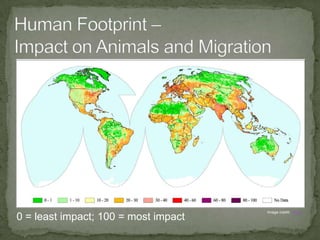
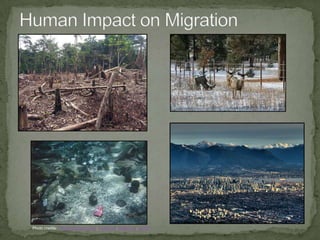
  • #18 many of these migratory species are threatened by the spread of human civilization, which increasingly encroaches upon their habitat and sometimes blocks access to the routes that species may have used for thousands of years. Additionally, humans sometimes compete with migratory animals for food or water sources, or destroy them through development.Cause extinction like migratory passenger pigeonsSeverely reduces and damages important ecosystemsRead more: http://channel.nationalgeographic.com/channel/great-migrations-science#ixzz17k5yXrk6Human Footprint Map Nasa Earth Observatory and Columbia University’s Last of the Wild Project: http://earthobservatory.nasa.gov/IOTD/view.php?id=3254
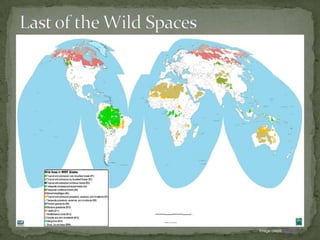
  • #19 Columbia University’s The Last of the Wild project: http://www.ciesin.columbia.edu/wild_areas/#
  • #21 Provide food and water for animalsConserveRecycle
  • #27 File Transfer resource page