Emerging Pedagogies,
Learning Spaces and Communities
                Steve Wheeler
                 @timbuckteeth
               Plymouth University
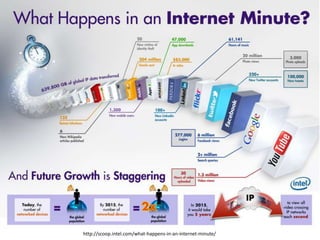
http://scoop.intel.com/what-happens-in-an-internet-minute/
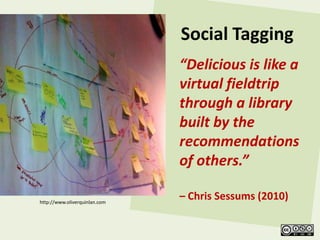
Social Tagging
                               “Delicious is like a
                               virtual fieldtrip
                               through a library
                               built by the
                               recommendations
                               of others.”

http://www.oliverquinlan.com
                               – Chris Sessums (2010)
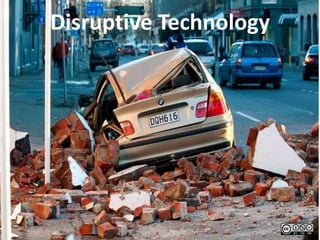
Disruptive Technology
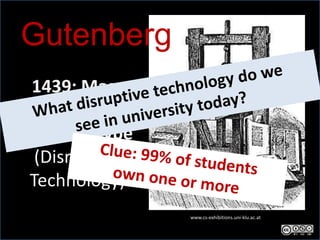
Gutenberg
 1439: Mass
  produced     M

movable type
 (Disruptive
Technology)
                   www.cs-exhibitions.uni-klu.ac.at
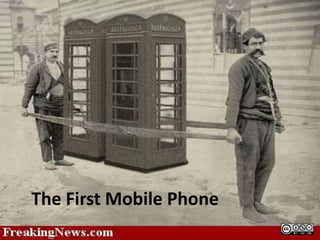
The First Mobile Phone
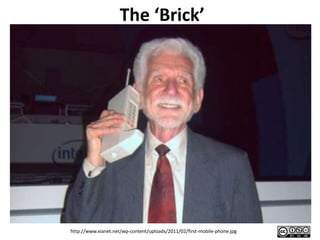
The ‘Brick’


http://www.xianet.net/wp-content/uploads/2011/02/first-mobile-phone.jpg
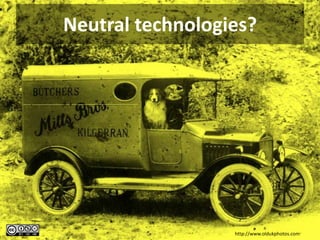
Neutral technologies?


                  http://www.oldukphotos.com
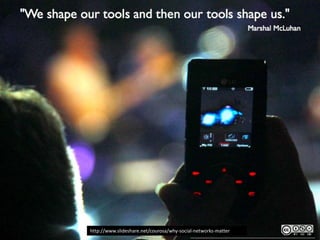
http://www.slideshare.net/courosa/why-social-networks-matter
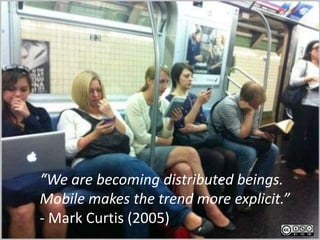
“We are becoming distributed beings.
Mobile makes the trend more explicit.”
- Mark Curtis (2005)
Digital Cultural Capital
                                              (Membership of the Tribe)
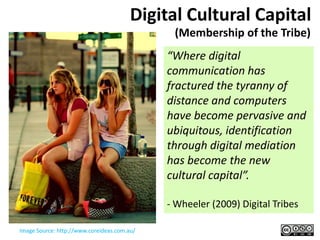
                                             “Where digital
                                             communication has
                                             fractured the tyranny of
                                             distance and computers
                                             have become pervasive and
                                             ubiquitous, identification
                                             through digital mediation
                                             has become the new
                                             cultural capital”.

                                             - Wheeler (2009) Digital Tribes

Image Source: http://www.coreideas.com.au/
Digital Totems

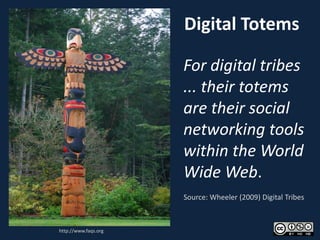
                      For digital tribes
                      ... their totems
                      are their social
                      networking tools
                      within the World
                      Wide Web.
                      Source: Wheeler (2009) Digital Tribes


http://www.faqs.org
Digital Totems
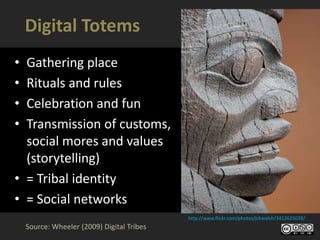
• Gathering place
• Rituals and rules
• Celebration and fun
• Transmission of customs,
  social mores and values
  (storytelling)
• = Tribal identity
• = Social networks
                                            http://www.flickr.com/photos/jcbwalsh/3412625028/
    Source: Wheeler (2009) Digital Tribes
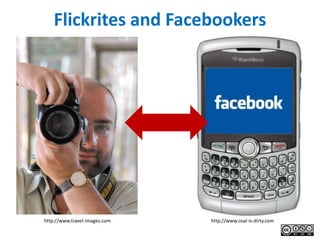
Flickrites and Facebookers


http://www.travel-images.com   http://www.coal-is-dirty.com
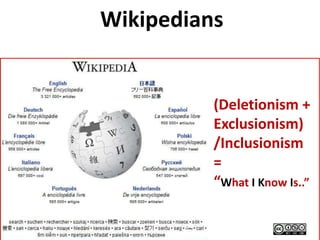
Wikipedians


          (Deletionism +
          Exclusionism)
          /Inclusionism
          =
          “What I Know Is..”
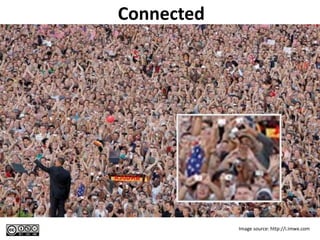
Connected


Image source: http://i.imwx.com


                                  cc Steve Wheeler, University of Plymouth, 2010
The Future...?

• 1990: ‘The future is multi-media’
• 2000: ‘The future is the Web’
• 2010: ‘The future is smart mobile’
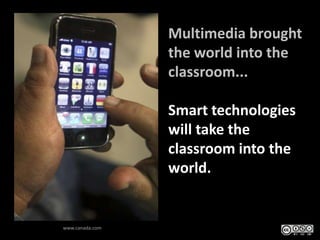
Multimedia brought
                 the world into the
                 classroom...

                 Smart technologies
                 will take the
                 classroom into the
                 world.


www.canada.com
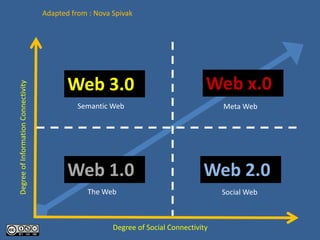
Adapted from : Nova Spivak


                                            Web 3.0                                  Web x.0
Degree of Information Connectivity


                                               Semantic Web                              Meta Web


                                            Web 1.0                                 Web 2.0
                                                  The Web                                Social Web


                                                         Degree of Social Connectivity
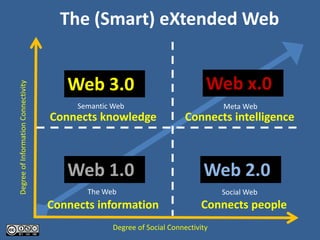
The (Smart) eXtended Web


                                        Web 3.0                                Web x.0
Degree of Information Connectivity


                                          Semantic Web                             Meta Web
                                     Connects knowledge                  Connects intelligence


                                        Web 1.0                               Web 2.0
                                            The Web                                Social Web
                                     Connects information                     Connects people
                                                   Degree of Social Connectivity
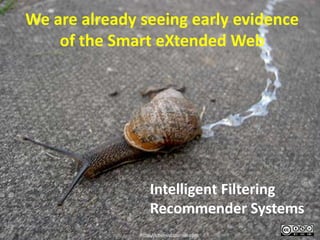
We are already seeing early evidence
    of the Smart eXtended Web


                   Intelligent Filtering
                   Recommender Systems
               http://chemistscorner.com
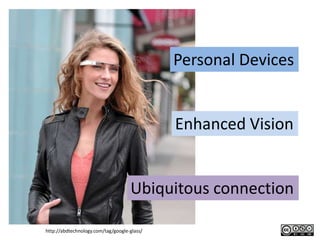
Personal Devices


                                             Enhanced Vision


                                    Ubiquitous connection

http://abdtechnology.com/tag/google-glass/
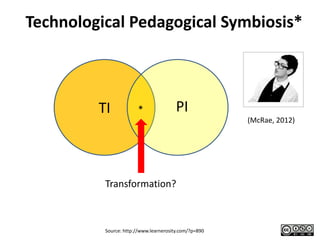
Technological Pedagogical Symbiosis*


         TI            *                PI
                                                       (McRae, 2012)


          Transformation?


          Source: http://www.learnerosity.com/?p=890
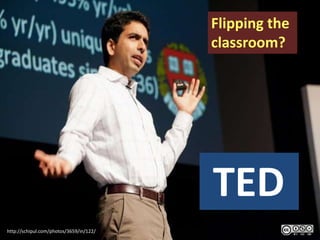
Flipping the
                                         classroom?


                                         TED
http://schipul.com/photos/3659/in/122/
Flip the roles, not the classroom
We learn by teaching

 http://campussolutionsinc.com/tag/reach-college-students/
Bearpit Pedagogy


http://open.salon.com
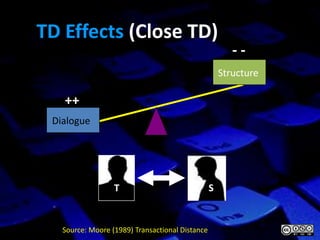
TD Effects (Close TD)
                                                        --
                                                     Structure

   ++
 Dialogue


                  T                              S


   Source: Moore (1989) Transactional Distance
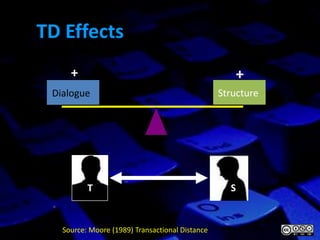
TD Effects
     +                                                 +
 Dialogue                                        Structure


          T                                        S


   Source: Moore (1989) Transactional Distance
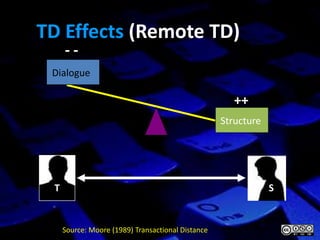
TD Effects (Remote TD)
     --
 Dialogue

                                                      ++
                                                   Structure


 T                                                             S


     Source: Moore (1989) Transactional Distance
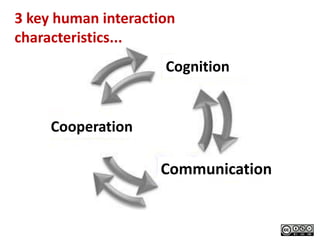
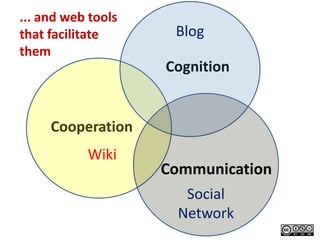
3 key human interaction
characteristics...
                     Cognition


     Cooperation

                    Communication
... and web tools
that facilitate      Blog
them
                    Cognition


     Cooperation
           Wiki
                    Communication
                       Social
                      Network
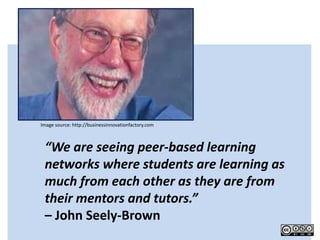
Image source: http://businessinnovationfactory.com


 “We are seeing peer-based learning
 networks where students are learning as
 much from each other as they are from
 their mentors and tutors.”
 – John Seely-Brown
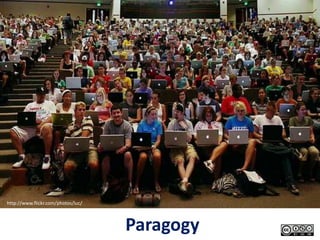
http://www.flickr.com/photos/luc/


                                    Paragogy
Connectivism
             We live in a techno-social world

      Learning occurs inside and outside of
       people – we store our knowledge in
         computers and in other people
                – George Siemens


 Source: George Siemens www.connectivism.ca/
http://www.sciencedaily.com
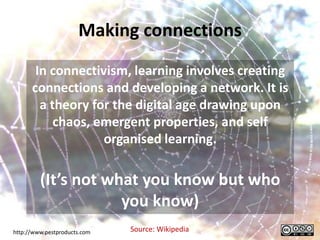
Making connections
       In connectivism, learning involves creating
      connections and developing a network. It is
        a theory for the digital age drawing upon
           chaos, emergent properties, and self
                   organised learning.

         (It’s not what you know but who
                     you know)
http://www.pestproducts.com   Source: Wikipedia
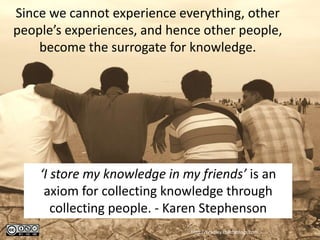
Since we cannot experience everything, other
people’s experiences, and hence other people,
    become the surrogate for knowledge.


    ‘I store my knowledge in my friends’ is an
     axiom for collecting knowledge through
       collecting people. - Karen Stephenson
                              http://bradley.chattablogs.com
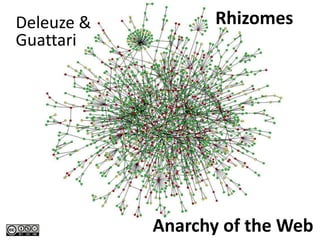
Deleuze &          Rhizomes
Guattari


            Anarchy of the Web
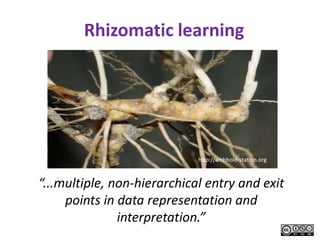
Rhizomatic learning


                             http://archbold-station.org


“...multiple, non-hierarchical entry and exit
     points in data representation and
               interpretation.”
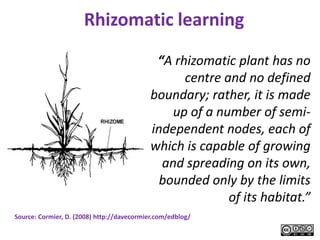
Rhizomatic learning

                                             “A rhizomatic plant has no


                                                                         © Steve Wheeler, University of Plymouth, 2008
                                                  centre and no defined
                                            boundary; rather, it is made
                                                up of a number of semi-
                                            independent nodes, each of
                                            which is capable of growing
                                              and spreading on its own,
                                              bounded only by the limits
                                                          of its habitat.”
Source: Cormier, D. (2008) http://davecormier.com/edblog/
Rhizomatic learning

“In the rhizomatic view,


                                                                          © Steve Wheeler, University of Plymouth, 2008
knowledge can only be
negotiated, [and is] a
personal knowledge-
creation process with
mutable goals and
constantly negotiated
premises.”
              Source: Cormier, D. (2008) http://davecormier.com/edblog/
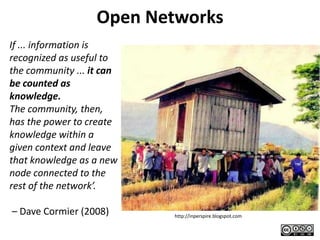
Open Networks
If ... information is
recognized as useful to
the community ... it can
be counted as
knowledge.
The community, then,
has the power to create
knowledge within a
given context and leave
that knowledge as a new
node connected to the
rest of the network’.

– Dave Cormier (2008)      http://inperspire.blogspot.com
Community as curriculum
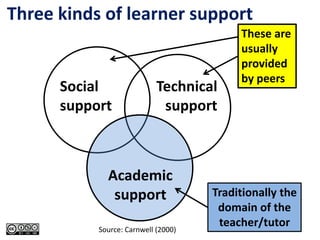
Three kinds of learner support
                                          These are
                                          usually
                                          provided
                                          by peers
      Social                Technical
      support                support


             Academic
              support                Traditionally the
                                      domain of the
           Source: Carnwell (2000)
                                      teacher/tutor
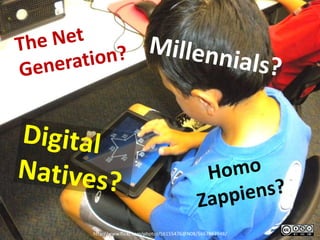
http://www.flickr.com/photos/56155476@N08/5667863948/
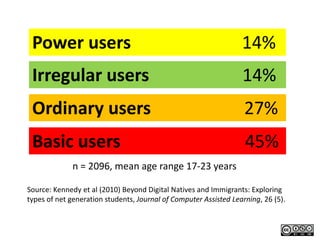
Power users                                                      14%
 Irregular users                                                  14%
 Ordinary users                                                    27%
 Basic users                                                       45%
              n = 2096, mean age range 17-23 years

Source: Kennedy et al (2010) Beyond Digital Natives and Immigrants: Exploring
types of net generation students, Journal of Computer Assisted Learning, 26 (5).
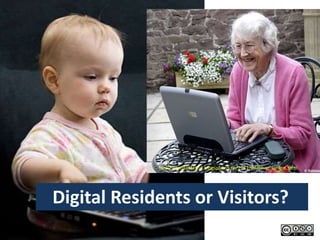
http://truedantalion.blogspot.co.uk/2011/09/silver-surfers.html


Digital Residents or Visitors?
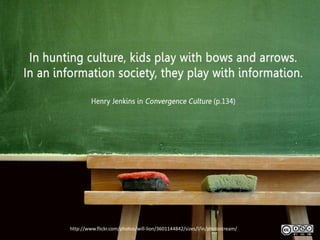
http://www.flickr.com/photos/will-lion/3601144842/sizes/l/in/photostream/
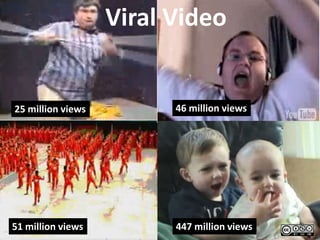
Viral Video


25 million views         46 million views


51 million views         447 million views
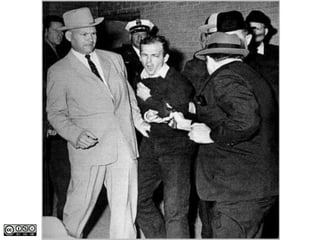
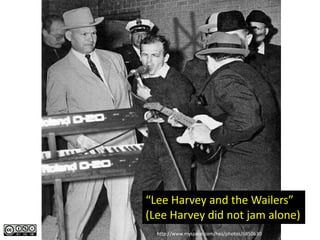
“Lee Harvey and the Wailers”
(Lee Harvey did not jam alone)
  http://www.myspace.com/hsu/photos/6850630
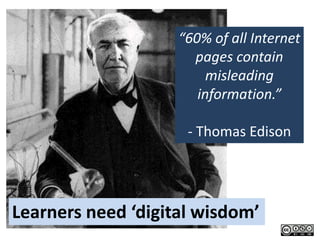
“60% of all Internet
                      pages contain
                         misleading
                       information.”

                     - Thomas Edison


Learners need ‘digital wisdom’
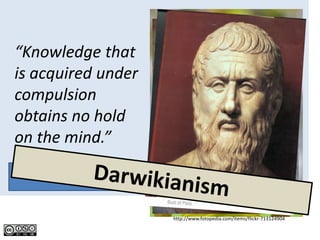
“Knowledge that
is acquired under
compulsion
obtains no hold
on the mind.”

     Plato
- Socrates
                    http://www.fotopedia.com/items/flickr-713124904
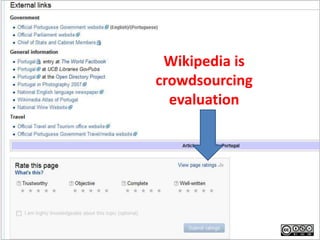
Wikipedia is
crowdsourcing
  evaluation
MOOC
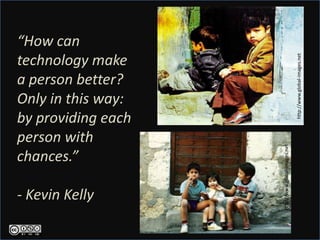
“How can
technology make


                                                   http://www.global-images.net
a person better?
Only in this way:
by providing each
person with


                    http://www.global-images.net
chances.”

- Kevin Kelly
W: steve-wheeler.net
E: swheeler@plymouth.ac.uk
B: steve-wheeler.blogspot.com
T: @timbuckteeth

Emerging Pedagogies, Learning Spaces and Communities

Editor's Notes

  • #52 [There are no digital natives. We are all in this together #ICL2012]