

Effective Plan Design &
Administration
April 29, 2015
Savannah Golf Club
presented by:
Rick Pummill, CLU, QPA, QKA
Manager of Consulting and Compliance
Brentwood, TN
Dayton, OH
Greenville, SC
800-529-4249
www.trpcweb.com
Brentwood, TN
Dayton, OH
Greenville, SC
www.trpcweb.com
What We Will Cover
• Plan Design Options
• Electronic Delivery of Participant Disclosures
• Compliance Testing
• Terminated Participants
Plan Design
Options
Plan Design
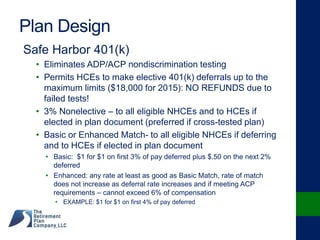
Safe Harbor 401(k)
• Eliminates ADP/ACP nondiscrimination testing
• Permits HCEs to make elective 401(k) deferrals up to the
maximum limits ($18,000 for 2015): NO REFUNDS due to
failed tests!
• 3% Nonelective – to all eligible NHCEs and to HCEs if
elected in plan document (preferred if cross-tested plan)
• Basic or Enhanced Match- to all eligible NHCEs if deferring
and to HCEs if elected in plan document
• Basic: $1 for $1 on first 3% of pay deferred plus $.50 on the next 2%
deferred
• Enhanced: any rate at least as good as Basic Match, rate of match
does not increase as deferral rate increases and if meeting ACP
requirements – cannot exceed 6% of compensation
• EXAMPLE: $1 for $1 on first 4% of pay deferred
Plan Design
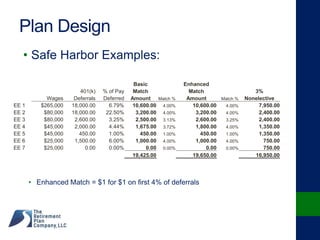
• Safe Harbor Examples:
Basic Enhanced
401(k) % of Pay Match Match 3%
Wages Deferrals Deferred Amount Match % Amount Match % Nonelective
EE 1 $265,000 18,000.00 6.79% 10,600.00 4.00% 10,600.00 4.00% 7,950.00
EE 2 $80,000 18,000.00 22.50% 3,200.00 4.00% 3,200.00 4.00% 2,400.00
EE 3 $80,000 2,600.00 3.25% 2,500.00 3.13% 2,600.00 3.25% 2,400.00
EE 4 $45,000 2,000.00 4.44% 1,675.00 3.72% 1,800.00 4.00% 1,350.00
EE 5 $45,000 450.00 1.00% 450.00 1.00% 450.00 1.00% 1,350.00
EE 6 $25,000 1,500.00 6.00% 1,000.00 4.00% 1,000.00 4.00% 750.00
EE 7 $25,000 0.00 0.00% 0.00 0.00% 0.00 0.00% 750.00
19,425.00 19,650.00 16,950.00
• Enhanced Match = $1 for $1 on first 4% of deferrals
Plan Design
Auto Enrollment 401(k)
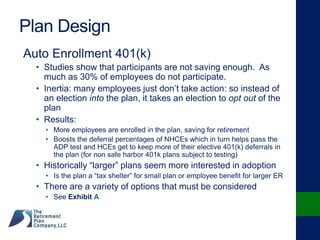
• Studies show that participants are not saving enough. As
much as 30% of employees do not participate.
• Inertia: many employees just don’t take action: so instead of
an election into the plan, it takes an election to opt out of the
plan
• Results:
• More employees are enrolled in the plan, saving for retirement
• Boosts the deferral percentages of NHCEs which in turn helps pass the
ADP test and HCEs get to keep more of their elective 401(k) deferrals in
the plan (for non safe harbor 401k plans subject to testing)
• Historically “larger” plans seem more interested in adoption
• Is the plan a “tax shelter” for small plan or employee benefit for larger ER
• There are a variety of options that must be considered
• See Exhibit A
Plan Design
Auto Enrollment 401(k)
• HR departments must be diligent in administering auto
enrollment features:
• Properly enroll new entrants and keep track of who is auto
enrolled
• Notices- upon enrollment and annually thereafter
• Investment of new participants deferral; default – QDIA?
• 90-day withdrawal option for those who ultimately decide not to
participate
• Automatic escalators if any; % will vary from employee to
employee
• Properly track traditional and Roth deferrals
• Coordinate with payroll provider!
Plan Design
Cross Testing (aka “new comparability”)
• Plan Documents must contain the methodology that will be
used to allocate any nonelective (i.e. profit sharing)
contributions
• Typically: 1) prorata on compensation or 2) “permitted
disparity” aka social security integration
• Cross Testing – profit sharing with a “twist”
• Plan document provision: employer has the ability to target various groups
or individuals and skew more of the contribution towards those individuals
• Permitted to put all participants in their own group
• E.g. Salaried and hourly employees or Savannah and Atlanta locations
• Nondiscrimination testing projects current contributions to normal
retirement age and compares the annual benefits that could be provided
• Testing will typically work best if a the “favored” individual/group is
somewhat older than others or relatively equal range of ages
Plan Design
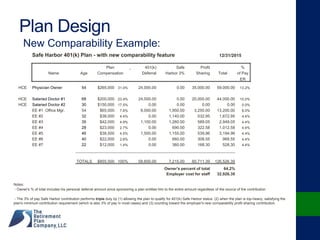
New Comparability Example:
Safe Harbor 401(k) Plan - with new comparability feature 12/31/2015
Plan 401(k) Safe Profit %
Name Age Compensation Deferral Harbor 3% Sharing Total of Pay
ER
HCE Physician Owner 54 $265,000 31.0% 24,000.00 0.00 35,000.00 59,000.00 13.2%
HCE Salaried Doctor #1 68 $200,000 23.4% 24,000.00 0.00 20,000.00 44,000.00 10.0%
HCE Salaried Doctor #2 30 $150,000 17.5% 0.00 0.00 0.00 0.00 0.0%
EE #1 Office Mgr. 54 $65,000 7.6% 8,000.00 1,950.00 3,250.00 13,200.00 8.0%
EE #2 32 $38,000 4.4% 0.00 1,140.00 532.95 1,672.95 4.4%
EE #3 35 $42,000 4.9% 1,100.00 1,260.00 589.05 2,949.05 4.4%
EE #4 28 $23,000 2.7% 0.00 690.00 322.58 1,012.58 4.4%
EE #5 46 $38,500 4.5% 1,500.00 1,155.00 539.96 3,194.96 4.4%
EE #6 40 $22,000 2.6% 0.00 660.00 308.55 968.55 4.4%
EE #7 22 $12,000 1.4% 0.00 360.00 168.30 528.30 4.4%
TOTALS $855,500 100% 58,600.00 7,215.00 60,711.39 126,526.39
Owner's percent of total 64.2%
Employer cost for staff 32,926.39
Notes:
- Owner's % of total includes his personal deferral amount since sponsoring a plan entitles him to the entire amount regardless of the source of the contribution
- The 3% of pay Safe Harbor contribution performs triple duty by (1) allowing the plan to qualify for 401(k) Safe Harbor status (2) when the plan is top-heavy, satisfying the
plan's minimum contribution requirement (which is also 3% of pay in most cases) and (3) counting toward the employer's new comparability profit sharing contribution.
Plan Design
Related Employers – what to do?
• Controlled group or affiliated service group members
• Might not be different companies but rather two or more
locations or natural division of employees
• Savannah and Atlanta / Salaried and Hourly
• If both employers have a plan or desire to have a plan should
they be separate plans or one larger plan?
• Another company can also adopt your plan
• Considerations
• Cost!
• Economies of scale – administration costs likely to be less if one
larger plan; combining investment arrangements for discounts; one
plan document vs two; but
• Possibility of plan audits earlier when one larger plan
• Sharing plan information – not always a good thing
• Compliance testing
Plan Restatements
REMINDER! DC PPA Restatements
• Preapproved plans: Restatement period is 5/1/14 to
4/30/16
• Is your plan already restated?
• If not, do you have a document provider who is
scheduled to complete this important task?
Electronic Delivery of
Participant Disclosures
Electronic Delivery
ERISA/DOL Disclosures
• Summary Plan Description
• Summary of Material Modifications
• Summary Annual Report
• Fee Disclosure & Comparative Chart
• ERISA 404(c) Related Disclosures
• Mapping Notice
• Blackout Notice
• ERISA 204(h) Notice
• Benefit Statements
• QDIA Notice
Electronic Delivery
IRS Related Notices
• 402(f) or rollover notice, Tax withholding notice
• QJSA, QOSA and QPSA Notices
• Notice to Interested Parties
• Safe Harbor 401(k) Notices
• SIMPLE Notice
• Automatic Contribution, EACA, Notice
• Divestiture of Employer Stock Notice
• Participant Loan Related Notices/Disclosures
• QDRO Related Notices
Electronic Delivery
DOL established a general standard for
delivering plan information:
• Plan Administrator must use measures
“reasonably calculated to ensure actual
receipt of the material”
• In-hand delivery at an employee’s worksite
• First class mail or other classes of mail if return
and forwarding postage is guaranteed and
address corrections
• Insert in a periodical distributed to employees
• Merely making a disclosure available or posting it
on a bulletin board does not satisfy this general
standard.
Electronic Delivery
• Using electronic methods for delivering
communications and disclosures may:
• Simplify the process
• Provide more reliable delivery
• Possibly reduce administration costs
• Electronic methods:
• Electronic mail
• Website (typically at workplace)
• Telephonic system
• Magnetic disk
• CD-ROM
Electronic Delivery
IRS and DOL have authority over different
notices
• IRS rules are less restrictive than DOL because they
only require an employee be reasonably able to
access the information system, not that the employee
is required to do so regularly as part of their normal job
duties.
• Therefore, if you meet the DOL Safe Harbor for all
communications they will generally satisfy the IRS
Guidance
Electronic Delivery
DOL Safe Harbor
General requirements of electronic delivery of document:
• Designed to reasonably assure actual receipt (may require
periodic reviews and return receipt or undeliverable notifications)
• Designed to protect confidentiality of personal information
• Notice to participants that the document is available, and
apprises participants of the document’s significance
• Informs participants of the right to request a paper copy
• Satisfies any applicable style, format and consent
requirements to the particular disclosure
• Must contain all of the information required to be included
in the particular disclosure
Electronic Delivery
DOL Safe Harbor – 2 Groups of EEs
Wired at Work – Can send documents electronically to current
employees participating in a 401(k) or other retirement plan without
obtaining advance consent. To be “Wired at Work”:
• An employee must have the ability to effectively access electronic
documents at any location where the employee is reasonably
expected to perform their duties as an employee, and
• Using the employer’s electronic information system must be an
integral part of the employee’s duties
Because this group uses their employers’ electronic system as a regular part
of their employment, the DOL has not required the notice and system
access safeguards that apply where participants and beneficiaries give
“Affirmative Consent” to receive plan information electronically. In fact, it is
an open question whether an employee who is “Wired at Work” may opt-out
of receiving plan information electronically.
Electronic Delivery
DOL Safe Harbor – 2 Groups of EEs
Wired at Work
NOTE: A common question asked about the “Wired at Work”
method is whether an employer may set up computer kiosks for
use during work hours to access plan information when
employees do not have computers on their desks. The DOL has
consistently taken the position that mere “access” to a computer
during working hours is insufficient; rather, access must be an
“integral part” of the employee’s duties. Simply
providing computer kiosks on a shop floor or in a mail room,
even if employees may use the computers during working
hours, does not make employees “Wired at Work.”
Electronic Delivery
DOL Safe Harbor – 2 Groups of EEs
Affirmative Consent - Cannot send documents electronically
without affirmative consent. For employees that don’t meet the “wired at
work” conditions as well as former employee participants, alternate payees
or beneficiaries. They must, before consenting, receive a clear statement
describing: (Exhibit B)
• The types of documents to which the consent would apply
• That consent can be withdrawn at any time without charge
• The procedures for withdrawing consent and for updating the
individual’s address for receiving electronically delivered
documents
• The right to request and obtain a paper version of an electronic
document, including whether the paper version will be provided free
of charge, and
• Identify any hardware and software requirements for accessing and
retaining the documents (if a change then additional disclosures required
and participant must reconsent)
Electronic Delivery
DOL Additional Methods Approved
Continuous Access Website
• Permits plans to make quarterly benefit statements
available through one or more “secure continuous
access websites”
• Annual notice needed with the following information:
• Explanation of the availability of the information on website
• Instructions on how to access the information, and
• Participant’s right to request free of charge a paper copy
• Can send notice electronically to participants who are
“wired at work” or who have given “affirmative consent”,
otherwise via first class mail or other approved method.
• Even if the notice has to be sent via mail, the quarterly
statement can still be on the website
Electronic Delivery
DOL Additional Methods Approved
Assumed Consent
• In a Technical Release (2011-03R) the assumed
consent method can be used for electronic delivery
• Required annual fee and investment information for
participant directed plans, a participant’s consent can be
assumed if:
• Participant provided with an initial notice containing similar
information to what is required under “Affirmative Consent”
• After receiving the notice, the participant voluntarily provides
the plan administrator an e-mail address, and
• Plan Administrator provides the participant an annual notice
similar to the initial notice
• If the quarterly expense information is provided as part of the participant
benefit statement, then the disclosures may be furnished in the same way
that the other information in the benefit statement is furnished.
Electronic Delivery
Final thoughts
• An electronic notice or participant election must be able
to be electronically preserved so it can be accurately
reproduced for later reference (or the method of
communication may be denied)
• Considerable effort and expense is required to provide
all required disclosures; a good reason to make the
effort to cash out participants with small balances
(< $5,000) in order to minimize the total number
• See Exhibit C for possible steps in delivering
documents on a workplace website
Compliance Testing
Compliance Testing
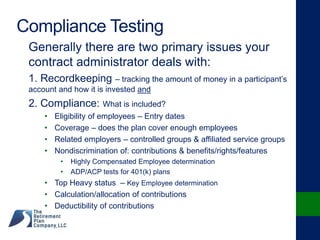
Generally there are two primary issues your
contract administrator deals with:
1. Recordkeeping – tracking the amount of money in a participant’s
account and how it is invested and
2. Compliance: What is included?
• Eligibility of employees – Entry dates
• Coverage – does the plan cover enough employees
• Related employers – controlled groups & affiliated service groups
• Nondiscrimination of: contributions & benefits/rights/features
• Highly Compensated Employee determination
• ADP/ACP tests for 401(k) plans
• Top Heavy status – Key Employee determination
• Calculation/allocation of contributions
• Deductibility of contributions
Compliance Testing
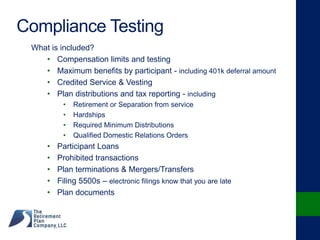
What is included?
• Compensation limits and testing
• Maximum benefits by participant - including 401k deferral amount
• Credited Service & Vesting
• Plan distributions and tax reporting - including
• Retirement or Separation from service
• Hardships
• Required Minimum Distributions
• Qualified Domestic Relations Orders
• Participant Loans
• Prohibited transactions
• Plan terminations & Mergers/Transfers
• Filing 5500s – electronic filings know that you are late
• Plan documents
Compliance Testing
What is your role?
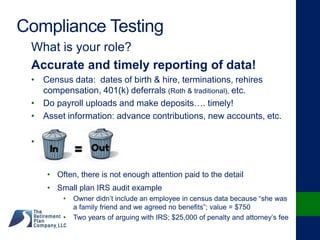
Accurate and timely reporting of data!
• Census data: dates of birth & hire, terminations, rehires
compensation, 401(k) deferrals (Roth & traditional), etc.
• Do payroll uploads and make deposits…. timely!
• Asset information: advance contributions, new accounts, etc.
• image
• Often, there is not enough attention paid to the detail
• Small plan IRS audit example
• Owner didn’t include an employee in census data because “she was
a family friend and we agreed no benefits”; value = $750
• Two years of arguing with IRS; $25,000 of penalty and attorney’s fee
Compliance Testing
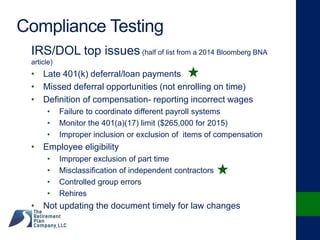
IRS/DOL top issues (half of list from a 2014 Bloomberg BNA
article)
• Late 401(k) deferral/loan payments
• Missed deferral opportunities (not enrolling on time)
• Definition of compensation- reporting incorrect wages
• Failure to coordinate different payroll systems
• Monitor the 401(a)(17) limit ($265,000 for 2015)
• Improper inclusion or exclusion of items of compensation
• Employee eligibility
• Improper exclusion of part time
• Misclassification of independent contractors
• Controlled group errors
• Rehires
• Not updating the document timely for law changes
Compliance Testing
IRS/DOL top issues
• Failure to increase contr. % in auto-enrollment plans
• Hardship distributions – impermissible reasons, lack of
evidence and not applying the 6-month suspension of
deferrals
• ADP/ACP testing – inaccurate data
• Top heavy compliance- Key employees not identified, testing
not completed on larger plans
• Required Minimum Distributions – service terminations after
age 70.5
• Vesting failures – partial plan terminations, inter-company
transfers, 100% at normal retirement age
• Plan loans
• Failure to make timely payments (DOL top issue) not adhering to
loan policy
Compliance Testing
When there are problems - what to do?
• There are programs in place to provide a fix
• Employee Plans Compliance Resolution System (aka
EPCRS) (IRS program)
• Self Correction Program (SCP) – no IRS review
• Voluntary Correction Program (VCP) – formal application to
IRS and approval
• Audit Closing Agreement Program (Audit Cap) – deals with
errors after discovery upon audit (most expensive!)
• Voluntary Fiduciary Correction Program (aka VFCP)(DOL
program)
• Relief from excise taxes
• e.g. Delinquent participant contributions or loan payments,
failure to charge fair market rates to loans, defaulted
participant loans, purchase or sale of assets by parties in
interest, improper payment of expenses, improper valuation
of asset
Terminated Participants
When a participant terminates should I force
them out?
• What does your document say? Cash out provision?
• NO…
• My plan is well managed, reasonably priced, offers excellent
investment options; I would be providing former employees a
better option than most IRA options
• The plan may accumulate a higher level of assets entitling me to
lower advisor fees
• YES…
• I continue to be liable as a fiduciary for their accounts
• Additional expenses if the company pays for some/all expenses
• Pushing me closer to a required audit if I am not already there
• Constant notices, documents that must be provided
• Keeping track of where they are located
Terminated Participants
Forcing Distribution of Small Balances
• Cash out provision – typically less than $5,000
• Higher balances stay- subject to RMDs
• Before cash out must be given at least a 30-day notice
• Unrelated rollover balances may or may not be included as part
of $5,000 limit
• Direct rollover option required for those amounts $1,000-$5,000
• Still problems with “missing” participants and uncashed checks
• Options to consider (no one size fits all)
• Force out those <$5,000; $1,000 to $5,000 to IRAs; <$1,000 paid
in cash
• Force out those <$5,000; all to IRAs
• Force out those <$1,000; all paid in cash
• No force outs at all
Terminated Participants
Forcing Distribution of Small Balances
• What if balance exceeds $5,000? Cannot force out
• May still encourage participant to take a distribution
• Send the paperwork
• Incentive - you are permitted to charge former participants
fees that you do not charge current employees
• Remember that unrelated rollovers may not count towards
the $5,000 in your plan
• You should have a plan for dealing with this issue
• Check with our administration partners
• Exhibit E
Exhibits
A – TRPC Newsletter re Auto Enrollment Plans
B – DOL Disclosure Guide (not entire guide, selected pages)
C – Participant Consent to Electronic Communications
D – Example: Use of a company website
E – Example: Cash out plan for terminated participants
POT of GOLD
in YOUR 401k?
start young!

Rick Pummill - TRPC - Effective Plan Design and Administration

  • 1.
    Effective Plan Design& Administration April 29, 2015 Savannah Golf Club presented by: Rick Pummill, CLU, QPA, QKA Manager of Consulting and Compliance Brentwood, TN Dayton, OH Greenville, SC 800-529-4249 www.trpcweb.com
  • 2.
    Brentwood, TN Dayton, OH Greenville,SC www.trpcweb.com What We Will Cover • Plan Design Options • Electronic Delivery of Participant Disclosures • Compliance Testing • Terminated Participants
  • 3.
  • 4.
    Plan Design Safe Harbor401(k) • Eliminates ADP/ACP nondiscrimination testing • Permits HCEs to make elective 401(k) deferrals up to the maximum limits ($18,000 for 2015): NO REFUNDS due to failed tests! • 3% Nonelective – to all eligible NHCEs and to HCEs if elected in plan document (preferred if cross-tested plan) • Basic or Enhanced Match- to all eligible NHCEs if deferring and to HCEs if elected in plan document • Basic: $1 for $1 on first 3% of pay deferred plus $.50 on the next 2% deferred • Enhanced: any rate at least as good as Basic Match, rate of match does not increase as deferral rate increases and if meeting ACP requirements – cannot exceed 6% of compensation • EXAMPLE: $1 for $1 on first 4% of pay deferred
  • 5.
    Plan Design • SafeHarbor Examples: Basic Enhanced 401(k) % of Pay Match Match 3% Wages Deferrals Deferred Amount Match % Amount Match % Nonelective EE 1 $265,000 18,000.00 6.79% 10,600.00 4.00% 10,600.00 4.00% 7,950.00 EE 2 $80,000 18,000.00 22.50% 3,200.00 4.00% 3,200.00 4.00% 2,400.00 EE 3 $80,000 2,600.00 3.25% 2,500.00 3.13% 2,600.00 3.25% 2,400.00 EE 4 $45,000 2,000.00 4.44% 1,675.00 3.72% 1,800.00 4.00% 1,350.00 EE 5 $45,000 450.00 1.00% 450.00 1.00% 450.00 1.00% 1,350.00 EE 6 $25,000 1,500.00 6.00% 1,000.00 4.00% 1,000.00 4.00% 750.00 EE 7 $25,000 0.00 0.00% 0.00 0.00% 0.00 0.00% 750.00 19,425.00 19,650.00 16,950.00 • Enhanced Match = $1 for $1 on first 4% of deferrals
  • 6.
    Plan Design Auto Enrollment401(k) • Studies show that participants are not saving enough. As much as 30% of employees do not participate. • Inertia: many employees just don’t take action: so instead of an election into the plan, it takes an election to opt out of the plan • Results: • More employees are enrolled in the plan, saving for retirement • Boosts the deferral percentages of NHCEs which in turn helps pass the ADP test and HCEs get to keep more of their elective 401(k) deferrals in the plan (for non safe harbor 401k plans subject to testing) • Historically “larger” plans seem more interested in adoption • Is the plan a “tax shelter” for small plan or employee benefit for larger ER • There are a variety of options that must be considered • See Exhibit A
  • 7.
    Plan Design Auto Enrollment401(k) • HR departments must be diligent in administering auto enrollment features: • Properly enroll new entrants and keep track of who is auto enrolled • Notices- upon enrollment and annually thereafter • Investment of new participants deferral; default – QDIA? • 90-day withdrawal option for those who ultimately decide not to participate • Automatic escalators if any; % will vary from employee to employee • Properly track traditional and Roth deferrals • Coordinate with payroll provider!
  • 8.
    Plan Design Cross Testing(aka “new comparability”) • Plan Documents must contain the methodology that will be used to allocate any nonelective (i.e. profit sharing) contributions • Typically: 1) prorata on compensation or 2) “permitted disparity” aka social security integration • Cross Testing – profit sharing with a “twist” • Plan document provision: employer has the ability to target various groups or individuals and skew more of the contribution towards those individuals • Permitted to put all participants in their own group • E.g. Salaried and hourly employees or Savannah and Atlanta locations • Nondiscrimination testing projects current contributions to normal retirement age and compares the annual benefits that could be provided • Testing will typically work best if a the “favored” individual/group is somewhat older than others or relatively equal range of ages
  • 9.
    Plan Design New ComparabilityExample: Safe Harbor 401(k) Plan - with new comparability feature 12/31/2015 Plan 401(k) Safe Profit % Name Age Compensation Deferral Harbor 3% Sharing Total of Pay ER HCE Physician Owner 54 $265,000 31.0% 24,000.00 0.00 35,000.00 59,000.00 13.2% HCE Salaried Doctor #1 68 $200,000 23.4% 24,000.00 0.00 20,000.00 44,000.00 10.0% HCE Salaried Doctor #2 30 $150,000 17.5% 0.00 0.00 0.00 0.00 0.0% EE #1 Office Mgr. 54 $65,000 7.6% 8,000.00 1,950.00 3,250.00 13,200.00 8.0% EE #2 32 $38,000 4.4% 0.00 1,140.00 532.95 1,672.95 4.4% EE #3 35 $42,000 4.9% 1,100.00 1,260.00 589.05 2,949.05 4.4% EE #4 28 $23,000 2.7% 0.00 690.00 322.58 1,012.58 4.4% EE #5 46 $38,500 4.5% 1,500.00 1,155.00 539.96 3,194.96 4.4% EE #6 40 $22,000 2.6% 0.00 660.00 308.55 968.55 4.4% EE #7 22 $12,000 1.4% 0.00 360.00 168.30 528.30 4.4% TOTALS $855,500 100% 58,600.00 7,215.00 60,711.39 126,526.39 Owner's percent of total 64.2% Employer cost for staff 32,926.39 Notes: - Owner's % of total includes his personal deferral amount since sponsoring a plan entitles him to the entire amount regardless of the source of the contribution - The 3% of pay Safe Harbor contribution performs triple duty by (1) allowing the plan to qualify for 401(k) Safe Harbor status (2) when the plan is top-heavy, satisfying the plan's minimum contribution requirement (which is also 3% of pay in most cases) and (3) counting toward the employer's new comparability profit sharing contribution.
  • 10.
    Plan Design Related Employers– what to do? • Controlled group or affiliated service group members • Might not be different companies but rather two or more locations or natural division of employees • Savannah and Atlanta / Salaried and Hourly • If both employers have a plan or desire to have a plan should they be separate plans or one larger plan? • Another company can also adopt your plan • Considerations • Cost! • Economies of scale – administration costs likely to be less if one larger plan; combining investment arrangements for discounts; one plan document vs two; but • Possibility of plan audits earlier when one larger plan • Sharing plan information – not always a good thing • Compliance testing
  • 11.
    Plan Restatements REMINDER! DCPPA Restatements • Preapproved plans: Restatement period is 5/1/14 to 4/30/16 • Is your plan already restated? • If not, do you have a document provider who is scheduled to complete this important task?
  • 12.
  • 13.
    Electronic Delivery ERISA/DOL Disclosures •Summary Plan Description • Summary of Material Modifications • Summary Annual Report • Fee Disclosure & Comparative Chart • ERISA 404(c) Related Disclosures • Mapping Notice • Blackout Notice • ERISA 204(h) Notice • Benefit Statements • QDIA Notice
  • 14.
    Electronic Delivery IRS RelatedNotices • 402(f) or rollover notice, Tax withholding notice • QJSA, QOSA and QPSA Notices • Notice to Interested Parties • Safe Harbor 401(k) Notices • SIMPLE Notice • Automatic Contribution, EACA, Notice • Divestiture of Employer Stock Notice • Participant Loan Related Notices/Disclosures • QDRO Related Notices
  • 15.
    Electronic Delivery DOL establisheda general standard for delivering plan information: • Plan Administrator must use measures “reasonably calculated to ensure actual receipt of the material” • In-hand delivery at an employee’s worksite • First class mail or other classes of mail if return and forwarding postage is guaranteed and address corrections • Insert in a periodical distributed to employees • Merely making a disclosure available or posting it on a bulletin board does not satisfy this general standard.
  • 16.
    Electronic Delivery • Usingelectronic methods for delivering communications and disclosures may: • Simplify the process • Provide more reliable delivery • Possibly reduce administration costs • Electronic methods: • Electronic mail • Website (typically at workplace) • Telephonic system • Magnetic disk • CD-ROM
  • 17.
    Electronic Delivery IRS andDOL have authority over different notices • IRS rules are less restrictive than DOL because they only require an employee be reasonably able to access the information system, not that the employee is required to do so regularly as part of their normal job duties. • Therefore, if you meet the DOL Safe Harbor for all communications they will generally satisfy the IRS Guidance
  • 18.
    Electronic Delivery DOL SafeHarbor General requirements of electronic delivery of document: • Designed to reasonably assure actual receipt (may require periodic reviews and return receipt or undeliverable notifications) • Designed to protect confidentiality of personal information • Notice to participants that the document is available, and apprises participants of the document’s significance • Informs participants of the right to request a paper copy • Satisfies any applicable style, format and consent requirements to the particular disclosure • Must contain all of the information required to be included in the particular disclosure
  • 19.
    Electronic Delivery DOL SafeHarbor – 2 Groups of EEs Wired at Work – Can send documents electronically to current employees participating in a 401(k) or other retirement plan without obtaining advance consent. To be “Wired at Work”: • An employee must have the ability to effectively access electronic documents at any location where the employee is reasonably expected to perform their duties as an employee, and • Using the employer’s electronic information system must be an integral part of the employee’s duties Because this group uses their employers’ electronic system as a regular part of their employment, the DOL has not required the notice and system access safeguards that apply where participants and beneficiaries give “Affirmative Consent” to receive plan information electronically. In fact, it is an open question whether an employee who is “Wired at Work” may opt-out of receiving plan information electronically.
  • 20.
    Electronic Delivery DOL SafeHarbor – 2 Groups of EEs Wired at Work NOTE: A common question asked about the “Wired at Work” method is whether an employer may set up computer kiosks for use during work hours to access plan information when employees do not have computers on their desks. The DOL has consistently taken the position that mere “access” to a computer during working hours is insufficient; rather, access must be an “integral part” of the employee’s duties. Simply providing computer kiosks on a shop floor or in a mail room, even if employees may use the computers during working hours, does not make employees “Wired at Work.”
  • 21.
    Electronic Delivery DOL SafeHarbor – 2 Groups of EEs Affirmative Consent - Cannot send documents electronically without affirmative consent. For employees that don’t meet the “wired at work” conditions as well as former employee participants, alternate payees or beneficiaries. They must, before consenting, receive a clear statement describing: (Exhibit B) • The types of documents to which the consent would apply • That consent can be withdrawn at any time without charge • The procedures for withdrawing consent and for updating the individual’s address for receiving electronically delivered documents • The right to request and obtain a paper version of an electronic document, including whether the paper version will be provided free of charge, and • Identify any hardware and software requirements for accessing and retaining the documents (if a change then additional disclosures required and participant must reconsent)
  • 22.
    Electronic Delivery DOL AdditionalMethods Approved Continuous Access Website • Permits plans to make quarterly benefit statements available through one or more “secure continuous access websites” • Annual notice needed with the following information: • Explanation of the availability of the information on website • Instructions on how to access the information, and • Participant’s right to request free of charge a paper copy • Can send notice electronically to participants who are “wired at work” or who have given “affirmative consent”, otherwise via first class mail or other approved method. • Even if the notice has to be sent via mail, the quarterly statement can still be on the website
  • 23.
    Electronic Delivery DOL AdditionalMethods Approved Assumed Consent • In a Technical Release (2011-03R) the assumed consent method can be used for electronic delivery • Required annual fee and investment information for participant directed plans, a participant’s consent can be assumed if: • Participant provided with an initial notice containing similar information to what is required under “Affirmative Consent” • After receiving the notice, the participant voluntarily provides the plan administrator an e-mail address, and • Plan Administrator provides the participant an annual notice similar to the initial notice • If the quarterly expense information is provided as part of the participant benefit statement, then the disclosures may be furnished in the same way that the other information in the benefit statement is furnished.
  • 24.
    Electronic Delivery Final thoughts •An electronic notice or participant election must be able to be electronically preserved so it can be accurately reproduced for later reference (or the method of communication may be denied) • Considerable effort and expense is required to provide all required disclosures; a good reason to make the effort to cash out participants with small balances (< $5,000) in order to minimize the total number • See Exhibit C for possible steps in delivering documents on a workplace website
  • 25.
  • 26.
    Compliance Testing Generally thereare two primary issues your contract administrator deals with: 1. Recordkeeping – tracking the amount of money in a participant’s account and how it is invested and 2. Compliance: What is included? • Eligibility of employees – Entry dates • Coverage – does the plan cover enough employees • Related employers – controlled groups & affiliated service groups • Nondiscrimination of: contributions & benefits/rights/features • Highly Compensated Employee determination • ADP/ACP tests for 401(k) plans • Top Heavy status – Key Employee determination • Calculation/allocation of contributions • Deductibility of contributions
  • 27.
    Compliance Testing What isincluded? • Compensation limits and testing • Maximum benefits by participant - including 401k deferral amount • Credited Service & Vesting • Plan distributions and tax reporting - including • Retirement or Separation from service • Hardships • Required Minimum Distributions • Qualified Domestic Relations Orders • Participant Loans • Prohibited transactions • Plan terminations & Mergers/Transfers • Filing 5500s – electronic filings know that you are late • Plan documents
  • 28.
    Compliance Testing What isyour role? Accurate and timely reporting of data! • Census data: dates of birth & hire, terminations, rehires compensation, 401(k) deferrals (Roth & traditional), etc. • Do payroll uploads and make deposits…. timely! • Asset information: advance contributions, new accounts, etc. • image • Often, there is not enough attention paid to the detail • Small plan IRS audit example • Owner didn’t include an employee in census data because “she was a family friend and we agreed no benefits”; value = $750 • Two years of arguing with IRS; $25,000 of penalty and attorney’s fee
  • 29.
    Compliance Testing IRS/DOL topissues (half of list from a 2014 Bloomberg BNA article) • Late 401(k) deferral/loan payments • Missed deferral opportunities (not enrolling on time) • Definition of compensation- reporting incorrect wages • Failure to coordinate different payroll systems • Monitor the 401(a)(17) limit ($265,000 for 2015) • Improper inclusion or exclusion of items of compensation • Employee eligibility • Improper exclusion of part time • Misclassification of independent contractors • Controlled group errors • Rehires • Not updating the document timely for law changes
  • 30.
    Compliance Testing IRS/DOL topissues • Failure to increase contr. % in auto-enrollment plans • Hardship distributions – impermissible reasons, lack of evidence and not applying the 6-month suspension of deferrals • ADP/ACP testing – inaccurate data • Top heavy compliance- Key employees not identified, testing not completed on larger plans • Required Minimum Distributions – service terminations after age 70.5 • Vesting failures – partial plan terminations, inter-company transfers, 100% at normal retirement age • Plan loans • Failure to make timely payments (DOL top issue) not adhering to loan policy
  • 31.
    Compliance Testing When thereare problems - what to do? • There are programs in place to provide a fix • Employee Plans Compliance Resolution System (aka EPCRS) (IRS program) • Self Correction Program (SCP) – no IRS review • Voluntary Correction Program (VCP) – formal application to IRS and approval • Audit Closing Agreement Program (Audit Cap) – deals with errors after discovery upon audit (most expensive!) • Voluntary Fiduciary Correction Program (aka VFCP)(DOL program) • Relief from excise taxes • e.g. Delinquent participant contributions or loan payments, failure to charge fair market rates to loans, defaulted participant loans, purchase or sale of assets by parties in interest, improper payment of expenses, improper valuation of asset
  • 32.
  • 33.
    Terminated Participants When aparticipant terminates should I force them out? • What does your document say? Cash out provision? • NO… • My plan is well managed, reasonably priced, offers excellent investment options; I would be providing former employees a better option than most IRA options • The plan may accumulate a higher level of assets entitling me to lower advisor fees • YES… • I continue to be liable as a fiduciary for their accounts • Additional expenses if the company pays for some/all expenses • Pushing me closer to a required audit if I am not already there • Constant notices, documents that must be provided • Keeping track of where they are located
  • 34.
    Terminated Participants Forcing Distributionof Small Balances • Cash out provision – typically less than $5,000 • Higher balances stay- subject to RMDs • Before cash out must be given at least a 30-day notice • Unrelated rollover balances may or may not be included as part of $5,000 limit • Direct rollover option required for those amounts $1,000-$5,000 • Still problems with “missing” participants and uncashed checks • Options to consider (no one size fits all) • Force out those <$5,000; $1,000 to $5,000 to IRAs; <$1,000 paid in cash • Force out those <$5,000; all to IRAs • Force out those <$1,000; all paid in cash • No force outs at all
  • 35.
    Terminated Participants Forcing Distributionof Small Balances • What if balance exceeds $5,000? Cannot force out • May still encourage participant to take a distribution • Send the paperwork • Incentive - you are permitted to charge former participants fees that you do not charge current employees • Remember that unrelated rollovers may not count towards the $5,000 in your plan • You should have a plan for dealing with this issue • Check with our administration partners • Exhibit E
  • 36.
    Exhibits A – TRPCNewsletter re Auto Enrollment Plans B – DOL Disclosure Guide (not entire guide, selected pages) C – Participant Consent to Electronic Communications D – Example: Use of a company website E – Example: Cash out plan for terminated participants
  • 37.
    POT of GOLD inYOUR 401k? start young!