Cross-Tested Plans 
James A . van I waarden, F S A , E A 
Con s u l t i ng A c t u a r y 
Van I wa a rde n A s s o c i a tes 
Minneapo l is, MN 
ISCEBS Sympo s ium, B o s ton 
Sep tember 2 5 , 2 013
Today’s Menu 
y What are cross-tested plans? 
y History 
y Cross-testing “recipe” 
y Plan designs 
y Other uses 
y What works, what to avoid 
y How to use cross-tested plans with 401(k)’s
What are Cross-Tested Plans? 
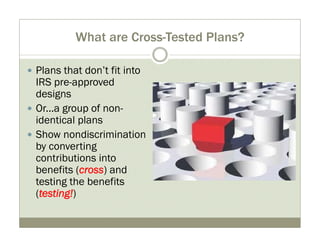
y Plans that don’t fit into 
IRS pre-approved 
designs 
y Or...a group of non-identical 
plans 
y Show nondiscrimination 
by converting 
contributions into 
benefits (cross) and 
testing the benefits 
(testing!)
History of Cross-Testing – Part I 
§401(a)(4) 
•...benefits or 
contributions 
do not 
discriminate 
in favor of 
HCEs... 
RR 81- 
202 
•comparability 
of plans 
410(b) & 
401(a)(4) 
regs 
•200+ pages, 
early 1990’s
History of Cross-Testing – Part II 
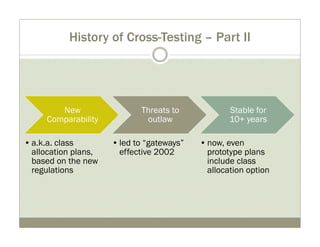
New 
Comparability 
•a.k.a. class 
allocation plans, 
based on the new 
regulations 
Threats to 
outlaw 
• led to “gateways” 
effective 2002 
Stable for 
10+ years 
•now, even 
prototype plans 
include class 
allocation option
Cross-Testing “Recipe” for DC Plans 
Step 1: pass thru any of three “gateways” 
Go! 
Broadly available 
allocation rates 
Gradual age or 
service schedule 
Minimum alloc rate: 
5% or 1/3 top HCE
Cross-Testing “Recipe” for DC Plans 
y Step 2: prepare the ingredients 
@ 8½% 
interest 
Contribution 
for each ee 
To age 
65 
÷ annuity factor (we’ll use 10) to get annual benefit 
÷ pay = accrual rate
Cross-Testing “Recipe” for DC Plans 
y Step 3: mix it all together 
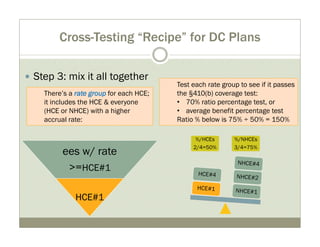
There’s a rate group for each HCE; 
it includes the HCE & everyone 
(HCE or NHCE) with a higher 
accrual rate: 
ees w/ rate 
>=HCE#1 
HCE#1 
Test each rate group to see if it passes 
the §410(b) coverage test: 
• 70% ratio percentage test, or 
• average benefit percentage test 
Ratio % below is 75% ÷ 50% = 150% 
%/HCEs 
2/4=50% 
%/NHCEs 
3/4=75%
Cross-Tested Plan Designs 
y Common designs include: 
{ Age-weighted: guaranteed to pass 
{ Service-weighted 
{ Class allocation (aka “new comparability”) 
{ DB/DC, usually cash balance & profit sharing 
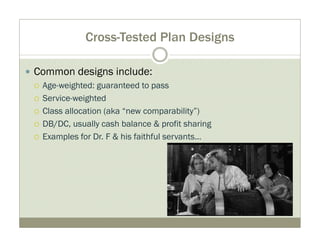
{ Examples for Dr. F & his faithful servants...
Cross-Tested Plan Designs 
y Age-weighted profit sharing plan 
{ Always passes §401(a)(4) test, but not very flexible 
{ Gateway is gradual age or service schedule 
{ One rate group covers HCE (Dr. F) & both NHCEs, ratio % = 100% 
Age Service Pay PS % PS $ 
Benefit 
Accrual 
Rate 
Dr. Frankenstein 60 40 $255,000 20% $51,000 3.01% 
Igor 40 10 50,000 3.91% 1,955 3.01% 
Inga 30 5 30,000 3%* 900 5.22% 
* Age-weighted formula produces 1.73%, but 3% top-heavy minimum applies.
Cross-Tested Plan Designs 
y Service-weighted profit sharing plan 
{ Rewards loyalty, not very common 
{ PS in this example is ½% of pay per year of service 
{ Gateway is gradual age or service schedule 
{ One rate group covers HCE (Dr. F) & both NHCEs, ratio % = 100% 
Age Service Pay PS % PS $ 
Benefit 
Accrual 
Rate 
Dr. Frankenstein 60 40 $255,000 20% $51,000 3.01% 
Igor 40 10 50,000 5% 2,500 3.85% 
Inga 30 5 30,000 3%* 900 5.22% 
* Service-weighted formula produces 2.5%, but 3% top-heavy minimum applies.
Cross-Tested Plan Designs 
y Class allocation (aka “new comparability”) profit sharing 
{ Very common, even prototype documents include this option 
{ Gateway is minimum allocation 5% or 1/3 of highest HCE rate 
{ One rate group covers HCE (Dr. F) & both NHCEs, ratio % = 100% 
Age Service Pay PS % PS $ 
Benefit 
Accrual 
Rate 
Dr. Frankenstein 60 40 $255,000 20% $51,000 3.01% 
Igor 40 10 50,000 5% 2,500 3.85% 
Inga 30 5 30,000 5% 1,500 8.69%
Cross-Tested Plan Designs 
y DB/DC combo: cash balance & profit sharing 
{ Common for professional firms 
{ Enables large deductible contributions for owners 
{ Gateway here is 7½% DC; Igor & Inga get 3% cash balance credits 
{ This example is for a PBGC-covered plan, Frankenstein Mfg. Inc. 
Ù A PBGC-exempt professional firm may need to limit DC er contrs to 6% 
Age Pay 
Cash 
Balance 
Credit 
PS & 
3% Safe 
Harbor 
401(k) & 
Catchup Total 
Dr. F’stein 60 $255,000 $230,000 $33,500 $23,000 $286,500 
Igor 40 50,000 1,500 3,750 whatever 5,250+401k 
Inga 30 30,000 900 2,250 whatever 3,150+401k
Other Uses for Cross-Testing 
y Can structure retirement plans by business unit 
y Could be all DB, all DC or a combination 
y It’s a lifesaver for mergers & acquisitions
Other Uses for Cross-Testing 
y Case study: parent & acquisitions, 25,000 total ees 
DB/DC DB only DC only 
y Combine all the plans and test on a benefits basis 
y Can apply this for any group of non-identical plans
Cross-Testing – What Works, What to Avoid 
y What works great 
{ Profit sharing / cash balance combination 
Ù PS projected at 8½% interest 
Ù Cash balance at interest crediting rate (usually much lower) 
Ù Better results than pure DB or pure DC 
Ù Effect is known as
Cross-Testing – What Works, What to Avoid 
y What works great 
{ 401(k) 3% safe harbor 
{ You get a triple dip 
Ù Free pass for ADP & ACP tests 
Ù Covers DC top-heavy requirement 
Ù Counts for cross-testing base & gateway 
{ A few issues 
Ù Notice required >30 days before plan year starts 
Ù 100% vesting 
Ù Can’t impute “permitted disparity” (FICA recognition) for testing 
{ Add profit sharing, if needed to meet gateway
Cross-Testing – What Works, What to Avoid 
y What to avoid 
{ Unfavorable demographics 
Ù HCEs younger than others 
Ù Usually a solution, but it’s tricky 
{ Inflexible plan designs 
Ù Contribution rates specified in plan document 
Ù Even prototypes now allow each participant in own class
Cross-Testing – What Works, What to Avoid 
y What to avoid 
{ Failing the §401(a)(4) test! 
{ Causes 
Ù Demographic changes, especially new young HCEs 
Ù Inflexible plan designs 
{ Prevention 
Ù Test before contributing 
Ù Flexible plan designs 
{ Cure 
Ù §1.401(a)(4)-11(g) corrective amendment 
Ù Can provide extra contributions for a targeted group of NHCEs 
Ù Must be done within 9½ months after end of year
Cross-Testing – What Works, What to Avoid 
y What to avoid 
{ 401(k) matching contributions (even safe harbor) 
{ Really? 
{ Deferrals & match don’t count for 1st stage of §401(a)(4) test 
{ You can still match, but it’s an extra expense 
{ What can you do? 
Ù Convert match to 3% safe harbor, with advance notice 
Ù Add profit sharing for gateway & cross-testing base
Using Cross-Tested Plans with 401(k)’s 
y Get top people within deferral range of §415 DC maximum 
{ In 2013, that’s $51,000 - $17,500 = $33,500 (13.14% of max pay) 
y Cover the gateway for NHCEs 
{ If HCEs are at 13.14%, NHCEs need to be at 1/3 of that: 4.38% 
y Use 3% non-matching safe harbor 
{ That leaves only 1.38% needed for NHCE profit sharing 
{ Frees HCEs to maximize 401(k) deferrals 
y Still need to run the test 
{ But gateway is often enough to pass 
20% 
15% 
10% 
5% 
0% 
NHCE HCE 
Def 
PS 
SH
Take-Out Menu 
y Cross-testing is the most powerful testing tool there is! 
y You can structure plans to fit business needs 
y It makes some amazing plan designs possible

Cross tested plans - how-to & examples

  • 1.
    Cross-Tested Plans JamesA . van I waarden, F S A , E A Con s u l t i ng A c t u a r y Van I wa a rde n A s s o c i a tes Minneapo l is, MN ISCEBS Sympo s ium, B o s ton Sep tember 2 5 , 2 013
  • 2.
    Today’s Menu yWhat are cross-tested plans? y History y Cross-testing “recipe” y Plan designs y Other uses y What works, what to avoid y How to use cross-tested plans with 401(k)’s
  • 3.
    What are Cross-TestedPlans? y Plans that don’t fit into IRS pre-approved designs y Or...a group of non-identical plans y Show nondiscrimination by converting contributions into benefits (cross) and testing the benefits (testing!)
  • 4.
    History of Cross-Testing– Part I §401(a)(4) •...benefits or contributions do not discriminate in favor of HCEs... RR 81- 202 •comparability of plans 410(b) & 401(a)(4) regs •200+ pages, early 1990’s
  • 5.
    History of Cross-Testing– Part II New Comparability •a.k.a. class allocation plans, based on the new regulations Threats to outlaw • led to “gateways” effective 2002 Stable for 10+ years •now, even prototype plans include class allocation option
  • 6.
    Cross-Testing “Recipe” forDC Plans Step 1: pass thru any of three “gateways” Go! Broadly available allocation rates Gradual age or service schedule Minimum alloc rate: 5% or 1/3 top HCE
  • 7.
    Cross-Testing “Recipe” forDC Plans y Step 2: prepare the ingredients @ 8½% interest Contribution for each ee To age 65 ÷ annuity factor (we’ll use 10) to get annual benefit ÷ pay = accrual rate
  • 8.
    Cross-Testing “Recipe” forDC Plans y Step 3: mix it all together There’s a rate group for each HCE; it includes the HCE & everyone (HCE or NHCE) with a higher accrual rate: ees w/ rate >=HCE#1 HCE#1 Test each rate group to see if it passes the §410(b) coverage test: • 70% ratio percentage test, or • average benefit percentage test Ratio % below is 75% ÷ 50% = 150% %/HCEs 2/4=50% %/NHCEs 3/4=75%
  • 9.
    Cross-Tested Plan Designs y Common designs include: { Age-weighted: guaranteed to pass { Service-weighted { Class allocation (aka “new comparability”) { DB/DC, usually cash balance & profit sharing { Examples for Dr. F & his faithful servants...
  • 10.
    Cross-Tested Plan Designs y Age-weighted profit sharing plan { Always passes §401(a)(4) test, but not very flexible { Gateway is gradual age or service schedule { One rate group covers HCE (Dr. F) & both NHCEs, ratio % = 100% Age Service Pay PS % PS $ Benefit Accrual Rate Dr. Frankenstein 60 40 $255,000 20% $51,000 3.01% Igor 40 10 50,000 3.91% 1,955 3.01% Inga 30 5 30,000 3%* 900 5.22% * Age-weighted formula produces 1.73%, but 3% top-heavy minimum applies.
  • 11.
    Cross-Tested Plan Designs y Service-weighted profit sharing plan { Rewards loyalty, not very common { PS in this example is ½% of pay per year of service { Gateway is gradual age or service schedule { One rate group covers HCE (Dr. F) & both NHCEs, ratio % = 100% Age Service Pay PS % PS $ Benefit Accrual Rate Dr. Frankenstein 60 40 $255,000 20% $51,000 3.01% Igor 40 10 50,000 5% 2,500 3.85% Inga 30 5 30,000 3%* 900 5.22% * Service-weighted formula produces 2.5%, but 3% top-heavy minimum applies.
  • 12.
    Cross-Tested Plan Designs y Class allocation (aka “new comparability”) profit sharing { Very common, even prototype documents include this option { Gateway is minimum allocation 5% or 1/3 of highest HCE rate { One rate group covers HCE (Dr. F) & both NHCEs, ratio % = 100% Age Service Pay PS % PS $ Benefit Accrual Rate Dr. Frankenstein 60 40 $255,000 20% $51,000 3.01% Igor 40 10 50,000 5% 2,500 3.85% Inga 30 5 30,000 5% 1,500 8.69%
  • 13.
    Cross-Tested Plan Designs y DB/DC combo: cash balance & profit sharing { Common for professional firms { Enables large deductible contributions for owners { Gateway here is 7½% DC; Igor & Inga get 3% cash balance credits { This example is for a PBGC-covered plan, Frankenstein Mfg. Inc. Ù A PBGC-exempt professional firm may need to limit DC er contrs to 6% Age Pay Cash Balance Credit PS & 3% Safe Harbor 401(k) & Catchup Total Dr. F’stein 60 $255,000 $230,000 $33,500 $23,000 $286,500 Igor 40 50,000 1,500 3,750 whatever 5,250+401k Inga 30 30,000 900 2,250 whatever 3,150+401k
  • 14.
    Other Uses forCross-Testing y Can structure retirement plans by business unit y Could be all DB, all DC or a combination y It’s a lifesaver for mergers & acquisitions
  • 15.
    Other Uses forCross-Testing y Case study: parent & acquisitions, 25,000 total ees DB/DC DB only DC only y Combine all the plans and test on a benefits basis y Can apply this for any group of non-identical plans
  • 16.
    Cross-Testing – WhatWorks, What to Avoid y What works great { Profit sharing / cash balance combination Ù PS projected at 8½% interest Ù Cash balance at interest crediting rate (usually much lower) Ù Better results than pure DB or pure DC Ù Effect is known as
  • 17.
    Cross-Testing – WhatWorks, What to Avoid y What works great { 401(k) 3% safe harbor { You get a triple dip Ù Free pass for ADP & ACP tests Ù Covers DC top-heavy requirement Ù Counts for cross-testing base & gateway { A few issues Ù Notice required >30 days before plan year starts Ù 100% vesting Ù Can’t impute “permitted disparity” (FICA recognition) for testing { Add profit sharing, if needed to meet gateway
  • 18.
    Cross-Testing – WhatWorks, What to Avoid y What to avoid { Unfavorable demographics Ù HCEs younger than others Ù Usually a solution, but it’s tricky { Inflexible plan designs Ù Contribution rates specified in plan document Ù Even prototypes now allow each participant in own class
  • 19.
    Cross-Testing – WhatWorks, What to Avoid y What to avoid { Failing the §401(a)(4) test! { Causes Ù Demographic changes, especially new young HCEs Ù Inflexible plan designs { Prevention Ù Test before contributing Ù Flexible plan designs { Cure Ù §1.401(a)(4)-11(g) corrective amendment Ù Can provide extra contributions for a targeted group of NHCEs Ù Must be done within 9½ months after end of year
  • 20.
    Cross-Testing – WhatWorks, What to Avoid y What to avoid { 401(k) matching contributions (even safe harbor) { Really? { Deferrals & match don’t count for 1st stage of §401(a)(4) test { You can still match, but it’s an extra expense { What can you do? Ù Convert match to 3% safe harbor, with advance notice Ù Add profit sharing for gateway & cross-testing base
  • 21.
    Using Cross-Tested Planswith 401(k)’s y Get top people within deferral range of §415 DC maximum { In 2013, that’s $51,000 - $17,500 = $33,500 (13.14% of max pay) y Cover the gateway for NHCEs { If HCEs are at 13.14%, NHCEs need to be at 1/3 of that: 4.38% y Use 3% non-matching safe harbor { That leaves only 1.38% needed for NHCE profit sharing { Frees HCEs to maximize 401(k) deferrals y Still need to run the test { But gateway is often enough to pass 20% 15% 10% 5% 0% NHCE HCE Def PS SH
  • 22.
    Take-Out Menu yCross-testing is the most powerful testing tool there is! y You can structure plans to fit business needs y It makes some amazing plan designs possible