Non-Federal Match
Council on Rural Services
2016-2017
Agenda
• Current NFM Status (Dan)
• Overview of NFM (Grantee Specialist)
• Continuous Improvement (Liz)
• Q&A (All Staff)
Current Status
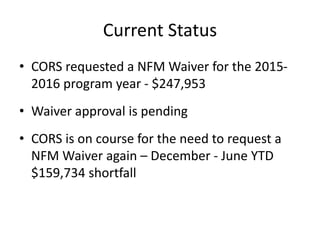
• CORS requested a NFM Waiver for the 2015-
2016 program year - $247,953
• Waiver approval is pending
• CORS is on course for the need to request a
NFM Waiver again – December - June YTD
$159,734 shortfall
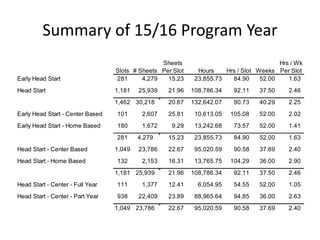
Summary of 15/16 Program Year
Sheets Hrs / Wk
Slots # Sheets Per Slot Hours Hrs / Slot Weeks Per Slot
Early Head Start 281 4,279 15.23 23,855.73 84.90 52.00 1.63
Head Start 1,181 25,939 21.96 108,786.34 92.11 37.50 2.46
1,462 30,218 20.67 132,642.07 90.73 40.29 2.25
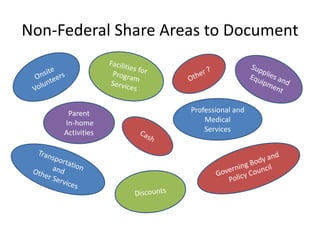
Early Head Start - Center Based 101 2,607 25.81 10,613.05 105.08 52.00 2.02
Early Head Start - Home Based 180 1,672 9.29 13,242.68 73.57 52.00 1.41
281 4,279 15.23 23,855.73 84.90 52.00 1.63
Head Start - Center Based 1,049 23,786 22.67 95,020.59 90.58 37.69 2.40
Head Start - Home Based 132 2,153 16.31 13,765.75 104.29 36.00 2.90
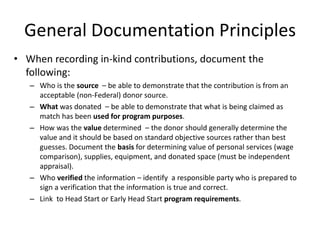
1,181 25,939 21.96 108,786.34 92.11 37.50 2.46
Head Start - Center - Full Year 111 1,377 12.41 6,054.95 54.55 52.00 1.05
Head Start - Center - Part Year 938 22,409 23.89 88,965.64 94.85 36.00 2.63
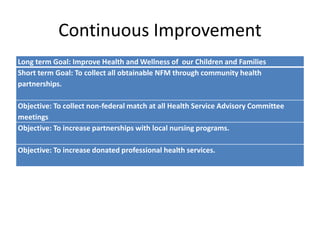
1,049 23,786 22.67 95,020.59 90.58 37.69 2.40
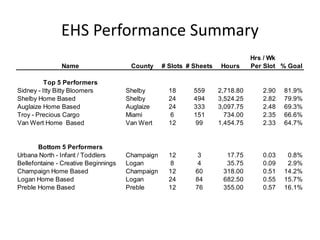
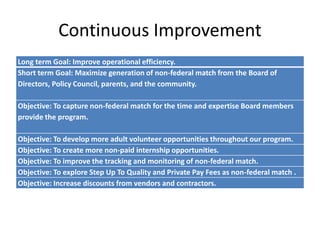
EHS Performance Summary
Hrs / Wk
Name County # Slots # Sheets Hours Per Slot % Goal
Top 5 Performers
Sidney - Itty Bitty Bloomers Shelby 18 559 2,718.80 2.90 81.9%
Shelby Home Based Shelby 24 494 3,524.25 2.82 79.9%
Auglaize Home Based Auglaize 24 333 3,097.75 2.48 69.3%
Troy - Precious Cargo Miami 6 151 734.00 2.35 66.6%
Van Wert Home Based Van Wert 12 99 1,454.75 2.33 64.7%
Bottom 5 Performers
Urbana North - Infant / Toddlers Champaign 12 3 17.75 0.03 0.8%
Bellefontaine - Creative Beginnings Logan 8 4 35.75 0.09 2.9%
Champaign Home Based Champaign 12 60 318.00 0.51 14.2%
Logan Home Based Logan 24 84 682.50 0.55 15.7%
Preble Home Based Preble 12 76 355.00 0.57 16.1%
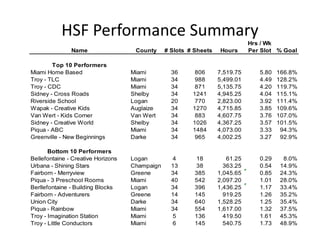
HSF Performance Summary
Hrs / Wk
Name County # Slots # Sheets Hours Per Slot % Goal
Top 10 Performers
Miami Home Based Miami 36 806 7,519.75 5.80 166.8%
Troy - TLC Miami 34 988 5,499.01 4.49 128.2%
Troy - CDC Miami 34 871 5,135.75 4.20 119.7%
Sidney - Cross Roads Shelby 34 1241 4,945.25 4.04 115.1%
Riverside School Logan 20 770 2,823.00 3.92 111.4%
Wapak - Creative Kids Auglaize 34 1270 4,715.85 3.85 109.6%
Van Wert - Kids Corner Van Wert 34 883 4,607.75 3.76 107.0%
Sidney - Creative World Shelby 34 1026 4,367.25 3.57 101.5%
Piqua - ABC Miami 34 1484 4,073.00 3.33 94.3%
Greenville - New Beginnings Darke 34 965 4,002.25 3.27 92.9%
Bottom 10 Performers
Bellefontaine - Creative Horizons Logan 4 18 61.25 0.29 8.0%
Urbana - Shining Stars Champaign 13 38 363.25 0.54 14.9%
Fairborn - Merryview Greene 34 385 1,045.65 0.85 24.3%
Piqua - 3 Preschool Rooms Miami 40 542 2,097.20 1.01 28.0%
Berllefontaine - Building Blocks Logan 34 396 1,436.25 1.17 33.4%
Fairborn - Adventurers Greene 14 145 919.25 1.26 35.2%
Union City Darke 34 640 1,528.25 1.25 35.4%
Piqua - Rainbow Miami 34 554 1,617.00 1.32 37.5%
Troy - Imagination Station Miami 5 136 419.50 1.61 45.3%
Troy - Little Conductors Miami 6 145 540.75 1.73 48.9%
Prepared by Belinda Rinker, JD
Senior Advisor, Office of Head Start
Non-Federal
Share
Presented by : Ametta L. Reaves
Grantee Specialist
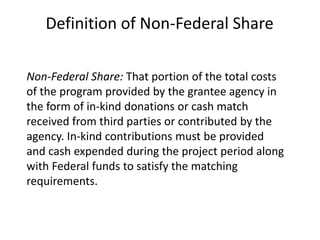
Definition of Non-Federal Share
Non-Federal Share: That portion of the total costs
of the program provided by the grantee agency in
the form of in-kind donations or cash match
received from third parties or contributed by the
agency. In-kind contributions must be provided
and cash expended during the project period along
with Federal funds to satisfy the matching
requirements.
Importance of Non-Federal Share
Non-Federal Share:
• Is a condition of the grant award required by the
Head Start Act and applicable regulations.
• Represents 20% of the program’s capacity to
provide high quality services to children and
families.
• Reflects the extent to which the program is engaged
with and supported by the community.
• Supports associated Federal funds making up the
other 80% of the total grant award.
Sources of Non-Federal Share
• In-Kind: Property or services that benefit a grant supported project or
program and are contributed by non-Federal third parties without charge to
the grantee. In-kind contributions may consist of the value of real property
and equipment and the value of goods and services directly benefiting the
grant program and specifically identifiable to it. In-kind match is counted for
the period when the services are provided or when the donated goods are
received and used.
• Cash Contributions: The grantee's cash outlay, which is generated by the
grantee or donated by a third party, and is expended to fund allowable
program costs. Cash match counts toward the non-Federal share
requirement when expended, not when donated to or generated by the
grantee.
45 CFR §1301.20(b): The non-Federal
share will not be required to exceed 20
percent of the total costs of the program.
Head Start Act
Sec. 640(b) Financial assistance extended under this subchapter for a
Head Start program shall not exceed 80 percent of the approved costs of
the assisted program or activities, except that the Secretary may
approve assistance in excess of such percentage if the Secretary
determines that such action is required in furtherance of the purposes of
this subchapter.
Method 1: (80/20) Method 2: General
• Federal Funds x .25 = Non-
Federal Share
• $2,000,000 (Federal Funds) x
.25 =
$500,000 (Non-Federal Share)
• Total Grant =
$2,500,000
• Federal Funds ÷ Federal
Share = Total Grant –
Federal Funds = Non-
Federal Share
• $2,000,000 ÷ .85 =
$2,352,941 - $2,000,000 =
$352,941
Calculating Non-Federal Share
Criteria for Acceptable Non-Federal
Share
• To be accepted, all cost sharing or matching contributions,
including cash and third party in-kind, shall meet all of the
following criteria:
– Are verifiable from the recipient's records;
– Are not included as contributions for any other federally-assisted
project or program;
– Are necessary and reasonable for proper and efficient
accomplishment of project or program objectives;
– Are allowable under the applicable cost principles;
– Are not paid by the Federal Government under another award,
except where authorized by Federal statute to be used for cost
sharing or matching;
– Are provided for in the approved budget; and
– Conform to other provisions of this part, as applicable.
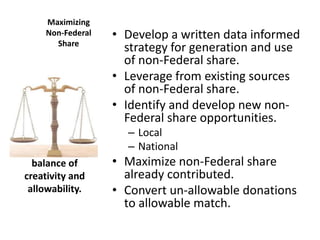
Maximizing
Non-Federal
Share
The correct
balance of
creativity and
allowability.
• Develop a written data informed
strategy for generation and use
of non-Federal share.
• Leverage from existing sources
of non-Federal share.
• Identify and develop new non-
Federal share opportunities.
– Local
– National
• Maximize non-Federal share
already contributed.
• Convert un-allowable donations
to allowable match.
Allowable Cost Requirement
Allowable Cost: Third party in-kind contributions shall count
toward satisfying a cost-sharing or matching requirement only
where, if the party receiving the contribution were to pay for
them, they would be an allowable cost. Allowable costs are
determined by the tests of reasonableness, necessity and
allocability as defined in Title 2 of the Code of Federal
Regulations (2 CFR 220, 2 CFR 225, and 2 CFR 230), commonly
called the cost principles.
Allowable Non-Federal Share Costs
• Allowable Cost: Third party in-kind contributions shall count toward
satisfying a cost-sharing or matching requirement only where, if the
party receiving the contribution were to pay for them, they would be
an allowable cost.
• Cash Contributions: The grantee's cash outlay, which is generated by
the grantee or donated by a third party, and is expended to fund
allowable program costs. Cash match counts toward the non-Federal
share requirement when expended, not when donated to or
generated by the grantee.
– Donations, non-Federal program income, local and state funds, foundation grants,
corporate contributions
Elements of an Allowable Cost
• Reasonable for the performance of the award.
• Allocable to the award.
• Conform to any applicable limitations or exclusions. For example:
– Use of Head Start funds to assist, promote or deter union organizing. Head Start Act,
Sec. 644(e).
– Alcoholic beverages. 2 CFR Part 230, Appendix B(3).
• Consistent with policies and procedures that apply to both Federally
funded and other activities.
• Accorded consistent treatment.
• Meet generally accepted accounting principles (GAAP).
• Not included as a cost or cost sharing for any other Federally funded
program.
• Adequately documented. 2 CFR Part 230, Appendix A(2)
Reasonableness of Costs
• A cost is reasonable if, in its nature or amount, it does not
exceed that which would be incurred by a prudent person under
the circumstances prevailing at the time the decision was made
to incur the costs.
– Generally recognized as ordinary and necessary.
– Exemplifies sound business practices, arms length bargaining, complies with
laws, rules, regulations and grant awards.
– Whether the individuals involved acted in meeting their responsibilities with
prudence under the circumstances.
– Significant deviation from established practices of the organization.
2 CFR Part 230, Appendix A(3)
Allocable Costs
• A cost is allocable to a particular cost objective, such as a grant,
contract, project, service, or other activity, in accordance with
the relative benefits received. A cost is allocable to a Federal
award if it is treated consistently with other costs incurred for
the same purpose in like circumstances and:
– Is incurred specifically for the award.
– Benefits both the award and other work and can be distributed in
reasonable proportion to the benefits received, or
– Is necessary to the overall operation of the organization, although a
direct relationship to any particular cost objective cannot be shown.
2 CFR Part 230, Appendix A(4)
Documentation
• Documentation is the process used to maintain tangible
evidence to demonstrate that in-kind and cash
contributions claimed as non-Federal share are:
– allowable under applicable cost principles, and
– used to support program objectives.
• The documentation requirements for non-Federal share
should be part of the agency’s written fiscal policies and
procedures.
• Important for planning, budgeting, allocation, reporting,
auditing, triennial monitoring and general fiscal
accountability.
Non-Federal Share Areas to Document
Parent
In-home
Activities
Professional and
Medical
Services
Volunteers
 Volunteer services furnished by professional and technical personnel, consultants,
and other skilled and unskilled labor may be counted as cost sharing or matching if
the service is an integral and necessary part of an approved project or program. Rates
for volunteer services shall be consistent with those paid for similar work in the
recipient's organization. In those instances in which the required skills are not found
in the recipient's organization, rates shall be consistent with those paid for similar
work in the labor market in which the recipient competes for the kind of services
involved. In either case, fringe benefits consistent with those paid that are
reasonable, allowable, and allocable may be included in the valuation.
 Volunteer services shall be documented and, to the extent feasible, supported by the
same methods used by the recipient for its own employees, including time records.
 The basis for determining the valuation for personal services shall be documented.
Donated Space
 The value of donated space shall not exceed the fair rental value of
comparable space.
 Established by an independent appraisal of comparable space and
facilities in a privately-owned building in the same locality.
 By a certified real property appraiser.
 The basis for determining the valuation for buildings and land shall be
documented.
 For related parties, may not exceed depreciation or use allowance.
Equipment
The value of donated equipment shall not
exceed the fair market value of equipment of
the same age and condition at the time of
donation.
The basis for determining the valuation for
equipment shall be documented.
Supplies
Donated supplies may include such items as
expendable property, office supplies, laboratory
supplies or workshop and classroom supplies.
Value assessed to donated supplies included in the
cost sharing or matching share shall be reasonable
and shall not exceed the fair market value of the
property at the time of the donation.
The basis for determining the valuation for material
shall be documented.
General Documentation Principles
• When recording in-kind contributions, document the
following:
– Who is the source – be able to demonstrate that the contribution is from an
acceptable (non-Federal) donor source.
– What was donated – be able to demonstrate that what is being claimed as
match has been used for program purposes.
– How was the value determined – the donor should generally determine the
value and it should be based on standard objective sources rather than best
guesses. Document the basis for determining value of personal services (wage
comparison), supplies, equipment, and donated space (must be independent
appraisal).
– Who verified the information – identify a responsible party who is prepared to
sign a verification that the information is true and correct.
– Link to Head Start or Early Head Start program requirements.
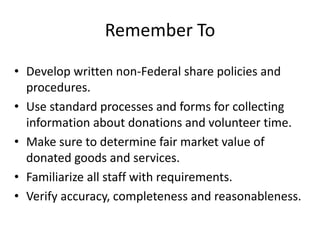
Remember To
• Develop written non-Federal share policies and
procedures.
• Use standard processes and forms for collecting
information about donations and volunteer time.
• Make sure to determine fair market value of
donated goods and services.
• Familiarize all staff with requirements.
• Verify accuracy, completeness and reasonableness.
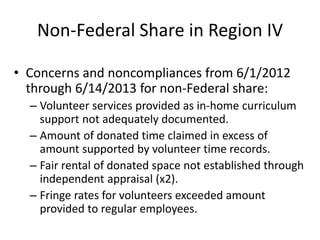
Non-Federal Share in Region IV
• Concerns and noncompliances from 6/1/2012
through 6/14/2013 for non-Federal share:
– Volunteer services provided as in-home curriculum
support not adequately documented.
– Amount of donated time claimed in excess of
amount supported by volunteer time records.
– Fair rental of donated space not established through
independent appraisal (x2).
– Fringe rates for volunteers exceeded amount
provided to regular employees.
Continuous Improvement
Long term Goal: Improve Health and Wellness of our Children and Families
Short term Goal: To collect all obtainable NFM through community health
partnerships.
Objective: To collect non-federal match at all Health Service Advisory Committee
meetings
Objective: To increase partnerships with local nursing programs.
Objective: To increase donated professional health services.
Continuous Improvement
Long term Goal: Improve operational efficiency.
Short term Goal: Maximize generation of non-federal match from the Board of
Directors, Policy Council, parents, and the community.
Objective: To capture non-federal match for the time and expertise Board members
provide the program.
Objective: To develop more adult volunteer opportunities throughout our program.
Objective: To create more non-paid internship opportunities.
Objective: To improve the tracking and monitoring of non-federal match.
Objective: To explore Step Up To Quality and Private Pay Fees as non-federal match .
Objective: Increase discounts from vendors and contractors.
Continuous Improvement
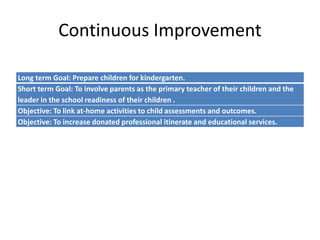
Long term Goal: Prepare children for kindergarten.
Short term Goal: To involve parents as the primary teacher of their children and the
leader in the school readiness of their children .
Objective: To link at-home activities to child assessments and outcomes.
Objective: To increase donated professional itinerate and educational services.
Q & A
•“Have you met your
match?”
~Jeanine Bensman

Non Federal Match

  • 1.
    Non-Federal Match Council onRural Services 2016-2017
  • 2.
    Agenda • Current NFMStatus (Dan) • Overview of NFM (Grantee Specialist) • Continuous Improvement (Liz) • Q&A (All Staff)
  • 3.
    Current Status • CORSrequested a NFM Waiver for the 2015- 2016 program year - $247,953 • Waiver approval is pending • CORS is on course for the need to request a NFM Waiver again – December - June YTD $159,734 shortfall
  • 4.
    Summary of 15/16Program Year Sheets Hrs / Wk Slots # Sheets Per Slot Hours Hrs / Slot Weeks Per Slot Early Head Start 281 4,279 15.23 23,855.73 84.90 52.00 1.63 Head Start 1,181 25,939 21.96 108,786.34 92.11 37.50 2.46 1,462 30,218 20.67 132,642.07 90.73 40.29 2.25 Early Head Start - Center Based 101 2,607 25.81 10,613.05 105.08 52.00 2.02 Early Head Start - Home Based 180 1,672 9.29 13,242.68 73.57 52.00 1.41 281 4,279 15.23 23,855.73 84.90 52.00 1.63 Head Start - Center Based 1,049 23,786 22.67 95,020.59 90.58 37.69 2.40 Head Start - Home Based 132 2,153 16.31 13,765.75 104.29 36.00 2.90 1,181 25,939 21.96 108,786.34 92.11 37.50 2.46 Head Start - Center - Full Year 111 1,377 12.41 6,054.95 54.55 52.00 1.05 Head Start - Center - Part Year 938 22,409 23.89 88,965.64 94.85 36.00 2.63 1,049 23,786 22.67 95,020.59 90.58 37.69 2.40
  • 5.
    EHS Performance Summary Hrs/ Wk Name County # Slots # Sheets Hours Per Slot % Goal Top 5 Performers Sidney - Itty Bitty Bloomers Shelby 18 559 2,718.80 2.90 81.9% Shelby Home Based Shelby 24 494 3,524.25 2.82 79.9% Auglaize Home Based Auglaize 24 333 3,097.75 2.48 69.3% Troy - Precious Cargo Miami 6 151 734.00 2.35 66.6% Van Wert Home Based Van Wert 12 99 1,454.75 2.33 64.7% Bottom 5 Performers Urbana North - Infant / Toddlers Champaign 12 3 17.75 0.03 0.8% Bellefontaine - Creative Beginnings Logan 8 4 35.75 0.09 2.9% Champaign Home Based Champaign 12 60 318.00 0.51 14.2% Logan Home Based Logan 24 84 682.50 0.55 15.7% Preble Home Based Preble 12 76 355.00 0.57 16.1%
  • 6.
    HSF Performance Summary Hrs/ Wk Name County # Slots # Sheets Hours Per Slot % Goal Top 10 Performers Miami Home Based Miami 36 806 7,519.75 5.80 166.8% Troy - TLC Miami 34 988 5,499.01 4.49 128.2% Troy - CDC Miami 34 871 5,135.75 4.20 119.7% Sidney - Cross Roads Shelby 34 1241 4,945.25 4.04 115.1% Riverside School Logan 20 770 2,823.00 3.92 111.4% Wapak - Creative Kids Auglaize 34 1270 4,715.85 3.85 109.6% Van Wert - Kids Corner Van Wert 34 883 4,607.75 3.76 107.0% Sidney - Creative World Shelby 34 1026 4,367.25 3.57 101.5% Piqua - ABC Miami 34 1484 4,073.00 3.33 94.3% Greenville - New Beginnings Darke 34 965 4,002.25 3.27 92.9% Bottom 10 Performers Bellefontaine - Creative Horizons Logan 4 18 61.25 0.29 8.0% Urbana - Shining Stars Champaign 13 38 363.25 0.54 14.9% Fairborn - Merryview Greene 34 385 1,045.65 0.85 24.3% Piqua - 3 Preschool Rooms Miami 40 542 2,097.20 1.01 28.0% Berllefontaine - Building Blocks Logan 34 396 1,436.25 1.17 33.4% Fairborn - Adventurers Greene 14 145 919.25 1.26 35.2% Union City Darke 34 640 1,528.25 1.25 35.4% Piqua - Rainbow Miami 34 554 1,617.00 1.32 37.5% Troy - Imagination Station Miami 5 136 419.50 1.61 45.3% Troy - Little Conductors Miami 6 145 540.75 1.73 48.9%
  • 7.
    Prepared by BelindaRinker, JD Senior Advisor, Office of Head Start Non-Federal Share Presented by : Ametta L. Reaves Grantee Specialist
  • 8.
    Definition of Non-FederalShare Non-Federal Share: That portion of the total costs of the program provided by the grantee agency in the form of in-kind donations or cash match received from third parties or contributed by the agency. In-kind contributions must be provided and cash expended during the project period along with Federal funds to satisfy the matching requirements.
  • 9.
    Importance of Non-FederalShare Non-Federal Share: • Is a condition of the grant award required by the Head Start Act and applicable regulations. • Represents 20% of the program’s capacity to provide high quality services to children and families. • Reflects the extent to which the program is engaged with and supported by the community. • Supports associated Federal funds making up the other 80% of the total grant award.
  • 10.
    Sources of Non-FederalShare • In-Kind: Property or services that benefit a grant supported project or program and are contributed by non-Federal third parties without charge to the grantee. In-kind contributions may consist of the value of real property and equipment and the value of goods and services directly benefiting the grant program and specifically identifiable to it. In-kind match is counted for the period when the services are provided or when the donated goods are received and used. • Cash Contributions: The grantee's cash outlay, which is generated by the grantee or donated by a third party, and is expended to fund allowable program costs. Cash match counts toward the non-Federal share requirement when expended, not when donated to or generated by the grantee.
  • 11.
    45 CFR §1301.20(b):The non-Federal share will not be required to exceed 20 percent of the total costs of the program. Head Start Act Sec. 640(b) Financial assistance extended under this subchapter for a Head Start program shall not exceed 80 percent of the approved costs of the assisted program or activities, except that the Secretary may approve assistance in excess of such percentage if the Secretary determines that such action is required in furtherance of the purposes of this subchapter.
  • 12.
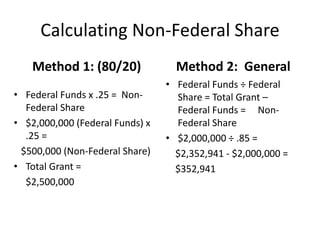
    Method 1: (80/20)Method 2: General • Federal Funds x .25 = Non- Federal Share • $2,000,000 (Federal Funds) x .25 = $500,000 (Non-Federal Share) • Total Grant = $2,500,000 • Federal Funds ÷ Federal Share = Total Grant – Federal Funds = Non- Federal Share • $2,000,000 ÷ .85 = $2,352,941 - $2,000,000 = $352,941 Calculating Non-Federal Share
  • 13.
    Criteria for AcceptableNon-Federal Share • To be accepted, all cost sharing or matching contributions, including cash and third party in-kind, shall meet all of the following criteria: – Are verifiable from the recipient's records; – Are not included as contributions for any other federally-assisted project or program; – Are necessary and reasonable for proper and efficient accomplishment of project or program objectives; – Are allowable under the applicable cost principles; – Are not paid by the Federal Government under another award, except where authorized by Federal statute to be used for cost sharing or matching; – Are provided for in the approved budget; and – Conform to other provisions of this part, as applicable.
  • 14.
    Maximizing Non-Federal Share The correct balance of creativityand allowability. • Develop a written data informed strategy for generation and use of non-Federal share. • Leverage from existing sources of non-Federal share. • Identify and develop new non- Federal share opportunities. – Local – National • Maximize non-Federal share already contributed. • Convert un-allowable donations to allowable match.
  • 15.
    Allowable Cost Requirement AllowableCost: Third party in-kind contributions shall count toward satisfying a cost-sharing or matching requirement only where, if the party receiving the contribution were to pay for them, they would be an allowable cost. Allowable costs are determined by the tests of reasonableness, necessity and allocability as defined in Title 2 of the Code of Federal Regulations (2 CFR 220, 2 CFR 225, and 2 CFR 230), commonly called the cost principles.
  • 16.
    Allowable Non-Federal ShareCosts • Allowable Cost: Third party in-kind contributions shall count toward satisfying a cost-sharing or matching requirement only where, if the party receiving the contribution were to pay for them, they would be an allowable cost. • Cash Contributions: The grantee's cash outlay, which is generated by the grantee or donated by a third party, and is expended to fund allowable program costs. Cash match counts toward the non-Federal share requirement when expended, not when donated to or generated by the grantee. – Donations, non-Federal program income, local and state funds, foundation grants, corporate contributions
  • 17.
    Elements of anAllowable Cost • Reasonable for the performance of the award. • Allocable to the award. • Conform to any applicable limitations or exclusions. For example: – Use of Head Start funds to assist, promote or deter union organizing. Head Start Act, Sec. 644(e). – Alcoholic beverages. 2 CFR Part 230, Appendix B(3). • Consistent with policies and procedures that apply to both Federally funded and other activities. • Accorded consistent treatment. • Meet generally accepted accounting principles (GAAP). • Not included as a cost or cost sharing for any other Federally funded program. • Adequately documented. 2 CFR Part 230, Appendix A(2)
  • 18.
    Reasonableness of Costs •A cost is reasonable if, in its nature or amount, it does not exceed that which would be incurred by a prudent person under the circumstances prevailing at the time the decision was made to incur the costs. – Generally recognized as ordinary and necessary. – Exemplifies sound business practices, arms length bargaining, complies with laws, rules, regulations and grant awards. – Whether the individuals involved acted in meeting their responsibilities with prudence under the circumstances. – Significant deviation from established practices of the organization. 2 CFR Part 230, Appendix A(3)
  • 19.
    Allocable Costs • Acost is allocable to a particular cost objective, such as a grant, contract, project, service, or other activity, in accordance with the relative benefits received. A cost is allocable to a Federal award if it is treated consistently with other costs incurred for the same purpose in like circumstances and: – Is incurred specifically for the award. – Benefits both the award and other work and can be distributed in reasonable proportion to the benefits received, or – Is necessary to the overall operation of the organization, although a direct relationship to any particular cost objective cannot be shown. 2 CFR Part 230, Appendix A(4)
  • 20.
    Documentation • Documentation isthe process used to maintain tangible evidence to demonstrate that in-kind and cash contributions claimed as non-Federal share are: – allowable under applicable cost principles, and – used to support program objectives. • The documentation requirements for non-Federal share should be part of the agency’s written fiscal policies and procedures. • Important for planning, budgeting, allocation, reporting, auditing, triennial monitoring and general fiscal accountability.
  • 21.
    Non-Federal Share Areasto Document Parent In-home Activities Professional and Medical Services
  • 22.
    Volunteers  Volunteer servicesfurnished by professional and technical personnel, consultants, and other skilled and unskilled labor may be counted as cost sharing or matching if the service is an integral and necessary part of an approved project or program. Rates for volunteer services shall be consistent with those paid for similar work in the recipient's organization. In those instances in which the required skills are not found in the recipient's organization, rates shall be consistent with those paid for similar work in the labor market in which the recipient competes for the kind of services involved. In either case, fringe benefits consistent with those paid that are reasonable, allowable, and allocable may be included in the valuation.  Volunteer services shall be documented and, to the extent feasible, supported by the same methods used by the recipient for its own employees, including time records.  The basis for determining the valuation for personal services shall be documented.
  • 23.
    Donated Space  Thevalue of donated space shall not exceed the fair rental value of comparable space.  Established by an independent appraisal of comparable space and facilities in a privately-owned building in the same locality.  By a certified real property appraiser.  The basis for determining the valuation for buildings and land shall be documented.  For related parties, may not exceed depreciation or use allowance.
  • 24.
    Equipment The value ofdonated equipment shall not exceed the fair market value of equipment of the same age and condition at the time of donation. The basis for determining the valuation for equipment shall be documented.
  • 25.
    Supplies Donated supplies mayinclude such items as expendable property, office supplies, laboratory supplies or workshop and classroom supplies. Value assessed to donated supplies included in the cost sharing or matching share shall be reasonable and shall not exceed the fair market value of the property at the time of the donation. The basis for determining the valuation for material shall be documented.
  • 26.
    General Documentation Principles •When recording in-kind contributions, document the following: – Who is the source – be able to demonstrate that the contribution is from an acceptable (non-Federal) donor source. – What was donated – be able to demonstrate that what is being claimed as match has been used for program purposes. – How was the value determined – the donor should generally determine the value and it should be based on standard objective sources rather than best guesses. Document the basis for determining value of personal services (wage comparison), supplies, equipment, and donated space (must be independent appraisal). – Who verified the information – identify a responsible party who is prepared to sign a verification that the information is true and correct. – Link to Head Start or Early Head Start program requirements.
  • 27.
    Remember To • Developwritten non-Federal share policies and procedures. • Use standard processes and forms for collecting information about donations and volunteer time. • Make sure to determine fair market value of donated goods and services. • Familiarize all staff with requirements. • Verify accuracy, completeness and reasonableness.
  • 28.
    Non-Federal Share inRegion IV • Concerns and noncompliances from 6/1/2012 through 6/14/2013 for non-Federal share: – Volunteer services provided as in-home curriculum support not adequately documented. – Amount of donated time claimed in excess of amount supported by volunteer time records. – Fair rental of donated space not established through independent appraisal (x2). – Fringe rates for volunteers exceeded amount provided to regular employees.
  • 29.
    Continuous Improvement Long termGoal: Improve Health and Wellness of our Children and Families Short term Goal: To collect all obtainable NFM through community health partnerships. Objective: To collect non-federal match at all Health Service Advisory Committee meetings Objective: To increase partnerships with local nursing programs. Objective: To increase donated professional health services.
  • 30.
    Continuous Improvement Long termGoal: Improve operational efficiency. Short term Goal: Maximize generation of non-federal match from the Board of Directors, Policy Council, parents, and the community. Objective: To capture non-federal match for the time and expertise Board members provide the program. Objective: To develop more adult volunteer opportunities throughout our program. Objective: To create more non-paid internship opportunities. Objective: To improve the tracking and monitoring of non-federal match. Objective: To explore Step Up To Quality and Private Pay Fees as non-federal match . Objective: Increase discounts from vendors and contractors.
  • 31.
    Continuous Improvement Long termGoal: Prepare children for kindergarten. Short term Goal: To involve parents as the primary teacher of their children and the leader in the school readiness of their children . Objective: To link at-home activities to child assessments and outcomes. Objective: To increase donated professional itinerate and educational services.
  • 32.
    Q & A •“Haveyou met your match?” ~Jeanine Bensman

Editor's Notes

  • #10 Agreed to when funds are accepted. Is not “funny money”. The quality of non-Federal share can drive overall program capacity. Reflection of how well we tell the Head Start story, evidenced in sequestration. Disallowance of non-Federal share results in disallowance of associated Federal grant funds.
  • #14 So, one issue is the allowability of non-Federal share, which we’ll talk about at length. The other issue is how to generate and maximize non-Federal share. Some ideas….
  • #15 Look at historic sources of non-Federal share and where non-Federal share has made the strongest contribution or been most available. Are there barriers you can remove? E.g. certified appraisers. Look at related entities to existing sources…students to dental schools, medical providers, related organizations. Discounts specific to the program v. general discounts, car sitters, garage sale, vocational rehabilitation, human resources organizations (SHRM), local and state bar associations, retired and senior programs, Target, OfficeMax.