
New Versus Former-Generation
Diffractive Trifocal Intraocular Lens
Timon Ax, D. Breyer, H. Kaymak, K. Klabe, P. Hagen, F. Kretz, G. Auffarth
Financial Disclosure
Breyer, Kaymak & Klabe Eye Surgery and Premium Eyes are Consulting, Study Center & MAB for:
Abott, Alcon, AlimeraSciences, Allergan, AMO, Bayer, Carl Zeiss Meditec, Ellex, Fluoron,
Geuder, iOptics, LensAR, Medicem, Novartis, Oculentis, Oertli, Revision Optics,
Santen, Staar Surgical, Sifi Medtech, Thea, Topcon, Visufarma, Ziemer
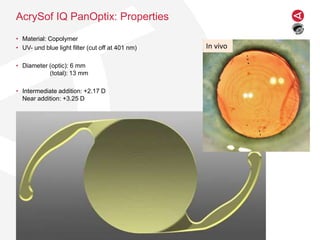
AcrySof IQ PanOptix: Properties
• Material: Copolymer
• UV- und blue light filter (cut off at 401 nm)
• Diameter (optic): 6 mm
(total): 13 mm
• Intermediate addition: +2.17 D
Near addition: +3.25 D
In vivo
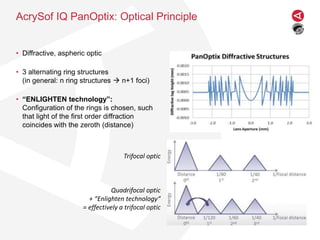
AcrySof IQ PanOptix: Optical Principle
• Diffractive, aspheric optic
• 3 alternating ring structures
(in general: n ring structures  n+1 foci)
• “ENLIGHTEN technology”:
Configuration of the rings is chosen, such
that light of the first order diffraction
coincides with the zeroth (distance)
Trifocal optic
Quadrifocal optic
+ “Enlighten technology“
= effectively a trifocal optic
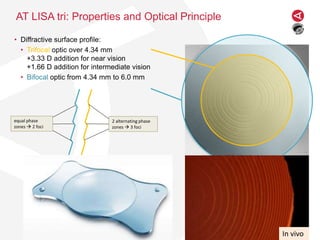
equal phase
zones  2 foci
2 alternating phase
zones  3 foci
AT LISA tri: Properties and Optical Principle
• Diffractive surface profile:
• Trifocal optic over 4.34 mm
+3.33 D addition for near vision
+1.66 D addition for intermediate vision
• Bifocal optic from 4.34 mm to 6.0 mm
In vivo
Materials and Methods: Preoperative Patient Data
Mean ± SD
AT LISA tri
Carl Zeiss Meditec
AcrySof IQ PanOptix
Alcon
Number of eyes 372 20
M:F [%] 34:66 50:50
Age [years] 59.2 ± 10.7 64.4 ± 7.2
SE [D] -0.4 ± 3.9 0.4 ± 3.8
Cylinder [D] -1.1 ± 1.0 -0.4 ± 0.3
CDVA [logMAR] 0.20 ± 0.18 0.15 ± 0.20
UDVA [logMAR] 0.62 ± 0.40 0.71 ± 0.32
IOL-Power [D] 20.6 ± 5.2 22.2 ± 3.9
Target SE [D] -0.13 ± 0.20 -0.13 ± 0.25
0%
25%
50%
75%
100%
(-oo, -1) [-1, -0.5) [-0.5, 0.5] (0.5, 1] (1, oo)
Percentageofeyes[%]
∆SE [D]
Predictability: SE(post) - SE(target)
Results: Predictability
• Comparable deviation from
target refraction after 3 months
• Light but significant (p<0.05)
undercorrection in case of
PanOptix
( more date needed)
MIOL # eyes ∆SE [D]
|∆SE| ≤
0.5 D 1.0 D
LISA tri 269 0.08 ± 0.62 66.2% 93.3%
PanOptix 20 -0.19 ± 0.54 70.0% 90.0%
Monofocal IOL (mon, cc)
PanOptix (mon, cc, n=13)
Lisa Tri (mon, cc, n=18)
Reference Curve VA=1,0 (mon, sc)
0.00
0.25
0.50
0.75
1.00
1.25
-3.0
-2.5
-2.0
-1.5
-1.0
-0.5
0.0
DecimalVA
Defocus [D]
Results: Monocular Defocus Curves
• PanOptix significantly (p<0.05) better at: -2.0 D (intermediate)
AT LISA tri significantly better at: -1.0 D and -0.5 D (far)
• Comparable MIOL capacities
80%
43%
100%
83%
MIOL capacity:
Area under the curve
from -3.0 D to 0.0 D
PanOptix:
Comparable
to published
data
(58 patients)
Defocus [D]
DecimalVA
n = number of eyes
mon = monocular
cc = corrected
Monofocal IOL (mon, cc)
PanOptix (bin, sc, n=10)
Lisa Tri (bin, sc, n=36)
Reference Curve VA=1,0 (mon, sc)
0.00
0.25
0.50
0.75
1.00
1.25
-3.0
-2.5
-2.0
-1.5
-1.0
-0.5
0.0
DecimalVA
Defocus [D]
Results: Binocular Defocus Curves
n = number of eyes
bin = binocular
sc = uncorrected
94%
43%
100%
88%
MIOL capacity:
Area under the curve
from -3.0 D to 0.0 D
• PanOptix significantly
(p<0.05) better at -3.0 D
(near vision)
• LISA tri with better far vision
• Comparable MIOL capacities
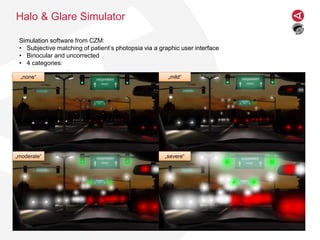
Halo & Glare Simulator
Simulation software from CZM:
• Subjective matching of patient‘s photopsia via a graphic user interface
• Binocular and uncorrected
• 4 categories:
„none“
„severe“„moderate“
„mild“
Results: Halo & Glare Simulator
0%
25%
50%
75%
100%
"none" "mild" "moderate" "severe"
PercentageofEyes[%]
Strength of Halo&Glare
Halo & Glare Simulator Phakic Eyes (n=126)
LisaTri EV (n=52)
PanOptix EV (n=12)
n = number of eyes
Phakic Eyes = employees
(age: 16-60)
EV = Emmetropic Vision
• First results: PanOptix comparable to LISA tri
• Both distributions show more Halo & Glare than phakic eyes of employees (age: 16-60)
Conclusion and Outlook
• Knowledge of MIOL capacity is essential to meet patients visual needs
• 3-month results: Broad range of good binocular vision:
LISA tri slightly better at far
PanOptix slightly better at near + intermediate
(in agreement with optical bench measurements)
Diffractive
trifofal IOL
Binocular visual acuity [logMAR] MIOL-capacity [%]
Halo&Glare
strength [%]
UDVA UIVA UNVA mono cc bino sc
LISA tri -0.03 ± 0.10 0.08 ± 0.08 0.10 ± 0.10 83 88 57 ± 11
PanOptix 0.01 ± 0.06 0.02 ± 0.02 0.05 ± 0.10 80 94 54 ± 11
Conclusion and Outlook
• Halo & Glare comparable for
PanOptix and LISA tri
but significantly stronger than for
phakic eyes
(30% ± 16%).
• Cave: Postoperative period of
several months
for satisfying neuroadaption.
Thank you very much for your attention!
Partner of

New Versus Former-Generation Diffractive Trifocal Intraocular Lens

  • 1.
    New Versus Former-Generation DiffractiveTrifocal Intraocular Lens Timon Ax, D. Breyer, H. Kaymak, K. Klabe, P. Hagen, F. Kretz, G. Auffarth
  • 2.
    Financial Disclosure Breyer, Kaymak& Klabe Eye Surgery and Premium Eyes are Consulting, Study Center & MAB for: Abott, Alcon, AlimeraSciences, Allergan, AMO, Bayer, Carl Zeiss Meditec, Ellex, Fluoron, Geuder, iOptics, LensAR, Medicem, Novartis, Oculentis, Oertli, Revision Optics, Santen, Staar Surgical, Sifi Medtech, Thea, Topcon, Visufarma, Ziemer
  • 3.
    AcrySof IQ PanOptix:Properties • Material: Copolymer • UV- und blue light filter (cut off at 401 nm) • Diameter (optic): 6 mm (total): 13 mm • Intermediate addition: +2.17 D Near addition: +3.25 D In vivo
  • 4.
    AcrySof IQ PanOptix:Optical Principle • Diffractive, aspheric optic • 3 alternating ring structures (in general: n ring structures  n+1 foci) • “ENLIGHTEN technology”: Configuration of the rings is chosen, such that light of the first order diffraction coincides with the zeroth (distance) Trifocal optic Quadrifocal optic + “Enlighten technology“ = effectively a trifocal optic
  • 5.
    equal phase zones 2 foci 2 alternating phase zones  3 foci AT LISA tri: Properties and Optical Principle • Diffractive surface profile: • Trifocal optic over 4.34 mm +3.33 D addition for near vision +1.66 D addition for intermediate vision • Bifocal optic from 4.34 mm to 6.0 mm In vivo
  • 6.
    Materials and Methods:Preoperative Patient Data Mean ± SD AT LISA tri Carl Zeiss Meditec AcrySof IQ PanOptix Alcon Number of eyes 372 20 M:F [%] 34:66 50:50 Age [years] 59.2 ± 10.7 64.4 ± 7.2 SE [D] -0.4 ± 3.9 0.4 ± 3.8 Cylinder [D] -1.1 ± 1.0 -0.4 ± 0.3 CDVA [logMAR] 0.20 ± 0.18 0.15 ± 0.20 UDVA [logMAR] 0.62 ± 0.40 0.71 ± 0.32 IOL-Power [D] 20.6 ± 5.2 22.2 ± 3.9 Target SE [D] -0.13 ± 0.20 -0.13 ± 0.25
  • 7.
    0% 25% 50% 75% 100% (-oo, -1) [-1,-0.5) [-0.5, 0.5] (0.5, 1] (1, oo) Percentageofeyes[%] ∆SE [D] Predictability: SE(post) - SE(target) Results: Predictability • Comparable deviation from target refraction after 3 months • Light but significant (p<0.05) undercorrection in case of PanOptix ( more date needed) MIOL # eyes ∆SE [D] |∆SE| ≤ 0.5 D 1.0 D LISA tri 269 0.08 ± 0.62 66.2% 93.3% PanOptix 20 -0.19 ± 0.54 70.0% 90.0%
  • 8.
    Monofocal IOL (mon,cc) PanOptix (mon, cc, n=13) Lisa Tri (mon, cc, n=18) Reference Curve VA=1,0 (mon, sc) 0.00 0.25 0.50 0.75 1.00 1.25 -3.0 -2.5 -2.0 -1.5 -1.0 -0.5 0.0 DecimalVA Defocus [D] Results: Monocular Defocus Curves • PanOptix significantly (p<0.05) better at: -2.0 D (intermediate) AT LISA tri significantly better at: -1.0 D and -0.5 D (far) • Comparable MIOL capacities 80% 43% 100% 83% MIOL capacity: Area under the curve from -3.0 D to 0.0 D PanOptix: Comparable to published data (58 patients) Defocus [D] DecimalVA n = number of eyes mon = monocular cc = corrected
  • 9.
    Monofocal IOL (mon,cc) PanOptix (bin, sc, n=10) Lisa Tri (bin, sc, n=36) Reference Curve VA=1,0 (mon, sc) 0.00 0.25 0.50 0.75 1.00 1.25 -3.0 -2.5 -2.0 -1.5 -1.0 -0.5 0.0 DecimalVA Defocus [D] Results: Binocular Defocus Curves n = number of eyes bin = binocular sc = uncorrected 94% 43% 100% 88% MIOL capacity: Area under the curve from -3.0 D to 0.0 D • PanOptix significantly (p<0.05) better at -3.0 D (near vision) • LISA tri with better far vision • Comparable MIOL capacities
  • 10.
    Halo & GlareSimulator Simulation software from CZM: • Subjective matching of patient‘s photopsia via a graphic user interface • Binocular and uncorrected • 4 categories: „none“ „severe“„moderate“ „mild“
  • 11.
    Results: Halo &Glare Simulator 0% 25% 50% 75% 100% "none" "mild" "moderate" "severe" PercentageofEyes[%] Strength of Halo&Glare Halo & Glare Simulator Phakic Eyes (n=126) LisaTri EV (n=52) PanOptix EV (n=12) n = number of eyes Phakic Eyes = employees (age: 16-60) EV = Emmetropic Vision • First results: PanOptix comparable to LISA tri • Both distributions show more Halo & Glare than phakic eyes of employees (age: 16-60)
  • 12.
    Conclusion and Outlook •Knowledge of MIOL capacity is essential to meet patients visual needs • 3-month results: Broad range of good binocular vision: LISA tri slightly better at far PanOptix slightly better at near + intermediate (in agreement with optical bench measurements) Diffractive trifofal IOL Binocular visual acuity [logMAR] MIOL-capacity [%] Halo&Glare strength [%] UDVA UIVA UNVA mono cc bino sc LISA tri -0.03 ± 0.10 0.08 ± 0.08 0.10 ± 0.10 83 88 57 ± 11 PanOptix 0.01 ± 0.06 0.02 ± 0.02 0.05 ± 0.10 80 94 54 ± 11
  • 13.
    Conclusion and Outlook •Halo & Glare comparable for PanOptix and LISA tri but significantly stronger than for phakic eyes (30% ± 16%). • Cave: Postoperative period of several months for satisfying neuroadaption.
  • 14.
    Thank you verymuch for your attention! Partner of