Non-Player types
Gamelab 13, barcelona
29th June 2017
Richard A. Bartle
University of esSex, uk
Why people don’t play your game
introduction
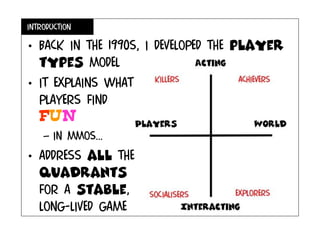
• back in the 1990s, I developed the player
types model
• It explains what
players find
FUN
– In MMOs...
• Address all the
quadrants
for a stable,
long-lived game
insular
• This model is insular, though
• It tells you why people do play, but not
why they don’t
– Which is often more useful
• So, that’s what i’m going to talk about
today: Types of Non-players
– Or non-player types
• You’re the first people i’ve described
this to, so feel free to shoot me down
in flames afterwards
Quiet Sunday
• here’s an opera singer
obvious
• There are some very obvious reasons
why an individual may not play a game
– They’ve never heard of it
– They don’t own the right hardware
– They don’t have the time
– They don’t like the genre
– They don’t like the graphics
– It’s against their religion
– They prefer to read books or watch movies
– Lots more...
• assume no such external factors apply…
Why stop?
• In fact, Suppose someone is playing your
game but then stops playing
• Why might they stop? Some possibilities...
1) They finished it
2) A beTter game came along
3) It was too easy
4) It was too hard
5) They couldn’t engage with it
6) It had too many flaws in their view
• Let’s lOok at these a little closer
Closer look
• 1) If they finished the game, fair enough
– Likewise if they dropped dead
• 2) If a betTer game came along, well
what makes it better?
– Assuming not an external reason such as
its being based on their favourite tv show
• Well, betterness is related to why people
do play, not why they don’t
• it’s just the other position restated
– player type theory explains it for MMORPGs...
difficulty
• 3)/4) If a game is too easy/hard, it misses
the sweEt spot of the gaME’s
chalLenge versus the PLAYER’s skilL
• The game is asking
either too much or
too little of you
• You won’t
participate unless
the balance is right
(for you)
engagement
• 5) being unable to engage with a game
means you can’t enter its magic circle
• You look at it objectively but can’t
make the jump to do so subjectively
• Basically, you don’t understand it
• This isn’t the same as when a game is
too challenging OR TOO COMPLEX
• It’s more that you can’t work out
what the game means
– It’s inacCesSible to you
accessibility
• inaCcesSible art speaks over your head
– You can’t get a handle on it
• Lady apart, paul klee snoopy, charles m schulz
flaws
• 6) If a PLAYER FEELS A game has flaws, it
can be for one of two reasons
• Firstly, It may be buggy, which will
remind players they’re in a game
– Abandoning it is, therefore, reasonable
• Secondly, it may be bug-frEe but the
player keeps seeing ways to improve it
• In This second case, the player engages
with the game so much that they think
of it objectively instead of subjectively
understanding
• Points 5) and 6) concern the same thing:
• Whether or not you understand what
the game is saying to you
• In point 5), the game is too deEp for you
to grasp what it’s saying
• In point 6), it’s too shalLow for what
it says to be interesting
• As with easy/difficult, there’s a sweEt
spot where the game’s depth matches
the player’s insight
reflection
• This time, the player is asking the
game for content and is answered
with either too much or too liTtle
• Too much makes it
inacCesSible; Too
little, trivial
• You won’t
participate unless
the balance is right
(for you)
Enchanted city
• here’s a rock
dialogue
• What we have here is a dialogue
1) The game asks the player to do something
2) The player answers by doing it
3) In so doing, the player asks the game a
question
4) The game answers by providing another
sliver/chunk of content
5) In so doing, Back to step 1)
• This can happen at multiple levels
– The lowest one has a name: the core loOp
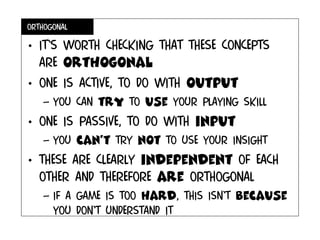
ORTHOGONAL
• IT’S WORTH checking that these concepts
are orthogonal
• One is active, to do with output
– You can try to use your playing skill
• One is passive, to do with input
– you can’t try not to use your insight
• These are clearly independent of each
other and therefore are orthogonal
– If a game is too hard, this isn’t because
you don’t understand it
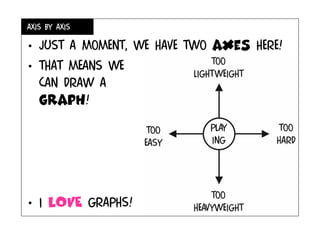
Axis by axis
• Just a moment, we have two axes here!
• That means we
can draw a
graph!
• I LOVE GRAPHS!
quadrants
• How should we label the quadrants?
• Well it’s a little dangerous to do so
because this is game-by-game
• In player types, if you’re an achiever
then you’re an achiever for a long time
• In non-player types, you may not like
this game because it’s too shallow but
that one because it’s too difficult
• It may be more useful to look at their
particular grievances
In/out/sleep
• here’s a baby
Top right
• A game that’s too hard and too
shalLow means you know what it’s
saying and it’s frustrating to play
– For me, that would be pong and space invaders
• a game that is interesting but you
can’t beat it would be near the X axis
– Fleet battles in the master of orion 2 rewrite
• A game that puts up a fight but has
litTle depth would be near the y axis
– Tetris, candy crush saga, brain age, ...
Bottom right
• A game that’s too hard and too deEp
will be full of unfathomable
experiences and snail-paced progress
– For me, starcraft and eve online go here
• A game that’s seems to hang together but
you’re useleSs at is nearer the x axis
– Undertale, Castlevania, assassin’s creed, ...
• A game you can play but which makes
little sense is nearer the y axis
– Chess, go, Civilization VI, dota 2, ...
Meanwhile, In 1968
• Ooh! It’s a zombie
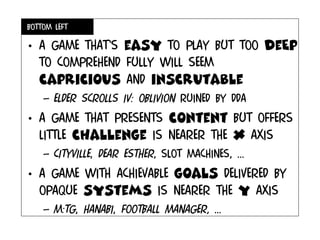
Bottom left
• A game that’s easy to play but too deEp
to comprehend fully will seem
capricious and inscrutable
– Elder scrolls IV: oblivion ruined by DDA
• A game that presents content but offers
little challenge is nearer the x axis
– cityville, dear esther, slot machines, ...
• A game with achievable goals delivered by
opaque systems is nearer the y axis
– M:tg, hanabi, football manager, ...
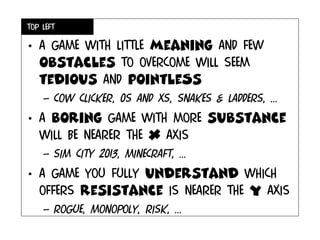
Top left
• A game with little meaning and few
obstacles to overcome will seem
tedious and pointleSs
– Cow clicker, 0s and xs, snakes & ladders, ...
• A boring game with more substance
will be nearer the x axis
– Sim city 2013, minecraft, ...
• A game you fully understand which
offers resistance is nearer the y axis
– Rogue, monopoly, risk, ...
example
• This is what the
graph looks like
for me:
• Yours will
look different
– So will mine as my skills and insight change
exit
• so, players will leave games that have:
– TR: Meaningless, unnecessary obstacles
• Like rocks
– BR: Inarticulate, frustrating demands
• Like babies
– BL: straightforward, pretentious nonsense
• Like opera
– TL: Vacuous actions for vacuous reasons
• Like zombies
• Easy recall: rock babes & opera zombies
pull
• The pull of each axis is quite strong
• People may put
up with unsuitable
gameplay if it’s
meaningful
– And vice versa
• The graph could
therefore look
more like this
extrapolation
• In my original player types paper, I
extrapolated the types
• What would haPpen if you moved too
far in one direction?
– Say, towards acting on the world
• The players with that orientation
would still like what they saw
– but it wouldn’t be an mmorpg
• The other players would stop playing
and all dynamic cohesion would be lost
Players playing
• The focus changes from players to
what they (don’t) play
interpolation
• We can do a similar trick with non-
player types
– Look at what players like before the game
pushes them toO far
• This changes the focus to the players
from what they (don’t) play
• It turns out you already know what
these player types are because they’ve got
established names in the industry
– Any guesses?
Playing players
• I’m already regretting those quadrant
names...
Skip this slide
• Casual gamers like games that aren’t
very deEp and are easy to play
• Care bear gamers like games that have
depth but aren’t very chalLenging
• Core gamers like more difFicult games
but aren’t interested in the meSsage
• Hard core gamers like full-on,
demanding gameplay that has emotional
or intellectual substance
• As I said, You knew all that anyway…
Use or useless
• This is all well and good, but is it any
actual use?
• Ok, so This is the point at which academics
start using words such as “lens” and
“framework”
• I’m just going to say i don’t know
• I guess we could try it out, though...
• Let’s see if we can use it to say
something about the frEe-to-play
(microtransactions) revenue model
Basic rules
• Players won’t pay to make a game
more challenging, because they can make
it more challenging on their own
• Players might pay to make a game
leSs challenging if they like easy games
• Players might pay to make a game
more accessible if they like deep games
• Players won’t pay to make a game lesS
accessible, because who likes being
patronised?
result
• APplying these ruLes:
– Care bear gamers will pay to remove
challenges or for richer content
– Hard core gamers will pay for richer
content
– Casual gamers will pay to remove
challenges
– Core gamers won’t pay for anything
• asSeSsment: f2p is risky for
games that appeal to those who like
tricky but shalLow gameplay
conclusion
• By looking at what stops players
playing, we can explain in a formal
manner some concepts we already knew
• We can apPly the resulting theory, but
it may merely add the weight of theory
to existing, well-tried heuristics
• The dialogue part could actually
help academics teach this stuff
• I expect to be shot down in flames
now!

Richard Bartle's Gamelab presentation

  • 1.
    Non-Player types Gamelab 13,barcelona 29th June 2017 Richard A. Bartle University of esSex, uk Why people don’t play your game
  • 2.
    introduction • back inthe 1990s, I developed the player types model • It explains what players find FUN – In MMOs... • Address all the quadrants for a stable, long-lived game
  • 3.
    insular • This modelis insular, though • It tells you why people do play, but not why they don’t – Which is often more useful • So, that’s what i’m going to talk about today: Types of Non-players – Or non-player types • You’re the first people i’ve described this to, so feel free to shoot me down in flames afterwards
  • 4.
  • 5.
    obvious • There aresome very obvious reasons why an individual may not play a game – They’ve never heard of it – They don’t own the right hardware – They don’t have the time – They don’t like the genre – They don’t like the graphics – It’s against their religion – They prefer to read books or watch movies – Lots more... • assume no such external factors apply…
  • 6.
    Why stop? • Infact, Suppose someone is playing your game but then stops playing • Why might they stop? Some possibilities... 1) They finished it 2) A beTter game came along 3) It was too easy 4) It was too hard 5) They couldn’t engage with it 6) It had too many flaws in their view • Let’s lOok at these a little closer
  • 7.
    Closer look • 1)If they finished the game, fair enough – Likewise if they dropped dead • 2) If a betTer game came along, well what makes it better? – Assuming not an external reason such as its being based on their favourite tv show • Well, betterness is related to why people do play, not why they don’t • it’s just the other position restated – player type theory explains it for MMORPGs...
  • 8.
    difficulty • 3)/4) Ifa game is too easy/hard, it misses the sweEt spot of the gaME’s chalLenge versus the PLAYER’s skilL • The game is asking either too much or too little of you • You won’t participate unless the balance is right (for you)
  • 9.
    engagement • 5) beingunable to engage with a game means you can’t enter its magic circle • You look at it objectively but can’t make the jump to do so subjectively • Basically, you don’t understand it • This isn’t the same as when a game is too challenging OR TOO COMPLEX • It’s more that you can’t work out what the game means – It’s inacCesSible to you
  • 10.
    accessibility • inaCcesSible artspeaks over your head – You can’t get a handle on it • Lady apart, paul klee snoopy, charles m schulz
  • 11.
    flaws • 6) Ifa PLAYER FEELS A game has flaws, it can be for one of two reasons • Firstly, It may be buggy, which will remind players they’re in a game – Abandoning it is, therefore, reasonable • Secondly, it may be bug-frEe but the player keeps seeing ways to improve it • In This second case, the player engages with the game so much that they think of it objectively instead of subjectively
  • 12.
    understanding • Points 5)and 6) concern the same thing: • Whether or not you understand what the game is saying to you • In point 5), the game is too deEp for you to grasp what it’s saying • In point 6), it’s too shalLow for what it says to be interesting • As with easy/difficult, there’s a sweEt spot where the game’s depth matches the player’s insight
  • 13.
    reflection • This time,the player is asking the game for content and is answered with either too much or too liTtle • Too much makes it inacCesSible; Too little, trivial • You won’t participate unless the balance is right (for you)
  • 14.
  • 15.
    dialogue • What wehave here is a dialogue 1) The game asks the player to do something 2) The player answers by doing it 3) In so doing, the player asks the game a question 4) The game answers by providing another sliver/chunk of content 5) In so doing, Back to step 1) • This can happen at multiple levels – The lowest one has a name: the core loOp
  • 16.
    ORTHOGONAL • IT’S WORTHchecking that these concepts are orthogonal • One is active, to do with output – You can try to use your playing skill • One is passive, to do with input – you can’t try not to use your insight • These are clearly independent of each other and therefore are orthogonal – If a game is too hard, this isn’t because you don’t understand it
  • 17.
    Axis by axis •Just a moment, we have two axes here! • That means we can draw a graph! • I LOVE GRAPHS!
  • 18.
    quadrants • How shouldwe label the quadrants? • Well it’s a little dangerous to do so because this is game-by-game • In player types, if you’re an achiever then you’re an achiever for a long time • In non-player types, you may not like this game because it’s too shallow but that one because it’s too difficult • It may be more useful to look at their particular grievances
  • 19.
  • 20.
    Top right • Agame that’s too hard and too shalLow means you know what it’s saying and it’s frustrating to play – For me, that would be pong and space invaders • a game that is interesting but you can’t beat it would be near the X axis – Fleet battles in the master of orion 2 rewrite • A game that puts up a fight but has litTle depth would be near the y axis – Tetris, candy crush saga, brain age, ...
  • 21.
    Bottom right • Agame that’s too hard and too deEp will be full of unfathomable experiences and snail-paced progress – For me, starcraft and eve online go here • A game that’s seems to hang together but you’re useleSs at is nearer the x axis – Undertale, Castlevania, assassin’s creed, ... • A game you can play but which makes little sense is nearer the y axis – Chess, go, Civilization VI, dota 2, ...
  • 22.
    Meanwhile, In 1968 •Ooh! It’s a zombie
  • 23.
    Bottom left • Agame that’s easy to play but too deEp to comprehend fully will seem capricious and inscrutable – Elder scrolls IV: oblivion ruined by DDA • A game that presents content but offers little challenge is nearer the x axis – cityville, dear esther, slot machines, ... • A game with achievable goals delivered by opaque systems is nearer the y axis – M:tg, hanabi, football manager, ...
  • 24.
    Top left • Agame with little meaning and few obstacles to overcome will seem tedious and pointleSs – Cow clicker, 0s and xs, snakes & ladders, ... • A boring game with more substance will be nearer the x axis – Sim city 2013, minecraft, ... • A game you fully understand which offers resistance is nearer the y axis – Rogue, monopoly, risk, ...
  • 25.
    example • This iswhat the graph looks like for me: • Yours will look different – So will mine as my skills and insight change
  • 26.
    exit • so, playerswill leave games that have: – TR: Meaningless, unnecessary obstacles • Like rocks – BR: Inarticulate, frustrating demands • Like babies – BL: straightforward, pretentious nonsense • Like opera – TL: Vacuous actions for vacuous reasons • Like zombies • Easy recall: rock babes & opera zombies
  • 27.
    pull • The pullof each axis is quite strong • People may put up with unsuitable gameplay if it’s meaningful – And vice versa • The graph could therefore look more like this
  • 28.
    extrapolation • In myoriginal player types paper, I extrapolated the types • What would haPpen if you moved too far in one direction? – Say, towards acting on the world • The players with that orientation would still like what they saw – but it wouldn’t be an mmorpg • The other players would stop playing and all dynamic cohesion would be lost
  • 29.
    Players playing • Thefocus changes from players to what they (don’t) play
  • 30.
    interpolation • We cando a similar trick with non- player types – Look at what players like before the game pushes them toO far • This changes the focus to the players from what they (don’t) play • It turns out you already know what these player types are because they’ve got established names in the industry – Any guesses?
  • 31.
    Playing players • I’malready regretting those quadrant names...
  • 32.
    Skip this slide •Casual gamers like games that aren’t very deEp and are easy to play • Care bear gamers like games that have depth but aren’t very chalLenging • Core gamers like more difFicult games but aren’t interested in the meSsage • Hard core gamers like full-on, demanding gameplay that has emotional or intellectual substance • As I said, You knew all that anyway…
  • 33.
    Use or useless •This is all well and good, but is it any actual use? • Ok, so This is the point at which academics start using words such as “lens” and “framework” • I’m just going to say i don’t know • I guess we could try it out, though... • Let’s see if we can use it to say something about the frEe-to-play (microtransactions) revenue model
  • 34.
    Basic rules • Playerswon’t pay to make a game more challenging, because they can make it more challenging on their own • Players might pay to make a game leSs challenging if they like easy games • Players might pay to make a game more accessible if they like deep games • Players won’t pay to make a game lesS accessible, because who likes being patronised?
  • 35.
    result • APplying theseruLes: – Care bear gamers will pay to remove challenges or for richer content – Hard core gamers will pay for richer content – Casual gamers will pay to remove challenges – Core gamers won’t pay for anything • asSeSsment: f2p is risky for games that appeal to those who like tricky but shalLow gameplay
  • 36.
    conclusion • By lookingat what stops players playing, we can explain in a formal manner some concepts we already knew • We can apPly the resulting theory, but it may merely add the weight of theory to existing, well-tried heuristics • The dialogue part could actually help academics teach this stuff • I expect to be shot down in flames now!