The Theory of Fun
Qualifier PhD. Defense Presentation
Joseph Krall
People play games to reach a certain state of mind
- Defining that state of mind
- Describing how we enter that state of mind
- Theories of how to keep players there
- This benefits the Video Game Industry
Overview
10/26/2012 2Games and Software Engineering
Making a Statement
This is a Qualifier Presentation
So here’s some topics about stuff we did
– Dimensions of Fun
– Believable AI
– Procedural Content Generation
– Designing Games
– Our Theory of Fun
10/26/2012 Games and Software Engineering 3
Overview
Overview
1. Dimensions of Fun
2. Believable AI
3. Procedural Content Generation
4. A Theory of Fun
5. Playability
6. Replayability
7. Our Method of Studying Games
Conclusion
10/26/2012 Games and Software Engineering 4
Table of Contents
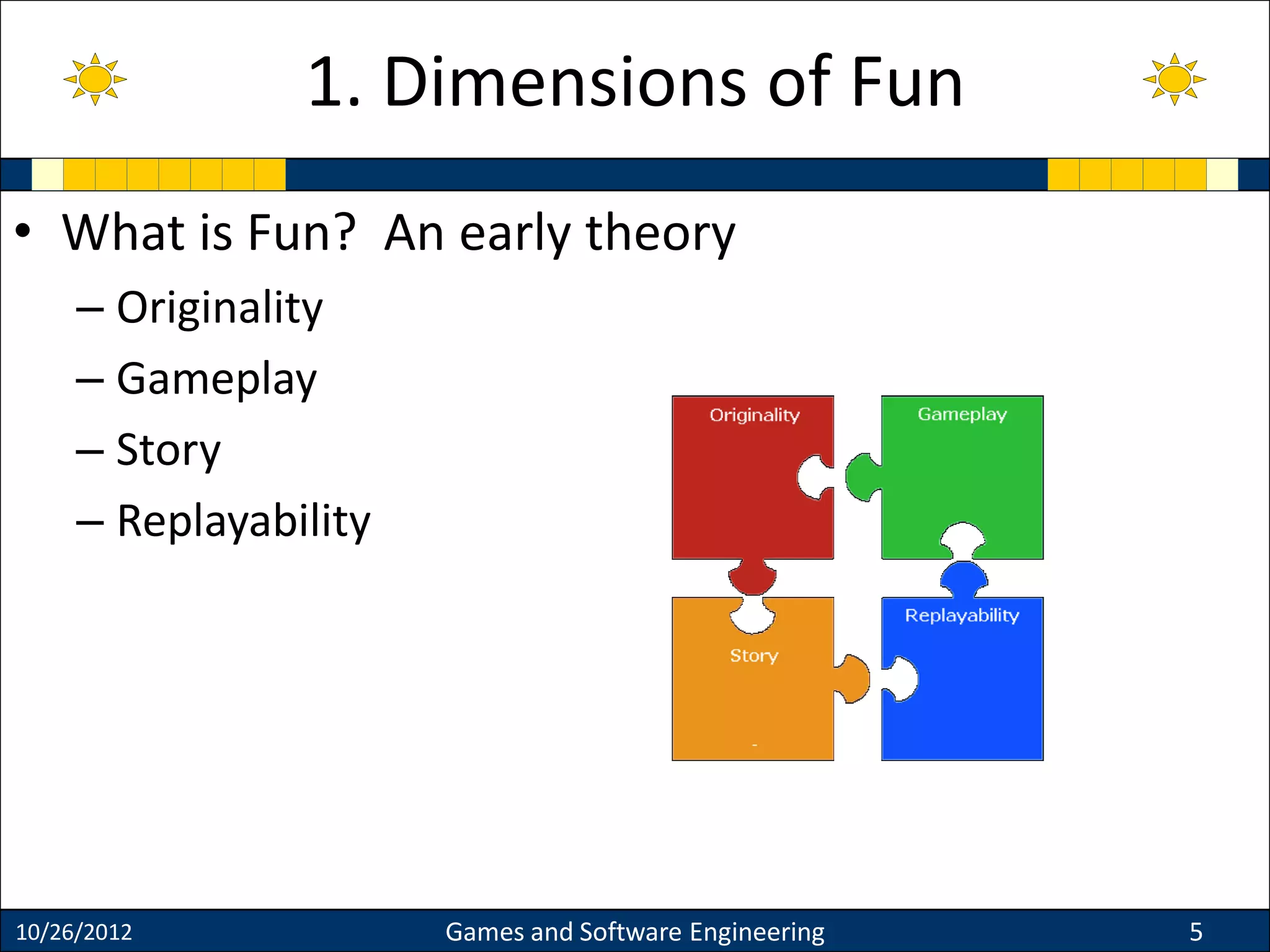
• What is Fun? An early theory
– Originality
– Gameplay
– Story
– Replayability
10/26/2012 Games and Software Engineering 5
1. Dimensions of Fun
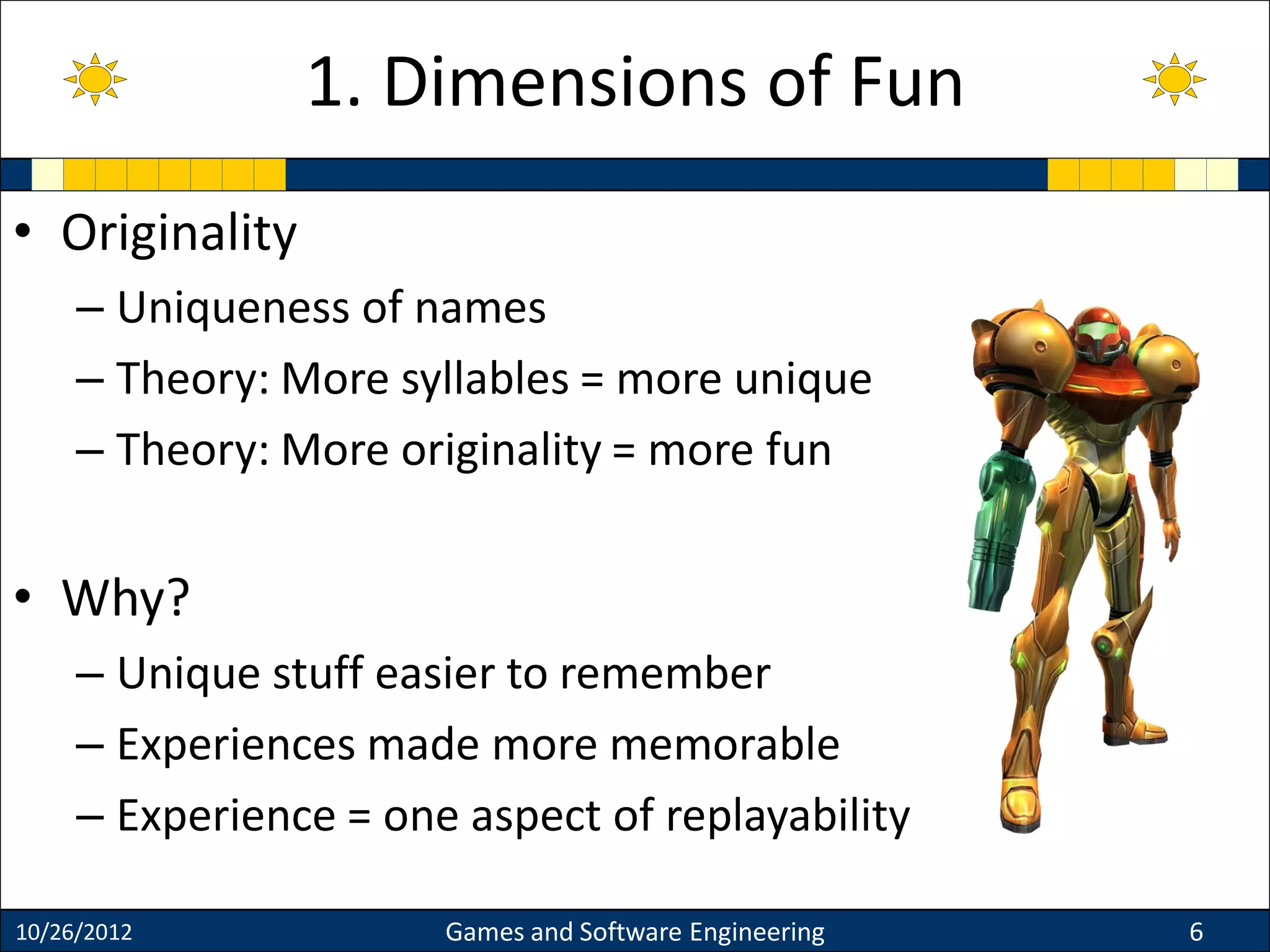
• Originality
– Uniqueness of names
– Theory: More syllables = more unique
– Theory: More originality = more fun
• Why?
– Unique stuff easier to remember
– Experiences made more memorable
– Experience = one aspect of replayability
10/26/2012 Games and Software Engineering 6
1. Dimensions of Fun
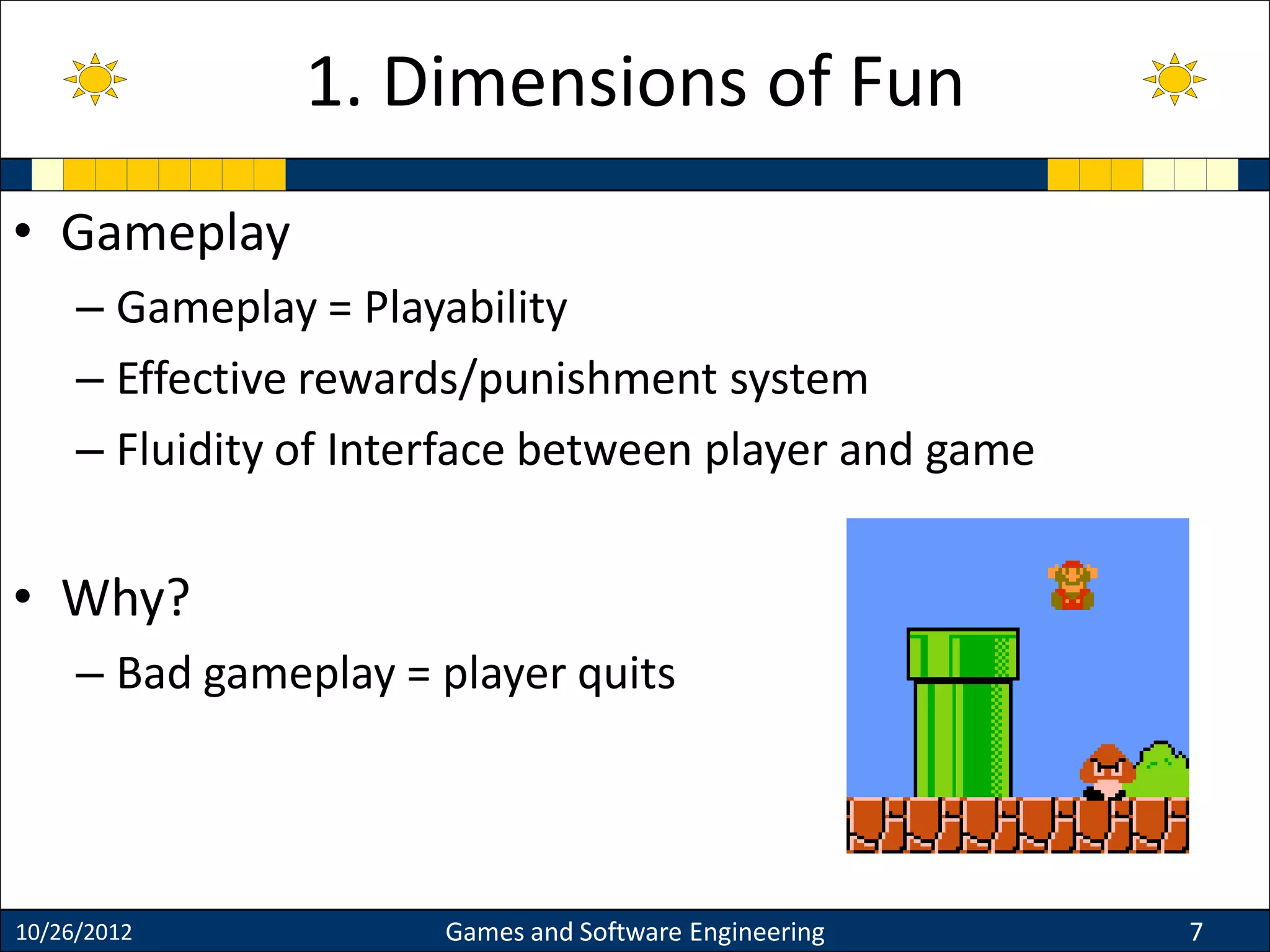
• Gameplay
– Gameplay = Playability
– Effective rewards/punishment system
– Fluidity of Interface between player and game
• Why?
– Bad gameplay = player quits
10/26/2012 Games and Software Engineering 7
1. Dimensions of Fun
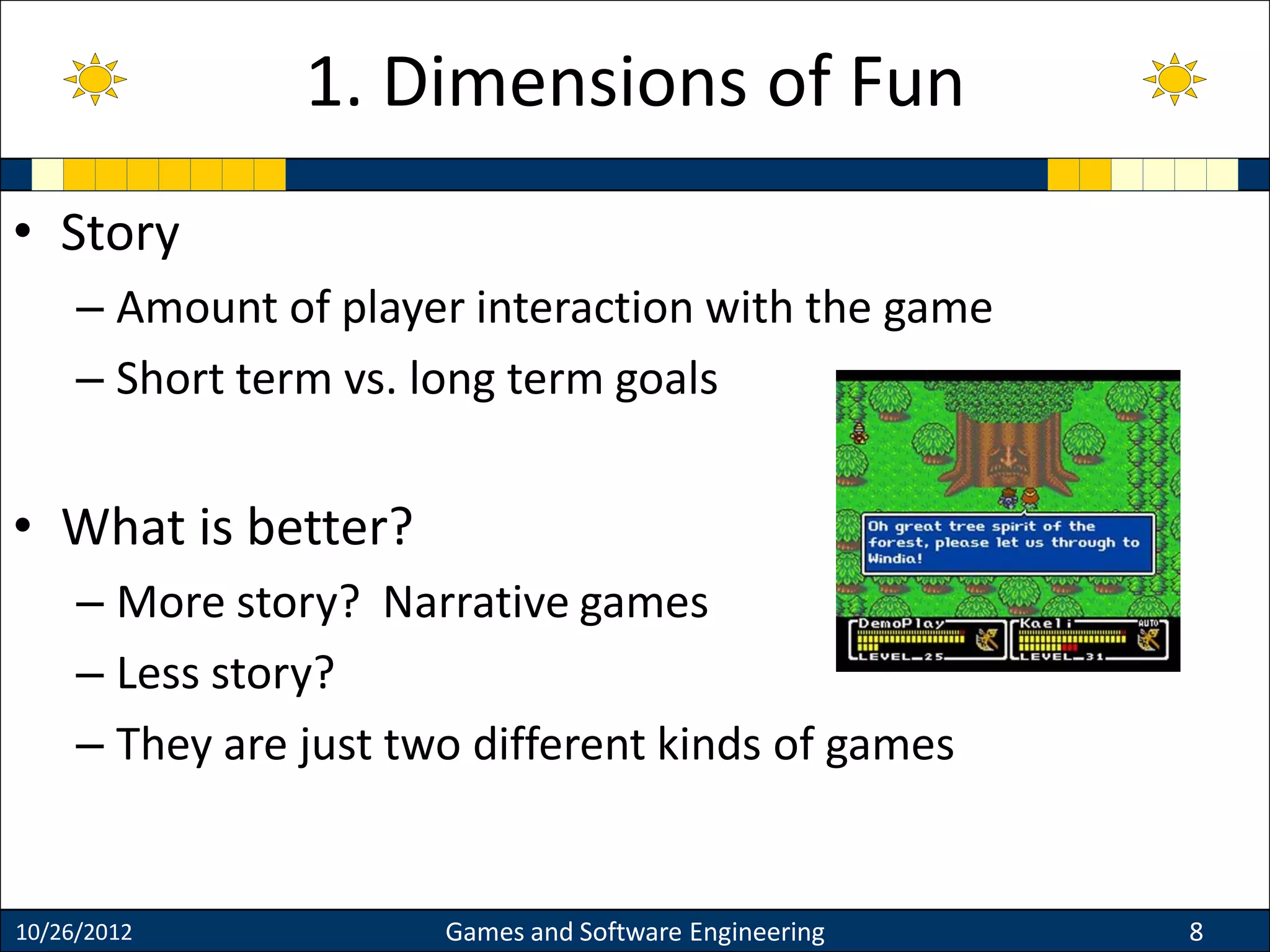
• Story
– Amount of player interaction with the game
– Short term vs. long term goals
• What is better?
– More story? Narrative games
– Less story?
– They are just two different kinds of games
10/26/2012 Games and Software Engineering 8
1. Dimensions of Fun
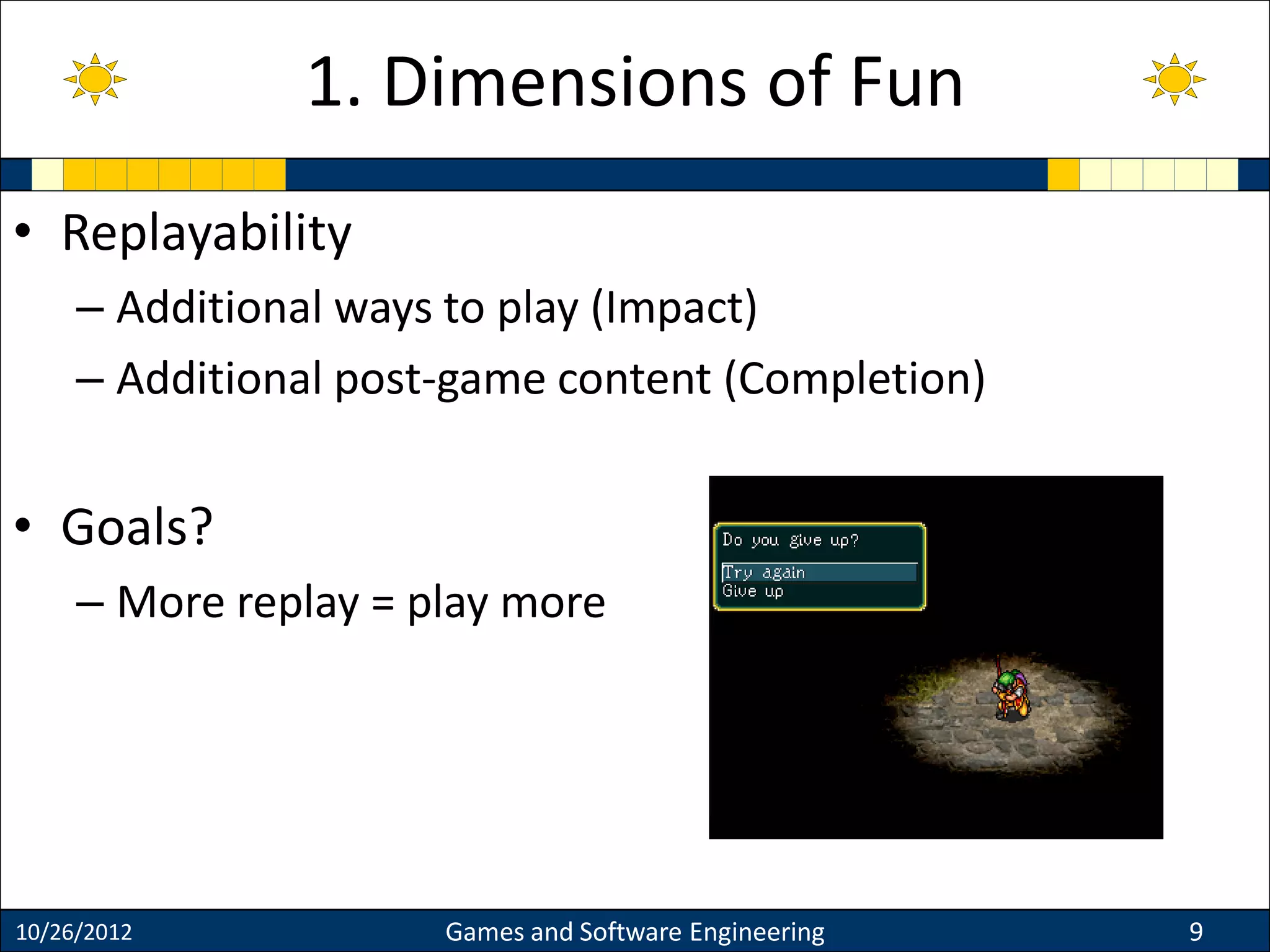
• Replayability
– Additional ways to play (Impact)
– Additional post-game content (Completion)
• Goals?
– More replay = play more
10/26/2012 Games and Software Engineering 9
1. Dimensions of Fun
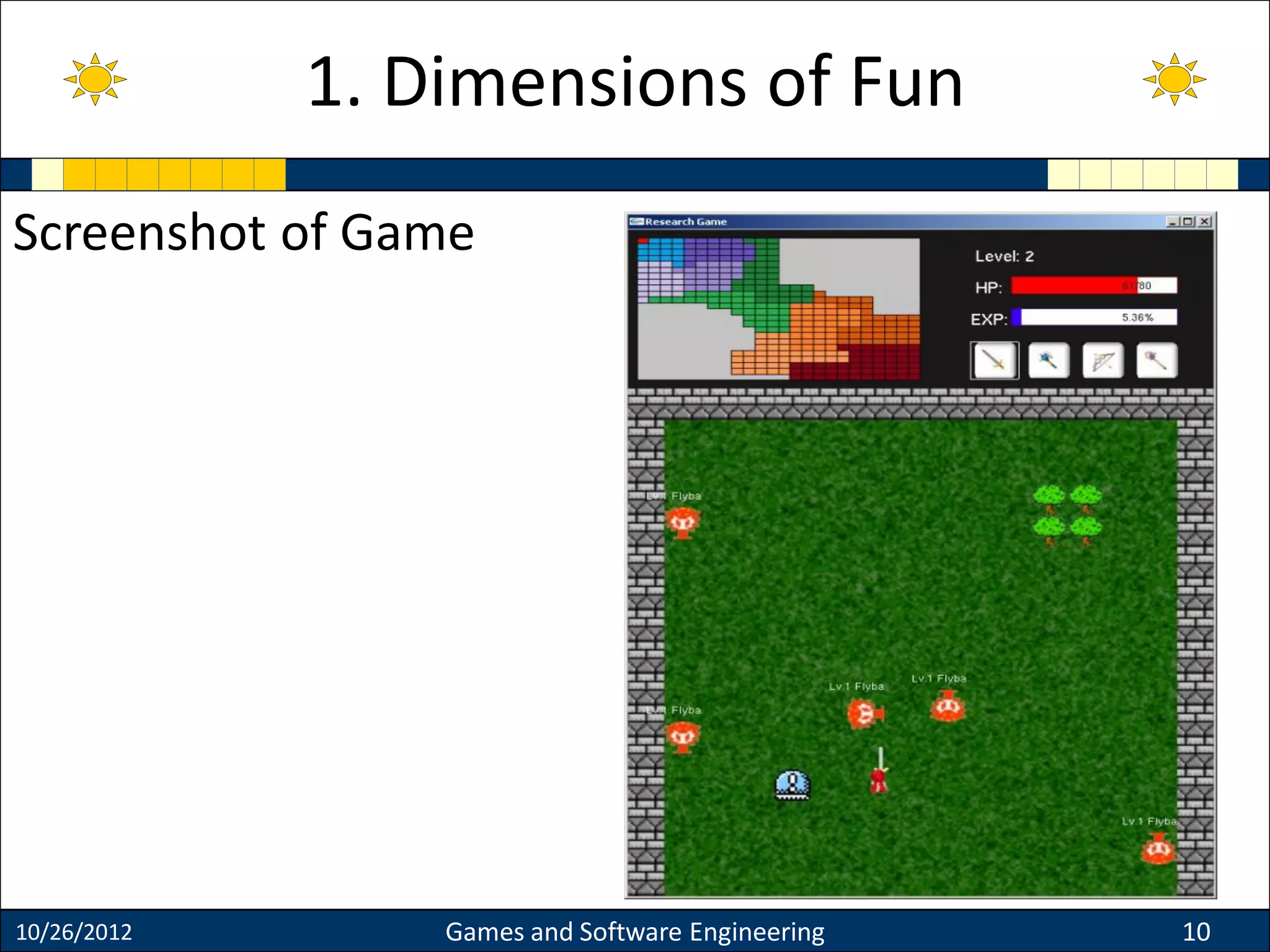
Screenshot of Game
10/26/2012 Games and Software Engineering 10
1. Dimensions of Fun
Overview
1. Dimensions of Fun
2. Believable AI
3. Procedural Content Generation
4. A Theory of Fun
5. Playability
6. Replayability
7. Our Method of Studying Games
8. Conclusion
10/26/2012 Games and Software Engineering 11
Table of Contents
10/26/2012 Games and Software Engineering 12
2. Believable AI
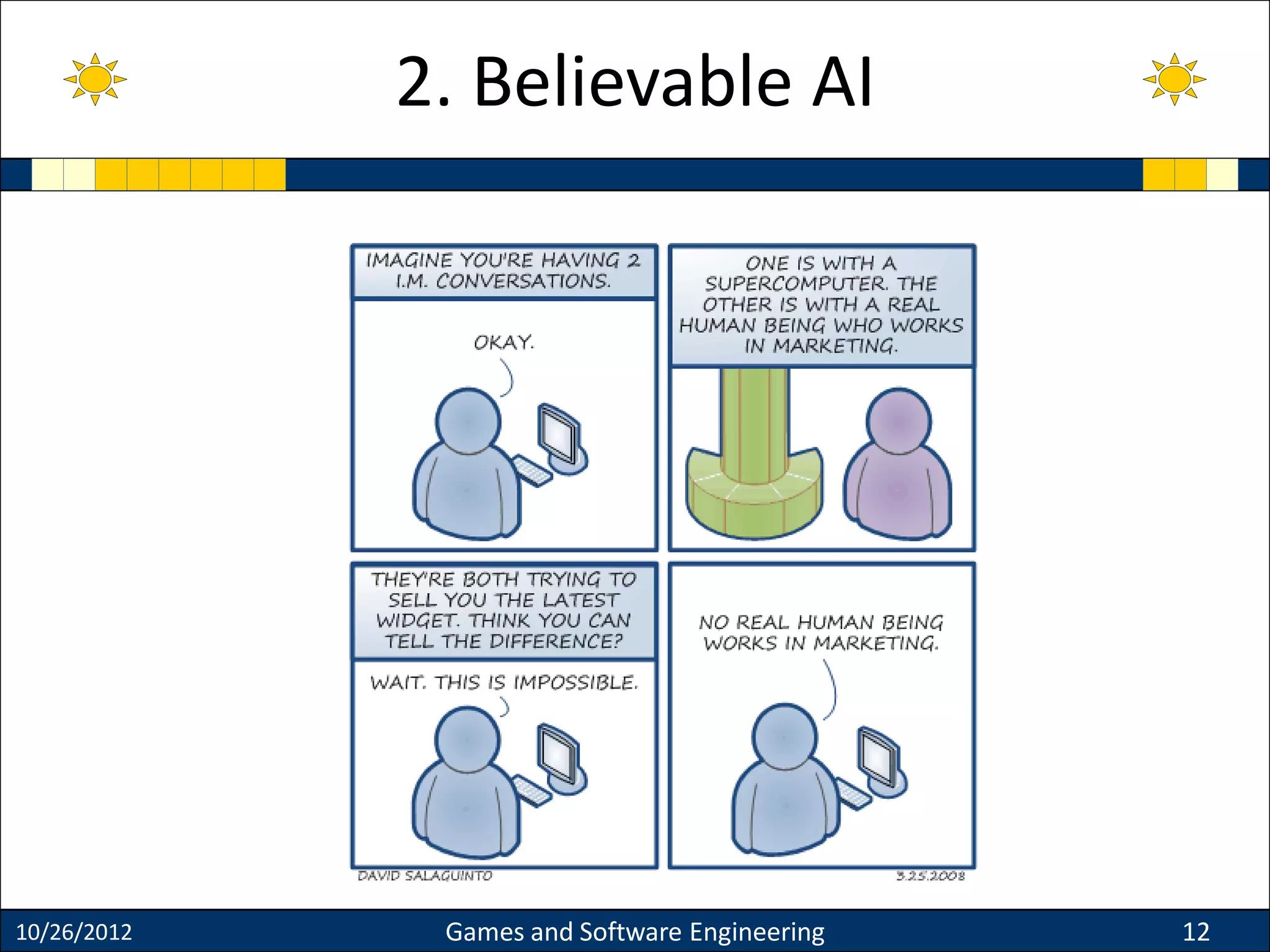
• Turing’s Test
– Is it a computer or a human?
• Believability in Games
– Preserving the “Magic Circle”
– Limit Distractions (High Playability)
10/26/2012 Games and Software Engineering 13
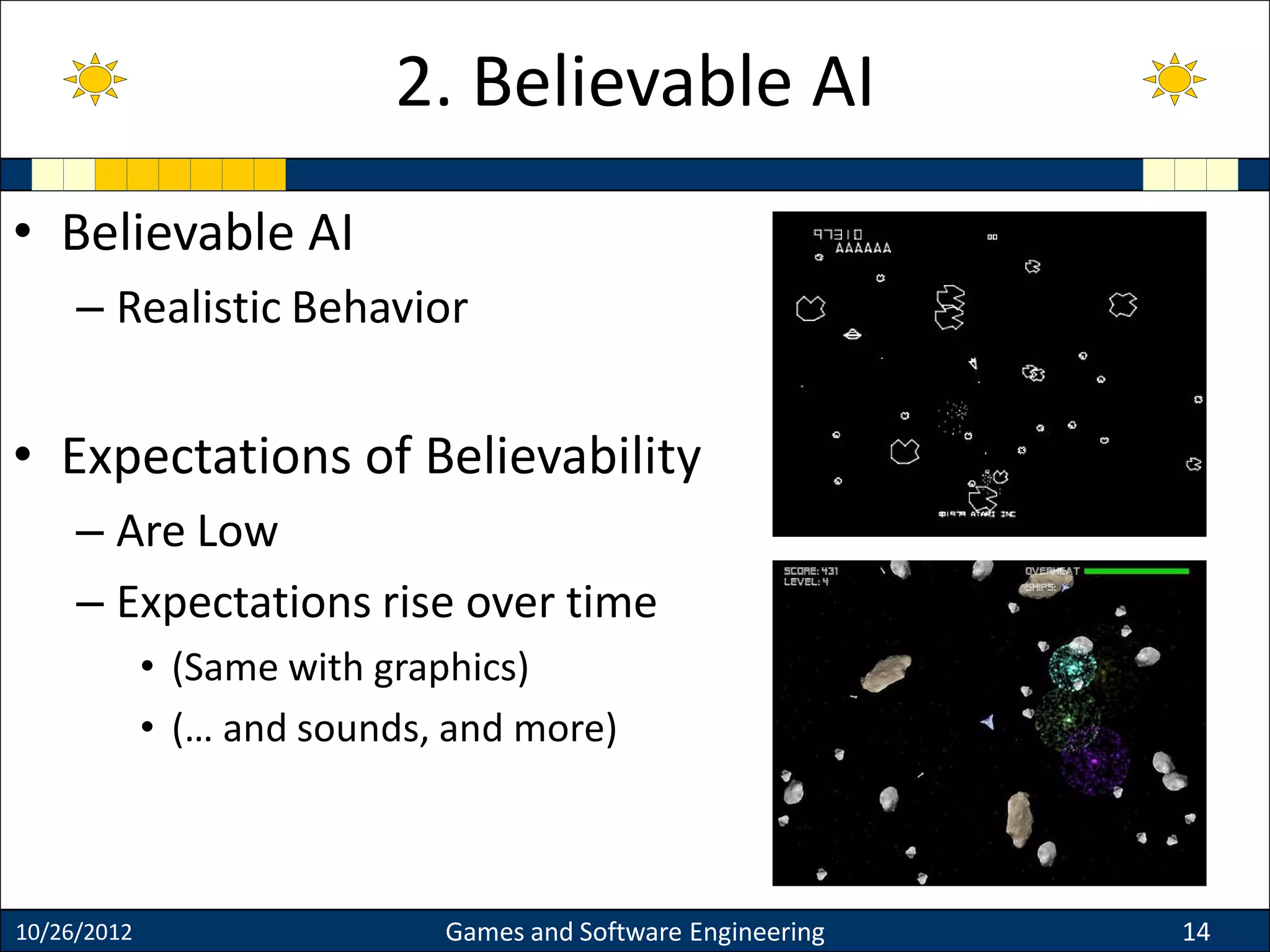
2. Believable AI
• Believable AI
– Realistic Behavior
• Expectations of Believability
– Are Low
– Expectations rise over time
• (Same with graphics)
• (… and sounds, and more)
10/26/2012 Games and Software Engineering 14
2. Believable AI
Overview
1. Dimensions of Fun
2. Believable AI
3. Procedural Content Generation
4. A Theory of Fun
5. Playability
6. Replayability
7. Our Method of Studying Games
8. Conclusion
10/26/2012 Games and Software Engineering 15
Table of Contents
• What is PCG?
– Procedural Content Generation
– Automated generation of content
• Why use PCG?
– Game with static content gets boring
– Keep a game fresh, add replayability
– Assist the game designer
10/26/2012 Games and Software Engineering 16
3. PCG
• Many kinds of PCG
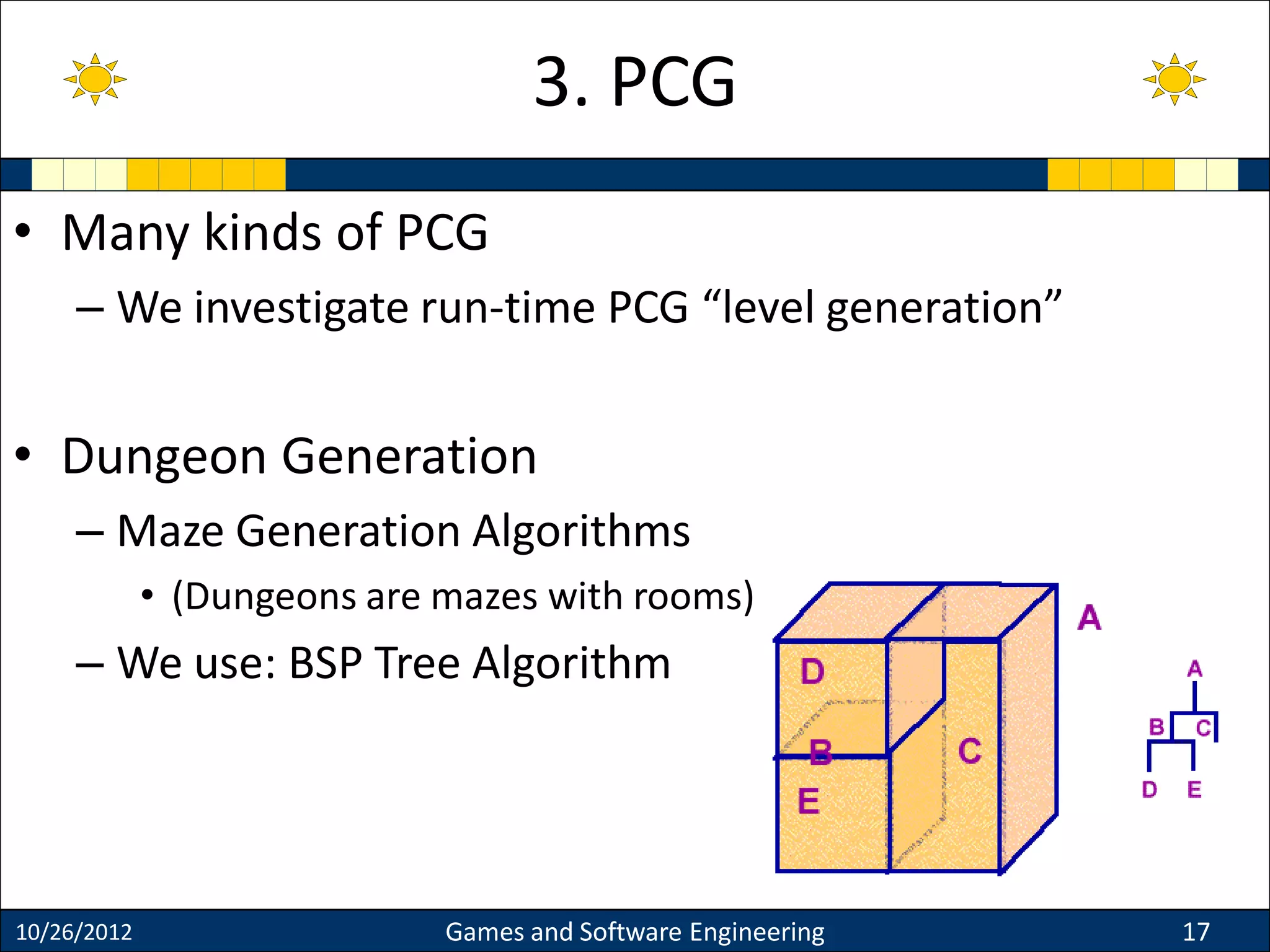
– We investigate run-time PCG “level generation”
• Dungeon Generation
– Maze Generation Algorithms
• (Dungeons are mazes with rooms)
– We use: BSP Tree Algorithm
10/26/2012 Games and Software Engineering 17
3. PCG
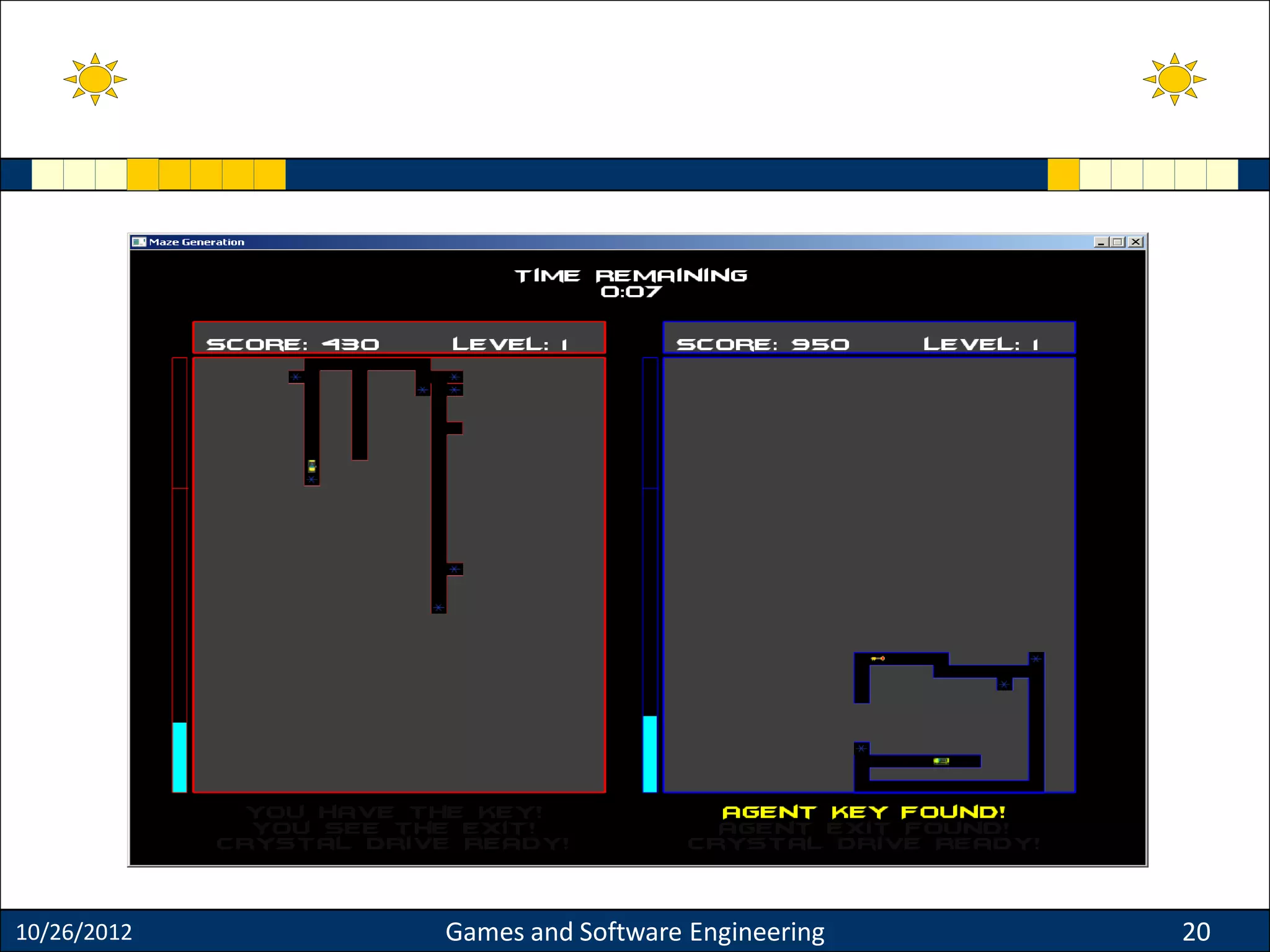
• AiMazed2D Game
– Build a dungeon with BSP Tree Algorithm
– Add objectives
– Solve it automatically
• AI Solver Agent
– Movement through dungeon in human manner
– Choice Points Survey to learn human manner
10/26/2012 Games and Software Engineering 18
3. PCG
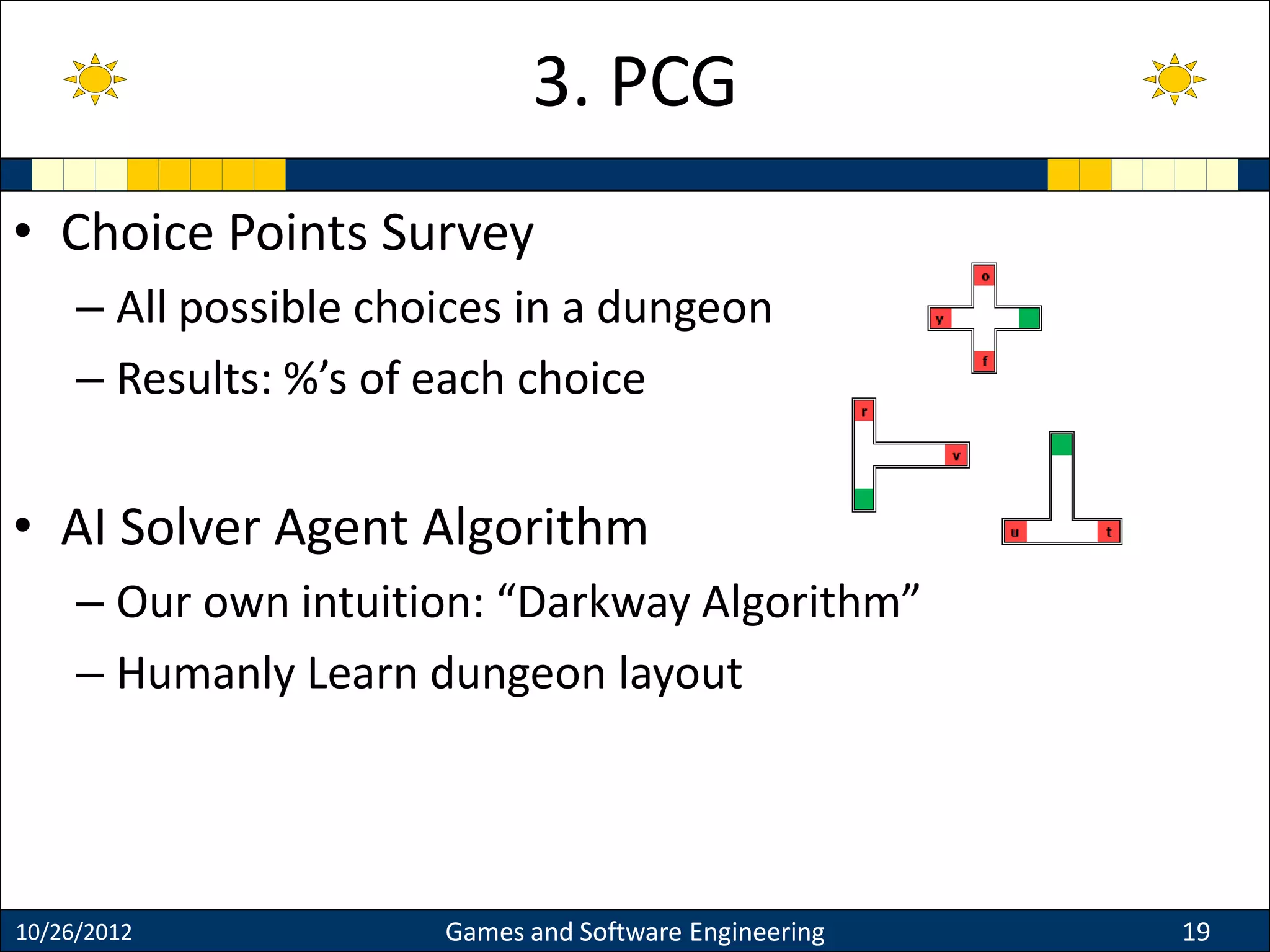
• Choice Points Survey
– All possible choices in a dungeon
– Results: %’s of each choice
• AI Solver Agent Algorithm
– Our own intuition: “Darkway Algorithm”
– Humanly Learn dungeon layout
10/26/2012 Games and Software Engineering 19
3. PCG
10/26/2012 Games and Software Engineering 20
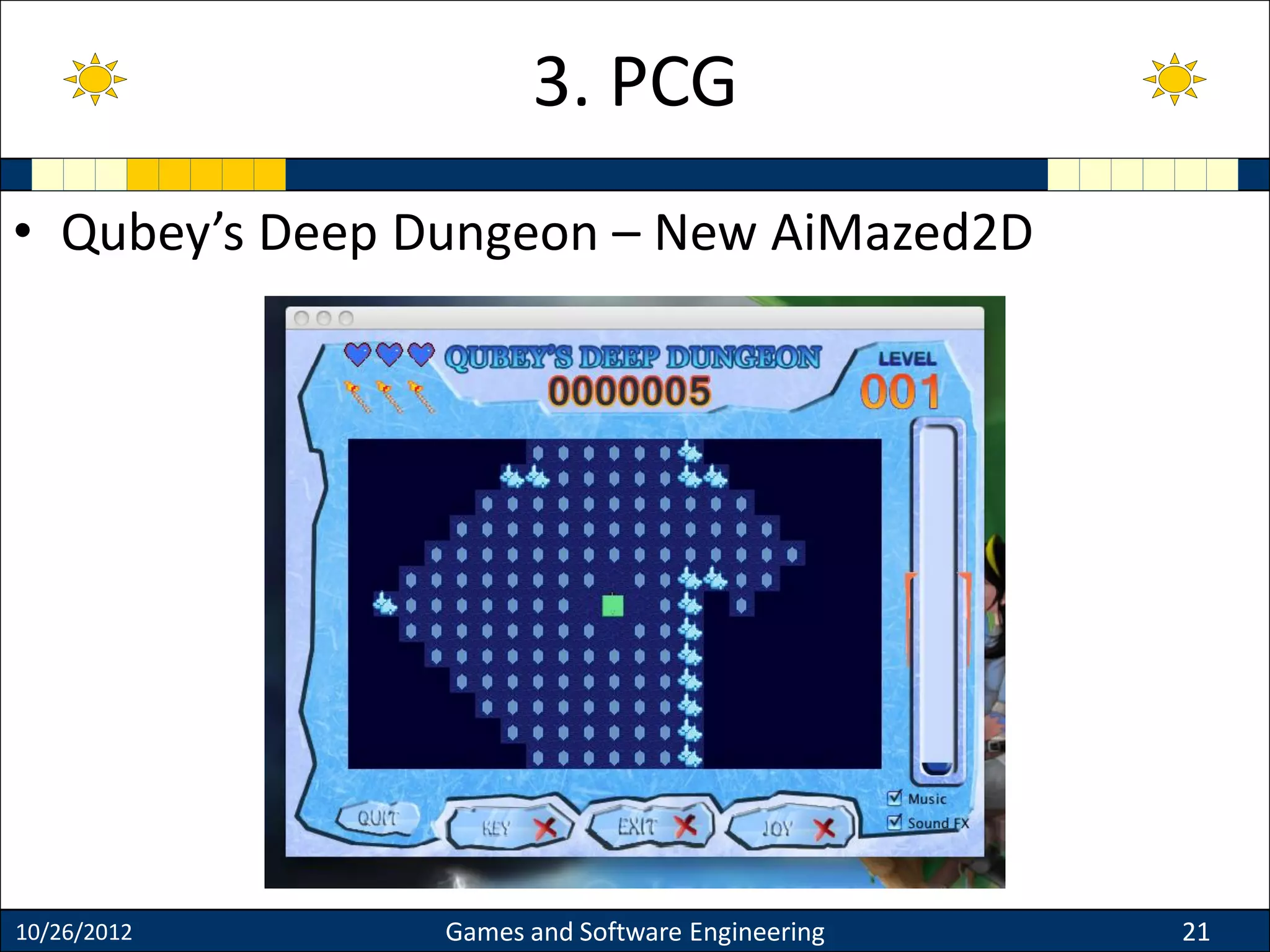
• Qubey’s Deep Dungeon – New AiMazed2D
10/26/2012 Games and Software Engineering 21
3. PCG
Overview
1. Dimensions of Fun
2. Believable AI
3. Procedural Content Generation
4. A Theory of Fun
5. Playability
6. Replayability
7. Our Method of Studying Games
8. Conclusion
10/26/2012 Games and Software Engineering 22
Table of Contents
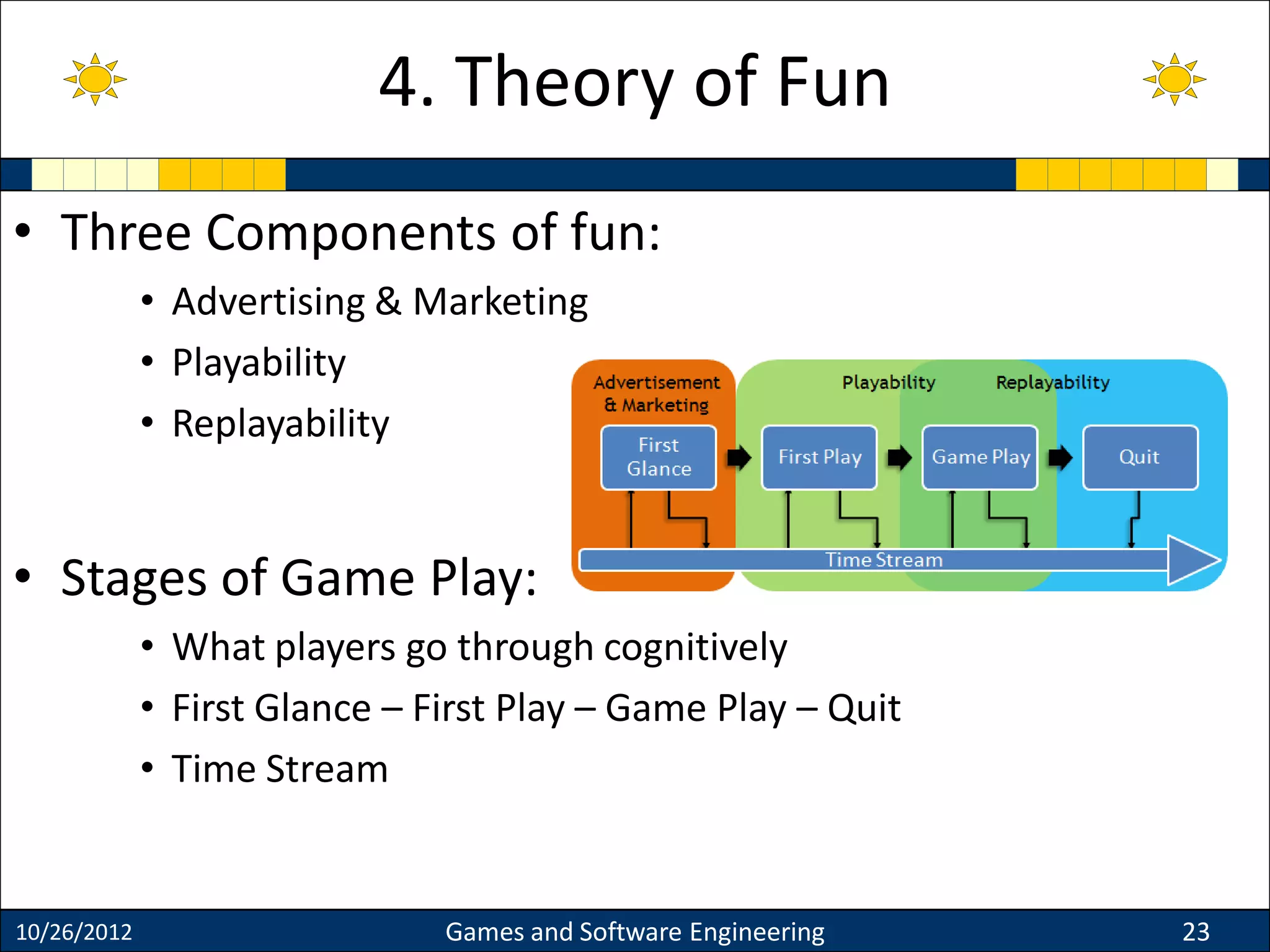
• Three Components of fun:
• Advertising & Marketing
• Playability
• Replayability
• Stages of Game Play:
• What players go through cognitively
• First Glance – First Play – Game Play – Quit
• Time Stream
10/26/2012 Games and Software Engineering 23
4. Theory of Fun
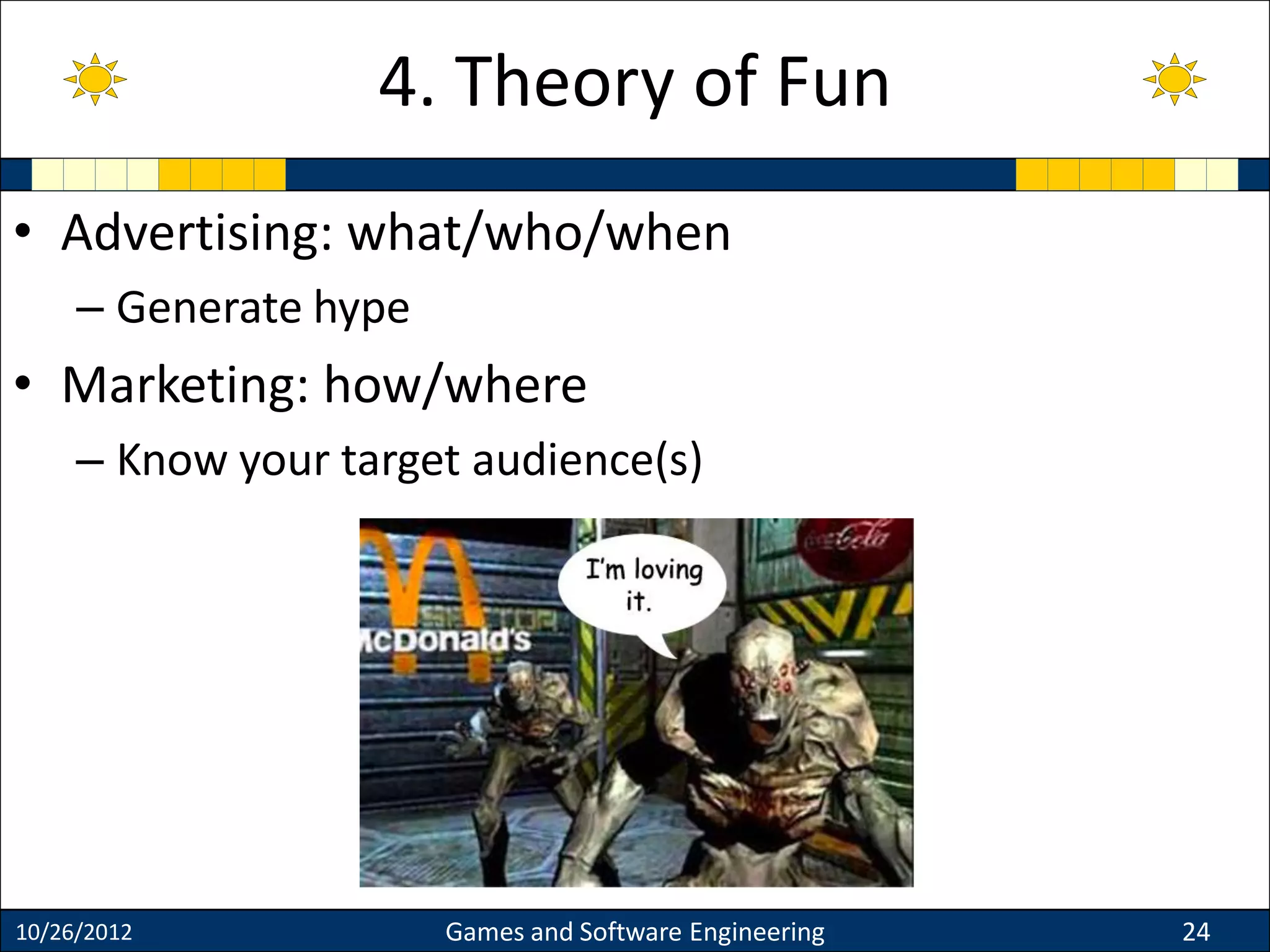
• Advertising: what/who/when
– Generate hype
• Marketing: how/where
– Know your target audience(s)
10/26/2012 Games and Software Engineering 24
4. Theory of Fun
• Playability
– Limiting Distractions
– What not to do
– Section 5
• Replayability
– How long until we get bored?
– What to do
– Section 6
10/26/2012 Games and Software Engineering 25
4. Theory of Fun
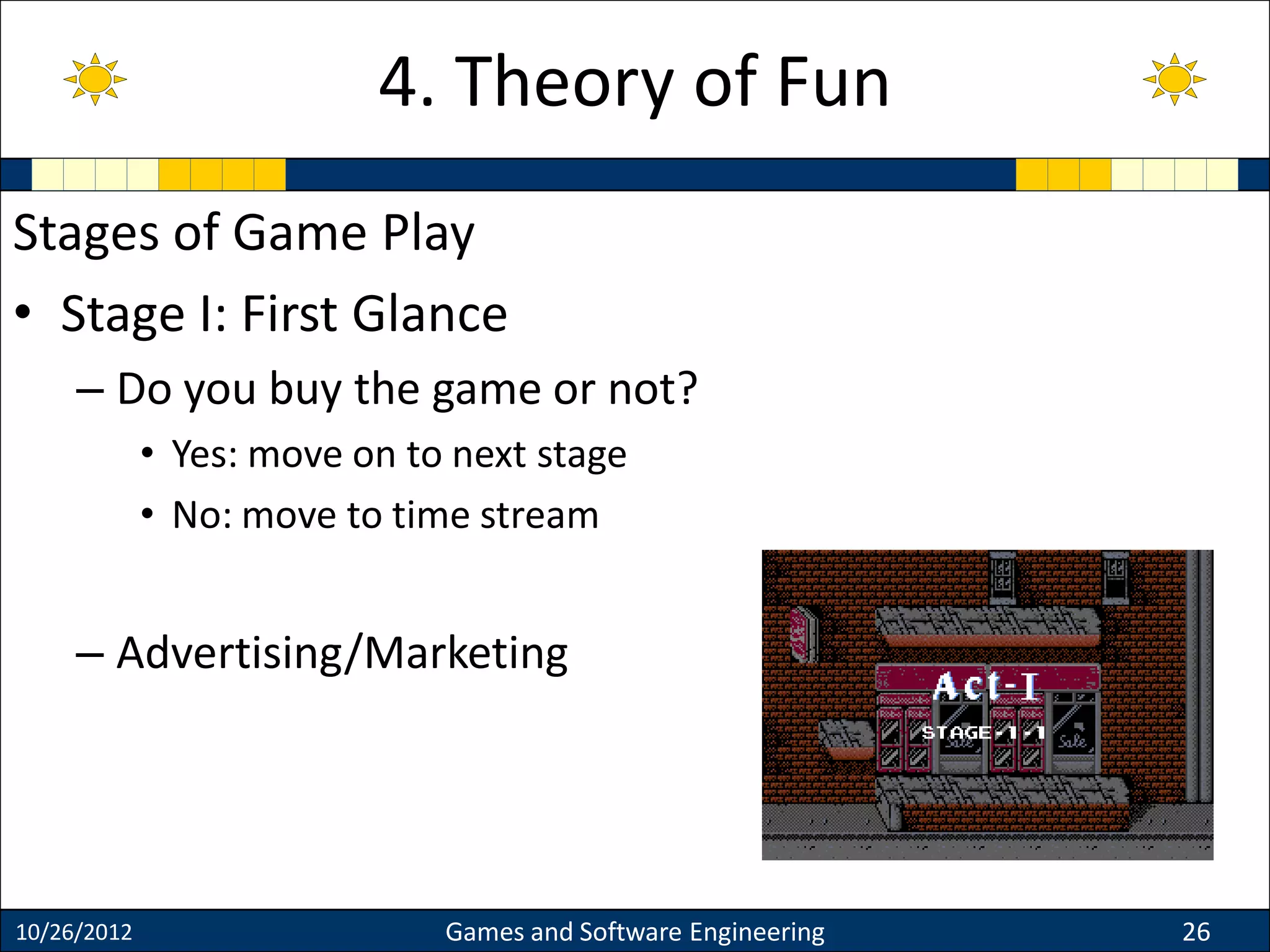
Stages of Game Play
• Stage I: First Glance
– Do you buy the game or not?
• Yes: move on to next stage
• No: move to time stream
– Advertising/Marketing
10/26/2012 Games and Software Engineering 26
4. Theory of Fun
• Stage II: First Play
– First Experience vs. Expectations
• Yes: move on to next stage
• No: move to Time Stream
– Low Playability?
10/26/2012 Games and Software Engineering 27
4. Theory of Fun
• Stage III: Game Play
– Goal: Get here and stay
• Replayability
– When they quit:
• Before “long”: game got boring
– Move to time stream (bad)
• After “long”: game was exhausted
– Advance to final stage (good)
10/26/2012 Games and Software Engineering 28
4. Theory of Fun
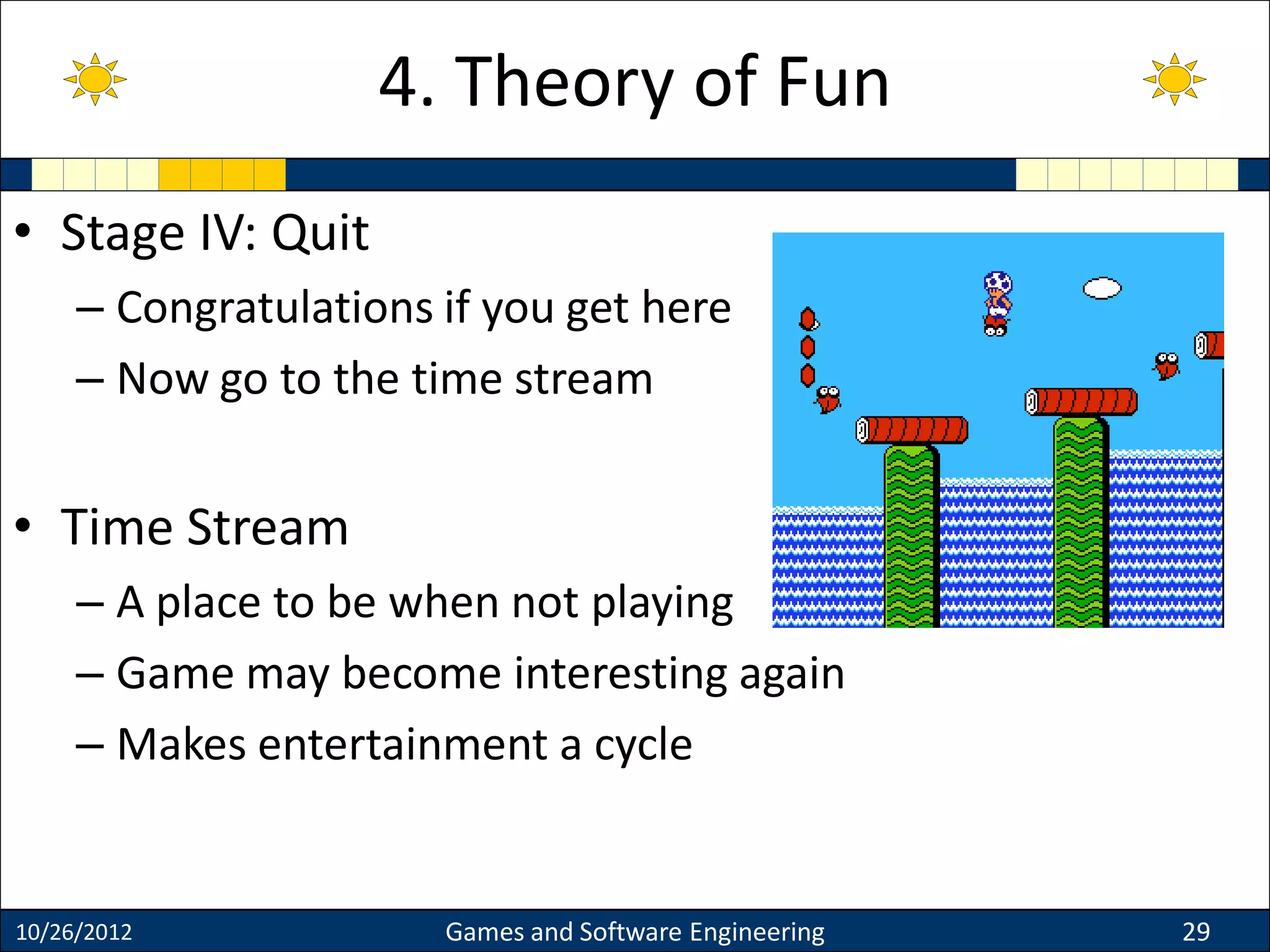
• Stage IV: Quit
– Congratulations if you get here
– Now go to the time stream
• Time Stream
– A place to be when not playing
– Game may become interesting again
– Makes entertainment a cycle
10/26/2012 Games and Software Engineering 29
4. Theory of Fun
Overview
1. Dimensions of Fun
2. Believable AI
3. Procedural Content Generation
4. A Theory of Fun
5. Playability
6. Replayability
7. Our Method of Studying Games
8. Conclusion
10/26/2012 Games and Software Engineering 30
Table of Contents
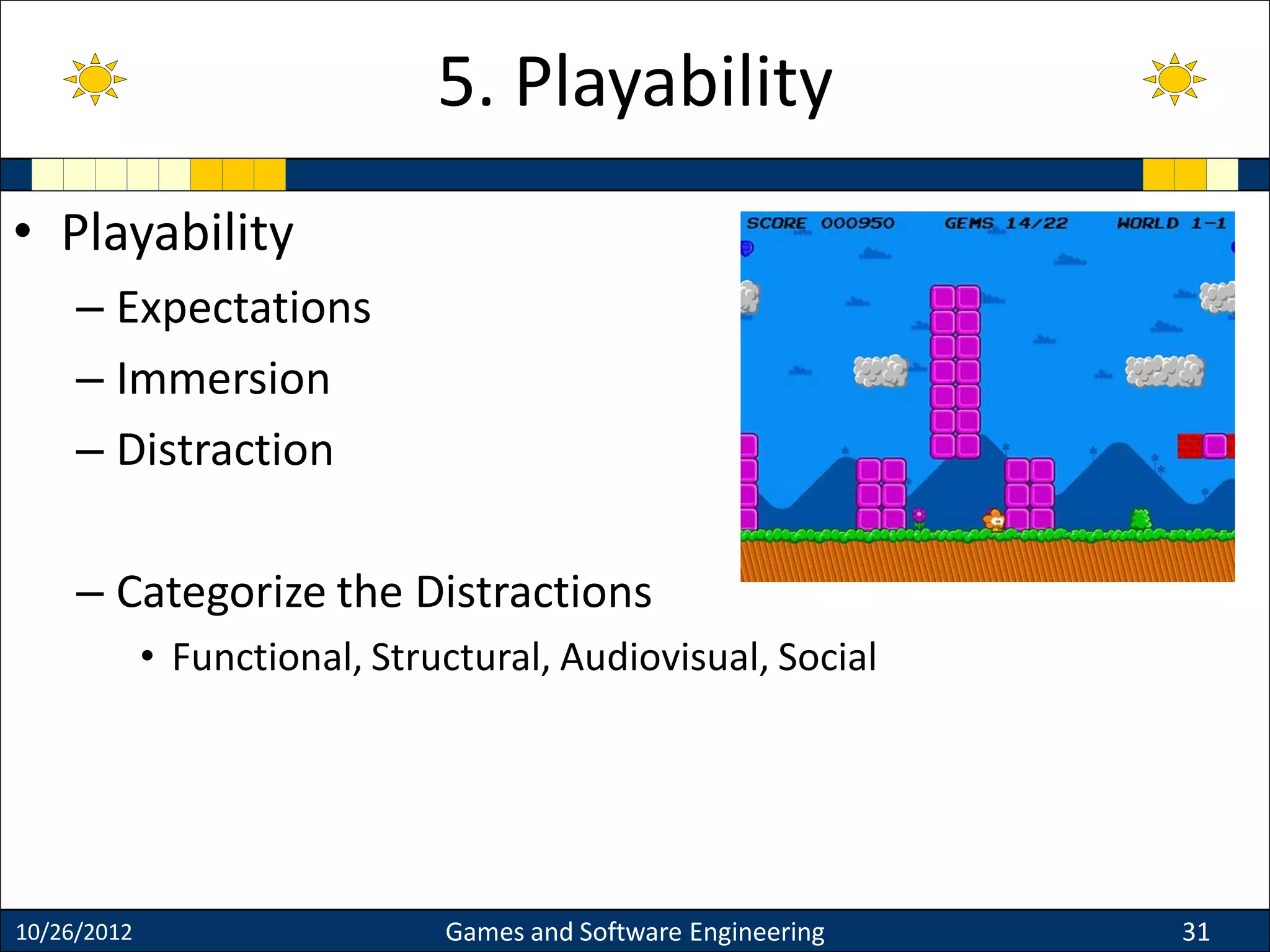
• Playability
– Expectations
– Immersion
– Distraction
– Categorize the Distractions
• Functional, Structural, Audiovisual, Social
10/26/2012 Games and Software Engineering 31
5. Playability
• Functional Playability
– System performance
– Interface fluidity
• Structural Playability
– Too Easy < Optimal flow state < Too Difficult
– Progression
10/26/2012 Games and Software Engineering 32
5. Playability
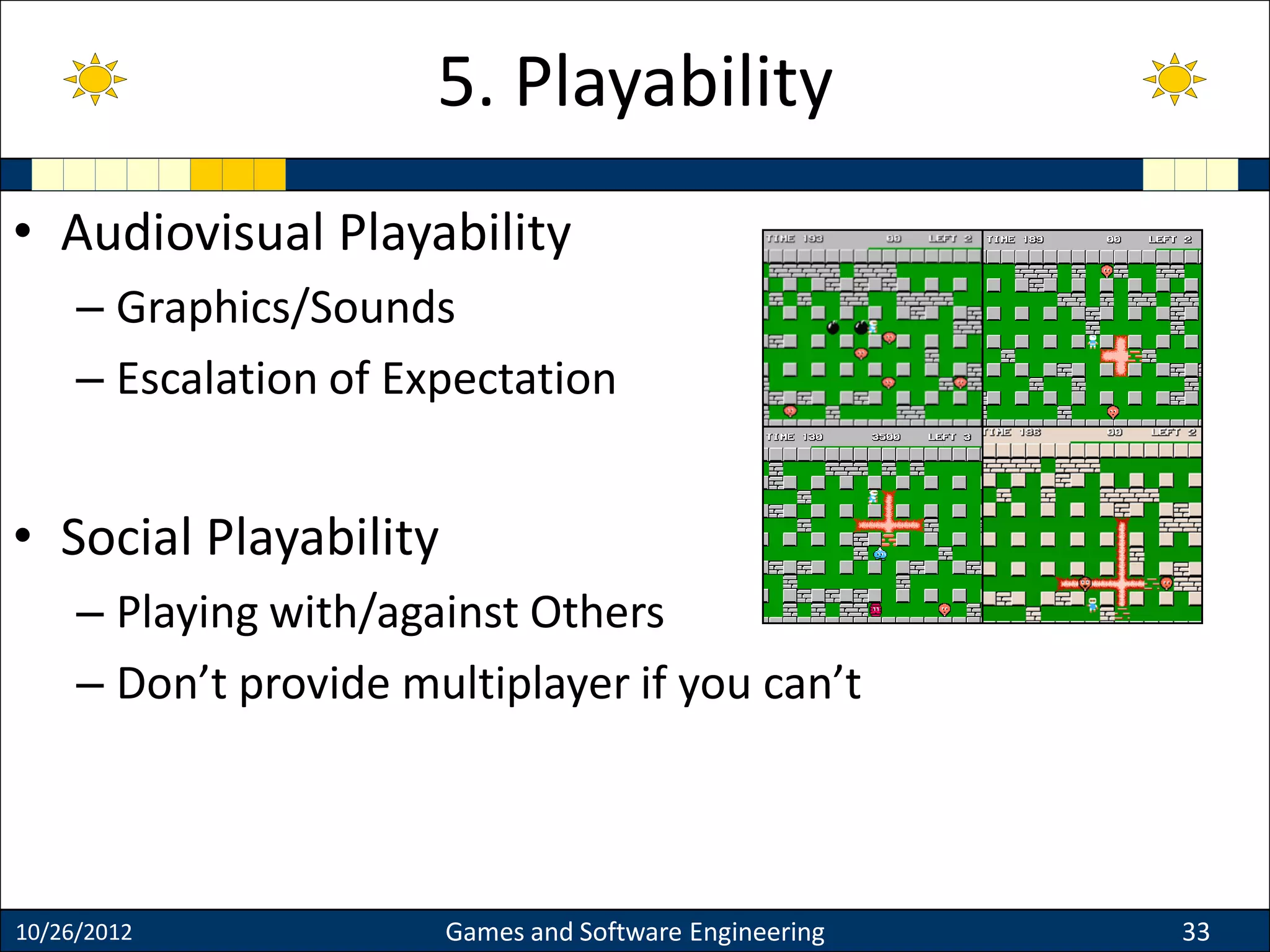
• Audiovisual Playability
– Graphics/Sounds
– Escalation of Expectation
• Social Playability
– Playing with/against Others
– Don’t provide multiplayer if you can’t
10/26/2012 Games and Software Engineering 33
5. Playability
Overview
1. Dimensions of Fun
2. Believable AI
3. Procedural Content Generation
4. A Theory of Fun
5. Playability
6. Replayability
7. Our Method of Studying Games
8. Conclusion
10/26/2012 Games and Software Engineering 34
Table of Contents
• Replayability
– Permanence of one’s Willingness to Immerse
• What keeps a game from becoming boring
– Six “Aspects of Replayability” = SChEMICo
• Social, Challenge, Experience, Mastery, Impact, Completion
10/26/2012 Games and Software Engineering 35
6. Replayability
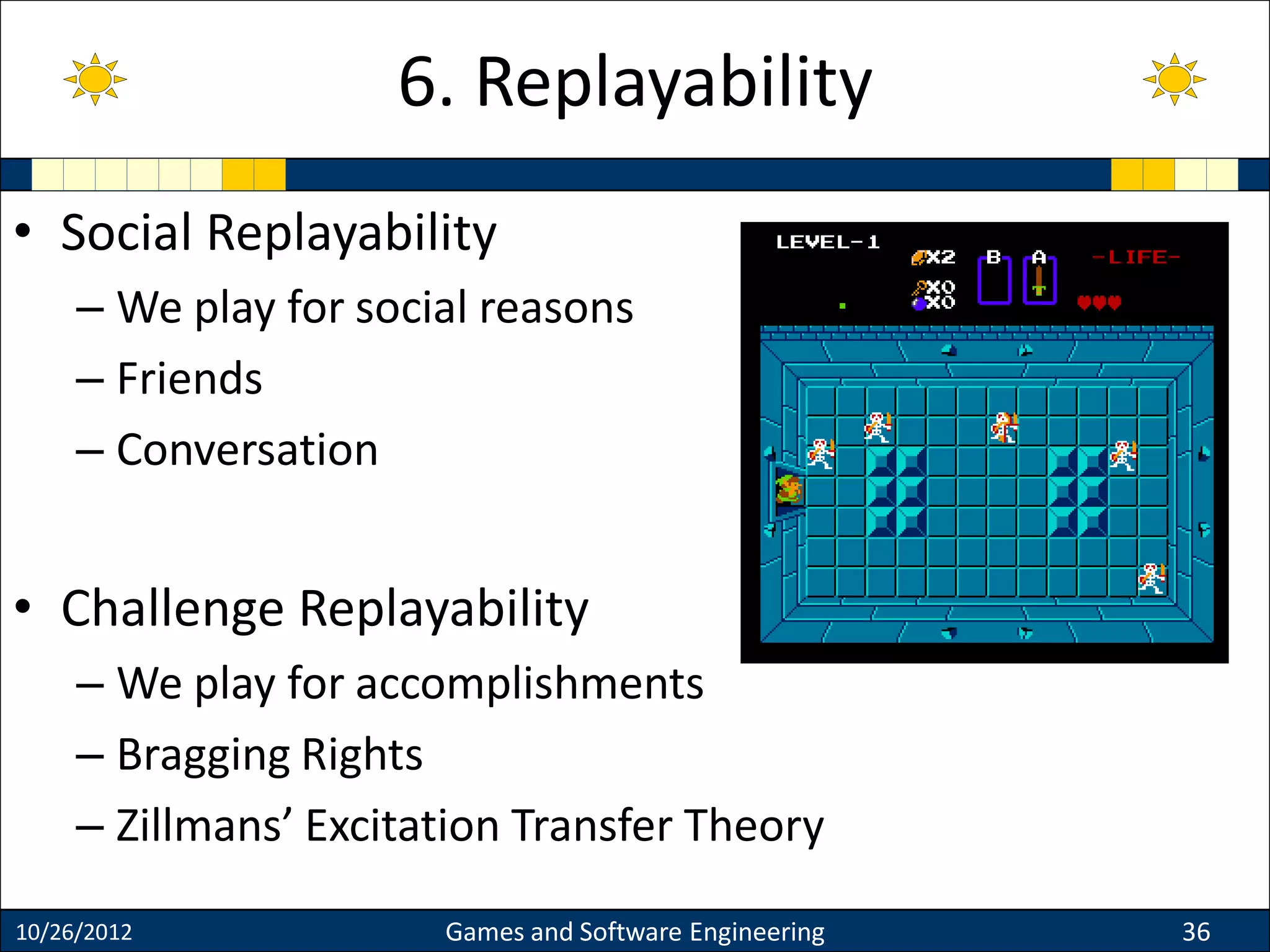
• Social Replayability
– We play for social reasons
– Friends
– Conversation
• Challenge Replayability
– We play for accomplishments
– Bragging Rights
– Zillmans’ Excitation Transfer Theory
10/26/2012 Games and Software Engineering 36
6. Replayability
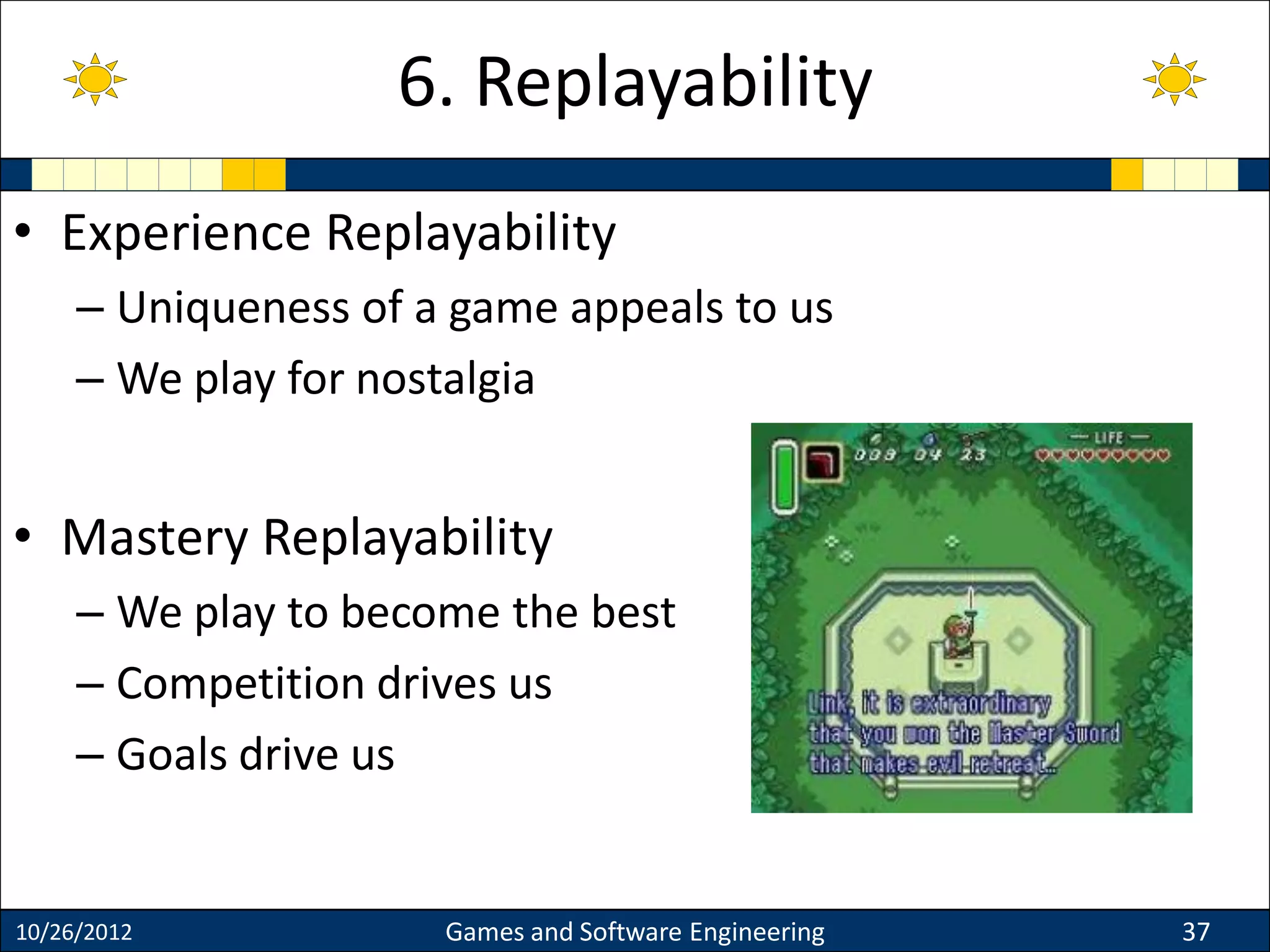
• Experience Replayability
– Uniqueness of a game appeals to us
– We play for nostalgia
• Mastery Replayability
– We play to become the best
– Competition drives us
– Goals drive us
10/26/2012 Games and Software Engineering 37
6. Replayability
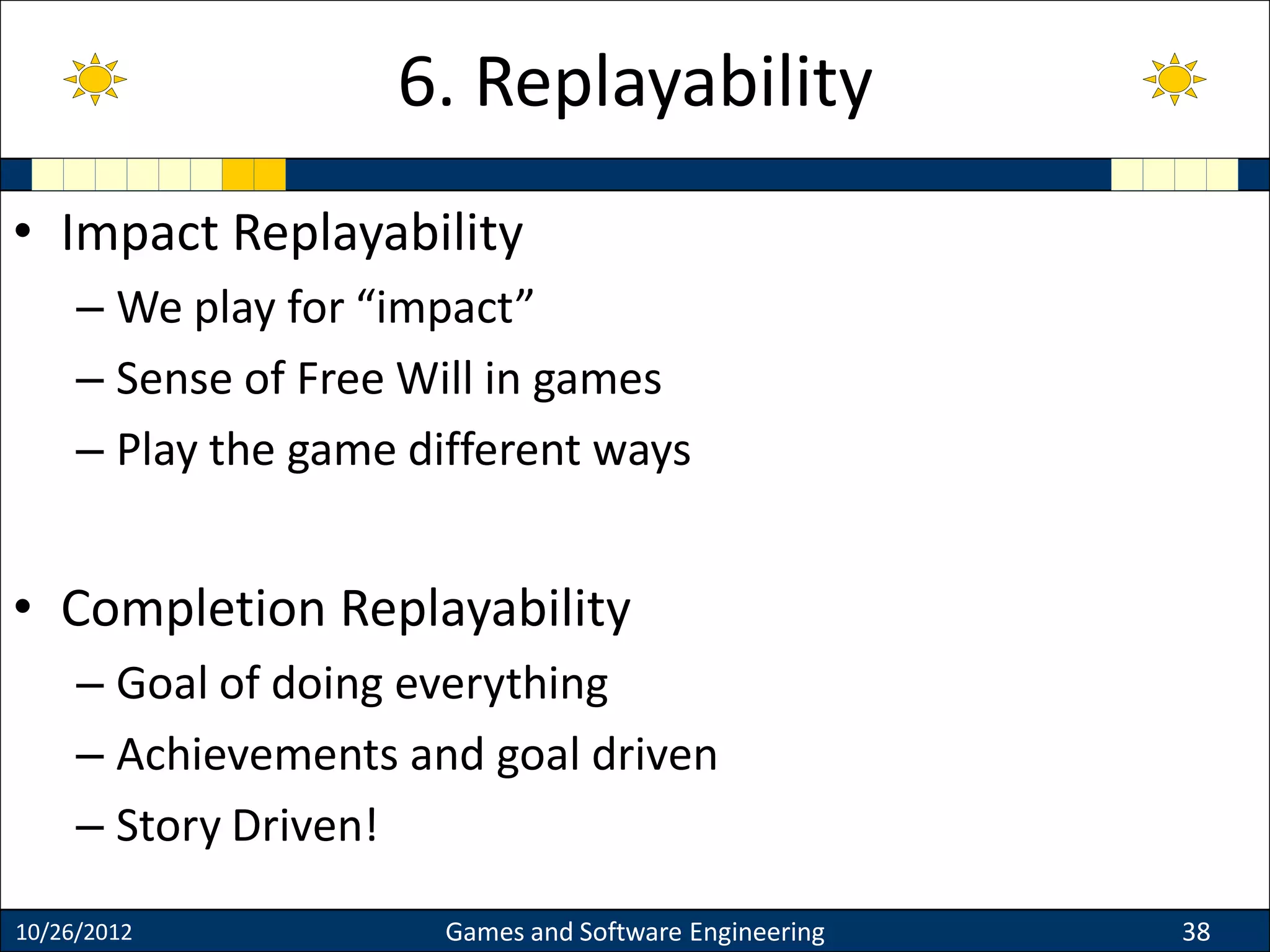
• Impact Replayability
– We play for “impact”
– Sense of Free Will in games
– Play the game different ways
• Completion Replayability
– Goal of doing everything
– Achievements and goal driven
– Story Driven!
10/26/2012 Games and Software Engineering 38
6. Replayability
Overview
1. Dimensions of Fun
2. Believable AI
3. Procedural Content Generation
4. A Theory of Fun
5. Playability
6. Replayability
7. Studying Games
8. Conclusion
10/26/2012 Games and Software Engineering 39
Table of Contents
• JSEA Paper
– Describe how/why to study games
• Surveys
– Gaming Datasets about Replayability
– Analysis & Ecological Effects
10/26/2012 Games and Software Engineering 40
7. Studying Games
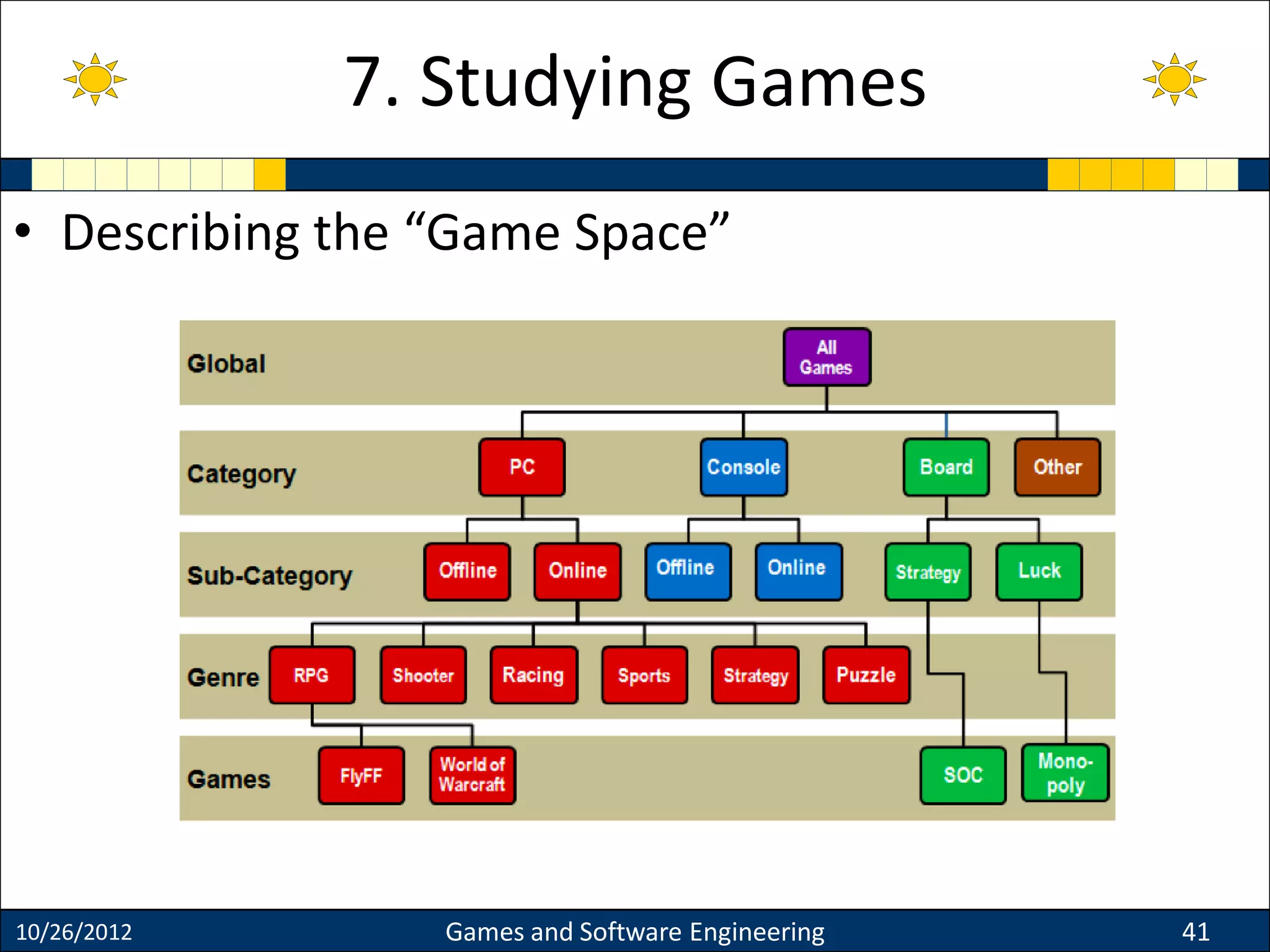
• Describing the “Game Space”
10/26/2012 Games and Software Engineering 41
7. Studying Games
• Previous Gaming Data
– Fratessi et al: “All Games”
• Gaming Data we gathered:
– “All Board Games”
– “Settlers of Catan” (SOC)
– “Fly for Fun” (FlyFF)
10/26/2012 Games and Software Engineering 42
7. Studying Games
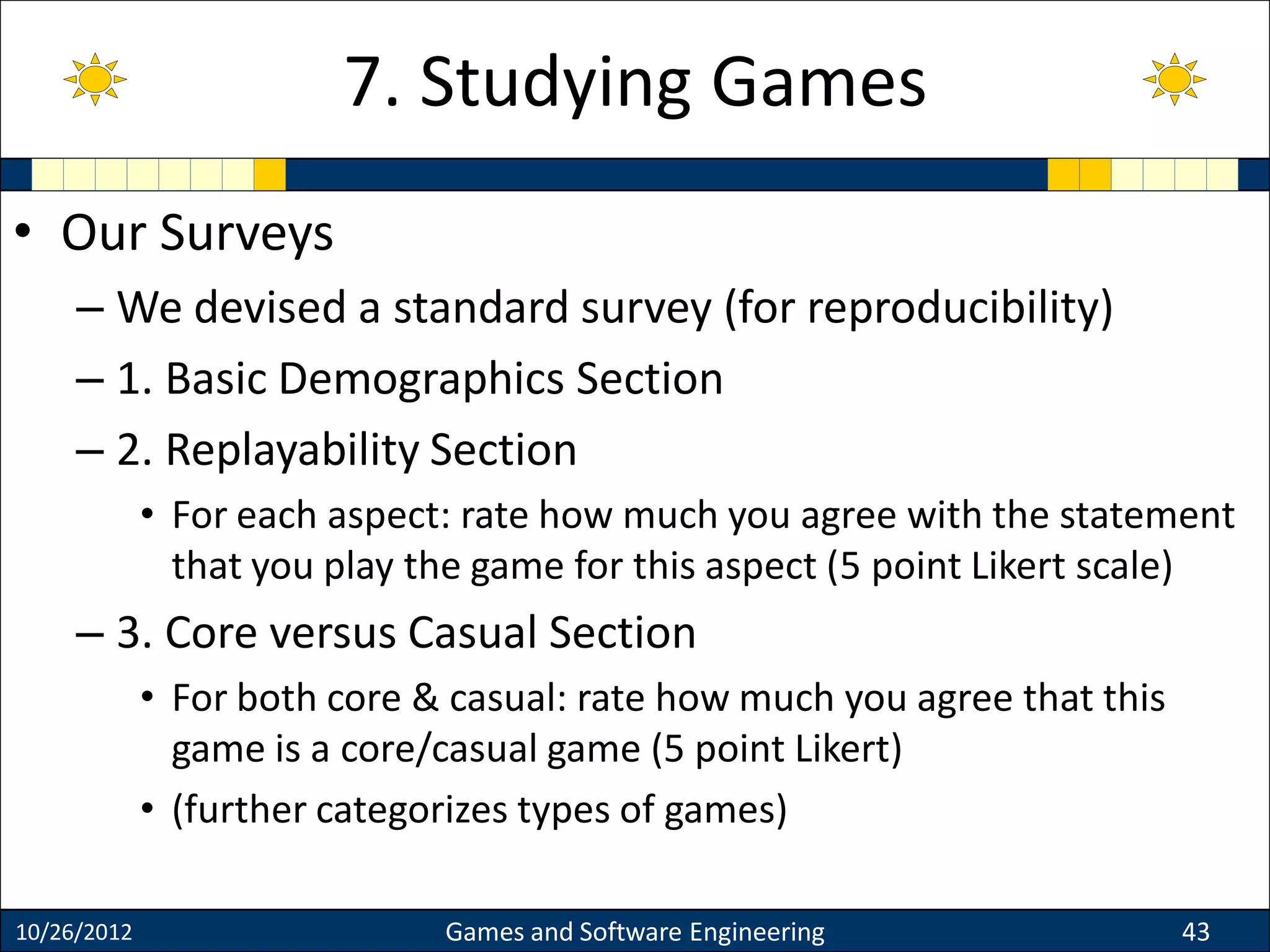
• Our Surveys
– We devised a standard survey (for reproducibility)
– 1. Basic Demographics Section
– 2. Replayability Section
• For each aspect: rate how much you agree with the statement
that you play the game for this aspect (5 point Likert scale)
– 3. Core versus Casual Section
• For both core & casual: rate how much you agree that this
game is a core/casual game (5 point Likert)
• (further categorizes types of games)
10/26/2012 Games and Software Engineering 43
7. Studying Games
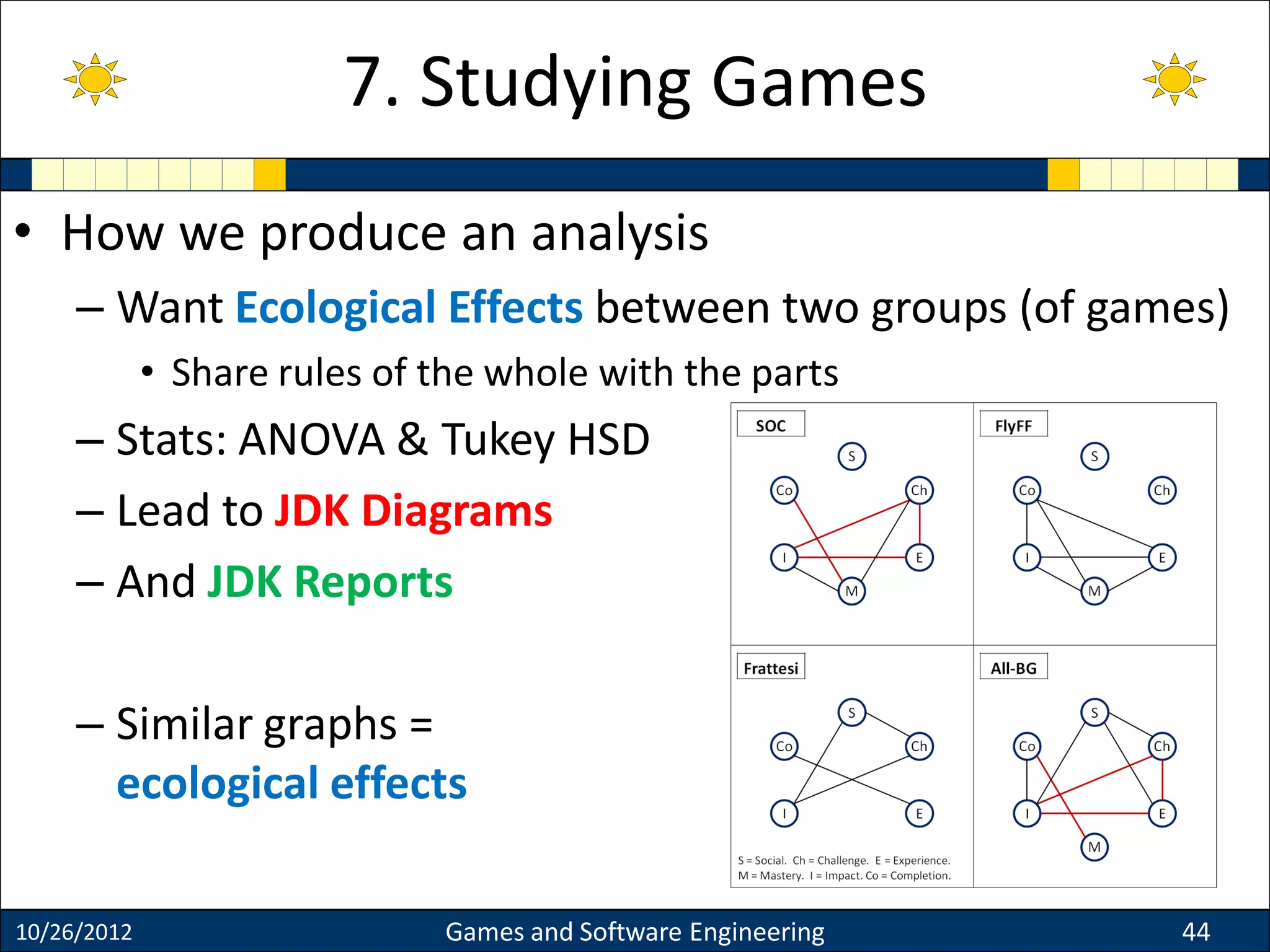
• How we produce an analysis
– Want Ecological Effects between two groups (of games)
• Share rules of the whole with the parts
– Stats: ANOVA & Tukey HSD
– Lead to JDK Diagrams
– And JDK Reports
– Similar graphs =
ecological effects
10/26/2012 Games and Software Engineering 44
7. Studying Games
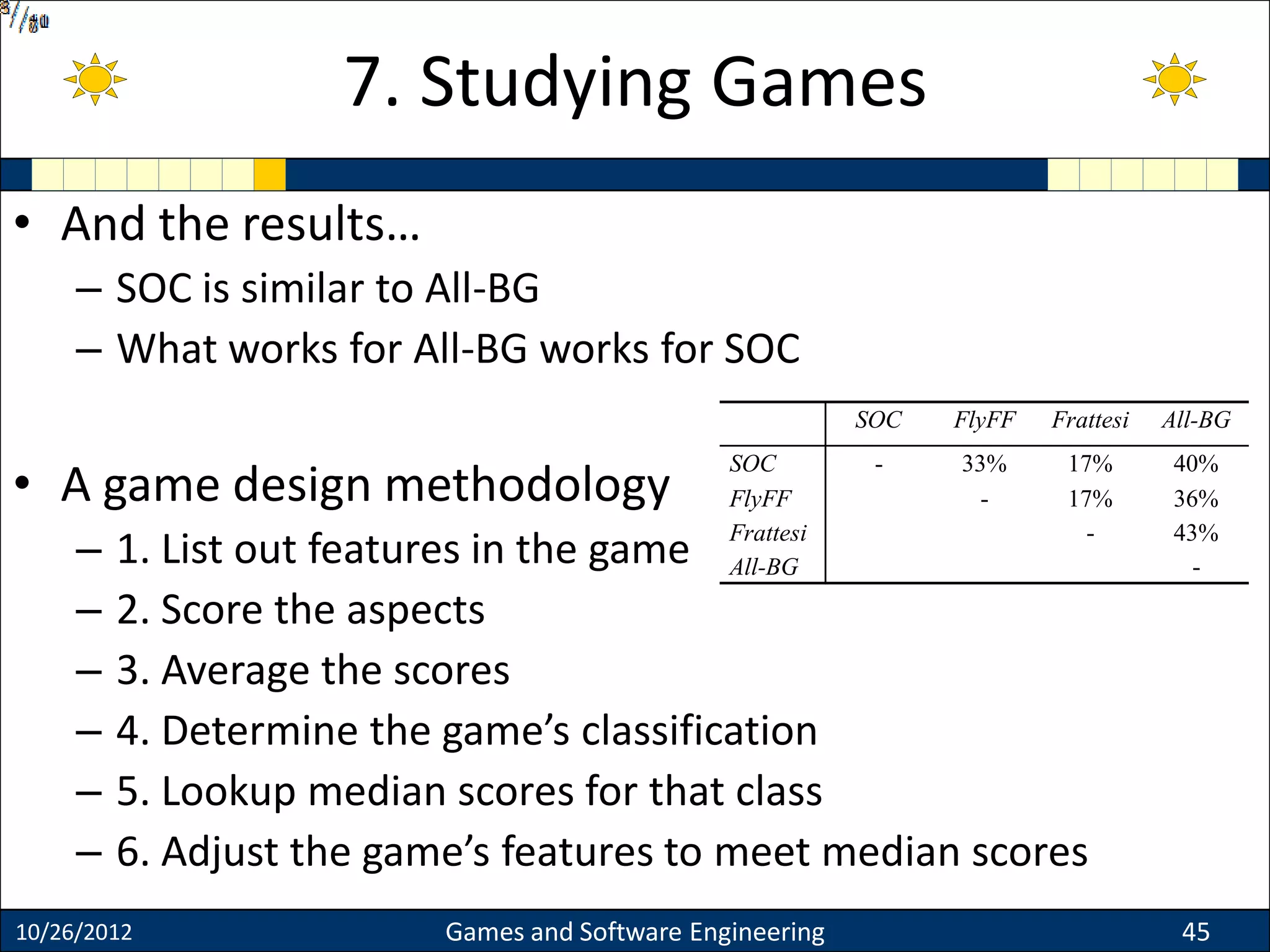
• And the results…
– SOC is similar to All-BG
– What works for All-BG works for SOC
• A game design methodology
– 1. List out features in the game
– 2. Score the aspects
– 3. Average the scores
– 4. Determine the game’s classification
– 5. Lookup median scores for that class
– 6. Adjust the game’s features to meet median scores
10/26/2012 Games and Software Engineering 45
7. Studying Games
SOC FlyFF Frattesi All-BG
SOC - 33% 17% 40%
FlyFF - 17% 36%
Frattesi - 43%
All-BG -
Overview
1. Dimensions of Fun
2. Believable AI
3. Procedural Content Generation
4. A Theory of Fun
5. Playability
6. Replayability
7. Studying Games
8. Conclusion
10/26/2012 Games and Software Engineering 46
Table of Contents
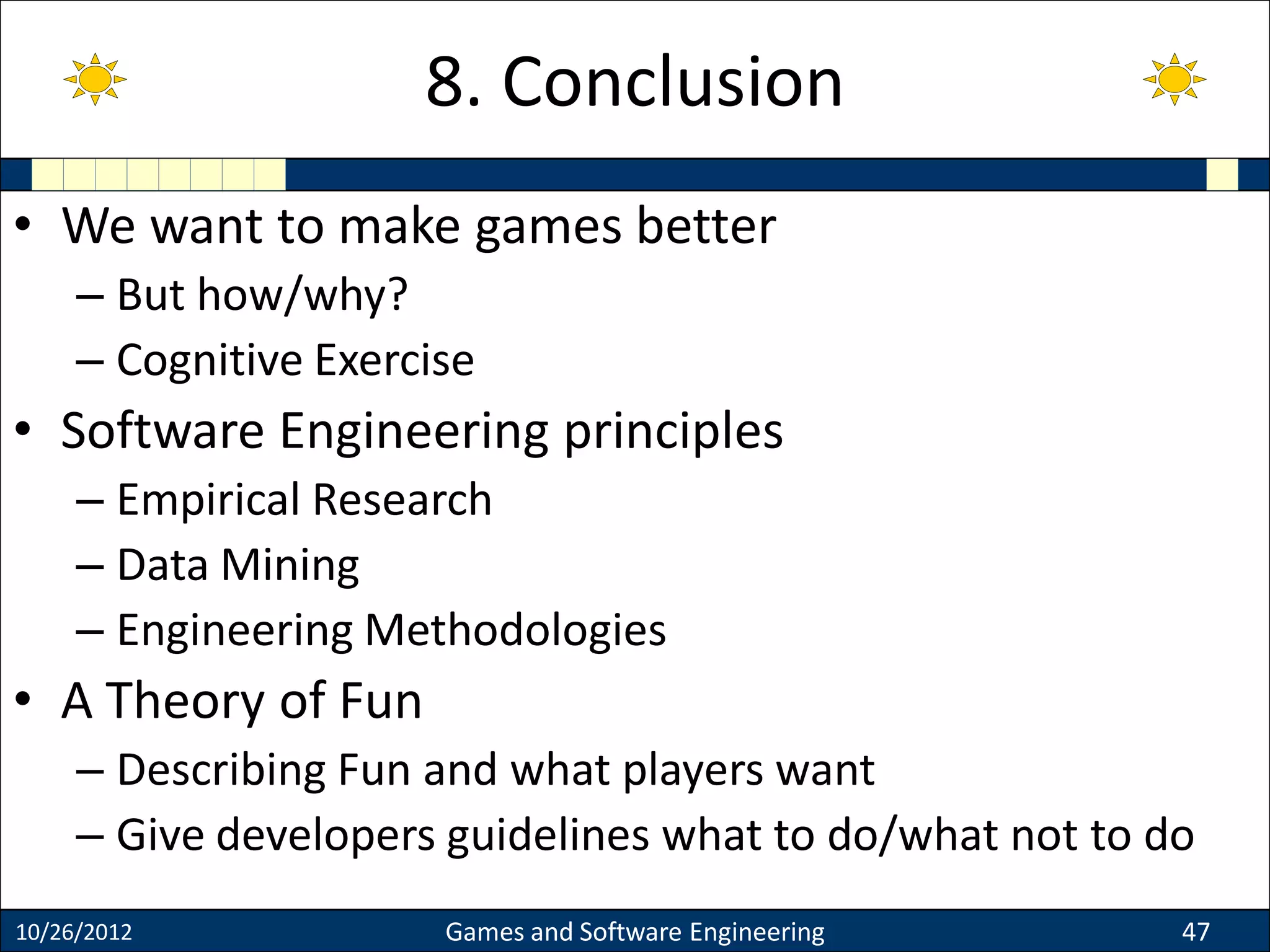
• We want to make games better
– But how/why?
– Cognitive Exercise
• Software Engineering principles
– Empirical Research
– Data Mining
– Engineering Methodologies
• A Theory of Fun
– Describing Fun and what players want
– Give developers guidelines what to do/what not to do
10/26/2012 Games and Software Engineering 47
8. Conclusion
• Game Over. Play again?
– Questions?
10/26/2012 Games and Software Engineering 48
The End

Qualifier presentation

  • 1.
    The Theory ofFun Qualifier PhD. Defense Presentation Joseph Krall
  • 2.
    People play gamesto reach a certain state of mind - Defining that state of mind - Describing how we enter that state of mind - Theories of how to keep players there - This benefits the Video Game Industry Overview 10/26/2012 2Games and Software Engineering Making a Statement
  • 3.
    This is aQualifier Presentation So here’s some topics about stuff we did – Dimensions of Fun – Believable AI – Procedural Content Generation – Designing Games – Our Theory of Fun 10/26/2012 Games and Software Engineering 3 Overview
  • 4.
    Overview 1. Dimensions ofFun 2. Believable AI 3. Procedural Content Generation 4. A Theory of Fun 5. Playability 6. Replayability 7. Our Method of Studying Games Conclusion 10/26/2012 Games and Software Engineering 4 Table of Contents
  • 5.
    • What isFun? An early theory – Originality – Gameplay – Story – Replayability 10/26/2012 Games and Software Engineering 5 1. Dimensions of Fun
  • 6.
    • Originality – Uniquenessof names – Theory: More syllables = more unique – Theory: More originality = more fun • Why? – Unique stuff easier to remember – Experiences made more memorable – Experience = one aspect of replayability 10/26/2012 Games and Software Engineering 6 1. Dimensions of Fun
  • 7.
    • Gameplay – Gameplay= Playability – Effective rewards/punishment system – Fluidity of Interface between player and game • Why? – Bad gameplay = player quits 10/26/2012 Games and Software Engineering 7 1. Dimensions of Fun
  • 8.
    • Story – Amountof player interaction with the game – Short term vs. long term goals • What is better? – More story? Narrative games – Less story? – They are just two different kinds of games 10/26/2012 Games and Software Engineering 8 1. Dimensions of Fun
  • 9.
    • Replayability – Additionalways to play (Impact) – Additional post-game content (Completion) • Goals? – More replay = play more 10/26/2012 Games and Software Engineering 9 1. Dimensions of Fun
  • 10.
    Screenshot of Game 10/26/2012Games and Software Engineering 10 1. Dimensions of Fun
  • 11.
    Overview 1. Dimensions ofFun 2. Believable AI 3. Procedural Content Generation 4. A Theory of Fun 5. Playability 6. Replayability 7. Our Method of Studying Games 8. Conclusion 10/26/2012 Games and Software Engineering 11 Table of Contents
  • 12.
    10/26/2012 Games andSoftware Engineering 12 2. Believable AI
  • 13.
    • Turing’s Test –Is it a computer or a human? • Believability in Games – Preserving the “Magic Circle” – Limit Distractions (High Playability) 10/26/2012 Games and Software Engineering 13 2. Believable AI
  • 14.
    • Believable AI –Realistic Behavior • Expectations of Believability – Are Low – Expectations rise over time • (Same with graphics) • (… and sounds, and more) 10/26/2012 Games and Software Engineering 14 2. Believable AI
  • 15.
    Overview 1. Dimensions ofFun 2. Believable AI 3. Procedural Content Generation 4. A Theory of Fun 5. Playability 6. Replayability 7. Our Method of Studying Games 8. Conclusion 10/26/2012 Games and Software Engineering 15 Table of Contents
  • 16.
    • What isPCG? – Procedural Content Generation – Automated generation of content • Why use PCG? – Game with static content gets boring – Keep a game fresh, add replayability – Assist the game designer 10/26/2012 Games and Software Engineering 16 3. PCG
  • 17.
    • Many kindsof PCG – We investigate run-time PCG “level generation” • Dungeon Generation – Maze Generation Algorithms • (Dungeons are mazes with rooms) – We use: BSP Tree Algorithm 10/26/2012 Games and Software Engineering 17 3. PCG
  • 18.
    • AiMazed2D Game –Build a dungeon with BSP Tree Algorithm – Add objectives – Solve it automatically • AI Solver Agent – Movement through dungeon in human manner – Choice Points Survey to learn human manner 10/26/2012 Games and Software Engineering 18 3. PCG
  • 19.
    • Choice PointsSurvey – All possible choices in a dungeon – Results: %’s of each choice • AI Solver Agent Algorithm – Our own intuition: “Darkway Algorithm” – Humanly Learn dungeon layout 10/26/2012 Games and Software Engineering 19 3. PCG
  • 20.
    10/26/2012 Games andSoftware Engineering 20
  • 21.
    • Qubey’s DeepDungeon – New AiMazed2D 10/26/2012 Games and Software Engineering 21 3. PCG
  • 22.
    Overview 1. Dimensions ofFun 2. Believable AI 3. Procedural Content Generation 4. A Theory of Fun 5. Playability 6. Replayability 7. Our Method of Studying Games 8. Conclusion 10/26/2012 Games and Software Engineering 22 Table of Contents
  • 23.
    • Three Componentsof fun: • Advertising & Marketing • Playability • Replayability • Stages of Game Play: • What players go through cognitively • First Glance – First Play – Game Play – Quit • Time Stream 10/26/2012 Games and Software Engineering 23 4. Theory of Fun
  • 24.
    • Advertising: what/who/when –Generate hype • Marketing: how/where – Know your target audience(s) 10/26/2012 Games and Software Engineering 24 4. Theory of Fun
  • 25.
    • Playability – LimitingDistractions – What not to do – Section 5 • Replayability – How long until we get bored? – What to do – Section 6 10/26/2012 Games and Software Engineering 25 4. Theory of Fun
  • 26.
    Stages of GamePlay • Stage I: First Glance – Do you buy the game or not? • Yes: move on to next stage • No: move to time stream – Advertising/Marketing 10/26/2012 Games and Software Engineering 26 4. Theory of Fun
  • 27.
    • Stage II:First Play – First Experience vs. Expectations • Yes: move on to next stage • No: move to Time Stream – Low Playability? 10/26/2012 Games and Software Engineering 27 4. Theory of Fun
  • 28.
    • Stage III:Game Play – Goal: Get here and stay • Replayability – When they quit: • Before “long”: game got boring – Move to time stream (bad) • After “long”: game was exhausted – Advance to final stage (good) 10/26/2012 Games and Software Engineering 28 4. Theory of Fun
  • 29.
    • Stage IV:Quit – Congratulations if you get here – Now go to the time stream • Time Stream – A place to be when not playing – Game may become interesting again – Makes entertainment a cycle 10/26/2012 Games and Software Engineering 29 4. Theory of Fun
  • 30.
    Overview 1. Dimensions ofFun 2. Believable AI 3. Procedural Content Generation 4. A Theory of Fun 5. Playability 6. Replayability 7. Our Method of Studying Games 8. Conclusion 10/26/2012 Games and Software Engineering 30 Table of Contents
  • 31.
    • Playability – Expectations –Immersion – Distraction – Categorize the Distractions • Functional, Structural, Audiovisual, Social 10/26/2012 Games and Software Engineering 31 5. Playability
  • 32.
    • Functional Playability –System performance – Interface fluidity • Structural Playability – Too Easy < Optimal flow state < Too Difficult – Progression 10/26/2012 Games and Software Engineering 32 5. Playability
  • 33.
    • Audiovisual Playability –Graphics/Sounds – Escalation of Expectation • Social Playability – Playing with/against Others – Don’t provide multiplayer if you can’t 10/26/2012 Games and Software Engineering 33 5. Playability
  • 34.
    Overview 1. Dimensions ofFun 2. Believable AI 3. Procedural Content Generation 4. A Theory of Fun 5. Playability 6. Replayability 7. Our Method of Studying Games 8. Conclusion 10/26/2012 Games and Software Engineering 34 Table of Contents
  • 35.
    • Replayability – Permanenceof one’s Willingness to Immerse • What keeps a game from becoming boring – Six “Aspects of Replayability” = SChEMICo • Social, Challenge, Experience, Mastery, Impact, Completion 10/26/2012 Games and Software Engineering 35 6. Replayability
  • 36.
    • Social Replayability –We play for social reasons – Friends – Conversation • Challenge Replayability – We play for accomplishments – Bragging Rights – Zillmans’ Excitation Transfer Theory 10/26/2012 Games and Software Engineering 36 6. Replayability
  • 37.
    • Experience Replayability –Uniqueness of a game appeals to us – We play for nostalgia • Mastery Replayability – We play to become the best – Competition drives us – Goals drive us 10/26/2012 Games and Software Engineering 37 6. Replayability
  • 38.
    • Impact Replayability –We play for “impact” – Sense of Free Will in games – Play the game different ways • Completion Replayability – Goal of doing everything – Achievements and goal driven – Story Driven! 10/26/2012 Games and Software Engineering 38 6. Replayability
  • 39.
    Overview 1. Dimensions ofFun 2. Believable AI 3. Procedural Content Generation 4. A Theory of Fun 5. Playability 6. Replayability 7. Studying Games 8. Conclusion 10/26/2012 Games and Software Engineering 39 Table of Contents
  • 40.
    • JSEA Paper –Describe how/why to study games • Surveys – Gaming Datasets about Replayability – Analysis & Ecological Effects 10/26/2012 Games and Software Engineering 40 7. Studying Games
  • 41.
    • Describing the“Game Space” 10/26/2012 Games and Software Engineering 41 7. Studying Games
  • 42.
    • Previous GamingData – Fratessi et al: “All Games” • Gaming Data we gathered: – “All Board Games” – “Settlers of Catan” (SOC) – “Fly for Fun” (FlyFF) 10/26/2012 Games and Software Engineering 42 7. Studying Games
  • 43.
    • Our Surveys –We devised a standard survey (for reproducibility) – 1. Basic Demographics Section – 2. Replayability Section • For each aspect: rate how much you agree with the statement that you play the game for this aspect (5 point Likert scale) – 3. Core versus Casual Section • For both core & casual: rate how much you agree that this game is a core/casual game (5 point Likert) • (further categorizes types of games) 10/26/2012 Games and Software Engineering 43 7. Studying Games
  • 44.
    • How weproduce an analysis – Want Ecological Effects between two groups (of games) • Share rules of the whole with the parts – Stats: ANOVA & Tukey HSD – Lead to JDK Diagrams – And JDK Reports – Similar graphs = ecological effects 10/26/2012 Games and Software Engineering 44 7. Studying Games
  • 45.
    • And theresults… – SOC is similar to All-BG – What works for All-BG works for SOC • A game design methodology – 1. List out features in the game – 2. Score the aspects – 3. Average the scores – 4. Determine the game’s classification – 5. Lookup median scores for that class – 6. Adjust the game’s features to meet median scores 10/26/2012 Games and Software Engineering 45 7. Studying Games SOC FlyFF Frattesi All-BG SOC - 33% 17% 40% FlyFF - 17% 36% Frattesi - 43% All-BG -
  • 46.
    Overview 1. Dimensions ofFun 2. Believable AI 3. Procedural Content Generation 4. A Theory of Fun 5. Playability 6. Replayability 7. Studying Games 8. Conclusion 10/26/2012 Games and Software Engineering 46 Table of Contents
  • 47.
    • We wantto make games better – But how/why? – Cognitive Exercise • Software Engineering principles – Empirical Research – Data Mining – Engineering Methodologies • A Theory of Fun – Describing Fun and what players want – Give developers guidelines what to do/what not to do 10/26/2012 Games and Software Engineering 47 8. Conclusion
  • 48.
    • Game Over.Play again? – Questions? 10/26/2012 Games and Software Engineering 48 The End