Principles and patterns of social games Where’s the difference compared to other games? Staffan Björk Dept. of Applied IT, Gothenburg University Game Studio, Interactive Institute
Takeaway An exploration in how to differentiate between the “new” trend of social games and ordinary games Based upon these differences, some specific gameplay patterns that are  commonly used in social games
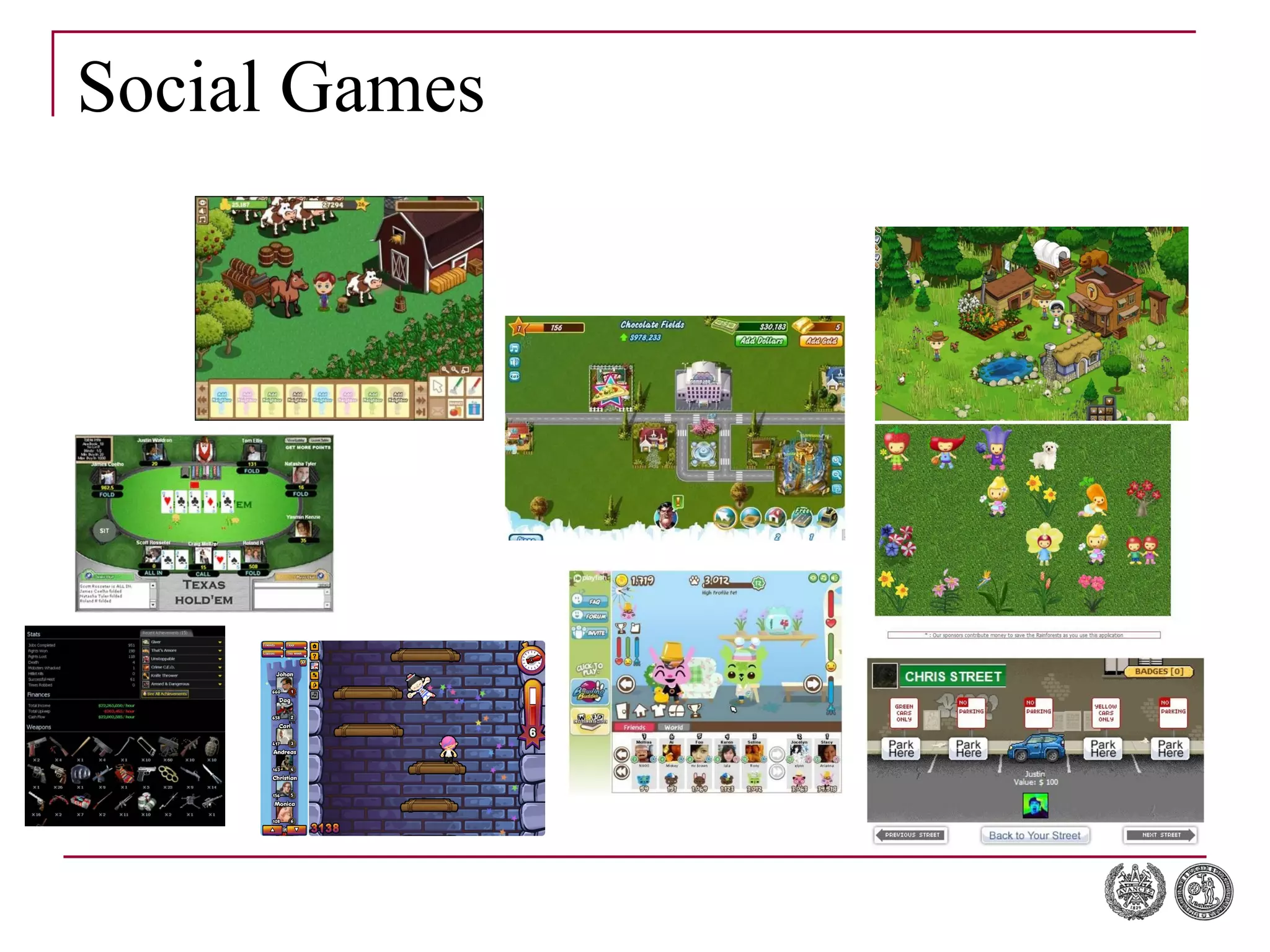
Social Games
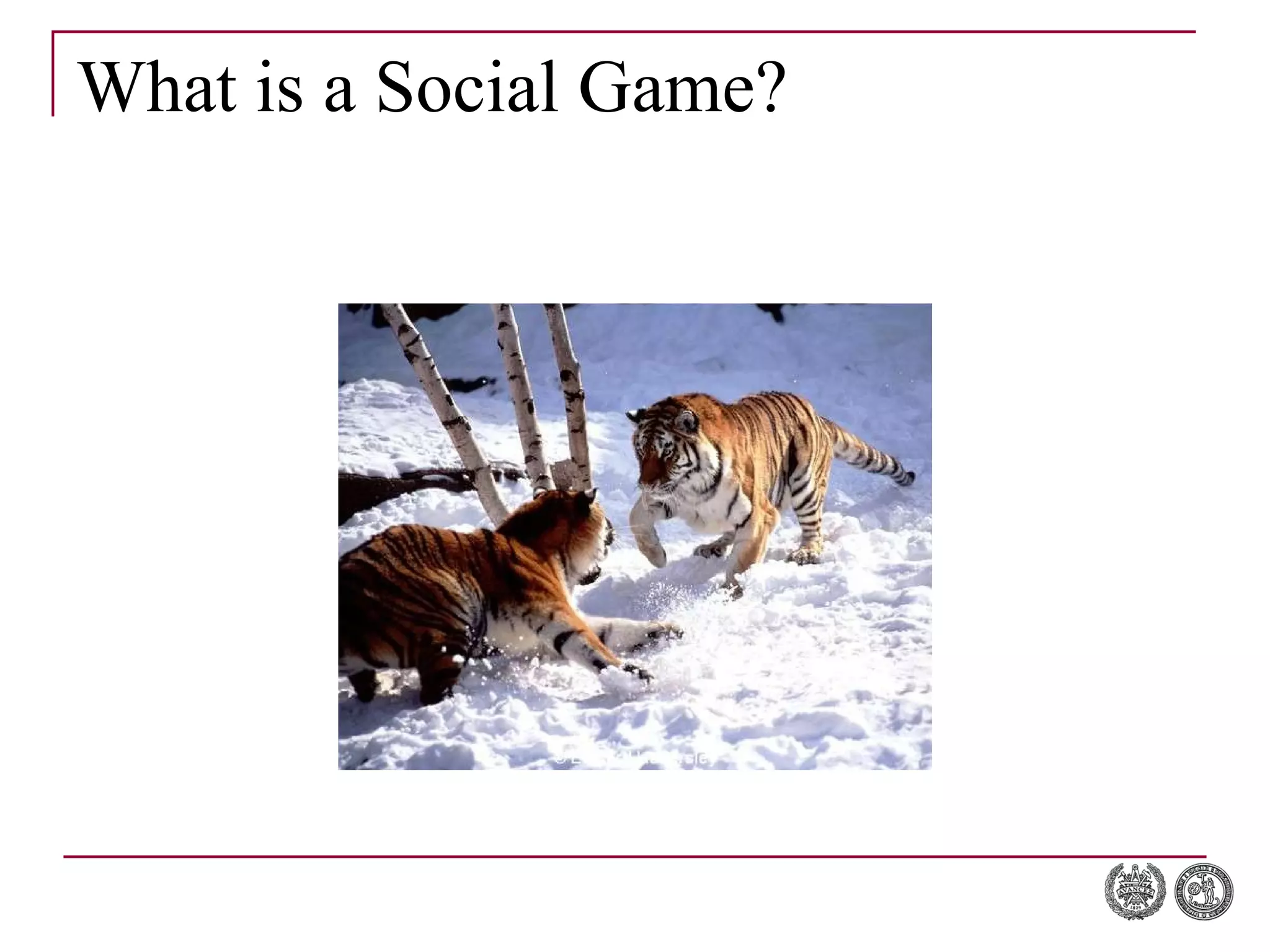
What is a Social Game?
A definition of play Johan Huizinga ” [Play is] a free activity standing quite consciously outside ”ordinary” life as being ”not serious”, but at the same time absorbing the player intensely and utterly. It is an activity connected with no material interest, and no profit can be gained by it. It proceeds within its own proper boundaries of time and space according to fixed rules and in an orderly manner. It promotes  the formation of social groupings , which tend to surround themselves with secrecy and to stress their difference from the common world by disguise or other means.” Huizinga, J.  Homo Ludens,  1938
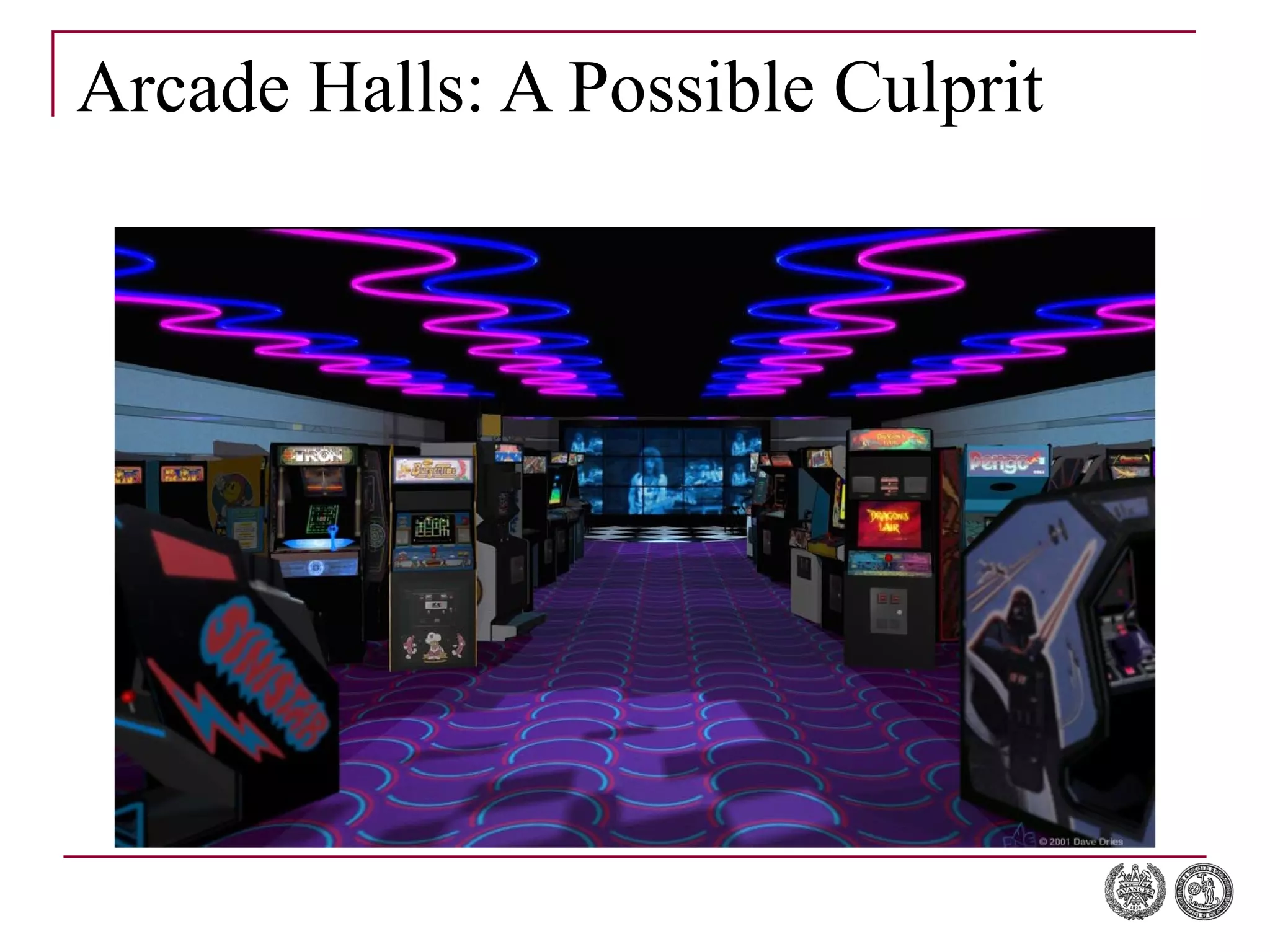
Arcade Halls: A Possible Culprit
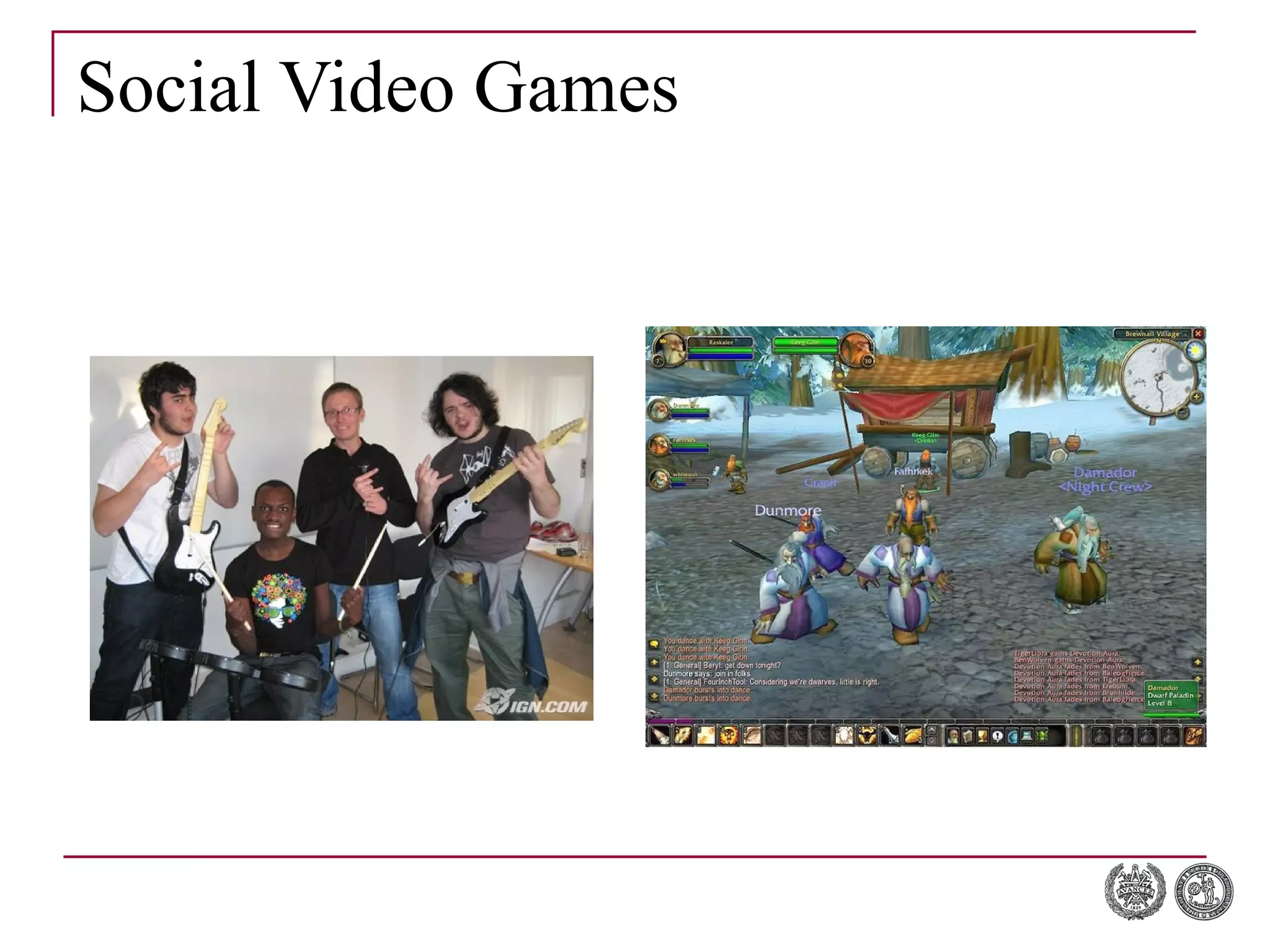
Social Video Games
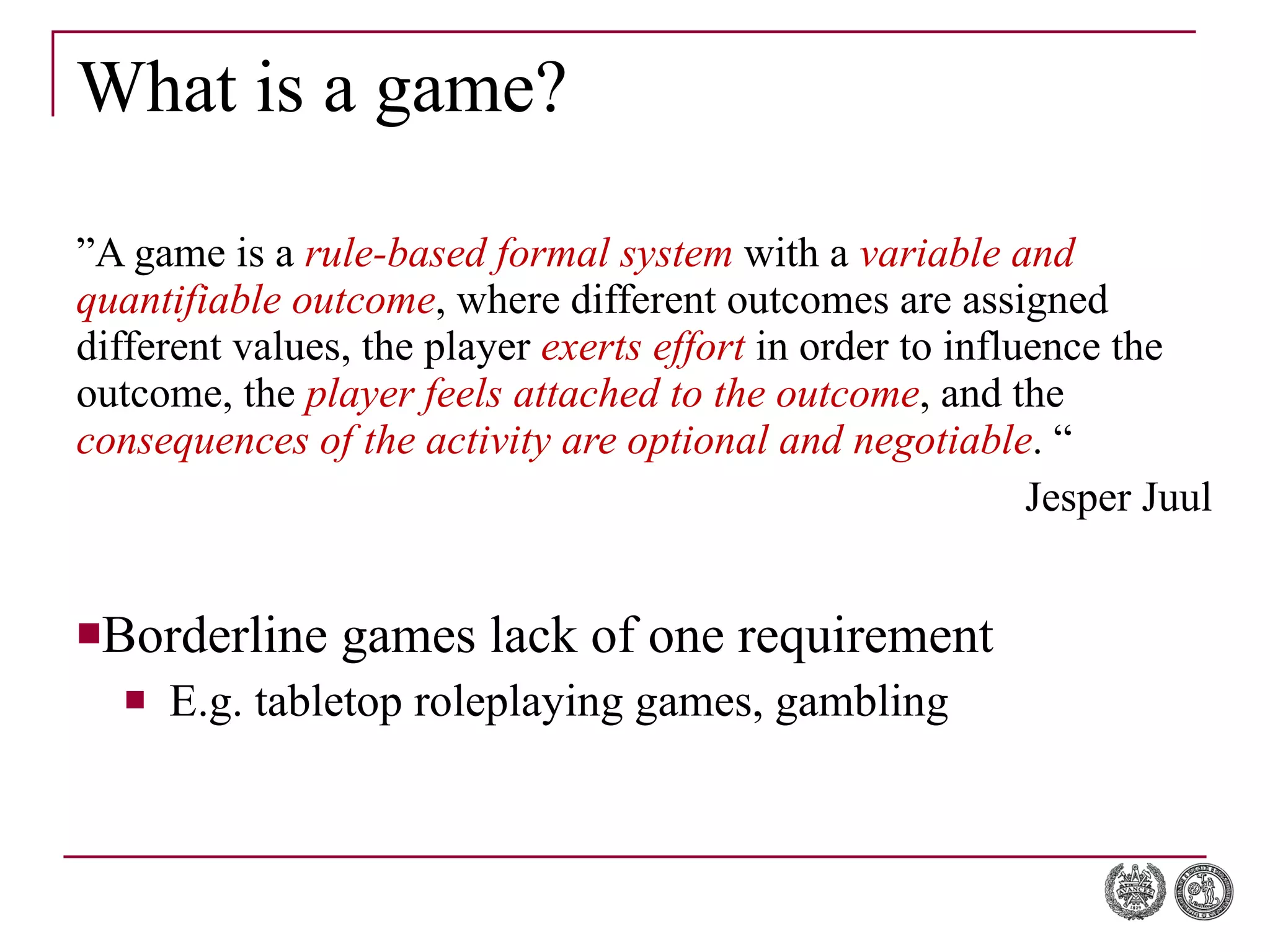
What is a game? ” A game is a  rule-based formal system  with a  variable and quantifiable outcome , where different outcomes are assigned different values, the player  exerts effort  in order to influence the outcome, the  player feels attached to the outcome , and the  consequences of the activity are optional and negotiable . “ Jesper Juul Borderline games lack of one requirement E.g. tabletop roleplaying games, gambling
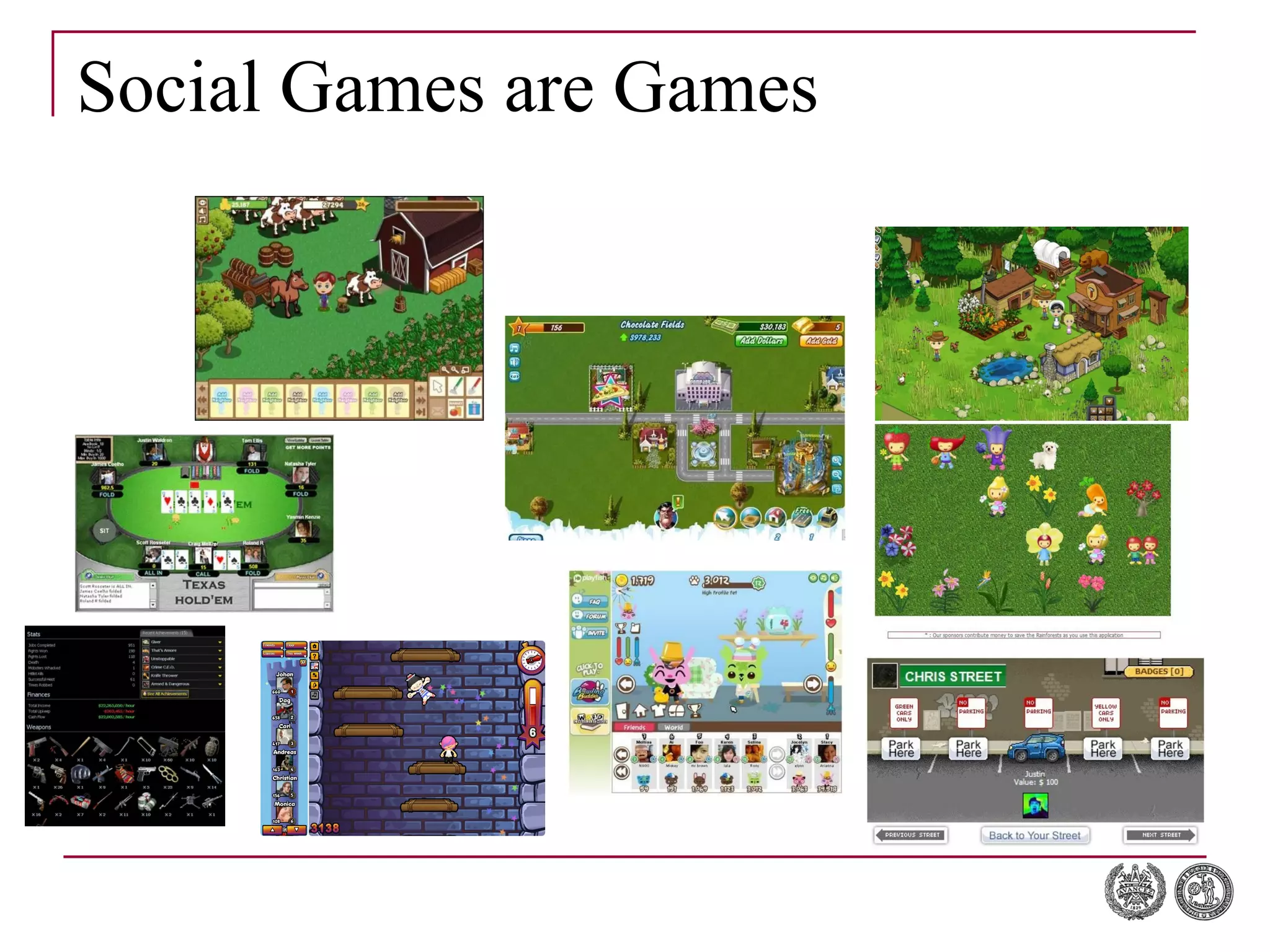
Social Games are Games
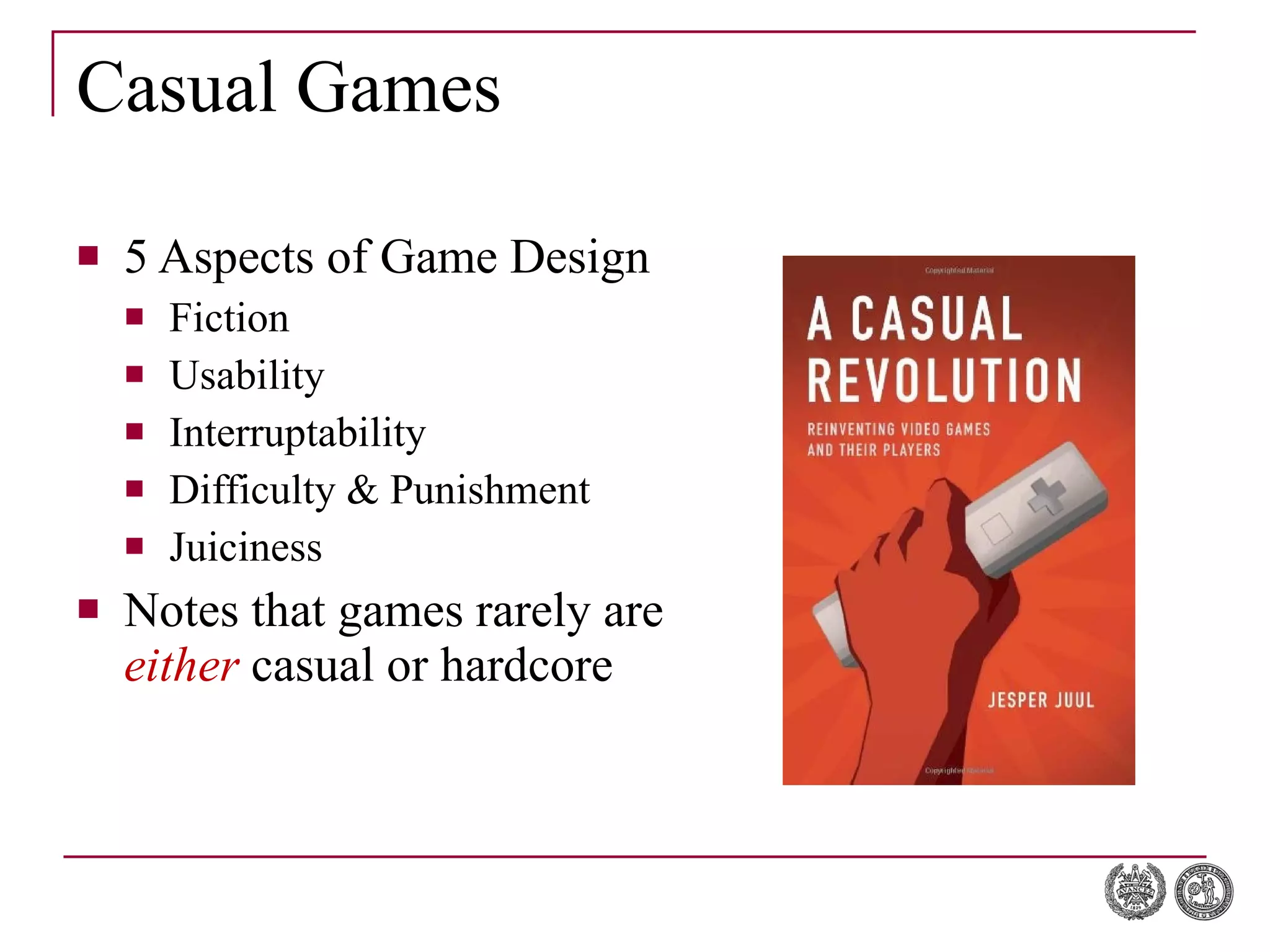
Casual Games 5 Aspects of Game Design Fiction Usability Interruptability Difficulty & Punishment Juiciness Notes that games rarely are  either  casual or hardcore
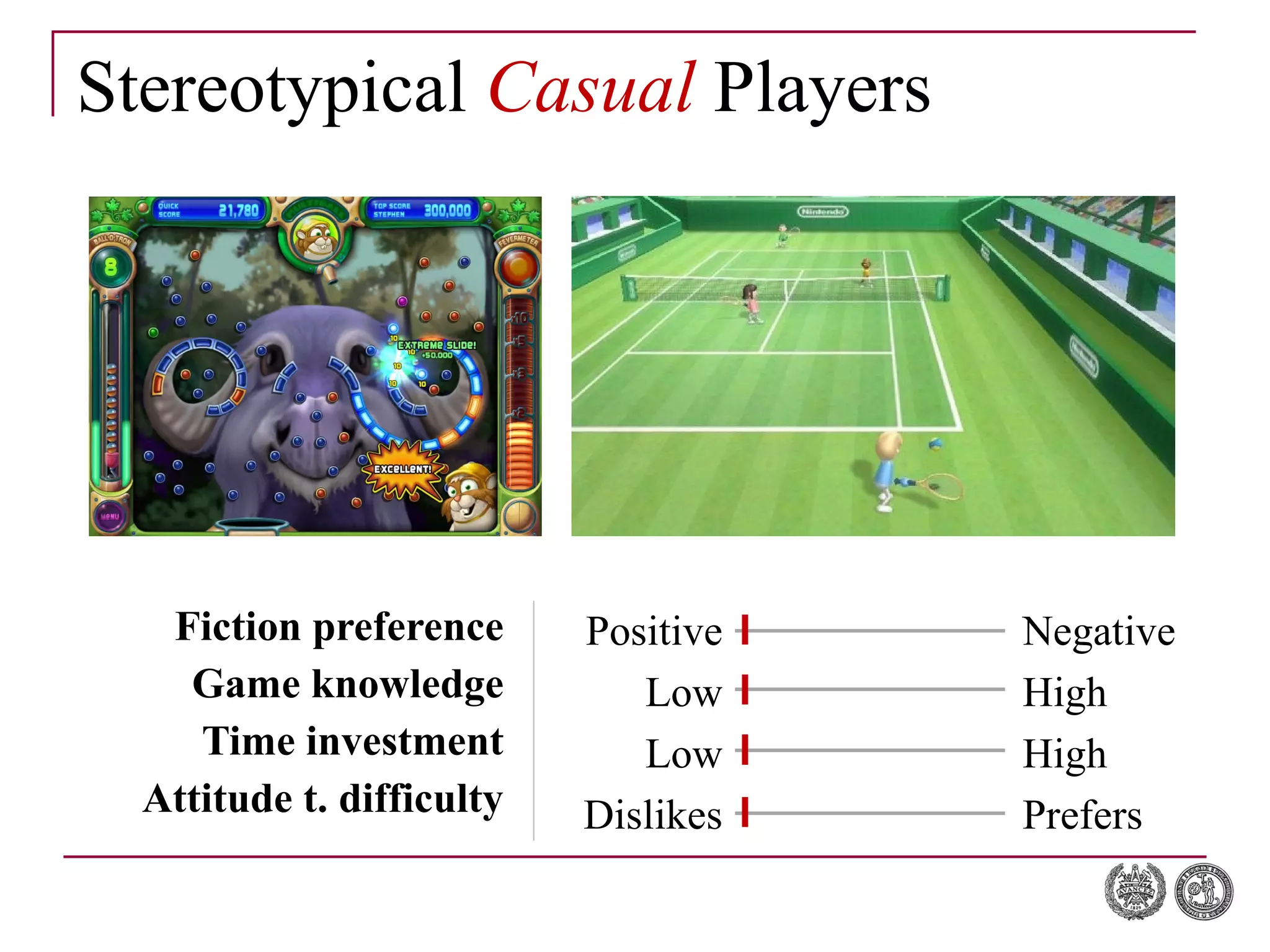
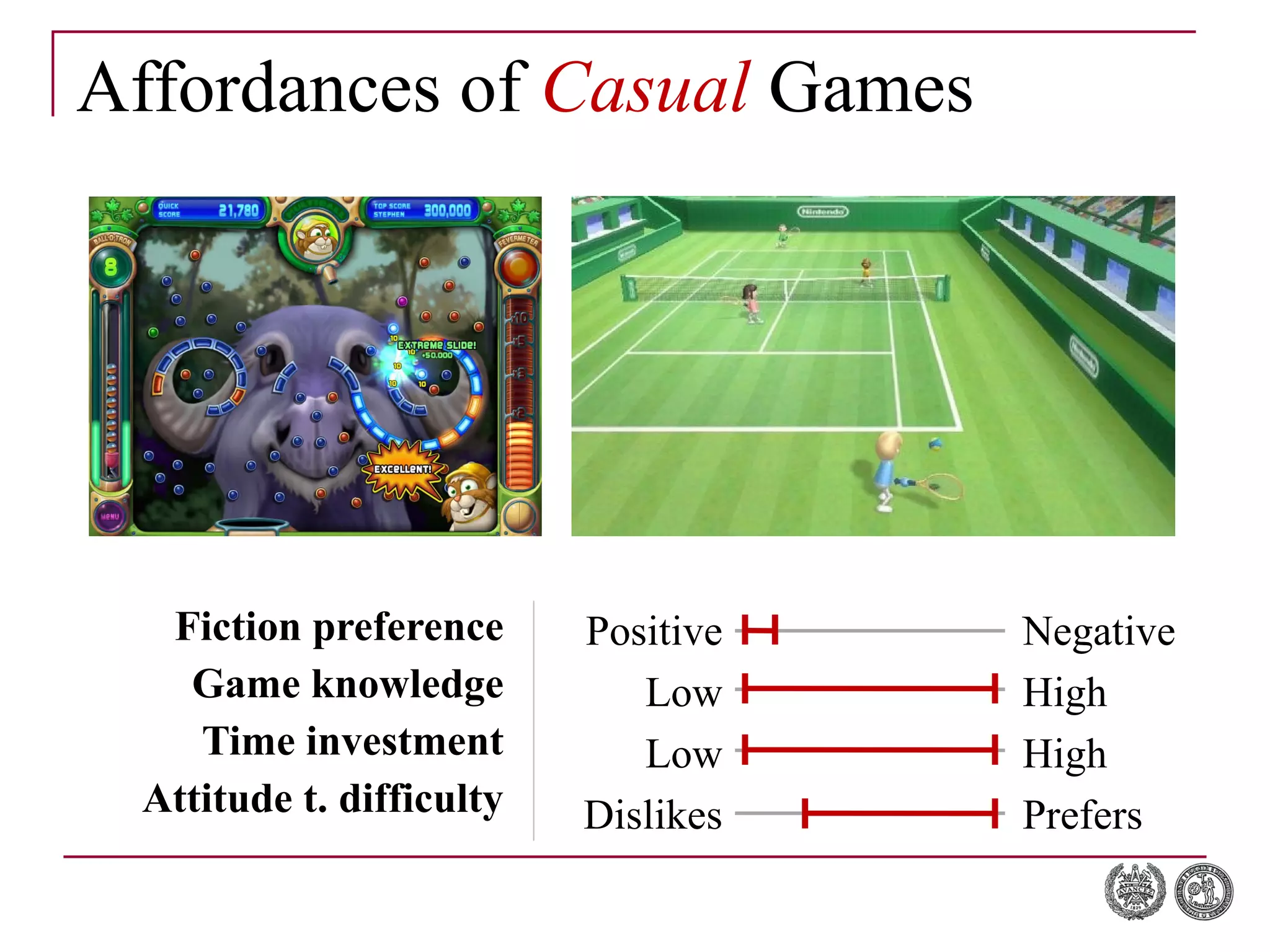
Stereotypical  Casual  Players Fiction preference Game knowledge Time investment Attitude t. difficulty Positive Low Low Dislikes Negative High High Prefers
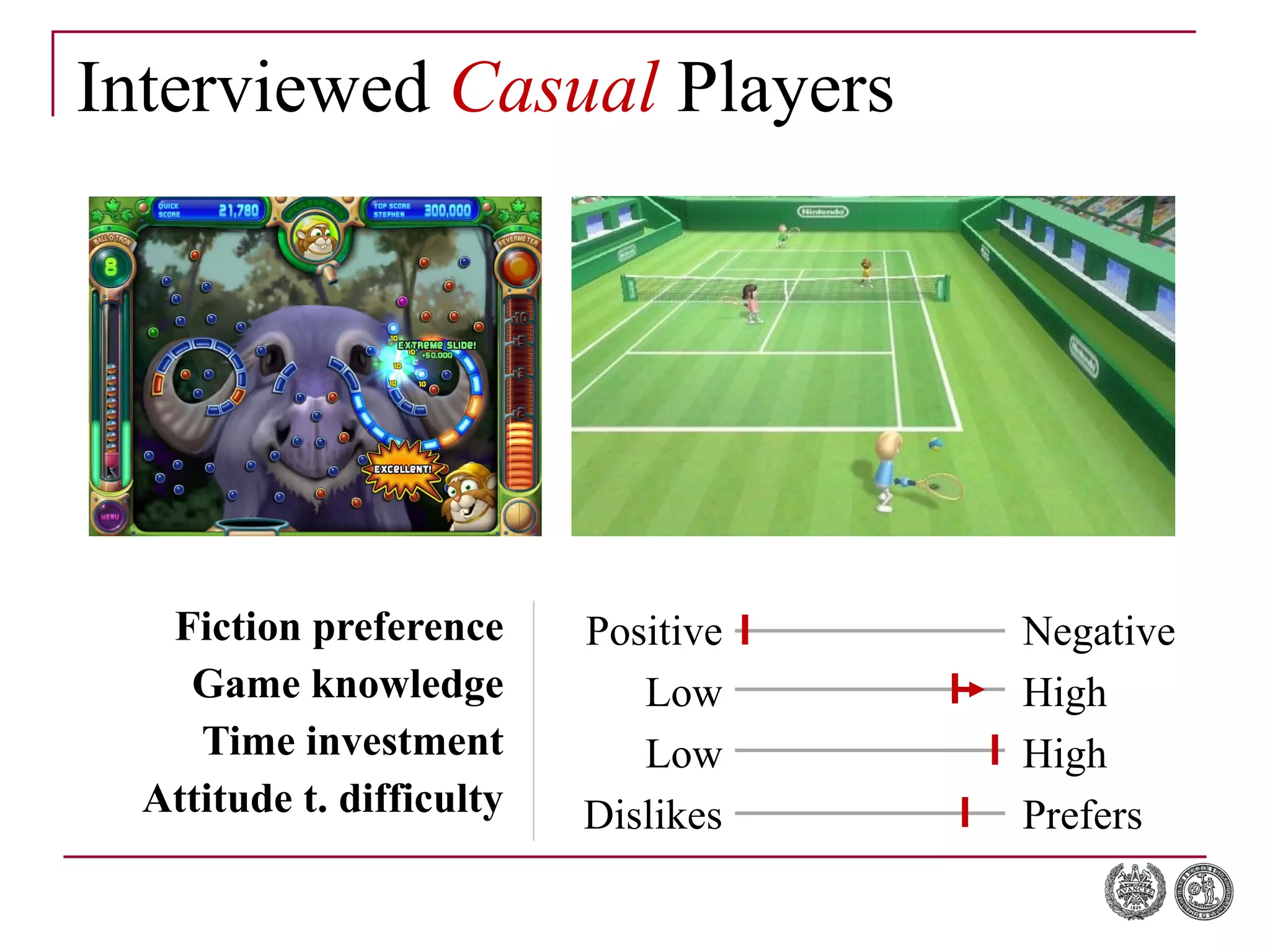
Interviewed  Casual  Players Fiction preference Game knowledge Time investment Attitude t. difficulty Positive Low Low Dislikes Negative High High Prefers
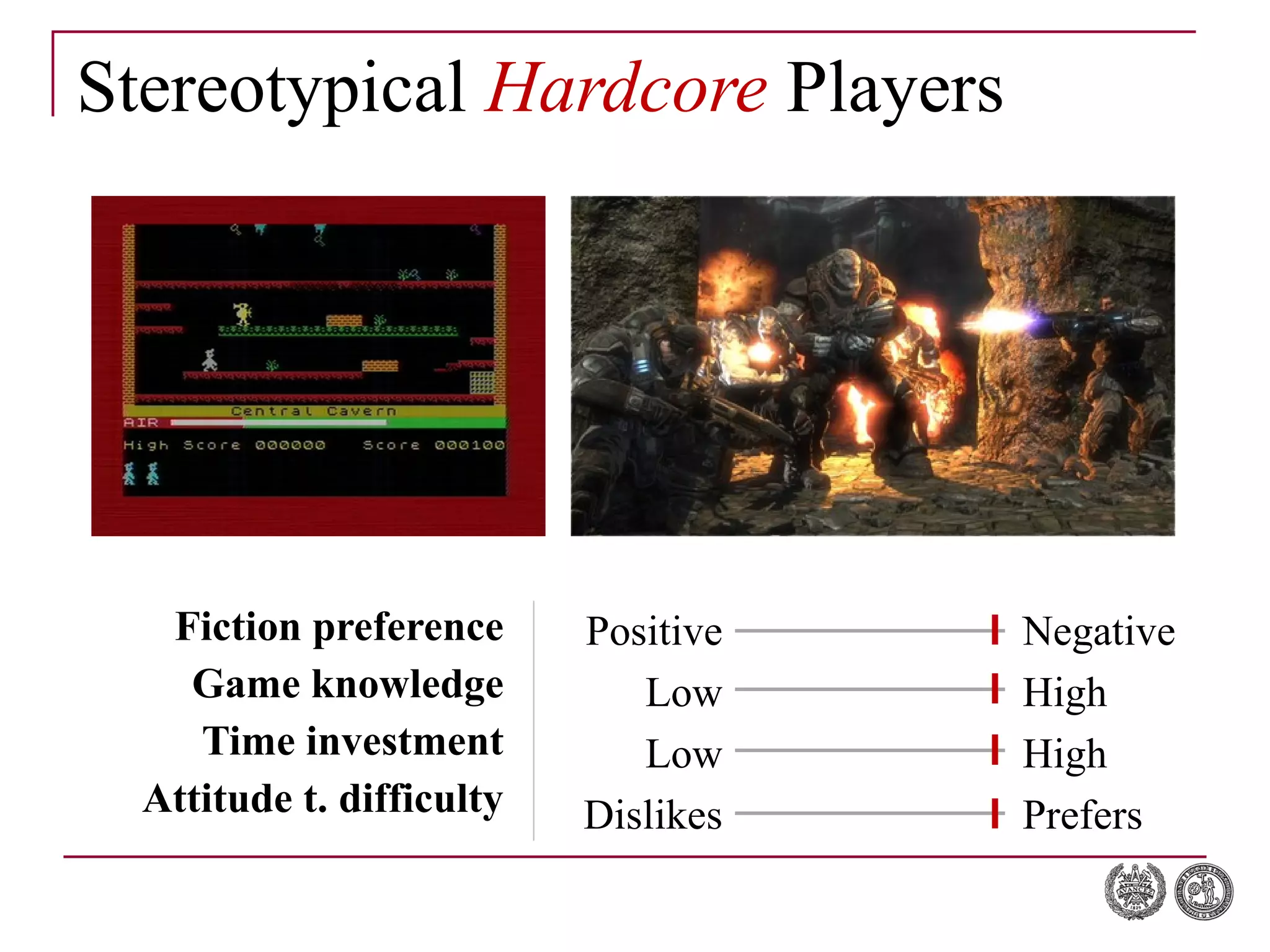
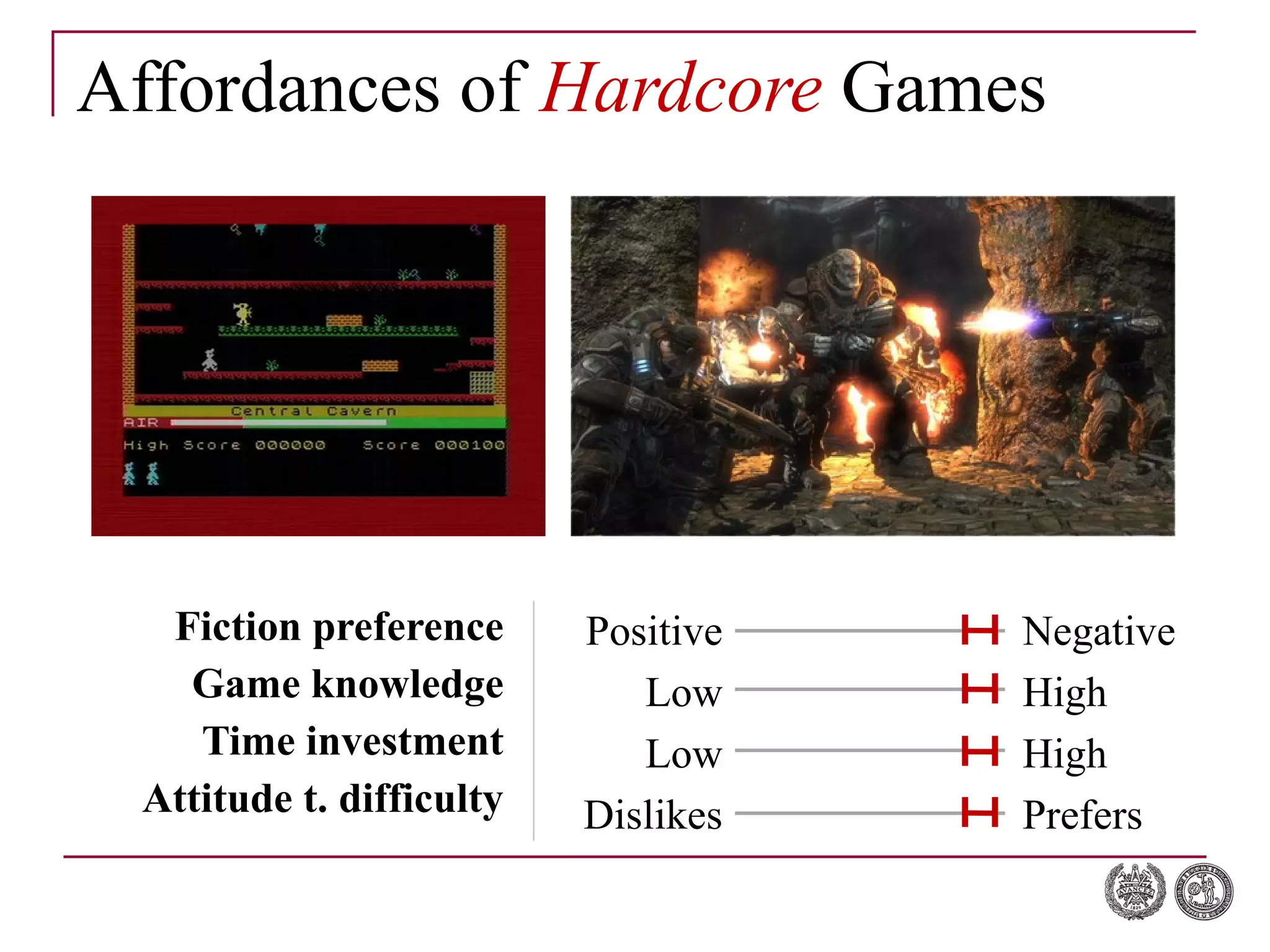
Stereotypical  Hardcore  Players Fiction preference Game knowledge Time investment Attitude t. difficulty Positive Low Low Dislikes Negative High High Prefers
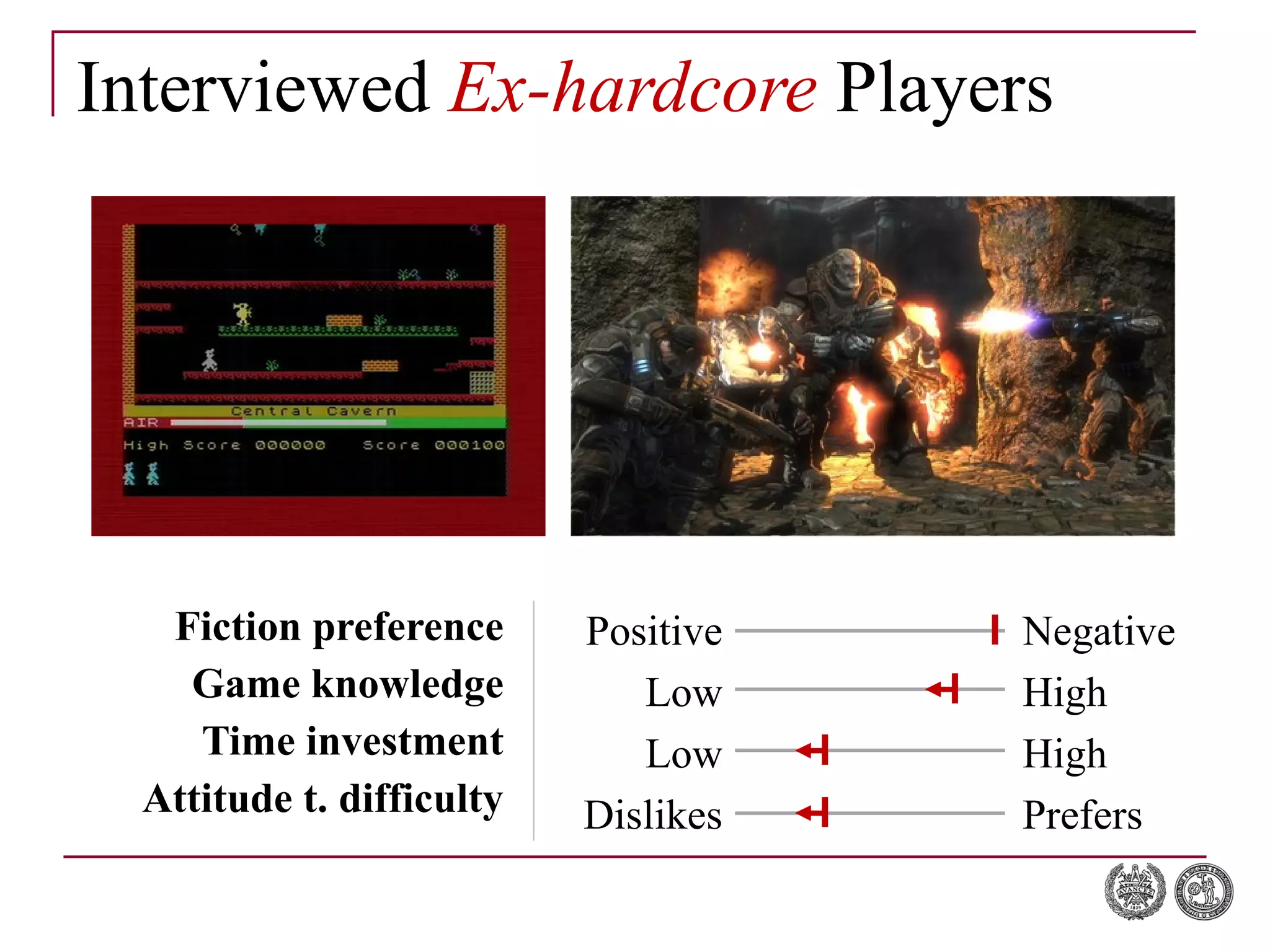
Interviewed  Ex-hardcore  Players Fiction preference Game knowledge Time investment Attitude t. difficulty Positive Low Low Dislikes Negative High High Prefers
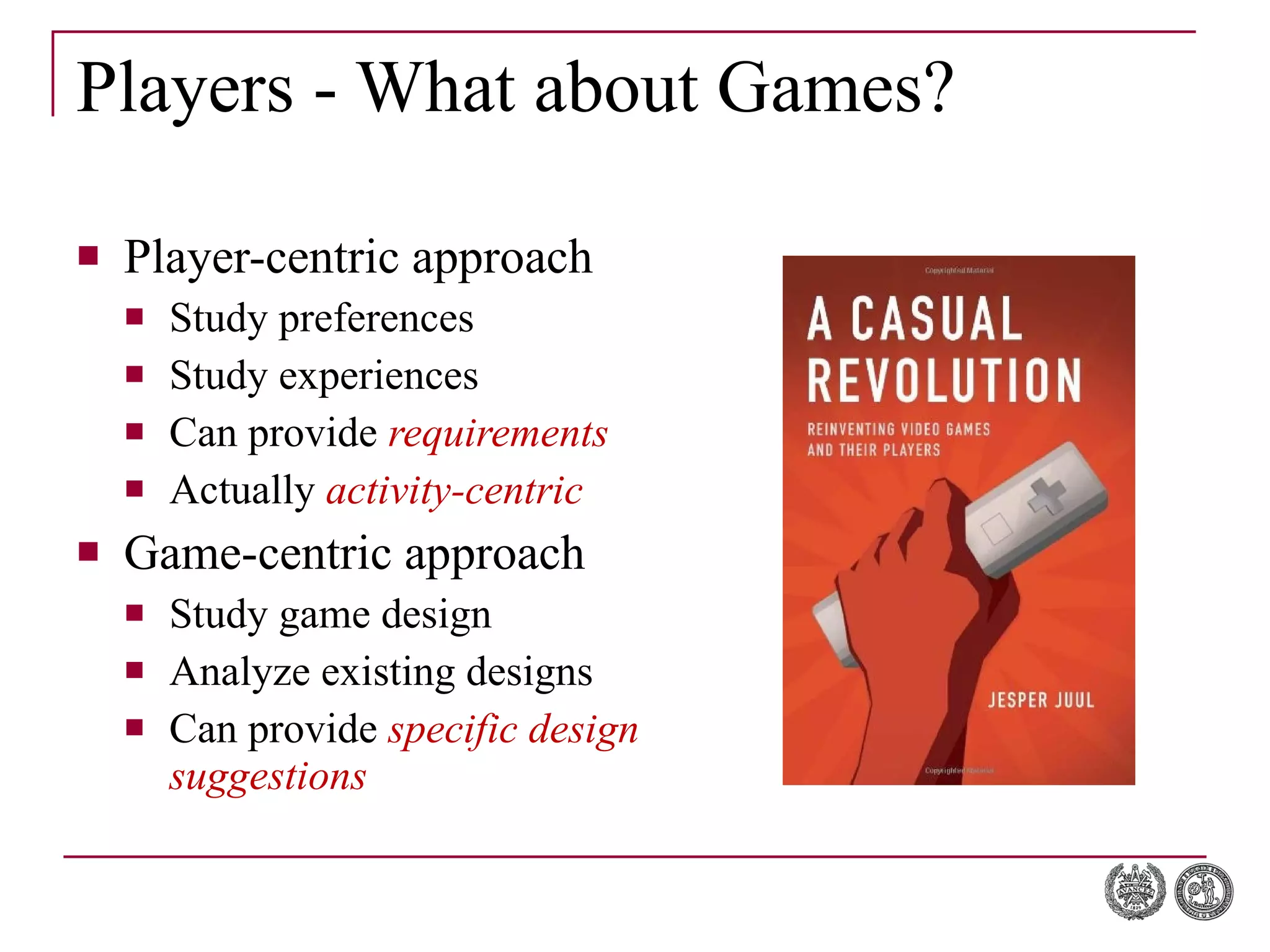
Players - What about Games? Player-centric approach Study preferences Study experiences Can provide  requirements Actually  activity-centric Game-centric approach Study game design Analyze existing designs Can provide  specific design suggestions
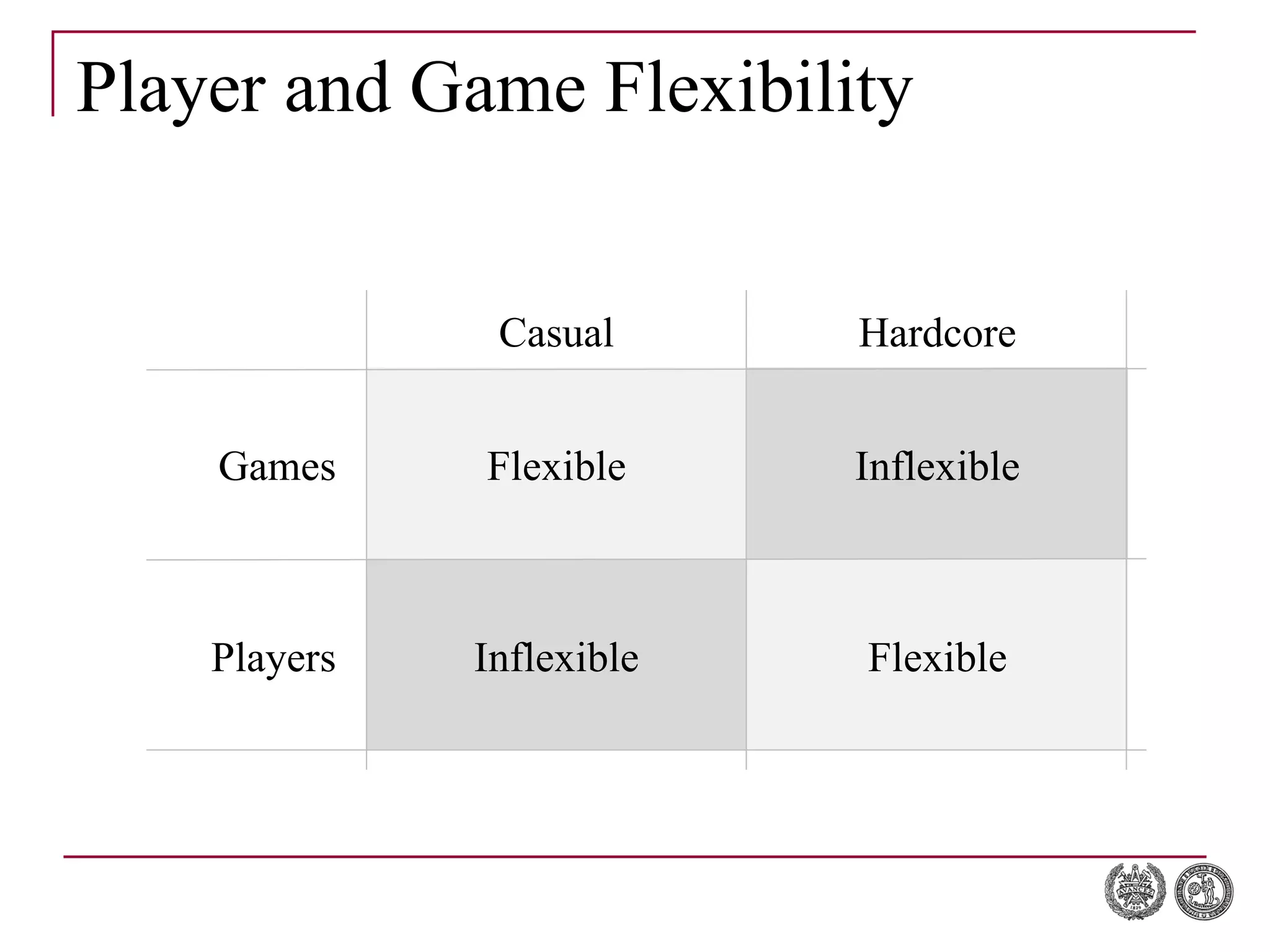
Player and Game Flexibility Casual Hardcore Games Flexible Inflexible Players Inflexible Flexible
Affordances of  Casual  Games Fiction preference Game knowledge Time investment Attitude t. difficulty Positive Low Low Dislikes Negative High High Prefers
Affordances of  Hardcore  Games Fiction preference Game knowledge Time investment Attitude t. difficulty Positive Low Low Dislikes Negative High High Prefers
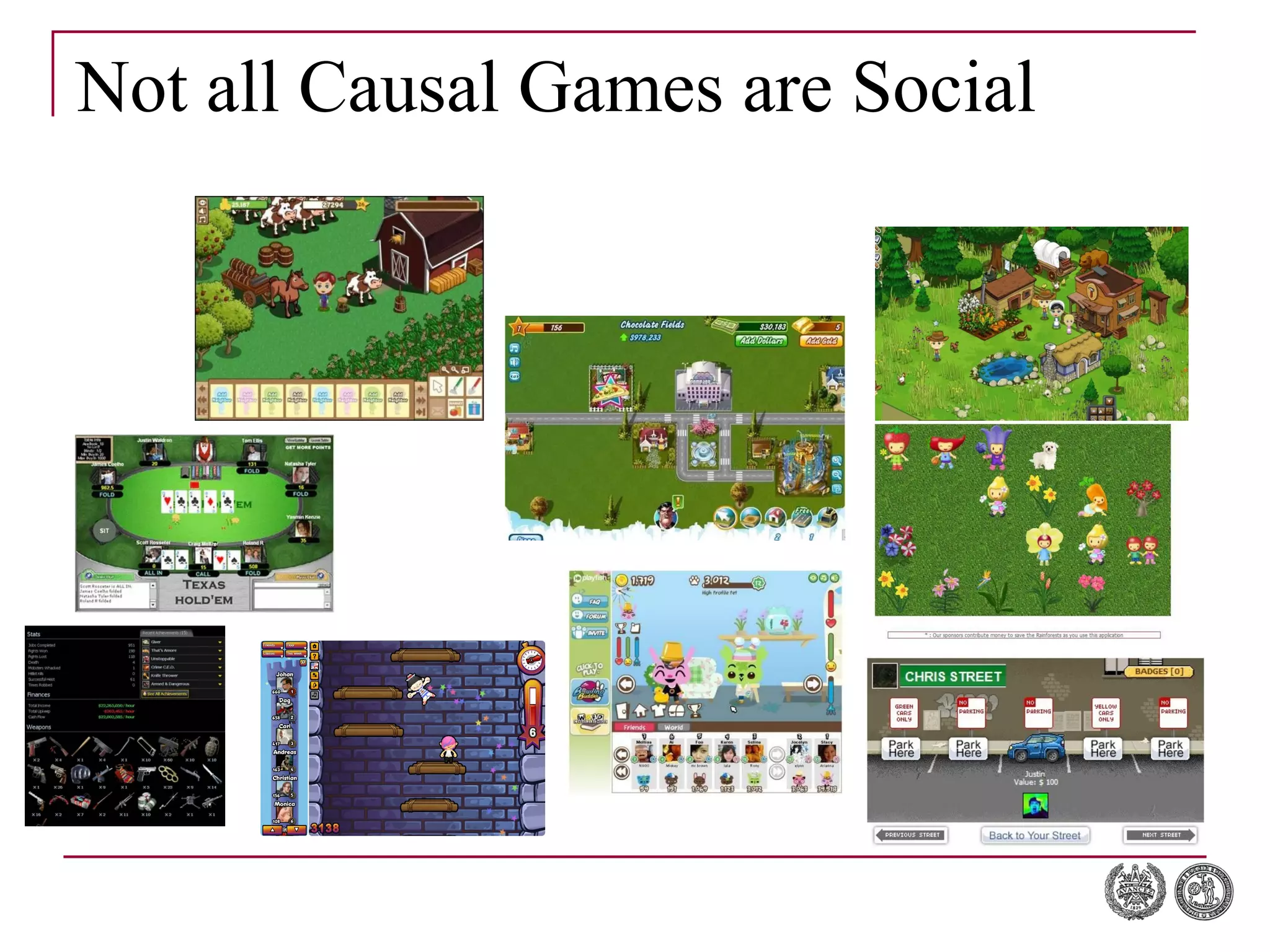
Not all Causal Games are Social
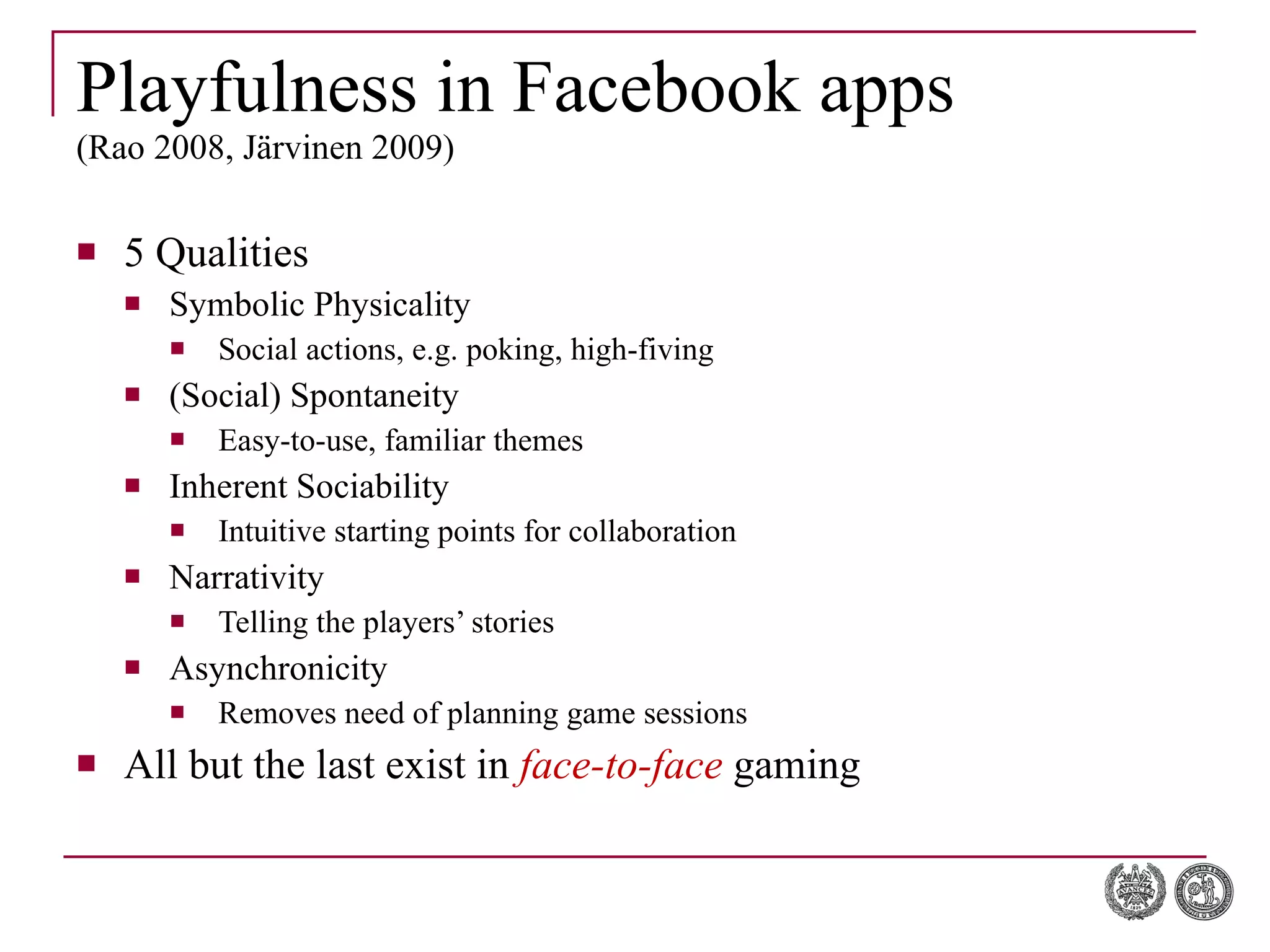
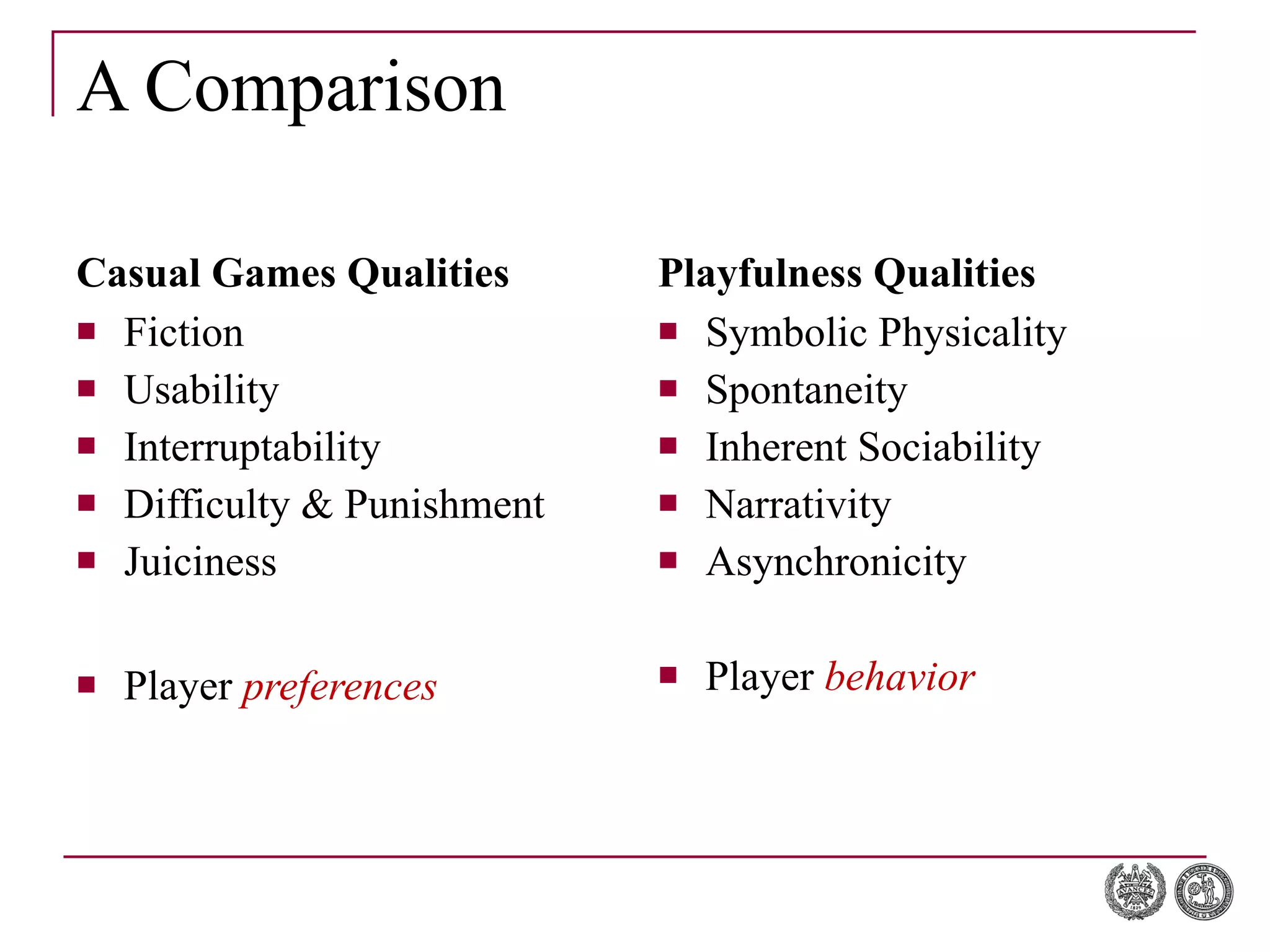
Playfulness in Facebook apps (Rao 2008, Järvinen 2009) 5 Qualities Symbolic Physicality Social actions, e.g. poking, high-fiving (Social) Spontaneity Easy-to-use, familiar themes Inherent Sociability Intuitive starting points for collaboration Narrativity Telling the players’ stories Asynchronicity Removes need of planning game sessions All but the last exist in  face-to-face  gaming
A Comparison Casual Games Qualities Fiction Usability Interruptability Difficulty & Punishment Juiciness Player  preferences Playfulness Qualities Symbolic Physicality Spontaneity Inherent Sociability Narrativity Asynchronicity Player  behavior
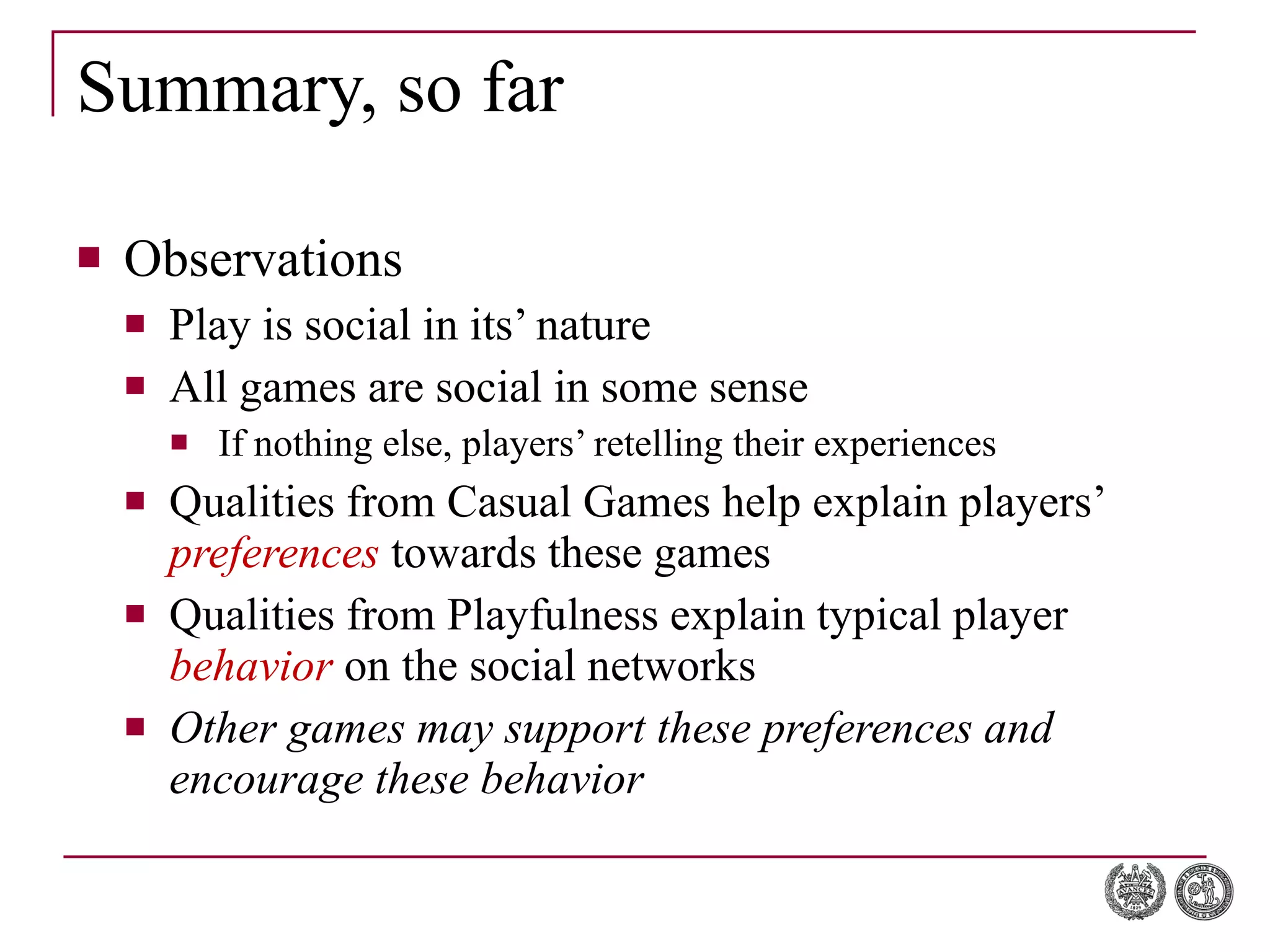
Summary, so far Observations Play is social in its’ nature All games are social in some sense If nothing else, players’ retelling their experiences Qualities from Casual Games help explain players’  preferences  towards these games Qualities from Playfulness explain typical player  behavior  on the social networks Other games may support these preferences and encourage these behavior
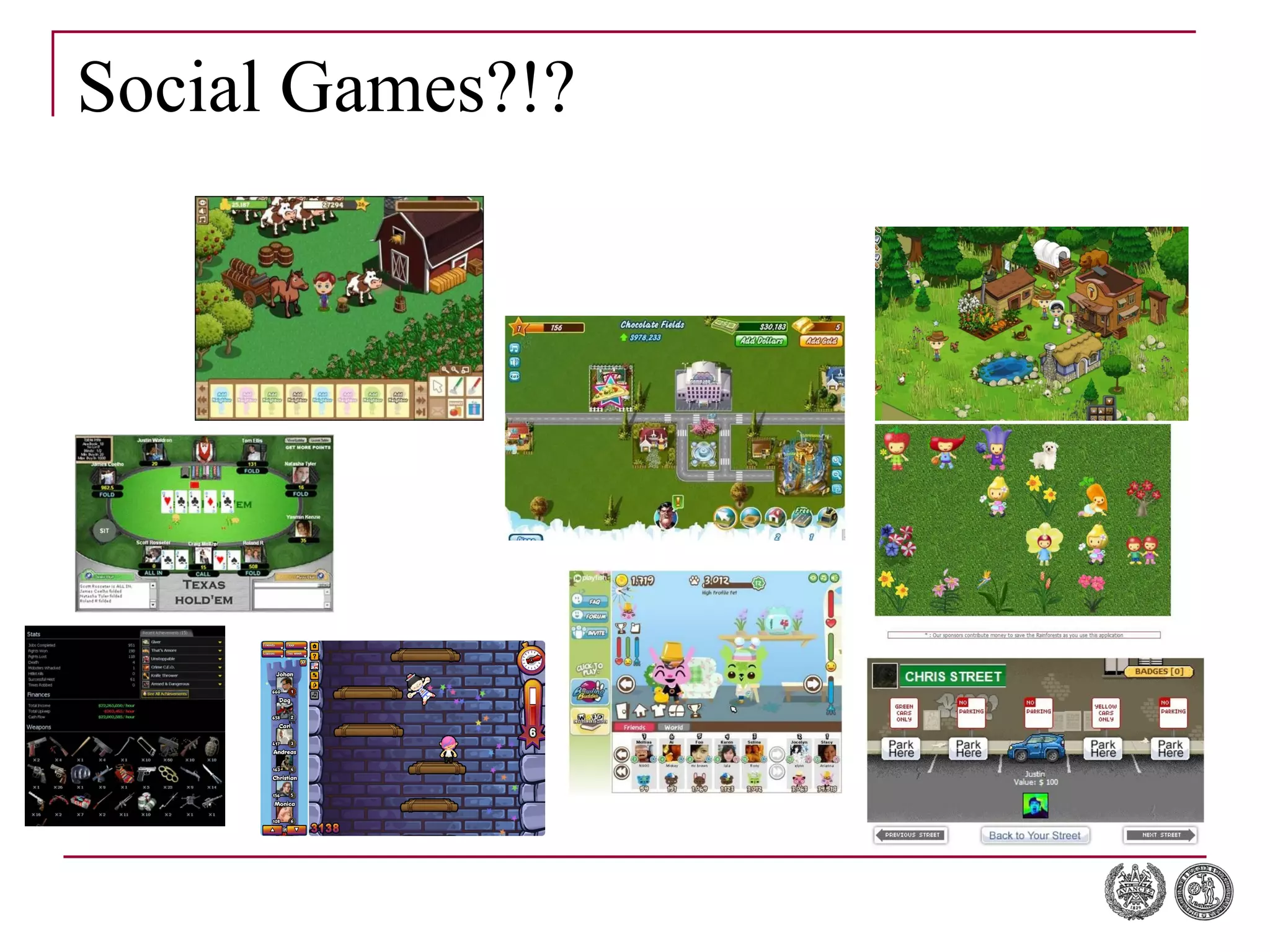
Social Games?!?
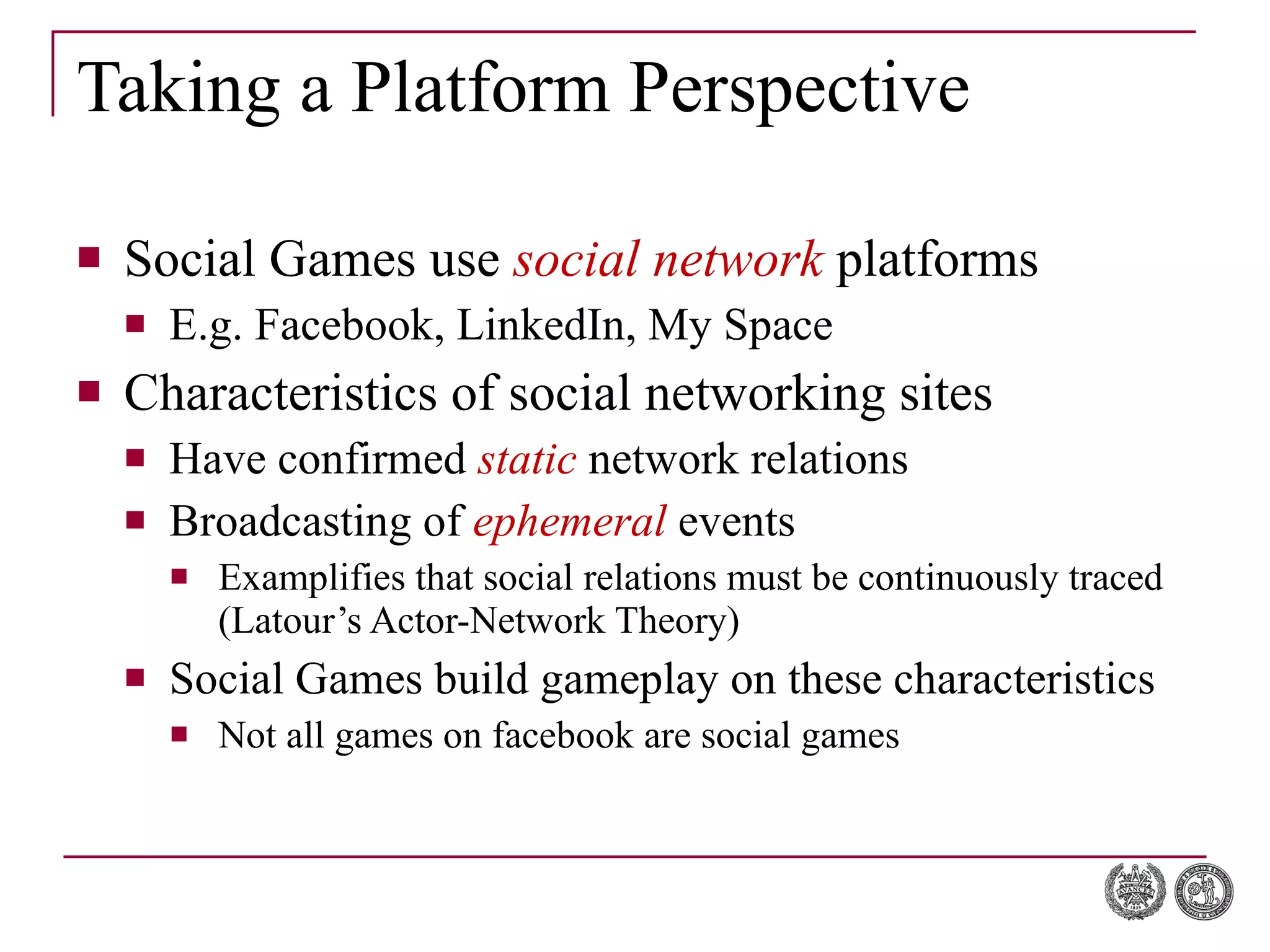
Taking a Platform Perspective Social Games use  social network  platforms E.g. Facebook, LinkedIn, My Space Characteristics of social networking sites Have confirmed  static  network relations Broadcasting of  ephemeral  events Examplifies that social relations must be continuously traced (Latour’s Actor-Network Theory) Social Games build gameplay on these characteristics Not all games on facebook are social games
Gameplay Design Patterns for Social Games That build upon the functionality of social network platforms
Gameplay Design Patterns “ Semi-formal inter-dependent descriptions of commonly  reoccurring parts  of the design of a game  that concern gameplay ” Björk & Holopainen Separate function from form Defines “fuzzy” concepts Range from concrete to abstract Work also for unintentional features
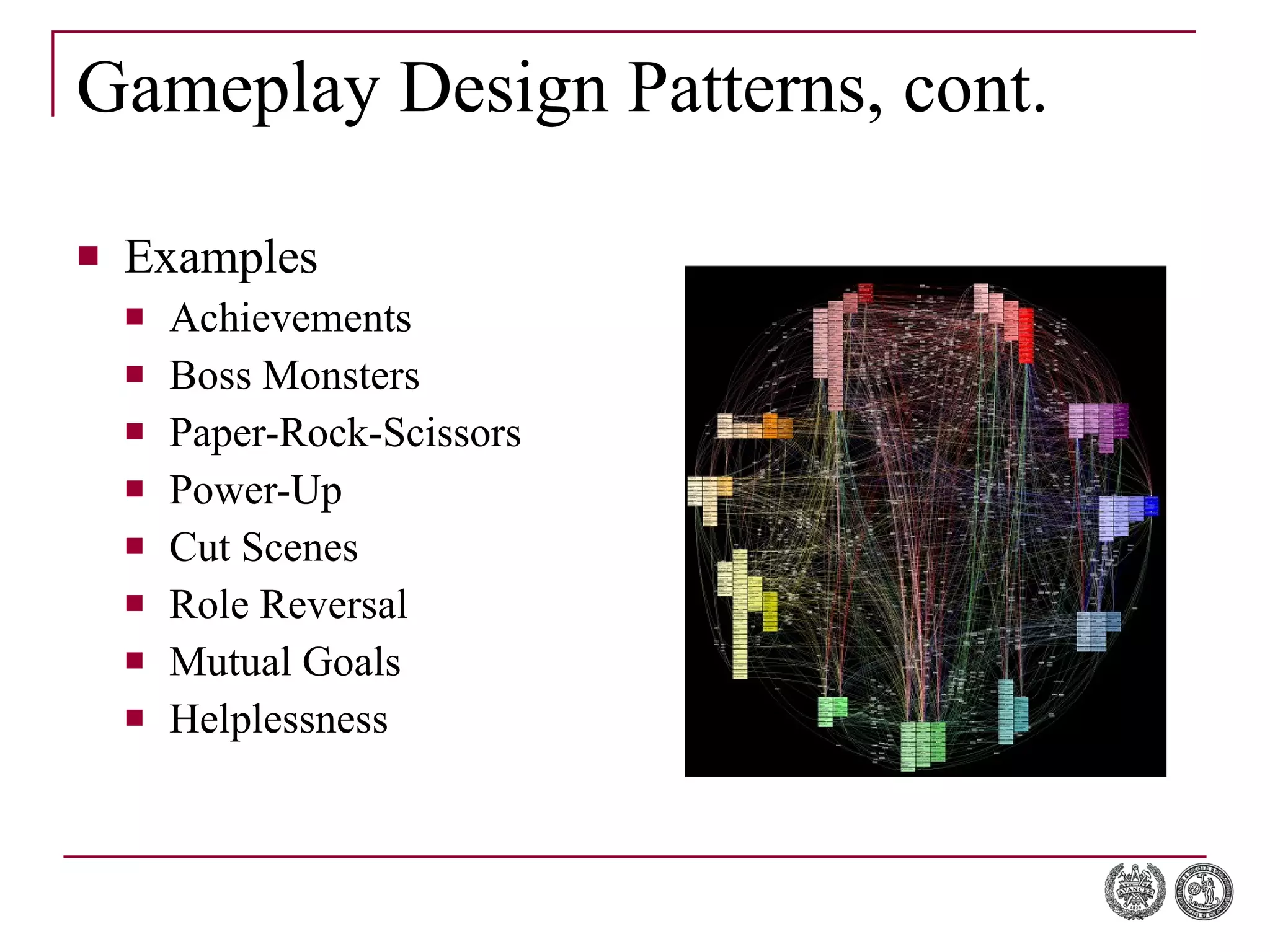
Gameplay Design Patterns, cont. Examples Achievements Boss Monsters Paper-Rock-Scissors Power-Up Cut Scenes Role Reversal Mutual Goals Helplessness
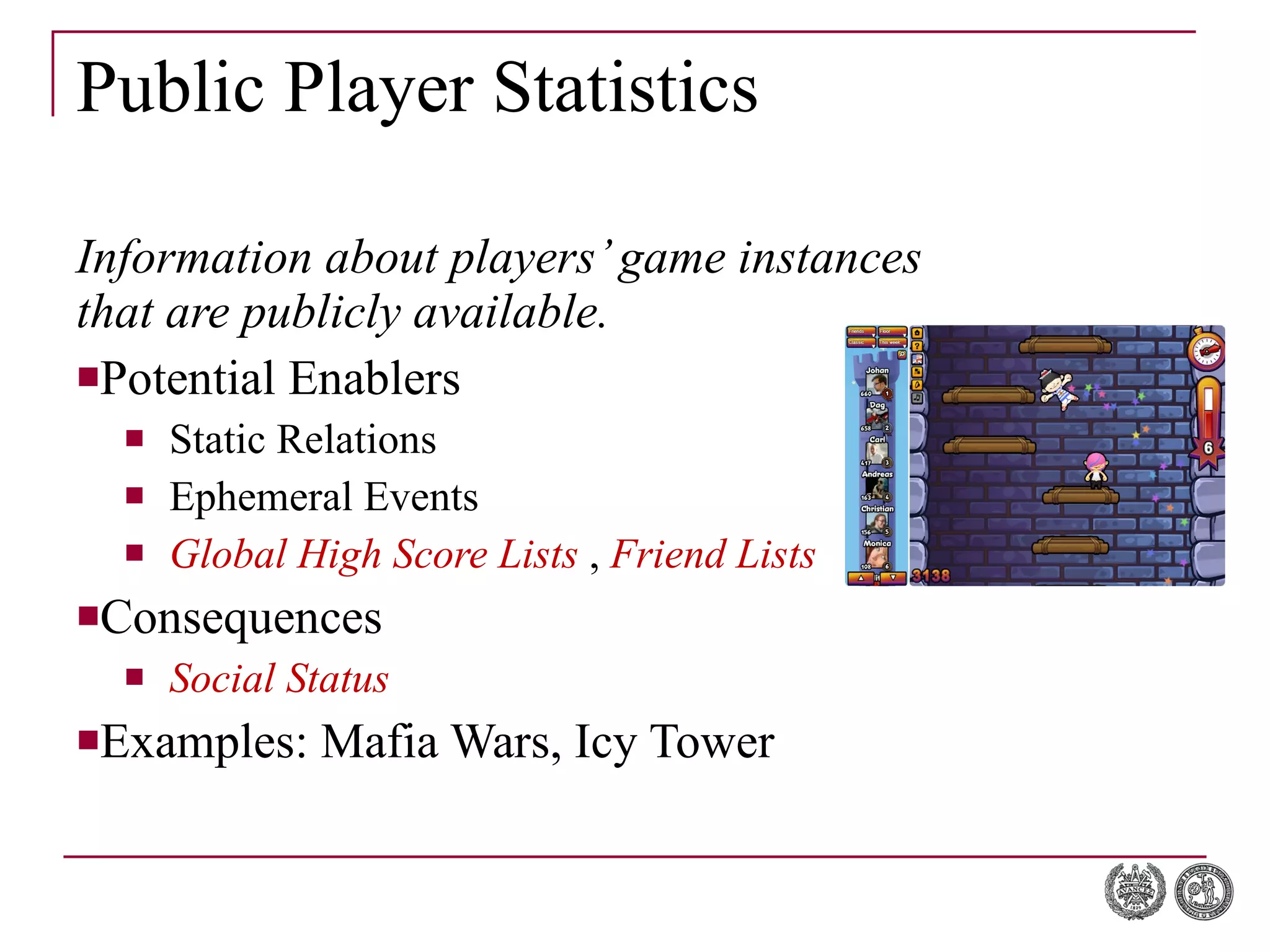
Public Player Statistics Information about players’ game instances that are publicly available. Potential Enablers Static Relations Ephemeral Events Global High Score Lists  ,  Friend Lists   Consequences Social Status Examples: Mafia Wars, Icy Tower
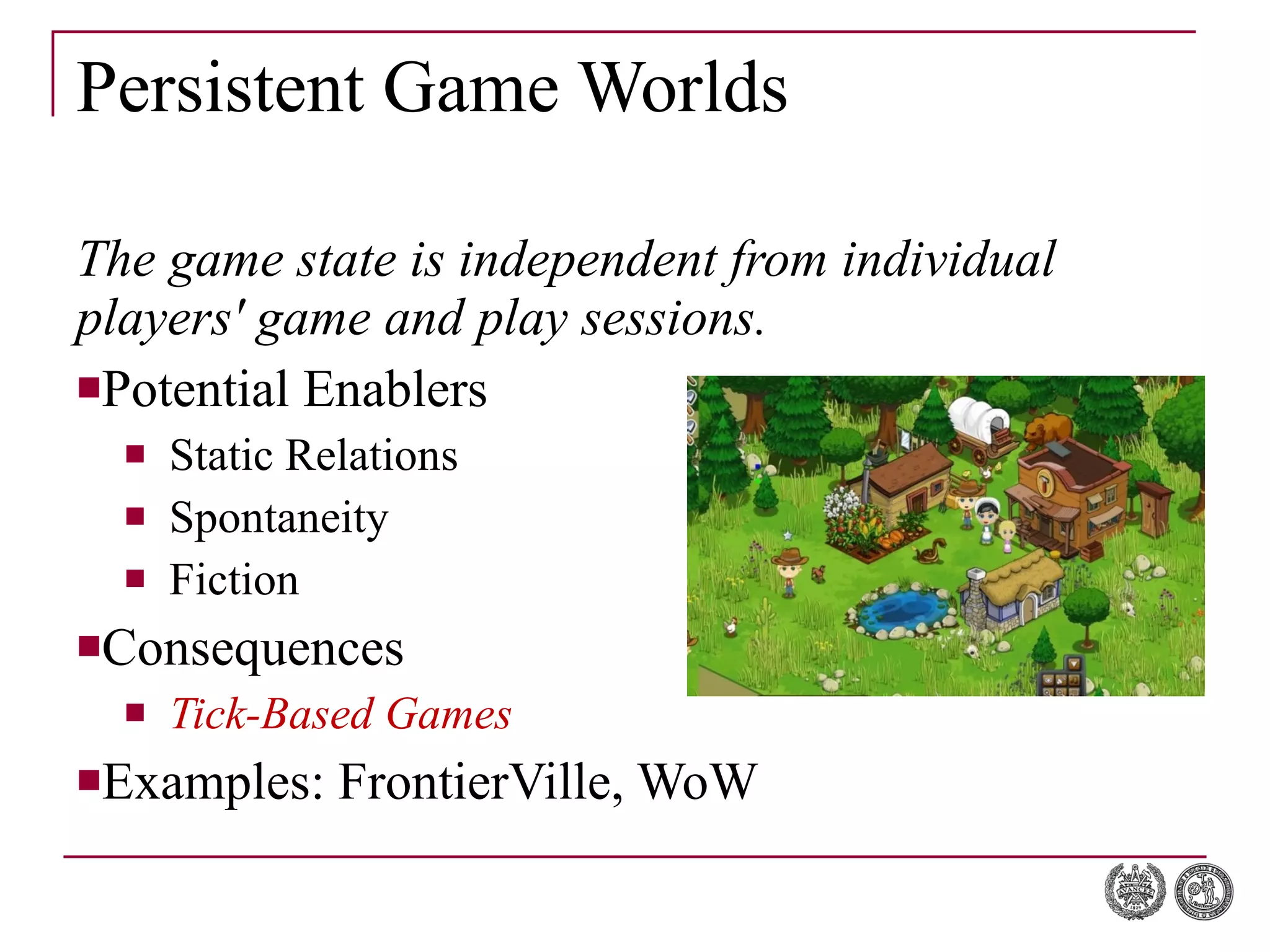
Persistent Game Worlds The game state is independent from individual players' game and play sessions. Potential Enablers Static Relations Spontaneity Fiction Consequences Tick-Based Games Examples: FrontierVille, WoW
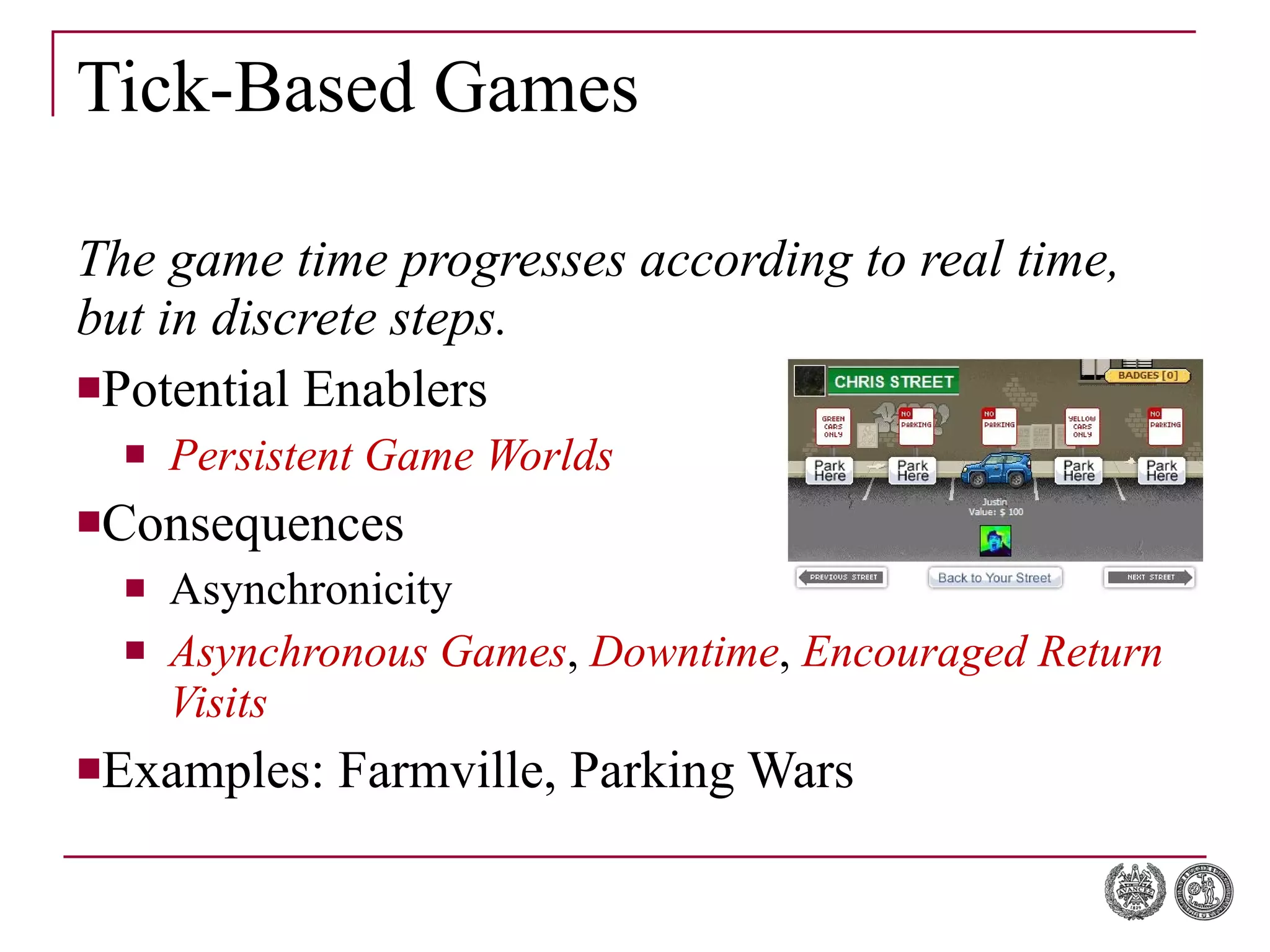
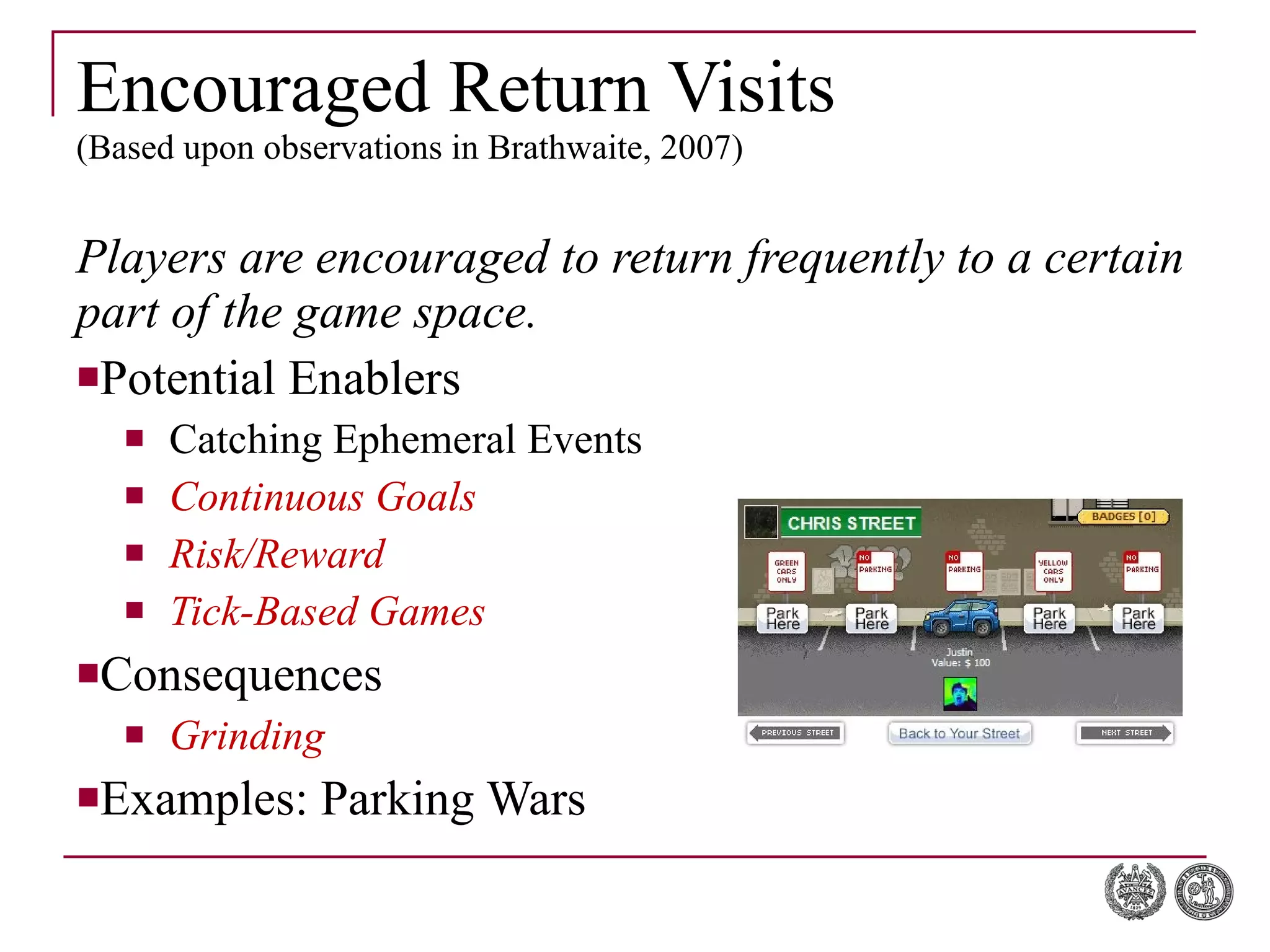
Tick-Based Games The game time progresses according to real time, but in discrete steps. Potential Enablers Persistent Game Worlds Consequences Asynchronicity Asynchronous Games ,  Downtime ,  Encouraged Return Visits Examples: Farmville, Parking Wars
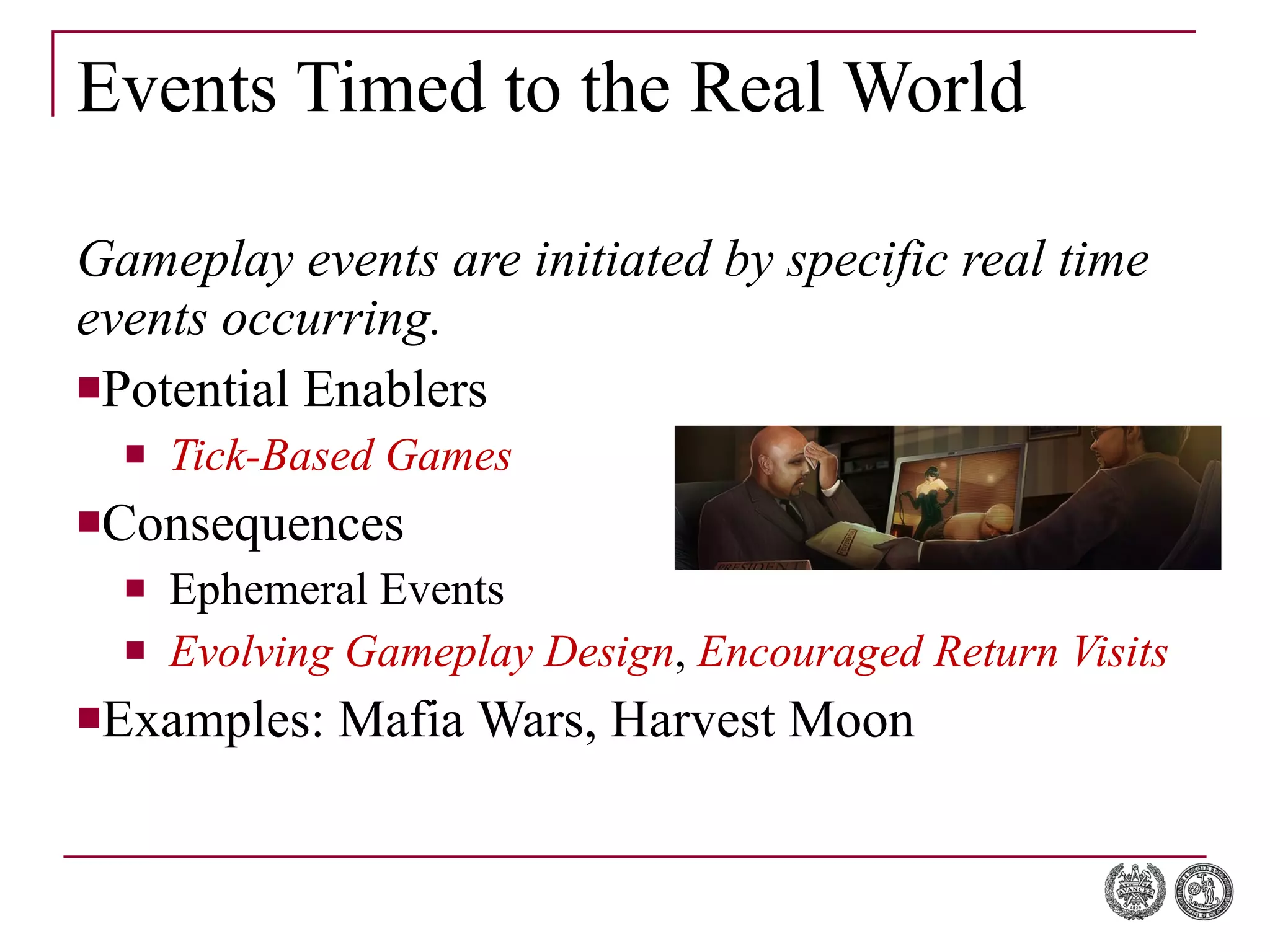
Events Timed to the Real World Gameplay events are initiated by specific real time events occurring. Potential Enablers Tick-Based Games Consequences Ephemeral Events Evolving Gameplay Design ,  Encouraged Return Visits Examples: Mafia Wars, Harvest Moon
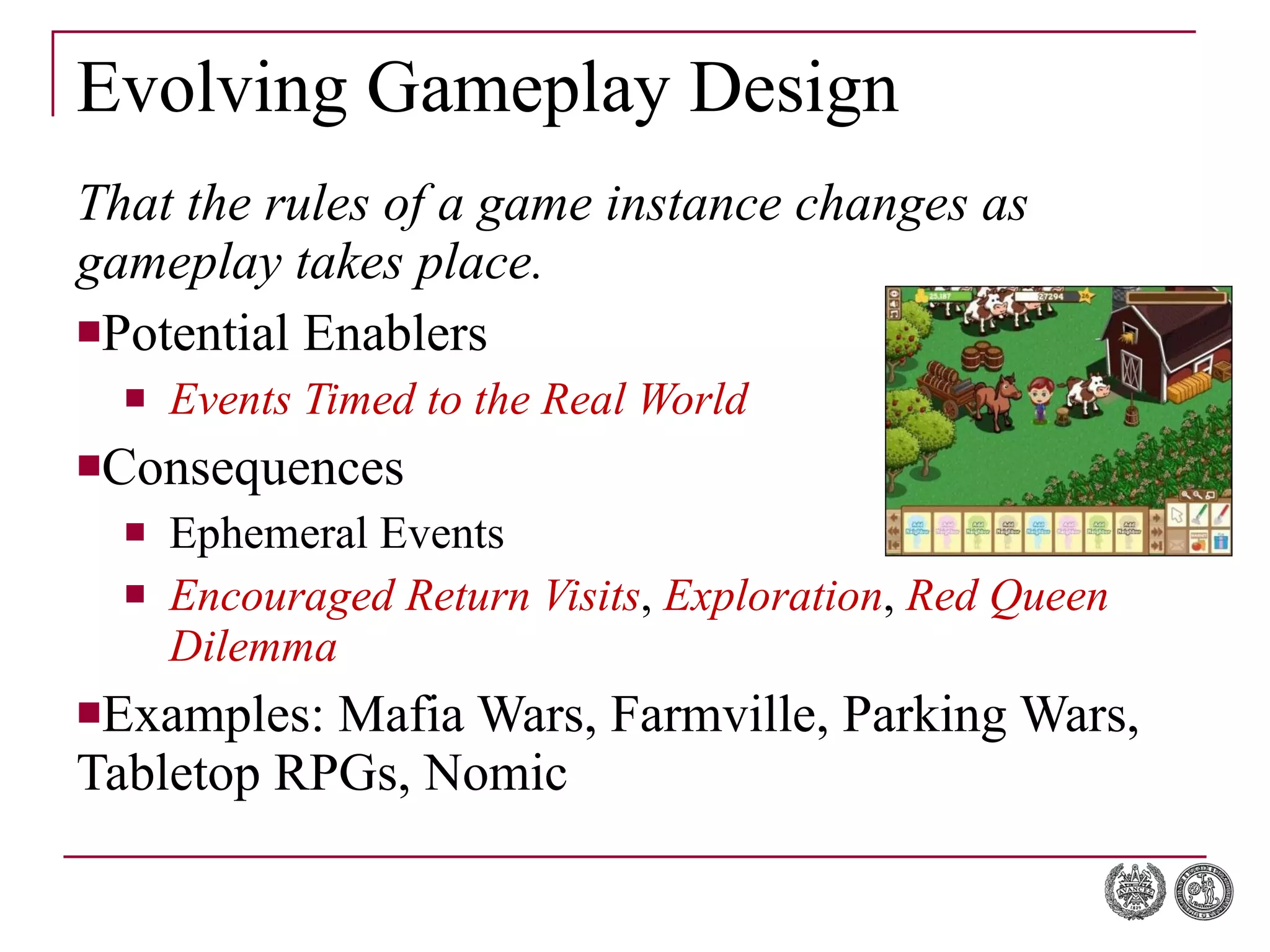
Evolving Gameplay Design That the rules of a game instance changes as gameplay takes place. Potential Enablers Events Timed to the Real World Consequences Ephemeral Events Encouraged Return Visits ,  Exploration ,  Red Queen Dilemma Examples: Mafia Wars, Farmville, Parking Wars, Tabletop RPGs, Nomic
Encouraged Return Visits (Based upon observations in Brathwaite, 2007) Players are encouraged to return frequently to a certain part of the game space. Potential Enablers Catching Ephemeral Events Continuous Goals Risk/Reward Tick-Based Games Consequences Grinding Examples: Parking Wars
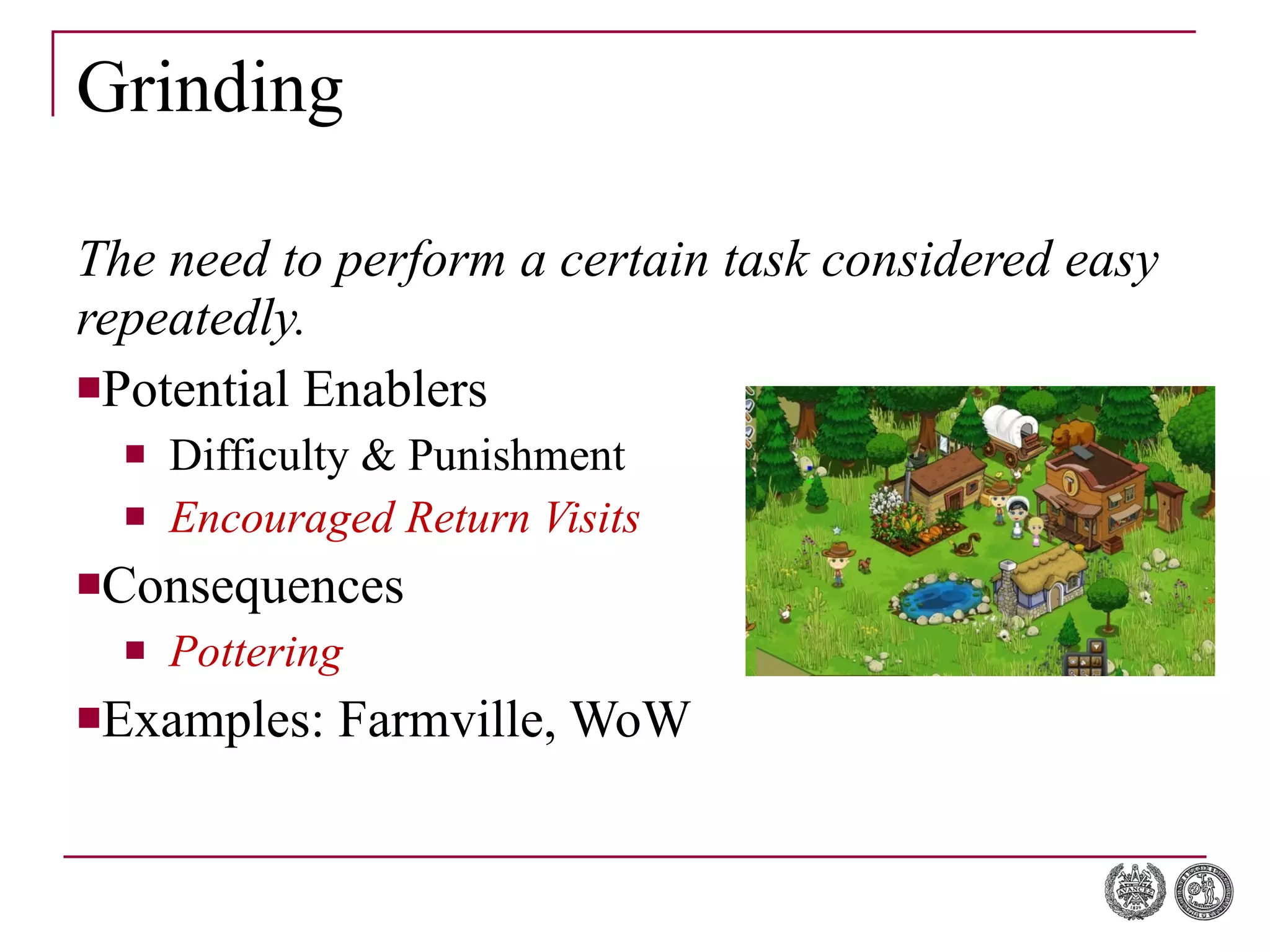
Grinding The need to perform a certain task considered easy repeatedly. Potential Enablers Difficulty & Punishment Encouraged Return Visits  Consequences Pottering Examples: Farmville, WoW
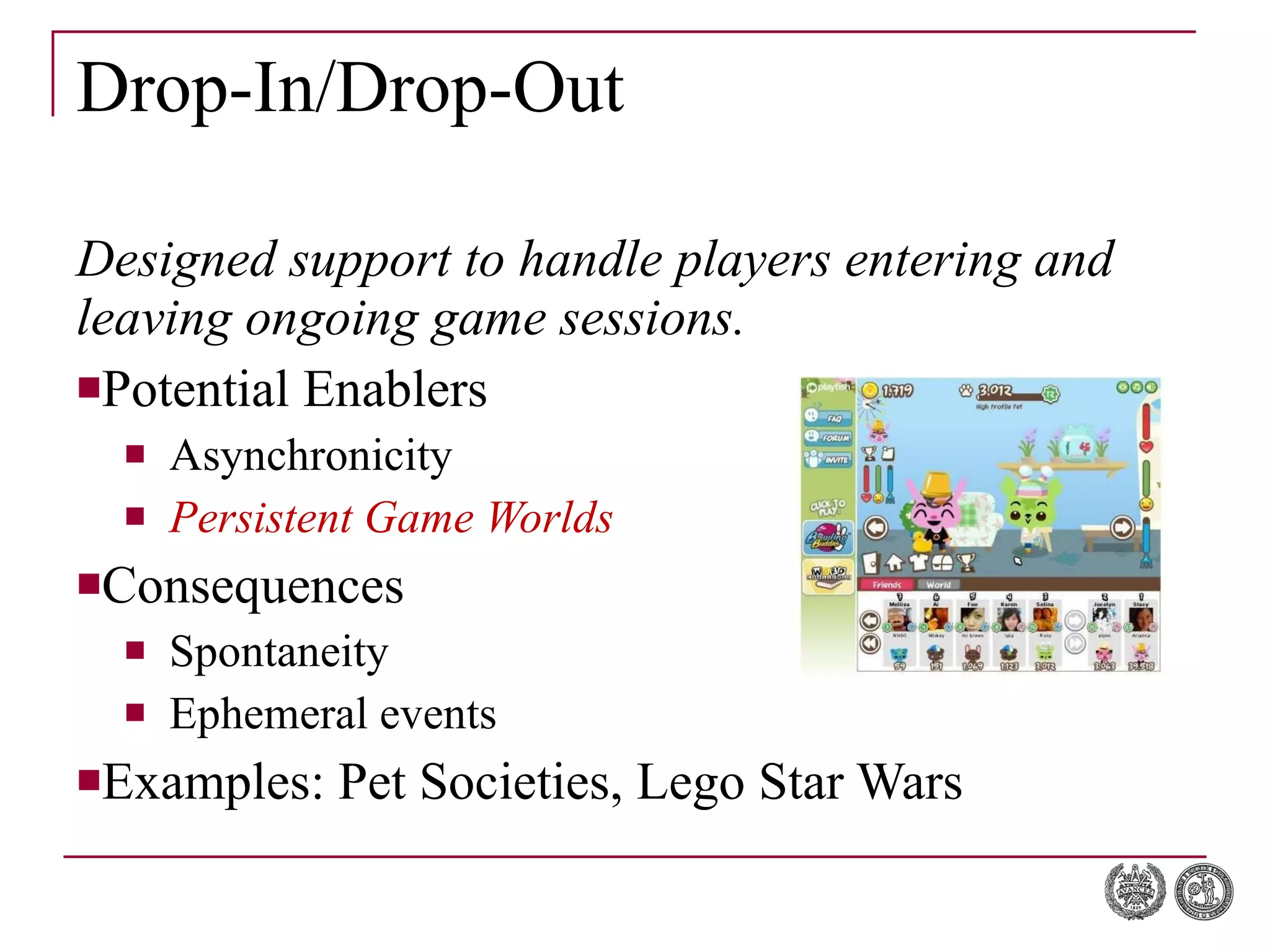
Drop-In/Drop-Out Designed support to handle players entering and leaving ongoing game sessions. Potential Enablers Asynchronicity Persistent Game Worlds Consequences Spontaneity Ephemeral  events Examples: Pet Societies, Lego Star Wars
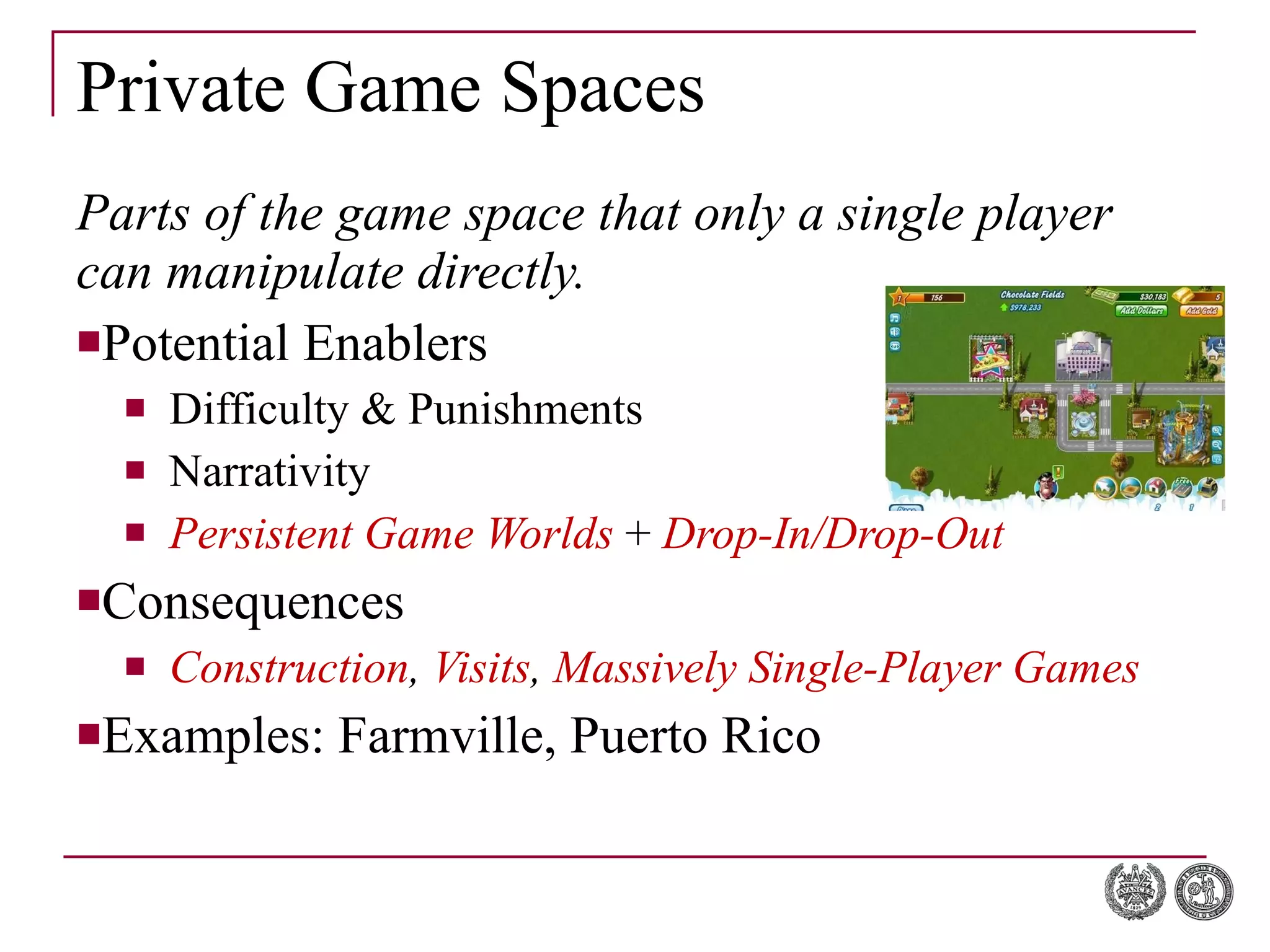
Private Game Spaces Parts of the game space that only a single player can manipulate directly. Potential Enablers Difficulty & Punishments Narrativity Persistent Game Worlds  +  Drop-In/Drop-Out Consequences Construction ,  Visits ,   Massively Single-Player Games Examples: Farmville, Puerto Rico
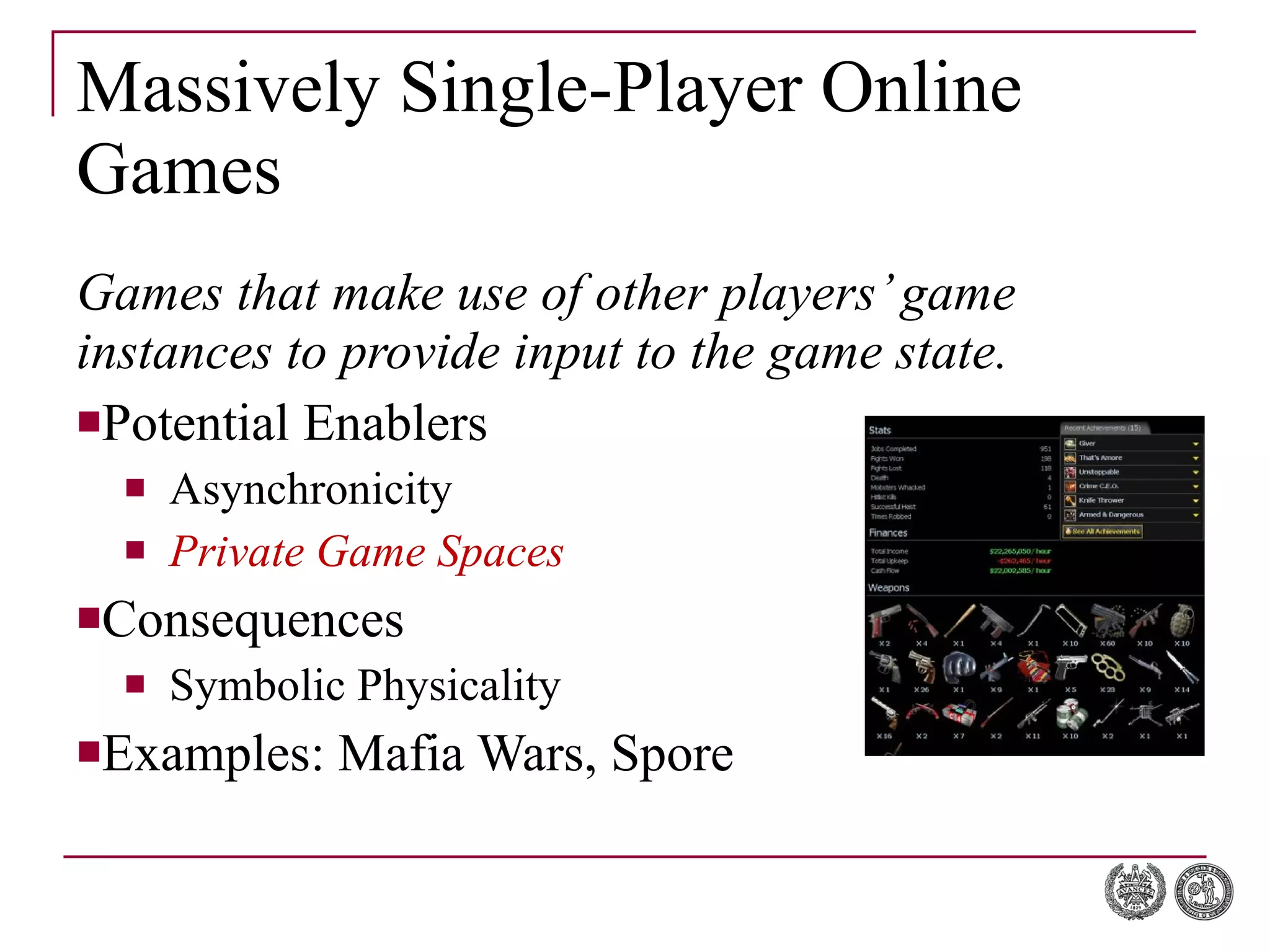
Massively Single-Player Online Games Games that make use of other players’ game instances to provide input to the game state. Potential Enablers Asynchronicity Private Game Spaces Consequences Symbolic Physicality Examples: Mafia Wars, Spore
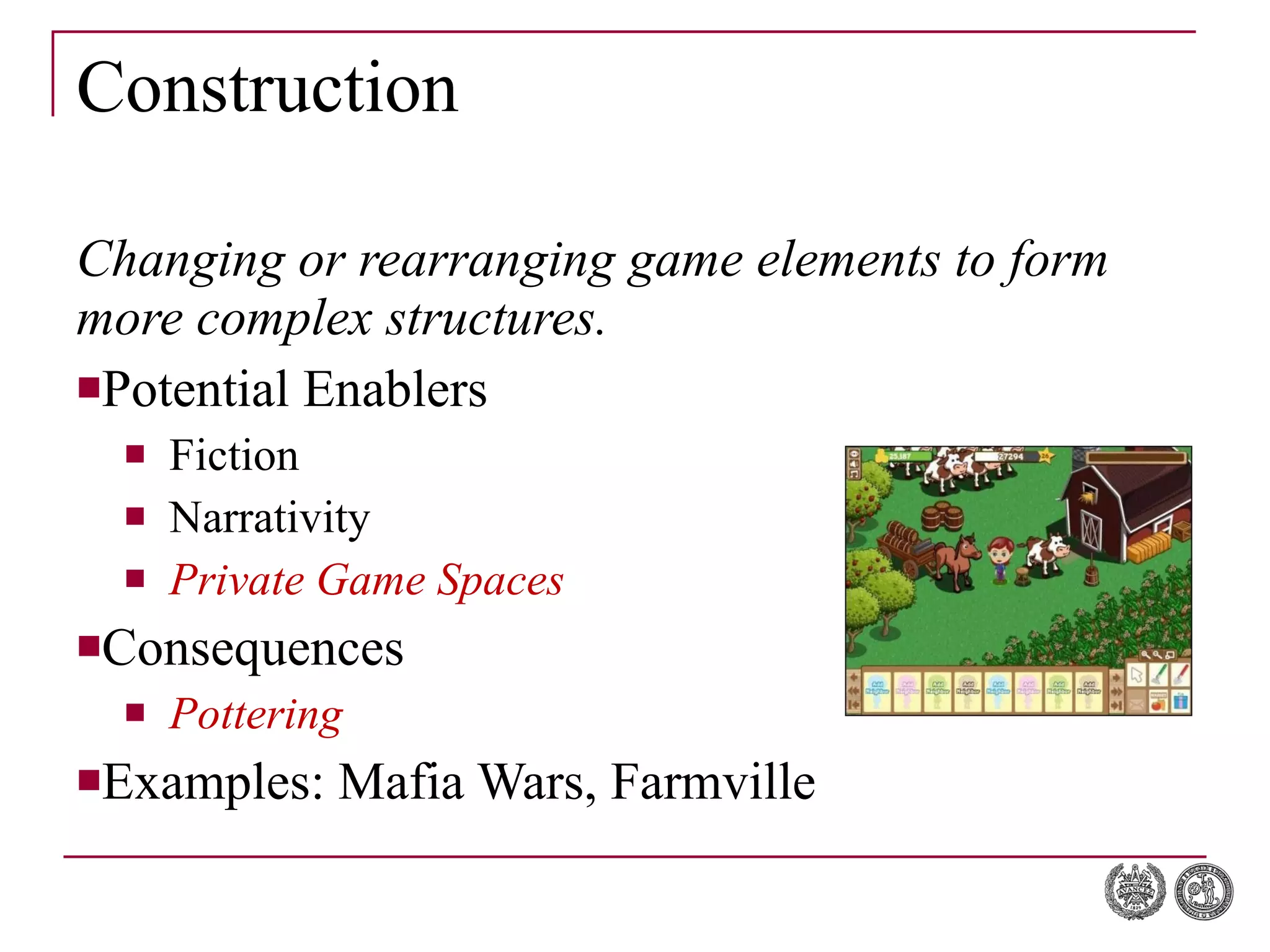
Construction Changing or rearranging game elements to form more complex structures. Potential Enablers Fiction Narrativity Private Game Spaces Consequences Pottering Examples: Mafia Wars, Farmville
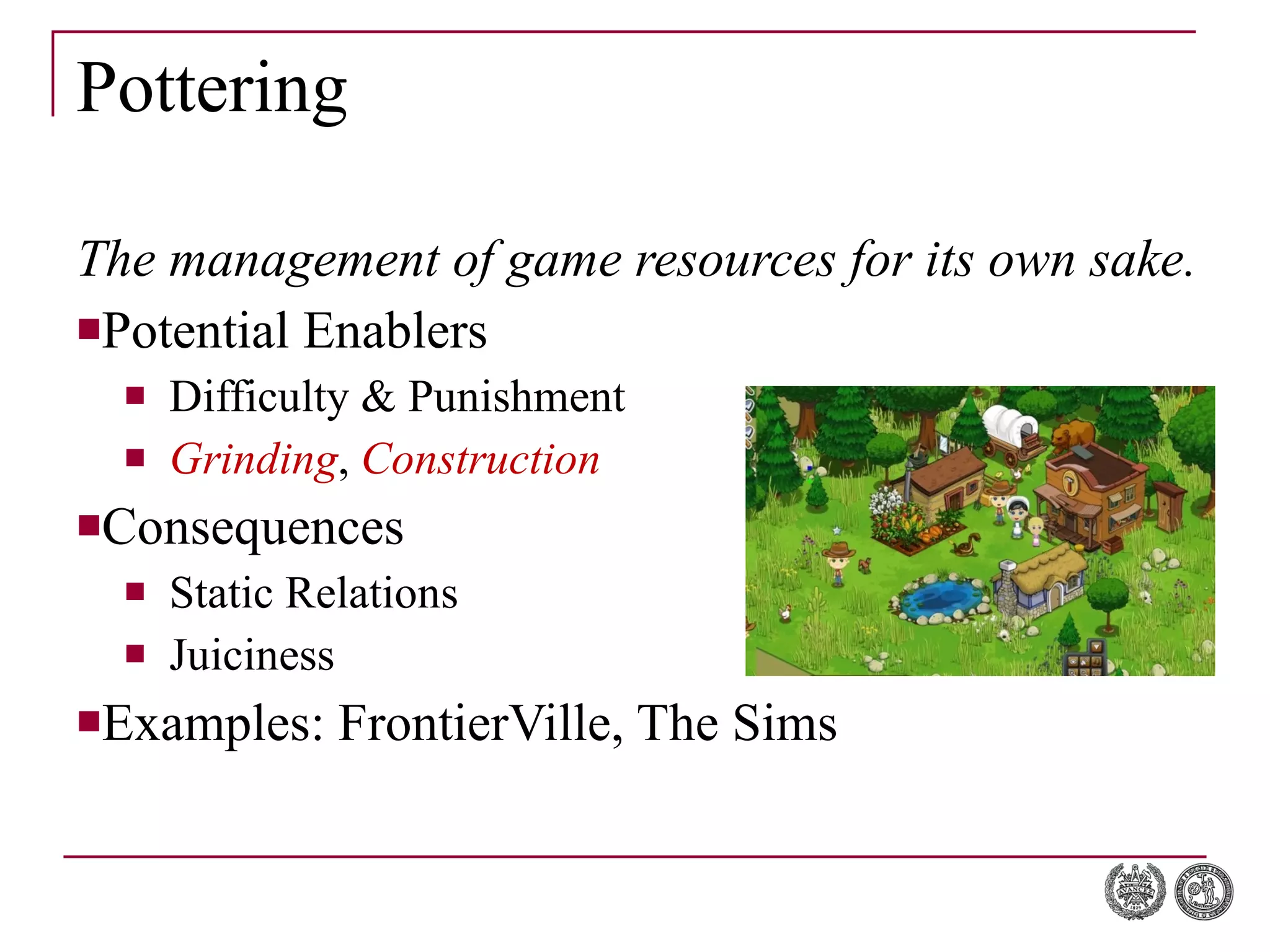
Pottering The management of game resources for its own sake. Potential Enablers Difficulty & Punishment Grinding ,  Construction Consequences Static Relations Juiciness Examples: FrontierVille, The Sims
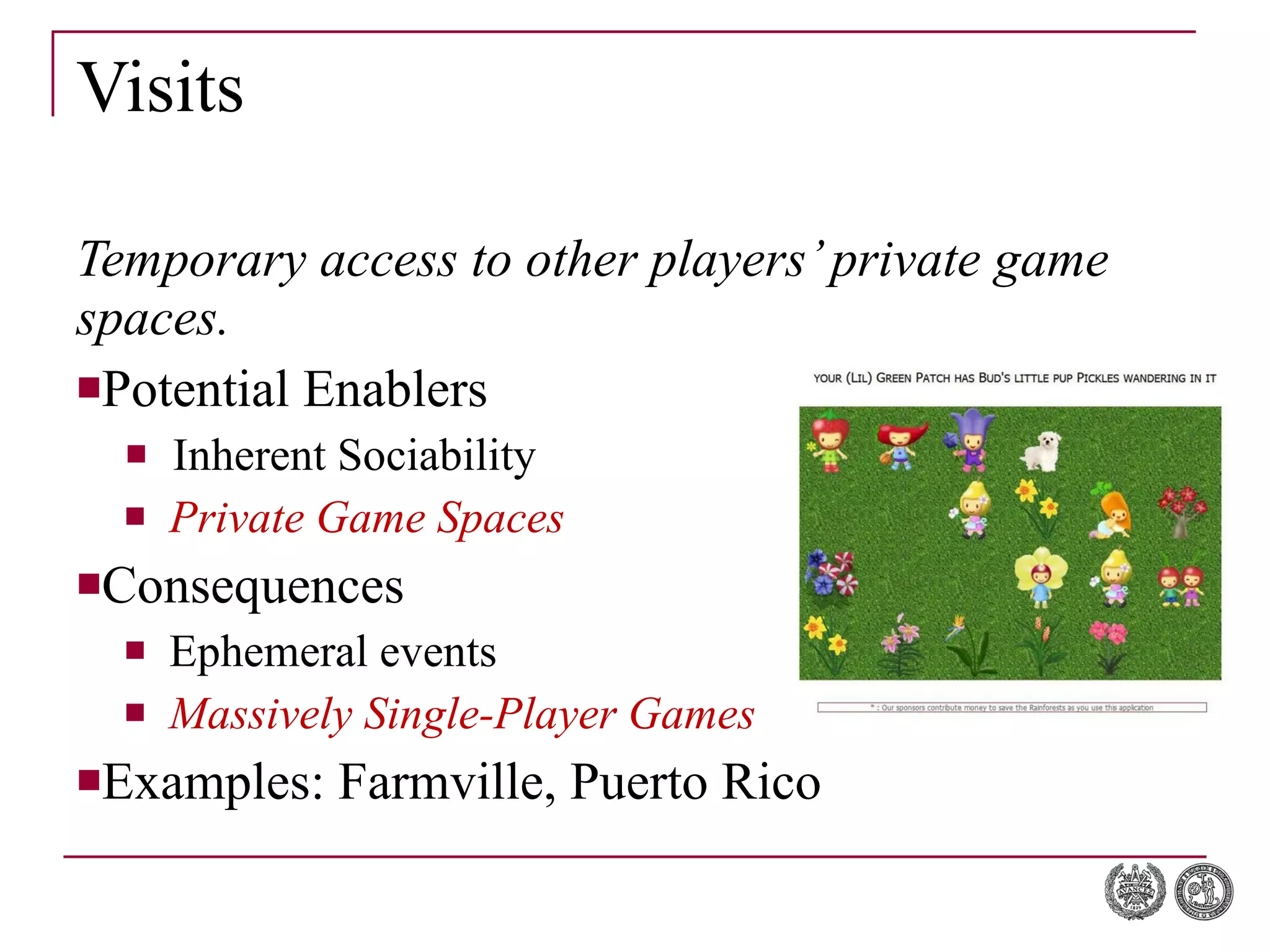
Visits Temporary access to other players’ private game spaces. Potential Enablers Inherent Sociability Private Game Spaces Consequences Ephemeral   events Massively Single-Player Games Examples: Farmville, Puerto Rico
Altruistic Actions Actions that have only explicit benefits for somebody else than is performing the action. Potential Enablers Inherent Sociability Free Gift Inventories ,  Visits Consequences Non-Player Help ,  Collaboration ,  Expected Reciprocity Examples: Farmville,  D&D Tiny Adventures
Free Gift Inventories Players have an inventory of game items that can only be given to other players, but these items are generated for free. Potential Enablers Inherent Sociability Consequences Altruistic Actions Examples: Farmville, Frontiersville
Non-Player Help Players can receive help in the games by actions from those not playing. Potential Enablers Broadcasting Ephemeral Events Altruistic Actions Consequences Symbolic Physicality Extra-Game Event Broadcasting Examples:  Farmville, Lifelines in  Who Wants to Be a Millionaire?
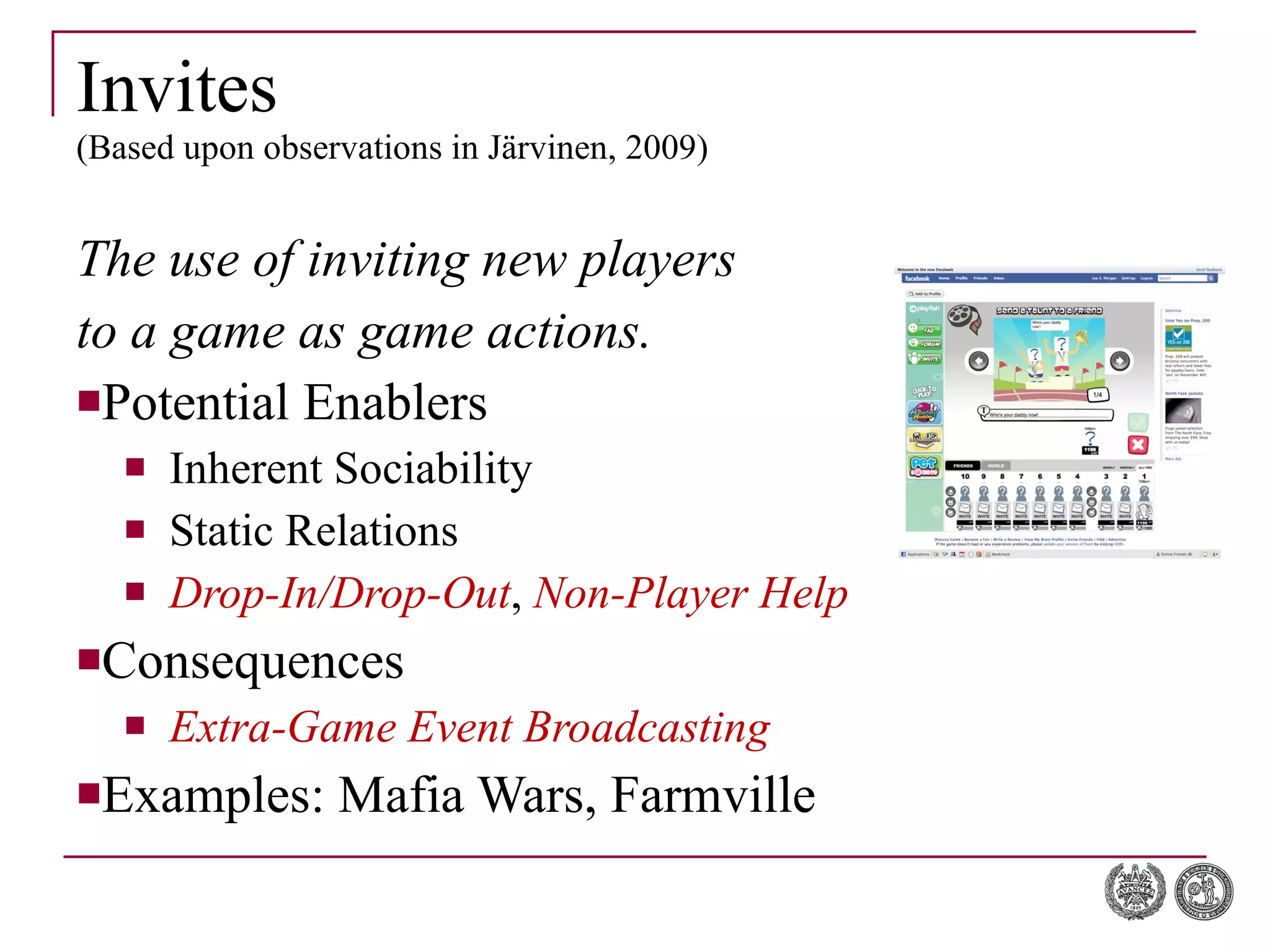
Invites (Based upon observations in Järvinen, 2009) The use of inviting new players  to a game as game actions. Potential Enablers Inherent Sociability Static Relations Drop-In/Drop-Out ,  Non-Player Help Consequences Extra-Game Event Broadcasting Examples: Mafia Wars, Farmville
Extra-Game Event Broadcasting Game Events are broadcasted in a medium where others can perceived them. Potential Enablers Achievements ,  Invites ,  Non-Player Help   Consequences Broadcasting Ephemeral Events Examples: Mafia Wars, Xbox Live
Collaborative Actions Compound actions that require several players to perform actions. Potential Enablers Inherent Sociability Altruistic Actions ,  Construction Consequences Symbolic Physicality Cooperation ,  Delayed Reciprocity ,  Purchasable Game Advantages Examples: Farmville, Pandemic
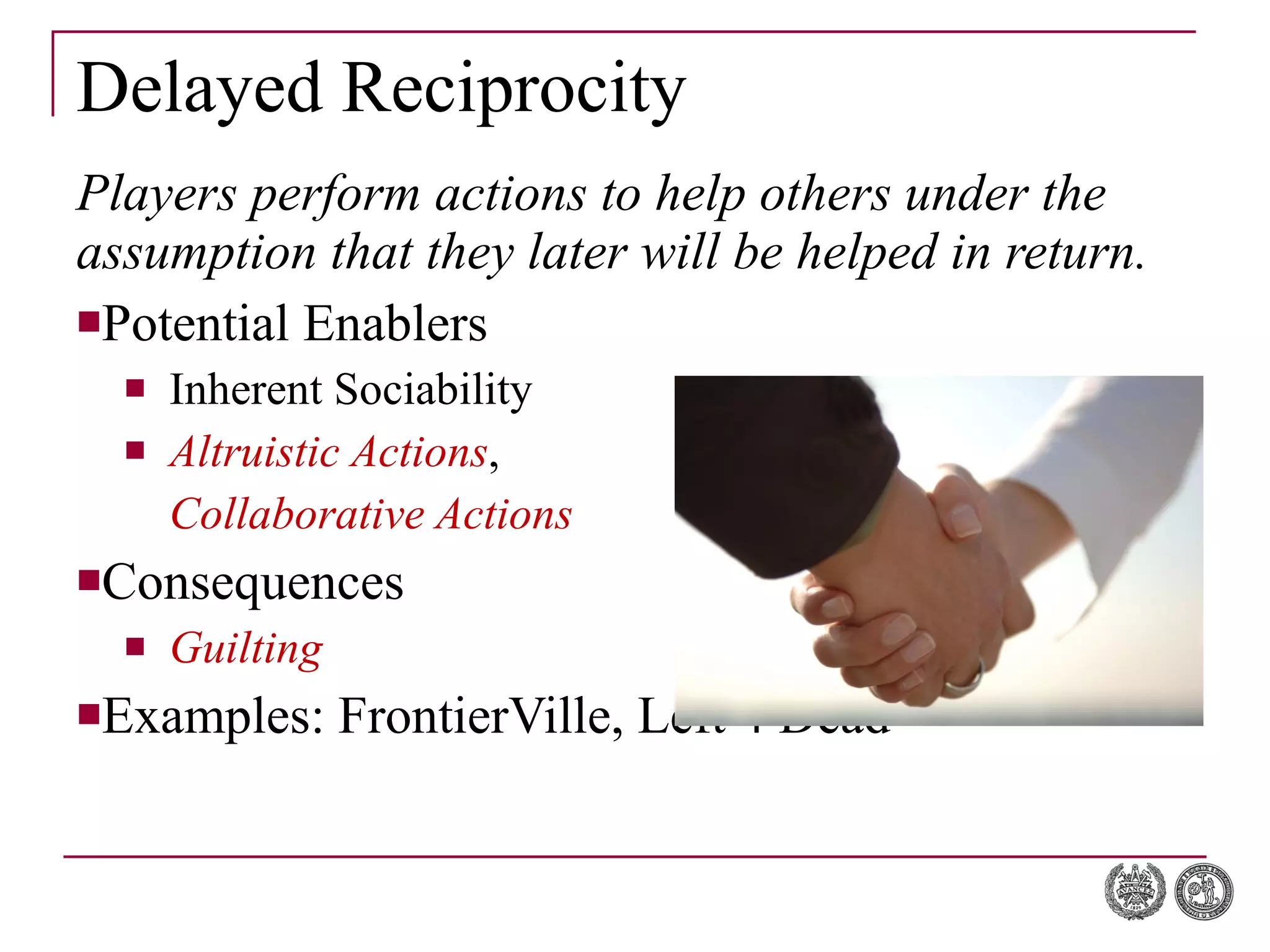
Delayed Reciprocity Players perform actions to help others under the assumption that they later will be helped in return. Potential Enablers Inherent Sociability Altruistic Actions ,  Collaborative Actions Consequences Guilting Examples: FrontierVille, Left 4 Dead
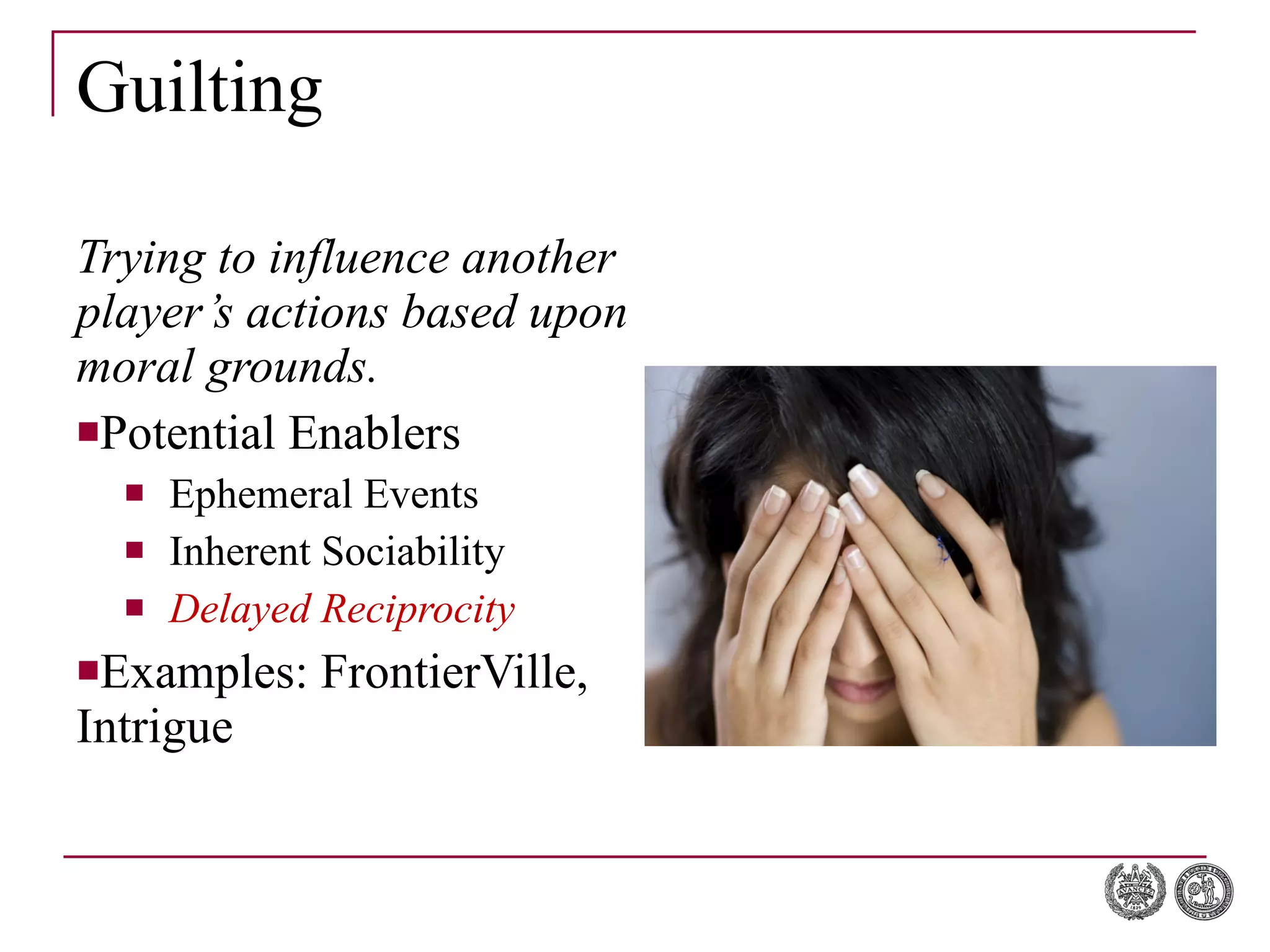
Guilting Trying to influence another player’s actions based upon moral grounds. Potential Enablers Ephemeral Events Inherent Sociability Delayed Reciprocity Examples: FrontierVille, Intrigue
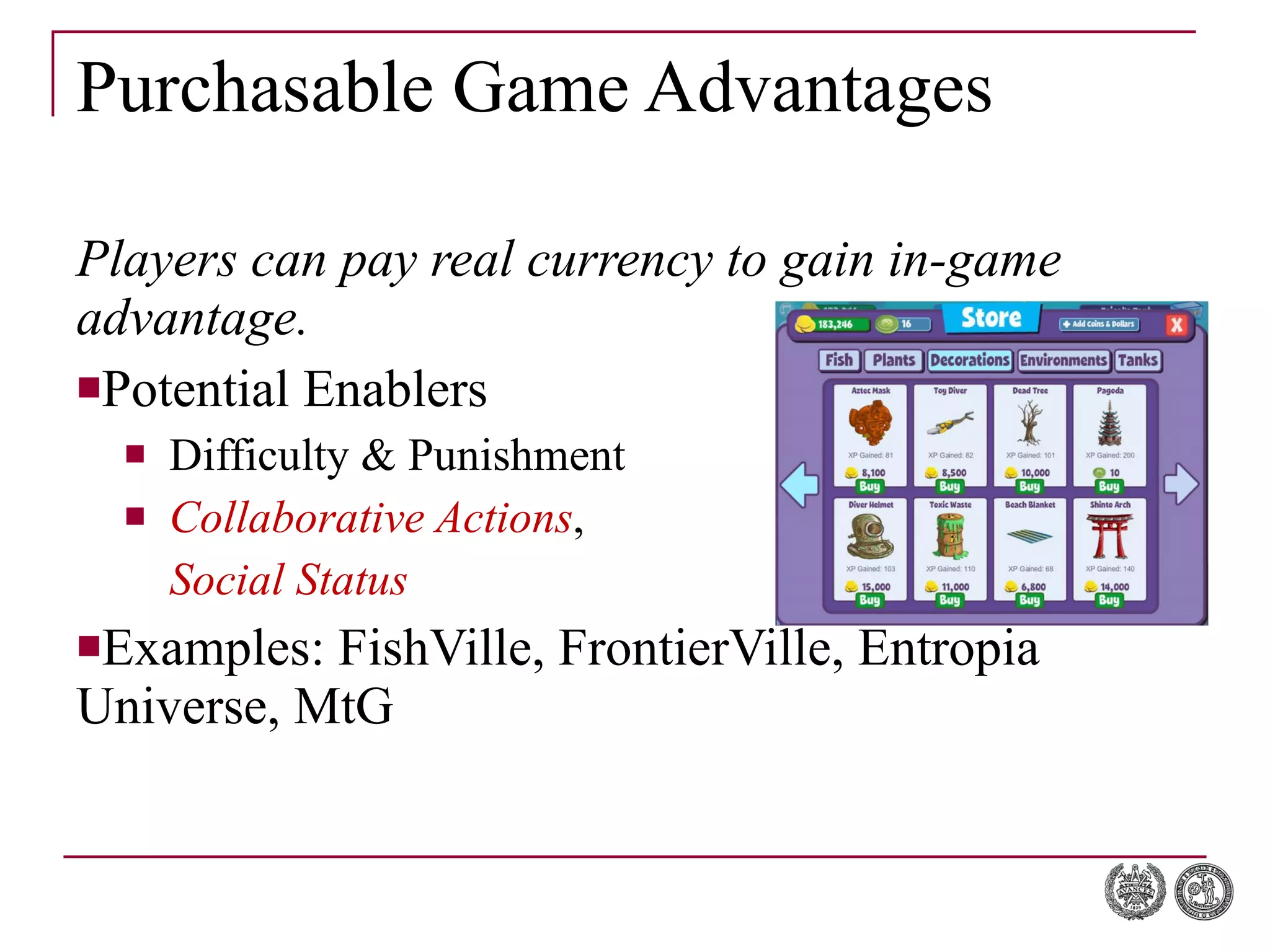
Purchasable Game Advantages Players can pay real currency to gain in-game advantage. Potential Enablers Difficulty & Punishment Collaborative Actions ,  Social Status Examples: FishVille, FrontierVille, Entropia Universe, MtG
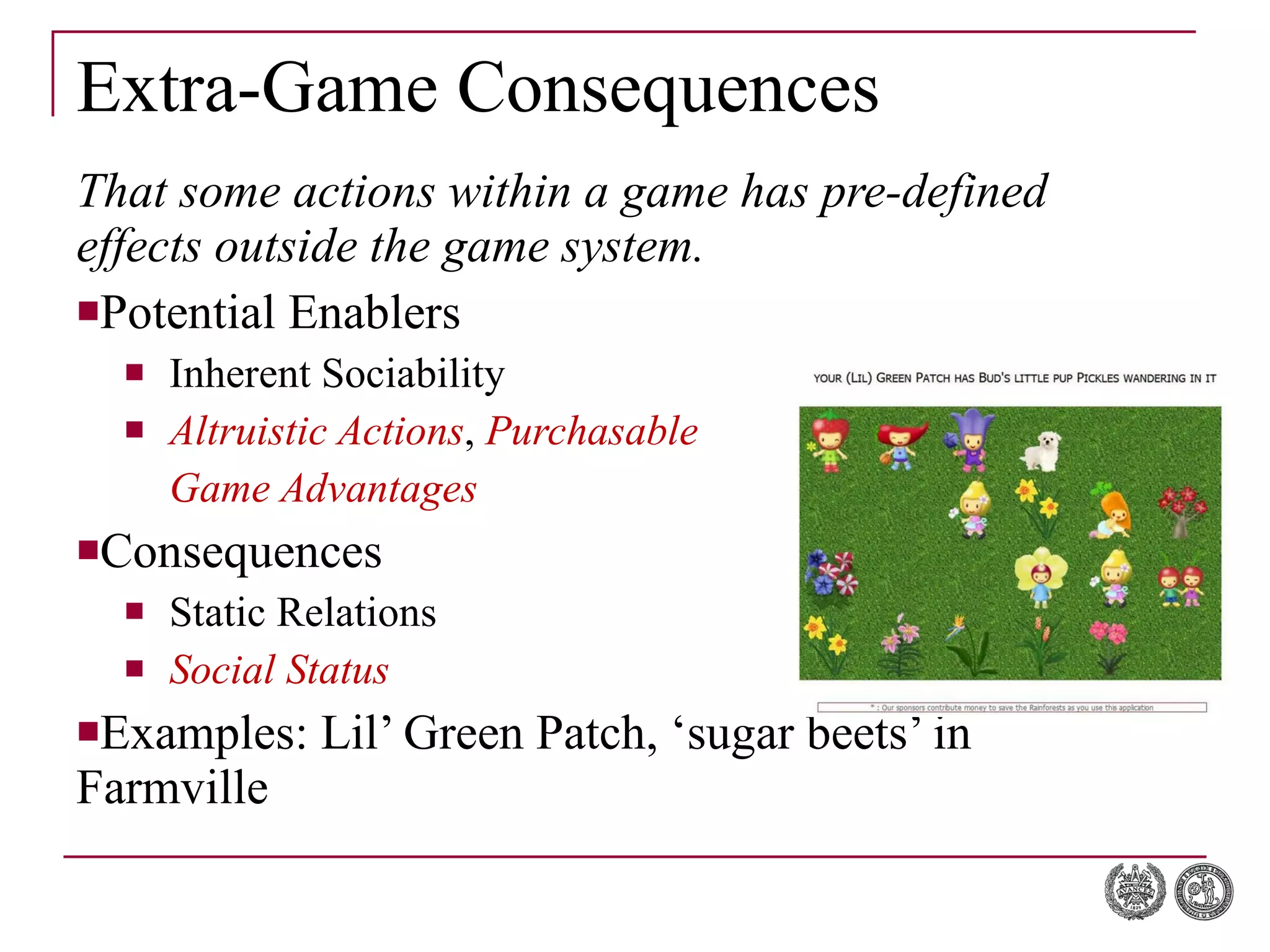
Extra-Game Consequences That some actions within a game has pre-defined effects outside the game system. Potential Enablers Inherent Sociability Altruistic Actions ,  Purchasable Game Advantages Consequences Static Relations Social Status Examples: Lil’ Green Patch, ‘sugar beets’ in Farmville
Summary Social Games can be described as those making use of  social networks  to provide gameplay Qualities from Casual Games help explain players’  preferences  towards these games Qualities from Playfulness explain typical player  behaviour  on the social networks With this as a basis, several different types of gameplay design patterns can be identified Some games provide their own social networks
Thank you! Questions?

Principles and patterns of social games

  • 1.
    Principles and patternsof social games Where’s the difference compared to other games? Staffan Björk Dept. of Applied IT, Gothenburg University Game Studio, Interactive Institute
  • 2.
    Takeaway An explorationin how to differentiate between the “new” trend of social games and ordinary games Based upon these differences, some specific gameplay patterns that are commonly used in social games
  • 3.
  • 4.
    What is aSocial Game?
  • 5.
    A definition ofplay Johan Huizinga ” [Play is] a free activity standing quite consciously outside ”ordinary” life as being ”not serious”, but at the same time absorbing the player intensely and utterly. It is an activity connected with no material interest, and no profit can be gained by it. It proceeds within its own proper boundaries of time and space according to fixed rules and in an orderly manner. It promotes the formation of social groupings , which tend to surround themselves with secrecy and to stress their difference from the common world by disguise or other means.” Huizinga, J. Homo Ludens, 1938
  • 6.
    Arcade Halls: APossible Culprit
  • 7.
  • 8.
    What is agame? ” A game is a rule-based formal system with a variable and quantifiable outcome , where different outcomes are assigned different values, the player exerts effort in order to influence the outcome, the player feels attached to the outcome , and the consequences of the activity are optional and negotiable . “ Jesper Juul Borderline games lack of one requirement E.g. tabletop roleplaying games, gambling
  • 9.
  • 10.
    Casual Games 5Aspects of Game Design Fiction Usability Interruptability Difficulty & Punishment Juiciness Notes that games rarely are either casual or hardcore
  • 11.
    Stereotypical Casual Players Fiction preference Game knowledge Time investment Attitude t. difficulty Positive Low Low Dislikes Negative High High Prefers
  • 12.
    Interviewed Casual Players Fiction preference Game knowledge Time investment Attitude t. difficulty Positive Low Low Dislikes Negative High High Prefers
  • 13.
    Stereotypical Hardcore Players Fiction preference Game knowledge Time investment Attitude t. difficulty Positive Low Low Dislikes Negative High High Prefers
  • 14.
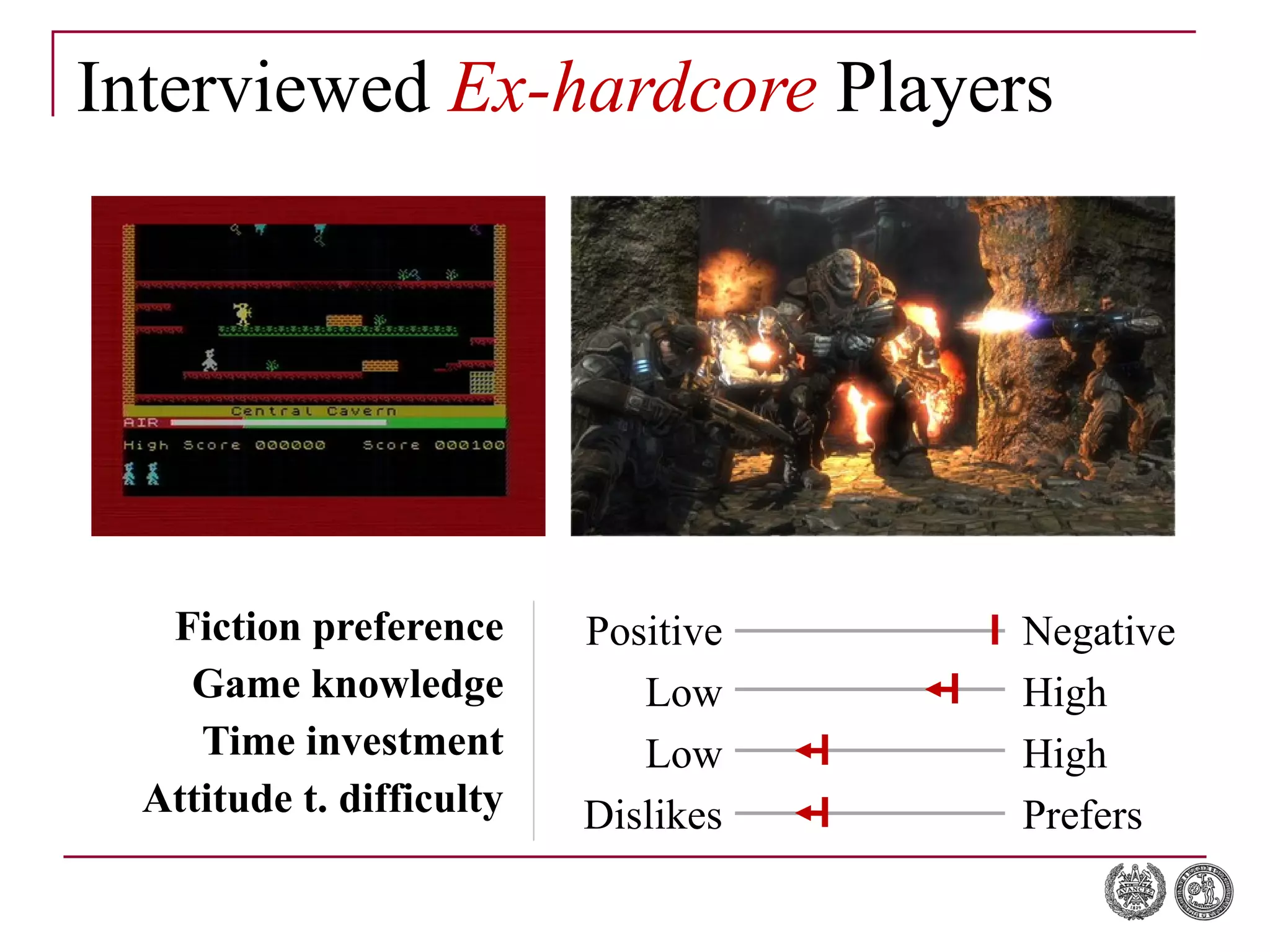
    Interviewed Ex-hardcore Players Fiction preference Game knowledge Time investment Attitude t. difficulty Positive Low Low Dislikes Negative High High Prefers
  • 15.
    Interviewed Ex-hardcore Players Fiction preference Game knowledge Time investment Attitude t. difficulty Positive Low Low Dislikes Negative High High Prefers
  • 16.
    Players - Whatabout Games? Player-centric approach Study preferences Study experiences Can provide requirements Actually activity-centric Game-centric approach Study game design Analyze existing designs Can provide specific design suggestions
  • 17.
    Player and GameFlexibility Casual Hardcore Games Flexible Inflexible Players Inflexible Flexible
  • 18.
    Affordances of Casual Games Fiction preference Game knowledge Time investment Attitude t. difficulty Positive Low Low Dislikes Negative High High Prefers
  • 19.
    Affordances of Hardcore Games Fiction preference Game knowledge Time investment Attitude t. difficulty Positive Low Low Dislikes Negative High High Prefers
  • 20.
    Not all CausalGames are Social
  • 21.
    Playfulness in Facebookapps (Rao 2008, Järvinen 2009) 5 Qualities Symbolic Physicality Social actions, e.g. poking, high-fiving (Social) Spontaneity Easy-to-use, familiar themes Inherent Sociability Intuitive starting points for collaboration Narrativity Telling the players’ stories Asynchronicity Removes need of planning game sessions All but the last exist in face-to-face gaming
  • 22.
    A Comparison CasualGames Qualities Fiction Usability Interruptability Difficulty & Punishment Juiciness Player preferences Playfulness Qualities Symbolic Physicality Spontaneity Inherent Sociability Narrativity Asynchronicity Player behavior
  • 23.
    Summary, so farObservations Play is social in its’ nature All games are social in some sense If nothing else, players’ retelling their experiences Qualities from Casual Games help explain players’ preferences towards these games Qualities from Playfulness explain typical player behavior on the social networks Other games may support these preferences and encourage these behavior
  • 24.
  • 25.
    Taking a PlatformPerspective Social Games use social network platforms E.g. Facebook, LinkedIn, My Space Characteristics of social networking sites Have confirmed static network relations Broadcasting of ephemeral events Examplifies that social relations must be continuously traced (Latour’s Actor-Network Theory) Social Games build gameplay on these characteristics Not all games on facebook are social games
  • 26.
    Gameplay Design Patternsfor Social Games That build upon the functionality of social network platforms
  • 27.
    Gameplay Design Patterns“ Semi-formal inter-dependent descriptions of commonly reoccurring parts of the design of a game that concern gameplay ” Björk & Holopainen Separate function from form Defines “fuzzy” concepts Range from concrete to abstract Work also for unintentional features
  • 28.
    Gameplay Design Patterns,cont. Examples Achievements Boss Monsters Paper-Rock-Scissors Power-Up Cut Scenes Role Reversal Mutual Goals Helplessness
  • 29.
    Public Player StatisticsInformation about players’ game instances that are publicly available. Potential Enablers Static Relations Ephemeral Events Global High Score Lists , Friend Lists Consequences Social Status Examples: Mafia Wars, Icy Tower
  • 30.
    Persistent Game WorldsThe game state is independent from individual players' game and play sessions. Potential Enablers Static Relations Spontaneity Fiction Consequences Tick-Based Games Examples: FrontierVille, WoW
  • 31.
    Tick-Based Games Thegame time progresses according to real time, but in discrete steps. Potential Enablers Persistent Game Worlds Consequences Asynchronicity Asynchronous Games , Downtime , Encouraged Return Visits Examples: Farmville, Parking Wars
  • 32.
    Events Timed tothe Real World Gameplay events are initiated by specific real time events occurring. Potential Enablers Tick-Based Games Consequences Ephemeral Events Evolving Gameplay Design , Encouraged Return Visits Examples: Mafia Wars, Harvest Moon
  • 33.
    Evolving Gameplay DesignThat the rules of a game instance changes as gameplay takes place. Potential Enablers Events Timed to the Real World Consequences Ephemeral Events Encouraged Return Visits , Exploration , Red Queen Dilemma Examples: Mafia Wars, Farmville, Parking Wars, Tabletop RPGs, Nomic
  • 34.
    Encouraged Return Visits(Based upon observations in Brathwaite, 2007) Players are encouraged to return frequently to a certain part of the game space. Potential Enablers Catching Ephemeral Events Continuous Goals Risk/Reward Tick-Based Games Consequences Grinding Examples: Parking Wars
  • 35.
    Grinding The needto perform a certain task considered easy repeatedly. Potential Enablers Difficulty & Punishment Encouraged Return Visits Consequences Pottering Examples: Farmville, WoW
  • 36.
    Drop-In/Drop-Out Designed supportto handle players entering and leaving ongoing game sessions. Potential Enablers Asynchronicity Persistent Game Worlds Consequences Spontaneity Ephemeral events Examples: Pet Societies, Lego Star Wars
  • 37.
    Private Game SpacesParts of the game space that only a single player can manipulate directly. Potential Enablers Difficulty & Punishments Narrativity Persistent Game Worlds + Drop-In/Drop-Out Consequences Construction , Visits , Massively Single-Player Games Examples: Farmville, Puerto Rico
  • 38.
    Massively Single-Player OnlineGames Games that make use of other players’ game instances to provide input to the game state. Potential Enablers Asynchronicity Private Game Spaces Consequences Symbolic Physicality Examples: Mafia Wars, Spore
  • 39.
    Construction Changing orrearranging game elements to form more complex structures. Potential Enablers Fiction Narrativity Private Game Spaces Consequences Pottering Examples: Mafia Wars, Farmville
  • 40.
    Pottering The managementof game resources for its own sake. Potential Enablers Difficulty & Punishment Grinding , Construction Consequences Static Relations Juiciness Examples: FrontierVille, The Sims
  • 41.
    Visits Temporary accessto other players’ private game spaces. Potential Enablers Inherent Sociability Private Game Spaces Consequences Ephemeral events Massively Single-Player Games Examples: Farmville, Puerto Rico
  • 42.
    Altruistic Actions Actionsthat have only explicit benefits for somebody else than is performing the action. Potential Enablers Inherent Sociability Free Gift Inventories , Visits Consequences Non-Player Help , Collaboration , Expected Reciprocity Examples: Farmville, D&D Tiny Adventures
  • 43.
    Free Gift InventoriesPlayers have an inventory of game items that can only be given to other players, but these items are generated for free. Potential Enablers Inherent Sociability Consequences Altruistic Actions Examples: Farmville, Frontiersville
  • 44.
    Non-Player Help Playerscan receive help in the games by actions from those not playing. Potential Enablers Broadcasting Ephemeral Events Altruistic Actions Consequences Symbolic Physicality Extra-Game Event Broadcasting Examples: Farmville, Lifelines in Who Wants to Be a Millionaire?
  • 45.
    Invites (Based uponobservations in Järvinen, 2009) The use of inviting new players to a game as game actions. Potential Enablers Inherent Sociability Static Relations Drop-In/Drop-Out , Non-Player Help Consequences Extra-Game Event Broadcasting Examples: Mafia Wars, Farmville
  • 46.
    Extra-Game Event BroadcastingGame Events are broadcasted in a medium where others can perceived them. Potential Enablers Achievements , Invites , Non-Player Help Consequences Broadcasting Ephemeral Events Examples: Mafia Wars, Xbox Live
  • 47.
    Collaborative Actions Compoundactions that require several players to perform actions. Potential Enablers Inherent Sociability Altruistic Actions , Construction Consequences Symbolic Physicality Cooperation , Delayed Reciprocity , Purchasable Game Advantages Examples: Farmville, Pandemic
  • 48.
    Delayed Reciprocity Playersperform actions to help others under the assumption that they later will be helped in return. Potential Enablers Inherent Sociability Altruistic Actions , Collaborative Actions Consequences Guilting Examples: FrontierVille, Left 4 Dead
  • 49.
    Guilting Trying toinfluence another player’s actions based upon moral grounds. Potential Enablers Ephemeral Events Inherent Sociability Delayed Reciprocity Examples: FrontierVille, Intrigue
  • 50.
    Purchasable Game AdvantagesPlayers can pay real currency to gain in-game advantage. Potential Enablers Difficulty & Punishment Collaborative Actions , Social Status Examples: FishVille, FrontierVille, Entropia Universe, MtG
  • 51.
    Extra-Game Consequences Thatsome actions within a game has pre-defined effects outside the game system. Potential Enablers Inherent Sociability Altruistic Actions , Purchasable Game Advantages Consequences Static Relations Social Status Examples: Lil’ Green Patch, ‘sugar beets’ in Farmville
  • 52.
    Summary Social Gamescan be described as those making use of social networks to provide gameplay Qualities from Casual Games help explain players’ preferences towards these games Qualities from Playfulness explain typical player behaviour on the social networks With this as a basis, several different types of gameplay design patterns can be identified Some games provide their own social networks
  • 53.

Editor's Notes

  • #27 Some more abstract levels Already suggested by Järvinen