Hawler Medical University
College of Health Science
Medical Microbiology
Prepared by:
Isra Khalil Salih
2019-2020
Supervised by:
Lanja Jalal Mahmood
Outlines
• Rheumatoid arthritis definition
• Causes of RA
• Symptoms
• Stages of RA
• Risk factors
• Reducing risks
• Diagnosis
• Treatment
• Living with rheumatoid arthritis
• References
Rheumatoid Arthritis
• Rheumatoid Arthritis[RA] is an autoimmune disease
in which the body’s immune system-which normally
protects its health by attacking foreign substances like
bacteria and viruses mistakenly attacks the joints.This
creates inflammation that causes the tissue that lines
the inside of joints[the synovium]to thicken, resulting
in swelling and pain in and around the joints.The
synovium makes a fluid that lubricates joints and
helps them move smoothly.
Causes of Rheumatoid Arthritis
Immune system normally makes antibodies that attack
bacteria and viruses,helping to fight infection .
If you have Rheumatoid Arthritis ,your immune system
mistakenly sends anti bodies to the lining of your
joints ,where they attack the tissue surrounding the
joint.this causes the thin layer of cells[synovium]
covering your joints to become sore and inflamed,
releasing chemicals that damage nearby:
• Bones
• Cartilage-the stretchy connective tissue between
bones
• Tendons-the tissue that connects bone to muscle
• Ligaments-the tissue that connects bone and cartilage
Symptoms affecting the joints
Rheumatoid arthritis mainly affects the joints . it can cause
problem in any joint in the body , although the small joints
in the hands and feet are often the first to be affected.
Pain: The joint pain associated with rheumatoid arthritis is
usually a throbbing and aching pain .it is often worse in
the morning and after a period of inactivity.
Stiffness: Joints affected by rheumatoid arthritis can feel stiff
. for example if your hands are affected , you may not be
able to fully bend your fingers or form a fist . like joint pain
the stiffness is often worse in the morning or after a
period of inactivity.
Swelling , warmth and redness:The lining of joints affected
by rheumatoid arthritis become inflamed , which can
cause the joints to swell , and become hot and tender to
touch.
Additional symptoms
Additional symptoms
As well as problems affecting the joints,some people with
rheumatoid arthritis have more general symptoms,such as;
•Tiredness and a lack of energy
•A high temperature
•Sweating
•A poor appetite
•Weight loss
Risk factors
Factor that may increase your risk of rheumatoid
arthritis include:
• Your gender.women are more likely than men to
develop rheumatoid arthritis.
• Age.rheumatoid arthritis can occur at any age,but it
most commonly begins in middel age.
• Family history.if a member of your family has
rheumatoid arthritis,you may have an increased risk
of the disease.
• Smoking.cigarette smoking increase your risk of
developing rheumatoid arthritis.
Risk factors
• Obesity.people-especially women age 55and
younger-who are overweight or obese appear to be at
a somewhat higher risk of developing rheumatoid
arthritis.
• Environmental exposure.some exposure such as
asbestos or silica may increase risk of developing
rheumatoid arthritis.
Diagnosis
Rheumatoid factor and anti-CCP antibodies:
Rheumatoid factors are proteins that immune system
produce when it attacks health tissue
A related blood test known as anti-cyclic citrullinated
peptide (anti CCP)test is also available.anti CCPs are
antibodies also produced by the immune system.
Assessing physical ability :
This is asking about how well you can do things like dress,
walk and eat and how good your grip strength is.
Rheumatoid arthritis can be difficult to diagnose in its
early stages because the early signs and symptoms mimic
those f many other diseases .
Diagnosis
Blood tests:
No blood tests can definitively prove or rule out a
diagnosis of rheumatoid arthritis but a number of blood
tests can show indication of the condition.
Some of blood tests used include:
• Erythrocyte sedimentation rate(ESR)-which can help
assess levels of inflammation in the body.
• C-reactive protein(CRP)-another test that can help
measure inflammation levels.
• Full blood count-this test can be used to help rule out
other possible causes of your symptoms as well as
provide an indicator your general health.
Diagnosis
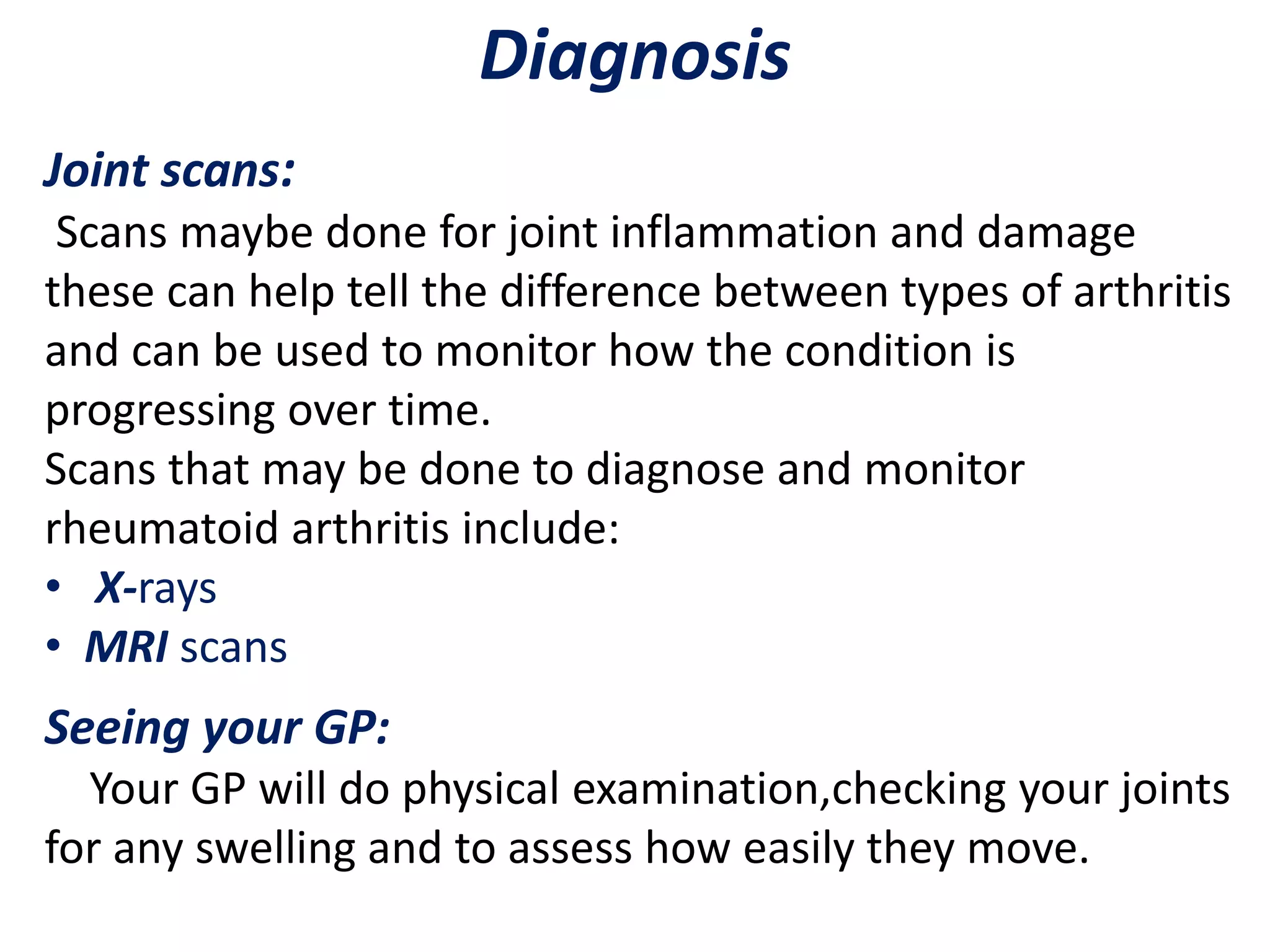
Joint scans:
Scans maybe done for joint inflammation and damage
these can help tell the difference between types of arthritis
and can be used to monitor how the condition is
progressing over time.
Scans that may be done to diagnose and monitor
rheumatoid arthritis include:
• X-rays
• MRI scans
Seeing your GP:
Your GP will do physical examination,checking your joints
for any swelling and to assess how easily they move.
MEDICATION
steroid
biologic
agents
DMARDs
NSAIDs
SURGERY
Joint
fusion
Synovectomy
Tendon
repair
Total joint
replacement
THERAPY
TREATMENT
SURGERY
THERAPY
MEDICATION
Medication
NSAIDs.nonsteroidal anti-inflammatory drugs (NSAIDs)can
relieve pain and reduce inflammation.
Steroids.corticosteroid medications.
Disease-modifying anti rheumatoid drugs(DMARDs).this
drugs can slow the progression rheumatoid arthritis and
save the joints and other tissues from permanent
damage.
Biologic agents.also known as biologic response
modifiers.
Therapy
Your doctor may send you to physical or occupational
therapist who can teach you exercises to help keep
your joints flexible. The therapist may also suggest
new ways to do daily tasks ,which will be easier on
your joints,for example,you may want to pick up an
object using your forearms. assistive devices can make
it easier to avoid stressing your painful joints.for
instance,a kitchen knife equipped with a hand grip
helps protect your finger and wrist joints.certain tools
such as buttonhooks can make it easier to get dressed
.catalogs and medical supply stores are good places to
look for ideas .
Surgery
Synovectomy: surgery to remove the inflamed lining of
joint(synovium)can be performed on knees,elbow
s,wrists, fingers and hips.
Tendon repair: inflammation and joint damage may cause
tendons around your joint to loosen or to rupture. your
surgeon may be able to repair the tendons around your
joint.
Joint fusion: surgically fusing a joint maybe recommended
to stabilize or realign a joint and for pain relief when a
joint replacement isn’t an option.
Total joint replacement: during joint replacement
surgery,your surgeon removes the damaged parts of your
joint and inserts a prosthesis made of metal and plastic.
references
• https://www.mayoclinic.org /disease-
conditions/rheumatoid-arthritis/diagnosis-
treatment/drc-20353653.
• https://www.nhs.uk/conditions/rheumatoid-
arthritis/.
• https://www.arthritis.org/about-
arthritis/types/rheumatoid-arthritis/what -is-
rheumatoid-arthrtis.php
• https://wwwnationaljewish.org/health-
insidhts/health-infographics/working-the-
rheum-tips-for-living-bettre-with-ra.
• https://www.very wellhealth.com/how-is-
rheumatoid-arthritis/diagnased-190339.

Rheumatoid Arthritis

  • 1.
    Hawler Medical University Collegeof Health Science Medical Microbiology Prepared by: Isra Khalil Salih 2019-2020 Supervised by: Lanja Jalal Mahmood
  • 2.
    Outlines • Rheumatoid arthritisdefinition • Causes of RA • Symptoms • Stages of RA • Risk factors • Reducing risks • Diagnosis • Treatment • Living with rheumatoid arthritis • References
  • 3.
    Rheumatoid Arthritis • RheumatoidArthritis[RA] is an autoimmune disease in which the body’s immune system-which normally protects its health by attacking foreign substances like bacteria and viruses mistakenly attacks the joints.This creates inflammation that causes the tissue that lines the inside of joints[the synovium]to thicken, resulting in swelling and pain in and around the joints.The synovium makes a fluid that lubricates joints and helps them move smoothly.
  • 4.
    Causes of RheumatoidArthritis Immune system normally makes antibodies that attack bacteria and viruses,helping to fight infection . If you have Rheumatoid Arthritis ,your immune system mistakenly sends anti bodies to the lining of your joints ,where they attack the tissue surrounding the joint.this causes the thin layer of cells[synovium] covering your joints to become sore and inflamed, releasing chemicals that damage nearby: • Bones • Cartilage-the stretchy connective tissue between bones • Tendons-the tissue that connects bone to muscle • Ligaments-the tissue that connects bone and cartilage
  • 5.
    Symptoms affecting thejoints Rheumatoid arthritis mainly affects the joints . it can cause problem in any joint in the body , although the small joints in the hands and feet are often the first to be affected. Pain: The joint pain associated with rheumatoid arthritis is usually a throbbing and aching pain .it is often worse in the morning and after a period of inactivity. Stiffness: Joints affected by rheumatoid arthritis can feel stiff . for example if your hands are affected , you may not be able to fully bend your fingers or form a fist . like joint pain the stiffness is often worse in the morning or after a period of inactivity.
  • 6.
    Swelling , warmthand redness:The lining of joints affected by rheumatoid arthritis become inflamed , which can cause the joints to swell , and become hot and tender to touch. Additional symptoms Additional symptoms As well as problems affecting the joints,some people with rheumatoid arthritis have more general symptoms,such as; •Tiredness and a lack of energy •A high temperature •Sweating •A poor appetite •Weight loss
  • 9.
    Risk factors Factor thatmay increase your risk of rheumatoid arthritis include: • Your gender.women are more likely than men to develop rheumatoid arthritis. • Age.rheumatoid arthritis can occur at any age,but it most commonly begins in middel age. • Family history.if a member of your family has rheumatoid arthritis,you may have an increased risk of the disease. • Smoking.cigarette smoking increase your risk of developing rheumatoid arthritis.
  • 10.
    Risk factors • Obesity.people-especiallywomen age 55and younger-who are overweight or obese appear to be at a somewhat higher risk of developing rheumatoid arthritis. • Environmental exposure.some exposure such as asbestos or silica may increase risk of developing rheumatoid arthritis.
  • 13.
    Diagnosis Rheumatoid factor andanti-CCP antibodies: Rheumatoid factors are proteins that immune system produce when it attacks health tissue A related blood test known as anti-cyclic citrullinated peptide (anti CCP)test is also available.anti CCPs are antibodies also produced by the immune system. Assessing physical ability : This is asking about how well you can do things like dress, walk and eat and how good your grip strength is. Rheumatoid arthritis can be difficult to diagnose in its early stages because the early signs and symptoms mimic those f many other diseases .
  • 14.
    Diagnosis Blood tests: No bloodtests can definitively prove or rule out a diagnosis of rheumatoid arthritis but a number of blood tests can show indication of the condition. Some of blood tests used include: • Erythrocyte sedimentation rate(ESR)-which can help assess levels of inflammation in the body. • C-reactive protein(CRP)-another test that can help measure inflammation levels. • Full blood count-this test can be used to help rule out other possible causes of your symptoms as well as provide an indicator your general health.
  • 15.
    Diagnosis Joint scans: Scans maybedone for joint inflammation and damage these can help tell the difference between types of arthritis and can be used to monitor how the condition is progressing over time. Scans that may be done to diagnose and monitor rheumatoid arthritis include: • X-rays • MRI scans Seeing your GP: Your GP will do physical examination,checking your joints for any swelling and to assess how easily they move.
  • 16.
  • 17.
    Medication NSAIDs.nonsteroidal anti-inflammatory drugs(NSAIDs)can relieve pain and reduce inflammation. Steroids.corticosteroid medications. Disease-modifying anti rheumatoid drugs(DMARDs).this drugs can slow the progression rheumatoid arthritis and save the joints and other tissues from permanent damage. Biologic agents.also known as biologic response modifiers.
  • 18.
    Therapy Your doctor maysend you to physical or occupational therapist who can teach you exercises to help keep your joints flexible. The therapist may also suggest new ways to do daily tasks ,which will be easier on your joints,for example,you may want to pick up an object using your forearms. assistive devices can make it easier to avoid stressing your painful joints.for instance,a kitchen knife equipped with a hand grip helps protect your finger and wrist joints.certain tools such as buttonhooks can make it easier to get dressed .catalogs and medical supply stores are good places to look for ideas .
  • 19.
    Surgery Synovectomy: surgery toremove the inflamed lining of joint(synovium)can be performed on knees,elbow s,wrists, fingers and hips. Tendon repair: inflammation and joint damage may cause tendons around your joint to loosen or to rupture. your surgeon may be able to repair the tendons around your joint. Joint fusion: surgically fusing a joint maybe recommended to stabilize or realign a joint and for pain relief when a joint replacement isn’t an option. Total joint replacement: during joint replacement surgery,your surgeon removes the damaged parts of your joint and inserts a prosthesis made of metal and plastic.
  • 21.
    references • https://www.mayoclinic.org /disease- conditions/rheumatoid-arthritis/diagnosis- treatment/drc-20353653. •https://www.nhs.uk/conditions/rheumatoid- arthritis/. • https://www.arthritis.org/about- arthritis/types/rheumatoid-arthritis/what -is- rheumatoid-arthrtis.php • https://wwwnationaljewish.org/health- insidhts/health-infographics/working-the- rheum-tips-for-living-bettre-with-ra. • https://www.very wellhealth.com/how-is- rheumatoid-arthritis/diagnased-190339.