Part 1  seminar camp science= chemistry
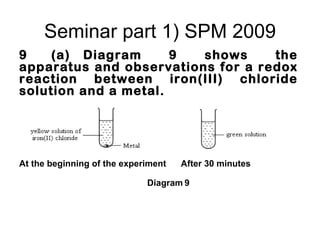
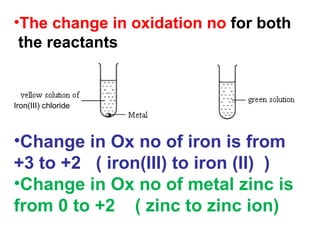
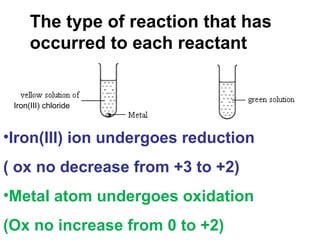
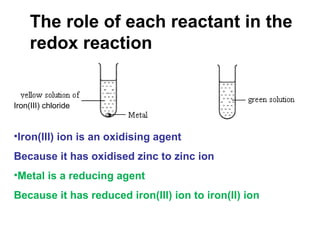
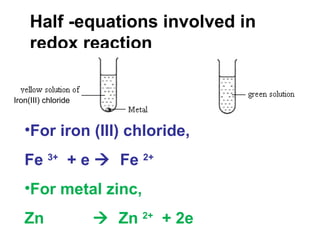
Seminar part 1) SPM 2009 9 (a) Diagram 9 shows the apparatus and observations for a redox reaction between iron(III) chloride solution and a metal.   At the beginning of the experiment  After 30 minutes   Diagram   9
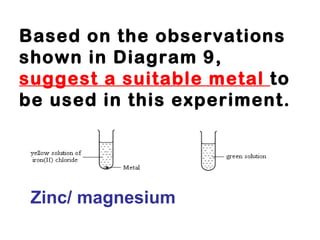
Based on the observations shown in Diagram 9,  suggest a suitable metal  to be used in this experiment.  Zinc/ magnesium
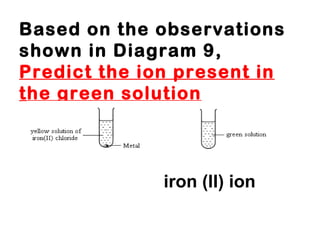
Based on the observations shown in Diagram 9,  Predict the ion present in the green solution iron (II) ion
The change in oxidation no  for both  the reactants Change in Ox no of iron is from  +3 to +2  ( iron(III) to iron (II)  ) Change in Ox no of metal zinc is from 0 to +2  ( zinc to zinc ion) Iron(III) chloride
The type of reaction that has occurred to each reactant  Iron(III) ion undergoes reduction  ( ox no decrease from +3 to +2) Metal atom undergoes oxidation (Ox no increase from 0 to +2) Iron(III) chloride
The role of each reactant in the redox reaction  Iron(III) ion is an oxidising agent Because it has oxidised zinc to zinc ion Metal is a reducing agent Because it has reduced iron(III) ion to iron(II) ion Iron(III) chloride
Half -equations involved in redox reaction  For iron (III) chloride, Fe  3+   + e     Fe  2+ For metal zinc, Zn     Zn  2+   + 2e Iron(III) chloride
    (b)   i odide ions are good reducing agent. You are given the following apparatus: U-tube, galvanometer, connecting wires, stopper, dropper, carbon electrodes and retort stand with clamps. Suggest  a suitable chemical  and  describe an experiment  to verify the above statement using the given apparatus.
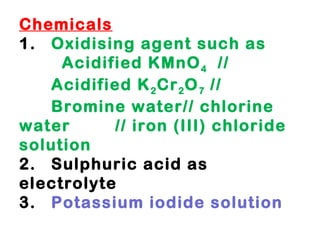
Chemicals 1. Oxidising agent such as    Acidified KMnO 4   //  Acidified K 2 Cr 2 O 7  // Bromine water// chlorine water  // iron (III) chloride solution  2. Sulphuric acid as electrolyte 3. Potassium iodide solution
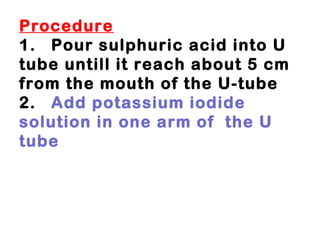
Procedure 1. Pour sulphuric acid into U tube untill it reach about 5 cm from the mouth of the U-tube 2. Add potassium iodide  solution in one arm of  the U tube
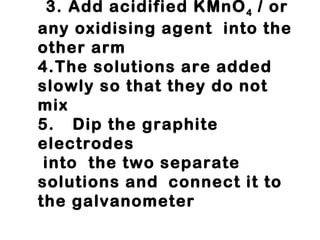
3. Add acidified KMnO 4  / or any oxidising agent  into the other arm 4.The solutions are added slowly so that they do not mix 5. Dip the graphite electrodes  into  the two separate solutions and  connect it to the galvanometer
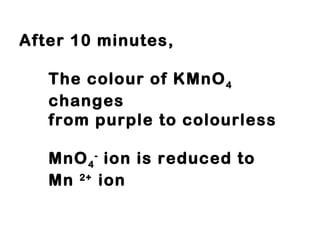
After 10 minutes,  The colour of KMnO 4  changes from purple to colourless MnO 4 -  ion is reduced to  Mn  2+  ion
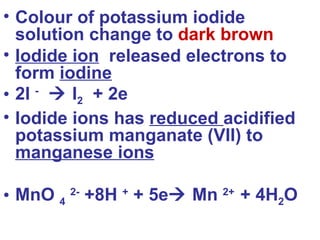
Colour of potassium iodide solution change to  dark brown Iodide ion   released electrons to form  iodine 2I  -     I 2   + 2e Iodide ions has  reduced  acidified potassium manganate (VII) to  manganese ions MnO  4   2-  +8H  +  + 5e   Mn  2+   + 4H 2 O
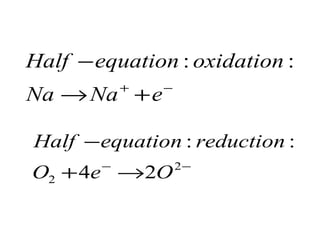
Part 1)SPM 2008 9 (a)   A metal M reacts with oxygen to form an oxide. The oxide is very soluble in water to produce an alkaline solution. Suggest the identity of metal M and describe an observation when the metal you have named reacts with oxygen, write the half-equations for oxidation and reduction for the reaction. [4 marks]
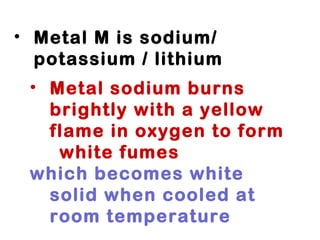
Metal M is sodium/ potassium / lithium Metal sodium burns brightly with a yellow flame in oxygen to form  white fumes  which becomes white solid when cooled at room temperature
 
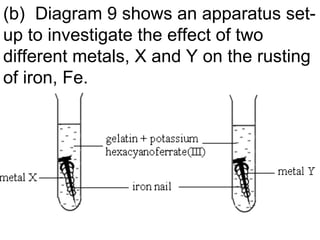
(b)   Diagram 9 shows an apparatus set-up to investigate the effect of two different metals, X and Y on the rusting of iron, Fe.
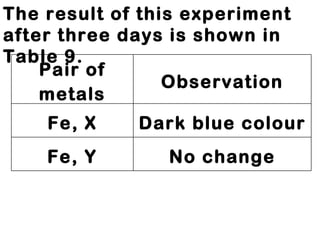
The result of this experiment after three days is shown in Table 9.  Pair of metals Observation Fe, X Dark blue colour Fe, Y No change
Based on Table 9, suggest the identity of metals, X and Y. Give two reasons for each of your choices [6 marks] Dark blue colour shows presence of iron(II) ions. Means iron nail has rusted Metal X is copper/ any metals below iron in ECS Because copper is less  electropositive than  iron  So, copper will encourage iron to rust
Based on Table 9, suggest the identity of metals, X and Y. Give two reasons for each of your choices [6 marks] No change means iron nail has not rusted Metal Y is zinc/Magnesium  Because zinc/magnesium  is more electropositive than  iron  So, zinc/magnesium will protect iron from rusting
 
Seminar Part 1) SPM 2008 9(C) Iron(II) ions can be converted to iron(III) ions and iron(III) ions can be converted back to iron(II) ions. By using a named metal as a reducing agent and a named halogen as an oxidising agent, describe briefly how you would carry out these two conversions. Describe a test to show that each conversion has taken place.   [10 marks]
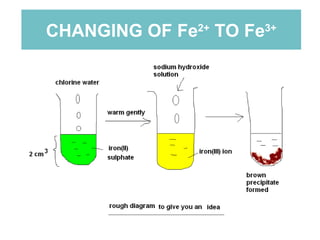
CHANGING OF Fe 2+  TO Fe 3+
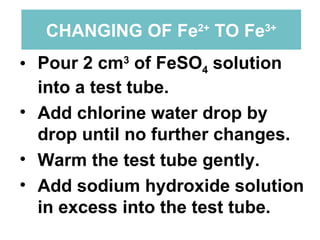
CHANGING OF Fe 2+  TO Fe 3+ Pour 2 cm 3  of FeSO 4  solution into a test tube. Add chlorine water drop by drop until no further changes. Warm the test tube gently. Add sodium hydroxide solution in excess into the test tube.
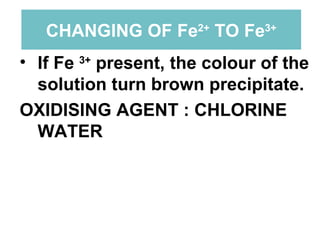
CHANGING OF Fe 2+  TO Fe 3+ If Fe  3+  present, the colour of the solution turn brown precipitate. OXIDISING AGENT : CHLORINE WATER
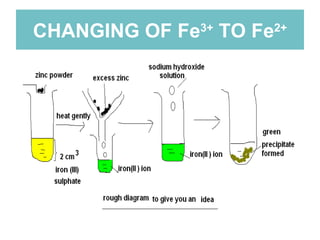
CHANGING OF Fe 3+  TO Fe 2+
CHANGING OF Fe 3+  TO Fe 2+ Pour 2 cm 3  of FeCl 3  solution into a test tube. Add half spatula of Zinc powder into the solution until no further changes. Warm the mixture.
CHANGING OF Fe 3+  TO Fe 2+ Filter the mixture using filter funnel and filter paper  to remove the excess zinc. The filtrate is then added with excess NaOH solution. If Fe  2+  present, green precipitate is observed.  REDUCING AGENT : Zn metal
End of part 1

Revision on redox ==july=2011=part 1

  • 1.
    Part 1 seminar camp science= chemistry
  • 2.
    Seminar part 1)SPM 2009 9 (a) Diagram 9 shows the apparatus and observations for a redox reaction between iron(III) chloride solution and a metal.   At the beginning of the experiment After 30 minutes Diagram 9
  • 3.
    Based on theobservations shown in Diagram 9, suggest a suitable metal to be used in this experiment. Zinc/ magnesium
  • 4.
    Based on theobservations shown in Diagram 9, Predict the ion present in the green solution iron (II) ion
  • 5.
    The change inoxidation no for both the reactants Change in Ox no of iron is from +3 to +2 ( iron(III) to iron (II) ) Change in Ox no of metal zinc is from 0 to +2 ( zinc to zinc ion) Iron(III) chloride
  • 6.
    The type ofreaction that has occurred to each reactant Iron(III) ion undergoes reduction ( ox no decrease from +3 to +2) Metal atom undergoes oxidation (Ox no increase from 0 to +2) Iron(III) chloride
  • 7.
    The role ofeach reactant in the redox reaction Iron(III) ion is an oxidising agent Because it has oxidised zinc to zinc ion Metal is a reducing agent Because it has reduced iron(III) ion to iron(II) ion Iron(III) chloride
  • 8.
    Half -equations involvedin redox reaction For iron (III) chloride, Fe 3+ + e  Fe 2+ For metal zinc, Zn  Zn 2+ + 2e Iron(III) chloride
  • 9.
      (b) i odide ions are good reducing agent. You are given the following apparatus: U-tube, galvanometer, connecting wires, stopper, dropper, carbon electrodes and retort stand with clamps. Suggest a suitable chemical and describe an experiment to verify the above statement using the given apparatus.
  • 10.
    Chemicals 1. Oxidisingagent such as Acidified KMnO 4 // Acidified K 2 Cr 2 O 7 // Bromine water// chlorine water // iron (III) chloride solution 2. Sulphuric acid as electrolyte 3. Potassium iodide solution
  • 11.
    Procedure 1. Poursulphuric acid into U tube untill it reach about 5 cm from the mouth of the U-tube 2. Add potassium iodide solution in one arm of the U tube
  • 12.
    3. Add acidifiedKMnO 4 / or any oxidising agent into the other arm 4.The solutions are added slowly so that they do not mix 5. Dip the graphite electrodes into the two separate solutions and connect it to the galvanometer
  • 13.
    After 10 minutes, The colour of KMnO 4 changes from purple to colourless MnO 4 - ion is reduced to Mn 2+ ion
  • 14.
    Colour of potassiumiodide solution change to dark brown Iodide ion released electrons to form iodine 2I -  I 2 + 2e Iodide ions has reduced acidified potassium manganate (VII) to manganese ions MnO 4 2- +8H + + 5e  Mn 2+ + 4H 2 O
  • 15.
    Part 1)SPM 20089 (a) A metal M reacts with oxygen to form an oxide. The oxide is very soluble in water to produce an alkaline solution. Suggest the identity of metal M and describe an observation when the metal you have named reacts with oxygen, write the half-equations for oxidation and reduction for the reaction. [4 marks]
  • 16.
    Metal M issodium/ potassium / lithium Metal sodium burns brightly with a yellow flame in oxygen to form white fumes which becomes white solid when cooled at room temperature
  • 17.
  • 18.
    (b) Diagram 9 shows an apparatus set-up to investigate the effect of two different metals, X and Y on the rusting of iron, Fe.
  • 19.
    The result ofthis experiment after three days is shown in Table 9. Pair of metals Observation Fe, X Dark blue colour Fe, Y No change
  • 20.
    Based on Table9, suggest the identity of metals, X and Y. Give two reasons for each of your choices [6 marks] Dark blue colour shows presence of iron(II) ions. Means iron nail has rusted Metal X is copper/ any metals below iron in ECS Because copper is less electropositive than iron So, copper will encourage iron to rust
  • 21.
    Based on Table9, suggest the identity of metals, X and Y. Give two reasons for each of your choices [6 marks] No change means iron nail has not rusted Metal Y is zinc/Magnesium Because zinc/magnesium is more electropositive than iron So, zinc/magnesium will protect iron from rusting
  • 22.
  • 23.
    Seminar Part 1)SPM 2008 9(C) Iron(II) ions can be converted to iron(III) ions and iron(III) ions can be converted back to iron(II) ions. By using a named metal as a reducing agent and a named halogen as an oxidising agent, describe briefly how you would carry out these two conversions. Describe a test to show that each conversion has taken place. [10 marks]
  • 24.
    CHANGING OF Fe2+ TO Fe 3+
  • 25.
    CHANGING OF Fe2+ TO Fe 3+ Pour 2 cm 3 of FeSO 4 solution into a test tube. Add chlorine water drop by drop until no further changes. Warm the test tube gently. Add sodium hydroxide solution in excess into the test tube.
  • 26.
    CHANGING OF Fe2+ TO Fe 3+ If Fe 3+ present, the colour of the solution turn brown precipitate. OXIDISING AGENT : CHLORINE WATER
  • 27.
    CHANGING OF Fe3+ TO Fe 2+
  • 28.
    CHANGING OF Fe3+ TO Fe 2+ Pour 2 cm 3 of FeCl 3 solution into a test tube. Add half spatula of Zinc powder into the solution until no further changes. Warm the mixture.
  • 29.
    CHANGING OF Fe3+ TO Fe 2+ Filter the mixture using filter funnel and filter paper to remove the excess zinc. The filtrate is then added with excess NaOH solution. If Fe 2+ present, green precipitate is observed. REDUCING AGENT : Zn metal
  • 30.