Program Design Process
developed by the Office of the Provost
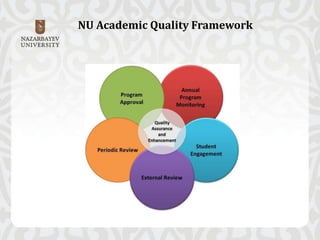
NU Academic Quality Framework
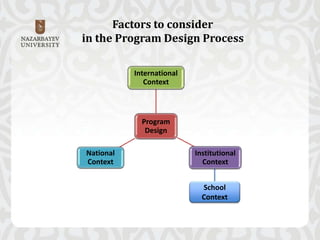
Factors to consider
in the Program Design Process
Program
Design
International
Context
Institutional
Context
National
Context
School
Context
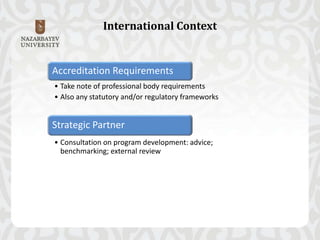
International Context
Accreditation Requirements
• Take note of professional body requirements
• Also any statutory and/or regulatory frameworks
Strategic Partner
• Consultation on program development: advice;
benchmarking; external review
International context
Bologna
Process*
Bologna Cycle*
FHEQ*
ECTS*
Dublin
descriptors*
Cycle 1. Bachelor
Cycle 2. Masters
Cycle 3. Doctoral
Level 6: Bachelor
Level 7: Masters
Level 8: Doctoral
1 ECTS credit = 25-30 hours of student
workload;
1 academic year = 60 ECTS;
Bachelor Degree = 180-240 ECTS;
Masters Degree = 90-120 ECTS
(note absolute min. 60 – but not at NU);
Doctoral = ECTS not defined
Broadly define expectations for each
cycle (outcomes-based)
Learning outcomes- based
*hyperlink
Industry and
employers
National
frameworks and
requirements
Students’
academic and
cultural
background
Consider market needs and potential
employability in design of the
learning outcomes (e.g. state priority
qualifications list, etc.)
Consider as and where appropriate
(e.g. National General Education
Standards)
Consider cultural context and
students’ academic background in
terms of knowledge, skills, attributes
and prior learning styles.
National Context
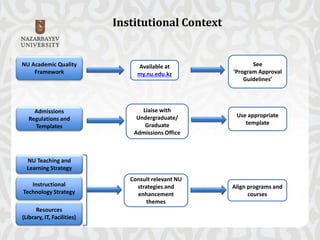
NU Academic Quality
Framework
NU Teaching and
Learning Strategy
Instructional
Technology Strategy
Admissions
Regulations and
Templates
Available at
my.nu.edu.kz
See
‘Program Approval
Guidelines’
Liaise with
Undergraduate/
Graduate
Admissions Office
Use appropriate
template
Consult relevant NU
strategies and
enhancement
themes
Align programs and
courses
Resources
(Library, IT, Facilities)
Institutional Context
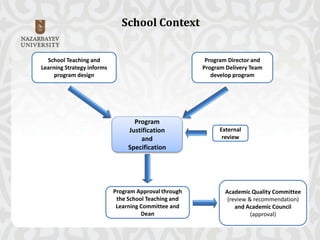
School Teaching and
Learning Strategy informs
program design
Program Director and
Program Delivery Team
develop program
Program
Justification
and
Specification
External
review
Program Approval through
the School Teaching and
Learning Committee and
Dean
Academic Quality Committee
(review & recommendation)
and Academic Council
(approval)
School Context
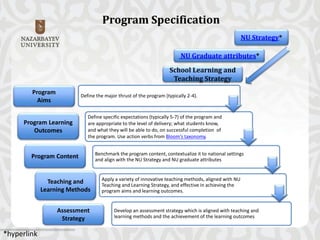
Program Specification
Define the major thrust of the program (typically 2-4).
Define specific expectations (typically 5-7) of the program and
are appropriate to the level of delivery; what students know,
and what they will be able to do, on successful completion of
the program. Use action verbs from Bloom’s taxonomy.
Benchmark the program content, contextualize it to national settings
and align with the NU Strategy and NU graduate attributes
Apply a variety of innovative teaching methods, aligned with NU
Teaching and Learning Strategy, and effective in achieving the
program aims and learning outcomes.
Develop an assessment strategy which is aligned with teaching and
learning methods and the achievement of the learning outcomes
Program
Aims
Program Content
Teaching and
Learning Methods
Assessment
Strategy
Program Learning
Outcomes
NU Strategy*
NU Graduate attributes*
School Learning and
Teaching Strategy
*hyperlink
• Programs and courses should contribute to the delivery of the NU graduate
attributes.
• Programs and courses should be benchmarked in terms of delivery level and
content.
• Program and course learning outcomes should be appropriate to the delivery
level, and be aligned with the graduate attributes.
• Teaching, learning and assessment methods should be aligned with course and
program learning outcomes.
• Appropriate and effective use should be made of instructional technologies
• Where possible and appropriate, research and teaching should be integrated.
• Assessment should contain both summative and formative components, and
should be criterion-referenced, valid, reliable, fair and transparent.
Summary
Program Design - Useful Links
Consult and employ appropriate level
descriptors
http://exchange.ac.uk/learning-and-teaching-theory-guide/levels-module-
descriptions.html
http://ecahe.eu/w/index.php/European_Qualifications_Framework#Level_5
http://www.ehea.info/Uploads/QF/Bologna_Framework_and_Certification_re
vised_29_02_08.pdf
Develop module aims http://www.seec.org.uk/wp-content/uploads/2013/seec-
files/SEEC%20Level%20Descriptors%202010.pdf
Write learning outcomes https://www.heacademy.ac.uk/sites/default/files/writing_learning_outcomes.
pdf
Develop ALIGNED assessment criteria and
methods
http://www.reading.ac.uk/engageinassessment/assessment-design/eia-
constructive-alignment-in-assessment-design.aspx
Develop an ALIGNED teaching and learning
strategy to enable students to reach
learning outcomes and assessment criteria
https://www.heacademy.ac.uk/sites/default/files/resources/id477_aligning_te
aching_for_constructing_learning.pdf
Claus Brabrand (2006): ‘Teaching Teaching & Understanding Understanding’ -
19-minute award-winning short-film on Constructive Alignment
http://www.daimi.au.dk/~brabrand/short-film
Implementation Support
Academic Quality Enhancement Team:
AQE website: http://my.nu.edu.kz/

Programme Design @ NU

  • 1.
    Program Design Process developedby the Office of the Provost
  • 2.
  • 3.
    Factors to consider inthe Program Design Process Program Design International Context Institutional Context National Context School Context
  • 4.
    International Context Accreditation Requirements •Take note of professional body requirements • Also any statutory and/or regulatory frameworks Strategic Partner • Consultation on program development: advice; benchmarking; external review
  • 5.
    International context Bologna Process* Bologna Cycle* FHEQ* ECTS* Dublin descriptors* Cycle1. Bachelor Cycle 2. Masters Cycle 3. Doctoral Level 6: Bachelor Level 7: Masters Level 8: Doctoral 1 ECTS credit = 25-30 hours of student workload; 1 academic year = 60 ECTS; Bachelor Degree = 180-240 ECTS; Masters Degree = 90-120 ECTS (note absolute min. 60 – but not at NU); Doctoral = ECTS not defined Broadly define expectations for each cycle (outcomes-based) Learning outcomes- based *hyperlink
  • 6.
    Industry and employers National frameworks and requirements Students’ academicand cultural background Consider market needs and potential employability in design of the learning outcomes (e.g. state priority qualifications list, etc.) Consider as and where appropriate (e.g. National General Education Standards) Consider cultural context and students’ academic background in terms of knowledge, skills, attributes and prior learning styles. National Context
  • 7.
    NU Academic Quality Framework NUTeaching and Learning Strategy Instructional Technology Strategy Admissions Regulations and Templates Available at my.nu.edu.kz See ‘Program Approval Guidelines’ Liaise with Undergraduate/ Graduate Admissions Office Use appropriate template Consult relevant NU strategies and enhancement themes Align programs and courses Resources (Library, IT, Facilities) Institutional Context
  • 8.
    School Teaching and LearningStrategy informs program design Program Director and Program Delivery Team develop program Program Justification and Specification External review Program Approval through the School Teaching and Learning Committee and Dean Academic Quality Committee (review & recommendation) and Academic Council (approval) School Context
  • 9.
    Program Specification Define themajor thrust of the program (typically 2-4). Define specific expectations (typically 5-7) of the program and are appropriate to the level of delivery; what students know, and what they will be able to do, on successful completion of the program. Use action verbs from Bloom’s taxonomy. Benchmark the program content, contextualize it to national settings and align with the NU Strategy and NU graduate attributes Apply a variety of innovative teaching methods, aligned with NU Teaching and Learning Strategy, and effective in achieving the program aims and learning outcomes. Develop an assessment strategy which is aligned with teaching and learning methods and the achievement of the learning outcomes Program Aims Program Content Teaching and Learning Methods Assessment Strategy Program Learning Outcomes NU Strategy* NU Graduate attributes* School Learning and Teaching Strategy *hyperlink
  • 10.
    • Programs andcourses should contribute to the delivery of the NU graduate attributes. • Programs and courses should be benchmarked in terms of delivery level and content. • Program and course learning outcomes should be appropriate to the delivery level, and be aligned with the graduate attributes. • Teaching, learning and assessment methods should be aligned with course and program learning outcomes. • Appropriate and effective use should be made of instructional technologies • Where possible and appropriate, research and teaching should be integrated. • Assessment should contain both summative and formative components, and should be criterion-referenced, valid, reliable, fair and transparent. Summary
  • 11.
    Program Design -Useful Links Consult and employ appropriate level descriptors http://exchange.ac.uk/learning-and-teaching-theory-guide/levels-module- descriptions.html http://ecahe.eu/w/index.php/European_Qualifications_Framework#Level_5 http://www.ehea.info/Uploads/QF/Bologna_Framework_and_Certification_re vised_29_02_08.pdf Develop module aims http://www.seec.org.uk/wp-content/uploads/2013/seec- files/SEEC%20Level%20Descriptors%202010.pdf Write learning outcomes https://www.heacademy.ac.uk/sites/default/files/writing_learning_outcomes. pdf Develop ALIGNED assessment criteria and methods http://www.reading.ac.uk/engageinassessment/assessment-design/eia- constructive-alignment-in-assessment-design.aspx Develop an ALIGNED teaching and learning strategy to enable students to reach learning outcomes and assessment criteria https://www.heacademy.ac.uk/sites/default/files/resources/id477_aligning_te aching_for_constructing_learning.pdf Claus Brabrand (2006): ‘Teaching Teaching & Understanding Understanding’ - 19-minute award-winning short-film on Constructive Alignment http://www.daimi.au.dk/~brabrand/short-film
  • 12.
    Implementation Support Academic QualityEnhancement Team: AQE website: http://my.nu.edu.kz/