International Research Journal of Engineering and Technology (IRJET) e-ISSN: 2395 -0056
Volume: 04 Issue: 01 | Jan -2017 www.irjet.net p-ISSN: 2395-0072
© 2017, IRJET | Impact Factor value: 5.181 | ISO 9001:2008 Certified Journal | Page 1266
REVIEW ON THE PARAMETRIC OPTIMIZATON OF TIG WELDING.
Kumar Rahul Anand1,Dr.Vijay Mittal2
1P.G, Scholar, Gateway Institute of Engineering and Technology,Sonipat.
2Principal, Gateway Institute of engineering and Technology,Sonipat.
---------------------------------------------------------------------***---------------------------------------------------------------------
Abstract - Welding is the process to join two or more
similar or dissimilar metal with the application of heat and
sometime pressure. Gas Tungsten Arc Welding (GTAW) is
commonly known as Tungsten Inert Gas Welding (TIG
Welding).The objective of this research is to study and
understand the various equipment used and the effect of
welding parameters such as welding current, gas flow rate,
welding speed, electrode etc. are inputs which affect the
output parameters such as tensile strength, hardness of weld.
Key Words: TIG welding, Welding Parameters, Tensile
Strength, Hardness.
1.INTRODUCTION
Development of TIG welding occur duringtheSECOND
WORLD WAR around1940.TodayTIGweldingisoneof
the mostly used welding process in the various
industries like aircraft, automobile industry, steam
industry, nuclearreactors,foodindustry,shipindustry,
building and bridge structure etc. The term TIG
welding is short of TungstenInertgaswelding.Inother
welding processes metal gets oxidized in molten state
but in TIG welding due to use of Inert gas which
provide shield between molten metalandatmospheric
air oxidation of metal is protected.
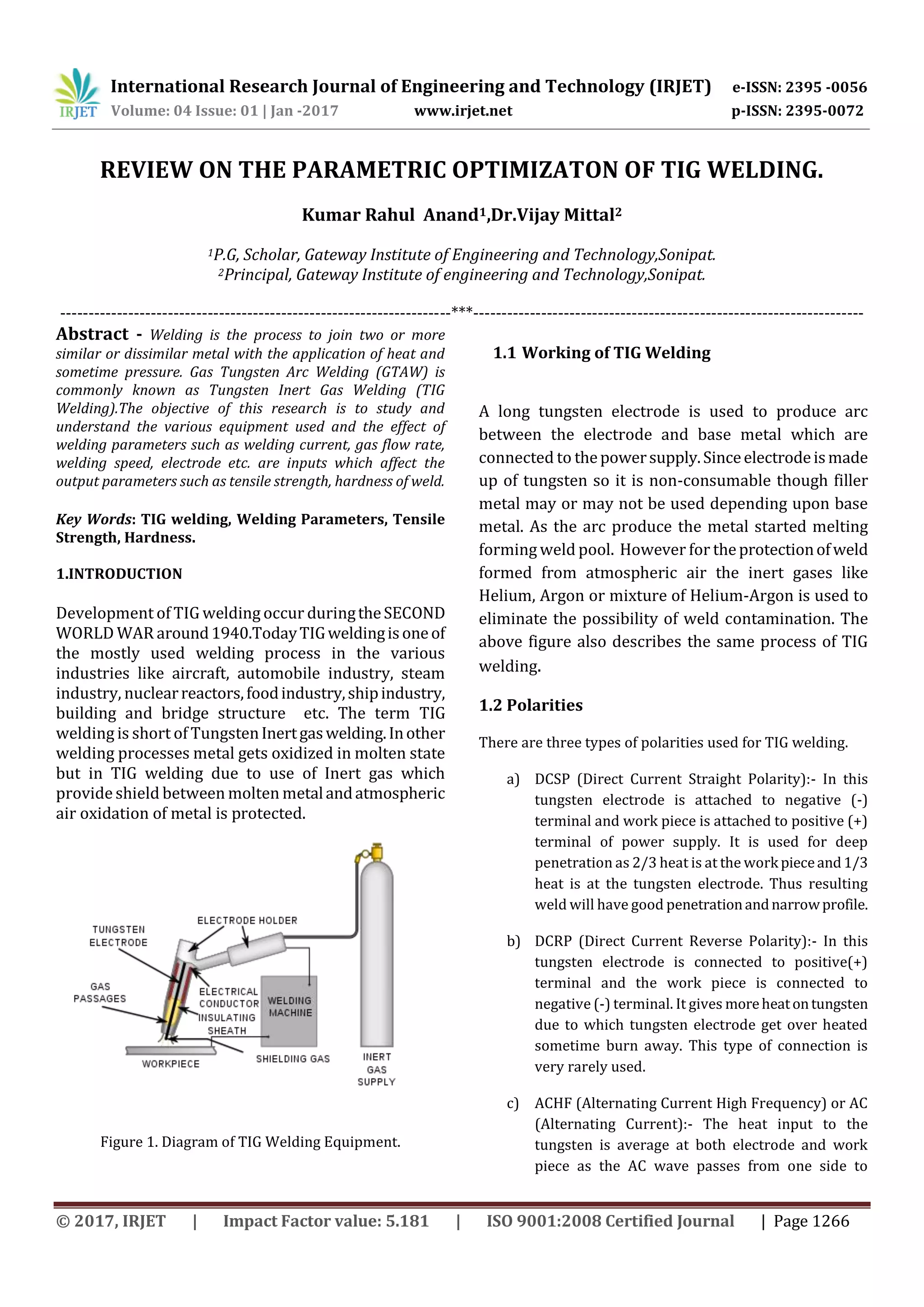
Figure 1. Diagram of TIG Welding Equipment.
1.1 Working of TIG Welding
A long tungsten electrode is used to produce arc
between the electrode and base metal which are
connected to thepowersupply.Sinceelectrodeismade
up of tungsten so it is non-consumable though filler
metal may or may not be used depending upon base
metal. As the arc produce the metal started melting
forming weld pool. However for theprotectionofweld
formed from atmospheric air the inert gases like
Helium, Argon or mixture of Helium-Argon is used to
eliminate the possibility of weld contamination. The
above figure also describes the same process of TIG
welding.
1.2 Polarities
There are three types of polarities used for TIG welding.
a) DCSP (Direct Current Straight Polarity):- In this
tungsten electrode is attached to negative (-)
terminal and work piece is attached to positive (+)
terminal of power supply. It is used for deep
penetration as 2/3 heat is at the work pieceand1/3
heat is at the tungsten electrode. Thus resulting
weld will have good penetrationandnarrowprofile.
b) DCRP (Direct Current Reverse Polarity):- In this
tungsten electrode is connected to positive(+)
terminal and the work piece is connected to
negative (-) terminal. It gives moreheatontungsten
due to which tungsten electrode get over heated
sometime burn away. This type of connection is
very rarely used.
c) ACHF (Alternating Current High Frequency) or AC
(Alternating Current):- The heat input to the
tungsten is average at both electrode and work
piece as the AC wave passes from one side to
International Research Journal of Engineering and Technology (IRJET) e-ISSN: 2395 -0056
Volume: 04 Issue: 01 | Jan -2017 www.irjet.net p-ISSN: 2395-0072
© 2017, IRJET | Impact Factor value: 5.181 | ISO 9001:2008 Certified Journal | Page 1267
another. It is used for welding mostly for white
metals such as aluminum and magnesium.
1.3 Electrode used in TIG welding
There are five types of electrode which are used in TIG
welding and identified with their colour.
1).Pure Tungsten (W) (Geen Colour).
2).1% Thoriated Tungsten (Yellow Colour).
3).2% Thoriated Tungsten (Red Colour).
4).Striped Tungsten (Blue Colour).
5).Zirconium Tungsten (Brown Colour).
1.4. Shielding Gases Used for TIG Welding
1) Argon.
2) Helium.
3) Mixture of Argon and Helium.
1.5. Advantages
1).It produces no noises or very less noises.
2).The quality of weld produced by the TIG welding is
far superior than other welding process.
3).Low sparks produces as very less filler metal is
added.
4).No flux is required or added.
5).Smoke or fumes is not produced.
6).Welding can be done I all positions.
7).Especially good for welding thin sections.
2.LITERATURE REVIEW
Sanjeev Gupta.2016[1] performed the experiment to
optimize the condition for performing the welding on
Utra-90 specimen in which he varies the current and
voltage while keeping the gas flow rate constant and
observed that welding joint not made properly below
50A and above 200A since then burning of specimen
stated. Ravinder & S.K.Jarial [2016] studied the Parametric
Optimization of TIG welding on stainless steel (202) and
mild steel by using Taguchi method and found the control
factor which had varying effect on the tensile strength, arc
voltage having the highest effectandalsofoundtheoptimum
parameter for tensile strength current 80 A,Arc voltage30V
and GFR 6 lt/min.
Dr.Simhachalam et al.[2015] carried on the effect of welding
process parameters on the mechanical properties of
stainless steel -316 (18Cr-8N) welded by TIG welding. The
specimen size is 40x15x5mm for experimentation observed
that the welding current has a significant effect though filler
rod do have some effect similar to current but compared to
current it is less significant. MINITAB software is used for
the prediction of the hardness, impact strength , depth of
penetrations.
R.Ramchandran [2015] studied the various effect of the TIG
welding on the Austenitic stainless steel 316L on micro
structural changes through destructive and nondestructive
method and various parameters such as tensile strength,
hardness on varying the current, voltage and gas flow ratio
respectively.
S.M.Ravi Kumar and DR.P.Vijian [2014] studied the weld
bead geometry in shielded metal arc welding and that is of
multiple performancecharacteristics intotheoptimizationof
the single performance characteristics called grey relational
garden and found the processparametersofweldingcurrent
140 A, welding speed 4 mm/sec and wind velocity 7m/s
.Also found by ANOVA heat the most significant welding
process parameter (47.71%) followed by welding speed
(30.40%) and wind velocity (19.54%) respectively.
S.R.Patil and C.A.Waghmare [2013] carried out the welding
parameter like current, voltage, speed on ultimate tensile
strength (UTS) of AISI1030 mild steel material during
welding. Taguchi method is used, an orthogonal array,signal
to noise ratio and analysis of variance (ANOVA) are
employed to study.
3. CONCLUSIONS
This paper gives the idea of the working of the TIG welding
and from above literature reviews it is clear that various
work have been done on TIG welding to studyandoptimized
the welding output suchastensilestrength,hardnessofweld
etc. on varying the input parameter such as welding current,
voltage, gas flow, welding speed etc. TIG welding has been
carried out on various material similar as well as dissimilar
materials.
REFERENCES
[1] Sanjeev Gupta (2016). Optimization Condition for
Performing GMAW Welding on Ultra 904L
Specimens.International Journal of Scientific and
Technical Advancements ISSN: 2454-1532.
[2] Ravinder,S.K.Jarial (2015). Parametric Optimization of
TIG Welding on Stainless Steel (202) & Mild Steel by
using Taguchi Method. InternationalJournalofEnhanced
Reserch in Science Technology & Engineering,ISSN:2319-
7463,vol.4,pp: (484-494).
[3] D.Simhachalam, N.Indraja, M.Raja Roy (2015).
Experimental Evaluation of Mechanical Properties of
Stainless Steel by TIG Welding at Weld Zone. Internation
Journal of Engineering Trends and Technology (IJETT)-
vol-26,Number3.
[4] R.Ramachandran (2015). Analysis And Experimental
Investigations of Weld Characteristics For A TIG
Welding With SS316L.International Journal ofAdvances
in Engineering Research (IJAER),VOL.NO.10,Issue
no.II,e-ISSN: 2231-5152/p-ISSN: 2454-1796.
[5] S.M.Ravikumar,Dr.P.Vijian (2014),Optimization of weld
bead geometry in Shielded Metal Arc Welding using
Taguchi Based Grey Relational Analysis. International
International Research Journal of Engineering and Technology (IRJET) e-ISSN: 2395 -0056
Volume: 04 Issue: 01 | Jan -2017 www.irjet.net p-ISSN: 2395-0072
© 2017, IRJET | Impact Factor value: 5.181 | ISO 9001:2008 Certified Journal | Page 1268
Journal of Mechanical & Mechatronics Engineering(
IJMME-IJENS)vol-14,no.04.
[6] S.R.Patil,C.A.Waghmare (2013).Optimization of MIG
Welding Parameters For Improving Strength Of Welded
Joints. International Journal of Advanced Engineering
Research and Studies, E-ISSN 2249-8974.
[7] Rupinderpreet Singh, Geetesh Goga and Lakhwinder
Singh.(2012). An Experimental Study of Effect Of
Welding Parameters On T-Weld Joint in TIG Welding OF
SS316L and Development Of Its Microstructure And
Mechanical Properties. International Journal Of
Innovative Technology and Creative Engineering, vol.2,
No.7, ISSN:204-8711.
[8] L.Suresh Kumar,Dr.S.M. Verma, P.Radhakrishna Prasad,
P.Kiran Kumar and Dr.T.Siva Shanker (2011).
Experimental Investigation for Welding Aspects of AISI
304 and 316 by Taguchi Technique for the Process of
TIG and MIG Welding. International Journal of
Engineering Trends and Technology, vol-2,Issue-2.
[9] J.Nayak, K.R.Udupa, K.R.Hebbar and
H.V.S.Nayak.(2004).EstimationofEmbrittlementDuring
aging of AISI316 Stainless Steel TIG Welds. Indian
Academy Of Science,Bull,Matter,Sci,vol-27,No.6,pp.511-
515.

Review on the parametric optimizaton of Tig welding

  • 1.
    International Research Journalof Engineering and Technology (IRJET) e-ISSN: 2395 -0056 Volume: 04 Issue: 01 | Jan -2017 www.irjet.net p-ISSN: 2395-0072 © 2017, IRJET | Impact Factor value: 5.181 | ISO 9001:2008 Certified Journal | Page 1266 REVIEW ON THE PARAMETRIC OPTIMIZATON OF TIG WELDING. Kumar Rahul Anand1,Dr.Vijay Mittal2 1P.G, Scholar, Gateway Institute of Engineering and Technology,Sonipat. 2Principal, Gateway Institute of engineering and Technology,Sonipat. ---------------------------------------------------------------------***--------------------------------------------------------------------- Abstract - Welding is the process to join two or more similar or dissimilar metal with the application of heat and sometime pressure. Gas Tungsten Arc Welding (GTAW) is commonly known as Tungsten Inert Gas Welding (TIG Welding).The objective of this research is to study and understand the various equipment used and the effect of welding parameters such as welding current, gas flow rate, welding speed, electrode etc. are inputs which affect the output parameters such as tensile strength, hardness of weld. Key Words: TIG welding, Welding Parameters, Tensile Strength, Hardness. 1.INTRODUCTION Development of TIG welding occur duringtheSECOND WORLD WAR around1940.TodayTIGweldingisoneof the mostly used welding process in the various industries like aircraft, automobile industry, steam industry, nuclearreactors,foodindustry,shipindustry, building and bridge structure etc. The term TIG welding is short of TungstenInertgaswelding.Inother welding processes metal gets oxidized in molten state but in TIG welding due to use of Inert gas which provide shield between molten metalandatmospheric air oxidation of metal is protected. Figure 1. Diagram of TIG Welding Equipment. 1.1 Working of TIG Welding A long tungsten electrode is used to produce arc between the electrode and base metal which are connected to thepowersupply.Sinceelectrodeismade up of tungsten so it is non-consumable though filler metal may or may not be used depending upon base metal. As the arc produce the metal started melting forming weld pool. However for theprotectionofweld formed from atmospheric air the inert gases like Helium, Argon or mixture of Helium-Argon is used to eliminate the possibility of weld contamination. The above figure also describes the same process of TIG welding. 1.2 Polarities There are three types of polarities used for TIG welding. a) DCSP (Direct Current Straight Polarity):- In this tungsten electrode is attached to negative (-) terminal and work piece is attached to positive (+) terminal of power supply. It is used for deep penetration as 2/3 heat is at the work pieceand1/3 heat is at the tungsten electrode. Thus resulting weld will have good penetrationandnarrowprofile. b) DCRP (Direct Current Reverse Polarity):- In this tungsten electrode is connected to positive(+) terminal and the work piece is connected to negative (-) terminal. It gives moreheatontungsten due to which tungsten electrode get over heated sometime burn away. This type of connection is very rarely used. c) ACHF (Alternating Current High Frequency) or AC (Alternating Current):- The heat input to the tungsten is average at both electrode and work piece as the AC wave passes from one side to
  • 2.
    International Research Journalof Engineering and Technology (IRJET) e-ISSN: 2395 -0056 Volume: 04 Issue: 01 | Jan -2017 www.irjet.net p-ISSN: 2395-0072 © 2017, IRJET | Impact Factor value: 5.181 | ISO 9001:2008 Certified Journal | Page 1267 another. It is used for welding mostly for white metals such as aluminum and magnesium. 1.3 Electrode used in TIG welding There are five types of electrode which are used in TIG welding and identified with their colour. 1).Pure Tungsten (W) (Geen Colour). 2).1% Thoriated Tungsten (Yellow Colour). 3).2% Thoriated Tungsten (Red Colour). 4).Striped Tungsten (Blue Colour). 5).Zirconium Tungsten (Brown Colour). 1.4. Shielding Gases Used for TIG Welding 1) Argon. 2) Helium. 3) Mixture of Argon and Helium. 1.5. Advantages 1).It produces no noises or very less noises. 2).The quality of weld produced by the TIG welding is far superior than other welding process. 3).Low sparks produces as very less filler metal is added. 4).No flux is required or added. 5).Smoke or fumes is not produced. 6).Welding can be done I all positions. 7).Especially good for welding thin sections. 2.LITERATURE REVIEW Sanjeev Gupta.2016[1] performed the experiment to optimize the condition for performing the welding on Utra-90 specimen in which he varies the current and voltage while keeping the gas flow rate constant and observed that welding joint not made properly below 50A and above 200A since then burning of specimen stated. Ravinder & S.K.Jarial [2016] studied the Parametric Optimization of TIG welding on stainless steel (202) and mild steel by using Taguchi method and found the control factor which had varying effect on the tensile strength, arc voltage having the highest effectandalsofoundtheoptimum parameter for tensile strength current 80 A,Arc voltage30V and GFR 6 lt/min. Dr.Simhachalam et al.[2015] carried on the effect of welding process parameters on the mechanical properties of stainless steel -316 (18Cr-8N) welded by TIG welding. The specimen size is 40x15x5mm for experimentation observed that the welding current has a significant effect though filler rod do have some effect similar to current but compared to current it is less significant. MINITAB software is used for the prediction of the hardness, impact strength , depth of penetrations. R.Ramchandran [2015] studied the various effect of the TIG welding on the Austenitic stainless steel 316L on micro structural changes through destructive and nondestructive method and various parameters such as tensile strength, hardness on varying the current, voltage and gas flow ratio respectively. S.M.Ravi Kumar and DR.P.Vijian [2014] studied the weld bead geometry in shielded metal arc welding and that is of multiple performancecharacteristics intotheoptimizationof the single performance characteristics called grey relational garden and found the processparametersofweldingcurrent 140 A, welding speed 4 mm/sec and wind velocity 7m/s .Also found by ANOVA heat the most significant welding process parameter (47.71%) followed by welding speed (30.40%) and wind velocity (19.54%) respectively. S.R.Patil and C.A.Waghmare [2013] carried out the welding parameter like current, voltage, speed on ultimate tensile strength (UTS) of AISI1030 mild steel material during welding. Taguchi method is used, an orthogonal array,signal to noise ratio and analysis of variance (ANOVA) are employed to study. 3. CONCLUSIONS This paper gives the idea of the working of the TIG welding and from above literature reviews it is clear that various work have been done on TIG welding to studyandoptimized the welding output suchastensilestrength,hardnessofweld etc. on varying the input parameter such as welding current, voltage, gas flow, welding speed etc. TIG welding has been carried out on various material similar as well as dissimilar materials. REFERENCES [1] Sanjeev Gupta (2016). Optimization Condition for Performing GMAW Welding on Ultra 904L Specimens.International Journal of Scientific and Technical Advancements ISSN: 2454-1532. [2] Ravinder,S.K.Jarial (2015). Parametric Optimization of TIG Welding on Stainless Steel (202) & Mild Steel by using Taguchi Method. InternationalJournalofEnhanced Reserch in Science Technology & Engineering,ISSN:2319- 7463,vol.4,pp: (484-494). [3] D.Simhachalam, N.Indraja, M.Raja Roy (2015). Experimental Evaluation of Mechanical Properties of Stainless Steel by TIG Welding at Weld Zone. Internation Journal of Engineering Trends and Technology (IJETT)- vol-26,Number3. [4] R.Ramachandran (2015). Analysis And Experimental Investigations of Weld Characteristics For A TIG Welding With SS316L.International Journal ofAdvances in Engineering Research (IJAER),VOL.NO.10,Issue no.II,e-ISSN: 2231-5152/p-ISSN: 2454-1796. [5] S.M.Ravikumar,Dr.P.Vijian (2014),Optimization of weld bead geometry in Shielded Metal Arc Welding using Taguchi Based Grey Relational Analysis. International
  • 3.
    International Research Journalof Engineering and Technology (IRJET) e-ISSN: 2395 -0056 Volume: 04 Issue: 01 | Jan -2017 www.irjet.net p-ISSN: 2395-0072 © 2017, IRJET | Impact Factor value: 5.181 | ISO 9001:2008 Certified Journal | Page 1268 Journal of Mechanical & Mechatronics Engineering( IJMME-IJENS)vol-14,no.04. [6] S.R.Patil,C.A.Waghmare (2013).Optimization of MIG Welding Parameters For Improving Strength Of Welded Joints. International Journal of Advanced Engineering Research and Studies, E-ISSN 2249-8974. [7] Rupinderpreet Singh, Geetesh Goga and Lakhwinder Singh.(2012). An Experimental Study of Effect Of Welding Parameters On T-Weld Joint in TIG Welding OF SS316L and Development Of Its Microstructure And Mechanical Properties. International Journal Of Innovative Technology and Creative Engineering, vol.2, No.7, ISSN:204-8711. [8] L.Suresh Kumar,Dr.S.M. Verma, P.Radhakrishna Prasad, P.Kiran Kumar and Dr.T.Siva Shanker (2011). Experimental Investigation for Welding Aspects of AISI 304 and 316 by Taguchi Technique for the Process of TIG and MIG Welding. International Journal of Engineering Trends and Technology, vol-2,Issue-2. [9] J.Nayak, K.R.Udupa, K.R.Hebbar and H.V.S.Nayak.(2004).EstimationofEmbrittlementDuring aging of AISI316 Stainless Steel TIG Welds. Indian Academy Of Science,Bull,Matter,Sci,vol-27,No.6,pp.511- 515.