Team: GTD Training - Internal
Vision for using GTD To build a work climate that fosters productivity, creativity and  passion  while yielding high ROI for our clients.
My Personal Goal To build a  fun workplace  by removing the stress and tension created by the constant challenge of managing: Input Tasks Projects Communication with each other
What is GTD GTD – the “Getting Things Done” organizational methodology.  Benefits: “ Mind Like Water”  High Impact “Doing” Mastering Workflow Effective Project Planning Increased Motivation
Review (optional slide) Fundamentals Collecting and Processing Organizing Reviewing Doing
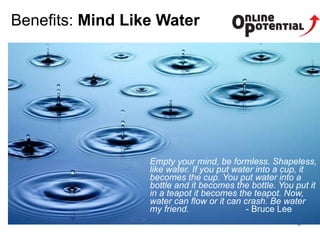
Benefits :  Mind Like Water Empty your mind, be formless. Shapeless, like water. If you put water into a cup, it becomes the cup. You put water into a bottle and it becomes the bottle. You put it in a teapot it becomes the teapot. Now, water can flow or it can crash. Be water my friend.   - Bruce Lee
Benefits : Stress Relief! Your mind is free of worry.  All the issues that were cluttering your mind are in a safe place. Your mind can give 100% of focus to the task at hand. Your mind is free to generate new, creative ideas. A stress free, clear mind, that is nimble and ready to give full attention to the right things.
Benefits : High Impact “Doing” Power = Concentration Concentration = Elimination of Distractions The ability to focus will have more impact on our ability to accomplish tasks than anything else.
Benefits :  Mastering Workflow Collect  – everything!  Get it out of your brain. Process   – quickly evaluate each item – actionable, delegate (waiting for), defer or if multiple actions are required create a project. Organize  – Projects, Events, Next Actions and Waiting For Review   – daily, weekly and base on goals/values Do   – context, time, energy and priorities
Benefits :  Effective Projects Defining Purpose and Principles  – why?  What does success look like?  Outcome Visioning   – we need to have a clear picture of what “wildly successful” looks like Brainstorming  – idea generation    out of our heads and onto paper.  Jay will LOVE this. Organizing  – sequencing the ideas.  Monte will LOVE this.  Identifying Next Actions  – to move forward
Benefits :  Increased Motivation Reduced Stress Levels Knowing that tasks are “high impact” Clear picture of outcomes Frequently reviewing and seeing progress No more “spinning out of control” or “where to begin”
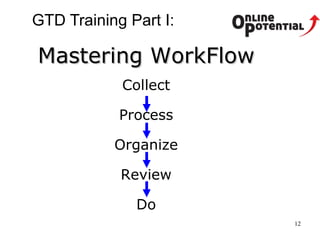
GTD Training Part I:  Mastering WorkFlow Collect Process Organize Review Do
GTD Training Part I:  Mastering WorkFlow Step 1 Collection - Fundamentals KP - gather ALL  incompletes  in your world.  KP - all things are all ready being collected Problem :  many are being collected in your psyche items in your desk drawer paperwork on your desktop all “open loops” Examples of inboxes” Email/Voice mail Physical inbox on your desk Pad and paper Smart phone
GTD Training Part I:  Mastering WorkFlow Step 1 Collection – Keys to Success Get it all of your head!  Keep inboxes close by As few as possible Empty Regularly!!
GTD Training Part I:  Mastering WorkFlow Step 2 Processing - Fundamentals Huge Source of Relief! (Work Flow Diagram) What Is It?  What does it mean and what needs to be done Is it  Actionable ? No Trash Reference Filing System (needs to be strong) Incubate YES  – need to determine two things: What project or outcome have you committed to? Capture on project list What is the NEXT action? (the critical question) Do it (will it take longer than 2 minutes?) Delegate it (am I the right person?) Defer it (> 2 minutes, track on actions list)
GTD Training Part I:  Mastering WorkFlow Step 2 Processing - Getting into Empty 3 Big Rules to follow process top item first process one item at a time NEVER put things back into IN What Do you do with reminders?  Someday/Maybe List Calendar or Tickler File Reference Material  – file it  immediately .  Note : He makes the point that a mission critical aspect of this system is an easy to access filing system within arm’s reach.
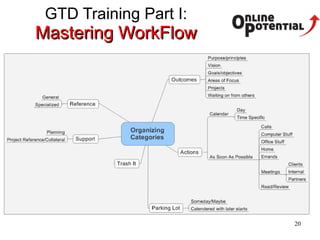
GTD Training Part I:  Mastering WorkFlow Step 3 Organizing - Fundamentals lets your mind let go of lower level thinking.  physical organization must be better than mental. Note:  this process will  evolve,  you won’t create it all at once.  Your categories need  hard edges . represent discreet agreements we make with ourselves.
GTD Training Part I:  Mastering WorkFlow Step 3 Organizing - Categories BASIC Categories 1. Projects List 2. Support Material 3. Calendared Actions 4. Next Actions 5. Reference Materials 6. Someday maybe list 7. Waiting for list
GTD Training Part I:  Mastering WorkFlow Step 3 Organizing – Action Reminders Defintion  – longer than two minutes and can’t be delegated Organize by context Computer list Errands list Kids List 2. Organize by Energy Online Phone Research/Reading
GTD Training Part I:  Mastering WorkFlow
GTD Training Part I:  Mastering WorkFlow Step 3 Organizing – Monte’s Dilemna Summary  –  Do next action tasks related to a project get put on my action list, or my projects list?  Or both?
GTD Training Part I:  Mastering WorkFlow GTD Workflow Chart 1
GTD Training Part I:  Mastering WorkFlow Step 4 Reviewing – Fundamentals Two Key Questions What to Review and When What to Do and How Often
GTD Training Part I:  Mastering WorkFlow Step 4 Reviewing – Daily Review Calendar Action Lists Note :  you might be able to get away with just these on many days.
GTD Training Part I:  Mastering WorkFlow Step 4 Reviewing – Weekly Review What to Review 1. Gather loose papers 2. Process your notes 3. Previous calendar data 4. Upcoming calendar data 5. Empty your head 6. Review project lists 7. Review next action lists 8. Review waiting for list 9. Review any checklists 10. Review someday maybe list 11. Review pending and support files 12. Be creative and courageous
GTD Training Part I:  Mastering WorkFlow Step 4 Reviewing – Best Practices Set Review Goals For Yourself: % Completed? Time Limited (under 3 hours?) Same Exact Time and Day? For Newbies – Consider Breaking It Up: Processing Reviewing
GTD Training Part I:  Mastering WorkFlow Step 4 Reviewing – Best Practices cont’d Understanding the importance of the weekly review Saves time in the long run Saves energy, you know what to DO Eliminates low level thinking Leads to big improvements in thinking Be Thorough! The Review ONLY works if you are  CURRENT
GTD Training Part I:  Mastering WorkFlow Step 4 Reviewing – High Level Because you soon will have the books I will not cover: Monthly Quarterly Annual These are all vital reviews … the big picture keeps you focused and helps you ascertain how tasks relate to the big picture
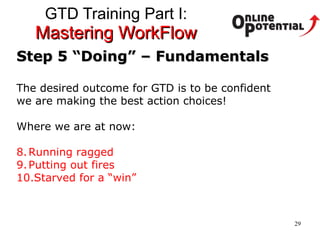
GTD Training Part I:  Mastering WorkFlow Step 5 “Doing” – Fundamentals The desired outcome for GTD is to be confident  we are making the best action choices!  Where we are at now: Running ragged Putting out fires Starved for a “win”
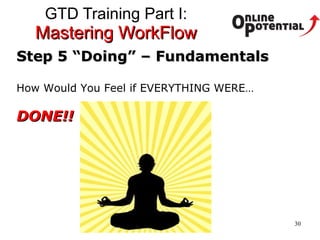
GTD Training Part I:  Mastering WorkFlow Step 5 “Doing” – Fundamentals How Would You Feel if EVERYTHING WERE… DONE!!
GTD Training Part I:  Mastering WorkFlow Step 5 “Doing” – What Next 3 Priority Frameworks for deciding  NEXT BEST  Actions #1 - 4 Criteria model for actions in the moment Context Energy Time Priority – relates to the 2 nd  model
GTD Training Part I:  Mastering WorkFlow Step 5 “Doing” – What Next 3 Priority Frameworks for deciding  NEXT BEST  Actions #1 - 4 Criteria model for actions in the moment Context Questions Do I have the tools?  Can I do this where I am at?
GTD Training Part I:  Mastering WorkFlow Step 5 “Doing” – What Next 3 Priority Frameworks for deciding  NEXT BEST  Actions #1 - 4 Criteria model for actions in the moment Time   – this is a critical criteria!  GTD blackbelts optimize time Must be able to adjust quickly
GTD Training Part I:  Mastering WorkFlow Step 5 “Doing” – What Next 3 Priority Frameworks for deciding  NEXT BEST  Actions #1 - 4 Criteria model for actions in the moment Energy   –  knowing what needs to be done allows you to best use your high and low energy cycles * Keep list of low energy activities
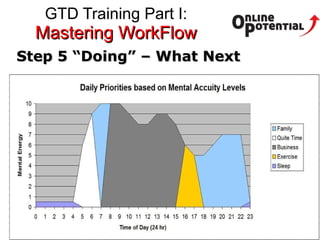
GTD Training Part I:  Mastering WorkFlow Step 5 “Doing” – What Next
GTD Training Part I:  Mastering WorkFlow Step 5 “Doing” – What Next 3 Priority Frameworks for deciding  NEXT BEST  Actions #1 - 4 Criteria model for actions in the moment Priority   – ties into the last model Goals Values
GTD Training Part I:  Mastering WorkFlow Step 5 “Doing” – What Next 3 Priority Frameworks for deciding  NEXT BEST  Actions #1 - 4 Criteria model for actions in the moment #2 – 3 Fold Model of Daily Work Pre – Defined Work Ad – Hoc Organizing Work
GTD Training Part I:  Mastering WorkFlow Step 5 “Doing” – What Next 3 Priority Frameworks for deciding  NEXT BEST  Actions #2 – 3 Fold Model of Daily Work Beware of  following into the trap of letting ad-hoc work dominate your day Do you do the immediate to avoid the important? Is a lack of organization hindering you and causing angst?
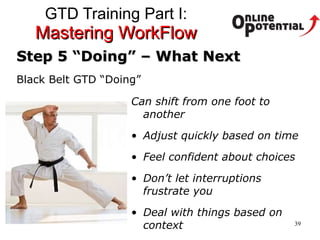
GTD Training Part I:  Mastering WorkFlow Step 5 “Doing” – What Next Black Belt GTD “Doing” Can shift from one foot to another Adjust quickly based on time Feel confident about choices Don’t let interruptions frustrate you Deal with things based on context
GTD Training Part I:  Mastering WorkFlow Step 5 “Doing” – What Next 3 Priority Frameworks for deciding  NEXT BEST  Actions #1 - 4 Criteria model for actions in the moment #2 – 3 Fold Model of Daily Work # 3 – 6 Level Model of Vertical Priorities
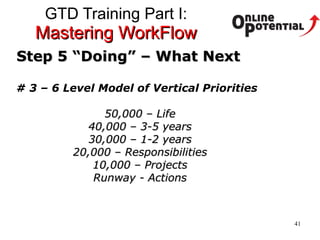
GTD Training Part I:  Mastering WorkFlow Step 5 “Doing” – What Next # 3 – 6 Level Model of Vertical Priorities 50,000 – Life 40,000 – 3-5 years 30,000 – 1-2 years 20,000 – Responsibilities 10,000 – Projects Runway - Actions

Getting Things Done - internal implementation plan

  • 1.
  • 2.
    Vision for usingGTD To build a work climate that fosters productivity, creativity and passion while yielding high ROI for our clients.
  • 3.
    My Personal GoalTo build a fun workplace by removing the stress and tension created by the constant challenge of managing: Input Tasks Projects Communication with each other
  • 4.
    What is GTDGTD – the “Getting Things Done” organizational methodology. Benefits: “ Mind Like Water” High Impact “Doing” Mastering Workflow Effective Project Planning Increased Motivation
  • 5.
    Review (optional slide)Fundamentals Collecting and Processing Organizing Reviewing Doing
  • 6.
    Benefits : Mind Like Water Empty your mind, be formless. Shapeless, like water. If you put water into a cup, it becomes the cup. You put water into a bottle and it becomes the bottle. You put it in a teapot it becomes the teapot. Now, water can flow or it can crash. Be water my friend. - Bruce Lee
  • 7.
    Benefits : StressRelief! Your mind is free of worry. All the issues that were cluttering your mind are in a safe place. Your mind can give 100% of focus to the task at hand. Your mind is free to generate new, creative ideas. A stress free, clear mind, that is nimble and ready to give full attention to the right things.
  • 8.
    Benefits : HighImpact “Doing” Power = Concentration Concentration = Elimination of Distractions The ability to focus will have more impact on our ability to accomplish tasks than anything else.
  • 9.
    Benefits : Mastering Workflow Collect – everything! Get it out of your brain. Process – quickly evaluate each item – actionable, delegate (waiting for), defer or if multiple actions are required create a project. Organize – Projects, Events, Next Actions and Waiting For Review – daily, weekly and base on goals/values Do – context, time, energy and priorities
  • 10.
    Benefits : Effective Projects Defining Purpose and Principles – why? What does success look like? Outcome Visioning – we need to have a clear picture of what “wildly successful” looks like Brainstorming – idea generation  out of our heads and onto paper. Jay will LOVE this. Organizing – sequencing the ideas. Monte will LOVE this. Identifying Next Actions – to move forward
  • 11.
    Benefits : Increased Motivation Reduced Stress Levels Knowing that tasks are “high impact” Clear picture of outcomes Frequently reviewing and seeing progress No more “spinning out of control” or “where to begin”
  • 12.
    GTD Training PartI: Mastering WorkFlow Collect Process Organize Review Do
  • 13.
    GTD Training PartI: Mastering WorkFlow Step 1 Collection - Fundamentals KP - gather ALL incompletes in your world. KP - all things are all ready being collected Problem : many are being collected in your psyche items in your desk drawer paperwork on your desktop all “open loops” Examples of inboxes” Email/Voice mail Physical inbox on your desk Pad and paper Smart phone
  • 14.
    GTD Training PartI: Mastering WorkFlow Step 1 Collection – Keys to Success Get it all of your head! Keep inboxes close by As few as possible Empty Regularly!!
  • 15.
    GTD Training PartI: Mastering WorkFlow Step 2 Processing - Fundamentals Huge Source of Relief! (Work Flow Diagram) What Is It? What does it mean and what needs to be done Is it Actionable ? No Trash Reference Filing System (needs to be strong) Incubate YES – need to determine two things: What project or outcome have you committed to? Capture on project list What is the NEXT action? (the critical question) Do it (will it take longer than 2 minutes?) Delegate it (am I the right person?) Defer it (> 2 minutes, track on actions list)
  • 16.
    GTD Training PartI: Mastering WorkFlow Step 2 Processing - Getting into Empty 3 Big Rules to follow process top item first process one item at a time NEVER put things back into IN What Do you do with reminders? Someday/Maybe List Calendar or Tickler File Reference Material – file it immediately . Note : He makes the point that a mission critical aspect of this system is an easy to access filing system within arm’s reach.
  • 17.
    GTD Training PartI: Mastering WorkFlow Step 3 Organizing - Fundamentals lets your mind let go of lower level thinking. physical organization must be better than mental. Note: this process will evolve, you won’t create it all at once. Your categories need hard edges . represent discreet agreements we make with ourselves.
  • 18.
    GTD Training PartI: Mastering WorkFlow Step 3 Organizing - Categories BASIC Categories 1. Projects List 2. Support Material 3. Calendared Actions 4. Next Actions 5. Reference Materials 6. Someday maybe list 7. Waiting for list
  • 19.
    GTD Training PartI: Mastering WorkFlow Step 3 Organizing – Action Reminders Defintion – longer than two minutes and can’t be delegated Organize by context Computer list Errands list Kids List 2. Organize by Energy Online Phone Research/Reading
  • 20.
    GTD Training PartI: Mastering WorkFlow
  • 21.
    GTD Training PartI: Mastering WorkFlow Step 3 Organizing – Monte’s Dilemna Summary – Do next action tasks related to a project get put on my action list, or my projects list? Or both?
  • 22.
    GTD Training PartI: Mastering WorkFlow GTD Workflow Chart 1
  • 23.
    GTD Training PartI: Mastering WorkFlow Step 4 Reviewing – Fundamentals Two Key Questions What to Review and When What to Do and How Often
  • 24.
    GTD Training PartI: Mastering WorkFlow Step 4 Reviewing – Daily Review Calendar Action Lists Note : you might be able to get away with just these on many days.
  • 25.
    GTD Training PartI: Mastering WorkFlow Step 4 Reviewing – Weekly Review What to Review 1. Gather loose papers 2. Process your notes 3. Previous calendar data 4. Upcoming calendar data 5. Empty your head 6. Review project lists 7. Review next action lists 8. Review waiting for list 9. Review any checklists 10. Review someday maybe list 11. Review pending and support files 12. Be creative and courageous
  • 26.
    GTD Training PartI: Mastering WorkFlow Step 4 Reviewing – Best Practices Set Review Goals For Yourself: % Completed? Time Limited (under 3 hours?) Same Exact Time and Day? For Newbies – Consider Breaking It Up: Processing Reviewing
  • 27.
    GTD Training PartI: Mastering WorkFlow Step 4 Reviewing – Best Practices cont’d Understanding the importance of the weekly review Saves time in the long run Saves energy, you know what to DO Eliminates low level thinking Leads to big improvements in thinking Be Thorough! The Review ONLY works if you are CURRENT
  • 28.
    GTD Training PartI: Mastering WorkFlow Step 4 Reviewing – High Level Because you soon will have the books I will not cover: Monthly Quarterly Annual These are all vital reviews … the big picture keeps you focused and helps you ascertain how tasks relate to the big picture
  • 29.
    GTD Training PartI: Mastering WorkFlow Step 5 “Doing” – Fundamentals The desired outcome for GTD is to be confident we are making the best action choices! Where we are at now: Running ragged Putting out fires Starved for a “win”
  • 30.
    GTD Training PartI: Mastering WorkFlow Step 5 “Doing” – Fundamentals How Would You Feel if EVERYTHING WERE… DONE!!
  • 31.
    GTD Training PartI: Mastering WorkFlow Step 5 “Doing” – What Next 3 Priority Frameworks for deciding NEXT BEST Actions #1 - 4 Criteria model for actions in the moment Context Energy Time Priority – relates to the 2 nd model
  • 32.
    GTD Training PartI: Mastering WorkFlow Step 5 “Doing” – What Next 3 Priority Frameworks for deciding NEXT BEST Actions #1 - 4 Criteria model for actions in the moment Context Questions Do I have the tools? Can I do this where I am at?
  • 33.
    GTD Training PartI: Mastering WorkFlow Step 5 “Doing” – What Next 3 Priority Frameworks for deciding NEXT BEST Actions #1 - 4 Criteria model for actions in the moment Time – this is a critical criteria! GTD blackbelts optimize time Must be able to adjust quickly
  • 34.
    GTD Training PartI: Mastering WorkFlow Step 5 “Doing” – What Next 3 Priority Frameworks for deciding NEXT BEST Actions #1 - 4 Criteria model for actions in the moment Energy – knowing what needs to be done allows you to best use your high and low energy cycles * Keep list of low energy activities
  • 35.
    GTD Training PartI: Mastering WorkFlow Step 5 “Doing” – What Next
  • 36.
    GTD Training PartI: Mastering WorkFlow Step 5 “Doing” – What Next 3 Priority Frameworks for deciding NEXT BEST Actions #1 - 4 Criteria model for actions in the moment Priority – ties into the last model Goals Values
  • 37.
    GTD Training PartI: Mastering WorkFlow Step 5 “Doing” – What Next 3 Priority Frameworks for deciding NEXT BEST Actions #1 - 4 Criteria model for actions in the moment #2 – 3 Fold Model of Daily Work Pre – Defined Work Ad – Hoc Organizing Work
  • 38.
    GTD Training PartI: Mastering WorkFlow Step 5 “Doing” – What Next 3 Priority Frameworks for deciding NEXT BEST Actions #2 – 3 Fold Model of Daily Work Beware of following into the trap of letting ad-hoc work dominate your day Do you do the immediate to avoid the important? Is a lack of organization hindering you and causing angst?
  • 39.
    GTD Training PartI: Mastering WorkFlow Step 5 “Doing” – What Next Black Belt GTD “Doing” Can shift from one foot to another Adjust quickly based on time Feel confident about choices Don’t let interruptions frustrate you Deal with things based on context
  • 40.
    GTD Training PartI: Mastering WorkFlow Step 5 “Doing” – What Next 3 Priority Frameworks for deciding NEXT BEST Actions #1 - 4 Criteria model for actions in the moment #2 – 3 Fold Model of Daily Work # 3 – 6 Level Model of Vertical Priorities
  • 41.
    GTD Training PartI: Mastering WorkFlow Step 5 “Doing” – What Next # 3 – 6 Level Model of Vertical Priorities 50,000 – Life 40,000 – 3-5 years 30,000 – 1-2 years 20,000 – Responsibilities 10,000 – Projects Runway - Actions

Editor's Notes

  • #6 We used this slide to quickly jump to new sections as the teachings were MWF for 3 weeks.
  • #13 The key is that that if any of these stages are weak, your system will LEAK. Collection is the most likely be the biggest leak. You must organize effectively and review regularly. If any of these are weak, you will not do the most important tasks at the right times.
  • #14 Collection is independent of organization. You have to gather everything that you have any commitment to changing! (magazines you want to read,
  • #15 You have to get to complete to have the motivation to continually use. Keep them close by… think of them as indespendable! (your best ideas will come to you outside of work) Keep it simple and few. Especially with the physical collection. In has to be able to function as “in”, not as a placeholder for tasks that you know you need to be reminded of.
  • #16 About projects Require mulitple actions! Projects are just multiple action items with a specific goal.
  • #18 All you really need is lists, and folders. Lists keep track of projects, someday maybes and actions. * most list makers haven't put the right things on lists. * lists give you an inventory of all active things. list = grouping of items with similar characteristics
  • #19 About projects Need to eliminate the tendency to slip back into ram, must have placeholders. Many small projects will exist. Need master list that includes ALL with next action steps.
  • #20 About projects Need to eliminate the tendency to slip back into ram, must have placeholders. Many small projects will exist. Need master list that includes ALL with next action steps.
  • #21 About projects Need to eliminate the tendency to slip back into ram, must have placeholders. Many small projects will exist. Need master list that includes ALL with next action steps.
  • #22 About projects Need to eliminate the tendency to slip back into ram, must have placeholders. Many small projects will exist. Need master list that includes ALL with next action steps.
  • #23 About projects Need to eliminate the tendency to slip back into ram, must have placeholders. Many small projects will exist. Need master list that includes ALL with next action steps.
  • #24 About projects Need to eliminate the tendency to slip back into ram, must have placeholders. Many small projects will exist. Need master list that includes ALL with next action steps.
  • #25 Calendar – look for your time and space parameters…they will dictate what you actually do in many instances. Ex: errands, time in between meetings etc Action Lists – the difficult part lies in balancing new tasks coming in vs. your action list. It is easier to focus on the new thing – the fire to put out.
  • #26 Calendar – look for your time and space parameters…they will dictate what you actually do in many instances. Ex: errands, time in between meetings etc Action Lists – the difficult part lies in balancing new tasks coming in vs. your action list. It is easier to focus on the new thing – the fire to put out.
  • #27 Calendar – look for your time and space parameters…they will dictate what you actually do in many instances. Ex: errands, time in between meetings etc Action Lists – the difficult part lies in balancing new tasks coming in vs. your action list. It is easier to focus on the new thing – the fire to put out.
  • #28 On the flip slide, there is a magical quality to the Weekly Review in that it actually saves time, energy, focus and attention on what you need to be thinking about, by giving you a systematic and trusted approach for reviewing your personal and professional commitments, so you can trust that you are making the best choices about what to DO
  • #32 These all relate to one another - Takes a “bottom up” approach Context – do I have the tools? Am I in the right place? Time – GTD blackbelts master this Energy -
  • #33 These all relate to one another - Takes a “bottom up” approach Context – do I have the tools? Am I in the right place? Time – GTD blackbelts master this Energy -
  • #34 Moving from foot to foot quickly.
  • #35 Low energy for me Reading Filing Back ups ** clean edges are important!! ** closing loops increases energy!
  • #38 These all relate to one another - Takes a “bottom up” approach Context – do I have the tools? Am I in the right place? Time – GTD blackbelts master this Energy -
  • #39 The sacrifices of NOT doing what is on your lists can only be tolerated if you kow what you AREN’T doing!!!
  • #41 These all relate to one another - Takes a “bottom up” approach Context – do I have the tools? Am I in the right place? Time – GTD blackbelts master this Energy -
  • #42 These all relate to one another - Takes a “bottom up” approach Context – do I have the tools? Am I in the right place? Time – GTD blackbelts master this Energy -