Rethinking our food systems: a
practical perspective
Dr. Martin Kropff
CIMMYT Director General
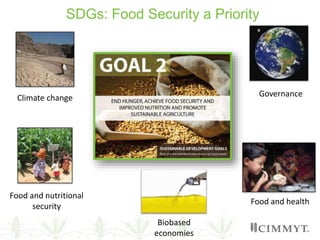
SDGs: Food Security a Priority
Food and nutritional
security
Climate change
Food and health
Governance
Biobased
economies
The Challenge
Can we sustainably increase food production by
2050
to meet the demand of changing dietary habits
and their growing populations
while also developing economically
and adapting to increasingly pressure from
climate change and depleting natural resources?
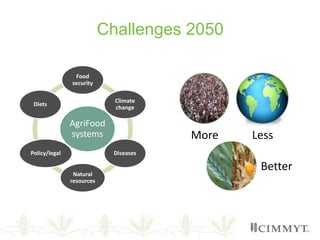
Challenges 2050
AgriFood
systems
Food
security
Climate
change
Diseases
Natural
resources
Policy/legal
Diets
More Less
Better
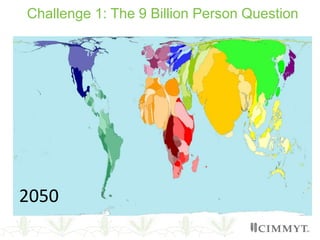
Challenge 1: The 9 Billion Person Question
19602050
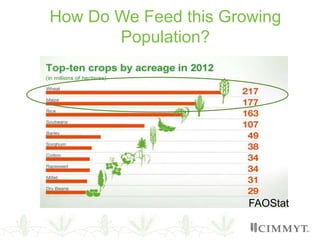
How Do We Feed this Growing
Population?
FAOStat
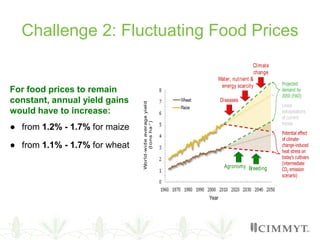
Challenge 2: Fluctuating Food Prices
For food prices to remain
constant, annual yield gains
would have to increase:
● from 1.2% - 1.7% for maize
● from 1.1% - 1.7% for wheat
Diseases
Climate
change
BreedingAgronomy
Projected
demand by
2050 (FAO)
World-wideaverageyield
(tonsha-1)
Linear
extrapolations
of current
trends
Water, nutrient &
energy scarcity
Potential effect
of climate-
change-induced
heat stress on
today’s cultivars
(intermediate
CO2 emission
scenario)
Year
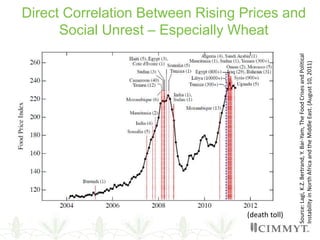
Direct Correlation Between Rising Prices and
Social Unrest – Especially Wheat
Source:Lagi,K.Z.Bertrand,Y.Bar-Yam,TheFoodCrisesandPolitical
InstabilityinNorthAfricaandtheMiddleEast.(August10,2011)
(death toll)
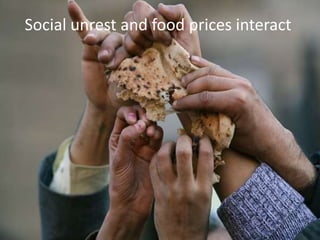
Social unrest and food prices interact
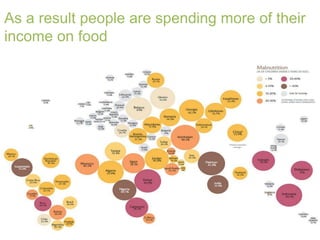
As a result people are spending more of their
income on food
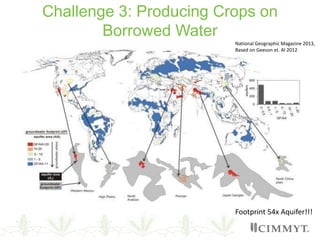
Challenge 3: Producing Crops on
Borrowed Water
National Geographic Magazine 2013,
Based on Geeson et. Al 2012
Footprint 54x Aquifer!!!
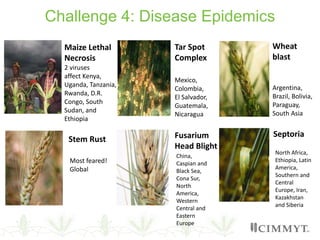
Challenge 4: Disease Epidemics
Maize Lethal
Necrosis
2 viruses
affect Kenya,
Uganda, Tanzania,
Rwanda, D.R.
Congo, South
Sudan, and
Ethiopia
Stem Rust
Tar Spot
Complex
Mexico,
Colombia,
El Salvador,
Guatemala,
Nicaragua
Fusarium
Head Blight
Wheat
blast
Argentina,
Brazil, Bolivia,
Paraguay,
South Asia
Septoria
Most feared!
Global
China,
Caspian and
Black Sea,
Cona Sur,
North
America,
Western
Central and
Eastern
Europe
North Africa,
Ethiopia, Latin
America,
Southern and
Central
Europe, Iran,
Kazakhstan
and Siberia
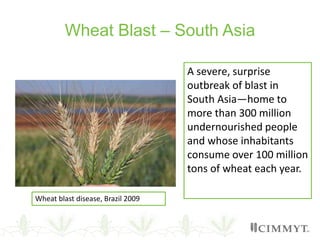
Wheat Blast – South Asia
A severe, surprise
outbreak of blast in
South Asia—home to
more than 300 million
undernourished people
and whose inhabitants
consume over 100 million
tons of wheat each year.
Wheat blast disease, Brazil 2009
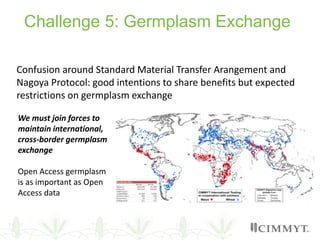
Challenge 5: Germplasm Exchange
Confusion around Standard Material Transfer Arangement and
Nagoya Protocol: good intentions to share benefits but expected
restrictions on germplasm exchange
We must join forces to
maintain international,
cross-border germplasm
exchange
Open Access germplasm
is as important as Open
Access data
Challenge 6: Climate Change
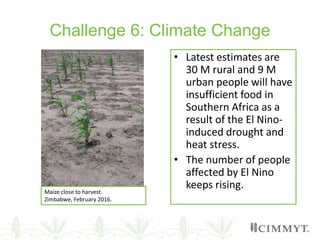
• Latest estimates are
30 M rural and 9 M
urban people will have
insufficient food in
Southern Africa as a
result of the El Nino-
induced drought and
heat stress.
• The number of people
affected by El Nino
keeps rising.Maize close to harvest.
Zimbabwe, February 2016.
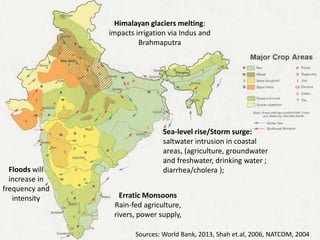
Himalayan glaciers melting:
impacts irrigation via Indus and
Brahmaputra
Sources: World Bank, 2013, Shah et.al, 2006, NATCOM, 2004
Sea-level rise/Storm surge:
saltwater intrusion in coastal
areas, (agriculture, groundwater
and freshwater, drinking water ;
diarrhea/cholera );Floods will
increase in
frequency and
intensity Erratic Monsoons
Rain-fed agriculture,
rivers, power supply,
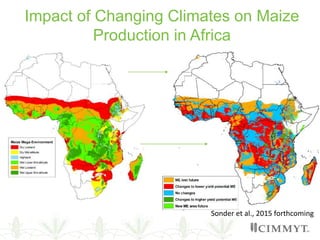
Impact of Changing Climates on Maize
Production in Africa
Sonder et al., 2015 forthcoming
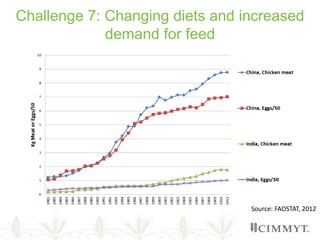
Source: FAOSTAT, 2012
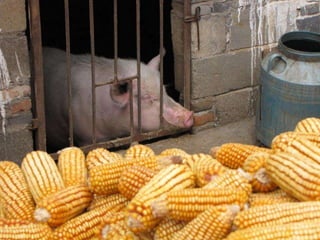
Challenge 7: Changing diets and increased
demand for feed
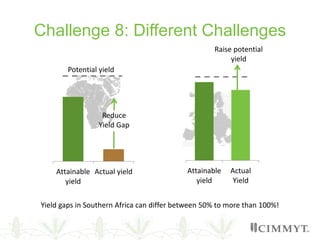
Challenge 8: Different Challenges
Attainable
yield
Actual yield
Reduce
Yield Gap
Potential yield
Attainable
yield
Actual
Yield
Raise potential
yield
Yield gaps in Southern Africa can differ between 50% to more than 100%!
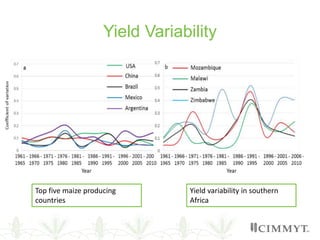
Yield Variability
Top five maize producing
countries
Yield variability in southern
Africa
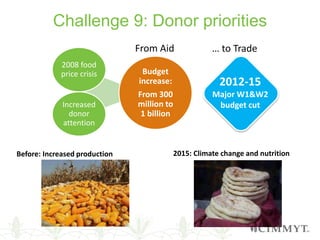
Challenge 9: Donor priorities
2008 food
price crisis
Increased
donor
attention
Budget
increase:
From 300
million to
1 billion
Before: Increased production 2015: Climate change and nutrition
2012-15
Major W1&W2
budget cut
From Aid … to Trade
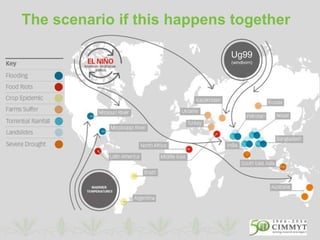
The scenario if this happens together
Ug99
(windborn)
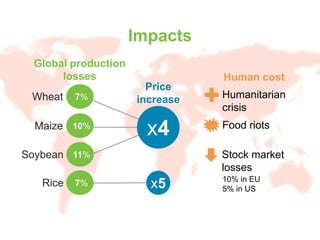
Price
increase
s
x4
x5
Stock market
losses
Food riots
Humanitarian
crisis
Human cost
10% in EU
5% in US
Wheat
Maize
Rice
Soybean
7%
10%
11%
Global production
losses
7%
Impacts
WHAT ENSURES FOOD AND
NUTRITION SECURITY?
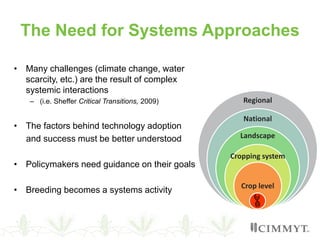
Regional
National
Landscape
Cropping system
Crop level
The Need for Systems Approaches
• Many challenges (climate change, water
scarcity, etc.) are the result of complex
systemic interactions
– (i.e. Sheffer Critical Transitions, 2009)
• The factors behind technology adoption
and success must be better understood
• Policymakers need guidance on their goals
• Breeding becomes a systems activity
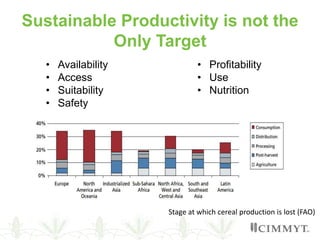
Sustainable Productivity is not the
Only Target
• Availability
• Access
• Suitability
• Safety
• Profitability
• Use
• Nutrition
Stage at which cereal production is lost (FAO)
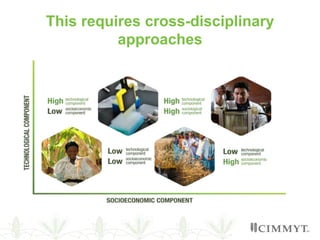
This requires cross-disciplinary
approaches
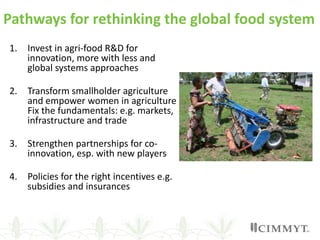
1. Invest in agri-food R&D for
innovation, more with less and
global systems approaches
2. Transform smallholder agriculture
and empower women in agriculture
Fix the fundamentals: e.g. markets,
infrastructure and trade
3. Strengthen partnerships for co-
innovation, esp. with new players
4. Policies for the right incentives e.g.
subsidies and insurances
Pathways for rethinking the global food system
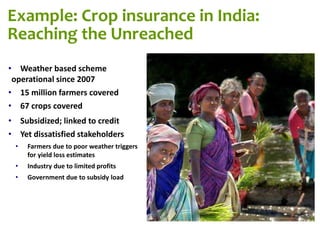
Example: Crop insurance in India:
Reaching the Unreached
• Weather based scheme
operational since 2007
• 15 million farmers covered
• 67 crops covered
• Subsidized; linked to credit
• Yet dissatisfied stakeholders
• Farmers due to poor weather triggers
for yield loss estimates
• Industry due to limited profits
• Government due to subsidy load
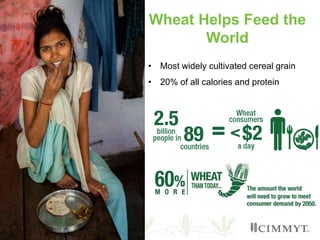
• Most widely cultivated cereal grain
• 20% of all calories and protein
Wheat Helps Feed the
World
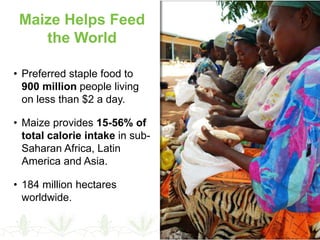
• Preferred staple food to
900 million people living
on less than $2 a day.
• Maize provides 15-56% of
total calorie intake in sub-
Saharan Africa, Latin
America and Asia.
• 184 million hectares
worldwide.
Maize Helps Feed
the World
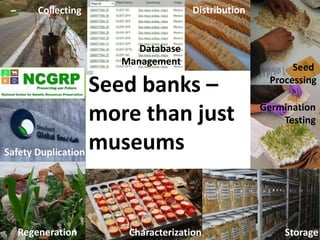
Seed banks –
more than just
museums
Storage
Germination
Testing
CharacterizationRegeneration
Collecting Distribution
Seed
Processing
Safety Duplication
Database
Management
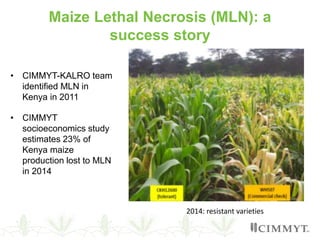
Maize Lethal Necrosis (MLN): a
success story
• CIMMYT-KALRO team
identified MLN in
Kenya in 2011
• CIMMYT
socioeconomics study
estimates 23% of
Kenya maize
production lost to MLN
in 2014
2014: resistant varieties
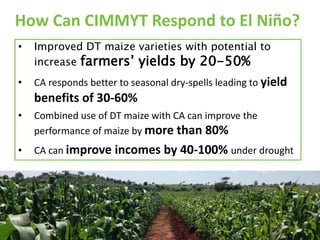
How Can CIMMYT Respond to El Niño?
• Improved DT maize varieties with potential to
increase farmers’ yields by 20-50%
• CA responds better to seasonal dry-spells leading to yield
benefits of 30-60%
• Combined use of DT maize with CA can improve the
performance of maize by more than 80%
• CA can improve incomes by 40-100% under drought
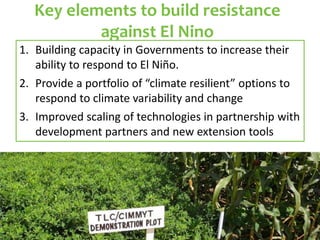
Key elements to build resistance
against El Nino
1. Building capacity in Governments to increase their
ability to respond to El Niño.
2. Provide a portfolio of “climate resilient” options to
respond to climate variability and change
3. Improved scaling of technologies in partnership with
development partners and new extension tools
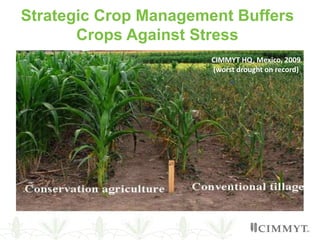
Strategic Crop Management Buffers
Crops Against Stress
CIMMYT HQ, Mexico, 2009
(worst drought on record)
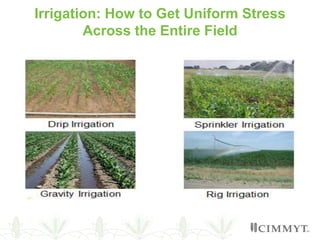
Irrigation: How to Get Uniform Stress
Across the Entire Field
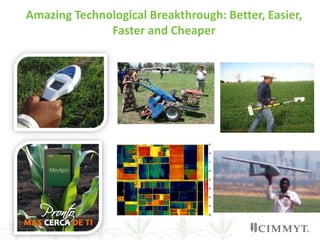
Amazing Technological Breakthrough: Better, Easier,
Faster and Cheaper
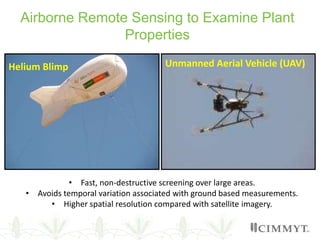
Airborne Remote Sensing to Examine Plant
Properties
Helium Blimp Unmanned Aerial Vehicle (UAV)
• Fast, non-destructive screening over large areas.
• Avoids temporal variation associated with ground based measurements.
• Higher spatial resolution compared with satellite imagery.
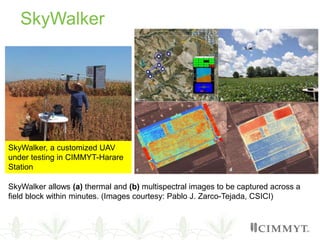
SkyWalker
SkyWalker allows (a) thermal and (b) multispectral images to be captured across a
field block within minutes. (Images courtesy: Pablo J. Zarco-Tejada, CSICI)
SkyWalker, a customized UAV
under testing in CIMMYT-Harare
Station
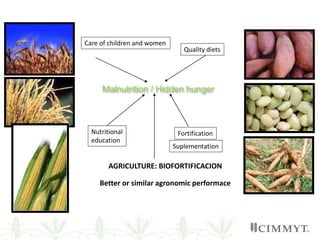
Malnutrition / Hidden hunger
Care of children and women
Quality diets
Nutritional
education
Fortification
Suplementation
AGRICULTURE: BIOFORTIFICACION
Better or similar agronomic performace
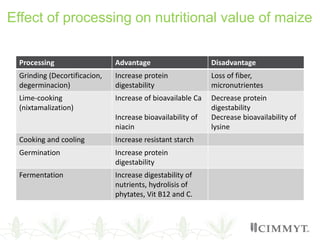
Processing Advantage Disadvantage
Grinding (Decortificacion,
degerminacion)
Increase protein
digestability
Loss of fiber,
micronutrientes
Lime-cooking
(nixtamalization)
Increase of bioavailable Ca
Increase bioavailability of
niacin
Decrease protein
digestability
Decrease bioavailability of
lysine
Cooking and cooling Increase resistant starch
Germination Increase protein
digestability
Fermentation Increase digestability of
nutrients, hydrolisis of
phytates, Vit B12 and C.
Effect of processing on nutritional value of maize
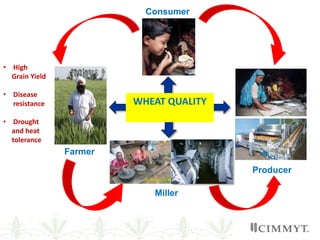
Consumer
Miller
Farmer
Producer
• High
Grain Yield
• Disease
resistance
• Drought
and heat
tolerance
WHEAT QUALITY
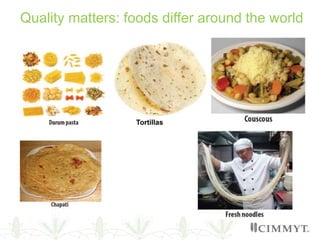
Quality matters: foods differ around the world
Tortillas
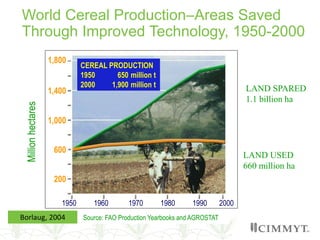
World Cereal Production–Areas Saved
Through Improved Technology, 1950-2000
CEREAL PRODUCTION
1950 650 million t
2000 1,900 million t
1,800
1,400
1,000
600
1950 1960 1970 1980 1990 2000
LAND SPARED
1.1 billion ha
LAND USED
660 million ha
Millionhectares
200
Source: FAO Production Yearbooks and AGROSTATBorlaug, 2004
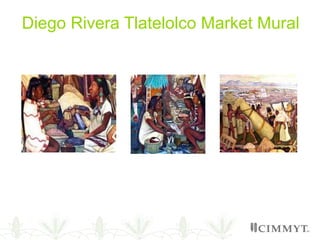
Diego Rivera Tlatelolco Market Mural
Food Security is an Escalating
Concern
BUT, Policy Makers, Regulators and
Scientists CAN Provide Solutions
Thank you!
Photo Credits (top left to bottom right): Julia Cumes/CIMMYT, Awais
Yaqub/CIMMYT, CIMMYT archives, Marcelo Ortiz/CIMMYT, David
Hansen/University of Minnesota, CIMMYT archives, CIMMYT archives
(maize), Ranak Martin/CIMMYT, CIMMYT archives.
Rethinking the global food system

  • 1.
    Rethinking our foodsystems: a practical perspective Dr. Martin Kropff CIMMYT Director General
  • 2.
    SDGs: Food Securitya Priority Food and nutritional security Climate change Food and health Governance Biobased economies
  • 3.
    The Challenge Can wesustainably increase food production by 2050 to meet the demand of changing dietary habits and their growing populations while also developing economically and adapting to increasingly pressure from climate change and depleting natural resources?
  • 4.
  • 5.
    Challenge 1: The9 Billion Person Question 19602050
  • 6.
    How Do WeFeed this Growing Population? FAOStat
  • 7.
    Challenge 2: FluctuatingFood Prices For food prices to remain constant, annual yield gains would have to increase: ● from 1.2% - 1.7% for maize ● from 1.1% - 1.7% for wheat Diseases Climate change BreedingAgronomy Projected demand by 2050 (FAO) World-wideaverageyield (tonsha-1) Linear extrapolations of current trends Water, nutrient & energy scarcity Potential effect of climate- change-induced heat stress on today’s cultivars (intermediate CO2 emission scenario) Year
  • 8.
    Direct Correlation BetweenRising Prices and Social Unrest – Especially Wheat Source:Lagi,K.Z.Bertrand,Y.Bar-Yam,TheFoodCrisesandPolitical InstabilityinNorthAfricaandtheMiddleEast.(August10,2011) (death toll)
  • 9.
    Social unrest andfood prices interact
  • 10.
    As a resultpeople are spending more of their income on food
  • 13.
    Challenge 3: ProducingCrops on Borrowed Water National Geographic Magazine 2013, Based on Geeson et. Al 2012 Footprint 54x Aquifer!!!
  • 14.
    Challenge 4: DiseaseEpidemics Maize Lethal Necrosis 2 viruses affect Kenya, Uganda, Tanzania, Rwanda, D.R. Congo, South Sudan, and Ethiopia Stem Rust Tar Spot Complex Mexico, Colombia, El Salvador, Guatemala, Nicaragua Fusarium Head Blight Wheat blast Argentina, Brazil, Bolivia, Paraguay, South Asia Septoria Most feared! Global China, Caspian and Black Sea, Cona Sur, North America, Western Central and Eastern Europe North Africa, Ethiopia, Latin America, Southern and Central Europe, Iran, Kazakhstan and Siberia
  • 15.
    Wheat Blast –South Asia A severe, surprise outbreak of blast in South Asia—home to more than 300 million undernourished people and whose inhabitants consume over 100 million tons of wheat each year. Wheat blast disease, Brazil 2009
  • 16.
    Challenge 5: GermplasmExchange Confusion around Standard Material Transfer Arangement and Nagoya Protocol: good intentions to share benefits but expected restrictions on germplasm exchange We must join forces to maintain international, cross-border germplasm exchange Open Access germplasm is as important as Open Access data
  • 17.
    Challenge 6: ClimateChange • Latest estimates are 30 M rural and 9 M urban people will have insufficient food in Southern Africa as a result of the El Nino- induced drought and heat stress. • The number of people affected by El Nino keeps rising.Maize close to harvest. Zimbabwe, February 2016.
  • 18.
    Himalayan glaciers melting: impactsirrigation via Indus and Brahmaputra Sources: World Bank, 2013, Shah et.al, 2006, NATCOM, 2004 Sea-level rise/Storm surge: saltwater intrusion in coastal areas, (agriculture, groundwater and freshwater, drinking water ; diarrhea/cholera );Floods will increase in frequency and intensity Erratic Monsoons Rain-fed agriculture, rivers, power supply,
  • 19.
    Impact of ChangingClimates on Maize Production in Africa Sonder et al., 2015 forthcoming
  • 20.
    Source: FAOSTAT, 2012 Challenge7: Changing diets and increased demand for feed
  • 23.
    Challenge 8: DifferentChallenges Attainable yield Actual yield Reduce Yield Gap Potential yield Attainable yield Actual Yield Raise potential yield Yield gaps in Southern Africa can differ between 50% to more than 100%!
  • 24.
    Yield Variability Top fivemaize producing countries Yield variability in southern Africa
  • 25.
    Challenge 9: Donorpriorities 2008 food price crisis Increased donor attention Budget increase: From 300 million to 1 billion Before: Increased production 2015: Climate change and nutrition 2012-15 Major W1&W2 budget cut From Aid … to Trade
  • 26.
    The scenario ifthis happens together Ug99 (windborn)
  • 27.
    Price increase s x4 x5 Stock market losses Food riots Humanitarian crisis Humancost 10% in EU 5% in US Wheat Maize Rice Soybean 7% 10% 11% Global production losses 7% Impacts
  • 28.
    WHAT ENSURES FOODAND NUTRITION SECURITY?
  • 29.
    Regional National Landscape Cropping system Crop level TheNeed for Systems Approaches • Many challenges (climate change, water scarcity, etc.) are the result of complex systemic interactions – (i.e. Sheffer Critical Transitions, 2009) • The factors behind technology adoption and success must be better understood • Policymakers need guidance on their goals • Breeding becomes a systems activity
  • 30.
    Sustainable Productivity isnot the Only Target • Availability • Access • Suitability • Safety • Profitability • Use • Nutrition Stage at which cereal production is lost (FAO)
  • 31.
  • 32.
    1. Invest inagri-food R&D for innovation, more with less and global systems approaches 2. Transform smallholder agriculture and empower women in agriculture Fix the fundamentals: e.g. markets, infrastructure and trade 3. Strengthen partnerships for co- innovation, esp. with new players 4. Policies for the right incentives e.g. subsidies and insurances Pathways for rethinking the global food system
  • 33.
    Example: Crop insurancein India: Reaching the Unreached • Weather based scheme operational since 2007 • 15 million farmers covered • 67 crops covered • Subsidized; linked to credit • Yet dissatisfied stakeholders • Farmers due to poor weather triggers for yield loss estimates • Industry due to limited profits • Government due to subsidy load
  • 34.
    • Most widelycultivated cereal grain • 20% of all calories and protein Wheat Helps Feed the World
  • 35.
    • Preferred staplefood to 900 million people living on less than $2 a day. • Maize provides 15-56% of total calorie intake in sub- Saharan Africa, Latin America and Asia. • 184 million hectares worldwide. Maize Helps Feed the World
  • 36.
    Seed banks – morethan just museums Storage Germination Testing CharacterizationRegeneration Collecting Distribution Seed Processing Safety Duplication Database Management
  • 37.
    Maize Lethal Necrosis(MLN): a success story • CIMMYT-KALRO team identified MLN in Kenya in 2011 • CIMMYT socioeconomics study estimates 23% of Kenya maize production lost to MLN in 2014 2014: resistant varieties
  • 38.
    How Can CIMMYTRespond to El Niño? • Improved DT maize varieties with potential to increase farmers’ yields by 20-50% • CA responds better to seasonal dry-spells leading to yield benefits of 30-60% • Combined use of DT maize with CA can improve the performance of maize by more than 80% • CA can improve incomes by 40-100% under drought
  • 39.
    Key elements tobuild resistance against El Nino 1. Building capacity in Governments to increase their ability to respond to El Niño. 2. Provide a portfolio of “climate resilient” options to respond to climate variability and change 3. Improved scaling of technologies in partnership with development partners and new extension tools
  • 40.
    Strategic Crop ManagementBuffers Crops Against Stress CIMMYT HQ, Mexico, 2009 (worst drought on record)
  • 41.
    Irrigation: How toGet Uniform Stress Across the Entire Field
  • 42.
    Amazing Technological Breakthrough:Better, Easier, Faster and Cheaper
  • 43.
    Airborne Remote Sensingto Examine Plant Properties Helium Blimp Unmanned Aerial Vehicle (UAV) • Fast, non-destructive screening over large areas. • Avoids temporal variation associated with ground based measurements. • Higher spatial resolution compared with satellite imagery.
  • 44.
    SkyWalker SkyWalker allows (a)thermal and (b) multispectral images to be captured across a field block within minutes. (Images courtesy: Pablo J. Zarco-Tejada, CSICI) SkyWalker, a customized UAV under testing in CIMMYT-Harare Station
  • 45.
    Malnutrition / Hiddenhunger Care of children and women Quality diets Nutritional education Fortification Suplementation AGRICULTURE: BIOFORTIFICACION Better or similar agronomic performace
  • 46.
    Processing Advantage Disadvantage Grinding(Decortificacion, degerminacion) Increase protein digestability Loss of fiber, micronutrientes Lime-cooking (nixtamalization) Increase of bioavailable Ca Increase bioavailability of niacin Decrease protein digestability Decrease bioavailability of lysine Cooking and cooling Increase resistant starch Germination Increase protein digestability Fermentation Increase digestability of nutrients, hydrolisis of phytates, Vit B12 and C. Effect of processing on nutritional value of maize
  • 48.
    Consumer Miller Farmer Producer • High Grain Yield •Disease resistance • Drought and heat tolerance WHEAT QUALITY
  • 49.
    Quality matters: foodsdiffer around the world Tortillas
  • 50.
    World Cereal Production–AreasSaved Through Improved Technology, 1950-2000 CEREAL PRODUCTION 1950 650 million t 2000 1,900 million t 1,800 1,400 1,000 600 1950 1960 1970 1980 1990 2000 LAND SPARED 1.1 billion ha LAND USED 660 million ha Millionhectares 200 Source: FAO Production Yearbooks and AGROSTATBorlaug, 2004
  • 51.
  • 53.
    Food Security isan Escalating Concern BUT, Policy Makers, Regulators and Scientists CAN Provide Solutions
  • 54.
    Thank you! Photo Credits(top left to bottom right): Julia Cumes/CIMMYT, Awais Yaqub/CIMMYT, CIMMYT archives, Marcelo Ortiz/CIMMYT, David Hansen/University of Minnesota, CIMMYT archives, CIMMYT archives (maize), Ranak Martin/CIMMYT, CIMMYT archives.
Editor's Notes

  • #3 Goal 2 in details: 2.1 by 2030 end hunger and ensure access by all people, in particular the poor and people in vulnerable situations including infants, to safe, nutritious and sufficient food all year round 2.2 by 2030 end all forms of malnutrition, including achieving by 2025 the internationally agreed targets on stunting and wasting in children under five years of age, and address the nutritional needs of adolescent girls, pregnant and lactating women, and older persons 2.3 by 2030 double the agricultural productivity and the incomes of small-scale food producers, particularly women, indigenous peoples, family farmers, pastoralists and fishers, including through secure and equal access to land, other productive resources and inputs, knowledge, financial services, markets, and opportunities for value addition and non-farm employment 2.4 by 2030 ensure sustainable food production systems and implement resilient agricultural practices that increase productivity and production, that help maintain ecosystems, that strengthen capacity for adaptation to climate change, extreme weather, drought, flooding and other disasters, and that progressively improve land and soil quality 2.5 by 2020 maintain genetic diversity of seeds, cultivated plants, farmed and domesticated animals and their related wild species, including through soundly managed and diversified seed and plant banks at national, regional and international levels, and ensure access to and fair and equitable sharing of benefits arising from the utilization of genetic resources and associated traditional knowledge as internationally agreed 2.a increase investment, including through enhanced international cooperation, in rural infrastructure, agricultural research and extension services, technology development, and plant and livestock gene banks to enhance agricultural productive capacity in developing countries, in particular in least developed countries 2.b. correct and prevent trade restrictions and distortions in world agricultural markets including by the parallel elimination of all forms of agricultural export subsidies and all export measures with equivalent effect, in accordance with the mandate of the Doha Development Round 2.c. adopt measures to ensure the proper functioning of food commodity markets and their derivatives, and facilitate timely access to market information, including on food reserves, in order to help limit extreme food price volatility Goal 1End poverty in all its forms everywhere Goal 2End hunger, achieve food security and improved nutrition and promote sustainable agriculture Goal 3Ensure healthy lives and promote well-being for all at all ages Goal 4Ensure inclusive and equitable quality education and promote lifelong learning opportunities for all Goal 5Achieve gender equality and empower all women and girls Goal 6Ensure availability and sustainable management of water and sanitation for all Goal 7Ensure access to affordable, reliable, sustainable and modern energy for all Goal 8Promote sustained, inclusive and sustainable economic growth, full and productive employment and decent work for all Goal 9Build resilient infrastructure, promote inclusive and sustainable industrialization and foster innovation Goal 10Reduce inequality within and among countries Goal 11Make cities and human settlements inclusive, safe, resilient and sustainable Goal 12Ensure sustainable consumption and production patterns Goal 13Take urgent action to combat climate change and its impacts Goal 14Conserve and sustainably use the oceans, seas and marine resources for sustainable development Goal 15Protect, restore and promote sustainable use of terrestrial ecosystems, sustainably manage forests, combat desertification, and halt and reverse land degradation and halt biodiversity loss Goal 16Promote peaceful and inclusive societies for sustainable development, provide access to justice for all and build effective, accountable and inclusive institutions at all levels Goal 17Strengthen the means of implementation and revitalize the global partnership for sustainable development
  • #5 This slide is a build – shows both 1960 and 2050
  • #6 This slide is a build – shows both 1960 and 2050
  • #9 This study was based on the arab spring in North Africa and Middle East – high wheat eating areas. The black line shows food prices, the red dashed vertical lines correspond to beginning dates of “food riots” and protests associated with overall death toll reported in parentheses
  • #15 Maize Lethal Necrosis Disease (MLND) is a result of a combination of two viruses, the Maize Chlorotic Mottle Virus (MCMoV) and any of the cereal viruses in the Potyviridae group, like the Sugarcane Mosaic Virus (SCMV), Wheat Streak Mosaic Virus (WSMV) or Maize Dwarf Mosaic Virus (MDMV).  Tar spot complex caused by Phyllachora maydis and Monographella maydis in association. Affected ears are light in weight with loose kernels. Many kernels at the tip of the ear show premature germination while still on the cob. The wheat blast pathogen is Magnaporthe oryzae. Although it is the same fungal species that causes rice blast, the wheat blast pathogen is a distinct population of M. oryzae (referred as M. oryzae Triticum population) and does not cause disease in rice. Stem rust is the most feared disease of wheat. Stem rust spores arriving as late as one month before harvest can turn a previously healthy crop into a tangled mass of stems, which produces little to no grain. Moderately infected fields can produce as many as 1011 spores/hectare, which are picked up by wind currents, resulting in the movement of astronomical numbers of rust spores hundreds or thousands of kilometers to infect other regions. Fusarium head blight of wheat (FHB), also called head scab, is caused mainly by the fungus Gibberella zeae (also known as Fusarium graminearum). This disease periodically causes significant yield loss and reduced grain quality. Gibberella zeae also produces mycotoxins, which are chemicals that are toxic to humans and livestock. Septoria – two major diseases. These are Septoria tritici blotch, incited by the fungus Septoria tritici (teleomorph: Mycophaerella graminicola), and Septoria nodorum blotch, caused by the fungus Septoria nodorum (teleomorph: Leptosphaeria nodorum). Both diseases cause serious yield losses reported to range from 31 to 53 percent 
  • #16 One of the most fearsome and intractable in recent decades is wheat blast, caused by the fungus Magnaporthe oryzae. It directly strikes the wheat ear and can shrivel and deform the grain in less than a week from first symptoms, leaving farmers no time to act. Fungicides typically provide only a partial defense. They are also often hard to obtain or use in the regions where blast occurs, and must be applied well before any symptoms appear—a prohibitive expense for many farmers.
  • #20 Maize megaenvironments are based on a combination of temperature and rainful. They are determine by comparing changes over time. The current megaenvironments are 1950 – 2000, future megaenvironments 2039 - 2070 These maps were an ensemble of 30 models: Orange – the maize megaenvironment will be lost – meaning that there is potential that maize will not be productive anymore and farmers will have to switch to sorghum or millet as an alternative. Red – based on Fischer, Byerlee and Edmeades ( yield potential by mega environment) people may be able to grow maize, but will be very dependent on improved varieties and improved technologies Dark green – changes could be beneficial for yield Current MEs do not currently include dry lowlands hot, humid lowlands hot ME’s established by Marianne and ?? 1995 Maize ME (do not include irrigation)
  • #24 Arrow from attainable to potential (always a small yield gap) Yield gaps exist in most countries, ranging from almost negligible in the Netherlands to 90 percent in many African environments. Yield gap between attainable yield and actual yield
  • #25 Maize in southern Africa is characterised by both low yields and large year to year variability. The left graph shows yield variability in the top 5 maize producing countries in the world, the right graph shows yield variability in southern African countries
  • #27 Food System Shock: The insurance impacts of acute disruption to global food supply. Lloyds Emerging Risk Report – 2015 Experts developed a plausible scenario of a global staple crop production shock, and the cascade of impacts that could result
  • #30 S is for socioeconomics
  • #37 Mention that it is named after Glenn Anderson
  • #39 Results are from long-term on-farm trials from southern Africa
  • #40 Objective 1. Create knowledge and build the capacity of governments and institutions to reduce climate risks Objective 2. Reduce variability and sustainably improve agricultural productivity of smallholder and emerging commercial farmers to increase national food and nutritional security Objective 3. Improved scaling approaches to increase the knowledge and adaptive capacity of smallholder and emerging commercial farmers
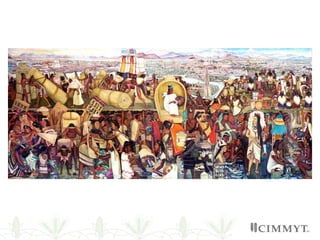
  • #52 Women removing kernals from an ear of corn. Part of the Diego Rivera Tlatelolco Market mural – Tlatelolco was an Aztec city established in 1337 in what is now Mexico City