1st Semester
Project
BY- SAHIL ARORA
M.B.A – 3
SECTOR INFORMATION
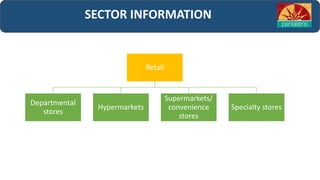
Retail
Departmental
stores
Hypermarkets
Supermarkets/
convenience
stores
Specialty stores
SECTOR INFORMATION
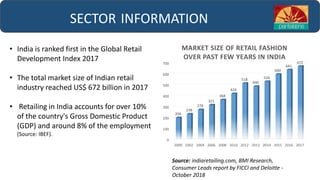
• India is ranked first in the Global Retail
Development Index 2017
• The total market size of Indian retail
industry reached US$ 672 billion in 2017
• Retailing in India accounts for over 10%
of the country's Gross Domestic Product
(GDP) and around 8% of the employment
(Source: IBEF).
Source: indiaretailing.com, BMI Research,
Consumer Leads report by FICCI and Deloitte -
October 2018
0
100
200
300
400
500
600
700
2000 2002 2004 2006 2008 2010 2012 2013 2014 2015 2016 2017
204
238
278
321
368
424
518
490
534
600
641
672
MARKET SIZE OF RETAIL FASHION
OVER PAST FEW YEARS IN INDIA
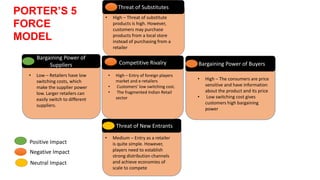
Threat of Substitutes
Threat of New Entrants
• High – Threat of substitute
products is high. However,
customers may purchase
products from a local store
instead of purchasing from a
retailer
Bargaining Power of
Suppliers
• Low – Retailers have low
switching costs, which
make the supplier power
low. Larger retailers can
easily switch to different
suppliers.
Competitive Rivalry
• High – Entry of foreign players
market and e-retailers
• Customers’ low switching cost.
• The fragmented Indian Retail
sector
Bargaining Power of Buyers
• High – The consumers are price
sensitive and have information
about the product and its price
• Low switching cost gives
customers high bargaining
power
• Medium – Entry as a retailer
is quite simple. However,
players need to establish
strong distribution channels
and achieve economies of
scale to compete
Positive Impact
Negative Impact
Neutral Impact
PORTER’S 5
FORCE
MODEL
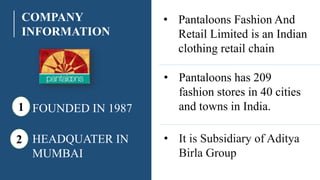
COMPANY
INFORMATION
1 FOUNDED IN 1987
2 • It is Subsidiary of Aditya
Birla Group
• Pantaloons Fashion And
Retail Limited is an Indian
clothing retail chain
• Pantaloons has 209
fashion stores in 40 cities
and towns in India.
HEADQUATER IN
MUMBAI
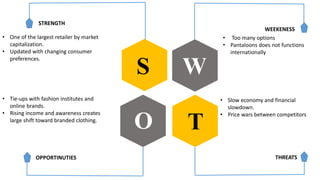
S W
O T
STRENGTH
WEEKENESS
OPPORTINUTIES THREATS
• One of the largest retailer by market
capitalization.
• Updated with changing consumer
preferences.
• Too many options
• Pantaloons does not functions
internationally
• Slow economy and financial
slowdown.
• Price wars between competitors
• Tie-ups with fashion institutes and
online brands.
• Rising income and awareness creates
large shift toward branded clothing.
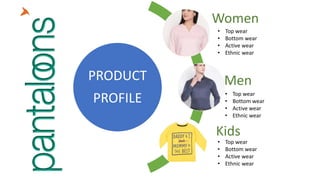
PRODUCT
PROFILE
Women
Men
Kids
• Top wear
• Bottom wear
• Active wear
• Ethnic wear
• Top wear
• Bottom wear
• Active wear
• Ethnic wear
• Top wear
• Bottom wear
• Active wear
• Ethnic wear
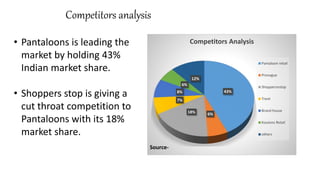
Competitors analysis
43%
6%18%
7%
8%
6%
12%
Competitors Analysis
Pantaloon retail
Provogue
Shoppersnstop
Trent
Brand house
Koutons Retail
others
Source-
• Pantaloons is leading the
market by holding 43%
Indian market share.
• Shoppers stop is giving a
cut throat competition to
Pantaloons with its 18%
market share.
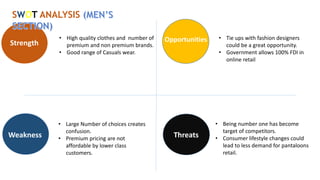
• High quality clothes and number of
premium and non premium brands.
• Good range of Casuals wear.
• Large Number of choices creates
confusion.
• Premium pricing are not
affordable by lower class
customers.
• Tie ups with fashion designers
could be a great opportunity.
• Government allows 100% FDI in
online retail
Strength
Weakness
Opportunities
Threats
• Being number one has become
target of competitors.
• Consumer lifestyle changes could
lead to less demand for pantaloons
retail.
SWOT ANALYSIS
MARKETING MIX
P
R
O
D
U
C
T
P
R
I
C
E
P
L
A
C
E
P
R
O
M
T
I
O
N
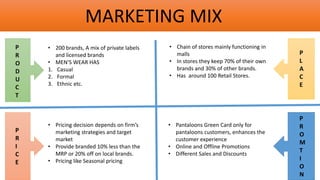
• 200 brands, A mix of private labels
and licensed brands
• MEN’S WEAR HAS
1. Casual
2. Formal
3. Ethnic etc.
• Pricing decision depends on firm’s
marketing strategies and target
market
• Provide branded 10% less than the
MRP or 20% off on local brands.
• Pricing like Seasonal pricing
• Pantaloons Green Card only for
pantaloons customers, enhances the
customer experience
• Online and Offline Promotions
• Different Sales and Discounts
• Chain of stores mainly functioning in
malls
• In stores they keep 70% of their own
brands and 30% of other brands.
• Has around 100 Retail Stores.
SEGMENTING
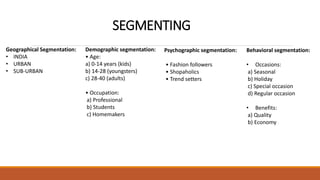
Geographical Segmentation:
• INDIA
• URBAN
• SUB-URBAN
Demographic segmentation:
• Age:
a) 0-14 years (kids)
b) 14-28 (youngsters)
c) 28-40 (adults)
• Occupation:
a) Professional
b) Students
c) Homemakers
Psychographic segmentation:
• Fashion followers
• Shopaholics
• Trend setters
Behavioral segmentation:
• Occasions:
a) Seasonal
b) Holiday
c) Special occasion
d) Regular occasion
• Benefits:
a) Quality
b) Economy
TARGETING
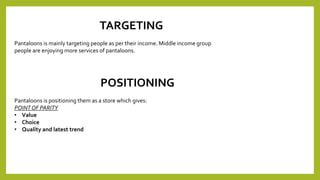
Pantaloons is mainly targeting people as per their income. Middle income group
people are enjoying more services of pantaloons.
POSITIONING
Pantaloons is positioning them as a store which gives:
POINT OF PARITY
• Value
• Choice
• Quality and latest trend
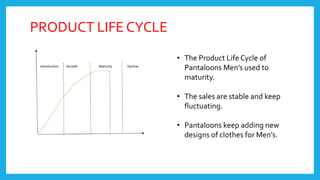
PRODUCT LIFE CYCLE
• The Product Life Cycle of
Pantaloons Men’s used to
maturity.
• The sales are stable and keep
fluctuating.
• Pantaloons keep adding new
designs of clothes for Men’s.
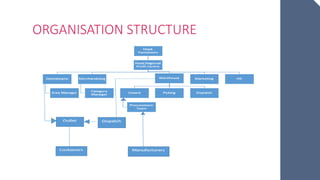
ORGANISATION STRUCTURE
JOB DISCRIPTION
• MANAGEMENT TRAINEE- Minimum qualification required
• MBA’s from “A” and “B” grade Institutes (MARKETING, FINANCE,
H.R.)
• IT Engineers
• Fresh CA’s
SELECTION PROCESS
• STANDARD APPLICATION FORM:
• LETTER OF APPOINTMENT
• SERVICE AGREEMENT
• ANTECEDENT VERIFICATION
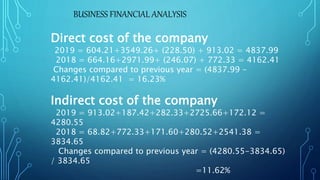
BUSINESS FINANCIAL ANALYSIS
Direct cost of the company
2019 = 604.21+3549.26+ (228.50) + 913.02 = 4837.99
2018 = 664.16+2971.99+ (246.07) + 772.33 = 4162.41
Changes compared to previous year = (4837.99 –
4162.41)/4162.41 = 16.23%
Indirect cost of the company
2019 = 913.02+187.42+282.33+2725.66+172.12 =
4280.55
2018 = 68.82+772.33+171.60+280.52+2541.38 =
3834.65
Changes compared to previous year = (4280.55-3834.65)
/ 3834.65
=11.62%
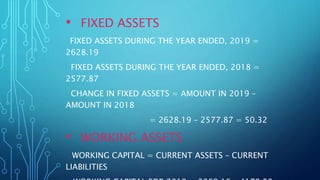
• FIXED ASSETS
FIXED ASSETS DURING THE YEAR ENDED, 2019 =
2628.19
FIXED ASSETS DURING THE YEAR ENDED, 2018 =
2577.87
CHANGE IN FIXED ASSETS = AMOUNT IN 2019 –
AMOUNT IN 2018
= 2628.19 – 2577.87 = 50.32
• WORKING ASSETS
WORKING CAPITAL = CURRENT ASSETS – CURRENT
LIABILITIES
detailed information about pantaloons

detailed information about pantaloons

  • 1.
  • 2.
  • 3.
    SECTOR INFORMATION • Indiais ranked first in the Global Retail Development Index 2017 • The total market size of Indian retail industry reached US$ 672 billion in 2017 • Retailing in India accounts for over 10% of the country's Gross Domestic Product (GDP) and around 8% of the employment (Source: IBEF). Source: indiaretailing.com, BMI Research, Consumer Leads report by FICCI and Deloitte - October 2018 0 100 200 300 400 500 600 700 2000 2002 2004 2006 2008 2010 2012 2013 2014 2015 2016 2017 204 238 278 321 368 424 518 490 534 600 641 672 MARKET SIZE OF RETAIL FASHION OVER PAST FEW YEARS IN INDIA
  • 4.
    Threat of Substitutes Threatof New Entrants • High – Threat of substitute products is high. However, customers may purchase products from a local store instead of purchasing from a retailer Bargaining Power of Suppliers • Low – Retailers have low switching costs, which make the supplier power low. Larger retailers can easily switch to different suppliers. Competitive Rivalry • High – Entry of foreign players market and e-retailers • Customers’ low switching cost. • The fragmented Indian Retail sector Bargaining Power of Buyers • High – The consumers are price sensitive and have information about the product and its price • Low switching cost gives customers high bargaining power • Medium – Entry as a retailer is quite simple. However, players need to establish strong distribution channels and achieve economies of scale to compete Positive Impact Negative Impact Neutral Impact PORTER’S 5 FORCE MODEL
  • 5.
    COMPANY INFORMATION 1 FOUNDED IN1987 2 • It is Subsidiary of Aditya Birla Group • Pantaloons Fashion And Retail Limited is an Indian clothing retail chain • Pantaloons has 209 fashion stores in 40 cities and towns in India. HEADQUATER IN MUMBAI
  • 6.
    S W O T STRENGTH WEEKENESS OPPORTINUTIESTHREATS • One of the largest retailer by market capitalization. • Updated with changing consumer preferences. • Too many options • Pantaloons does not functions internationally • Slow economy and financial slowdown. • Price wars between competitors • Tie-ups with fashion institutes and online brands. • Rising income and awareness creates large shift toward branded clothing.
  • 7.
    PRODUCT PROFILE Women Men Kids • Top wear •Bottom wear • Active wear • Ethnic wear • Top wear • Bottom wear • Active wear • Ethnic wear • Top wear • Bottom wear • Active wear • Ethnic wear
  • 8.
    Competitors analysis 43% 6%18% 7% 8% 6% 12% Competitors Analysis Pantaloonretail Provogue Shoppersnstop Trent Brand house Koutons Retail others Source- • Pantaloons is leading the market by holding 43% Indian market share. • Shoppers stop is giving a cut throat competition to Pantaloons with its 18% market share.
  • 9.
    • High qualityclothes and number of premium and non premium brands. • Good range of Casuals wear. • Large Number of choices creates confusion. • Premium pricing are not affordable by lower class customers. • Tie ups with fashion designers could be a great opportunity. • Government allows 100% FDI in online retail Strength Weakness Opportunities Threats • Being number one has become target of competitors. • Consumer lifestyle changes could lead to less demand for pantaloons retail. SWOT ANALYSIS
  • 10.
    MARKETING MIX P R O D U C T P R I C E P L A C E P R O M T I O N • 200brands, A mix of private labels and licensed brands • MEN’S WEAR HAS 1. Casual 2. Formal 3. Ethnic etc. • Pricing decision depends on firm’s marketing strategies and target market • Provide branded 10% less than the MRP or 20% off on local brands. • Pricing like Seasonal pricing • Pantaloons Green Card only for pantaloons customers, enhances the customer experience • Online and Offline Promotions • Different Sales and Discounts • Chain of stores mainly functioning in malls • In stores they keep 70% of their own brands and 30% of other brands. • Has around 100 Retail Stores.
  • 11.
    SEGMENTING Geographical Segmentation: • INDIA •URBAN • SUB-URBAN Demographic segmentation: • Age: a) 0-14 years (kids) b) 14-28 (youngsters) c) 28-40 (adults) • Occupation: a) Professional b) Students c) Homemakers Psychographic segmentation: • Fashion followers • Shopaholics • Trend setters Behavioral segmentation: • Occasions: a) Seasonal b) Holiday c) Special occasion d) Regular occasion • Benefits: a) Quality b) Economy
  • 12.
    TARGETING Pantaloons is mainlytargeting people as per their income. Middle income group people are enjoying more services of pantaloons. POSITIONING Pantaloons is positioning them as a store which gives: POINT OF PARITY • Value • Choice • Quality and latest trend
  • 13.
    PRODUCT LIFE CYCLE •The Product Life Cycle of Pantaloons Men’s used to maturity. • The sales are stable and keep fluctuating. • Pantaloons keep adding new designs of clothes for Men’s.
  • 14.
  • 15.
    JOB DISCRIPTION • MANAGEMENTTRAINEE- Minimum qualification required • MBA’s from “A” and “B” grade Institutes (MARKETING, FINANCE, H.R.) • IT Engineers • Fresh CA’s SELECTION PROCESS • STANDARD APPLICATION FORM: • LETTER OF APPOINTMENT • SERVICE AGREEMENT • ANTECEDENT VERIFICATION
  • 16.
    BUSINESS FINANCIAL ANALYSIS Directcost of the company 2019 = 604.21+3549.26+ (228.50) + 913.02 = 4837.99 2018 = 664.16+2971.99+ (246.07) + 772.33 = 4162.41 Changes compared to previous year = (4837.99 – 4162.41)/4162.41 = 16.23% Indirect cost of the company 2019 = 913.02+187.42+282.33+2725.66+172.12 = 4280.55 2018 = 68.82+772.33+171.60+280.52+2541.38 = 3834.65 Changes compared to previous year = (4280.55-3834.65) / 3834.65 =11.62%
  • 17.
    • FIXED ASSETS FIXEDASSETS DURING THE YEAR ENDED, 2019 = 2628.19 FIXED ASSETS DURING THE YEAR ENDED, 2018 = 2577.87 CHANGE IN FIXED ASSETS = AMOUNT IN 2019 – AMOUNT IN 2018 = 2628.19 – 2577.87 = 50.32 • WORKING ASSETS WORKING CAPITAL = CURRENT ASSETS – CURRENT LIABILITIES